

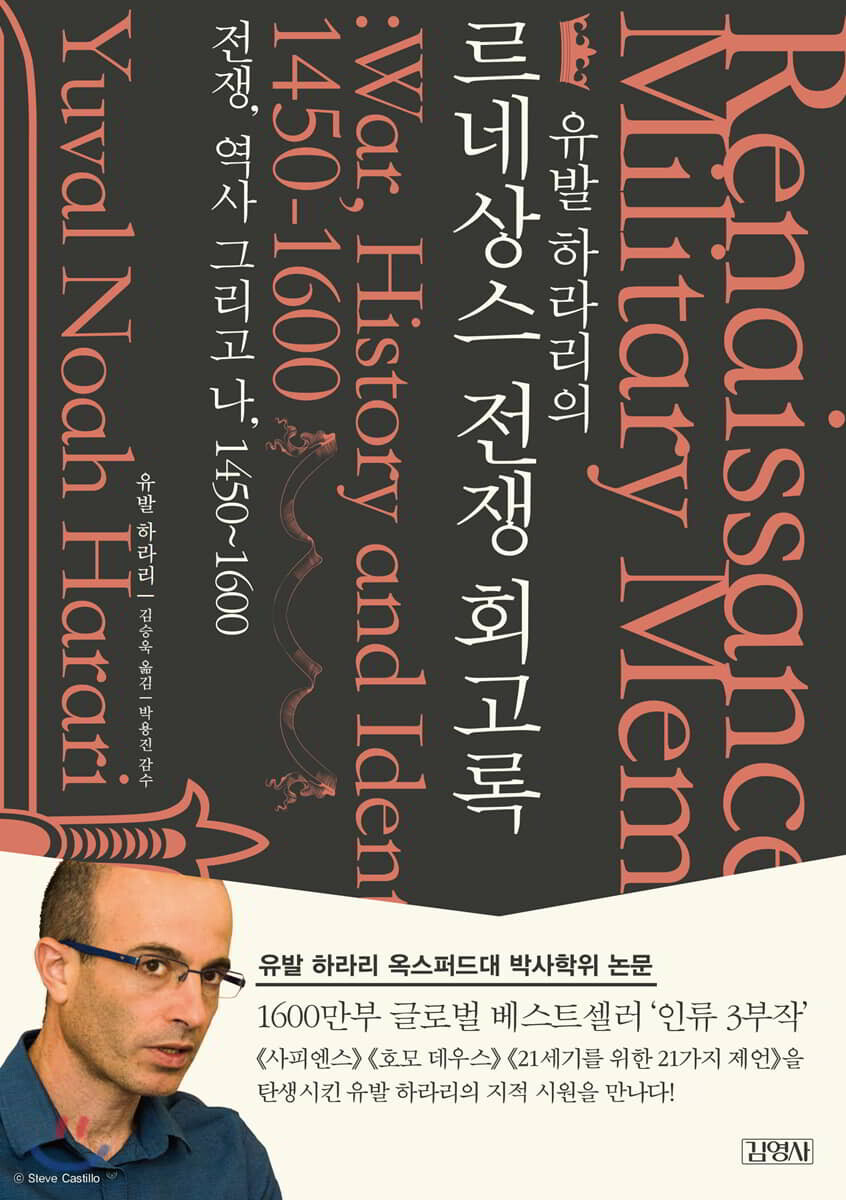
Yuval Harari's Renaissance War Memoir
 |
Description
Book Introduction
- A word from MD
-
History and the Individual: A Profound ThemeThis is a preliminary study that serves as the background for Yuval Harari's 'Humanity Trilogy' and is also his doctoral thesis.
If the 'Humanity Trilogy' provided insight into the structure of the world, this book explores the meaning of the individual.
We analyzed how Renaissance soldiers perceived war and portrayed themselves as historical actors.
July 23, 2019. History PD Son Min-gyu
An individual who stood up against the king and state that monopolized history
What did Yuval Harari, a thinker of our time, see in their memoirs?
“Who am I and what is the meaning of the world?” This is a core theme that runs through Yuval Harari’s thinking.
If the 'Humanity Trilogy' is a result of insight into the meaning of the world from a big historical perspective, in this book, Harari explores the meaning of myself.
How did Renaissance soldiers attempt to establish themselves as protagonists of history in their struggle against the political power of kings and states? What political message might be hidden in a record that is nothing more than a series of heroic tales devoid of logical causality? What implications are there in writing "my" history while leaving "our" history behind?
Yuval Harari's Renaissance War Memoirs is a preliminary study (originally published in 2004) that serves as the ideological background for the 'humanity trilogy' including Sapiens, and is Harari's doctoral thesis from Oxford University.
Now it's time to take a closer look at the origins of Harari's thought, which presents a new and bold perspective on history and the future.
What did Yuval Harari, a thinker of our time, see in their memoirs?
“Who am I and what is the meaning of the world?” This is a core theme that runs through Yuval Harari’s thinking.
If the 'Humanity Trilogy' is a result of insight into the meaning of the world from a big historical perspective, in this book, Harari explores the meaning of myself.
How did Renaissance soldiers attempt to establish themselves as protagonists of history in their struggle against the political power of kings and states? What political message might be hidden in a record that is nothing more than a series of heroic tales devoid of logical causality? What implications are there in writing "my" history while leaving "our" history behind?
Yuval Harari's Renaissance War Memoirs is a preliminary study (originally published in 2004) that serves as the ideological background for the 'humanity trilogy' including Sapiens, and is Harari's doctoral thesis from Oxford University.
Now it's time to take a closer look at the origins of Harari's thought, which presents a new and bold perspective on history and the future.
- You can preview some of the book's contents.
Preview
index
Release_ A journey to find my meaning in history
preface
Part 1: Witness testimony or personal records
1.
Types of Memoir Protagonists | 2.
True Eyewitness Account | 3.
individualism hypothesis
Part 2: Reality in Renaissance Soldier Memoirs
4.
War Experience | 5.
War as a phenomenon and image | 6.
Abstract power relations and tangible actions
Part 3: Things Worth Remembering
7.
Commemoration | 8.
Absence of historical and psychological causality | 9.
Erasing the Difference Between History and Personal History
Part IV: The Politics of Renaissance Military Memoirs
10.
The Independence of the Nobility and the Politics of Causality | 11.
The politics of exclusion
Conclusion
Appendix A: Were Renaissance Military Memoirs a New Phenomenon?
Appendix B: Memoir Authors
Note | References | Illustrations | Acknowledgements | Index
preface
Part 1: Witness testimony or personal records
1.
Types of Memoir Protagonists | 2.
True Eyewitness Account | 3.
individualism hypothesis
Part 2: Reality in Renaissance Soldier Memoirs
4.
War Experience | 5.
War as a phenomenon and image | 6.
Abstract power relations and tangible actions
Part 3: Things Worth Remembering
7.
Commemoration | 8.
Absence of historical and psychological causality | 9.
Erasing the Difference Between History and Personal History
Part IV: The Politics of Renaissance Military Memoirs
10.
The Independence of the Nobility and the Politics of Causality | 11.
The politics of exclusion
Conclusion
Appendix A: Were Renaissance Military Memoirs a New Phenomenon?
Appendix B: Memoir Authors
Note | References | Illustrations | Acknowledgements | Index
Into the book
So what does Guyon's writing tell us? Guyon's writing falls into the category of what's generally categorized as a "military memoir."
Around the time Guyon was writing, a considerable number of works of this kind were being written in Western Europe, and almost all of their authors were warrior nobles like Guyon.
I will talk about some of the commonalities of these types of writing in the future.
These writings, like Guiyong's, moved between history and personal history.
In this book, I will delve into military memoirs written in French, German, Spanish, and English between 1450 and 1600 to definitively identify them.
--- pp.23~24
In Renaissance military memoirs, the author's role as a witness who produces and guarantees truth was at best secondary in importance.
It is rare for the personal history of the memoirist to be specifically presented as the basis for guaranteeing the truthfulness of the writing.
Most memoirists were more concerned with fame than with whether they actually witnessed the events.
Many authors do not bother to mention that they actually witnessed the event.
Even authors who have given importance to eyewitness accounts by mentioning the fact are rarely consistent on this issue.
There is hardly a single memoirist who, from beginning to end, has maintained a distinction between what he has witnessed and what he has not, or who has written only about what he has witnessed.
--- p.92~93
The subject of Renaissance military memoirs is not war.
In contrast to the obsessive interest in war in twentieth-century memoirists, Renaissance military memoirists of all classes were completely uninterested in war as a phenomenon.
With few exceptions, they have always dealt with specific wars, and even then, they have been primarily interested in specific facts about those wars, not the war as a whole.
No one attempted to understand the phenomenon of 'war' or the true nature of the 'Italian War'.
In this respect, their writings can be compared again to soccer match articles published in today's newspapers.
Newspapers churn out dozens of articles about dozens of football matches every week.
However, these articles only cover specific soccer matches in detail.
There are no articles that attempt to understand the phenomenon of soccer.
--- pp.186~187
Contemporary memoirists, including Monluc, were well aware that they had a personality and an inner self.
However, I thought that what defines a person is his actions, not the feelings he feels while doing them or the internal motivations that lead to those actions.
So while it was important for them to reveal that they had suffered forty-six injuries in Novara, it wasn't important how they felt about those injuries.
The fact that he was injured was the only thing that brought him honor and defined him.
--- p.292
The message conveyed by Renaissance military memoirs is that actions should be judged by their intrinsic value rather than their subsequent impact; that honor is not a reward for service but something inherent in certain kinds of actions and people; and that the right to violence is autonomous and derives from personal honor rather than from the grand narrative of a dynasty or nation.
In short, the fragmented depiction of historical reality in Renaissance military memoirs amounts to a declaration in favor of a divided political power in the world, undermining the very foundations of the claim that monarchies monopolize power.
Around the time Guyon was writing, a considerable number of works of this kind were being written in Western Europe, and almost all of their authors were warrior nobles like Guyon.
I will talk about some of the commonalities of these types of writing in the future.
These writings, like Guiyong's, moved between history and personal history.
In this book, I will delve into military memoirs written in French, German, Spanish, and English between 1450 and 1600 to definitively identify them.
--- pp.23~24
In Renaissance military memoirs, the author's role as a witness who produces and guarantees truth was at best secondary in importance.
It is rare for the personal history of the memoirist to be specifically presented as the basis for guaranteeing the truthfulness of the writing.
Most memoirists were more concerned with fame than with whether they actually witnessed the events.
Many authors do not bother to mention that they actually witnessed the event.
Even authors who have given importance to eyewitness accounts by mentioning the fact are rarely consistent on this issue.
There is hardly a single memoirist who, from beginning to end, has maintained a distinction between what he has witnessed and what he has not, or who has written only about what he has witnessed.
--- p.92~93
The subject of Renaissance military memoirs is not war.
In contrast to the obsessive interest in war in twentieth-century memoirists, Renaissance military memoirists of all classes were completely uninterested in war as a phenomenon.
With few exceptions, they have always dealt with specific wars, and even then, they have been primarily interested in specific facts about those wars, not the war as a whole.
No one attempted to understand the phenomenon of 'war' or the true nature of the 'Italian War'.
In this respect, their writings can be compared again to soccer match articles published in today's newspapers.
Newspapers churn out dozens of articles about dozens of football matches every week.
However, these articles only cover specific soccer matches in detail.
There are no articles that attempt to understand the phenomenon of soccer.
--- pp.186~187
Contemporary memoirists, including Monluc, were well aware that they had a personality and an inner self.
However, I thought that what defines a person is his actions, not the feelings he feels while doing them or the internal motivations that lead to those actions.
So while it was important for them to reveal that they had suffered forty-six injuries in Novara, it wasn't important how they felt about those injuries.
The fact that he was injured was the only thing that brought him honor and defined him.
--- p.292
The message conveyed by Renaissance military memoirs is that actions should be judged by their intrinsic value rather than their subsequent impact; that honor is not a reward for service but something inherent in certain kinds of actions and people; and that the right to violence is autonomous and derives from personal honor rather than from the grand narrative of a dynasty or nation.
In short, the fragmented depiction of historical reality in Renaissance military memoirs amounts to a declaration in favor of a divided political power in the world, undermining the very foundations of the claim that monarchies monopolize power.
--- p.317
Publisher's Review
A question that opens Harari's unique interpretation of history.
"What is history? What is the meaning of 'I' in history?"
The question Harari posed through his 'Humanity Trilogy' was, "Where did we come from and where are we going?"
The epic tale of Homo sapiens, a once insignificant being, conquering the Earth and now declaring themselves gods, has won wide support from all walks of life as a brilliant and bold story that gives meaning to an incomprehensible world.
In short, we wrote our own history to find meaning in the world.
So, who is the "I" within it? How does the history of "I" exist? This book is Harari's journey to discover the meaning of "I" within history, before asking questions about "us."
To delve into the question of personal identity, Harari turned to the memoirs of Renaissance soldiers.
Their memoirs sharply expose the tension between history and lifestory before the emergence of the centralized modern state in the 17th century.
It vividly shows the political radicalism of an independent individual who resisted a state that began to pursue 'history making' centered on the king and the people.
The military memoirs chosen as the main subjects of the study are French, German, Spanish, and English documents written by 34 men between 1450 and 1600.
“History is a hall of fame that encompasses the entire world!”
The historical understanding of Renaissance soldiers, which refutes existing theories and sheds new light on them.
The memoirs of Renaissance soldiers are hardly full-fledged writings by today's standards.
Rather than a story with a causal relationship, it is a dry list of individual episodes, and it is a confusing piece of writing that tries to remain in the reader's memory without even trying to make the reader understand, and historical events and autobiographical realities are haphazardly mixed together.
Moreover, how should we interpret records that largely ignore everyday life and instead focus solely on tales of wartime heroism? Existing theories include the "true eyewitness account" hypothesis (the memoirist, as a witness to historical events, guarantees authenticity) and the "individualism" hypothesis (the memoirist, as a modern individual, creates or expresses individuality).
However, Harari refutes the 'true eyewitness account' hypothesis by pointing out that the source of truth in the era relied more on the honor of the nobility than on experiences such as eyewitness accounts.
The word 'trustworthy' was synonymous with honor, and the truth came not from eyewitnesses but from nobles of honor.
In fact, Renaissance soldiers were warrior noblemen who valued honor as their lifeblood.
If you were not a noble, you could not find a place in history and were stripped of your identity.
Meanwhile, the 'individualism' hypothesis is also rejected on the grounds that memoirists who do not describe their autonomous inner and psychological states cannot be considered modern individuals.
Of course, they also had thoughts and feelings.
But they didn't feel the need to mention their personal inner selves.
At that time, it was a world where everything happened in an external reality that anyone could see.
“Historians say nothing about soldiers who were not kings or princes.”
Who writes history and how?
* How did Renaissance soldiers establish themselves as protagonists of history in the face of the political power of kings and states?
They did not describe facts through the filter of emotions or thoughts.
I left the facts as they were.
In the 20th-century military memoirs that Harari cites for comparative analysis, thirst is described as a distressing experience, as if “I would drink even that poisonous river” (p. 151), whereas in the Renaissance memoirs, only the fact that “I almost died of thirst” (p. 152) is dryly mentioned.
Because concrete actions, rather than abstract experiences, were the standard of honor.
Therefore, for them, war was not an abstract struggle for the king and national interests, but rather a showdown for tangible desires and honor.
According to the principle of equality of honor, anyone who performed honorable acts, regardless of status, deserved equal treatment.
Even low-ranking soldiers have claimed equal status with the greatest nobles and kings in history.
Starting his military career as a common soldier and rising to the rank of mid-level commander, Perry de Guyon firmly believed that he and the Holy Roman Emperor Charles V held an equal place in history.
That is why he was able to establish himself and the emperor as equal protagonists of history, as in “I remained in Valenciennes for a while, and the emperor left for Brussels” (p. 20).
* What political message is hidden in a record that is nothing more than a list of anecdotes without any logical causal relationship?
For Renaissance soldiers, history was a hall of fame.
History was meant to commemorate what was memorable, not to impart knowledge or teach lessons.
What was worth remembering for them were heroic deeds, that is, military exploits.
The individual's achievements in battle were far more important than the reasons or consequences of the battle, because it was believed that acts of bravery were inherently worthy of commemoration.
Berlingingen, a German professional soldier, briefly summarized the major battles and campaigns in which he had participated, and was much more interested in personal events, such as the fights he had to make for his honor (p. 253).
Because of this historical perception that prioritized the intrinsic value of force over historical context, Renaissance memoirs became dry, anecdotal accounts of honorable acts.
Naturally, it is bound to clash with the centralized ideology of the modern state, which Harari calls the “great story of the dynasty-nation.”
Because history, centered on dynasties, peoples, and nations, must be described according to causal relationships.
When the events are rearranged in order of importance according to causality, Charles V becomes a figure incomparably more important than Guyon (p. 316).
But the historical reality depicted in Renaissance military memoirs threatens dynastic-national ideology by ignoring such causal relationships and influences.
* What are the implications of pushing back the history of ‘us’ and writing the history of ‘me’?
When the 'historical' part of human reality belongs to the distant past, it is called 'history'; when it belongs to the near past, present, or future, it is called 'politics'.
The question of where the boundaries of historical reality lie is a political rather than an academic one.
New powers and roles are created within the people and events within the borders.
On the other hand, if you are pushed out of historical reality, you will also be pushed out of the world of politics (pp. 310-311).
Harari examines the way Renaissance military memoirs portray historical reality, equating history with personal history.
Anecdotal history is one in which each record has meaning and the ending is open to addition at any time.
If each person could write freely without the oppression of causality, life would also have meaning and would not be closed off.
'The Great Story of a Dynasty and a Nation' is the history of 'us', separated from our personal history.
Renaissance military memoirs are the history of 'me' where history and personal history coincide.
Of course, there are limitations in that the authors of contemporary memoirs were limited to noble men and the content of history was limited to honorable acts. However, it is a worthy yardstick for showing the tension between history and personal history.
In the 21st century, the meaning of ‘I’ is expanding.
When we need to fill the gap between 'our' history and 'my' history
In his concluding remarks, Harari predicts that current history is returning to a collection of open-ended anecdotes.
The diagnosis is that Renaissance military memoirs have gone beyond equating personal history with history, and now personal history is trying to take precedence over history.
It is based on the argument that history can only function properly when it is based on personal history and individual experiences (“Only Black Lesbian Women Can Write the Story of Black Lesbian Women,” p. 364).
Harari, who saw that the meaning of 'I' was expanding, published Sapiens seven years later and looked into the history of 'us'.
However, we confirm that there is still a large gap between the flow of history and individual happiness (Chapter 19 of Sapiens).
The commentary by Professor Yongjin Park (Institute of Humanities) of Seoul National University, a medieval expert, will be a very useful guide for readers who enjoy intellectual challenges.
To make it easier to understand the distinction between the terms ‘history’ and ‘personal history’ that Harari makes, we suggest rethinking them as follows:
‘History’ is the story of things that ‘we’ remember, and ‘personal history’ is the story of things that ‘I’ remember.
The tension between ‘we’ and ‘me’ becomes a little clearer.
As Harari already points out in Sapiens, “we must begin to fill this gap.”
As a first step toward filling this gap, Yuval Harari's Renaissance War Memoirs would be an excellent choice.
"What is history? What is the meaning of 'I' in history?"
The question Harari posed through his 'Humanity Trilogy' was, "Where did we come from and where are we going?"
The epic tale of Homo sapiens, a once insignificant being, conquering the Earth and now declaring themselves gods, has won wide support from all walks of life as a brilliant and bold story that gives meaning to an incomprehensible world.
In short, we wrote our own history to find meaning in the world.
So, who is the "I" within it? How does the history of "I" exist? This book is Harari's journey to discover the meaning of "I" within history, before asking questions about "us."
To delve into the question of personal identity, Harari turned to the memoirs of Renaissance soldiers.
Their memoirs sharply expose the tension between history and lifestory before the emergence of the centralized modern state in the 17th century.
It vividly shows the political radicalism of an independent individual who resisted a state that began to pursue 'history making' centered on the king and the people.
The military memoirs chosen as the main subjects of the study are French, German, Spanish, and English documents written by 34 men between 1450 and 1600.
“History is a hall of fame that encompasses the entire world!”
The historical understanding of Renaissance soldiers, which refutes existing theories and sheds new light on them.
The memoirs of Renaissance soldiers are hardly full-fledged writings by today's standards.
Rather than a story with a causal relationship, it is a dry list of individual episodes, and it is a confusing piece of writing that tries to remain in the reader's memory without even trying to make the reader understand, and historical events and autobiographical realities are haphazardly mixed together.
Moreover, how should we interpret records that largely ignore everyday life and instead focus solely on tales of wartime heroism? Existing theories include the "true eyewitness account" hypothesis (the memoirist, as a witness to historical events, guarantees authenticity) and the "individualism" hypothesis (the memoirist, as a modern individual, creates or expresses individuality).
However, Harari refutes the 'true eyewitness account' hypothesis by pointing out that the source of truth in the era relied more on the honor of the nobility than on experiences such as eyewitness accounts.
The word 'trustworthy' was synonymous with honor, and the truth came not from eyewitnesses but from nobles of honor.
In fact, Renaissance soldiers were warrior noblemen who valued honor as their lifeblood.
If you were not a noble, you could not find a place in history and were stripped of your identity.
Meanwhile, the 'individualism' hypothesis is also rejected on the grounds that memoirists who do not describe their autonomous inner and psychological states cannot be considered modern individuals.
Of course, they also had thoughts and feelings.
But they didn't feel the need to mention their personal inner selves.
At that time, it was a world where everything happened in an external reality that anyone could see.
“Historians say nothing about soldiers who were not kings or princes.”
Who writes history and how?
* How did Renaissance soldiers establish themselves as protagonists of history in the face of the political power of kings and states?
They did not describe facts through the filter of emotions or thoughts.
I left the facts as they were.
In the 20th-century military memoirs that Harari cites for comparative analysis, thirst is described as a distressing experience, as if “I would drink even that poisonous river” (p. 151), whereas in the Renaissance memoirs, only the fact that “I almost died of thirst” (p. 152) is dryly mentioned.
Because concrete actions, rather than abstract experiences, were the standard of honor.
Therefore, for them, war was not an abstract struggle for the king and national interests, but rather a showdown for tangible desires and honor.
According to the principle of equality of honor, anyone who performed honorable acts, regardless of status, deserved equal treatment.
Even low-ranking soldiers have claimed equal status with the greatest nobles and kings in history.
Starting his military career as a common soldier and rising to the rank of mid-level commander, Perry de Guyon firmly believed that he and the Holy Roman Emperor Charles V held an equal place in history.
That is why he was able to establish himself and the emperor as equal protagonists of history, as in “I remained in Valenciennes for a while, and the emperor left for Brussels” (p. 20).
* What political message is hidden in a record that is nothing more than a list of anecdotes without any logical causal relationship?
For Renaissance soldiers, history was a hall of fame.
History was meant to commemorate what was memorable, not to impart knowledge or teach lessons.
What was worth remembering for them were heroic deeds, that is, military exploits.
The individual's achievements in battle were far more important than the reasons or consequences of the battle, because it was believed that acts of bravery were inherently worthy of commemoration.
Berlingingen, a German professional soldier, briefly summarized the major battles and campaigns in which he had participated, and was much more interested in personal events, such as the fights he had to make for his honor (p. 253).
Because of this historical perception that prioritized the intrinsic value of force over historical context, Renaissance memoirs became dry, anecdotal accounts of honorable acts.
Naturally, it is bound to clash with the centralized ideology of the modern state, which Harari calls the “great story of the dynasty-nation.”
Because history, centered on dynasties, peoples, and nations, must be described according to causal relationships.
When the events are rearranged in order of importance according to causality, Charles V becomes a figure incomparably more important than Guyon (p. 316).
But the historical reality depicted in Renaissance military memoirs threatens dynastic-national ideology by ignoring such causal relationships and influences.
* What are the implications of pushing back the history of ‘us’ and writing the history of ‘me’?
When the 'historical' part of human reality belongs to the distant past, it is called 'history'; when it belongs to the near past, present, or future, it is called 'politics'.
The question of where the boundaries of historical reality lie is a political rather than an academic one.
New powers and roles are created within the people and events within the borders.
On the other hand, if you are pushed out of historical reality, you will also be pushed out of the world of politics (pp. 310-311).
Harari examines the way Renaissance military memoirs portray historical reality, equating history with personal history.
Anecdotal history is one in which each record has meaning and the ending is open to addition at any time.
If each person could write freely without the oppression of causality, life would also have meaning and would not be closed off.
'The Great Story of a Dynasty and a Nation' is the history of 'us', separated from our personal history.
Renaissance military memoirs are the history of 'me' where history and personal history coincide.
Of course, there are limitations in that the authors of contemporary memoirs were limited to noble men and the content of history was limited to honorable acts. However, it is a worthy yardstick for showing the tension between history and personal history.
In the 21st century, the meaning of ‘I’ is expanding.
When we need to fill the gap between 'our' history and 'my' history
In his concluding remarks, Harari predicts that current history is returning to a collection of open-ended anecdotes.
The diagnosis is that Renaissance military memoirs have gone beyond equating personal history with history, and now personal history is trying to take precedence over history.
It is based on the argument that history can only function properly when it is based on personal history and individual experiences (“Only Black Lesbian Women Can Write the Story of Black Lesbian Women,” p. 364).
Harari, who saw that the meaning of 'I' was expanding, published Sapiens seven years later and looked into the history of 'us'.
However, we confirm that there is still a large gap between the flow of history and individual happiness (Chapter 19 of Sapiens).
The commentary by Professor Yongjin Park (Institute of Humanities) of Seoul National University, a medieval expert, will be a very useful guide for readers who enjoy intellectual challenges.
To make it easier to understand the distinction between the terms ‘history’ and ‘personal history’ that Harari makes, we suggest rethinking them as follows:
‘History’ is the story of things that ‘we’ remember, and ‘personal history’ is the story of things that ‘I’ remember.
The tension between ‘we’ and ‘me’ becomes a little clearer.
As Harari already points out in Sapiens, “we must begin to fill this gap.”
As a first step toward filling this gap, Yuval Harari's Renaissance War Memoirs would be an excellent choice.
GOODS SPECIFICS
- Date of publication: July 18, 2019
- Page count, weight, size: 516 pages | 806g | 152*215*28mm
- ISBN13: 9788934996873
- ISBN10: 8934996870
You may also like
카테고리
korean


korean

![GQ KOREA Mark (Monthly): December [2025]](http://librairie.coreenne.fr/cdn/shop/files/8ef265dbbfbf186523ed75ba7319009d.jpg?v=1765340328&width=3840)


