

Dokdo, Republic of Korea
 |
Description
Book Introduction
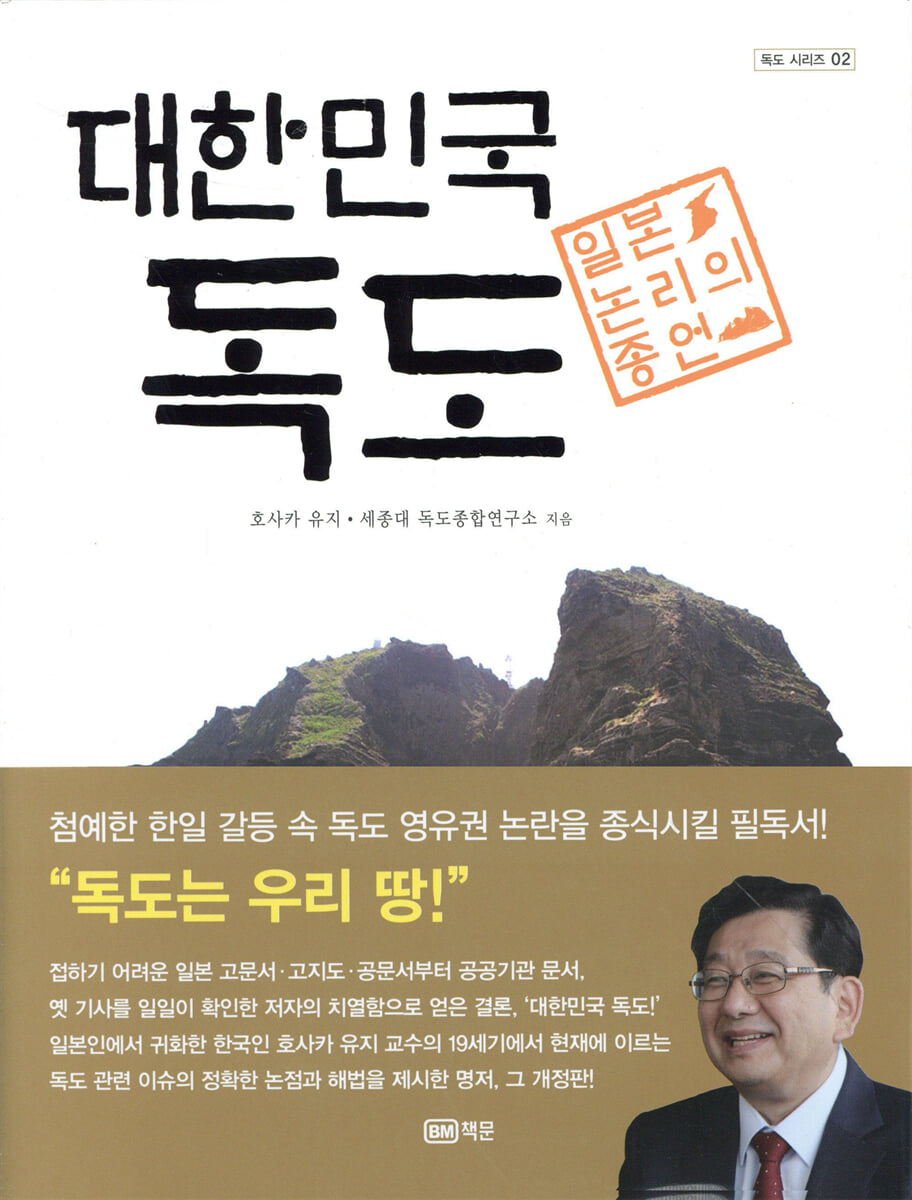
The cover photo of this book shows a map of the Korean Peninsula on Dokdo's East Island, and there is a meaningful explanation that this shape is pointed towards Japan.
The repeated claim of sovereignty over Dokdo every year is an extremely subtle source of conflict between Korea and Japan.
Recently, the conflict between Korea and Japan over Dokdo appears to be intensifying.
On March 25, the Japanese Ministry of Foreign Affairs officially protested through diplomatic channels after learning of the Korea Hydrographic and Oceanographic Research Institute (KHOA)'s plan to deploy an "Autonomous Ocean Observation Vehicle (AOV)," a drone that sails over the sea, to Dokdo to conduct an unmanned marine survey.
A day later, on March 26, our government strongly condemned the approval of a Japanese national elementary school social studies textbook for grades 3-6 that contained unfair claims about Dokdo, and urged its withdrawal. We also summoned the Japanese ambassador to Korea to protest.
The revised edition of [Dokdo, Republic of Korea], published after 10 years by Professor Yuji Hosaka of Sejong University's College of Ocean Humanities, who was born Japanese during this time, became naturalized Korean, and has been actively spreading the historical truth about Dokdo through writing, broadcasting, research, and lectures, proving that "Dokdo is Korea's inherent territory," is of great significance.
In this revised edition (equivalent to the 4th printing), the overall framework of the book has been maintained, while the main text has been supplemented and approximately 30 new pages have been written on matters related to Dokdo since 2010.
In particular, we supplemented meaningful data, such as a screen on the website of the United States Board on Geographic Names acknowledging that Dokdo is under Korea's effective control, and we logically reexamine the situations since 2012, when issues arose regarding the exchange of official documents between Korea and Japan in 1965.
Professor Yuji Hosaka concludes with the logic that, “In order to firmly establish that Dokdo is not a disputed territory, the Korean government must accurately analyze Japan’s logic for Dokdo ownership, summarize criticisms and overcoming measures, and always accurately communicate this to the outside world.”
This book will be of great help in overcoming the Dokdo issue by responding calmly with reason and logic, rather than relying on emotions based on national sentiment.
The repeated claim of sovereignty over Dokdo every year is an extremely subtle source of conflict between Korea and Japan.
Recently, the conflict between Korea and Japan over Dokdo appears to be intensifying.
On March 25, the Japanese Ministry of Foreign Affairs officially protested through diplomatic channels after learning of the Korea Hydrographic and Oceanographic Research Institute (KHOA)'s plan to deploy an "Autonomous Ocean Observation Vehicle (AOV)," a drone that sails over the sea, to Dokdo to conduct an unmanned marine survey.
A day later, on March 26, our government strongly condemned the approval of a Japanese national elementary school social studies textbook for grades 3-6 that contained unfair claims about Dokdo, and urged its withdrawal. We also summoned the Japanese ambassador to Korea to protest.
The revised edition of [Dokdo, Republic of Korea], published after 10 years by Professor Yuji Hosaka of Sejong University's College of Ocean Humanities, who was born Japanese during this time, became naturalized Korean, and has been actively spreading the historical truth about Dokdo through writing, broadcasting, research, and lectures, proving that "Dokdo is Korea's inherent territory," is of great significance.
In this revised edition (equivalent to the 4th printing), the overall framework of the book has been maintained, while the main text has been supplemented and approximately 30 new pages have been written on matters related to Dokdo since 2010.
In particular, we supplemented meaningful data, such as a screen on the website of the United States Board on Geographic Names acknowledging that Dokdo is under Korea's effective control, and we logically reexamine the situations since 2012, when issues arose regarding the exchange of official documents between Korea and Japan in 1965.
Professor Yuji Hosaka concludes with the logic that, “In order to firmly establish that Dokdo is not a disputed territory, the Korean government must accurately analyze Japan’s logic for Dokdo ownership, summarize criticisms and overcoming measures, and always accurately communicate this to the outside world.”
This book will be of great help in overcoming the Dokdo issue by responding calmly with reason and logic, rather than relying on emotions based on national sentiment.
- You can preview some of the book's contents.
Preview
index
Author's Note | Greetings with a new edition
Congratulatory remarks | Celebrating the publication of Dokdo of the Republic of Korea
Recommendation | A book that approaches the modern Dokdo issue with new discoveries and strategies.
Introduction | 100th Anniversary of the Gyeongsul National Shame: Japan's Dokdo Sovereignty Logic Dead
Part 1: Dokdo until the Gyeongsul Treaty
Chapter 1: Dokdo and Imperial Decree No. 41 of the Korean Empire
Chapter 2: The Meiji Government and Dokdo
Chapter 3: The Discovery of Ulleungdo and Dokdo by Westerners
Column 1 | Siebold and Japan
Chapter 4: 'Surouji' and Dokdo after 1880
Column 2 | Maps with Traditional Names
Chapter 5 Japan's Forcible Annexation of Dokdo and Emperor Gojong
Part 2: The Dokdo Issue After World War II
Chapter 6: Dokdo and the San Francisco Peace Treaty
Chapter 7: The Intensification of the Dokdo Dispute Between Korea and Japan and the Peace Line
Chapter 8 Dokdo as Appeared in the Korea-Japan Agreement
Chapter 9: Strategic Considerations on Dokdo
References
Search
Congratulatory remarks | Celebrating the publication of Dokdo of the Republic of Korea
Recommendation | A book that approaches the modern Dokdo issue with new discoveries and strategies.
Introduction | 100th Anniversary of the Gyeongsul National Shame: Japan's Dokdo Sovereignty Logic Dead
Part 1: Dokdo until the Gyeongsul Treaty
Chapter 1: Dokdo and Imperial Decree No. 41 of the Korean Empire
Chapter 2: The Meiji Government and Dokdo
Chapter 3: The Discovery of Ulleungdo and Dokdo by Westerners
Column 1 | Siebold and Japan
Chapter 4: 'Surouji' and Dokdo after 1880
Column 2 | Maps with Traditional Names
Chapter 5 Japan's Forcible Annexation of Dokdo and Emperor Gojong
Part 2: The Dokdo Issue After World War II
Chapter 6: Dokdo and the San Francisco Peace Treaty
Chapter 7: The Intensification of the Dokdo Dispute Between Korea and Japan and the Peace Line
Chapter 8 Dokdo as Appeared in the Korea-Japan Agreement
Chapter 9: Strategic Considerations on Dokdo
References
Search
Detailed image

Into the book
Since the first edition of this book, “Dokdo, Republic of Korea,” was published in September 2010, there have been incidents that have greatly shaken Korea-Japan relations due to the Dokdo issue.
The trigger for the significant deterioration of Korea-Japan relations due to the Dokdo issue was the Great East Japan Earthquake that occurred in Japan on March 17, 2011.
At the time, the Korean side, regardless of public or private sector, supported Japan in recovering from the earthquake and tsunami damage.
However, at the end of March, the Japanese government's Ministry of Education, Culture, Sports, Science and Technology approved a large number of high school social studies textbooks that listed Dokdo as Japanese territory.
(Omitted) As part of this backlash against Japan, a bill to build a marine science base 1km off the coast of Dokdo was passed in the Korean National Assembly in May 2011.
(Omitted) Not only that, in May of the same year, Korean Air conducted a test flight between Incheon and Dokdo, saying that it was a test flight of a new type of airplane.
In response, the Japanese Ministry of Foreign Affairs expressed its protest to the Korean side, ordering its staff not to use Korean Air for a month.
(Omitted) Then, on August 1, 2011, a more decisive Dokdo conflict occurred.
An incident occurred where three Japanese Liberal Democratic Party lawmakers belonging to the Territorial Special Committee attempted to enter Korea through Gimpo Airport.
(Omitted) On August 10, 2012, South Korean President Lee Myung-bak made a surprise visit to Dokdo, becoming the first South Korean president to do so.
President Lee Myung-bak's visit to Dokdo served as a new opportunity for Japan to pressure South Korea to refer the Dokdo issue to the International Court of Justice (ICJ), but the South Korean government did not accept the request from then-Japanese Prime Minister Yoshihiko Noda.
(syncopation)
In December 2012, Japan's Liberal Democratic Party won a landslide victory in the House of Representatives election, retaking power from the Democratic Party after three and a half years, and Shinzo Abe, known as a historical revisionist and hard-right winger, was reelected as Japan's prime minister.
This book contains the above-mentioned movements from Japan and corrects and supplements any errors or shortcomings in the first edition.
As the author, I would be immensely pleased if, while reading this book, you would think, even just a little, about what the people of the Republic of Korea should do to protect Dokdo.
---From the author's note
“Now that I look at it, I can’t neglect it for even a moment, and I can’t throw away even a single piece of land.”
-『Gojong Sillok』Volume 19, June 5, 1882
(Omitted) Due to the conclusion of the 'Japan-Korea Bilateral Regulations', which recognized Japan's extraterritoriality, the Japanese, who believed that they would not be punished for illegal acts, increasingly abused Ulleungdo and Dokdo.
This rule was primarily for the Japanese.
This is because at that time, Koreans did not go to the coastal waters of Japan to fish.
Therefore, the 'Japan-Korea Bilateral Fishery Control Regulations' concluded between Joseon and Japan in 1889 ultimately resulted in encouraging illegal fishing activities by Japanese people.
This unequal rule gave rise to people like Nakai Yozaburo, who continued to hunt sea lions on Dokdo without notifying the Korean Empire, even though he knew that Dokdo was Korean territory. In 1905, Japan disguised Nakai Yozaburo's illegal actions as an act of preemptive occupation of an uninhabited island and incorporated Dokdo into Shimane Prefecture.
Therefore, Japan's incorporation of Dokdo into Shimane Prefecture in 1905 was an illegal act that abused the extraterritoriality clause of the "Japan-Korea Bilateral Regulations."
---From "Dokdo and 'Korean Empire Ordinance No. 41'"
Emperor Gojong named the Ulleungdo Islands as Uldo County through ‘Korean Empire Ordinance No. 41.’
And in the conversation with Lee Gyu-won, Dokdo was called Usando or Songdo, but in 'Korean Empire Ordinance No. 41', the name of Dokdo was written as Seokdo (石島).
(Omitted) This was because the new residents of Ulleungdo due to the Ulleungdo relocation policy called Dokdo Dolseom, and Dolseom was written in Chinese characters as Seokdo.
Eventually, after 1880, the name of Dokdo, Usando, disappeared from history, and Dolseom changed to Dokseom, which was eventually settled as Dokdo.
(Omitted) In this way, the Korean Empire published ‘Korean Empire Ordinance No. 41’ in the Official Gazette, declaring to the world that Seokdo, or Dokdo, was the territory of the Korean Empire.
This was five years before Japan forcibly incorporated Dokdo into Shimane Prefecture.
---From "Dokdo and 'Korean Empire Ordinance No. 41'"
Article 76, Paragraph 1 of the Constitution of the Empire of Japan (Meiji Constitution)
All existing laws, regulations, orders, or whatever name they may be used to represent (Taijonggwan laws) that do not contradict this Constitution shall be followed.
(Omitted) How does Japan's current Constitution (enacted in 1946) regulate the validity of laws promulgated by the Daijokan? The current Constitution contains no explicit provisions on this matter.
However, if you look at the interpretation made by Japan, it is stated that things that were mandates in the Meiji Constitution also have the effect of mandates in the Japanese Constitution as long as they do not violate the Constitution.
(Omitted) In 1877, the Tajōkan acknowledged that Dokdo was Joseon territory, stating that Takeshima and the other islands in the East Sea had no relation to Japan.
(Omitted) Since the Taijokan clearly stated that “Takeshima and other islands” were not Japanese territory, it means that even the Japanese government at the time clearly knew that “Ulleungdo and Dokdo” were not Japanese territory.
The current Japanese government is well aware of this fact, and is therefore maintaining silence regarding the 'Taijōkan Directive'.
This is because the legal interpretation within Japan is that the orders of the Taichungkan are still valid to this day as long as they do not violate the Constitution.
---From "The Meiji Government and Dokdo"
In fact, around 2005, the document "History of the Compilation of Land and Land of Takeshima and Other Islands in the Sea of Japan" was also released as a microfilm, but the image quality was so poor that I had to visit the National Archives of Korea to check it in person.
However, it appears that the release of video footage has been completely halted recently.
Moreover, when I visited the National Archives of Japan in 2005 and requested to view the original, not the video version, the book the library staff brought back, claiming it was the original, was in fact not the original.
The fake original was a deliberately rewritten manuscript in a cursive script that was difficult to read.
The author later learned that the entire 『Kongmunrok』, which included the "History of the Compilation of Land Registers of Takeshima and Other Islands in the Sea of Japan," was intentionally transcribed in "difficult-to-read cursive script," and that the Japanese side had done so for a reason.
The reason is that the original had a shogunate inserted indicating that the two islands that the Taichungkan had determined to be outside of Japanese territory were Ulleungdo and Dokdo.
---From "The Meiji Government and Dokdo"
The Japanese Ministry of Home Affairs rejected Nakai Yozaburo's "Petition for the Incorporation of Ryango Island Territory and the Great House of Representatives" on the grounds that Dokdo "could possibly be Joseon territory." However, the Ministry of Foreign Affairs, without even conducting a proper investigation, emphasized the urgent situation of the Russo-Japanese War and regarded Dokdo as terra nullius. After persuading other ministries, they eventually incorporated Dokdo into Shimane Prefecture in 1905.
The incident in which Japan incorporated Dokdo into Shimane Prefecture in 1905 was an incident that provided the impetus for the Navy's Hydrographic Department to commit illegal acts, ignoring the historical fact that its people had traditionally called Dokdo Matsushima and recognized it as Korean territory.
---From "Surouji and Dokdo after 1880"
In June 1907, three months after the publication of the 『Joseon Hydrographic Journal』, the Hydrographic Department of the Japanese Navy separately published the 『Japan Hydrographic Journal』.
At this time, the Hydrographic Department was displeased with the fact that Dokdo was recorded in the 『Joseon Hydrographic Journal』 three months earlier, so they completely transferred Dokdo and related information to the 『Japan Hydrographic Journal』 (June 1907).
These facts suggest that Japan transferred Dokdo from the territory of the Korean Empire to Japanese territory.
In other words, by intentionally moving the contents of Dokdo and its related contents from the “Joseon Hydrographic Journal” to the “Japan Hydrographic Journal,” the Japanese Navy Ministry Hydrographic Department acknowledged that Dokdo was the territory of the Korean Empire (Joseon) until 1905.
---From "Surouji and Dokdo after 1880"
The 'Korea-Japan Protocol' stipulated that, in exchange for guaranteeing the independence and territorial integrity of the Korean Empire and the safety of the Imperial Family, the Japanese military would be allowed to operate freely on Korean territory and use land necessary for military strategy.
That was the core content of the ‘Korea-Japan Protocol.’
(Omitted) Therefore, the ‘Korea-Japan Protocol’ can be said to be the first treaty through which Japan made the Korean Empire a colony.
Japan's colonization of the Korean Peninsula began on February 23, 1904, when the Korea-Japan Protocol was signed.
Therefore, the view that the forced conclusion of the Eulsa Treaty (October 1905) marked the beginning of Japan's full-scale invasion of Korea must be corrected.
---From "Japan's Forced Annexation of Dokdo and Emperor Gojong"
The Japanese side distorts the truth by saying that the Korean Empire's cabinet at the time decided to force Emperor Gojong to abdicate, but the following data clearly shows that Japan forced Emperor Gojong to abdicate.
[Letter from Prime Minister Saionji]
(Strategy) The Emperor of the Korean Empire must be made to abdicate to the Crown Prince.
If we want to eliminate the root cause of future trouble, it may be inevitable to use such means.
However, it would be better to have the Korean Empire government carry out this matter.
(omitted)
As planned in this document, Emperor Gojong was forced to abdicate by the Korean Empire Cabinet.
Everything was carried out according to the Japanese conspiracy.
This document was sent by then Japanese Prime Minister Saionji to the Resident-General of Korea, Ito Hirobumi, on July 12, 1907.
(Omitted) Japan's claim that Dokdo became Japanese territory because the Korean Empire did not protest Japan's annexation of Dokdo, which is considered 'acquiescence' under international law, is not valid for the following reasons.
First, at the time, Emperor Gojong was in a situation where he could not protest directly to Japan, to the point where he had to send secret envoys to each country.
Second, Emperor Gojong denounced Japan's aggression through secret envoys and secret letters, and in particular, indirectly condemned Japan's ambitions at the Hague Peace Conference held in June 1907.
Therefore, since the international law logic of ‘tacit approval’ cannot be applied, Japan’s annexation of Dokdo is invalid.
---From "Japan's Forced Annexation of Dokdo and Emperor Gojong"
The United States, taking advantage of the Korean Embassy in the United States' mistake without properly investigating the history of Dokdo, sent the 'Rusk Letter' dated August 10, 1951, to Korea, demanding that it give up its sovereignty over Dokdo.
(Omitted) To summarize, the United States sent the ‘Rusk Letter’ solely to the Korean government on August 10th.
There is an opinion that the Rusk Letter had legal effect because the United States responded to Korea's request, but there is no document showing that Korea accepted the United States' view.
(Omitted) In the end, the United States was informally conveying to Japan that Dokdo would become Japanese territory without the agreement of other Allied nations.
In addition, on August 10, 1951, the United States sent the 'Rusk Letter' to Korea.
At that time, the United States tried to give Dokdo to Japan 'without agreement with the Allied Powers, that is, by deceiving the Allied Powers.'
---From "Dokdo and the San Francisco Peace Treaty"
Japan claims that the US military, which had been using Dokdo as a bombing range, stopped using it at Japan's request, and that this is clear evidence that Japan has sovereignty over Dokdo since the San Francisco Peace Treaty (April 1952) came into effect.
(Omitted) On the ‘Takeshima Issue’ webpage of the Japanese Ministry of Foreign Affairs website, it is written that ‘the US military also stopped using Takeshima (Dokdo) as a bombing training area in the winter of the same year (January 1953)’.
If you read only this, it may seem as if the US military voluntarily gave up using Dokdo as a bombing range, but in fact, it was because they accepted South Korea's protest.
The Ministry of Foreign Affairs website is deliberately omitting this crucial fact, deceiving the Japanese people and the world.
The U.S. military notified Korea through a letter dated January 20, 1953, that it would no longer use Dokdo as a bombing practice range.
(Omitted) If the United States had confirmed Dokdo as Japanese territory, it would not have accepted Korea's protest.
The reason the United States accepted South Korea's protest and decided to suspend bombing practice ranges on Dokdo was because it recognized South Korea's sovereignty over Dokdo.
---From "The Intensification of the Dokdo Dispute Between Korea and Japan and the Peace Line"
It is stated that Atomiya [後宮], Director of the Asian Affairs Bureau of the Japanese Ministry of Foreign Affairs, wrote about the process of negotiations between Korea and Japan on the Dokdo issue in an article titled “Some Recollections on Korea-Japan Negotiations,” but this part of the document is also blacked out, so its contents are unknown.
It seems like there is something the Japanese government wants to hide.
And on June 15th of the same year, a week before the signing ceremony, when U.S. Ambassador to Korea Browns and President Park Chung-hee met, the Japanese government also blacked out the document of their conversation on the Dokdo issue and made it unreadable.
This information can be found in documents 15-216, 15-217, and 15-218.
We can once again confirm that the Japanese government is attempting to conceal the truth of history by blacking out all information unfavorable to the country regarding the Dokdo issue.
What has been confirmed so far is that Japan has completely abandoned its claim to refer the Dokdo issue to the International Court of Justice.
---From "Dokdo as Appeared in the Korea-Japan Agreement"
Minister Lee Dong-won pointed out that even if a Japanese government other than the Sato administration later reasserts Japan's sovereignty over Dokdo by including the Dokdo issue in the exchange of official documents, the mediation process will not begin unless the two governments reach an agreement.
And since the exchange of notes did not explicitly state that the problem would be "resolved" when it arose, but only that it would "seek to resolve" it, he explained that there was no need to worry, as Dokdo had all the legal conditions to exercise sovereignty over it as Korean territory forever.
Therefore, Japan is currently carrying out provocations over Dokdo, while violating the concessions (abandonments) agreed upon between Korea and Japan at the time of the Korea-Japan Treaty.
---From "Dokdo as Appeared in the Korea-Japan Agreement"
The San Francisco Peace Treaty concluded that Dokdo was Korean territory.
Even Dulles, who was in charge of the American side of the San Francisco Peace Treaty, acknowledged that the American view was a unique American view without consensus.
Korea controls Dokdo, and the only country that opposes this is Japan.
Therefore, Korea and Japan discussed the Dokdo issue at the Korea-Japan talks when diplomatic relations were normalized.
But even at this time, there was no legal movement toward Dokdo being Korean territory.
After the signing of the Korea-Japan Agreement by both countries on June 22, 1965, the Japanese government repeatedly emphasized in the Japanese Diet that the Dokdo issue would be resolved peacefully through an “exchange of official documents to resolve the dispute.”
However, the Korean side issued a statement saying that Dokdo is Korea's inherent territory, so the Dokdo issue was excluded from the Korea-Japan talks, and that Dokdo was not included in the 'exchange of official documents'.
In response, the Japanese opposition parties began to attack during the National Assembly's deliberation on the Korea-Japan Agreement.
Opposition lawmakers claimed that the "exchange of official documents" did not contain an "agreement" to resolve the Dokdo issue based on its contents, and criticized the Japanese government for effectively giving up on Dokdo.
In response, the Japanese government claimed, “We have fully agreed with the Korean side that the Dokdo issue will be resolved through an exchange of official documents.”
However, as the barrage of questions continued, then Prime Minister Sato put forth the irrational logic that “the fact that there is no agreement between Korea and Japan, that is, the fact that there is no agreement on whether the Dokdo issue is a dispute, is itself a dispute.”
(syncopation)
The Japanese government submitted an official document to the National Assembly stating that the Dokdo issue should be resolved through the adjustments mentioned in the "exchange of official documents" unless there is a "special agreement" because it is an objective fact that the Dokdo issue is a dispute.
(Omitted) However, since Korea claims that there is no dispute and Japan claims that objectively there is a dispute, Japan's logic that the two countries have differences of opinion and that this is precisely the dispute and should be discussed at the International Court of Justice is fundamentally flawed.
Whether it is coordination of exchanges of official documents or judicial proceedings at the International Court of Justice, discussions can only be held after Korea acknowledges that Dokdo is a disputed territory, so the Japanese government's logic that the differences in opinion between the two countries over the existence of a dispute are considered a dispute is nothing but sophistry.
However, the Korean government must accurately analyze Japan's logic for Dokdo's sovereignty, summarize its criticisms and solutions, and always accurately communicate this to the outside world in order to firmly establish that Dokdo is not a disputed territory.
The trigger for the significant deterioration of Korea-Japan relations due to the Dokdo issue was the Great East Japan Earthquake that occurred in Japan on March 17, 2011.
At the time, the Korean side, regardless of public or private sector, supported Japan in recovering from the earthquake and tsunami damage.
However, at the end of March, the Japanese government's Ministry of Education, Culture, Sports, Science and Technology approved a large number of high school social studies textbooks that listed Dokdo as Japanese territory.
(Omitted) As part of this backlash against Japan, a bill to build a marine science base 1km off the coast of Dokdo was passed in the Korean National Assembly in May 2011.
(Omitted) Not only that, in May of the same year, Korean Air conducted a test flight between Incheon and Dokdo, saying that it was a test flight of a new type of airplane.
In response, the Japanese Ministry of Foreign Affairs expressed its protest to the Korean side, ordering its staff not to use Korean Air for a month.
(Omitted) Then, on August 1, 2011, a more decisive Dokdo conflict occurred.
An incident occurred where three Japanese Liberal Democratic Party lawmakers belonging to the Territorial Special Committee attempted to enter Korea through Gimpo Airport.
(Omitted) On August 10, 2012, South Korean President Lee Myung-bak made a surprise visit to Dokdo, becoming the first South Korean president to do so.
President Lee Myung-bak's visit to Dokdo served as a new opportunity for Japan to pressure South Korea to refer the Dokdo issue to the International Court of Justice (ICJ), but the South Korean government did not accept the request from then-Japanese Prime Minister Yoshihiko Noda.
(syncopation)
In December 2012, Japan's Liberal Democratic Party won a landslide victory in the House of Representatives election, retaking power from the Democratic Party after three and a half years, and Shinzo Abe, known as a historical revisionist and hard-right winger, was reelected as Japan's prime minister.
This book contains the above-mentioned movements from Japan and corrects and supplements any errors or shortcomings in the first edition.
As the author, I would be immensely pleased if, while reading this book, you would think, even just a little, about what the people of the Republic of Korea should do to protect Dokdo.
---From the author's note
“Now that I look at it, I can’t neglect it for even a moment, and I can’t throw away even a single piece of land.”
-『Gojong Sillok』Volume 19, June 5, 1882
(Omitted) Due to the conclusion of the 'Japan-Korea Bilateral Regulations', which recognized Japan's extraterritoriality, the Japanese, who believed that they would not be punished for illegal acts, increasingly abused Ulleungdo and Dokdo.
This rule was primarily for the Japanese.
This is because at that time, Koreans did not go to the coastal waters of Japan to fish.
Therefore, the 'Japan-Korea Bilateral Fishery Control Regulations' concluded between Joseon and Japan in 1889 ultimately resulted in encouraging illegal fishing activities by Japanese people.
This unequal rule gave rise to people like Nakai Yozaburo, who continued to hunt sea lions on Dokdo without notifying the Korean Empire, even though he knew that Dokdo was Korean territory. In 1905, Japan disguised Nakai Yozaburo's illegal actions as an act of preemptive occupation of an uninhabited island and incorporated Dokdo into Shimane Prefecture.
Therefore, Japan's incorporation of Dokdo into Shimane Prefecture in 1905 was an illegal act that abused the extraterritoriality clause of the "Japan-Korea Bilateral Regulations."
---From "Dokdo and 'Korean Empire Ordinance No. 41'"
Emperor Gojong named the Ulleungdo Islands as Uldo County through ‘Korean Empire Ordinance No. 41.’
And in the conversation with Lee Gyu-won, Dokdo was called Usando or Songdo, but in 'Korean Empire Ordinance No. 41', the name of Dokdo was written as Seokdo (石島).
(Omitted) This was because the new residents of Ulleungdo due to the Ulleungdo relocation policy called Dokdo Dolseom, and Dolseom was written in Chinese characters as Seokdo.
Eventually, after 1880, the name of Dokdo, Usando, disappeared from history, and Dolseom changed to Dokseom, which was eventually settled as Dokdo.
(Omitted) In this way, the Korean Empire published ‘Korean Empire Ordinance No. 41’ in the Official Gazette, declaring to the world that Seokdo, or Dokdo, was the territory of the Korean Empire.
This was five years before Japan forcibly incorporated Dokdo into Shimane Prefecture.
---From "Dokdo and 'Korean Empire Ordinance No. 41'"
Article 76, Paragraph 1 of the Constitution of the Empire of Japan (Meiji Constitution)
All existing laws, regulations, orders, or whatever name they may be used to represent (Taijonggwan laws) that do not contradict this Constitution shall be followed.
(Omitted) How does Japan's current Constitution (enacted in 1946) regulate the validity of laws promulgated by the Daijokan? The current Constitution contains no explicit provisions on this matter.
However, if you look at the interpretation made by Japan, it is stated that things that were mandates in the Meiji Constitution also have the effect of mandates in the Japanese Constitution as long as they do not violate the Constitution.
(Omitted) In 1877, the Tajōkan acknowledged that Dokdo was Joseon territory, stating that Takeshima and the other islands in the East Sea had no relation to Japan.
(Omitted) Since the Taijokan clearly stated that “Takeshima and other islands” were not Japanese territory, it means that even the Japanese government at the time clearly knew that “Ulleungdo and Dokdo” were not Japanese territory.
The current Japanese government is well aware of this fact, and is therefore maintaining silence regarding the 'Taijōkan Directive'.
This is because the legal interpretation within Japan is that the orders of the Taichungkan are still valid to this day as long as they do not violate the Constitution.
---From "The Meiji Government and Dokdo"
In fact, around 2005, the document "History of the Compilation of Land and Land of Takeshima and Other Islands in the Sea of Japan" was also released as a microfilm, but the image quality was so poor that I had to visit the National Archives of Korea to check it in person.
However, it appears that the release of video footage has been completely halted recently.
Moreover, when I visited the National Archives of Japan in 2005 and requested to view the original, not the video version, the book the library staff brought back, claiming it was the original, was in fact not the original.
The fake original was a deliberately rewritten manuscript in a cursive script that was difficult to read.
The author later learned that the entire 『Kongmunrok』, which included the "History of the Compilation of Land Registers of Takeshima and Other Islands in the Sea of Japan," was intentionally transcribed in "difficult-to-read cursive script," and that the Japanese side had done so for a reason.
The reason is that the original had a shogunate inserted indicating that the two islands that the Taichungkan had determined to be outside of Japanese territory were Ulleungdo and Dokdo.
---From "The Meiji Government and Dokdo"
The Japanese Ministry of Home Affairs rejected Nakai Yozaburo's "Petition for the Incorporation of Ryango Island Territory and the Great House of Representatives" on the grounds that Dokdo "could possibly be Joseon territory." However, the Ministry of Foreign Affairs, without even conducting a proper investigation, emphasized the urgent situation of the Russo-Japanese War and regarded Dokdo as terra nullius. After persuading other ministries, they eventually incorporated Dokdo into Shimane Prefecture in 1905.
The incident in which Japan incorporated Dokdo into Shimane Prefecture in 1905 was an incident that provided the impetus for the Navy's Hydrographic Department to commit illegal acts, ignoring the historical fact that its people had traditionally called Dokdo Matsushima and recognized it as Korean territory.
---From "Surouji and Dokdo after 1880"
In June 1907, three months after the publication of the 『Joseon Hydrographic Journal』, the Hydrographic Department of the Japanese Navy separately published the 『Japan Hydrographic Journal』.
At this time, the Hydrographic Department was displeased with the fact that Dokdo was recorded in the 『Joseon Hydrographic Journal』 three months earlier, so they completely transferred Dokdo and related information to the 『Japan Hydrographic Journal』 (June 1907).
These facts suggest that Japan transferred Dokdo from the territory of the Korean Empire to Japanese territory.
In other words, by intentionally moving the contents of Dokdo and its related contents from the “Joseon Hydrographic Journal” to the “Japan Hydrographic Journal,” the Japanese Navy Ministry Hydrographic Department acknowledged that Dokdo was the territory of the Korean Empire (Joseon) until 1905.
---From "Surouji and Dokdo after 1880"
The 'Korea-Japan Protocol' stipulated that, in exchange for guaranteeing the independence and territorial integrity of the Korean Empire and the safety of the Imperial Family, the Japanese military would be allowed to operate freely on Korean territory and use land necessary for military strategy.
That was the core content of the ‘Korea-Japan Protocol.’
(Omitted) Therefore, the ‘Korea-Japan Protocol’ can be said to be the first treaty through which Japan made the Korean Empire a colony.
Japan's colonization of the Korean Peninsula began on February 23, 1904, when the Korea-Japan Protocol was signed.
Therefore, the view that the forced conclusion of the Eulsa Treaty (October 1905) marked the beginning of Japan's full-scale invasion of Korea must be corrected.
---From "Japan's Forced Annexation of Dokdo and Emperor Gojong"
The Japanese side distorts the truth by saying that the Korean Empire's cabinet at the time decided to force Emperor Gojong to abdicate, but the following data clearly shows that Japan forced Emperor Gojong to abdicate.
[Letter from Prime Minister Saionji]
(Strategy) The Emperor of the Korean Empire must be made to abdicate to the Crown Prince.
If we want to eliminate the root cause of future trouble, it may be inevitable to use such means.
However, it would be better to have the Korean Empire government carry out this matter.
(omitted)
As planned in this document, Emperor Gojong was forced to abdicate by the Korean Empire Cabinet.
Everything was carried out according to the Japanese conspiracy.
This document was sent by then Japanese Prime Minister Saionji to the Resident-General of Korea, Ito Hirobumi, on July 12, 1907.
(Omitted) Japan's claim that Dokdo became Japanese territory because the Korean Empire did not protest Japan's annexation of Dokdo, which is considered 'acquiescence' under international law, is not valid for the following reasons.
First, at the time, Emperor Gojong was in a situation where he could not protest directly to Japan, to the point where he had to send secret envoys to each country.
Second, Emperor Gojong denounced Japan's aggression through secret envoys and secret letters, and in particular, indirectly condemned Japan's ambitions at the Hague Peace Conference held in June 1907.
Therefore, since the international law logic of ‘tacit approval’ cannot be applied, Japan’s annexation of Dokdo is invalid.
---From "Japan's Forced Annexation of Dokdo and Emperor Gojong"
The United States, taking advantage of the Korean Embassy in the United States' mistake without properly investigating the history of Dokdo, sent the 'Rusk Letter' dated August 10, 1951, to Korea, demanding that it give up its sovereignty over Dokdo.
(Omitted) To summarize, the United States sent the ‘Rusk Letter’ solely to the Korean government on August 10th.
There is an opinion that the Rusk Letter had legal effect because the United States responded to Korea's request, but there is no document showing that Korea accepted the United States' view.
(Omitted) In the end, the United States was informally conveying to Japan that Dokdo would become Japanese territory without the agreement of other Allied nations.
In addition, on August 10, 1951, the United States sent the 'Rusk Letter' to Korea.
At that time, the United States tried to give Dokdo to Japan 'without agreement with the Allied Powers, that is, by deceiving the Allied Powers.'
---From "Dokdo and the San Francisco Peace Treaty"
Japan claims that the US military, which had been using Dokdo as a bombing range, stopped using it at Japan's request, and that this is clear evidence that Japan has sovereignty over Dokdo since the San Francisco Peace Treaty (April 1952) came into effect.
(Omitted) On the ‘Takeshima Issue’ webpage of the Japanese Ministry of Foreign Affairs website, it is written that ‘the US military also stopped using Takeshima (Dokdo) as a bombing training area in the winter of the same year (January 1953)’.
If you read only this, it may seem as if the US military voluntarily gave up using Dokdo as a bombing range, but in fact, it was because they accepted South Korea's protest.
The Ministry of Foreign Affairs website is deliberately omitting this crucial fact, deceiving the Japanese people and the world.
The U.S. military notified Korea through a letter dated January 20, 1953, that it would no longer use Dokdo as a bombing practice range.
(Omitted) If the United States had confirmed Dokdo as Japanese territory, it would not have accepted Korea's protest.
The reason the United States accepted South Korea's protest and decided to suspend bombing practice ranges on Dokdo was because it recognized South Korea's sovereignty over Dokdo.
---From "The Intensification of the Dokdo Dispute Between Korea and Japan and the Peace Line"
It is stated that Atomiya [後宮], Director of the Asian Affairs Bureau of the Japanese Ministry of Foreign Affairs, wrote about the process of negotiations between Korea and Japan on the Dokdo issue in an article titled “Some Recollections on Korea-Japan Negotiations,” but this part of the document is also blacked out, so its contents are unknown.
It seems like there is something the Japanese government wants to hide.
And on June 15th of the same year, a week before the signing ceremony, when U.S. Ambassador to Korea Browns and President Park Chung-hee met, the Japanese government also blacked out the document of their conversation on the Dokdo issue and made it unreadable.
This information can be found in documents 15-216, 15-217, and 15-218.
We can once again confirm that the Japanese government is attempting to conceal the truth of history by blacking out all information unfavorable to the country regarding the Dokdo issue.
What has been confirmed so far is that Japan has completely abandoned its claim to refer the Dokdo issue to the International Court of Justice.
---From "Dokdo as Appeared in the Korea-Japan Agreement"
Minister Lee Dong-won pointed out that even if a Japanese government other than the Sato administration later reasserts Japan's sovereignty over Dokdo by including the Dokdo issue in the exchange of official documents, the mediation process will not begin unless the two governments reach an agreement.
And since the exchange of notes did not explicitly state that the problem would be "resolved" when it arose, but only that it would "seek to resolve" it, he explained that there was no need to worry, as Dokdo had all the legal conditions to exercise sovereignty over it as Korean territory forever.
Therefore, Japan is currently carrying out provocations over Dokdo, while violating the concessions (abandonments) agreed upon between Korea and Japan at the time of the Korea-Japan Treaty.
---From "Dokdo as Appeared in the Korea-Japan Agreement"
The San Francisco Peace Treaty concluded that Dokdo was Korean territory.
Even Dulles, who was in charge of the American side of the San Francisco Peace Treaty, acknowledged that the American view was a unique American view without consensus.
Korea controls Dokdo, and the only country that opposes this is Japan.
Therefore, Korea and Japan discussed the Dokdo issue at the Korea-Japan talks when diplomatic relations were normalized.
But even at this time, there was no legal movement toward Dokdo being Korean territory.
After the signing of the Korea-Japan Agreement by both countries on June 22, 1965, the Japanese government repeatedly emphasized in the Japanese Diet that the Dokdo issue would be resolved peacefully through an “exchange of official documents to resolve the dispute.”
However, the Korean side issued a statement saying that Dokdo is Korea's inherent territory, so the Dokdo issue was excluded from the Korea-Japan talks, and that Dokdo was not included in the 'exchange of official documents'.
In response, the Japanese opposition parties began to attack during the National Assembly's deliberation on the Korea-Japan Agreement.
Opposition lawmakers claimed that the "exchange of official documents" did not contain an "agreement" to resolve the Dokdo issue based on its contents, and criticized the Japanese government for effectively giving up on Dokdo.
In response, the Japanese government claimed, “We have fully agreed with the Korean side that the Dokdo issue will be resolved through an exchange of official documents.”
However, as the barrage of questions continued, then Prime Minister Sato put forth the irrational logic that “the fact that there is no agreement between Korea and Japan, that is, the fact that there is no agreement on whether the Dokdo issue is a dispute, is itself a dispute.”
(syncopation)
The Japanese government submitted an official document to the National Assembly stating that the Dokdo issue should be resolved through the adjustments mentioned in the "exchange of official documents" unless there is a "special agreement" because it is an objective fact that the Dokdo issue is a dispute.
(Omitted) However, since Korea claims that there is no dispute and Japan claims that objectively there is a dispute, Japan's logic that the two countries have differences of opinion and that this is precisely the dispute and should be discussed at the International Court of Justice is fundamentally flawed.
Whether it is coordination of exchanges of official documents or judicial proceedings at the International Court of Justice, discussions can only be held after Korea acknowledges that Dokdo is a disputed territory, so the Japanese government's logic that the differences in opinion between the two countries over the existence of a dispute are considered a dispute is nothing but sophistry.
However, the Korean government must accurately analyze Japan's logic for Dokdo's sovereignty, summarize its criticisms and solutions, and always accurately communicate this to the outside world in order to firmly establish that Dokdo is not a disputed territory.
---From "Strategic Considerations on Dokdo"
Publisher's Review
A book that almost 100% overcomes Japan's Dokdo logic.
This book, which consists of two parts and nine chapters based on historical trends and issues, sheds new light on the "Taijōkan Directive," an official document of the Japanese government that shows that Japan itself denied sovereignty over Dokdo, and reveals that the document is still legally valid today.
Furthermore, when the Allied Powers and Japan signed the San Francisco Peace Treaty after the end of World War II, Japan claimed sovereignty over Dokdo based on the fact that the United States had at the time determined that "Dokdo is Japanese territory."
However, this book completely destroys the core of Japan's Dokdo sovereignty logic by revealing that the United States sent the message that "Dokdo is Japanese territory" only to the Korean government without reaching an agreement with the Allied Powers who had different views.
Furthermore, through recently declassified documents from the 1965 Japan-ROK Agreement released by the Japanese government, it was detailed that Japan partially accepted Syngman Rhee's line and gave up on referring the Dokdo issue to the International Court of Justice, ultimately effectively giving up Dokdo.
In the 109th year of the Gyeongsul National Shame, Japan's claim to Dokdo is dead.
As we mark the 109th anniversary of the Gyeongsul National Shame, active efforts are being made across politics and academia to seek a more progressive relationship between Korea and Japan.
However, each year, East Asian countries, including our country, that suffered the hardships of Japanese colonial rule, urge Japan to sincerely reflect on its actions.
This means that the issue of past history has not been properly resolved.
Among them, the issue that is most sharply at odds with Korea and Japan is the Dokdo issue discussed in this book.
Professor Yuji Hosaka, the author of this book, approached the Dokdo issue, which has been the subject of fierce debate and confrontation between Korea and Japan, from the 19th century to the present, with thorough research and logic.
Following 『Our History of Dokdo』 (2009, Chaekmun), which examined the history of Dokdo through the history of Korea-Japan relations from the 6th century, when Silla annexed Usanguk, to the early 19th century, this book meticulously researches and analyzes the process by which Japan invaded Dokdo while colonizing Joseon, as well as the current position and strategy of the Japanese government.
He argues that the Dokdo issue should not be addressed emotionally or with silence, but rather through intense research into historical records and verified data, so as to persuade not only the parties involved but also third parties.
And in order to approach the question of 'Which country's territory is Dokdo?', we approached it logically by comparing and analyzing the grounds for the positions and claims regarding Dokdo presented by both Korea and Japan.
For example, in Part 1, Chapter 1, Dokdo and ‘Korean Empire Ordinance No. 41,’ it is revealed that five years before Japan forcibly incorporated Dokdo into Shimane Prefecture, the Korean Empire published ‘Korean Empire Ordinance No. 41’ in the Official Gazette, declaring to the world that Seokdo, or Dokdo, was Korean Empire territory.
In Part 1, Chapter 2, “The Meiji Government and Dokdo,” it is revealed that the Daijokan, once Japan’s highest state organ, declared that Dokdo was not Japanese territory, but the Japanese government that succeeded it remained silent on the fact.
Also, Chapter 5 of Part 1 contains a counterargument to the claim that the Korean Empire did not protest when Japan annexed Dokdo, and thus effectively "acquiesced."
In other words, Emperor Gojong of the Korean Empire, who was unable to protest directly to Japan due to the continued military threats at the time, condemned Japan's invasion at the Hague Peace Conference held in June 1907, so it cannot be said that he "connived," and in this view, Japan's annexation of Dokdo was invalid.
Next, in Chapter 6 of Part 2, the author proves why Japan's logic of Dokdo's sovereignty is wrong through 'Dokdo and the San Francisco Peace Treaty,' which can be said to be the most crucial content of this book.
Currently, Japan claims that Dokdo remains Japanese territory based on certain provisions of the San Francisco Peace Treaty and the Rusk Letter, but a closer look at the facts reveals a completely different conclusion.
The United States sent the Rusk Letter to the Korean government on August 10, 1951, demanding that it "give up its sovereignty over Dokdo" without properly investigating the history of Dokdo.
However, this is invalid because at the time, the United States was trying to give Dokdo to Japan without an agreement with the Allied Powers, and there is no document proving that Korea accepted the United States' view.
In addition, the author criticizes the US military for allowing Dokdo to be used as a bombing range as if it were their own land, even though there is a possibility that Koreans may reside on Dokdo.
This incident ended with the US military, which effectively recognized Korea's sovereignty over Dokdo, accepting Korea's protest and excluding Dokdo from its bombing range.
This book also reveals that Japan effectively gave up Dokdo during the process of concluding the Korea-Japan Agreement, and that referring the Dokdo issue to the International Court of Justice was also excluded from the methods of resolving the Dokdo issue under the 1965 Korea-Japan agreement.
The author argues that since the "Republic of Korea's basic position on Dokdo" is insufficient in many ways compared to the Japanese government's view on Dokdo, logic and data must be fully prepared to end the Dokdo debate.
If the Korean side's argument is inadequate, it is highly likely that it will eventually be pushed back by Japan's logic, and if it does not refute Japan's arguments one by one, it could result in "connivance," which is quite dangerous from an international law perspective.
In conclusion, the author advises that in order to pursue "calm and firm diplomacy" regarding Dokdo, a website should be created that thoroughly refutes the Japanese government's claims and clearly demonstrates the Korean government's claim to Dokdo.
So, whenever the Japanese government asserts sovereignty over Dokdo, they insist that they must persuade both Japan and third countries by saying, “If you look at our official website, you will see that the Japanese government’s claim is wrong.”
It is right there that we begin to see a clue to resolving the Dokdo issue.
If we prepare our logic and data thoroughly like this, the 109th anniversary of the Gyeongsul National Shame will be recorded as the first year of resolving the Dokdo issue.
This book, which consists of two parts and nine chapters based on historical trends and issues, sheds new light on the "Taijōkan Directive," an official document of the Japanese government that shows that Japan itself denied sovereignty over Dokdo, and reveals that the document is still legally valid today.
Furthermore, when the Allied Powers and Japan signed the San Francisco Peace Treaty after the end of World War II, Japan claimed sovereignty over Dokdo based on the fact that the United States had at the time determined that "Dokdo is Japanese territory."
However, this book completely destroys the core of Japan's Dokdo sovereignty logic by revealing that the United States sent the message that "Dokdo is Japanese territory" only to the Korean government without reaching an agreement with the Allied Powers who had different views.
Furthermore, through recently declassified documents from the 1965 Japan-ROK Agreement released by the Japanese government, it was detailed that Japan partially accepted Syngman Rhee's line and gave up on referring the Dokdo issue to the International Court of Justice, ultimately effectively giving up Dokdo.
In the 109th year of the Gyeongsul National Shame, Japan's claim to Dokdo is dead.
As we mark the 109th anniversary of the Gyeongsul National Shame, active efforts are being made across politics and academia to seek a more progressive relationship between Korea and Japan.
However, each year, East Asian countries, including our country, that suffered the hardships of Japanese colonial rule, urge Japan to sincerely reflect on its actions.
This means that the issue of past history has not been properly resolved.
Among them, the issue that is most sharply at odds with Korea and Japan is the Dokdo issue discussed in this book.
Professor Yuji Hosaka, the author of this book, approached the Dokdo issue, which has been the subject of fierce debate and confrontation between Korea and Japan, from the 19th century to the present, with thorough research and logic.
Following 『Our History of Dokdo』 (2009, Chaekmun), which examined the history of Dokdo through the history of Korea-Japan relations from the 6th century, when Silla annexed Usanguk, to the early 19th century, this book meticulously researches and analyzes the process by which Japan invaded Dokdo while colonizing Joseon, as well as the current position and strategy of the Japanese government.
He argues that the Dokdo issue should not be addressed emotionally or with silence, but rather through intense research into historical records and verified data, so as to persuade not only the parties involved but also third parties.
And in order to approach the question of 'Which country's territory is Dokdo?', we approached it logically by comparing and analyzing the grounds for the positions and claims regarding Dokdo presented by both Korea and Japan.
For example, in Part 1, Chapter 1, Dokdo and ‘Korean Empire Ordinance No. 41,’ it is revealed that five years before Japan forcibly incorporated Dokdo into Shimane Prefecture, the Korean Empire published ‘Korean Empire Ordinance No. 41’ in the Official Gazette, declaring to the world that Seokdo, or Dokdo, was Korean Empire territory.
In Part 1, Chapter 2, “The Meiji Government and Dokdo,” it is revealed that the Daijokan, once Japan’s highest state organ, declared that Dokdo was not Japanese territory, but the Japanese government that succeeded it remained silent on the fact.
Also, Chapter 5 of Part 1 contains a counterargument to the claim that the Korean Empire did not protest when Japan annexed Dokdo, and thus effectively "acquiesced."
In other words, Emperor Gojong of the Korean Empire, who was unable to protest directly to Japan due to the continued military threats at the time, condemned Japan's invasion at the Hague Peace Conference held in June 1907, so it cannot be said that he "connived," and in this view, Japan's annexation of Dokdo was invalid.
Next, in Chapter 6 of Part 2, the author proves why Japan's logic of Dokdo's sovereignty is wrong through 'Dokdo and the San Francisco Peace Treaty,' which can be said to be the most crucial content of this book.
Currently, Japan claims that Dokdo remains Japanese territory based on certain provisions of the San Francisco Peace Treaty and the Rusk Letter, but a closer look at the facts reveals a completely different conclusion.
The United States sent the Rusk Letter to the Korean government on August 10, 1951, demanding that it "give up its sovereignty over Dokdo" without properly investigating the history of Dokdo.
However, this is invalid because at the time, the United States was trying to give Dokdo to Japan without an agreement with the Allied Powers, and there is no document proving that Korea accepted the United States' view.
In addition, the author criticizes the US military for allowing Dokdo to be used as a bombing range as if it were their own land, even though there is a possibility that Koreans may reside on Dokdo.
This incident ended with the US military, which effectively recognized Korea's sovereignty over Dokdo, accepting Korea's protest and excluding Dokdo from its bombing range.
This book also reveals that Japan effectively gave up Dokdo during the process of concluding the Korea-Japan Agreement, and that referring the Dokdo issue to the International Court of Justice was also excluded from the methods of resolving the Dokdo issue under the 1965 Korea-Japan agreement.
The author argues that since the "Republic of Korea's basic position on Dokdo" is insufficient in many ways compared to the Japanese government's view on Dokdo, logic and data must be fully prepared to end the Dokdo debate.
If the Korean side's argument is inadequate, it is highly likely that it will eventually be pushed back by Japan's logic, and if it does not refute Japan's arguments one by one, it could result in "connivance," which is quite dangerous from an international law perspective.
In conclusion, the author advises that in order to pursue "calm and firm diplomacy" regarding Dokdo, a website should be created that thoroughly refutes the Japanese government's claims and clearly demonstrates the Korean government's claim to Dokdo.
So, whenever the Japanese government asserts sovereignty over Dokdo, they insist that they must persuade both Japan and third countries by saying, “If you look at our official website, you will see that the Japanese government’s claim is wrong.”
It is right there that we begin to see a clue to resolving the Dokdo issue.
If we prepare our logic and data thoroughly like this, the 109th anniversary of the Gyeongsul National Shame will be recorded as the first year of resolving the Dokdo issue.
GOODS SPECIFICS
- Date of publication: March 27, 2019
- Page count, weight, size: 352 pages | 734g | 170*223*30mm
- ISBN13: 9788931582833
- ISBN10: 8931582838
You may also like
카테고리
korean


korean

![GQ KOREA Mark (Monthly): December [2025]](http://librairie.coreenne.fr/cdn/shop/files/8ef265dbbfbf186523ed75ba7319009d.jpg?v=1765340328&width=3840)


