

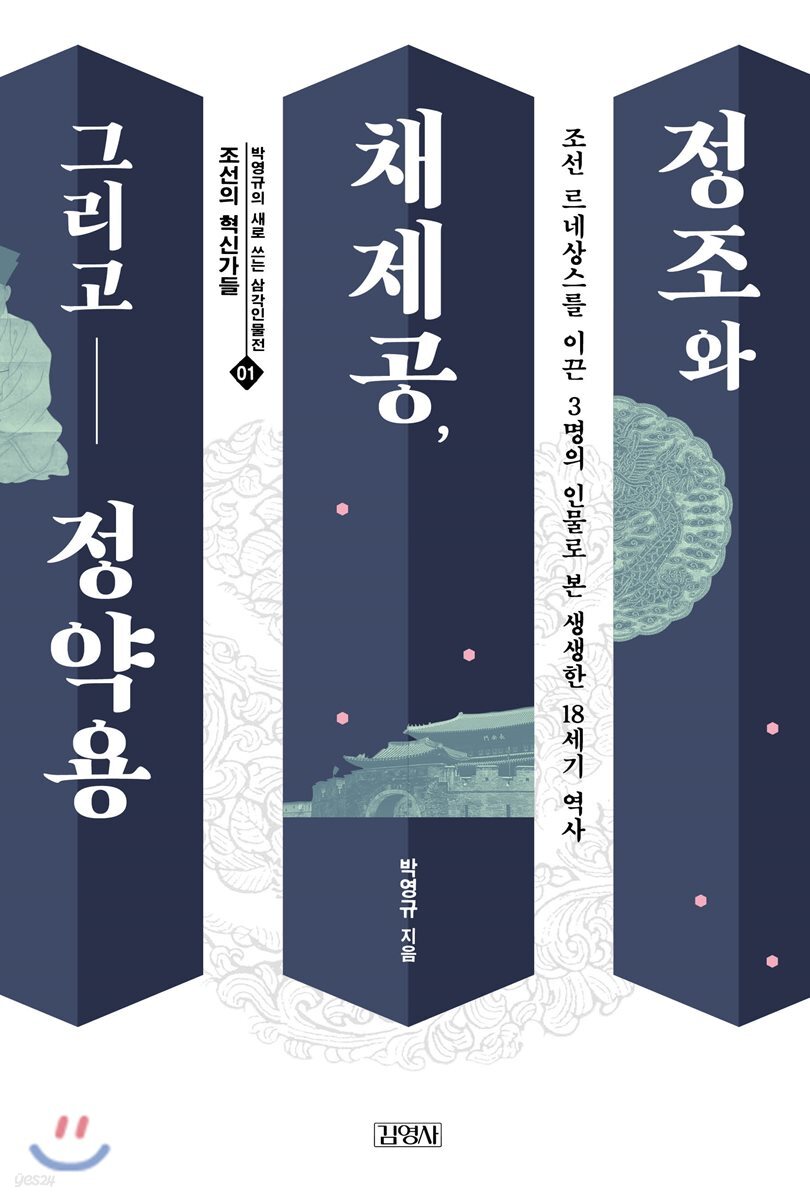
Jeongjo, Chae Je-gong, and Jeong Yak-yong
 |
Description
Book Introduction
The lives and ideals of innovators, as revisited by best-selling author Park Young-gyu
A Vivid 18th-Century History Through the Eyes of Three Figures Who Led the Joseon Renaissance
King Jeongjo, a scholar-monarch who led cultural innovation; Prime Minister Chae Je-gong, who sought balance amidst the whirlwind of factional strife; and Jeong Yak-yong, a Silhak scholar who yearned for a new era.
From their fateful encounter to the acceptance of new scholarship, the promotion of Tangpyeong, and the Suwon Hwaseong Project, this book examines the entire story of the innovative politics and literary renaissance planned by King Jeongjo, overseen by Chae Je-gong, and implemented by Jeong Yak-yong in a three-dimensional and objective manner.
The first book in the "Triangle Characters" series, a new book by Park Young-gyu, the author of the 3 million-selling Siloksa, presents a new history that delicately recreates the colorful aspects and dynamic interactions of three figures who changed the course of time and ushered in a new world.
A Vivid 18th-Century History Through the Eyes of Three Figures Who Led the Joseon Renaissance
King Jeongjo, a scholar-monarch who led cultural innovation; Prime Minister Chae Je-gong, who sought balance amidst the whirlwind of factional strife; and Jeong Yak-yong, a Silhak scholar who yearned for a new era.
From their fateful encounter to the acceptance of new scholarship, the promotion of Tangpyeong, and the Suwon Hwaseong Project, this book examines the entire story of the innovative politics and literary renaissance planned by King Jeongjo, overseen by Chae Je-gong, and implemented by Jeong Yak-yong in a three-dimensional and objective manner.
The first book in the "Triangle Characters" series, a new book by Park Young-gyu, the author of the 3 million-selling Siloksa, presents a new history that delicately recreates the colorful aspects and dynamic interactions of three figures who changed the course of time and ushered in a new world.
- You can preview some of the book's contents.
Preview
index
Introduction | Jeong Chae-jeong, the troika of the 18th-century Renaissance
Chapter 1: The Fateful Encounter of the Jeong Chae-jeong Troika
King Jeongjo and the 18th-Century Renaissance | King Jeongjo and Jeong Yak-yong's First Encounter | The Fateful Encounter Between King Jeongjo and Chae Je-gong, Spanning Two Generations | The Unusual Bond Between Chae Je-gong and Jeong Yak-yong
Chapter 2: Yi San, the Mad Prince's Son
The struggle for survival of Yeongjo, the son of a commoner | The most terrifying word in the world, father | Yeongjo, the father who drove his son mad | The mad crown prince who died locked in a rice chest | The violent patriarch obsessed with madness | Hyegyeonggung Hong, who abandoned her husband and chose her son | The eleven-year-old boy who witnessed his father's death | The crown prince, Yi San, who became the adopted son of Crown Prince Hyojang | Yeongjo's harsh imperial education | Princess Hwawan and Jeong Hu-gyeom who took control of the court | The crown prince in crisis | Yeongjo departs for Bukmangsan Mountain and Jeongjo ascends to the throne
Chapter 3: Chae Je-gong emerges as a new hope for the Nam-in
The Sarim's East-West Division and Factional Politics | The Namin and Seoin Factions' Fierce Power Struggle | Yi In-jwa's Rebellion and the Namin Faction's Branding as Traitors | Yeongjo's Tangpyeong Policy | Chae Je-gong, the Namin Faction's New Hope | The Noron Faction Tries to Banish, but Yeongjo Tries to Keep It | Chae Je-gong's Political Inclinations | Ascending to the Office of Royal Secretary and Rescuing the Crown Prince | Chae Je-gong's Lonely Political Struggle
Chapter 4: The Political Strategies of Hong Guk-yeong, the Prime Minister of the Three Kingdoms, and Jeongjo
The Dongdeokhoe Four, the most influential figures in King Jeongjo's ascension to the throne | The swift elimination of political opponents | Hong Guk-yeong's consolidation of all power | The real reason Jeongjo put Hong Guk-yeong first | The attempted assassination of Jeongjo | Hong Guk-yeong's voluntary resignation | The hidden face of Jeongjo behind Hong Guk-yeong's death
Chapter 5: Chae Je-gong and the Nam-in's Fierce Political Struggle
Jeongjo's Three Stages of Political Innovation | Partners in Political Innovation | The Noron and Soron factions' Killing of Chae Je-gong | Kim Bok-in Sets Out to Save Chae Je-gong | Chae Je-gong Finally Elected as Prime Minister | Laying the Foundation for a Three-Party System | Jeong Yak-yong Enters Politics | Yeongnam, the Home of the Namin Faction | Chae Je-gong's Dokseong System | The Yun Gu-jong Incident and the Manin Petition of Yeongnam Confucian Scholars | Lee Ga-hwan Emerges as the Leader of the Namin Faction | Noron Faction Waries Lee Ga-hwan | Chae Je-gong Ascends to the Chief State Councillor
Chapter 6: Catholicism: A New Reef for Political Innovation
Namin scholars who fell for Catholicism | The Eulsa Chujo Incident | Jinsan's ominous rumors | Two scholars who burned their parents' ancestral tablets | The first Catholic to be executed | Hong Nak-an's accusation | Jeongjo and Chae Je-gong's stance | Yi Seung-hun's dismissal and Kwon Il-sin's death
Chapter 7: Jeongjo's Innovative Organization and New Policies
Kyujanggak, the foundation for political innovation | Jangyongyeong, a symbol of strengthening royal authority | Shinhae Tonggong, who abolished the Geumnanjeonkwon (Golden Seal) | Easing discrimination against illegitimate children | Laying the foundation for the liberation of public slaves | The acceptance and flourishing of Northern Learning | The Munchebanjeong and the self-contradiction of King Jeongjo
Chapter 8: Hwaseong, the new city that embodies King Jeongjo's wishes
Building Hyeonryungwon in Suwon | Preparing for Prosperity | Suwon Reborn | Jeong Yak-yong's Hwaseong Fortress Design | Hwaseong Fortress: The Crown Jewel of Joseon Fortresses | The Most Beautiful Brick Fortress in the Orient | Facilities Inside and Outside Hwaseong Fortress
Chapter 9: Chae Je-gong's later years and Jeong Yak-yong's return to the countryside
Chae Je-gong's petition and the Geumdeungjisa | Everything was Jeongjo's production | The restructuring of the Tangpyeong government | The cornered Namin | The fallen Namin giant | Jeong Yak-yong returns to his hometown
Chapter 10: The Secret Politics of King Jeongjo, Who Dreamed of Being an Absolute Monarch
The Origins of Secret Inspection and Backroom Politics | King Jeongjo's True Face | The Meaning of Secret Inspection Left Behind by Sim Hwan-ji | Why He Promoted the Noron Byeokpa | What Did King Jeongjo Seek Through Secret Inspection? | The Mysteries and Truths Surrounding King Jeongjo's Death
Chapter 11: Dasan, the pinnacle of Silhak, blossoming in exile
The Sinyu Persecution and the Fall of the Namin | The First Book Written in Exile, "Chonbyeonghokchi" | Surviving Again as Dasan | Dasan's Monumental Works | The Remains of His Life in His Hometown
Chapter 1: The Fateful Encounter of the Jeong Chae-jeong Troika
King Jeongjo and the 18th-Century Renaissance | King Jeongjo and Jeong Yak-yong's First Encounter | The Fateful Encounter Between King Jeongjo and Chae Je-gong, Spanning Two Generations | The Unusual Bond Between Chae Je-gong and Jeong Yak-yong
Chapter 2: Yi San, the Mad Prince's Son
The struggle for survival of Yeongjo, the son of a commoner | The most terrifying word in the world, father | Yeongjo, the father who drove his son mad | The mad crown prince who died locked in a rice chest | The violent patriarch obsessed with madness | Hyegyeonggung Hong, who abandoned her husband and chose her son | The eleven-year-old boy who witnessed his father's death | The crown prince, Yi San, who became the adopted son of Crown Prince Hyojang | Yeongjo's harsh imperial education | Princess Hwawan and Jeong Hu-gyeom who took control of the court | The crown prince in crisis | Yeongjo departs for Bukmangsan Mountain and Jeongjo ascends to the throne
Chapter 3: Chae Je-gong emerges as a new hope for the Nam-in
The Sarim's East-West Division and Factional Politics | The Namin and Seoin Factions' Fierce Power Struggle | Yi In-jwa's Rebellion and the Namin Faction's Branding as Traitors | Yeongjo's Tangpyeong Policy | Chae Je-gong, the Namin Faction's New Hope | The Noron Faction Tries to Banish, but Yeongjo Tries to Keep It | Chae Je-gong's Political Inclinations | Ascending to the Office of Royal Secretary and Rescuing the Crown Prince | Chae Je-gong's Lonely Political Struggle
Chapter 4: The Political Strategies of Hong Guk-yeong, the Prime Minister of the Three Kingdoms, and Jeongjo
The Dongdeokhoe Four, the most influential figures in King Jeongjo's ascension to the throne | The swift elimination of political opponents | Hong Guk-yeong's consolidation of all power | The real reason Jeongjo put Hong Guk-yeong first | The attempted assassination of Jeongjo | Hong Guk-yeong's voluntary resignation | The hidden face of Jeongjo behind Hong Guk-yeong's death
Chapter 5: Chae Je-gong and the Nam-in's Fierce Political Struggle
Jeongjo's Three Stages of Political Innovation | Partners in Political Innovation | The Noron and Soron factions' Killing of Chae Je-gong | Kim Bok-in Sets Out to Save Chae Je-gong | Chae Je-gong Finally Elected as Prime Minister | Laying the Foundation for a Three-Party System | Jeong Yak-yong Enters Politics | Yeongnam, the Home of the Namin Faction | Chae Je-gong's Dokseong System | The Yun Gu-jong Incident and the Manin Petition of Yeongnam Confucian Scholars | Lee Ga-hwan Emerges as the Leader of the Namin Faction | Noron Faction Waries Lee Ga-hwan | Chae Je-gong Ascends to the Chief State Councillor
Chapter 6: Catholicism: A New Reef for Political Innovation
Namin scholars who fell for Catholicism | The Eulsa Chujo Incident | Jinsan's ominous rumors | Two scholars who burned their parents' ancestral tablets | The first Catholic to be executed | Hong Nak-an's accusation | Jeongjo and Chae Je-gong's stance | Yi Seung-hun's dismissal and Kwon Il-sin's death
Chapter 7: Jeongjo's Innovative Organization and New Policies
Kyujanggak, the foundation for political innovation | Jangyongyeong, a symbol of strengthening royal authority | Shinhae Tonggong, who abolished the Geumnanjeonkwon (Golden Seal) | Easing discrimination against illegitimate children | Laying the foundation for the liberation of public slaves | The acceptance and flourishing of Northern Learning | The Munchebanjeong and the self-contradiction of King Jeongjo
Chapter 8: Hwaseong, the new city that embodies King Jeongjo's wishes
Building Hyeonryungwon in Suwon | Preparing for Prosperity | Suwon Reborn | Jeong Yak-yong's Hwaseong Fortress Design | Hwaseong Fortress: The Crown Jewel of Joseon Fortresses | The Most Beautiful Brick Fortress in the Orient | Facilities Inside and Outside Hwaseong Fortress
Chapter 9: Chae Je-gong's later years and Jeong Yak-yong's return to the countryside
Chae Je-gong's petition and the Geumdeungjisa | Everything was Jeongjo's production | The restructuring of the Tangpyeong government | The cornered Namin | The fallen Namin giant | Jeong Yak-yong returns to his hometown
Chapter 10: The Secret Politics of King Jeongjo, Who Dreamed of Being an Absolute Monarch
The Origins of Secret Inspection and Backroom Politics | King Jeongjo's True Face | The Meaning of Secret Inspection Left Behind by Sim Hwan-ji | Why He Promoted the Noron Byeokpa | What Did King Jeongjo Seek Through Secret Inspection? | The Mysteries and Truths Surrounding King Jeongjo's Death
Chapter 11: Dasan, the pinnacle of Silhak, blossoming in exile
The Sinyu Persecution and the Fall of the Namin | The First Book Written in Exile, "Chonbyeonghokchi" | Surviving Again as Dasan | Dasan's Monumental Works | The Remains of His Life in His Hometown
Into the book
The main characters of the Renaissance of this era can be said to be King Jeongjo, a scholar-monarch who led cultural innovation, Prime Minister Chae Je-gong who supported his innovative politics, and Silhak scholars such as Park Je-ga, Park Ji-won, and Jeong Yak-yong who yearned for a new era.
In particular, among the many Silhak scholars, the role of the genius scholar Jeong Yak-yong, who was called the Da Vinci of Joseon, stood out the most.
Therefore, it would not be an exaggeration to call Jeongjo, Chae Je-gong, and Jeong Yak-yong the troika of the 18th-century Renaissance.
--- p.5
When and how did the historic first meeting of the Jeong Chae-Jeong troika take place? Chae Je-Gong, the eldest of the three, was born in 1720, while Jeongjo was born 32 years later, in 1752.
Jeong Yak-yong was born in 1762, ten years younger than Jeongjo, so it is unlikely that the three were related by age.
Moreover, it was difficult for Chae Je-gong and Jeong Yak-yong to even sit down face to face because of their age difference of 42 years.
Could Chae Je-gong have been Jeong Yak-yong's teacher? No.
Chae Je-gong and Jeong Yak-yong have something in common: they both come from the Nam-in family.
That is, they have the same political roots.
Another thing they have in common is that both of them were people that King Jeongjo cherished very much.
So, perhaps Jeongjo met the two subjects as king, while Chae Je-gong and Jeong Yak-yong met as superior and subordinate. Their first meeting didn't take place under such circumstances.
The meeting of the three people has a more complicated story.
--- p.19
If Chae Je-gong had remained in the court during the Im-o Incident, he might have once again offered advice without sparing his life for the crown prince.
Unfortunately, at that time, there was no one in the court who would risk his life to stop King Yeongjo's actions.
It is said that later, King Yeongjo regretted killing his son and lamented the fact that there was no loyal subject like Chae Je-gong in the court.
The reason King Yeongjo made Chae Je-gong a guest of the Crown Prince and kept him by King Jeongjo's side was because he knew of his loyalty.
In other words, the meeting between Chae Je-gong and Jeongjo was something that Yeongjo had prepared for Jeongjo a long time ago.
In that sense, the meeting between the two people could be said to be an inevitable fate.
--- p.27~29
Why did King Jeongjo cede all power to Hong Guk-yeong? At the time, Hong Guk-yeong was only twenty-nine, had little political experience, and was not particularly well-educated.
He was also the youngest of the four members of the Dongdeokhoe and held the lowest official position.
It was clear that suddenly giving him all the power was a deliberate act of King Jeongjo.
Historical historians have said that King Jeongjo trusted Hong Guk-yeong the most and entrusted him with power.
However, if we closely analyze the process by which Jeongjo expelled Hong Guk-yeong, it is more accurate to say that he used Hong Guk-yeong rather than trusted him.
In other words, it is more likely that he used Hong Guk-yeong as a shield to strengthen his political base, and then mercilessly abandoned him once his goal was achieved.
For example, it is said that Hong Guk-yeong was made a scapegoat for the Tosagu Peng.
--- p.138
When Jeong Yak-yong entered Sungkyunkwan, his brother-in-law Lee Seung-hun was devoted to Catholicism.
(…) These indigenous Catholics held regular meetings called ‘Ganghakhoe’, in which many young Confucian scholars from the Namin faction participated.
The person who led this lecture was Kwon Cheol-shin, the oldest among them.
(…) Jeong Yak-yong also followed Lee Byeok and attended for the first time.
However, Jeong Yak-yong was not as absorbed in Catholicism as his older brother, Yak-jeon.
(…) In short, Jeong Yak-yong attended Catholic meetings, but was too busy to devote time to Catholic studies.
This means that he had no further interest in Catholicism other than following the wall and reading a book.
--- p.216~218
Reading King Jeongjo's letter to Sim Hwan-ji, one gets the feeling that the court was nothing more than a performance hall directed by King Jeongjo.
There is also a content that when King Jeongjo orders Shim Hwan-ji to come forward for office, he should reply that he is ill and cannot come forward. There is also an instruction that he should write a petition and submit it to the court.
Considering that such instructions were given to Sim Hwan-ji, it is highly likely that the Soron, Noron, and Namin factions also moved in the same way.
If so, it is safe to say that most of what happened in the Joseon Dynasty at that time was secretly orchestrated by King Jeongjo.
In particular, among the many Silhak scholars, the role of the genius scholar Jeong Yak-yong, who was called the Da Vinci of Joseon, stood out the most.
Therefore, it would not be an exaggeration to call Jeongjo, Chae Je-gong, and Jeong Yak-yong the troika of the 18th-century Renaissance.
--- p.5
When and how did the historic first meeting of the Jeong Chae-Jeong troika take place? Chae Je-Gong, the eldest of the three, was born in 1720, while Jeongjo was born 32 years later, in 1752.
Jeong Yak-yong was born in 1762, ten years younger than Jeongjo, so it is unlikely that the three were related by age.
Moreover, it was difficult for Chae Je-gong and Jeong Yak-yong to even sit down face to face because of their age difference of 42 years.
Could Chae Je-gong have been Jeong Yak-yong's teacher? No.
Chae Je-gong and Jeong Yak-yong have something in common: they both come from the Nam-in family.
That is, they have the same political roots.
Another thing they have in common is that both of them were people that King Jeongjo cherished very much.
So, perhaps Jeongjo met the two subjects as king, while Chae Je-gong and Jeong Yak-yong met as superior and subordinate. Their first meeting didn't take place under such circumstances.
The meeting of the three people has a more complicated story.
--- p.19
If Chae Je-gong had remained in the court during the Im-o Incident, he might have once again offered advice without sparing his life for the crown prince.
Unfortunately, at that time, there was no one in the court who would risk his life to stop King Yeongjo's actions.
It is said that later, King Yeongjo regretted killing his son and lamented the fact that there was no loyal subject like Chae Je-gong in the court.
The reason King Yeongjo made Chae Je-gong a guest of the Crown Prince and kept him by King Jeongjo's side was because he knew of his loyalty.
In other words, the meeting between Chae Je-gong and Jeongjo was something that Yeongjo had prepared for Jeongjo a long time ago.
In that sense, the meeting between the two people could be said to be an inevitable fate.
--- p.27~29
Why did King Jeongjo cede all power to Hong Guk-yeong? At the time, Hong Guk-yeong was only twenty-nine, had little political experience, and was not particularly well-educated.
He was also the youngest of the four members of the Dongdeokhoe and held the lowest official position.
It was clear that suddenly giving him all the power was a deliberate act of King Jeongjo.
Historical historians have said that King Jeongjo trusted Hong Guk-yeong the most and entrusted him with power.
However, if we closely analyze the process by which Jeongjo expelled Hong Guk-yeong, it is more accurate to say that he used Hong Guk-yeong rather than trusted him.
In other words, it is more likely that he used Hong Guk-yeong as a shield to strengthen his political base, and then mercilessly abandoned him once his goal was achieved.
For example, it is said that Hong Guk-yeong was made a scapegoat for the Tosagu Peng.
--- p.138
When Jeong Yak-yong entered Sungkyunkwan, his brother-in-law Lee Seung-hun was devoted to Catholicism.
(…) These indigenous Catholics held regular meetings called ‘Ganghakhoe’, in which many young Confucian scholars from the Namin faction participated.
The person who led this lecture was Kwon Cheol-shin, the oldest among them.
(…) Jeong Yak-yong also followed Lee Byeok and attended for the first time.
However, Jeong Yak-yong was not as absorbed in Catholicism as his older brother, Yak-jeon.
(…) In short, Jeong Yak-yong attended Catholic meetings, but was too busy to devote time to Catholic studies.
This means that he had no further interest in Catholicism other than following the wall and reading a book.
--- p.216~218
Reading King Jeongjo's letter to Sim Hwan-ji, one gets the feeling that the court was nothing more than a performance hall directed by King Jeongjo.
There is also a content that when King Jeongjo orders Shim Hwan-ji to come forward for office, he should reply that he is ill and cannot come forward. There is also an instruction that he should write a petition and submit it to the court.
Considering that such instructions were given to Sim Hwan-ji, it is highly likely that the Soron, Noron, and Namin factions also moved in the same way.
If so, it is safe to say that most of what happened in the Joseon Dynasty at that time was secretly orchestrated by King Jeongjo.
--- p.336
Publisher's Review
The first book in the bestselling Siloksagi Park Young-gyu's Triangle Characters series.
A new history that delicately restores the troika of the 18th-century Renaissance: Jeongjo, Chae Je-gong, and Jeong Yak-yong.
The 18th century is often called the era of Jeongjo.
It was also the period that heralded the second Renaissance of Joseon after Sejong.
But were the numerous reforms and innovations that have come to be called the Renaissance solely the work of King Jeongjo? Who were the staunch supporters who forged this era of transformation alongside him? Park Young-gyu, the author of the 3 million-selling Siloksa, has published "Jeongjo, Chae Je-gong, and Jeong Yak-yong," the first book in his "Three-Way Biography" series.
Having written a comprehensive history of Joseon, analyzing individual events under a single theme through works such as 『Joseon Government Office Travelogue』 and 『Joseon War Annals』, he now attempts a new reading of history by simultaneously highlighting three figures for the first time in Korea.
This book examines Joseon's political, social, and cultural landscape in a three-dimensional and objective way through the lens of King Jeongjo, Chae Je-gong, and Jeong Yak-yong, who led the 18th-century Renaissance.
Not only does he vividly portray dramatic moments where characters and events intersect with his excellent commentary and eloquent writing style, but his unique, tenacious observation adds a deeper perspective to historical understanding, organically viewing the era.
King Jeongjo, a scholar-monarch who led cultural innovation; Prime Minister Chae Je-gong, who sought balance amidst the whirlwind of factional strife; and Jeong Yak-yong, a Silhak scholar who yearned for a new era.
This book meticulously depicts their political journey, sharing the joys and sorrows of innovative politics and the Renaissance, from their fateful encounter to their acceptance of new scholarship, the promotion of Tangpyeong, and the Suwon Hwaseong Project.
You can meet the various aspects of people who changed the flow of time and opened a new world.
How did the history of an individual become the history of an era?
The lives, ideals, and stories behind the lives of innovators, presented through three-dimensional and objective commentary.
The 18th century, the most splendid period of prosperity in the late Joseon Dynasty, was an era of glory that was barely achieved after overcoming rapid changes in domestic and international politics.
Such development was possible thanks to the politics of tangpyeong, which pursued healthy checks and balances.
To prevent the monopoly of one faction, King Jeongjo fostered the Namin faction and worked to establish a balanced three-party system along with the Noron and Soron factions, which were the mainstream factions of the time.
Chae Je-gong took charge of the reconstruction of the Nam-in faction and served as a lever for innovative politics, and King Jeongjo was able to carry out his policies stably thanks to Chae Je-gong.
It was young scholars like Jeong Yak-yong who participated in their real-world politics and concretized their policies.
Rather than focusing on their individual lives and achievements, the book delicately restores the dynamic interactions and colorful aspects of the three characters.
Thus, it reveals not only the ideals pursued by Jeongjo, Chae Je-gong, and Jeong Yak-yong, but also the failures that occurred in the process of pursuing these ideals.
The author boldly exposes the negative elements hidden behind Jeongjo's achievements without being biased towards one point of view.
Objective and cool-headed analysis is no exception for Chae Je-gong and Jeong Yak-yong.
It also discusses without reservation the political groups to which the characters belong, their political and social activities, and their perceptions.
The lives of three people, reconstructed from a comprehensive perspective, end up in the history of the era.
What kind of era are we each creating now? Jeongjo, Chae Je-gong, and Jeong Yak-yong.
The answer can be found through the history of three people.
Easier than a biography, and as exciting as a novel!
A history of solidarity and exchange among people who shaped the era
- King Jeongjo's struggle for survival and duality
Jeongjo was calm and logical, but at the same time he was suspicious and dogmatic.
The author explains that Jeongjo's duality was formed naturally from childhood.
His father, Crown Prince Sado, was jealous of his son who was favored by King Yeongjo, and after Crown Prince Sado's death, King Jeongjo was forced to justify his grandfather's actions.
Furthermore, he was afraid that if he failed to meet the high level of learning required by King Yeongjo, he would end up like his father.
Young Jeongjo studied diligently and obediently, but secretly suppressed his anger and tried to survive.
Ultimately, this led to his duality as a tyrannical monarch and a politician skilled in schemes and backroom deals.
- The vision pursued by Chae Je-gong even amidst endless political strife
The person who emphasized to King Jeongjo that the key to achieving stability in the court was Tangpyeong was none other than Chae Je-gong.
In order to achieve Tangpyeong, Chae Je-gong sought to revive the Nam-in faction, which was a means of Tangpyeong and his lifelong task.
To achieve this, he had to take on the risk of extreme backlash and criticism from the opposition, as well as constant dismissal.
In this way, Chae Je-gong faithfully fulfilled his role as a foundation for the world that King Jeongjo dreamed of and worked hard to realize his vision.
- King Jeongjo planned the court through backroom politics through secret agents.
Jeongjo engaged in backroom politics by sending letters to the core factions of the political factions at all hours of the day, night, and night, and coordinating opinions in advance on matters that needed to be officially discussed in the court.
In particular, the 350 secret letters sent to Sim Hwan-ji, the leader of the Noron faction, clearly reveal King Jeongjo's inner thoughts.
Secret investigation was a means for King Jeongjo to enforce his own political will while avoiding the eyes of the historians, and it was a form of politics that could distort the records of history.
- Suwon Hwaseong Fortress, a joint work of the Jeongjo, Chae Je-gong, and Jeong Yak-yong troika
Suwon Hwaseong Fortress is a symbol and embodiment of the cultural innovation of the Jeongjo era, which aimed to decentralize central power and establish a new political foundation.
This is also the project where the cooperation of the Jeong Chae-jeong Troika is most clearly revealed.
King Jeongjo planned Hwaseong Fortress as a strategic military and transportation hub. Chae Je-gong supervised the construction and management of the fortress walls, and Jeong Yak-yong carried out the actual construction work, including drawing up the Hwaseong Fortress blueprints.
- Before Dasan, the political journey of bureaucrat Jeong Yak-yong
Before he was exiled to Gangjin and took the pen name Dasan, Jeong Yak-yong was not a great scholar, but rather a young scholar who sought to contribute to social reform.
Jeong Yak-yong, who was from the Nam-in faction, was caught up in partisan strife from the time he entered politics, and his position was always threatened because he had many Catholic relatives, including his older brother, cousins, and brothers-in-law.
However, under the patronage and protection of King Jeongjo and Chae Je-gong, he not only achieved many technological achievements but also promoted social reforms in various fields, and was expected to be the next-generation leader of the Nam-in faction.
- Catholicism emerged as a reef for political innovation.
King Jeongjo and King Chae Je-gong executed Catholics who burned their parents' ancestral tablets, but they tried to avoid escalating the Catholic issue as much as possible.
Chae Je-gong could not actively prohibit the Nam-in faction because most of them were his close associates who had devoted themselves to Catholicism, and King Jeongjo could not suppress them strongly because the growth of the Nam-in faction was essential for political innovation.
Catholicism, which was imported in the early 17th century, was a factor that hindered the reforms promoted by King Jeongjo and Chae Je-gong.
A new history that delicately restores the troika of the 18th-century Renaissance: Jeongjo, Chae Je-gong, and Jeong Yak-yong.
The 18th century is often called the era of Jeongjo.
It was also the period that heralded the second Renaissance of Joseon after Sejong.
But were the numerous reforms and innovations that have come to be called the Renaissance solely the work of King Jeongjo? Who were the staunch supporters who forged this era of transformation alongside him? Park Young-gyu, the author of the 3 million-selling Siloksa, has published "Jeongjo, Chae Je-gong, and Jeong Yak-yong," the first book in his "Three-Way Biography" series.
Having written a comprehensive history of Joseon, analyzing individual events under a single theme through works such as 『Joseon Government Office Travelogue』 and 『Joseon War Annals』, he now attempts a new reading of history by simultaneously highlighting three figures for the first time in Korea.
This book examines Joseon's political, social, and cultural landscape in a three-dimensional and objective way through the lens of King Jeongjo, Chae Je-gong, and Jeong Yak-yong, who led the 18th-century Renaissance.
Not only does he vividly portray dramatic moments where characters and events intersect with his excellent commentary and eloquent writing style, but his unique, tenacious observation adds a deeper perspective to historical understanding, organically viewing the era.
King Jeongjo, a scholar-monarch who led cultural innovation; Prime Minister Chae Je-gong, who sought balance amidst the whirlwind of factional strife; and Jeong Yak-yong, a Silhak scholar who yearned for a new era.
This book meticulously depicts their political journey, sharing the joys and sorrows of innovative politics and the Renaissance, from their fateful encounter to their acceptance of new scholarship, the promotion of Tangpyeong, and the Suwon Hwaseong Project.
You can meet the various aspects of people who changed the flow of time and opened a new world.
How did the history of an individual become the history of an era?
The lives, ideals, and stories behind the lives of innovators, presented through three-dimensional and objective commentary.
The 18th century, the most splendid period of prosperity in the late Joseon Dynasty, was an era of glory that was barely achieved after overcoming rapid changes in domestic and international politics.
Such development was possible thanks to the politics of tangpyeong, which pursued healthy checks and balances.
To prevent the monopoly of one faction, King Jeongjo fostered the Namin faction and worked to establish a balanced three-party system along with the Noron and Soron factions, which were the mainstream factions of the time.
Chae Je-gong took charge of the reconstruction of the Nam-in faction and served as a lever for innovative politics, and King Jeongjo was able to carry out his policies stably thanks to Chae Je-gong.
It was young scholars like Jeong Yak-yong who participated in their real-world politics and concretized their policies.
Rather than focusing on their individual lives and achievements, the book delicately restores the dynamic interactions and colorful aspects of the three characters.
Thus, it reveals not only the ideals pursued by Jeongjo, Chae Je-gong, and Jeong Yak-yong, but also the failures that occurred in the process of pursuing these ideals.
The author boldly exposes the negative elements hidden behind Jeongjo's achievements without being biased towards one point of view.
Objective and cool-headed analysis is no exception for Chae Je-gong and Jeong Yak-yong.
It also discusses without reservation the political groups to which the characters belong, their political and social activities, and their perceptions.
The lives of three people, reconstructed from a comprehensive perspective, end up in the history of the era.
What kind of era are we each creating now? Jeongjo, Chae Je-gong, and Jeong Yak-yong.
The answer can be found through the history of three people.
Easier than a biography, and as exciting as a novel!
A history of solidarity and exchange among people who shaped the era
- King Jeongjo's struggle for survival and duality
Jeongjo was calm and logical, but at the same time he was suspicious and dogmatic.
The author explains that Jeongjo's duality was formed naturally from childhood.
His father, Crown Prince Sado, was jealous of his son who was favored by King Yeongjo, and after Crown Prince Sado's death, King Jeongjo was forced to justify his grandfather's actions.
Furthermore, he was afraid that if he failed to meet the high level of learning required by King Yeongjo, he would end up like his father.
Young Jeongjo studied diligently and obediently, but secretly suppressed his anger and tried to survive.
Ultimately, this led to his duality as a tyrannical monarch and a politician skilled in schemes and backroom deals.
- The vision pursued by Chae Je-gong even amidst endless political strife
The person who emphasized to King Jeongjo that the key to achieving stability in the court was Tangpyeong was none other than Chae Je-gong.
In order to achieve Tangpyeong, Chae Je-gong sought to revive the Nam-in faction, which was a means of Tangpyeong and his lifelong task.
To achieve this, he had to take on the risk of extreme backlash and criticism from the opposition, as well as constant dismissal.
In this way, Chae Je-gong faithfully fulfilled his role as a foundation for the world that King Jeongjo dreamed of and worked hard to realize his vision.
- King Jeongjo planned the court through backroom politics through secret agents.
Jeongjo engaged in backroom politics by sending letters to the core factions of the political factions at all hours of the day, night, and night, and coordinating opinions in advance on matters that needed to be officially discussed in the court.
In particular, the 350 secret letters sent to Sim Hwan-ji, the leader of the Noron faction, clearly reveal King Jeongjo's inner thoughts.
Secret investigation was a means for King Jeongjo to enforce his own political will while avoiding the eyes of the historians, and it was a form of politics that could distort the records of history.
- Suwon Hwaseong Fortress, a joint work of the Jeongjo, Chae Je-gong, and Jeong Yak-yong troika
Suwon Hwaseong Fortress is a symbol and embodiment of the cultural innovation of the Jeongjo era, which aimed to decentralize central power and establish a new political foundation.
This is also the project where the cooperation of the Jeong Chae-jeong Troika is most clearly revealed.
King Jeongjo planned Hwaseong Fortress as a strategic military and transportation hub. Chae Je-gong supervised the construction and management of the fortress walls, and Jeong Yak-yong carried out the actual construction work, including drawing up the Hwaseong Fortress blueprints.
- Before Dasan, the political journey of bureaucrat Jeong Yak-yong
Before he was exiled to Gangjin and took the pen name Dasan, Jeong Yak-yong was not a great scholar, but rather a young scholar who sought to contribute to social reform.
Jeong Yak-yong, who was from the Nam-in faction, was caught up in partisan strife from the time he entered politics, and his position was always threatened because he had many Catholic relatives, including his older brother, cousins, and brothers-in-law.
However, under the patronage and protection of King Jeongjo and Chae Je-gong, he not only achieved many technological achievements but also promoted social reforms in various fields, and was expected to be the next-generation leader of the Nam-in faction.
- Catholicism emerged as a reef for political innovation.
King Jeongjo and King Chae Je-gong executed Catholics who burned their parents' ancestral tablets, but they tried to avoid escalating the Catholic issue as much as possible.
Chae Je-gong could not actively prohibit the Nam-in faction because most of them were his close associates who had devoted themselves to Catholicism, and King Jeongjo could not suppress them strongly because the growth of the Nam-in faction was essential for political innovation.
Catholicism, which was imported in the early 17th century, was a factor that hindered the reforms promoted by King Jeongjo and Chae Je-gong.
GOODS SPECIFICS
- Date of issue: February 8, 2019
- Page count, weight, size: 376 pages | 650g | 152*225*30mm
- ISBN13: 9788934985099
- ISBN10: 8934985097
You may also like
카테고리
korean


korean

![GQ KOREA Mark (Monthly): December [2025]](http://librairie.coreenne.fr/cdn/shop/files/8ef265dbbfbf186523ed75ba7319009d.jpg?v=1765340328&width=3840)


