

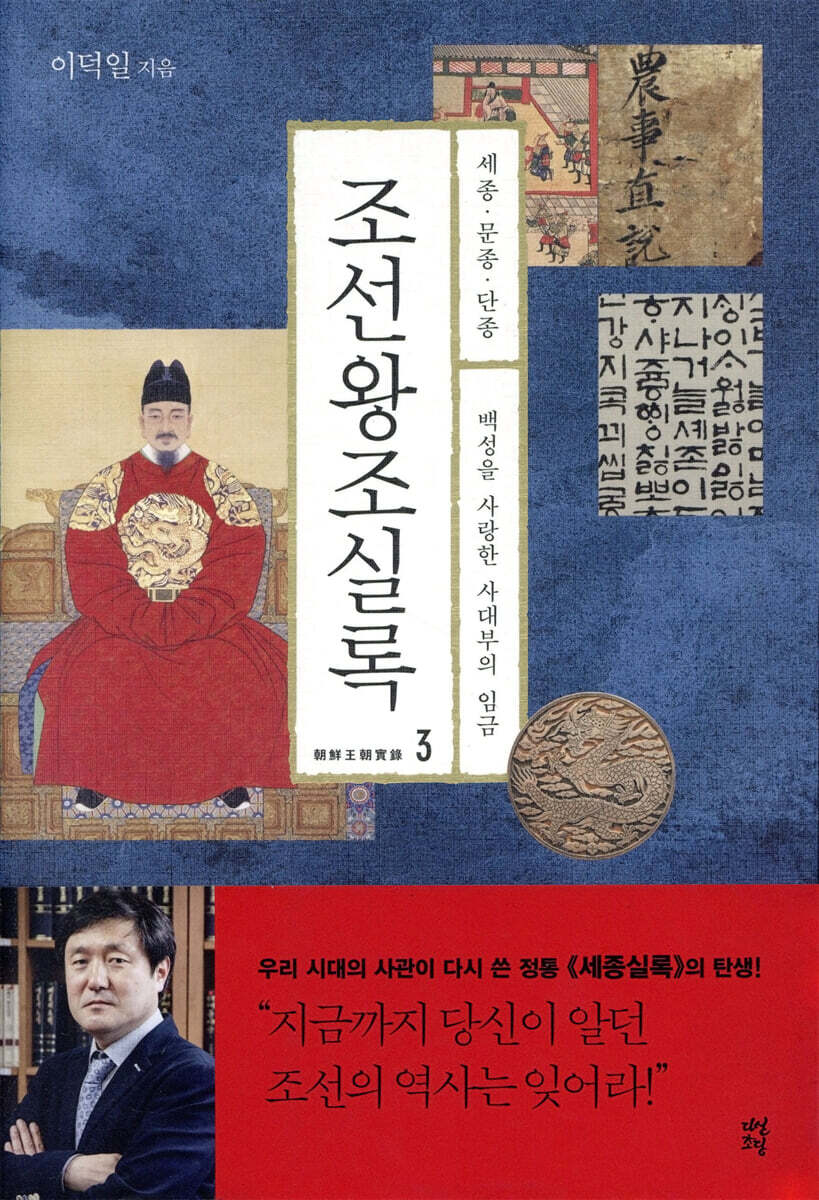
Annals of the Joseon Dynasty 3: King Sejong, King Munjong, and King Danjong
 |
Description
Book Introduction
The birth of the authentic 『Sejong Sillok』 rewritten by a contemporary historian
“Forget the history of Joseon you knew so far!”
The first authentic Korean historical record of the Joseon Dynasty, planned with the goal of 10 volumes after 10 years of planning and research, 5 years of writing, and publication, Lee Deok-il's 『The Annals of the Joseon Dynasty』, which awakens the true joy of reading an authentic history book, has returned with a 3-volume edition of 'Sejong, Munjong, and Danjong.'
Six months after Volume 1, “Taejo,” and Volume 2, “Jeongjong and Taejong,” the exciting story of the Joseon Dynasty continues.
Volume 3, “Sejong, Munjong, and Danjong,” fully restores the period from Sejong to Danjong, and evaluates and reinterprets the leadership of various figures, including the king, from a thoroughly modern perspective.
In particular, it broadens readers' understanding by offering a new interpretation of King Sejong, who has been held up as the greatest king in Korean history.
When we see how his policies, which prioritized politics for the aristocracy, such as creating the law prohibiting the prosecution of officials and reducing the slave-servant system to the clan system, contradict each other with his policies for the people, such as the creation of Hunminjeongeum, tax system reform, and the development of science and technology including agriculture, we find ourselves empathizing with Sejong's deep anguish and thinking again about the meaning of building a country worthy of being called a country and our role in it.
As historian Lee Deok-il emphasizes, history is the most excellent study of the future, and we can find answers to the questions we each grapple with in history.
Moreover, a fair and objective assessment of Sejong opens new eyes to our history and the world.
As we have just come to the end of 2018, the 600th anniversary of King Sejong's ascension to the throne, the third volume of the Annals of the Joseon Dynasty, "Sejong, Munjong, and Danjong," will guide you and cheer you on as you move forward.
“Forget the history of Joseon you knew so far!”
The first authentic Korean historical record of the Joseon Dynasty, planned with the goal of 10 volumes after 10 years of planning and research, 5 years of writing, and publication, Lee Deok-il's 『The Annals of the Joseon Dynasty』, which awakens the true joy of reading an authentic history book, has returned with a 3-volume edition of 'Sejong, Munjong, and Danjong.'
Six months after Volume 1, “Taejo,” and Volume 2, “Jeongjong and Taejong,” the exciting story of the Joseon Dynasty continues.
Volume 3, “Sejong, Munjong, and Danjong,” fully restores the period from Sejong to Danjong, and evaluates and reinterprets the leadership of various figures, including the king, from a thoroughly modern perspective.
In particular, it broadens readers' understanding by offering a new interpretation of King Sejong, who has been held up as the greatest king in Korean history.
When we see how his policies, which prioritized politics for the aristocracy, such as creating the law prohibiting the prosecution of officials and reducing the slave-servant system to the clan system, contradict each other with his policies for the people, such as the creation of Hunminjeongeum, tax system reform, and the development of science and technology including agriculture, we find ourselves empathizing with Sejong's deep anguish and thinking again about the meaning of building a country worthy of being called a country and our role in it.
As historian Lee Deok-il emphasizes, history is the most excellent study of the future, and we can find answers to the questions we each grapple with in history.
Moreover, a fair and objective assessment of Sejong opens new eyes to our history and the world.
As we have just come to the end of 2018, the 600th anniversary of King Sejong's ascension to the throne, the third volume of the Annals of the Joseon Dynasty, "Sejong, Munjong, and Danjong," will guide you and cheer you on as you move forward.
- You can preview some of the book's contents.
Preview
index
Introduction : Reading the Annals of the Joseon Dynasty
Part 1: Sejong Creates a Nation of the Aristocrats
On the way to my parents' house
-The King's Birthday and the Queen Mother's Death
-The position of royal in-law
-The death of the former king and the reign of King Sejong
-Sejong's first official affair was the issue of Prince Yangnyeong
The nobles are the masters of the country.
-The Anti-Claim Law is an evil law
-The opposition of the yangban class to the Jongbu Law
-Sejong's ambiguous attitude
The era of reading management
-King of learning, King of competition
-Various scenes from the competition
-The purpose of creating Jiphyeonjeon
Conflicts surrounding the caste system
-If only I could be of Taejo's bloodline
-Even a commoner can become a military officer or technical officer
- Conduct a public opinion poll
Part 2: The King Who Created Letters for the People
End political retaliation
-There is no such thing as political revenge in my dictionary.
- Appoint Jeongjeok Hwang Hui as a high-ranking official
Four Great Relations and Territorial Demarcation
-The Light and Darkness of Diplomacy between the Four Great Powers
-How should we deal with the northern Jurchen?
-From Cheoryeong north of the Yalu River to Gongheumjin north of the Duman River
Hunminjeongeum: Yesterday and Today
-Who created Hunminjeongeum?
-The logic behind Choi Man-ri and others' opposition to Hunminjeongeum
-Were there old letters before Hunminjeongeum?
-Between Hunminjeongeum and today's Hangul
Decentralization of power and succession training
-Taejong's direct descendants who strengthened royal authority
-Sejong's royal secretary who favored the prime minister
-The king and crown prince's regency during the sick period
-Organize music
-Brightness and darkness of the Sejong era
Part 3: King Munjong's quick departure from the throne
A prepared king with both civil and military skills
-Crown Prince's Acting Regent
-Prince Suyang's political involvement
King Munjong, who was skilled in both literature and martial arts
-Royal Buddhism and the double standards of the aristocrats
The short life of a prepared monarch
-The Ming Dynasty in crisis
-The doctor Jeon Sun-ui who ignored the prescription
-Gang Maeng-gyeong, a subject of Prince Suyang and the Chief State Councillor
Part 4: The Young King Danjong and His Uncles
The young king and his grown uncles
-The wise young king
- Suspicions of King Munjong's signature are rising
-The Office of the Inspector General requests the execution of royal physicians.
- A physician who served pheasant meat to a patient with a boil
The Gye-Yu Rebellion, King Danjong's incapacitation
-People who fight against Suyang through feng shui
-The Gye-Yu Jeongnan coup
- King Danjong being kicked out
King Sejong, the greatest leader in Korean history whose passing is all the more regrettable because of his great words .
Chronology
Search
Part 1: Sejong Creates a Nation of the Aristocrats
On the way to my parents' house
-The King's Birthday and the Queen Mother's Death
-The position of royal in-law
-The death of the former king and the reign of King Sejong
-Sejong's first official affair was the issue of Prince Yangnyeong
The nobles are the masters of the country.
-The Anti-Claim Law is an evil law
-The opposition of the yangban class to the Jongbu Law
-Sejong's ambiguous attitude
The era of reading management
-King of learning, King of competition
-Various scenes from the competition
-The purpose of creating Jiphyeonjeon
Conflicts surrounding the caste system
-If only I could be of Taejo's bloodline
-Even a commoner can become a military officer or technical officer
- Conduct a public opinion poll
Part 2: The King Who Created Letters for the People
End political retaliation
-There is no such thing as political revenge in my dictionary.
- Appoint Jeongjeok Hwang Hui as a high-ranking official
Four Great Relations and Territorial Demarcation
-The Light and Darkness of Diplomacy between the Four Great Powers
-How should we deal with the northern Jurchen?
-From Cheoryeong north of the Yalu River to Gongheumjin north of the Duman River
Hunminjeongeum: Yesterday and Today
-Who created Hunminjeongeum?
-The logic behind Choi Man-ri and others' opposition to Hunminjeongeum
-Were there old letters before Hunminjeongeum?
-Between Hunminjeongeum and today's Hangul
Decentralization of power and succession training
-Taejong's direct descendants who strengthened royal authority
-Sejong's royal secretary who favored the prime minister
-The king and crown prince's regency during the sick period
-Organize music
-Brightness and darkness of the Sejong era
Part 3: King Munjong's quick departure from the throne
A prepared king with both civil and military skills
-Crown Prince's Acting Regent
-Prince Suyang's political involvement
King Munjong, who was skilled in both literature and martial arts
-Royal Buddhism and the double standards of the aristocrats
The short life of a prepared monarch
-The Ming Dynasty in crisis
-The doctor Jeon Sun-ui who ignored the prescription
-Gang Maeng-gyeong, a subject of Prince Suyang and the Chief State Councillor
Part 4: The Young King Danjong and His Uncles
The young king and his grown uncles
-The wise young king
- Suspicions of King Munjong's signature are rising
-The Office of the Inspector General requests the execution of royal physicians.
- A physician who served pheasant meat to a patient with a boil
The Gye-Yu Rebellion, King Danjong's incapacitation
-People who fight against Suyang through feng shui
-The Gye-Yu Jeongnan coup
- King Danjong being kicked out
King Sejong, the greatest leader in Korean history whose passing is all the more regrettable because of his great words .
Chronology
Search
Into the book
Joseon was not a large country like the Ming Dynasty.
It is no exaggeration to say that the history of China's dynasties is a history of bloody purges within the royal family.
But Goryeo and Joseon were different.
Empress Dowager Cheonchu of Goryeo also sent King Hyeonjong, who was the political enemy of her own son King Mokjong, to a temple, but did not kill him.
In Goryeo, where Buddhism was the state religion, and Joseon, where Confucianism was the state religion, mercy and benevolence were practiced in the royal family.
Sejong knew very well that having Yangnyeong's blood on his hands would mean undermining the legitimacy of his ascension to the throne.
In the Confucian state of Joseon, having one's older brother's blood on one's hands was not only against benevolent governance, but also against one's father's will.
So, Sejong decided to keep Yangnyeong alive, but to pursue a policy that would extinguish the support of the nobles for Yangnyeong.
He thought that if only the nobles would firmly support him, Yangnyeong would not become a threat.
So, Sejong placed politics for the nobles at the forefront.
---From "Sejong's first political affairs were the issues surrounding Prince Yangnyeong"
Even in changing just one law, Sejong put his heart and soul into it.
I thought about that evil again and again.
The method established by Sejong was implemented nationwide, first in Gyeonggi-do in the 7th year of King Sejo's reign (1461), then in Chungcheong-do in the 8th year of King Sejo's reign (1462), and then in Gyeongsang-do in the 9th year of King Sejo's reign (1463).
As the new tax system was implemented to implement the public works method, many hidden loopholes that had previously been omitted from taxation were revealed.
So, even though the taxes collected from the people were reduced, the grain collected from the country increased.
It was a tax law revision process that was good for both the country and the people, akin to killing two birds with one stone.
---From "Conducting a Public Opinion Survey"
The Annals of King Sejong states, “The king himself created 28 letters of the Korean alphabet (上親制諺文二十八字).”
Since the Annals were written down whenever subjects performed an action under the king's command, the statement that "the king made it himself" means that Sejong made it alone.
If we were to choose a co-creator, it would be King Munjong, who served as regent from the 25th year of King Sejong's reign.
---From "Who Created Hunminjeongeum?"
In fact, thanks to Taejong's iron fist rule, Sejong did not need to get his hands dirty.
No one challenged the king's authority, and no one thought of replacing the king's power.
On this foundation, Sejong opened a Confucian society where Confucian scholars were respected and led the country.
Sejong believed that it was in line with Confucian ideals for the king and the nobles to rule the people.
He believed that the cornerstone of social stability was for the king to act like a king, the nobles to act like nobles, and the people to act like people.
In this way, Joseon became a Confucian society.
---From "The Light and Darkness of the Sejong Era"
King Munjong, the first king of the Joseon Dynasty to be prepared, passed away before he could fully realize his ambitions.
This cannot but be a great loss, especially considering that he was a king who had a deep interest in military affairs and fostered military power.
If Emperor Wenzong had held out while the Ming Dynasty continued to be in turmoil, the situation might have been different.
However, King Munjong passed away amidst suspicions, leaving behind a young king who was practically an orphan.
In addition, suspicions about King Munjong's death began to pour in.
---From "Gang Maeng-gyeong, the Minister of State, a subject of Prince Suyang"
A whopping 39 people lost their lives in one day and at one time.
They were hanged simply because they were the family of people who were on the opposite side of the Suyang movement.
Taejong was different.
Although King Taejong killed Jeong Do-jeon in the Prince's Rebellion and appointed his son Jeong Jin as a naval commander, in the 7th year of his reign (1407), he appointed Jeong Jin as the governor of Pannaju, and in the 1st year of King Sejong's reign (1418), he promoted him to the position of provincial governor of Chungcheong Province.
Although Jeong Do-jeon was removed because their positions were different, his son Jeong Jin was promoted to the high-ranking position of 2nd rank.
However, Suyang and his group killed countless people and harmed their families simply because they opposed their coup.
And they divided their property.
This was not the end.
On September 9th, the 2nd year of King Danjong's reign, the Office of the Inspector General requested that any grandchildren under the age of 16 be strangled to death after waiting until they turned 16.
Danjong had no choice but to accept it.
It is no exaggeration to say that the history of China's dynasties is a history of bloody purges within the royal family.
But Goryeo and Joseon were different.
Empress Dowager Cheonchu of Goryeo also sent King Hyeonjong, who was the political enemy of her own son King Mokjong, to a temple, but did not kill him.
In Goryeo, where Buddhism was the state religion, and Joseon, where Confucianism was the state religion, mercy and benevolence were practiced in the royal family.
Sejong knew very well that having Yangnyeong's blood on his hands would mean undermining the legitimacy of his ascension to the throne.
In the Confucian state of Joseon, having one's older brother's blood on one's hands was not only against benevolent governance, but also against one's father's will.
So, Sejong decided to keep Yangnyeong alive, but to pursue a policy that would extinguish the support of the nobles for Yangnyeong.
He thought that if only the nobles would firmly support him, Yangnyeong would not become a threat.
So, Sejong placed politics for the nobles at the forefront.
---From "Sejong's first political affairs were the issues surrounding Prince Yangnyeong"
Even in changing just one law, Sejong put his heart and soul into it.
I thought about that evil again and again.
The method established by Sejong was implemented nationwide, first in Gyeonggi-do in the 7th year of King Sejo's reign (1461), then in Chungcheong-do in the 8th year of King Sejo's reign (1462), and then in Gyeongsang-do in the 9th year of King Sejo's reign (1463).
As the new tax system was implemented to implement the public works method, many hidden loopholes that had previously been omitted from taxation were revealed.
So, even though the taxes collected from the people were reduced, the grain collected from the country increased.
It was a tax law revision process that was good for both the country and the people, akin to killing two birds with one stone.
---From "Conducting a Public Opinion Survey"
The Annals of King Sejong states, “The king himself created 28 letters of the Korean alphabet (上親制諺文二十八字).”
Since the Annals were written down whenever subjects performed an action under the king's command, the statement that "the king made it himself" means that Sejong made it alone.
If we were to choose a co-creator, it would be King Munjong, who served as regent from the 25th year of King Sejong's reign.
---From "Who Created Hunminjeongeum?"
In fact, thanks to Taejong's iron fist rule, Sejong did not need to get his hands dirty.
No one challenged the king's authority, and no one thought of replacing the king's power.
On this foundation, Sejong opened a Confucian society where Confucian scholars were respected and led the country.
Sejong believed that it was in line with Confucian ideals for the king and the nobles to rule the people.
He believed that the cornerstone of social stability was for the king to act like a king, the nobles to act like nobles, and the people to act like people.
In this way, Joseon became a Confucian society.
---From "The Light and Darkness of the Sejong Era"
King Munjong, the first king of the Joseon Dynasty to be prepared, passed away before he could fully realize his ambitions.
This cannot but be a great loss, especially considering that he was a king who had a deep interest in military affairs and fostered military power.
If Emperor Wenzong had held out while the Ming Dynasty continued to be in turmoil, the situation might have been different.
However, King Munjong passed away amidst suspicions, leaving behind a young king who was practically an orphan.
In addition, suspicions about King Munjong's death began to pour in.
---From "Gang Maeng-gyeong, the Minister of State, a subject of Prince Suyang"
A whopping 39 people lost their lives in one day and at one time.
They were hanged simply because they were the family of people who were on the opposite side of the Suyang movement.
Taejong was different.
Although King Taejong killed Jeong Do-jeon in the Prince's Rebellion and appointed his son Jeong Jin as a naval commander, in the 7th year of his reign (1407), he appointed Jeong Jin as the governor of Pannaju, and in the 1st year of King Sejong's reign (1418), he promoted him to the position of provincial governor of Chungcheong Province.
Although Jeong Do-jeon was removed because their positions were different, his son Jeong Jin was promoted to the high-ranking position of 2nd rank.
However, Suyang and his group killed countless people and harmed their families simply because they opposed their coup.
And they divided their property.
This was not the end.
On September 9th, the 2nd year of King Danjong's reign, the Office of the Inspector General requested that any grandchildren under the age of 16 be strangled to death after waiting until they turned 16.
Danjong had no choice but to accept it.
---From "The Coup d'état of Gye-Yu Jeongnan"
Publisher's Review
10 years of planning and research, 5 years of writing!
The first authentic Joseon Dynasty Annals by Lee Deok-il, the greatest historian of our time!
There are 78 historical dramas set in Joseon! Joseon's history itself is a perfect drama.
All of this is because there was an annals that recorded everything about the Joseon Dynasty, but unfortunately, there are not many readers who have properly read the annals of the Joseon Dynasty.
Because of its vastness, only digest history books focused on imparting knowledge have been published.
Here, Lee Deok-il, the greatest historian of our time, publishes the authentic 10-volume Annals of the Joseon Dynasty, with fascinating storytelling and insight that penetrates the essence of human life.
This history book was born after 10 years of planning and research, and 5 years of writing.
In a publishing market where there were only introductory books, the 'Authentic Annals of the Joseon Dynasty' was finally born.
Lee Deok-il, who has been creating a new style for historical textbooks, uses his characteristically sharp and solid writing style to question existing interpretations and find modern meaning in this book.
In particular, the original assessment of the key figures who led Joseon provides readers with an opportunity to deeply reflect on their own lives.
Because it fully embodies the national aspiration and zeitgeist to create a "country worthy of being called a country," the message it conveys to our society today is also incredibly powerful.
Our history, which is several times more interesting and moving than the Romance of the Three Kingdoms or the history of Rome, will now make your heart race.
We finally have a history book that goes beyond 'The Story of the Romans'!
1.
Korea's first 10-volume authentic Joseon Dynasty Annals
The Annals of the Joseon Dynasty are a UNESCO World Heritage Site and are the world's best written heritage, recording the rise and fall of 500 years of history without omission.
This was possible because there were historians who recorded reality harshly without being swayed by interference from those in power.
Lee Deok-il's 『Annals of the Joseon Dynasty』 inherited the spirit of the historian and focused on fully conveying the original value of the Annals of the Joseon Dynasty to today's readers.
Thanks to this, we can look at each character and event from a balanced perspective and read the real story hidden behind what appears on the surface.
Additionally, this book helps readers understand Joseon history in a more three-dimensional way by arranging the text in terms of causal relationships that influence events rather than in simple chronological order.
2.
A storytelling history filled with fascinating details
History is not knowledge, it is stories.
It is also a living story that exerts powerful force in the present and future.
That is why works such as 『The Romans』, a historical book with enhanced storytelling, and 『Romance of the Three Kingdoms』, a historical novel, capture the hearts of the public and are read continuously for a long time.
In this context, Lee Deok-il's 『Annals of the Joseon Dynasty』 is a masterpiece that succeeded in writing a history book centered on stories about our own history.
The Annals of the Joseon Dynasty, a world-renowned historical record that meticulously records everything, has finally seen the light of day thanks to the skillful work of a master.
As a result, we can approach history, which used to seem difficult and boring, in a more interesting way than any drama.
3.
Brilliant insights that guide life
Readers can gain three important pieces of wisdom that will help them in life through Lee Deok-il's 『Annals of the Joseon Dynasty』.
First, we can predict and prepare for the future of our society or an organization.
Through the big and small decisions of key figures, we come to understand the path we should take going forward, and this is the most important reason why we should study history.
Second, you can find out who is needed in the society or organization you belong to.
By observing the activities of the famous advisors who create successful leadership and the tolerance of the leaders who handle them, you will learn the secrets of recruiting talented people.
Third, readers can reflect on their personal lives.
If we encounter the scholarly spirit of our ancestors, who protected what they had to protect even at the risk of a knife to their throat, we, who are easily swayed by the world, will be able to establish a firm sense of self-centeredness.
4.
Vivid Korean history through photos and drawings
In Lee Deok-il's 『Annals of the Joseon Dynasty』, fragmentary knowledge becomes vivid and real through various relics and materials.
For example, we can directly appreciate the horse 'Hongungol' that Yi Seong-gye rode in the battle with Nahachu through An Gyeon's [Paljundo], and we can vividly experience the scene of Yi Seong-gye playing gyeokgu in Gaegyeong through Yi Yeo-seong's [Gyeokgudo].
In addition, portraits of key figures and various cultural assets appear throughout the book to aid readers' understanding and add life to the interesting story.
By allowing readers to embark on a museum tour in the palm of their hand, they will be able to immerse themselves more deeply in the grand drama that is the Annals of the Joseon Dynasty.
5.
A sharp eye to correct distorted history
A backward and stagnant country, a country that is weak and dependent on others, a country that is immersed in the metaphysics of Neo-Confucianism, a country where the ruling class only engages in factional strife and is the first to flee when disaster strikes, a cowardly country.
When we think of Joseon, a critical impression comes to mind.
However, a dynasty that lasted for a long time of 518 years cannot be simply defined in such a few words.
We need to be able to look at the institutions, systems, and spirit of the country called Joseon with a more balanced perspective.
In this context, Lee Deok-il's 『Annals of the Joseon Dynasty』 made every effort to correct distorted history.
By distinguishing between the 'practical vassalage' of the early Joseon Dynasty and the 'ideological vassalage' of the late Joseon Dynasty, we clearly assessed their merits and demerits, and we also corrected misconceptions about the territorial consciousness of our ancestors from the Goryeo Dynasty to the Joseon Dynasty.
If you remember the saying, "A nation that forgets its history has no future," let us now open this book, face the truth of our history, and prepare to move forward into a new future.
6.
The protagonists of Joseon history, met through new interpretations and historical imagination.
Ultimately, it is people who make history and change the course of history.
Lee Deok-il's 『Annals of the Joseon Dynasty』 breaks away from the fragmentary character critiques of the past and provides a three-dimensional evaluation of the key figures who shaped Joseon's history, seeking out their modern significance.
In particular, it attempts to approach each character's desires and will, as well as the situations and dilemmas they face. Through this process, we come to understand each character more deeply, and learn what we can learn from them and what we can use as a stepping stone.
Through the delicate observations and historical imagination of Lee Deok-il, the greatest historian of our time, the protagonists of Joseon history were given new life.
Is he a king for the nobles or a wise king who loved the people?
King Sejong, who embraced an era of contradiction
The protagonist of Volume 3 of the Annals of the Joseon Dynasty is undoubtedly King Sejong.
He became the crown prince late in life due to the misdeeds of his older brother, Prince Yangnyeong, and ascended to the throne immediately after becoming crown prince. However, thanks to King Taejong, who took on the role of a villain and purged the group of meritorious retainers, he had strong royal authority from the beginning to carry out good politics.
In Volume 3 of Lee Deok-il's 『Annals of the Joseon Dynasty』, he points out how King Sejong ruled the people and was revered as a virtuous king, and what his limitations were, and paints a comprehensive and three-dimensional picture of the era of King Sejong, which had been understood fragmentarily until then.
In a word, this book defines Sejong as the 'king of contradictions' and Sejong's era as the 'era of contradictions.'
Sejong reverted the slave and servant law revised by Taejong to the servant and servant law, and created the evil law called the Prohibition of Complaints against Majesty, thereby prioritizing a “country for the nobles” and regressing Joseon society.
Not only was he born into the royal family, he had a strong sense of class, but it was also a wrong choice to win the hearts of some noblemen who still supported Yangnyeong.
However, his love for the people was also sincere, and he achieved achievements such as creating the Hunminjeongeum, developing science and technology including agriculture, and reforming the tax system through public opinion polls of all the people.
He kept Hwang Hui, who was a political opponent of Yangnyeong, in high esteem until the end, constantly tried to protect the territory handed down from his ancestors, and firmly refused the Ming Dynasty's unreasonable request to send troops, even keeping it a secret from the literati.
Sejong's politics, which spanned a wide spectrum from the most conservative to the most progressive, could be considered as inclusive as it was contradictory.
The evaluation of King Munjong and King Danjong and the interpretation of their tragic fate are also interesting.
King Munjong, the first king to be prepared, was a king capable of resolving all the contradictions left behind by Sejong. However, due to chronic illness and complacent judgment about power, he caused not only himself but also his only son to walk an unfortunate path.
The era from Sejong to Danjong is like a roller coaster ride, allowing one to experience everything from the best to the worst moments in Joseon history.
In this era, where there is much room for interpretation and much to think about, readers will be able to gain new insights into how to live their lives.
The first authentic Joseon Dynasty Annals by Lee Deok-il, the greatest historian of our time!
There are 78 historical dramas set in Joseon! Joseon's history itself is a perfect drama.
All of this is because there was an annals that recorded everything about the Joseon Dynasty, but unfortunately, there are not many readers who have properly read the annals of the Joseon Dynasty.
Because of its vastness, only digest history books focused on imparting knowledge have been published.
Here, Lee Deok-il, the greatest historian of our time, publishes the authentic 10-volume Annals of the Joseon Dynasty, with fascinating storytelling and insight that penetrates the essence of human life.
This history book was born after 10 years of planning and research, and 5 years of writing.
In a publishing market where there were only introductory books, the 'Authentic Annals of the Joseon Dynasty' was finally born.
Lee Deok-il, who has been creating a new style for historical textbooks, uses his characteristically sharp and solid writing style to question existing interpretations and find modern meaning in this book.
In particular, the original assessment of the key figures who led Joseon provides readers with an opportunity to deeply reflect on their own lives.
Because it fully embodies the national aspiration and zeitgeist to create a "country worthy of being called a country," the message it conveys to our society today is also incredibly powerful.
Our history, which is several times more interesting and moving than the Romance of the Three Kingdoms or the history of Rome, will now make your heart race.
We finally have a history book that goes beyond 'The Story of the Romans'!
1.
Korea's first 10-volume authentic Joseon Dynasty Annals
The Annals of the Joseon Dynasty are a UNESCO World Heritage Site and are the world's best written heritage, recording the rise and fall of 500 years of history without omission.
This was possible because there were historians who recorded reality harshly without being swayed by interference from those in power.
Lee Deok-il's 『Annals of the Joseon Dynasty』 inherited the spirit of the historian and focused on fully conveying the original value of the Annals of the Joseon Dynasty to today's readers.
Thanks to this, we can look at each character and event from a balanced perspective and read the real story hidden behind what appears on the surface.
Additionally, this book helps readers understand Joseon history in a more three-dimensional way by arranging the text in terms of causal relationships that influence events rather than in simple chronological order.
2.
A storytelling history filled with fascinating details
History is not knowledge, it is stories.
It is also a living story that exerts powerful force in the present and future.
That is why works such as 『The Romans』, a historical book with enhanced storytelling, and 『Romance of the Three Kingdoms』, a historical novel, capture the hearts of the public and are read continuously for a long time.
In this context, Lee Deok-il's 『Annals of the Joseon Dynasty』 is a masterpiece that succeeded in writing a history book centered on stories about our own history.
The Annals of the Joseon Dynasty, a world-renowned historical record that meticulously records everything, has finally seen the light of day thanks to the skillful work of a master.
As a result, we can approach history, which used to seem difficult and boring, in a more interesting way than any drama.
3.
Brilliant insights that guide life
Readers can gain three important pieces of wisdom that will help them in life through Lee Deok-il's 『Annals of the Joseon Dynasty』.
First, we can predict and prepare for the future of our society or an organization.
Through the big and small decisions of key figures, we come to understand the path we should take going forward, and this is the most important reason why we should study history.
Second, you can find out who is needed in the society or organization you belong to.
By observing the activities of the famous advisors who create successful leadership and the tolerance of the leaders who handle them, you will learn the secrets of recruiting talented people.
Third, readers can reflect on their personal lives.
If we encounter the scholarly spirit of our ancestors, who protected what they had to protect even at the risk of a knife to their throat, we, who are easily swayed by the world, will be able to establish a firm sense of self-centeredness.
4.
Vivid Korean history through photos and drawings
In Lee Deok-il's 『Annals of the Joseon Dynasty』, fragmentary knowledge becomes vivid and real through various relics and materials.
For example, we can directly appreciate the horse 'Hongungol' that Yi Seong-gye rode in the battle with Nahachu through An Gyeon's [Paljundo], and we can vividly experience the scene of Yi Seong-gye playing gyeokgu in Gaegyeong through Yi Yeo-seong's [Gyeokgudo].
In addition, portraits of key figures and various cultural assets appear throughout the book to aid readers' understanding and add life to the interesting story.
By allowing readers to embark on a museum tour in the palm of their hand, they will be able to immerse themselves more deeply in the grand drama that is the Annals of the Joseon Dynasty.
5.
A sharp eye to correct distorted history
A backward and stagnant country, a country that is weak and dependent on others, a country that is immersed in the metaphysics of Neo-Confucianism, a country where the ruling class only engages in factional strife and is the first to flee when disaster strikes, a cowardly country.
When we think of Joseon, a critical impression comes to mind.
However, a dynasty that lasted for a long time of 518 years cannot be simply defined in such a few words.
We need to be able to look at the institutions, systems, and spirit of the country called Joseon with a more balanced perspective.
In this context, Lee Deok-il's 『Annals of the Joseon Dynasty』 made every effort to correct distorted history.
By distinguishing between the 'practical vassalage' of the early Joseon Dynasty and the 'ideological vassalage' of the late Joseon Dynasty, we clearly assessed their merits and demerits, and we also corrected misconceptions about the territorial consciousness of our ancestors from the Goryeo Dynasty to the Joseon Dynasty.
If you remember the saying, "A nation that forgets its history has no future," let us now open this book, face the truth of our history, and prepare to move forward into a new future.
6.
The protagonists of Joseon history, met through new interpretations and historical imagination.
Ultimately, it is people who make history and change the course of history.
Lee Deok-il's 『Annals of the Joseon Dynasty』 breaks away from the fragmentary character critiques of the past and provides a three-dimensional evaluation of the key figures who shaped Joseon's history, seeking out their modern significance.
In particular, it attempts to approach each character's desires and will, as well as the situations and dilemmas they face. Through this process, we come to understand each character more deeply, and learn what we can learn from them and what we can use as a stepping stone.
Through the delicate observations and historical imagination of Lee Deok-il, the greatest historian of our time, the protagonists of Joseon history were given new life.
Is he a king for the nobles or a wise king who loved the people?
King Sejong, who embraced an era of contradiction
The protagonist of Volume 3 of the Annals of the Joseon Dynasty is undoubtedly King Sejong.
He became the crown prince late in life due to the misdeeds of his older brother, Prince Yangnyeong, and ascended to the throne immediately after becoming crown prince. However, thanks to King Taejong, who took on the role of a villain and purged the group of meritorious retainers, he had strong royal authority from the beginning to carry out good politics.
In Volume 3 of Lee Deok-il's 『Annals of the Joseon Dynasty』, he points out how King Sejong ruled the people and was revered as a virtuous king, and what his limitations were, and paints a comprehensive and three-dimensional picture of the era of King Sejong, which had been understood fragmentarily until then.
In a word, this book defines Sejong as the 'king of contradictions' and Sejong's era as the 'era of contradictions.'
Sejong reverted the slave and servant law revised by Taejong to the servant and servant law, and created the evil law called the Prohibition of Complaints against Majesty, thereby prioritizing a “country for the nobles” and regressing Joseon society.
Not only was he born into the royal family, he had a strong sense of class, but it was also a wrong choice to win the hearts of some noblemen who still supported Yangnyeong.
However, his love for the people was also sincere, and he achieved achievements such as creating the Hunminjeongeum, developing science and technology including agriculture, and reforming the tax system through public opinion polls of all the people.
He kept Hwang Hui, who was a political opponent of Yangnyeong, in high esteem until the end, constantly tried to protect the territory handed down from his ancestors, and firmly refused the Ming Dynasty's unreasonable request to send troops, even keeping it a secret from the literati.
Sejong's politics, which spanned a wide spectrum from the most conservative to the most progressive, could be considered as inclusive as it was contradictory.
The evaluation of King Munjong and King Danjong and the interpretation of their tragic fate are also interesting.
King Munjong, the first king to be prepared, was a king capable of resolving all the contradictions left behind by Sejong. However, due to chronic illness and complacent judgment about power, he caused not only himself but also his only son to walk an unfortunate path.
The era from Sejong to Danjong is like a roller coaster ride, allowing one to experience everything from the best to the worst moments in Joseon history.
In this era, where there is much room for interpretation and much to think about, readers will be able to gain new insights into how to live their lives.
GOODS SPECIFICS
- Date of issue: January 2, 2019
- Page count, weight, size: 408 pages | 716g | 153*225*30mm
- ISBN13: 9791130620237
- ISBN10: 1130620239
You may also like
카테고리
korean


korean

![GQ KOREA Mark (Monthly): December [2025]](http://librairie.coreenne.fr/cdn/shop/files/8ef265dbbfbf186523ed75ba7319009d.jpg?v=1765340328&width=3840)


