

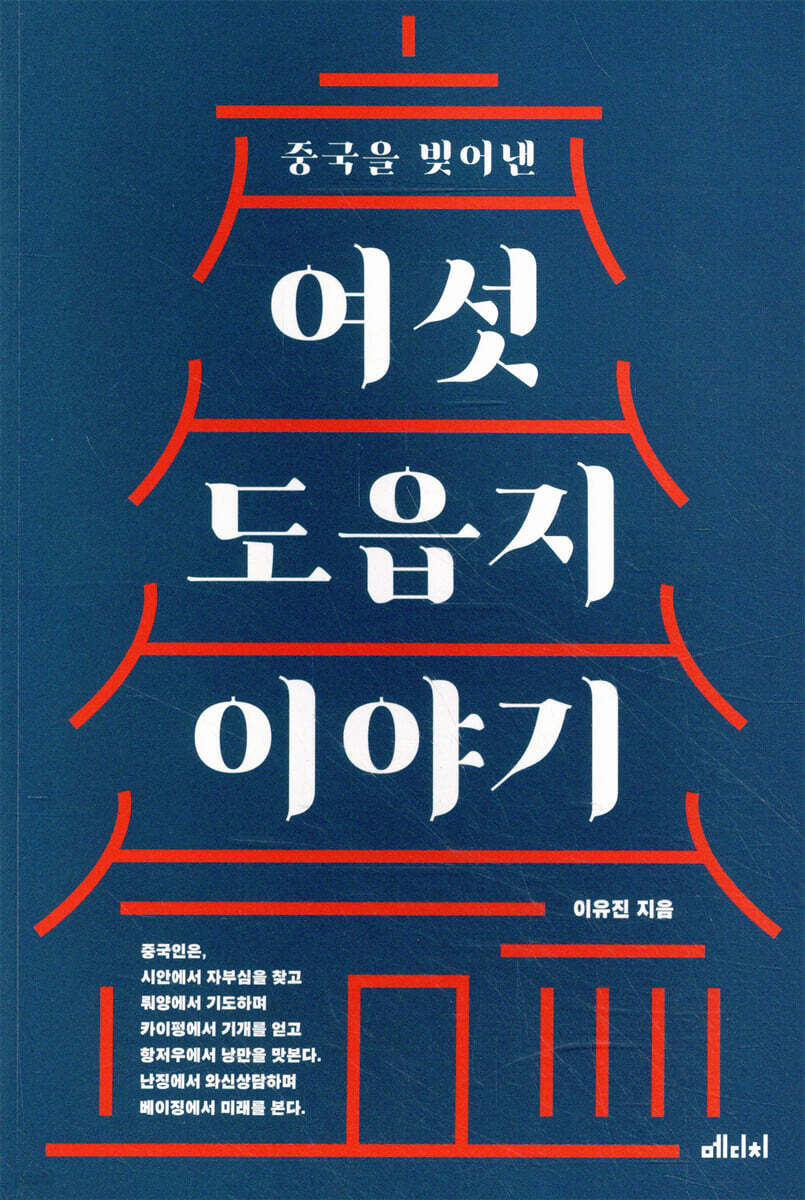
The Story of the Six Capitals That Shaped China
 |
Description
Book Introduction
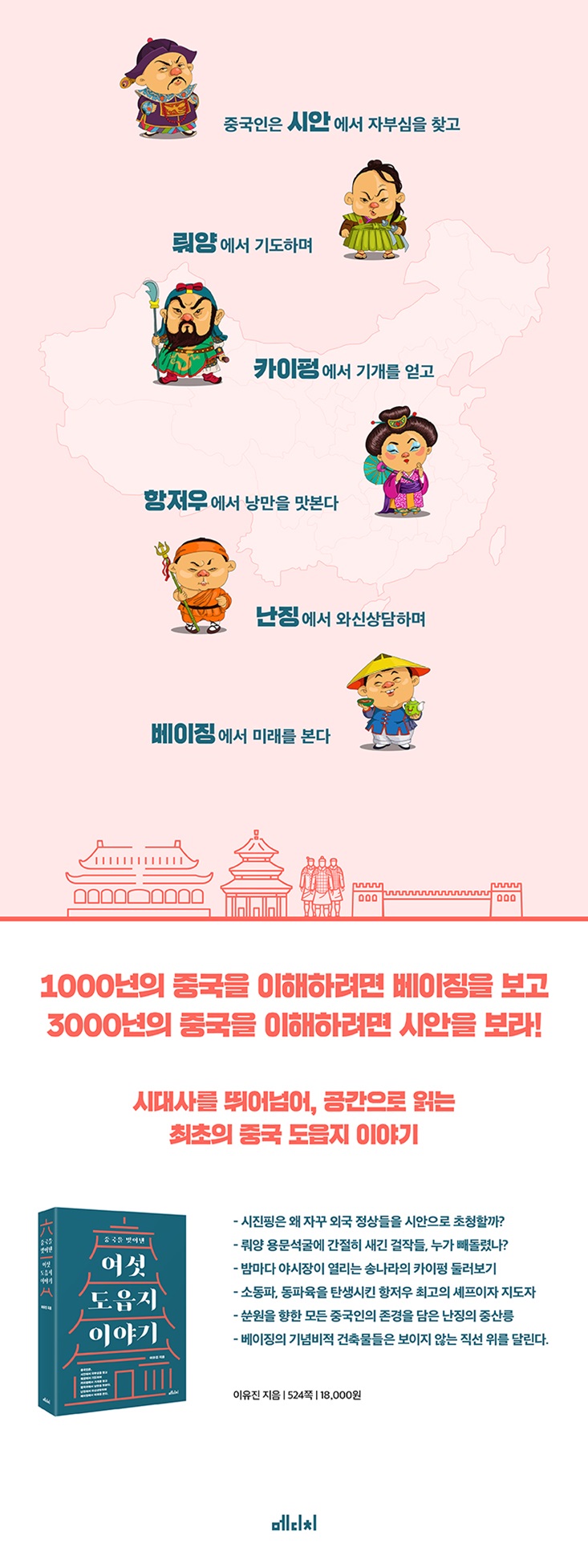
Korea's first "Story of the Chinese Capital" This is the story of Korea's first Chinese capital where Chinese history and 'space' meet. Beginning in Xi'an, the ancient capital of a thousand years, Luoyang, known as the "Romance of the Three Kingdoms", Kaifeng of the Song Dynasty, Hangzhou, the hometown of Su Dongpo, Nanjing, a city steeped in modern tragedy, and Beijing, this one volume encompasses the entire 3,000-year history of China. The author frequently visited cities with layers of history, including those along the Silk Road, and added character to the book with photos he took himself. This book is more than just a friendly and interesting story. Don't miss reading from 'our perspective today'. Author Lee Yu-jin is a humanist who has worked hard to popularize Chinese history. In addition to writing, translating, and lecturing, he is also a skilled storyteller who has hosted a segment on broadcasting that explains myths. This book is like a shower of rain in East Asian history, which is sorely lacking in popular books compared to Western history. If you read it without any burden, as if listening to an old story, you will soon have covered the entire history of China. 3,000 years of Chinese history in one volume The Tale of the Six Capitals of China There is a saying, “If you want to understand China 1,000 years ago, look at Beijing. If you want to understand China 3,000 years ago, look at Xi’an!” When understanding the history of a large, multi-ethnic country like China, the code of 'city' is attractive. For the Chinese today, the six capitals are like this. “Find pride in Xi’an, pray in Luoyang, find courage in Kaifeng, and taste romance in Hangzhou. “I consult with you in Nanjing and see the future in Beijing.” As Xi Jinping began his second term in office, he boldly declared the "great revival of the Chinese nation" as a dream shared by all Chinese people. As the story of his long-term rule is being told, “The historical resources of the Chinese dream are embedded in the capital cities of all time. “Looking at Chinese history through its capitals is also a way to look into their ‘old future,’” the author’s intention behind his writing is heard. In the thousand-year-old city of Xi'an, every stone has a story. The hen crows when the country is ruined? Rich stories including Qin Shi Huang, the Silk Road, and Xi Jinping's hometown. Xi'an, famous for its name of Chang'an in the Tang Dynasty, was the capital of the Zhou Dynasty, Jin Dynasty, Han Dynasty, Sui Dynasty, and Tang Dynasty. As the capital city has a history spanning over a thousand years, there are so many stories here and there that it could take up half a book. Chapter 1, the Xi'an section, begins with the story of the beautiful landscapes of the Shang and Zhou dynasties. Was the country ruined by the beautiful Dalgi and Posa, or did it end up blaming the hen? Why not look back at the stone carvings praising Qin Shi Huang and discern which of the great king and the assassin was truly the hero? Also, we cannot leave out the story of the Silk Road. The starting point of the Silk Road, which originated from the Han Dynasty, is the Miang Palace. The Great Ming Palace of the Tang Dynasty and the Great Tower of Xuanzang (Monk Tripitaka) also appear significantly. The title of the drama written by the loyal subject Han Xin in the magnificent Miang Palace, which was built to enhance the self-esteem of Liu Bang, the founder of the Han Dynasty, is 'Tosa Goupeng'. Xi'an is a key city in China's pride as a 'civilized nation'. Xi Jinping was born in Beijing, but he considers Xi'an, his father's hometown and where he spent his childhood, to be his hometown. Xi'an has been carrying out its hometown diplomacy in former Western countries like India, and in January 2018, French President Macron joined China's "One Belt, One Road" initiative by visiting Xi'an first, breaking the tradition of visiting the capital first. Don't say you know China without visiting its six capitals. Luoyang, Kaifeng, Hangzhengwu, Nanjing Who would command flowers to bloom on time? The majestic Empress Wu Zetian blamed the peony for blooming the latest and exiled it to Luoyang. The Longmen Grottoes, a must-see when visiting Luoyang, are the pinnacle of Chinese rock carving art. In the early 20th century, when China was being trampled by Western imperialism, even this greatest work of art suffered. In Kaifeng, the capital of the Song Dynasty, a night market was held every day. To get a glimpse of that atmosphere, 『Qingmingshanhetu』 is of great help. This is a Chinese national treasure that was also visited by the National Museum of Korea in 2016. How many people can truly connect Su Dongpo of Hangzhou with Dongpo Pork? Let's explore why Su Dongpo was both a chef and a nuanced leader, unlike the superhuman Bao Qingtian. Nanjing is a place that preserves the tragedy of modern and contemporary history. There is a memorial hall commemorating the Nanjing Massacre, in which 300,000 people were killed by Japan, and not far from there is a comfort women memorial hall. The statue in front depicts four comfort women, including the late grandmother Park Young-sim from South Pyongan Province. Meanwhile, the largest past examination site, Gangnam Park, and the eight beauties of Jinhoe Palyeom, who made the Shili Jinhoe of Nanjing's "Garosu-gil" shine even brighter, are also exciting cultural events. Beijing's buildings run in straight lines. Beijing was the capital chosen by the Yuan Dynasty. The Manchu Qing Dynasty also inherited the “most suitable place as a base for ruling the agricultural world while also governing the nomadic world to the north” as its capital. Lu Xun called the Great Wall of China a "great and cursed Great Wall." The Great Wall of China, built continuously since the time of Qin Shi Huang. Aren't the Chinese still trapped in a "Great Wall mentality" that seeks to build a wall against the outside world? If we were to condense the idea of China into a single image, it would be the "Central Axis." From the Forbidden City and Tiananmen Square to the Beijing Olympic Stadium, monumental buildings of all time lie on an imaginary straight line called the "central axis." |
- You can preview some of the book's contents.
Preview
index
Opening remarks
Chapter 1: Xi'an, Embracing the Glory of the Silk Road
Chapter 2: Luoyang, the City of Longmen Grottoes and Peonies
Chapter 3: Kaifeng, the Splendid Memories of the Song Dynasty
Chapter 4: Hangzhou, the romantic city of West Lake
Chapter 5: Nanjing, the place where the Six Dynasties' culture blossomed
Chapter 6: Beijing, the Border between the Sedentary and Nomadic Worlds
Closing remarks
References
Chapter 1: Xi'an, Embracing the Glory of the Silk Road
Chapter 2: Luoyang, the City of Longmen Grottoes and Peonies
Chapter 3: Kaifeng, the Splendid Memories of the Song Dynasty
Chapter 4: Hangzhou, the romantic city of West Lake
Chapter 5: Nanjing, the place where the Six Dynasties' culture blossomed
Chapter 6: Beijing, the Border between the Sedentary and Nomadic Worlds
Closing remarks
References
Detailed image
Into the book
After returning from his expedition, Yu Bang became angry at So Ha upon seeing the grand scale of Miang Palace.
“The world is in turmoil, and after many years of struggle, we still don’t know whether it will succeed or fail. How can we build such an excessive palace?”
“The palace is being built because the world is not yet stable.
The Emperor's home is the Four Seas, so unless it is magnificent and splendid, it cannot establish its majesty.
“We must also ensure that no palace greater than this can be built in future generations.”
The breasts were delighted to hear Soha's words.
Miang Palace was a symbolic building that was built to reveal the emperor's majesty that no one could surpass.
For Liu Bang, being born a commoner and becoming the emperor was both a source of pride and a complex.
If this factor had worked as a positive aspect, making people listen to others before they took over the world, it worked as a negative aspect, creating suspicion and anxiety that someone else might take their place after they had already taken over the world.
(Miang Palace, the eastern starting point of the Silk Road)
The logic of "the world" that applies equally to the stele erected by Qin Shi Huang after his unification and the 21st-century film "Hero" is not something from the Warring States period.
It is a logic that has been reinterpreted posthumously.
The basis of that logic is the current 'unified' situation.
The Warring States period was a time when the Seven Warring States, including Jin, Chu, Qi, Wei, Han, Zhao, and Yan, fiercely fought each other, as the word "Warring States" suggests.
The Jin Dynasty, which was already a superpower during the reign of King Yeongjeong, was more like an envoy to the six states and was by no means a force that could bring peace.
The six countries struggled to avoid the messenger.
(Qin Shi Huang and Jing Ke)
Today, Xi Jinping has also devoted all his efforts to the war against corruption since the beginning of his term, with the motto, “We will catch both tigers (high-ranking officials) and flies (low-ranking officials).”
In 2013, Xi'an authorities were planning to build a whopping 38 billion yuan "Afang Palace Cultural Industry Base," but coincidentally, it coincided with Xi Jinping's anti-corruption drive, which led to a public backlash and the project being folded.
Earlier that year, Xi Jinping cited the final part of the "Afang Palace Book" in relation to the fall of the Qin Dynasty, citing examples in Chinese history of regimes falling due to corruption within the ruling class.
China evokes and mobilizes history more effectively than any other country.
(Is it the ominousness of Yeosan?)
When the eunuch told her that the flowers were in full bloom, Empress Wu Zetian went to the Sangrimwon Garden overjoyed.
But what is this?
The peonies haven't bloomed yet.
Empress Wu Zetian, who had been caring for the peony for over 30 years, was furious that it had not bloomed on its own, and ordered that the peony be dug up and burned.
At this point, the princess stopped him again.
How could the peony, the king of flowers, not follow the instructions? Since the flower is large and has difficulty blooming, let's give it half a day more.
In the end, the peony bloomed under Empress Wu Zetian's threat.
However, Empress Wu Zetian, still uneasy, issued an edict to banish Peony.
The place where Peony was exiled was Luoyang.
It is said that this is how peonies became most prosperous in Luoyang.
(Luoyang Sanjeol and Tang Sancai)
If we imagine it with the senses of people 1,000 years ago, rather than with the senses of us living in a forest of high-rise buildings today, Kaifeng in the Song Dynasty was truly an amazing city.
The fact that large-scale privately run bars were thriving speaks volumes about the economic power of the society at the time.
During the Song Dynasty, China's population exceeded 100 million for the first time.
In the Gangnam region, large-scale rice paddies were reclaimed and double-cropping rice varieties were developed, allowing farmers to sell their surplus agricultural products.
The amount of grain transported from the south to the north through the canal was three times that of the Tang Dynasty.
all.
Kaifeng's huge population depended on this.
(The Qingming Festival depicting the peak of the Song Dynasty)
It is said that the people of Hangzhou offered pork to Su Shi on New Year's Day to express their gratitude, and Su Shi cooked it and shared it with those who dredged the West Lake.
Dongpo pork is a dish made by cutting pork into squares and simmering it with soy sauce, sugar, etc.
The name Su Dongpo is more familiar to us than the news, and Dongpo Pork refers to a pork dish made by Su Dongpo.
This is also a name that contains the people's love for news.
(The story behind Dongpa Pork)
Just because the exam is over doesn't mean it's over.
Until the results are announced, the good and bad dreams of passing and failing will continue.
It feels like the ancient mine is right in front of you, but then suddenly it turns into a skeleton.
The restless and helpless appearance is like a monkey tied to a rope.
Finally, on the day of the announcement, when he finds out that his name is not on the list of successful candidates, his face turns pale and he becomes as dazed as a dead person, and he becomes insensitive to touch like a fly that has been poisoned.
At first, he was so disappointed and angry that he felt like he would never think about the past again.
Then, as time passes, your heart calms down and you start to feel the urge to deal with the past again.
(Gangnam Park, the largest past examination site)
The great Chinese writer Lu Xun described the Great Wall of China as a “great and cursed Great Wall.”
Lu Xun saw the Great Wall, which was constantly renewed despite its inability to properly stop nomads and the resulting sacrifices of countless people, as a symbol of a cursed tradition.
In the documentary “Hasang” (1988), which represented anti-traditionalism in the 1980s, the Great Wall was denounced as a “huge tragic monument,” saying:
“A castle does not symbolize strength, progress, or glory, but only cowardice: isolation, conservatism, incompetent defense, and avoidance of attack.
Because of its grandeur and longevity, the Great Wall has deeply engraved pride and deception in the hearts of our people.” (The Great Wall, the embodiment of contradiction)
“The world is in turmoil, and after many years of struggle, we still don’t know whether it will succeed or fail. How can we build such an excessive palace?”
“The palace is being built because the world is not yet stable.
The Emperor's home is the Four Seas, so unless it is magnificent and splendid, it cannot establish its majesty.
“We must also ensure that no palace greater than this can be built in future generations.”
The breasts were delighted to hear Soha's words.
Miang Palace was a symbolic building that was built to reveal the emperor's majesty that no one could surpass.
For Liu Bang, being born a commoner and becoming the emperor was both a source of pride and a complex.
If this factor had worked as a positive aspect, making people listen to others before they took over the world, it worked as a negative aspect, creating suspicion and anxiety that someone else might take their place after they had already taken over the world.
(Miang Palace, the eastern starting point of the Silk Road)
The logic of "the world" that applies equally to the stele erected by Qin Shi Huang after his unification and the 21st-century film "Hero" is not something from the Warring States period.
It is a logic that has been reinterpreted posthumously.
The basis of that logic is the current 'unified' situation.
The Warring States period was a time when the Seven Warring States, including Jin, Chu, Qi, Wei, Han, Zhao, and Yan, fiercely fought each other, as the word "Warring States" suggests.
The Jin Dynasty, which was already a superpower during the reign of King Yeongjeong, was more like an envoy to the six states and was by no means a force that could bring peace.
The six countries struggled to avoid the messenger.
(Qin Shi Huang and Jing Ke)
Today, Xi Jinping has also devoted all his efforts to the war against corruption since the beginning of his term, with the motto, “We will catch both tigers (high-ranking officials) and flies (low-ranking officials).”
In 2013, Xi'an authorities were planning to build a whopping 38 billion yuan "Afang Palace Cultural Industry Base," but coincidentally, it coincided with Xi Jinping's anti-corruption drive, which led to a public backlash and the project being folded.
Earlier that year, Xi Jinping cited the final part of the "Afang Palace Book" in relation to the fall of the Qin Dynasty, citing examples in Chinese history of regimes falling due to corruption within the ruling class.
China evokes and mobilizes history more effectively than any other country.
(Is it the ominousness of Yeosan?)
When the eunuch told her that the flowers were in full bloom, Empress Wu Zetian went to the Sangrimwon Garden overjoyed.
But what is this?
The peonies haven't bloomed yet.
Empress Wu Zetian, who had been caring for the peony for over 30 years, was furious that it had not bloomed on its own, and ordered that the peony be dug up and burned.
At this point, the princess stopped him again.
How could the peony, the king of flowers, not follow the instructions? Since the flower is large and has difficulty blooming, let's give it half a day more.
In the end, the peony bloomed under Empress Wu Zetian's threat.
However, Empress Wu Zetian, still uneasy, issued an edict to banish Peony.
The place where Peony was exiled was Luoyang.
It is said that this is how peonies became most prosperous in Luoyang.
(Luoyang Sanjeol and Tang Sancai)
If we imagine it with the senses of people 1,000 years ago, rather than with the senses of us living in a forest of high-rise buildings today, Kaifeng in the Song Dynasty was truly an amazing city.
The fact that large-scale privately run bars were thriving speaks volumes about the economic power of the society at the time.
During the Song Dynasty, China's population exceeded 100 million for the first time.
In the Gangnam region, large-scale rice paddies were reclaimed and double-cropping rice varieties were developed, allowing farmers to sell their surplus agricultural products.
The amount of grain transported from the south to the north through the canal was three times that of the Tang Dynasty.
all.
Kaifeng's huge population depended on this.
(The Qingming Festival depicting the peak of the Song Dynasty)
It is said that the people of Hangzhou offered pork to Su Shi on New Year's Day to express their gratitude, and Su Shi cooked it and shared it with those who dredged the West Lake.
Dongpo pork is a dish made by cutting pork into squares and simmering it with soy sauce, sugar, etc.
The name Su Dongpo is more familiar to us than the news, and Dongpo Pork refers to a pork dish made by Su Dongpo.
This is also a name that contains the people's love for news.
(The story behind Dongpa Pork)
Just because the exam is over doesn't mean it's over.
Until the results are announced, the good and bad dreams of passing and failing will continue.
It feels like the ancient mine is right in front of you, but then suddenly it turns into a skeleton.
The restless and helpless appearance is like a monkey tied to a rope.
Finally, on the day of the announcement, when he finds out that his name is not on the list of successful candidates, his face turns pale and he becomes as dazed as a dead person, and he becomes insensitive to touch like a fly that has been poisoned.
At first, he was so disappointed and angry that he felt like he would never think about the past again.
Then, as time passes, your heart calms down and you start to feel the urge to deal with the past again.
(Gangnam Park, the largest past examination site)
The great Chinese writer Lu Xun described the Great Wall of China as a “great and cursed Great Wall.”
Lu Xun saw the Great Wall, which was constantly renewed despite its inability to properly stop nomads and the resulting sacrifices of countless people, as a symbol of a cursed tradition.
In the documentary “Hasang” (1988), which represented anti-traditionalism in the 1980s, the Great Wall was denounced as a “huge tragic monument,” saying:
“A castle does not symbolize strength, progress, or glory, but only cowardice: isolation, conservatism, incompetent defense, and avoidance of attack.
Because of its grandeur and longevity, the Great Wall has deeply engraved pride and deception in the hearts of our people.” (The Great Wall, the embodiment of contradiction)
---From the text
GOODS SPECIFICS
- Date of issue: April 25, 2018
- Page count, weight, size: 524 pages | 886g | 155*226*33mm
- ISBN13: 9791157061211
- ISBN10: 1157061214
You may also like
카테고리
korean


korean

![GQ KOREA Mark (Monthly): December [2025]](http://librairie.coreenne.fr/cdn/shop/files/8ef265dbbfbf186523ed75ba7319009d.jpg?v=1765340328&width=3840)


