

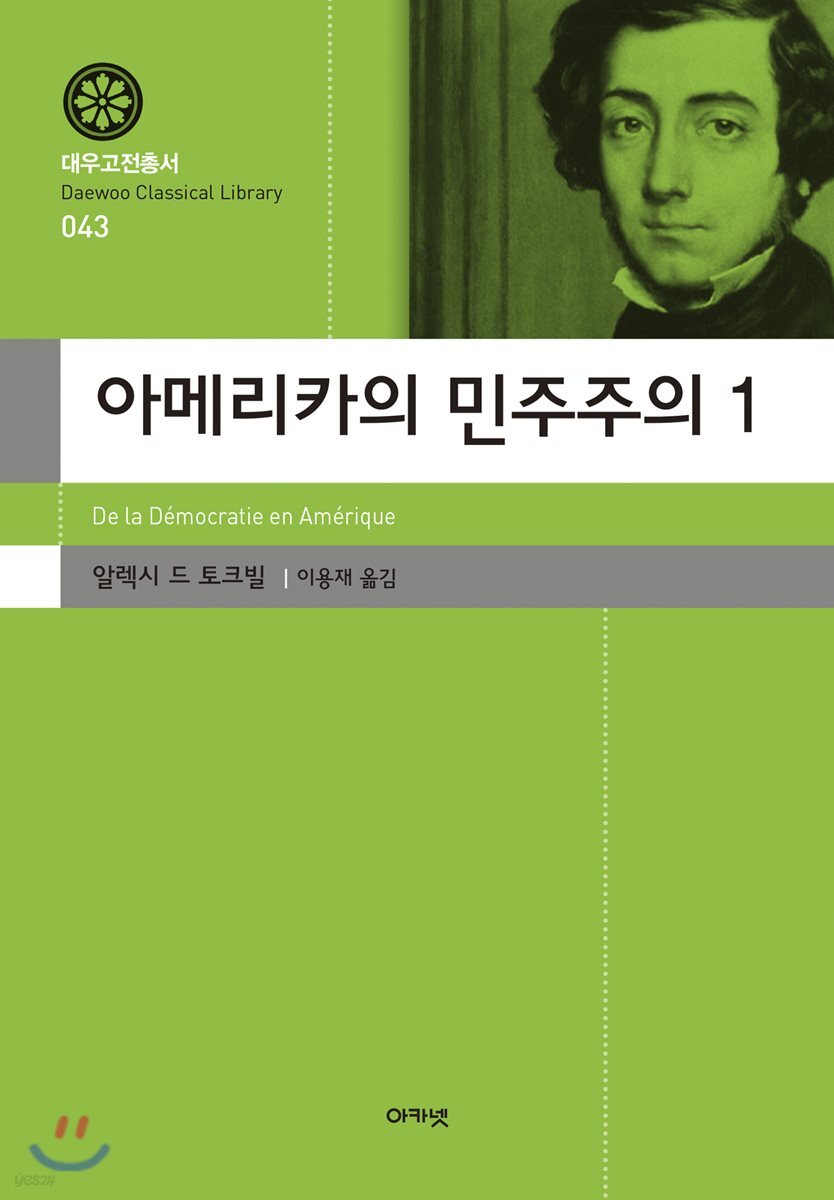
American Democracy 1
 |
Description
Book Introduction
A classic in the history of political thought that sharply captures the essence of democracy across time.
A complete translation of the original text, capturing the precise meaning of Tocqueville's uniquely elegant style, has been published.
"The logic is democracy, the object of analysis is equality, and the subject is freedom."
Alexis de Tocqueville (1805-1859), the 'prophet of democracy in the revolutionary era', left behind two major works diagnosing 19th century democratic society.
Democracy in America (De la Democra-
If 『The Old Regime and the French Revolution』(1835, 1840) is a sociological examination that reveals the institutions and operating methods of democracy in the New World, free from the legacy of the old regime, then 『The Old Regime and the French Revolution』(1856) can be said to be a historical reflection on the French Revolution, which attempted to open the era of democracy through a sharp break with the old regime.
If the former was an ambitious work from his youth that established Tocqueville's reputation as a thinker and his position as a politician, the latter was a work from his later years, written when he had left behind the real politics full of adventure and regret and entered a period of reflection and contemplation.
However, in Tocqueville's two major works, written over a period of about 20 years, the ultimate problem awareness he pursued throughout his life flows through.
In short, the argument is democracy, the object of analysis is equality, and the subject is freedom.
A direct reference to the United States of America, which meant an unknown new world.
A contemporary work that attempts to gauge the trends of modern democratic society through observation.
"A premier critique of American political culture."
Tocqueville wrote Democracy in America twice.
The first volume, written intensively over a year starting in the fall of 1833 after returning from a visit to America, was published in early 1835, and the second volume, written intermittently over a period of four years starting in about 1836, with repeated revisions and additions, was published in early 1840.
The first volume received enthusiastic responses from critics and politicians, making the author a celebrity.
However, the second volume received a series of cold and even critical reviews.
Today, Democracy in America is published in two volumes and read and introduced as a single work, but when it was first published, it received such conflicting reviews that it seemed like two different books.
Recognizing the mixed reviews of the first and second volumes, Tocqueville stated that the first volume, which dealt primarily with America, was empirical and descriptive, whereas the second volume, which contained abstract and theoretical reflections, dealt in fact with the problem of democracy itself.
A weighty classic in the history of political thought that is still widely read after more than a century.
Why did the lonely individuals of 20th-century mass society welcome the return of Tocqueville?
The difference between the first and second volumes is also reflected in readers' reactions.
When Democracy in America first appeared in 1835, its story about America, then an unknown world, was widely welcomed, and Tocqueville became a celebrity overnight.
The second volume, published five years later, did not receive much response and gradually faded from public interest.
It was around the mid-20th century that the forgotten thinker Tocqueville returned to the attention of readers.
The lonely individuals of modern mass society have rediscovered the visionary who, a century ago, foresaw the helplessness of humanity in the democratic era.
While 19th-century readers welcomed the first volume, 20th-century readers welcomed the second volume.
'The Return of Tocqueville' is the second volume of Tocqueville.
Democracy in America, published in 1835, and Democracy in America, published in 1840, dealt with the same subject matter but offered completely different assessments and perspectives.
The first volume, which presented an optimistic outlook on democracy after traveling through America, was subsequently significantly revised and supplemented in its content and argument, partly based on the author's experiences during his stay in England, and partly based on his own personal experience with real-world politics, including parliamentary elections and his entry into politics.
The second volume, which contains a critical assessment and gloomy outlook on democracy, contains the author's changed perspective on democracy.
The second volume of democracy is a theoretical democracy filtered through the cases of Britain and France, an ideal form of democracy that, in the author's words, "has never been seen before."
In the first volume, Tocqueville compared the cases of America and France, while painting a landscape of democracy with America at its center.
But in the second volume, he portrays the ideal of democracy itself, with America, Britain, and France as subtle backgrounds.
From 'America' to 'Democracy'
True freedom must be found within the horizon of 'political freedom,' which is participation in communal life.
Tocqueville's diagnosis and evaluation of democracy in the first volume of Democracy in America is not, in fact, significantly different from the framework of 19th-century classical liberalism.
In his critique of democracy, which argues that the oppression of the majority, which may be a realistic consequence of the principle of popular sovereignty, can infringe upon individual freedom, Tocqueville can be seen as sharing the same views as the liberals of his time.
However, in his second volume, published five years later, when he analyzed and prescribed individualism and democratic despotism as the core propositions of democracy, Tocqueville began to go beyond the liberals' arguments.
Tocqueville believes that the fundamental problem of democratic society does not arise from an excess of political participation, but from a lack of participation and a decline in public spirit due to the pursuit of material enjoyment and profit.
Therefore, he emphasizes that the restoration of political freedom must awaken civic spirit and communal bonds.
In a democratic age, the path to true freedom no longer lies in seeking personal security from external coercion, but in actively participating in the affairs of the community.
Tocqueville's argument that individuals in a democratic era must be reborn as citizens of a political community fits seamlessly with the republican logic that nourishes the upliftment of public spirit and the cultivation of political virtue.
In that case, Tocqueville's Democracy in America could be read as a republican prescription for the ills of modern democratic society.
A complete translation of the original text, capturing the precise meaning of Tocqueville's uniquely elegant style, has been published.
"The logic is democracy, the object of analysis is equality, and the subject is freedom."
Alexis de Tocqueville (1805-1859), the 'prophet of democracy in the revolutionary era', left behind two major works diagnosing 19th century democratic society.
Democracy in America (De la Democra-
If 『The Old Regime and the French Revolution』(1835, 1840) is a sociological examination that reveals the institutions and operating methods of democracy in the New World, free from the legacy of the old regime, then 『The Old Regime and the French Revolution』(1856) can be said to be a historical reflection on the French Revolution, which attempted to open the era of democracy through a sharp break with the old regime.
If the former was an ambitious work from his youth that established Tocqueville's reputation as a thinker and his position as a politician, the latter was a work from his later years, written when he had left behind the real politics full of adventure and regret and entered a period of reflection and contemplation.
However, in Tocqueville's two major works, written over a period of about 20 years, the ultimate problem awareness he pursued throughout his life flows through.
In short, the argument is democracy, the object of analysis is equality, and the subject is freedom.
A direct reference to the United States of America, which meant an unknown new world.
A contemporary work that attempts to gauge the trends of modern democratic society through observation.
"A premier critique of American political culture."
Tocqueville wrote Democracy in America twice.
The first volume, written intensively over a year starting in the fall of 1833 after returning from a visit to America, was published in early 1835, and the second volume, written intermittently over a period of four years starting in about 1836, with repeated revisions and additions, was published in early 1840.
The first volume received enthusiastic responses from critics and politicians, making the author a celebrity.
However, the second volume received a series of cold and even critical reviews.
Today, Democracy in America is published in two volumes and read and introduced as a single work, but when it was first published, it received such conflicting reviews that it seemed like two different books.
Recognizing the mixed reviews of the first and second volumes, Tocqueville stated that the first volume, which dealt primarily with America, was empirical and descriptive, whereas the second volume, which contained abstract and theoretical reflections, dealt in fact with the problem of democracy itself.
A weighty classic in the history of political thought that is still widely read after more than a century.
Why did the lonely individuals of 20th-century mass society welcome the return of Tocqueville?
The difference between the first and second volumes is also reflected in readers' reactions.
When Democracy in America first appeared in 1835, its story about America, then an unknown world, was widely welcomed, and Tocqueville became a celebrity overnight.
The second volume, published five years later, did not receive much response and gradually faded from public interest.
It was around the mid-20th century that the forgotten thinker Tocqueville returned to the attention of readers.
The lonely individuals of modern mass society have rediscovered the visionary who, a century ago, foresaw the helplessness of humanity in the democratic era.
While 19th-century readers welcomed the first volume, 20th-century readers welcomed the second volume.
'The Return of Tocqueville' is the second volume of Tocqueville.
Democracy in America, published in 1835, and Democracy in America, published in 1840, dealt with the same subject matter but offered completely different assessments and perspectives.
The first volume, which presented an optimistic outlook on democracy after traveling through America, was subsequently significantly revised and supplemented in its content and argument, partly based on the author's experiences during his stay in England, and partly based on his own personal experience with real-world politics, including parliamentary elections and his entry into politics.
The second volume, which contains a critical assessment and gloomy outlook on democracy, contains the author's changed perspective on democracy.
The second volume of democracy is a theoretical democracy filtered through the cases of Britain and France, an ideal form of democracy that, in the author's words, "has never been seen before."
In the first volume, Tocqueville compared the cases of America and France, while painting a landscape of democracy with America at its center.
But in the second volume, he portrays the ideal of democracy itself, with America, Britain, and France as subtle backgrounds.
From 'America' to 'Democracy'
True freedom must be found within the horizon of 'political freedom,' which is participation in communal life.
Tocqueville's diagnosis and evaluation of democracy in the first volume of Democracy in America is not, in fact, significantly different from the framework of 19th-century classical liberalism.
In his critique of democracy, which argues that the oppression of the majority, which may be a realistic consequence of the principle of popular sovereignty, can infringe upon individual freedom, Tocqueville can be seen as sharing the same views as the liberals of his time.
However, in his second volume, published five years later, when he analyzed and prescribed individualism and democratic despotism as the core propositions of democracy, Tocqueville began to go beyond the liberals' arguments.
Tocqueville believes that the fundamental problem of democratic society does not arise from an excess of political participation, but from a lack of participation and a decline in public spirit due to the pursuit of material enjoyment and profit.
Therefore, he emphasizes that the restoration of political freedom must awaken civic spirit and communal bonds.
In a democratic age, the path to true freedom no longer lies in seeking personal security from external coercion, but in actively participating in the affairs of the community.
Tocqueville's argument that individuals in a democratic era must be reborn as citizens of a political community fits seamlessly with the republican logic that nourishes the upliftment of public spirit and the cultivation of political virtue.
In that case, Tocqueville's Democracy in America could be read as a republican prescription for the ills of modern democratic society.
GOODS SPECIFICS
- Date of issue: April 12, 2018
- Page count, weight, size: 756 pages | Checking size
- ISBN13: 9788957335895
- ISBN10: 8957335897
You may also like
카테고리
korean


korean

![GQ KOREA Mark (Monthly): December [2025]](http://librairie.coreenne.fr/cdn/shop/files/8ef265dbbfbf186523ed75ba7319009d.jpg?v=1765340328&width=3840)


