

Seol Min-seok's Special Lecture on Korean Dance History
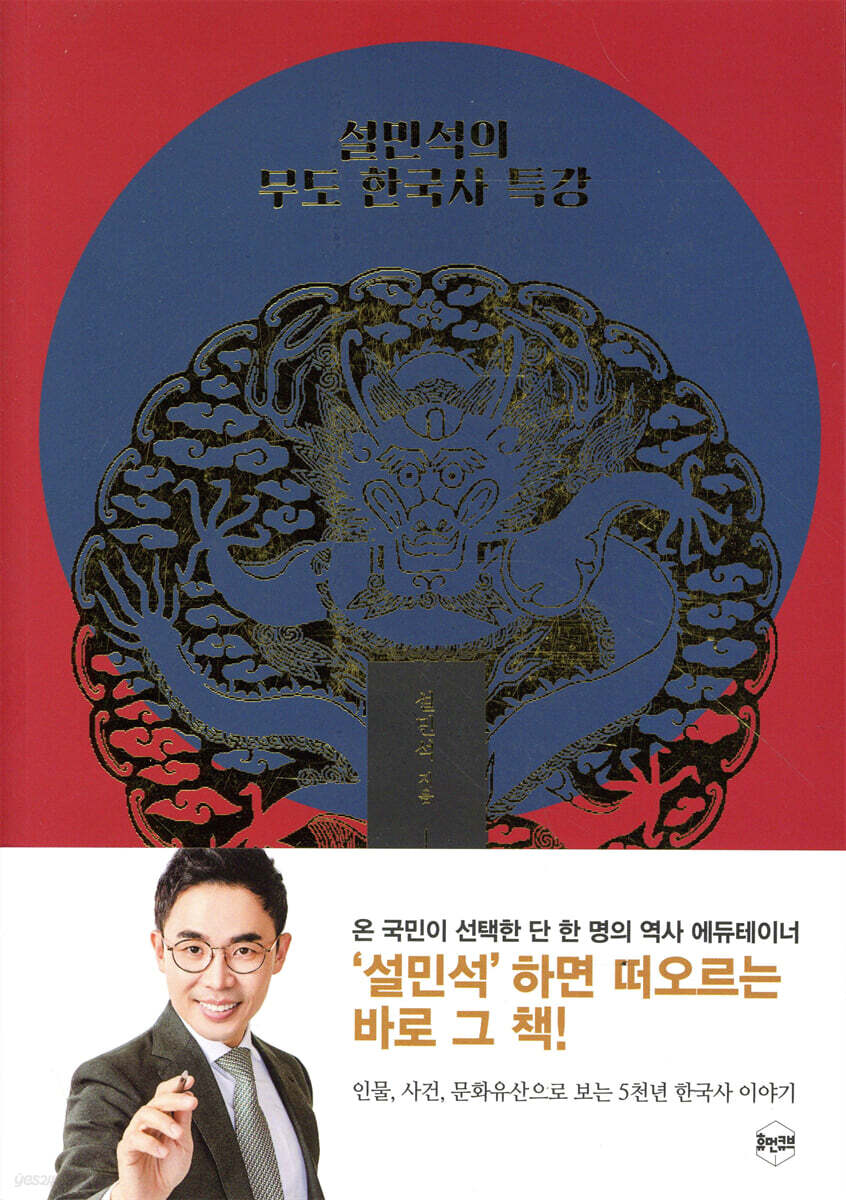 |
Description
Book Introduction
Seol Min-seok's first step toward popularizing Korean history!
The beginning of the Korean history craze in South Korea!
A very easy and helpful Korean history through three themes: people, events, and cultural heritage.
I'm clearly reading the book with my eyes, but I can hear Seol Min-seok's voice with my ears!
Seol Min-seok, the most famous Korean history lecturer in South Korea.
『Seol Min-seok's Special Lecture on Korean History in the Dance』, which was the first step in the project to popularize Korean history, has returned with a new edition to commemorate surpassing 300,000 copies sold.
Since its publication in January 2014, this book has been loved by readers of all ages as an entertaining and informative Korean history book, so we have made this first book even more substantial with a beginner's mind.
"Seol Min-seok's Special Lecture on Korean History of Dance" contains 30 key points from 5,000 years of Korean history that we must remember, under three themes: people, events, and cultural heritage.
It is composed so that anyone can easily read and understand it, encompassing not only historical facts but also stories of historical figures we were unaware of and the author's perspective.
In particular, we have made efforts to supplement the shortcomings of the first edition by publishing the revised edition.
We have tried to reflect the latest mainstream theories and issues as much as possible, and have gone through the process of content verification multiple times.
We have also further enhanced the photographic and historical materials.
We have taken a fresh look at the democratization movement and the labor movement, stories that are not so distant from us today, perhaps even the closest to us.
History is not made by the power of a few.
Every single day of our lives is history.
This clear fact is proven throughout history.
That's why we need to know history correctly, and this is why author Seol Min-seok writes books and gives lectures to inform people about Korean history.
My present is the history of my future.
The beginning of the Korean history craze in South Korea!
A very easy and helpful Korean history through three themes: people, events, and cultural heritage.
I'm clearly reading the book with my eyes, but I can hear Seol Min-seok's voice with my ears!
Seol Min-seok, the most famous Korean history lecturer in South Korea.
『Seol Min-seok's Special Lecture on Korean History in the Dance』, which was the first step in the project to popularize Korean history, has returned with a new edition to commemorate surpassing 300,000 copies sold.
Since its publication in January 2014, this book has been loved by readers of all ages as an entertaining and informative Korean history book, so we have made this first book even more substantial with a beginner's mind.
"Seol Min-seok's Special Lecture on Korean History of Dance" contains 30 key points from 5,000 years of Korean history that we must remember, under three themes: people, events, and cultural heritage.
It is composed so that anyone can easily read and understand it, encompassing not only historical facts but also stories of historical figures we were unaware of and the author's perspective.
In particular, we have made efforts to supplement the shortcomings of the first edition by publishing the revised edition.
We have tried to reflect the latest mainstream theories and issues as much as possible, and have gone through the process of content verification multiple times.
We have also further enhanced the photographic and historical materials.
We have taken a fresh look at the democratization movement and the labor movement, stories that are not so distant from us today, perhaps even the closest to us.
History is not made by the power of a few.
Every single day of our lives is history.
This clear fact is proven throughout history.
That's why we need to know history correctly, and this is why author Seol Min-seok writes books and gives lectures to inform people about Korean history.
My present is the history of my future.
- You can preview some of the book's contents.
Preview
index
Preface to the Revised Edition _004
Preface to the First Edition _006
Chapter 1: Characters
1.
My father's father, his father's father... ...Dangun Wanggeom _017
2.
Queen Seondeok's charm _029
3.
The Mystery of the Three Thousand Palace Ladies, King Uija _037
4.
For the stability and prosperity of the nation! King Taejo Wang Geon, who devoted his life to marriage _047
5.
King Gongmin, the man who gave everything for love _057
6.
Was Hangul really created by King Sejong? _069
7.
The Human Sejong We Never Knew_083
8.
The Couple with the Most Appearances in Dramas? Jang Hee-bin and King Sukjong (099)
9.
For the Day We Shout Manse, Thomas Ahn Jung-geun _109
10.
What I threw wasn't a lunchbox bomb! Dr. Yun Bong-gil _121
Chapter 2: Incidents
1.
Rule over 200 million with a population of 1 million: The Mongol Invasion and Resistance _133
2.
The Day Yi Seong-gye Turned His Horse's Head 1_145
3.
The Day Yi Seong-gye Turned His Horse's Head 2_157
4.
The Real Story of the Imjin War Outside the Textbooks 1_171
5.
The Real Story of the Imjin War Outside the Textbooks 2_191
6.
There were students there _209
7.
Who Pulled the Trigger? The Korean War: A National Tragedy _221
8.
Not so long ago, the democratization movement 1_233
9.
Not so long ago, the democratization movement 2_249
10.
Perhaps the story closest to us: the labor movement and Jeon Tae-il _265
Chapter 3 Cultural Heritage
1.
Seokguram Grotto, the embodiment of technical prowess and religious faith _283
2.
For the poor living beings who don't even know the Buddha statue... ... Buddha statues in history _295
3.
The Korean Tower That Even Bruce Lee Loved _307
4.
30 Years Just for Reading! Tripitaka Koreana _321
5.
Readers, make lots of money! Korean Currency _333
6.
The more you know about our seasonal customs, the more you fall in love with them_347
7.
From portraits to genre paintings! The all-rounder, Danwon Kim Hong-do _357
8.
I'm Not a Woman, Hyewon Shin Yun-bok _375
9.
Seol Min-seok drew folk paintings, so you can draw them too.
Korean Folk Paintings _391
10.
The Story of Gando and Dokdo _407
Dan-Kkum Korean History Chronology _408
Source of main text _426
Preface to the First Edition _006
Chapter 1: Characters
1.
My father's father, his father's father... ...Dangun Wanggeom _017
2.
Queen Seondeok's charm _029
3.
The Mystery of the Three Thousand Palace Ladies, King Uija _037
4.
For the stability and prosperity of the nation! King Taejo Wang Geon, who devoted his life to marriage _047
5.
King Gongmin, the man who gave everything for love _057
6.
Was Hangul really created by King Sejong? _069
7.
The Human Sejong We Never Knew_083
8.
The Couple with the Most Appearances in Dramas? Jang Hee-bin and King Sukjong (099)
9.
For the Day We Shout Manse, Thomas Ahn Jung-geun _109
10.
What I threw wasn't a lunchbox bomb! Dr. Yun Bong-gil _121
Chapter 2: Incidents
1.
Rule over 200 million with a population of 1 million: The Mongol Invasion and Resistance _133
2.
The Day Yi Seong-gye Turned His Horse's Head 1_145
3.
The Day Yi Seong-gye Turned His Horse's Head 2_157
4.
The Real Story of the Imjin War Outside the Textbooks 1_171
5.
The Real Story of the Imjin War Outside the Textbooks 2_191
6.
There were students there _209
7.
Who Pulled the Trigger? The Korean War: A National Tragedy _221
8.
Not so long ago, the democratization movement 1_233
9.
Not so long ago, the democratization movement 2_249
10.
Perhaps the story closest to us: the labor movement and Jeon Tae-il _265
Chapter 3 Cultural Heritage
1.
Seokguram Grotto, the embodiment of technical prowess and religious faith _283
2.
For the poor living beings who don't even know the Buddha statue... ... Buddha statues in history _295
3.
The Korean Tower That Even Bruce Lee Loved _307
4.
30 Years Just for Reading! Tripitaka Koreana _321
5.
Readers, make lots of money! Korean Currency _333
6.
The more you know about our seasonal customs, the more you fall in love with them_347
7.
From portraits to genre paintings! The all-rounder, Danwon Kim Hong-do _357
8.
I'm Not a Woman, Hyewon Shin Yun-bok _375
9.
Seol Min-seok drew folk paintings, so you can draw them too.
Korean Folk Paintings _391
10.
The Story of Gando and Dokdo _407
Dan-Kkum Korean History Chronology _408
Source of main text _426
Into the book
To my precious readers who pointed out various errors that I had overlooked and sent me compliments and encouragement, and sometimes criticisms; to the children who sent me crooked, handwritten letters expressing their thoughts on the book; to the parents who told me that they were having fun reading it with their children; to the students and working adults who told me that they had been hesitant to study Korean history but started because of this book; thank you to all of you.
Although I have faithfully told many historical stories that I have always wanted to share, there are still many shortcomings.
As many people have loved this book, I cannot help but feel a sense of responsibility for it, and that is why I have published a revised edition to address any shortcomings.
Now, the newly revamped "Seol Min-seok's Special Lecture on Korean History of Dance" is back for readers! We've strived to reflect the latest mainstream academic theories and issues as much as possible, and the content has been thoroughly vetted three times.
We also tried to add more photographic materials and historical materials.
Preface to the Revised Edition --- p.4
What is even more interesting is the origin of the name Bunhwangsa Temple.
There is an anecdote like this in 『Samguk Yusa』.
One day, Emperor Taizong of the Tang Dynasty sent Queen Seondeok a painting of peonies in three colors—red, purple, and white—and peony seeds.
But when Queen Seondeok saw the painting, she said, “This flower will definitely have no fragrance.”
She planted flower seeds and waited for them to bloom, but the flowers, in fact, had no fragrance! Later, people who found this surprising asked her how she knew the flowers would be fragranceless. Queen Seondeok replied:
“I drew flowers, but no butterflies.
So I could tell it had no scent.
This is the Tang emperor making fun of me for not having a husband.” Could this be considered sexual harassment in some way?
In response, Seondeok responds to the Tang emperor in her own way.
In 634, three years after ascending to the throne, Queen Seondeok built a temple and named it ‘Hwangjejesanggi.’
That temple is Bunhwangsa Temple.
Looking at the way the Tang emperor and Queen Seondeok communicated, I get the feeling that even though it was essentially mockery, the expression was very restrained and had a unique charm of the ancients.
Isn't it truly elegant to communicate through culture and metaphors rather than through direct exchanges of words? Above all, the most telling truth from all these anecdotes is that Queen Seondeok was a wise woman.
Because he had the insight to recognize the mockery he was being subjected to when he saw the painting sent by the Tang Emperor.
To add a little anecdote about [Peony], there is an interpretation that the Tang emperor sent three flowers because he predicted that three queens would emerge from Silla.
In fact, Silla produced three queens: Queen Seondeok, Queen Jindeok, and Queen Jinseong.
Queen Seondeok's charms shine through --- p.32
The Shanghai Incident is a factor that made Yun Bong-gil's actions possible, as history keeps repeating itself.
High-ranking Japanese generals gathered in Shanghai to commemorate the victory in the Shanghai Incident and to sign an armistice agreement with China. As it coincided with the Emperor's birthday, a large event was held in Shanghai's Hongkou Park.
For Mr. Yun Bong-gil, who had always dreamed of making a great achievement, an environment was created in which he could literally make a great achievement.
Mr. Yun Bong-gil, who was in Qingdao, China, for the independence movement, rushed to Shanghai as soon as he heard the news and immediately joined the Korean Patriotic Corps.
The preparations were very meticulous.
As it was a place where many high-ranking officials gathered, security was tight, so I couldn't just bring a bomb.
Taking advantage of the fact that lunch boxes were among the items they could carry, the Korean Patriotic Group created two bombs, one shaped like a lunch box and one shaped like a water bottle, to camouflage themselves.
The most common misunderstanding that arose here is that Mr. Yun Bong-gil threw a bomb shaped like a lunchbox.
However, what Mr. Yun Bong-gil actually threw for attack was a water bottle-shaped bomb.
So what was the lunchbox bomb? The lunchbox-shaped bomb appears to have been intended for suicide.
Unfortunately, after carrying out the uprising, Mr. Yun Bong-gil was determined to take his own life.
The conversation between Kim Gu and Yun Bong-gil about watches on the day of the uprising is famous.
While having breakfast with Mr. Kim Gu, Dr. Yun Bong-gil sees Mr. Kim Gu's old watch and says that his watch is a new one that he bought not long ago, so he wants to exchange it for his watch.
When I suggested exchanging the shabby watch for the expensive one, Mr. Kim Gu naturally refused.
Then, Dr. Yun Bong-gil said, “I only have one hour left,” and Kim Gu shed tears and said, “Let’s meet underground.”
What I threw wasn't a lunchbox bomb! From Dr. Yun Bong-gil --- p.126
Before delving into the democratization movement in earnest, we must first examine the relationship between modern history and the development of democracy.
Although it may seem like democracy began with the dawn of the modern era, in fact, democracy has existed since ancient times.
A political system in which citizens have sovereignty and can directly participate in political activities, like Athens in ancient Greece, is called democracy.
However, ancient democracy was a selective democracy that did not grant women, slaves, etc. the right to participate in political affairs.
As we move from the modern era to the present, the importance of human rights that must be guaranteed equally to all people, as well as the equality and freedom of each individual, begins to be emphasized.
In particular, the spirit of liberty, equality, and fraternity, which are values that all mankind should pursue in common, spread widely during the French Revolution.
Since then, the caste system and slavery were abolished, the right to participate in politics was extended to women, and today's democracy and democratic states emerged.
Of course, there are countries that do not choose democracy.
A representative example is North Korea.
A system that prioritizes the interests of society as a whole over the freedom of individuals, also called socialism.
Since its founding, the Republic of Korea has chosen democracy as its national system, with citizens directly electing their representatives. Therefore, the state must respect the rights and interests of each and every citizen.
This is also the most important value that must never be suppressed.
However, the Republic of Korea, which started out as a democratic system, faced several crises immediately after the establishment of the government.
Not so long ago, the democratization movement, part 1 --- p.234
During the 1960s and 1970s, Korean society experienced many changes as it enjoyed unprecedented economic growth.
First of all, the phenomenon of people moving to the city in search of jobs, and the gap between the rich and the poor, emerged as social problems.
Moreover, in contrast to the dazzling achievements of economic growth, the lives of the urban poor and the treatment of workers were dire.
At that time, workers who flocked to the city lived in shantytowns in Cheonggyecheon or in small rooms near factories, working 14 to 16 hours a day and receiving 1,500 won a month.
There is only one day off per month.
So, the daily wage is 50 won.
It was the price of a cup of coffee.
Most of the workers were young girls of middle school age who had been unable to attend school due to poverty and had gone to the city to earn money to support their families.
However, on the surface, the success of the state-led Five-Year Economic Development Plan and the Miracle on the Han River, the dazzling economic achievements that overcame the difficult economic situation after the Korean War, were emphasized.
This is the myth of economic growth under the Park Chung-hee administration, and it has been understood that the current Republic of Korea was born thanks to economic development led by a strong government.
I wonder if it wasn't a time when it was accepted that the people had to unite as one for the country to grow, and that some sacrifices were inevitable in the process.
Perhaps the story closest to our hearts: the labor movement and Jeon Tae-il --- p.268
Now that we have looked at the science and technology contained in Seokguram Grotto, let us experience its beauty.
Seokguram Grotto and Bulguksa Temple are temples that Kim Dae-seong designed as a set.
If Bulguksa Temple is a real-life representation of the process of entering the world of Buddha, Seokguram Grotto is a real-life embodiment of the moment of liberation.
The detailed and beautiful carvings of Seokguram Grotto
Each of them would have made visitors to Seokguram Grotto feel as if they had truly met Buddha.
First, when you enter Seokguram Grotto, a pair of guardian deities, Vajrapani and Vajrapani, who guard the path to the Buddha's world, look down at us with frightening expressions.
He looks ready to strike down anyone with ill intentions.
After passing through the Vajra, the Four Heavenly Kings, who protect the east, west, south, and north of the Buddha's world, appear.
The Four Heavenly Kings can be easily found at the entrance of ordinary temples.
The Four Heavenly Kings stand, each holding a weapon, trampling on the devil with their feet.
Seokguram Grotto, the embodiment of technical prowess and faith
Although I have faithfully told many historical stories that I have always wanted to share, there are still many shortcomings.
As many people have loved this book, I cannot help but feel a sense of responsibility for it, and that is why I have published a revised edition to address any shortcomings.
Now, the newly revamped "Seol Min-seok's Special Lecture on Korean History of Dance" is back for readers! We've strived to reflect the latest mainstream academic theories and issues as much as possible, and the content has been thoroughly vetted three times.
We also tried to add more photographic materials and historical materials.
Preface to the Revised Edition --- p.4
What is even more interesting is the origin of the name Bunhwangsa Temple.
There is an anecdote like this in 『Samguk Yusa』.
One day, Emperor Taizong of the Tang Dynasty sent Queen Seondeok a painting of peonies in three colors—red, purple, and white—and peony seeds.
But when Queen Seondeok saw the painting, she said, “This flower will definitely have no fragrance.”
She planted flower seeds and waited for them to bloom, but the flowers, in fact, had no fragrance! Later, people who found this surprising asked her how she knew the flowers would be fragranceless. Queen Seondeok replied:
“I drew flowers, but no butterflies.
So I could tell it had no scent.
This is the Tang emperor making fun of me for not having a husband.” Could this be considered sexual harassment in some way?
In response, Seondeok responds to the Tang emperor in her own way.
In 634, three years after ascending to the throne, Queen Seondeok built a temple and named it ‘Hwangjejesanggi.’
That temple is Bunhwangsa Temple.
Looking at the way the Tang emperor and Queen Seondeok communicated, I get the feeling that even though it was essentially mockery, the expression was very restrained and had a unique charm of the ancients.
Isn't it truly elegant to communicate through culture and metaphors rather than through direct exchanges of words? Above all, the most telling truth from all these anecdotes is that Queen Seondeok was a wise woman.
Because he had the insight to recognize the mockery he was being subjected to when he saw the painting sent by the Tang Emperor.
To add a little anecdote about [Peony], there is an interpretation that the Tang emperor sent three flowers because he predicted that three queens would emerge from Silla.
In fact, Silla produced three queens: Queen Seondeok, Queen Jindeok, and Queen Jinseong.
Queen Seondeok's charms shine through --- p.32
The Shanghai Incident is a factor that made Yun Bong-gil's actions possible, as history keeps repeating itself.
High-ranking Japanese generals gathered in Shanghai to commemorate the victory in the Shanghai Incident and to sign an armistice agreement with China. As it coincided with the Emperor's birthday, a large event was held in Shanghai's Hongkou Park.
For Mr. Yun Bong-gil, who had always dreamed of making a great achievement, an environment was created in which he could literally make a great achievement.
Mr. Yun Bong-gil, who was in Qingdao, China, for the independence movement, rushed to Shanghai as soon as he heard the news and immediately joined the Korean Patriotic Corps.
The preparations were very meticulous.
As it was a place where many high-ranking officials gathered, security was tight, so I couldn't just bring a bomb.
Taking advantage of the fact that lunch boxes were among the items they could carry, the Korean Patriotic Group created two bombs, one shaped like a lunch box and one shaped like a water bottle, to camouflage themselves.
The most common misunderstanding that arose here is that Mr. Yun Bong-gil threw a bomb shaped like a lunchbox.
However, what Mr. Yun Bong-gil actually threw for attack was a water bottle-shaped bomb.
So what was the lunchbox bomb? The lunchbox-shaped bomb appears to have been intended for suicide.
Unfortunately, after carrying out the uprising, Mr. Yun Bong-gil was determined to take his own life.
The conversation between Kim Gu and Yun Bong-gil about watches on the day of the uprising is famous.
While having breakfast with Mr. Kim Gu, Dr. Yun Bong-gil sees Mr. Kim Gu's old watch and says that his watch is a new one that he bought not long ago, so he wants to exchange it for his watch.
When I suggested exchanging the shabby watch for the expensive one, Mr. Kim Gu naturally refused.
Then, Dr. Yun Bong-gil said, “I only have one hour left,” and Kim Gu shed tears and said, “Let’s meet underground.”
What I threw wasn't a lunchbox bomb! From Dr. Yun Bong-gil --- p.126
Before delving into the democratization movement in earnest, we must first examine the relationship between modern history and the development of democracy.
Although it may seem like democracy began with the dawn of the modern era, in fact, democracy has existed since ancient times.
A political system in which citizens have sovereignty and can directly participate in political activities, like Athens in ancient Greece, is called democracy.
However, ancient democracy was a selective democracy that did not grant women, slaves, etc. the right to participate in political affairs.
As we move from the modern era to the present, the importance of human rights that must be guaranteed equally to all people, as well as the equality and freedom of each individual, begins to be emphasized.
In particular, the spirit of liberty, equality, and fraternity, which are values that all mankind should pursue in common, spread widely during the French Revolution.
Since then, the caste system and slavery were abolished, the right to participate in politics was extended to women, and today's democracy and democratic states emerged.
Of course, there are countries that do not choose democracy.
A representative example is North Korea.
A system that prioritizes the interests of society as a whole over the freedom of individuals, also called socialism.
Since its founding, the Republic of Korea has chosen democracy as its national system, with citizens directly electing their representatives. Therefore, the state must respect the rights and interests of each and every citizen.
This is also the most important value that must never be suppressed.
However, the Republic of Korea, which started out as a democratic system, faced several crises immediately after the establishment of the government.
Not so long ago, the democratization movement, part 1 --- p.234
During the 1960s and 1970s, Korean society experienced many changes as it enjoyed unprecedented economic growth.
First of all, the phenomenon of people moving to the city in search of jobs, and the gap between the rich and the poor, emerged as social problems.
Moreover, in contrast to the dazzling achievements of economic growth, the lives of the urban poor and the treatment of workers were dire.
At that time, workers who flocked to the city lived in shantytowns in Cheonggyecheon or in small rooms near factories, working 14 to 16 hours a day and receiving 1,500 won a month.
There is only one day off per month.
So, the daily wage is 50 won.
It was the price of a cup of coffee.
Most of the workers were young girls of middle school age who had been unable to attend school due to poverty and had gone to the city to earn money to support their families.
However, on the surface, the success of the state-led Five-Year Economic Development Plan and the Miracle on the Han River, the dazzling economic achievements that overcame the difficult economic situation after the Korean War, were emphasized.
This is the myth of economic growth under the Park Chung-hee administration, and it has been understood that the current Republic of Korea was born thanks to economic development led by a strong government.
I wonder if it wasn't a time when it was accepted that the people had to unite as one for the country to grow, and that some sacrifices were inevitable in the process.
Perhaps the story closest to our hearts: the labor movement and Jeon Tae-il --- p.268
Now that we have looked at the science and technology contained in Seokguram Grotto, let us experience its beauty.
Seokguram Grotto and Bulguksa Temple are temples that Kim Dae-seong designed as a set.
If Bulguksa Temple is a real-life representation of the process of entering the world of Buddha, Seokguram Grotto is a real-life embodiment of the moment of liberation.
The detailed and beautiful carvings of Seokguram Grotto
Each of them would have made visitors to Seokguram Grotto feel as if they had truly met Buddha.
First, when you enter Seokguram Grotto, a pair of guardian deities, Vajrapani and Vajrapani, who guard the path to the Buddha's world, look down at us with frightening expressions.
He looks ready to strike down anyone with ill intentions.
After passing through the Vajra, the Four Heavenly Kings, who protect the east, west, south, and north of the Buddha's world, appear.
The Four Heavenly Kings can be easily found at the entrance of ordinary temples.
The Four Heavenly Kings stand, each holding a weapon, trampling on the devil with their feet.
Seokguram Grotto, the embodiment of technical prowess and faith
--- p.290
Publisher's Review
To my precious readers who pointed out various errors that I had overlooked and sent me compliments and encouragement, and sometimes criticisms; to the children who sent me crooked, handwritten letters expressing their thoughts on the book; to the parents who told me that they were having fun reading it with their children; to the students and working adults who told me that they had been hesitant to study Korean history but started because of this book; thank you to all of you.
Although I have faithfully told many historical stories that I have always wanted to share, there are still many shortcomings.
As many people have loved this book, I cannot help but feel a sense of responsibility for it, and that is why I have published a revised edition to address any shortcomings.
Now, the newly revamped "Seol Min-seok's Special Lecture on Korean History of Dance" is back for readers! We've strived to reflect the latest mainstream academic theories and issues as much as possible, and the content has been thoroughly vetted three times.
We also tried to add more photographic materials and historical materials.
(Author's Note, from the preface to the revised edition)
Although I have faithfully told many historical stories that I have always wanted to share, there are still many shortcomings.
As many people have loved this book, I cannot help but feel a sense of responsibility for it, and that is why I have published a revised edition to address any shortcomings.
Now, the newly revamped "Seol Min-seok's Special Lecture on Korean History of Dance" is back for readers! We've strived to reflect the latest mainstream academic theories and issues as much as possible, and the content has been thoroughly vetted three times.
We also tried to add more photographic materials and historical materials.
(Author's Note, from the preface to the revised edition)
GOODS SPECIFICS
- Publication date: November 15, 2017
- Page count, weight, size: 436 pages | 915g | 170*240*26mm
- ISBN13: 9791196025892
- ISBN10: 1196025894
You may also like
카테고리
korean


korean

![GQ KOREA Mark (Monthly): December [2025]](http://librairie.coreenne.fr/cdn/shop/files/8ef265dbbfbf186523ed75ba7319009d.jpg?v=1765340328&width=3840)


