

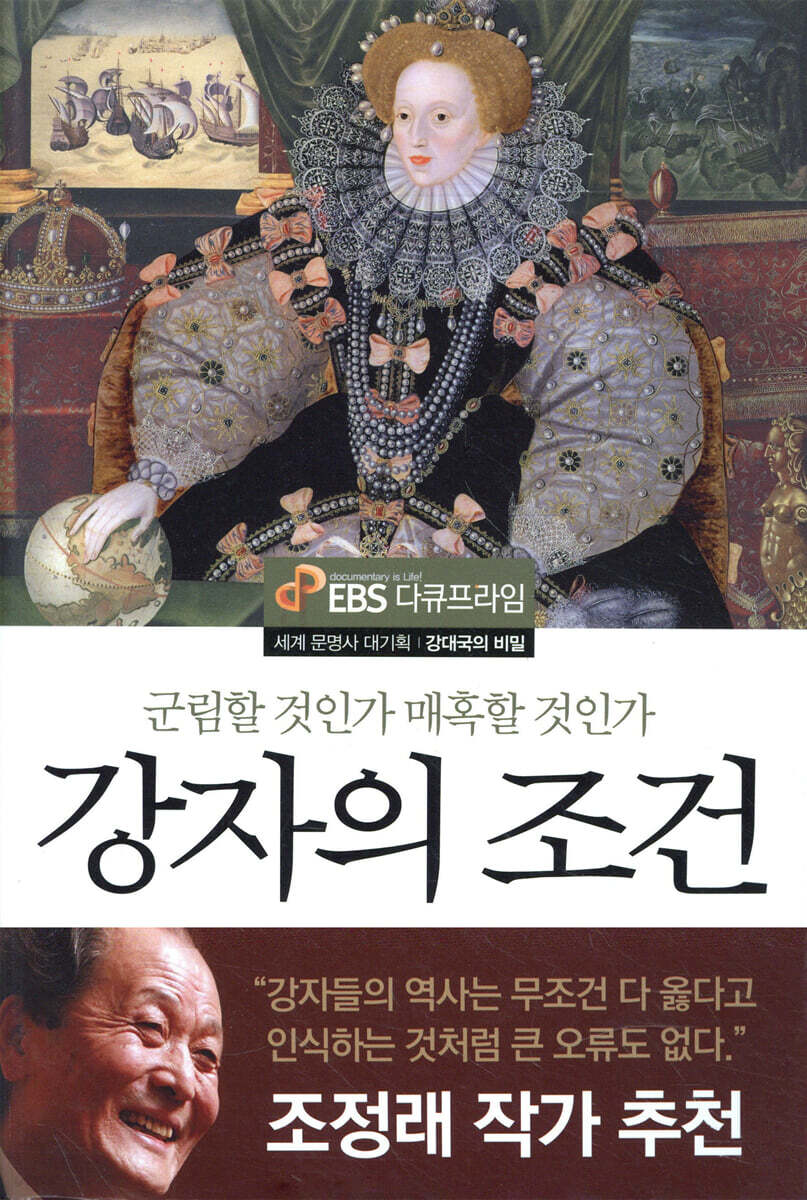
Conditions of the strong
 |
Description
Book Introduction
What do you think are the conditions for a strong person?
Sobering advice from the nation's top scholars
From the ancient Roman Empire to 20th-century America, 2,500 years of history speak for themselves.
The essence of leadership that creates a great power is not strength.
These were countries that excelled in 'diversity' more than any other country of their time, and were the most 'tolerant' countries by the standards of their time.
By examining how this "tolerance" and "diversity" made them powerful, you will be able to grasp the clues to the conditions that a true strong person must possess.
"The Conditions of the Strong" offers a scholarly approach to the world's hegemonic powers, and a comparative analysis of their contemporary competitors. It intuitively reveals their secrets, leading you to universal answers about what every nation, community, and your organization needs to thrive.
Through conversations with world-renowned scholars, including historian Paul Kennedy, famous for his book "The Rise and Fall of the Great Powers," and Harvard professors Joseph Nye and Carl Galinsky, we will hear about the future strategies that Korea, surrounded by great powers, must choose for the 21st century.
Let's learn the true 'conditions of being strong' from the leadership of the strong.
Sobering advice from the nation's top scholars
From the ancient Roman Empire to 20th-century America, 2,500 years of history speak for themselves.
The essence of leadership that creates a great power is not strength.
These were countries that excelled in 'diversity' more than any other country of their time, and were the most 'tolerant' countries by the standards of their time.
By examining how this "tolerance" and "diversity" made them powerful, you will be able to grasp the clues to the conditions that a true strong person must possess.
"The Conditions of the Strong" offers a scholarly approach to the world's hegemonic powers, and a comparative analysis of their contemporary competitors. It intuitively reveals their secrets, leading you to universal answers about what every nation, community, and your organization needs to thrive.
Through conversations with world-renowned scholars, including historian Paul Kennedy, famous for his book "The Rise and Fall of the Great Powers," and Harvard professors Joseph Nye and Carl Galinsky, we will hear about the future strategies that Korea, surrounded by great powers, must choose for the 21st century.
Let's learn the true 'conditions of being strong' from the leadership of the strong.
- You can preview some of the book's contents.
Preview
index
Introduction
Part 1 Roman Citizenship
Rome, resilient in times of crisis
Uncovers the secrets that enabled Rome to grow into an ancient hegemonic power.
Rome did not always win its wars.
Rather, it was common for it to start with defeat.
In particular, the Hannibal War (Second Punic War) that broke out in 218 BC can be said to be Rome's greatest crisis.
It shows how the Roman Union survived such a crisis and how Rome was able to command the loyalty of its allies even in desperate circumstances.
- Carthage, Hannibal's hometown
- Hannibal Crosses the Alps
- Hannibal's basic strategy
- Kannai
- Roman citizenship
- Hannibal, Fabius, Scipio
- The birth of the Roman Empire
Part 2: World Empire Mongolia
Mongolia conquered the world in a short period of 50 years
Uncover the secrets of the Mongol Empire, which conquered the world in 50 years.
We examine how the Mongol Empire, which began as a nomadic group in a remote region with a population of less than 100,000, was able to quickly become a global empire that ruled the entire world, from the Korean Peninsula in the east to Europe in the west.
It also tells the story of how a barbaric nomad people came to possess world-class technology in a short period of time.
- The Mongol Empire's invasion of Europe
- Strangers of the Empire
- The emergence of Genghis Khan
- Yeke Mongol Ulus
- Monk Rubruck
- Religious Debate in Karakorum
- Pax Mongolica
Part 3: The Birth of the British Empire
Britain, a remote island nation that defeated the Spanish Armada, a world empire
It reveals the secret behind the fall of the Spanish Armada and the rise of the remote island nation of England into the British Empire.
The 16th century Spanish Armada was Europe's 'invincible armada'.
However, in 1588, an unfortunate incident occurred where a fleet was dispatched to England and suffered a crushing defeat.
We examine the conditions for becoming a great power by examining the reasons why the Spanish Armada became a weak fleet after 17 years and why the small country of England on the periphery was able to defeat Spain, which was called a world empire.
- Defender of Catholicism
- Pirate Queen Elizabeth
- El Draco
- Race Built Galleon
- Departure of the Invincible Fleet
- Cannons and infantry
- Fire-breathing lizard
- Battle of Gravelin
- The era of the British Empire
Part 4: The Smallest Empire: The Netherlands
The Netherlands, the leader of European commerce
It reveals the secret of how the Netherlands, a small country the size of Gyeongsang Province, achieved its golden age in the 17th century.
In 1492, Spain issued an order: “All Jews… must leave.” The Jews of Spain, with tears in their eyes, wandered to Portugal and other places before settling in the Netherlands.
When the Netherlands declared independence from Spain, it presented freedom of religion as a firm belief.
Among those who left Spain there were some talented people.
Spain thus ceded the commerce of Europe to the Netherlands.
- Felipe and Willem
- Inquisition
- Alfonso X and medieval Spain
- Alhambra Decree
- Dutch War of Independence
- The Dutch Golden Age
- The bankruptcy of Felipe II
- Empire of Tolerance
Part 5: Freedom Summer in Mississippi, 1964
The United States, an unprecedented superpower in human history
Part 5 examines the impact of the civil rights movement in the 1960s on America.
It reveals how the racial conflict that divided America was resolved and the impact it had on American society.
- Incomplete liberation
- The Jim Crow Era
- A country of immigrants
- The era of the civil rights movement
- Mississippi Freedom Summer
- The Selma Uprising and the Voting Rights Act of 1965
- After the Voting Rights Act
Conclusion
References
Part 1 Roman Citizenship
Rome, resilient in times of crisis
Uncovers the secrets that enabled Rome to grow into an ancient hegemonic power.
Rome did not always win its wars.
Rather, it was common for it to start with defeat.
In particular, the Hannibal War (Second Punic War) that broke out in 218 BC can be said to be Rome's greatest crisis.
It shows how the Roman Union survived such a crisis and how Rome was able to command the loyalty of its allies even in desperate circumstances.
- Carthage, Hannibal's hometown
- Hannibal Crosses the Alps
- Hannibal's basic strategy
- Kannai
- Roman citizenship
- Hannibal, Fabius, Scipio
- The birth of the Roman Empire
Part 2: World Empire Mongolia
Mongolia conquered the world in a short period of 50 years
Uncover the secrets of the Mongol Empire, which conquered the world in 50 years.
We examine how the Mongol Empire, which began as a nomadic group in a remote region with a population of less than 100,000, was able to quickly become a global empire that ruled the entire world, from the Korean Peninsula in the east to Europe in the west.
It also tells the story of how a barbaric nomad people came to possess world-class technology in a short period of time.
- The Mongol Empire's invasion of Europe
- Strangers of the Empire
- The emergence of Genghis Khan
- Yeke Mongol Ulus
- Monk Rubruck
- Religious Debate in Karakorum
- Pax Mongolica
Part 3: The Birth of the British Empire
Britain, a remote island nation that defeated the Spanish Armada, a world empire
It reveals the secret behind the fall of the Spanish Armada and the rise of the remote island nation of England into the British Empire.
The 16th century Spanish Armada was Europe's 'invincible armada'.
However, in 1588, an unfortunate incident occurred where a fleet was dispatched to England and suffered a crushing defeat.
We examine the conditions for becoming a great power by examining the reasons why the Spanish Armada became a weak fleet after 17 years and why the small country of England on the periphery was able to defeat Spain, which was called a world empire.
- Defender of Catholicism
- Pirate Queen Elizabeth
- El Draco
- Race Built Galleon
- Departure of the Invincible Fleet
- Cannons and infantry
- Fire-breathing lizard
- Battle of Gravelin
- The era of the British Empire
Part 4: The Smallest Empire: The Netherlands
The Netherlands, the leader of European commerce
It reveals the secret of how the Netherlands, a small country the size of Gyeongsang Province, achieved its golden age in the 17th century.
In 1492, Spain issued an order: “All Jews… must leave.” The Jews of Spain, with tears in their eyes, wandered to Portugal and other places before settling in the Netherlands.
When the Netherlands declared independence from Spain, it presented freedom of religion as a firm belief.
Among those who left Spain there were some talented people.
Spain thus ceded the commerce of Europe to the Netherlands.
- Felipe and Willem
- Inquisition
- Alfonso X and medieval Spain
- Alhambra Decree
- Dutch War of Independence
- The Dutch Golden Age
- The bankruptcy of Felipe II
- Empire of Tolerance
Part 5: Freedom Summer in Mississippi, 1964
The United States, an unprecedented superpower in human history
Part 5 examines the impact of the civil rights movement in the 1960s on America.
It reveals how the racial conflict that divided America was resolved and the impact it had on American society.
- Incomplete liberation
- The Jim Crow Era
- A country of immigrants
- The era of the civil rights movement
- Mississippi Freedom Summer
- The Selma Uprising and the Voting Rights Act of 1965
- After the Voting Rights Act
Conclusion
References
Detailed image
Publisher's Review
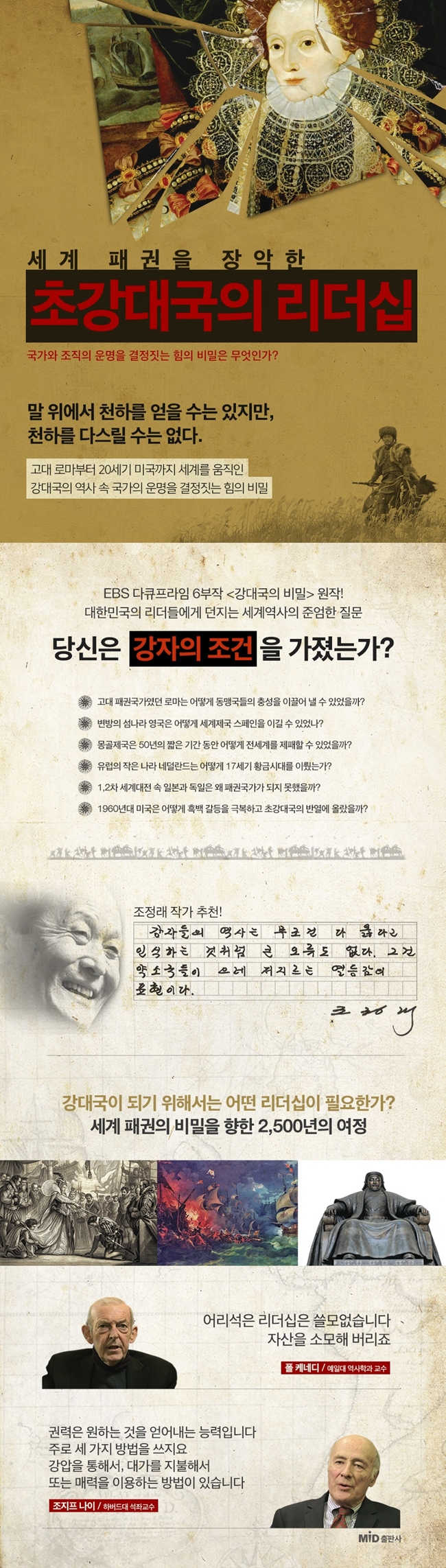
A stark question from world history to the leaders of South Korea.
Do you have the true 'conditions of strength'?
We live in a time when strong leadership is more urgent than ever.
However, as the old Mongol Empire saying goes, “You can rule the world on horseback, but you can’t govern it on horseback,” you can’t lead people with just power and authority.
The true essence of leadership possessed by the strong is not power, but inclusion through tolerance and openness.
America, where Steve Jobs, whose father was Syrian, Obama, whose father was Kenyan, and George Soros, whose father was Hungarian, coexist, has the power to attract talent from around the world simply through its diversity.
Kim Yong, who took office as the President of the World Bank in the United States, also became a hot topic at one time.
But what's remarkable here is not the individual abilities of President Kim Yong, but the fact that America is a country where people from other countries can succeed.
What do you think are the conditions for a strong person?
A 2,500-Year Journey to the Secret of World Hegemony
Find the source of power that determines the fate of nations and organizations.
From the ancient Roman Empire to 20th-century America, 2,500 years of history speak for themselves.
The essence of leadership that creates a great power is not strength.
These were countries that excelled in 'diversity' more than any other country of their time, and were the most 'tolerant' countries by the standards of their time.
By examining how this "tolerance" and "diversity" made them powerful, you will be able to grasp the clues to the conditions that a true strong person must possess.
Through a scholarly approach to the world's most powerful nations and a comparative analysis of their contemporary competitors, this book intuitively reveals their secrets, leading you to universal answers about what every nation, community, and your organization needs to thrive.
Sobering advice from the nation's top scholars
Learn the true 'conditions of being strong' from the leadership of the strong.
“Power is the ability to get what you want.
There are mainly three methods used.
Through coercion, by paying a price,
Or there is a way to use charm.”
Joseph Nye, Professor Emeritus at Harvard University and author of "Soft Power"
Through conversations with world-renowned scholars, including historian Paul Kennedy, famous for his book "The Rise and Fall of the Great Powers," and Harvard professors Joseph Nye and Carl Galinsky, we will hear about the future strategies that Korea, surrounded by great powers, must choose for the 21st century.
A closed attitude is bound to be vulnerable to environmental changes.
This will make you think again about how to apply tolerance and openness in a world constantly surrounded by competition, and what happens if you only focus on what you are familiar with and good at.
Do you have the true 'conditions of strength'?
We live in a time when strong leadership is more urgent than ever.
However, as the old Mongol Empire saying goes, “You can rule the world on horseback, but you can’t govern it on horseback,” you can’t lead people with just power and authority.
The true essence of leadership possessed by the strong is not power, but inclusion through tolerance and openness.
America, where Steve Jobs, whose father was Syrian, Obama, whose father was Kenyan, and George Soros, whose father was Hungarian, coexist, has the power to attract talent from around the world simply through its diversity.
Kim Yong, who took office as the President of the World Bank in the United States, also became a hot topic at one time.
But what's remarkable here is not the individual abilities of President Kim Yong, but the fact that America is a country where people from other countries can succeed.
What do you think are the conditions for a strong person?
A 2,500-Year Journey to the Secret of World Hegemony
Find the source of power that determines the fate of nations and organizations.
From the ancient Roman Empire to 20th-century America, 2,500 years of history speak for themselves.
The essence of leadership that creates a great power is not strength.
These were countries that excelled in 'diversity' more than any other country of their time, and were the most 'tolerant' countries by the standards of their time.
By examining how this "tolerance" and "diversity" made them powerful, you will be able to grasp the clues to the conditions that a true strong person must possess.
Through a scholarly approach to the world's most powerful nations and a comparative analysis of their contemporary competitors, this book intuitively reveals their secrets, leading you to universal answers about what every nation, community, and your organization needs to thrive.
Sobering advice from the nation's top scholars
Learn the true 'conditions of being strong' from the leadership of the strong.
“Power is the ability to get what you want.
There are mainly three methods used.
Through coercion, by paying a price,
Or there is a way to use charm.”
Joseph Nye, Professor Emeritus at Harvard University and author of "Soft Power"
Through conversations with world-renowned scholars, including historian Paul Kennedy, famous for his book "The Rise and Fall of the Great Powers," and Harvard professors Joseph Nye and Carl Galinsky, we will hear about the future strategies that Korea, surrounded by great powers, must choose for the 21st century.
A closed attitude is bound to be vulnerable to environmental changes.
This will make you think again about how to apply tolerance and openness in a world constantly surrounded by competition, and what happens if you only focus on what you are familiar with and good at.
GOODS SPECIFICS
- Date of publication: November 6, 2014
- Page count, weight, size: 432 pages | 774g | 153*224*26mm
- ISBN13: 9791185104133
- ISBN10: 1185104135
You may also like
카테고리
korean


korean

![GQ KOREA Mark (Monthly): December [2025]](http://librairie.coreenne.fr/cdn/shop/files/8ef265dbbfbf186523ed75ba7319009d.jpg?v=1765340328&width=3840)


