

The sunken and the rescued
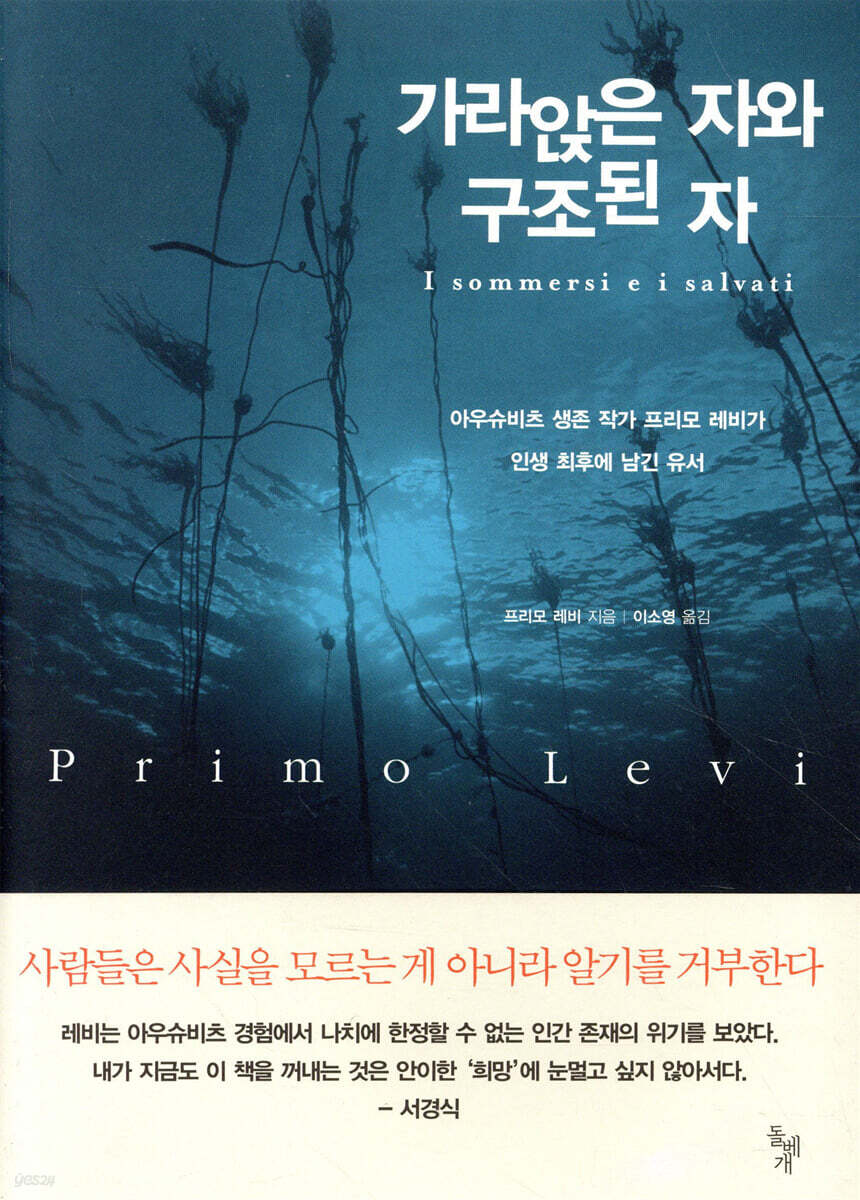 |
Description
Book Introduction
A problematic work that meticulously analyzes Nazism and the human crisis from the perspective of an observer 40 years after the victims of the concentration camps The last work of Auschwitz survivor Primo Levi This book, written 38 years after the publication of Is This a Human Being, which has been considered a testimonial work, is an essay analyzing the violence of the Nazis and the phenomenon of concentration camps based on the experience of Auschwitz. It is a work that is like a will for Levi, especially since it was written a year before he ended his life by suicide and it directly addresses the issue of Auschwitz, which was a central theme in his life as a survivor. In this book, Levy sharply examines the issues of memory, pain, and power relations between perpetrators and victims, the drowned (the dead) and the rescued (the survivors) through the phenomena that occurred within the concentration camps. This is a monumental work among books testifying to the Holocaust, as it coolly analyzes the events of that day from a person who was a victim of violence beyond imagination and a victim of the "destruction of humanity." Watch the video 'The Drowned and the Rescued' *Click* |
- You can preview some of the book's contents.
Preview
index
introduction
1.
Memories of wounds
2.
gray area
3.
black eye
4.
Communicate
5.
needless violence
6.
intellectuals of Auschwitz
7.
stereotypes
8.
Letters from Germans
conclusion
Appendix 1: Interview with Primo Leviwara Stampazi
Appendix 2: Chronology of Primo Levi
Appendix 3: Commentary on the work_Seo Kyung-sik
1.
Memories of wounds
2.
gray area
3.
black eye
4.
Communicate
5.
needless violence
6.
intellectuals of Auschwitz
7.
stereotypes
8.
Letters from Germans
conclusion
Appendix 1: Interview with Primo Leviwara Stampazi
Appendix 2: Chronology of Primo Levi
Appendix 3: Commentary on the work_Seo Kyung-sik
Publisher's Review
A victim of the concentration camps, from the perspective of an observer 40 years later, looks back on Nazism and
A problematic work that meticulously analyzes the human crisis
▶ A masterpiece of 20th-century testimonial literature that examines the crisis of human existence through Auschwitz.
The Drowned and the Saved (1986), the last work of Auschwitz survivor and writer Primo Levi, is being translated and introduced in Korea for the first time.
Primo Levi is a writer widely known in Korea for his classic work, If This Is a Man.
The Drowned and the Saved is a brilliant essay written by Levi 40 years after his release from the camp and 38 years after writing If This Is a Man, drawing on his experience in Auschwitz to analyze Nazi brutality and the phenomenon of the concentration camps.
It is a work that is like a will for Levi, especially since it was written a year before he ended his life by suicide and it directly addresses the issue of Auschwitz, which was a central theme in his life as a survivor.
In this book, Levy sharply examines the issues of memory, pain, and power relations between perpetrators and victims, the drowned (the dead) and the rescued (the survivors) through the phenomena that occurred within the concentration camps.
From 1933 to 1945, Germany systematically and systematically persecuted Jews, Gypsies, the disabled, sexual minorities, and political opponents, leading to the Holocaust.
This event was unprecedented in human history, both in scale and nature.
This book is a monumental work among those bearing witness to the Holocaust, as it coolly analyzes the events of that day from a person who was a victim of unimaginable violence and the "destruction of humanity."
Usually, the witness and the analyst (researcher) are inevitably separated, and even if it is not intentional, distortion or distance is bound to arise between the two.
However, Levy leaves no room for such distortion through thorough self-reflection and critical thinking.
The author mercilessly criticizes survivors, including himself.
It delves deep into the unconscious distortions in the memories of survivors, and the roots of the shame and guilt they experienced at the moment of liberation.
Levi saw in his Auschwitz experience a crisis of human existence that was not confined to the Nazis.
The world of the concentration camp that Levy depicts is a microcosm of the human world.
The prisoners within it fight fiercely for a handful of power and to create a lower class than themselves.
Levy vividly shows, through the laboratory of the concentration camp, how humans exposed to a system of violence come to resemble that system.
This book consists of an introduction, eight chapters: Chapter 1: Memory of Wounds, Chapter 2: Gray Areas, Chapter 3: Shame, Chapter 4: Communicating, Chapter 5: Useless Violence, Chapter 6: Intellectuals in Auschwitz, Chapter 7: Stereotypes, Chapter 8: Letters from Germans, and a conclusion.
Each of these topics goes beyond the Auschwitz issue and raises deeply controversial questions surrounding human existence.
Auschwitz poses many critical questions to us: violence (why such terrible violence?), responsibility (who is responsible, and to what extent?), memory (how will this event be remembered?), testimony (can this event be testified to, and can the testimony be passed on?), ethics (what should we think about not sharing a sip of water that was accidentally obtained in the midst of extreme exhaustion and thirst with a comrade?).
▶ The Gray Area Created by Oppression - How Are People Seduced by Power?
The most controversial part at the time of publication was Chapter 2, “The Gray Zone.”
It contains an analysis of the power that prisoners in the camps exercised over their weaker victims.
Levy resists the rhetoric often used to describe the survivors as returning heroes, and instead exposes their passive and violent world hidden beneath the surface.
New prisoners entered the camp expecting solidarity from fellow prisoners who shared their misfortune, but the first violence came from privileged fellow prisoners.
These were people who had secured special privileges, big or small, by cooperating with the authorities to escape the “final solution” (the gas chambers) or to eat one more bowl of porridge.
Privileged prisoners were a minority of the camp population, but they made up the overwhelming majority of the survivors.
Through the story of Chaim Rumkowski, the chairman of the Łódź ghetto, Levy vividly depicts how, within a system of oppression, a person comes to resemble that system.
Rumkowski, a failed businessman and known head of Jewish charities, is promoted to ghetto commissioner by vicious Nazi taunts.
He begins to imitate the monarch of an absolute monarchy.
He created his own currency, raised his own personal guard, and commissioned outstanding artists and craftsmen to print stamps bearing his likeness.
He also gave students a writing assignment praising themselves.
Meanwhile, he becomes increasingly convinced that he is the Messiah and the savior of his people.
But in September 1944, as the Russian front drew near, the Nazis began to liquidate the Lodz ghetto.
Tens of thousands of prisoners were forcibly deported to Auschwitz.
“Whether cowardly or heroic, humble or arrogant, the fate of the Jews in German hands was one.” The fate of the Jewish king, Rumkowski, was no different.
Rumkovsky represents our human frailty, easily seduced by power and prestige.
For Levy, this is a recurring spectacle throughout history.
Levy recalls the bloody struggles that took place in Hitler's court and among the ministers of the Republic of Salo in the final days of World War II.
They too were grey men, blind at first, then criminals, and fought fiercely to share the power of the dying, evil handful.
Levy emphasizes that Rumkowski's story is soon our story.
It is a story about the lower classes of power who work for a system and willingly turn a blind eye to the system's sins.
This is a story about mid-level executives who sign everything because it doesn't cost money.
It is the story of a man who shakes his head but acquiesces, and of a man who says, “If I don’t do it, someone worse than me will.”
(……) We all forget that we are in a ghetto (……) that outside there are the masters of death and that a train is waiting not far away.
In this way, we compromise with power, whether willingly or not. (pp. 79-80)
But Levi's concern was not with condemning or forgiving each individual who was inevitably complicit in the crimes committed at each level of the vast apparatus of oppression.
Rather, he accurately understood the criminality of the system itself and paid attention to the mechanism by which ordinary people, who cannot be divided into good and evil, become perpetrators or accomplices in the crimes of the oppressive apparatus.
▶ The essence of Nazi violence - the 'enemy' must not only die, but die in agony.
Levy identifies needless violence as one of the defining characteristics of Hitlerism.
Murderers usually have a clear motive for killing, whether it is for money or to suppress an enemy.
War also aims at some goal, even if it is a bad or evil goal.
It does not aim to inflict pain in itself.
However, a series of cases that occurred under the Nazi regime show the needless cruelty to prisoners.
The deportees were loaded onto trains without any preparation, including food, water, and even chamber pots.
Some people went crazy after going through hell for days or weeks.
Even after arriving at the camp, the prisoners endured horrific experiences that turned them into animals, such as the daily evening roll call (even the dead had to appear lying down), routine stripping, and eating porridge with their bare hands.
Levy shudders at the sight of such Nazi brutality.
Why did we have to break down the doors of dying people's homes? Why did we have to go through the trouble of dragging them on a train, only to have them die on the brink of a gas chamber in Poland after a long, pointless journey? On my train were two ninety-year-old women, both dying. One of them, cared for by her daughters, died in vain during the journey.
Wouldn't it have been simpler and more 'economical' to simply leave them to die in their beds, or even kill them on the spot, rather than add their suffering to the collective suffering on the train? (p. 145)
This kind of Nazi violence can also be seen through the Sonderkommandos, a special unit composed mainly of Jews.
Their gruesome task is to manage the camp's crematorium.
The series of tasks involved imposing order among those who were to be sent to the gas chambers, removing the bodies from the gas chambers and transporting them to the crematorium, and removing and disposing of the ashes.
Soon, “it was the Jews who had to be put in the furnaces.” Through these institutions, the Nazis attempted to shift the burden of guilt onto the victims.
Levy reads a message from the presence of the special forces.
We, the ruling race, are your destroyers, but you are no better than us.
If we only want to, we have the power to destroy not only your bodies but also your souls.
As if we had destroyed our souls.
(Page 61)
Levy thinks that the choice imposed from above by the Hitler regime was not to “extract maximum suffering, maximum mental and moral pain” from the prisoners.
The 'enemy' must not only die, but die in pain.
Likewise, Levi confronts the shocking truth about Nazi atrocities in an interview with former Treblinka commander Franz Stangl.
“We were going to kill them anyway… What was the point of humiliating them and committing cruel acts?” the author asked Stangl, who was serving a life sentence in a Düsseldorf prison.
“To train those who actually had to perform the mission.
“To enable them to do what they were doing.” (p. 152)
One of the reasons the Nazis committed atrocities against prisoners was to alleviate the guilt of those who killed them.
In order for the killer to do his job properly, the victim needed to be degraded to less than human before he died.
▶ The shame and guilt experienced by survivors - All the best people are dead
According to Levy, liberation was not always a happy experience for the prisoners.
As they regained their freedom, they were overcome with shame and guilt.
"When they emerged from the darkness, they were tormented by the realization that part of their being had been taken away." What was the nature of this guilt? When it was all over, the survivors realized they had done nothing, or not done enough, to challenge the system they had been swept up in.
It was also the case in terms of a failure of solidarity.
The survivors felt guilty for not helping at that time.
The weaker and more clumsy colleague next to me would persistently harass me by asking for help, or simply by being there.
Usually, they were in a situation where they needed help a lot, but the guilt did not go away.
But there is another shame that makes Levi feel guilty.
Levy can't shake the suspicion that he may have taken someone's place and survived.
Are you ashamed to have survived in someone else's place? Especially someone more generous, more sensitive, wiser, more useful, and more qualified than you? (p. 95)
This deep-seated suspicion—that I might be alive at the expense of others, and thus, in effect, killed—comes from the fact that the “rescued” in the camps were not the best of people, but rather the worst of the worst.
All the best people are dead.
It wasn't because they were bad.
They died because of the virtue of courage they possessed.
On the other hand, the worst of the worst took their place, as did the egoists, the gray zone collaborators, and those who had adapted to the camp system.
So Levy feels like he's somehow blended into the group of rescued people.
The real witnesses are not our survivors.
We survivors are an exceptional minority, not a small minority, who have not hit rock bottom through abuse of power, cleverness, or luck.
Those who hit the floor, those who saw the Gorgon, either did not return to testify, or returned mute.
But they are the “Muslims,” the sunken ones, the perfect witnesses (……).
They are the rule and we are the exception. (pp. 98-99)
Along with this, Levi speaks of a broader sense of shame felt by the righteous among us.
Many people feel pain of guilt and shame because of the wrongdoings of others and because they feel they are complicit in them.
Because they feel that what is happening around them, before their eyes, and inside them is irreversible.
Levy adds that this suffering is something that only humans can experience.
▶ People don't know the facts; they just refuse to know them.
Levy decorates the final chapter of this book with letters sent to him by Germans.
Levy is excited to hear that a German publisher has contracted the translation rights to Is This Human?
Because the real recipients of this book and the people it was aimed at like a weapon were the Germans.
However, among the 40 or so letters sent to him, some still contain the same excuses and deceptions, such as “I didn’t know” and “I had no choice.”
As Seo Gyeong-sik, who wrote the commentary for this book, pointed out, in the period shortly after the end of the war, there was a dominant tendency to explain Nazi leaders by pointing them out as “devils” possessed by “madness.”
However, as time passed and research deepened, such simple logic became invalid, and the "inconvenient truth" that the "Holocaust" was realized because of the active sympathy of ordinary people, including Germans and people from other European countries, became clear.
Levy points out that “the real sin of almost all Germans at that time was that they did not have the courage to speak out.”
The failure to spread the truth about the Lager is one of the greatest collective crimes committed by the German people and the clearest proof of the cowardice to which the German people were subjected by Hitler's terror.
It is a cowardice that has become ingrained in custom, a cowardice so deep that it prevents husbands from opening their mouths to their wives, and parents from opening their mouths to their children.
If this cowardice had not existed, we would not have gone to such extremes, and Europe and the world would be different today.
(Page 14)
The title of this book, “The Drowned and the Saved,” was taken by Levi from Dante’s Inferno.
“The sunken” is a metaphor for those who were swept away by the extermination system of the concentration camp.
Levy says they are the “perfect witnesses.”
The survivors, the rescued ones, are only there to testify on their behalf.
But despite his efforts, Levi became increasingly convinced in the final years of his life that the lessons of the Holocaust would be forgotten as just another of history's more common atrocities.
This book, which is like Levi's last will and testament, has even more significance in that respect.
The questions of what Auschwitz really was, whether the incident was truly over, and how safe we, living in the present, are from it will likely cause considerable concern for Korean readers today.
A problematic work that meticulously analyzes the human crisis
▶ A masterpiece of 20th-century testimonial literature that examines the crisis of human existence through Auschwitz.
The Drowned and the Saved (1986), the last work of Auschwitz survivor and writer Primo Levi, is being translated and introduced in Korea for the first time.
Primo Levi is a writer widely known in Korea for his classic work, If This Is a Man.
The Drowned and the Saved is a brilliant essay written by Levi 40 years after his release from the camp and 38 years after writing If This Is a Man, drawing on his experience in Auschwitz to analyze Nazi brutality and the phenomenon of the concentration camps.
It is a work that is like a will for Levi, especially since it was written a year before he ended his life by suicide and it directly addresses the issue of Auschwitz, which was a central theme in his life as a survivor.
In this book, Levy sharply examines the issues of memory, pain, and power relations between perpetrators and victims, the drowned (the dead) and the rescued (the survivors) through the phenomena that occurred within the concentration camps.
From 1933 to 1945, Germany systematically and systematically persecuted Jews, Gypsies, the disabled, sexual minorities, and political opponents, leading to the Holocaust.
This event was unprecedented in human history, both in scale and nature.
This book is a monumental work among those bearing witness to the Holocaust, as it coolly analyzes the events of that day from a person who was a victim of unimaginable violence and the "destruction of humanity."
Usually, the witness and the analyst (researcher) are inevitably separated, and even if it is not intentional, distortion or distance is bound to arise between the two.
However, Levy leaves no room for such distortion through thorough self-reflection and critical thinking.
The author mercilessly criticizes survivors, including himself.
It delves deep into the unconscious distortions in the memories of survivors, and the roots of the shame and guilt they experienced at the moment of liberation.
Levi saw in his Auschwitz experience a crisis of human existence that was not confined to the Nazis.
The world of the concentration camp that Levy depicts is a microcosm of the human world.
The prisoners within it fight fiercely for a handful of power and to create a lower class than themselves.
Levy vividly shows, through the laboratory of the concentration camp, how humans exposed to a system of violence come to resemble that system.
This book consists of an introduction, eight chapters: Chapter 1: Memory of Wounds, Chapter 2: Gray Areas, Chapter 3: Shame, Chapter 4: Communicating, Chapter 5: Useless Violence, Chapter 6: Intellectuals in Auschwitz, Chapter 7: Stereotypes, Chapter 8: Letters from Germans, and a conclusion.
Each of these topics goes beyond the Auschwitz issue and raises deeply controversial questions surrounding human existence.
Auschwitz poses many critical questions to us: violence (why such terrible violence?), responsibility (who is responsible, and to what extent?), memory (how will this event be remembered?), testimony (can this event be testified to, and can the testimony be passed on?), ethics (what should we think about not sharing a sip of water that was accidentally obtained in the midst of extreme exhaustion and thirst with a comrade?).
▶ The Gray Area Created by Oppression - How Are People Seduced by Power?
The most controversial part at the time of publication was Chapter 2, “The Gray Zone.”
It contains an analysis of the power that prisoners in the camps exercised over their weaker victims.
Levy resists the rhetoric often used to describe the survivors as returning heroes, and instead exposes their passive and violent world hidden beneath the surface.
New prisoners entered the camp expecting solidarity from fellow prisoners who shared their misfortune, but the first violence came from privileged fellow prisoners.
These were people who had secured special privileges, big or small, by cooperating with the authorities to escape the “final solution” (the gas chambers) or to eat one more bowl of porridge.
Privileged prisoners were a minority of the camp population, but they made up the overwhelming majority of the survivors.
Through the story of Chaim Rumkowski, the chairman of the Łódź ghetto, Levy vividly depicts how, within a system of oppression, a person comes to resemble that system.
Rumkowski, a failed businessman and known head of Jewish charities, is promoted to ghetto commissioner by vicious Nazi taunts.
He begins to imitate the monarch of an absolute monarchy.
He created his own currency, raised his own personal guard, and commissioned outstanding artists and craftsmen to print stamps bearing his likeness.
He also gave students a writing assignment praising themselves.
Meanwhile, he becomes increasingly convinced that he is the Messiah and the savior of his people.
But in September 1944, as the Russian front drew near, the Nazis began to liquidate the Lodz ghetto.
Tens of thousands of prisoners were forcibly deported to Auschwitz.
“Whether cowardly or heroic, humble or arrogant, the fate of the Jews in German hands was one.” The fate of the Jewish king, Rumkowski, was no different.
Rumkovsky represents our human frailty, easily seduced by power and prestige.
For Levy, this is a recurring spectacle throughout history.
Levy recalls the bloody struggles that took place in Hitler's court and among the ministers of the Republic of Salo in the final days of World War II.
They too were grey men, blind at first, then criminals, and fought fiercely to share the power of the dying, evil handful.
Levy emphasizes that Rumkowski's story is soon our story.
It is a story about the lower classes of power who work for a system and willingly turn a blind eye to the system's sins.
This is a story about mid-level executives who sign everything because it doesn't cost money.
It is the story of a man who shakes his head but acquiesces, and of a man who says, “If I don’t do it, someone worse than me will.”
(……) We all forget that we are in a ghetto (……) that outside there are the masters of death and that a train is waiting not far away.
In this way, we compromise with power, whether willingly or not. (pp. 79-80)
But Levi's concern was not with condemning or forgiving each individual who was inevitably complicit in the crimes committed at each level of the vast apparatus of oppression.
Rather, he accurately understood the criminality of the system itself and paid attention to the mechanism by which ordinary people, who cannot be divided into good and evil, become perpetrators or accomplices in the crimes of the oppressive apparatus.
▶ The essence of Nazi violence - the 'enemy' must not only die, but die in agony.
Levy identifies needless violence as one of the defining characteristics of Hitlerism.
Murderers usually have a clear motive for killing, whether it is for money or to suppress an enemy.
War also aims at some goal, even if it is a bad or evil goal.
It does not aim to inflict pain in itself.
However, a series of cases that occurred under the Nazi regime show the needless cruelty to prisoners.
The deportees were loaded onto trains without any preparation, including food, water, and even chamber pots.
Some people went crazy after going through hell for days or weeks.
Even after arriving at the camp, the prisoners endured horrific experiences that turned them into animals, such as the daily evening roll call (even the dead had to appear lying down), routine stripping, and eating porridge with their bare hands.
Levy shudders at the sight of such Nazi brutality.
Why did we have to break down the doors of dying people's homes? Why did we have to go through the trouble of dragging them on a train, only to have them die on the brink of a gas chamber in Poland after a long, pointless journey? On my train were two ninety-year-old women, both dying. One of them, cared for by her daughters, died in vain during the journey.
Wouldn't it have been simpler and more 'economical' to simply leave them to die in their beds, or even kill them on the spot, rather than add their suffering to the collective suffering on the train? (p. 145)
This kind of Nazi violence can also be seen through the Sonderkommandos, a special unit composed mainly of Jews.
Their gruesome task is to manage the camp's crematorium.
The series of tasks involved imposing order among those who were to be sent to the gas chambers, removing the bodies from the gas chambers and transporting them to the crematorium, and removing and disposing of the ashes.
Soon, “it was the Jews who had to be put in the furnaces.” Through these institutions, the Nazis attempted to shift the burden of guilt onto the victims.
Levy reads a message from the presence of the special forces.
We, the ruling race, are your destroyers, but you are no better than us.
If we only want to, we have the power to destroy not only your bodies but also your souls.
As if we had destroyed our souls.
(Page 61)
Levy thinks that the choice imposed from above by the Hitler regime was not to “extract maximum suffering, maximum mental and moral pain” from the prisoners.
The 'enemy' must not only die, but die in pain.
Likewise, Levi confronts the shocking truth about Nazi atrocities in an interview with former Treblinka commander Franz Stangl.
“We were going to kill them anyway… What was the point of humiliating them and committing cruel acts?” the author asked Stangl, who was serving a life sentence in a Düsseldorf prison.
“To train those who actually had to perform the mission.
“To enable them to do what they were doing.” (p. 152)
One of the reasons the Nazis committed atrocities against prisoners was to alleviate the guilt of those who killed them.
In order for the killer to do his job properly, the victim needed to be degraded to less than human before he died.
▶ The shame and guilt experienced by survivors - All the best people are dead
According to Levy, liberation was not always a happy experience for the prisoners.
As they regained their freedom, they were overcome with shame and guilt.
"When they emerged from the darkness, they were tormented by the realization that part of their being had been taken away." What was the nature of this guilt? When it was all over, the survivors realized they had done nothing, or not done enough, to challenge the system they had been swept up in.
It was also the case in terms of a failure of solidarity.
The survivors felt guilty for not helping at that time.
The weaker and more clumsy colleague next to me would persistently harass me by asking for help, or simply by being there.
Usually, they were in a situation where they needed help a lot, but the guilt did not go away.
But there is another shame that makes Levi feel guilty.
Levy can't shake the suspicion that he may have taken someone's place and survived.
Are you ashamed to have survived in someone else's place? Especially someone more generous, more sensitive, wiser, more useful, and more qualified than you? (p. 95)
This deep-seated suspicion—that I might be alive at the expense of others, and thus, in effect, killed—comes from the fact that the “rescued” in the camps were not the best of people, but rather the worst of the worst.
All the best people are dead.
It wasn't because they were bad.
They died because of the virtue of courage they possessed.
On the other hand, the worst of the worst took their place, as did the egoists, the gray zone collaborators, and those who had adapted to the camp system.
So Levy feels like he's somehow blended into the group of rescued people.
The real witnesses are not our survivors.
We survivors are an exceptional minority, not a small minority, who have not hit rock bottom through abuse of power, cleverness, or luck.
Those who hit the floor, those who saw the Gorgon, either did not return to testify, or returned mute.
But they are the “Muslims,” the sunken ones, the perfect witnesses (……).
They are the rule and we are the exception. (pp. 98-99)
Along with this, Levi speaks of a broader sense of shame felt by the righteous among us.
Many people feel pain of guilt and shame because of the wrongdoings of others and because they feel they are complicit in them.
Because they feel that what is happening around them, before their eyes, and inside them is irreversible.
Levy adds that this suffering is something that only humans can experience.
▶ People don't know the facts; they just refuse to know them.
Levy decorates the final chapter of this book with letters sent to him by Germans.
Levy is excited to hear that a German publisher has contracted the translation rights to Is This Human?
Because the real recipients of this book and the people it was aimed at like a weapon were the Germans.
However, among the 40 or so letters sent to him, some still contain the same excuses and deceptions, such as “I didn’t know” and “I had no choice.”
As Seo Gyeong-sik, who wrote the commentary for this book, pointed out, in the period shortly after the end of the war, there was a dominant tendency to explain Nazi leaders by pointing them out as “devils” possessed by “madness.”
However, as time passed and research deepened, such simple logic became invalid, and the "inconvenient truth" that the "Holocaust" was realized because of the active sympathy of ordinary people, including Germans and people from other European countries, became clear.
Levy points out that “the real sin of almost all Germans at that time was that they did not have the courage to speak out.”
The failure to spread the truth about the Lager is one of the greatest collective crimes committed by the German people and the clearest proof of the cowardice to which the German people were subjected by Hitler's terror.
It is a cowardice that has become ingrained in custom, a cowardice so deep that it prevents husbands from opening their mouths to their wives, and parents from opening their mouths to their children.
If this cowardice had not existed, we would not have gone to such extremes, and Europe and the world would be different today.
(Page 14)
The title of this book, “The Drowned and the Saved,” was taken by Levi from Dante’s Inferno.
“The sunken” is a metaphor for those who were swept away by the extermination system of the concentration camp.
Levy says they are the “perfect witnesses.”
The survivors, the rescued ones, are only there to testify on their behalf.
But despite his efforts, Levi became increasingly convinced in the final years of his life that the lessons of the Holocaust would be forgotten as just another of history's more common atrocities.
This book, which is like Levi's last will and testament, has even more significance in that respect.
The questions of what Auschwitz really was, whether the incident was truly over, and how safe we, living in the present, are from it will likely cause considerable concern for Korean readers today.
GOODS SPECIFICS
- Date of issue: May 12, 2014
- Page count, weight, size: 280 pages | 418g | 145*205*20mm
- ISBN13: 9788971996041
- ISBN10: 8971996048
You may also like
카테고리
korean


korean

![GQ KOREA Mark (Monthly): December [2025]](http://librairie.coreenne.fr/cdn/shop/files/8ef265dbbfbf186523ed75ba7319009d.jpg?v=1765340328&width=3840)


