

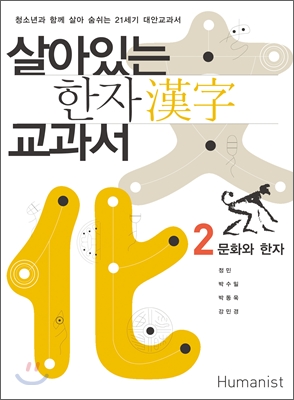
Living Chinese Character Textbook 2
 |
Description
Book Introduction
Thousand Character Classic, a synonym for studying Chinese characters.
However, Dasan Jeong Yak-yong once emphasized that people who are just starting to study should never read the Thousand Character Classic.
This is because the Thousand Character Classic makes you memorize each and every character without thinking, such as by simply listing characters and then suddenly switching to colors (think of the Thousand Character Classic's 'state of the world').
This book does not simply explain Chinese characters, idioms, and proverbs.
Instead, we looked at the cultural meaning contained in Chinese characters frequently used in daily life, such as ‘guess’ and ‘search’, and then moved on to other similar words.
This will have the effect of organizing the series of words in a clear and concise manner.
Therefore, readers of the book can naturally learn not only Chinese characters but also the culture they contain.
However, Dasan Jeong Yak-yong once emphasized that people who are just starting to study should never read the Thousand Character Classic.
This is because the Thousand Character Classic makes you memorize each and every character without thinking, such as by simply listing characters and then suddenly switching to colors (think of the Thousand Character Classic's 'state of the world').
This book does not simply explain Chinese characters, idioms, and proverbs.
Instead, we looked at the cultural meaning contained in Chinese characters frequently used in daily life, such as ‘guess’ and ‘search’, and then moved on to other similar words.
This will have the effect of organizing the series of words in a clear and concise manner.
Therefore, readers of the book can naturally learn not only Chinese characters but also the culture they contain.
- You can preview some of the book's contents.
Preview
index
preface
The power to read Chinese characters and culture
一 Signs and Symbols
1.
The meaning behind the numbers
Why do we shout "Manse" three times? / The four directions that connect to the four directions / The five sounds, the five constants, the five elements / The nine-layered palace
2.
Color and hue
White and plain clothes / Blue from indigo, blue comes from indigo / Red dot and single-mindedness / Black heart and black curtain
-Chinese Characters and Culture 1- Training in Dantian and Danhak
3.
length of time
Minute and angle / In a flash and in the blink of an eye / Moment and a moment / Eternity and eternity
-Reading Old Paintings 1-Students Studying in the Past
Two animals and Chinese characters
1.
Chinese characters related to wild animals
Recklessness and blindness / Leopard change and sudden change / Shrinkage and shrinkage / Imagination and imagination
2.
Chinese characters related to birds
Hanging a neck from a tree / A famous archer who hits the target / Waiting with a crane's head on his shoulder / Staring at the eagle
3.
fish and bugs
The encroachment of mulberry leaves / The rise of bees and the rise of ants / The dwelling of insects and the startling of insects / The mirage and the castle in the sky
-Chinese Characters and Culture 2-The Shape of the Korean Peninsula and the Tiger Map
4.
Imaginary animals
Yongsucheol (龍鬚鐵) and Yeokrin (逆鱗) / The promising Kirin-ah (麒麟兒) / Haetae (海苔) with eyes like bells / Nangpae (狼狽) and Nangja (狼藉)
-Reading Old Paintings 2-The Hidden Meaning of the Butterfly and Cat Painting
Three Plants and Chinese Characters
1.
Chinese characters related to grass
Floating bulrushes on the water / Manyeon and Myeonmyeon / Life like mustard / Hair in disarray and mugwort fields
2.
Chinese characters related to trees
The deepening conflict (葛藤) / The momentum of breaking bamboo and bamboo shoots after the rain / The pain of thorns and sticks / The mulberry field and the blue sea and the mulberry bush
3.
Chinese characters related to vegetables
Radish and napa cabbage kimchi / gourd and pumpkin / cabbage, chives, and lettuce / burdock and spinach
4.
Chinese characters related to grains
Sprouts and Ssagaji / What if the country is in danger? / A wife who has suffered alongside you in times of hardship, a wife of grain / High-quality liquor and sorghum stalks
-Reading Old Paintings 3-Dangling Branches and Cucumbers
Four cultures of food, clothing, and shelter
1.
Clothing culture
Green clothing and red skirt, green jacket and red skirt / The white-clad people who loved white clothes / Returning home in brocade and adding flowers to brocade / Collar and sleeves, Yeongsu
-Chinese Characters and Culture 4-Types of Hats
Chinese Characters and Culture 5 - Different Types of Shoes
2.
food culture
Soup culture using spoons / Kimchi, a global food / Noodles and Jajangmyeon / Rice and the culture of theft
3.
drinking culture
A vain drink / A toast and a bitter cup / A round of cups and a pavilion / Is it a hangover cure or a hangover cure?
4.
Housing culture
Laying the cornerstone / Beams and ridgepole inscriptions / Heonheonjangbu and the old man in the pavilion / Fragile roof tiles, collapse
-Reading Old Paintings 4-What happens when a chicken and a mandrake meet?
Five Systems and Life
1.
Past testing sites
Formulate a plan / Examination and performance evaluation / Failure and failing grade / Chaotic scene
-Chinese Characters and Culture 6-Chaotic and Crazy Cheat Sheets
2.
Marriage and Family
When lighting a candle / What is the relationship between dew and water / honeymoon / gift and contribution?
3.
Military and military tactics
Running for office and declaring one's candidacy / Back-to-water formation and long snake formation / Stopgap measures and desperate measures / Strongholds and Iron Fortresses
4.
Law and Punishment
Patrol and the Thief / The Thief's Office and the Hooligans / The Shackles and the Prison
-Reading old paintings 5- Traveling across the four seas
Six Arts and Sciences
1.
Music and instruments
Drumming and dancing / Tension and relaxation / Inflexible stick drum / Byeon-juk and Bok-pan
2.
Arts and Crafts
Self-portrait and self-praise / Painting first, then the essence / A painting without bones, a painting without bones / You must refine your character
-Chinese Characters and Culture 7-Nam Nabi, who only drew butterfly pictures
3.
Sky and Astronomy
Words referring to constellations, field / compatibility and four pillars / comets and meteors / physiognomy and physiognomy
4.
Land and Geography
The trajectory and the direction of the world / Public opinion and the remaining land / The watershed where waterways diverge / The land of joy and the world of the same kind
-Reading Old Paintings 6-The Meaning of the Three White Herons
Why is the latter in Chinese characters again?
The power to read Chinese characters and culture
一 Signs and Symbols
1.
The meaning behind the numbers
Why do we shout "Manse" three times? / The four directions that connect to the four directions / The five sounds, the five constants, the five elements / The nine-layered palace
2.
Color and hue
White and plain clothes / Blue from indigo, blue comes from indigo / Red dot and single-mindedness / Black heart and black curtain
-Chinese Characters and Culture 1- Training in Dantian and Danhak
3.
length of time
Minute and angle / In a flash and in the blink of an eye / Moment and a moment / Eternity and eternity
-Reading Old Paintings 1-Students Studying in the Past
Two animals and Chinese characters
1.
Chinese characters related to wild animals
Recklessness and blindness / Leopard change and sudden change / Shrinkage and shrinkage / Imagination and imagination
2.
Chinese characters related to birds
Hanging a neck from a tree / A famous archer who hits the target / Waiting with a crane's head on his shoulder / Staring at the eagle
3.
fish and bugs
The encroachment of mulberry leaves / The rise of bees and the rise of ants / The dwelling of insects and the startling of insects / The mirage and the castle in the sky
-Chinese Characters and Culture 2-The Shape of the Korean Peninsula and the Tiger Map
4.
Imaginary animals
Yongsucheol (龍鬚鐵) and Yeokrin (逆鱗) / The promising Kirin-ah (麒麟兒) / Haetae (海苔) with eyes like bells / Nangpae (狼狽) and Nangja (狼藉)
-Reading Old Paintings 2-The Hidden Meaning of the Butterfly and Cat Painting
Three Plants and Chinese Characters
1.
Chinese characters related to grass
Floating bulrushes on the water / Manyeon and Myeonmyeon / Life like mustard / Hair in disarray and mugwort fields
2.
Chinese characters related to trees
The deepening conflict (葛藤) / The momentum of breaking bamboo and bamboo shoots after the rain / The pain of thorns and sticks / The mulberry field and the blue sea and the mulberry bush
3.
Chinese characters related to vegetables
Radish and napa cabbage kimchi / gourd and pumpkin / cabbage, chives, and lettuce / burdock and spinach
4.
Chinese characters related to grains
Sprouts and Ssagaji / What if the country is in danger? / A wife who has suffered alongside you in times of hardship, a wife of grain / High-quality liquor and sorghum stalks
-Reading Old Paintings 3-Dangling Branches and Cucumbers
Four cultures of food, clothing, and shelter
1.
Clothing culture
Green clothing and red skirt, green jacket and red skirt / The white-clad people who loved white clothes / Returning home in brocade and adding flowers to brocade / Collar and sleeves, Yeongsu
-Chinese Characters and Culture 4-Types of Hats
Chinese Characters and Culture 5 - Different Types of Shoes
2.
food culture
Soup culture using spoons / Kimchi, a global food / Noodles and Jajangmyeon / Rice and the culture of theft
3.
drinking culture
A vain drink / A toast and a bitter cup / A round of cups and a pavilion / Is it a hangover cure or a hangover cure?
4.
Housing culture
Laying the cornerstone / Beams and ridgepole inscriptions / Heonheonjangbu and the old man in the pavilion / Fragile roof tiles, collapse
-Reading Old Paintings 4-What happens when a chicken and a mandrake meet?
Five Systems and Life
1.
Past testing sites
Formulate a plan / Examination and performance evaluation / Failure and failing grade / Chaotic scene
-Chinese Characters and Culture 6-Chaotic and Crazy Cheat Sheets
2.
Marriage and Family
When lighting a candle / What is the relationship between dew and water / honeymoon / gift and contribution?
3.
Military and military tactics
Running for office and declaring one's candidacy / Back-to-water formation and long snake formation / Stopgap measures and desperate measures / Strongholds and Iron Fortresses
4.
Law and Punishment
Patrol and the Thief / The Thief's Office and the Hooligans / The Shackles and the Prison
-Reading old paintings 5- Traveling across the four seas
Six Arts and Sciences
1.
Music and instruments
Drumming and dancing / Tension and relaxation / Inflexible stick drum / Byeon-juk and Bok-pan
2.
Arts and Crafts
Self-portrait and self-praise / Painting first, then the essence / A painting without bones, a painting without bones / You must refine your character
-Chinese Characters and Culture 7-Nam Nabi, who only drew butterfly pictures
3.
Sky and Astronomy
Words referring to constellations, field / compatibility and four pillars / comets and meteors / physiognomy and physiognomy
4.
Land and Geography
The trajectory and the direction of the world / Public opinion and the remaining land / The watershed where waterways diverge / The land of joy and the world of the same kind
-Reading Old Paintings 6-The Meaning of the Three White Herons
Why is the latter in Chinese characters again?
GOODS SPECIFICS
- Date of publication: May 23, 2011
- Page count, weight, size: 284 pages | 689g | 188*257*20mm
- ISBN13: 9788958620105
- ISBN10: 8958620102
You may also like
카테고리
korean


korean

![GQ KOREA Mark (Monthly): December [2025]](http://librairie.coreenne.fr/cdn/shop/files/8ef265dbbfbf186523ed75ba7319009d.jpg?v=1765340328&width=3840)


