

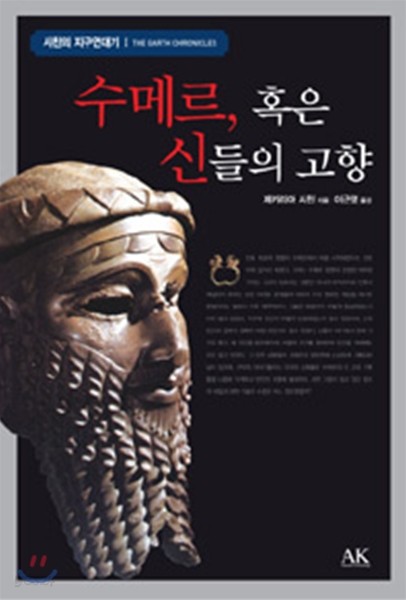
Sumer, or the home of the gods
 |
Description
Book Introduction
The convergence of evolution and creationism that reveals the secret of human birth.
What is the identity of the gods who created humans, and how did human history begin?
This book, part of archaeologist Zecharia Sitchin's "Earth's Timeline" series, covers the history of Sumer, the birthplace of the first civilization, and traces the footsteps of humanity through it.
In Sumer, or the Home of the Gods, the author focuses on the question of how humans first came into being, and talks about the aliens who created humans and established the first civilization on Earth, or more specifically, the divine beings of the 12th planet.
The Sumerian clay tablets that the author has revived contain detailed accounts of how the solar system was formed in the beginning, who created humans, why and how, and the great flood known as Noah's Flood, allowing us to get closer to the truth.
The book's historical narrative is filled with new and surprising content, and the author, drawing on detailed and rich sources, provides an enjoyable historical journey that explores Sumerian civilization, mythology, religion, literature, and science.
What is the identity of the gods who created humans, and how did human history begin?
This book, part of archaeologist Zecharia Sitchin's "Earth's Timeline" series, covers the history of Sumer, the birthplace of the first civilization, and traces the footsteps of humanity through it.
In Sumer, or the Home of the Gods, the author focuses on the question of how humans first came into being, and talks about the aliens who created humans and established the first civilization on Earth, or more specifically, the divine beings of the 12th planet.
The Sumerian clay tablets that the author has revived contain detailed accounts of how the solar system was formed in the beginning, who created humans, why and how, and the great flood known as Noah's Flood, allowing us to get closer to the truth.
The book's historical narrative is filled with new and surprising content, and the author, drawing on detailed and rich sources, provides an enjoyable historical journey that explores Sumerian civilization, mythology, religion, literature, and science.
index
Preface to the Korean Edition | To Korean Readers
Translator's Preface | Where did humans come from and where are they going?
Author's Preface | In Search of God, Man, and the Origins of Civilization
1.
Humans are not the result of evolution, but the exception to it.
The Out-of-Nowhere Emergence of Humanity | The Retreat of Evolution | The Emergence of a Mysterious Civilization
2.
The Sumerian civilization that began without warning
In Search of the Origins of Civilization | Assyria and Babylonia | The Secrets of the Akkadian Language
The Discovery of the Sumerian Language | Sumerian Cities and Temples | The Reality of Sumerian Civilization
History Begins in Sumer | The Mysteries of Sumerian Civilization
3.
Gods of Heaven and Earth
Greek Mythology and Gods | Hindu Mythology and Gods | Hittite Mythology and Gods
The Hurrians, the Bearers of Sumerian Civilization | Canaanite Myths and Gods
Egyptian Myths and Gods | Amorite Myths and Gods
4.
Sumer, the home of all gods
The Sumerian Godhead | Anu, the Father of the Gods | Enlil, the King of Kings
Enki and Ninhursang | Ninurta, son of Enlil, and the War of the Gods
Who is the Lord? | Nanna, another eldest son of Enlil | Utu, eldest son of Nanna
Inanna, the Sumerian Aphrodite | Ishkur, the youngest son of Enlil
Genealogy of the Sumerian Gods
5.
Nephilim, fire-breathing rocket riders
The Wings of the Goddess | The Attire of Angels in the Old Testament
Ancient Aviators and Flying Objects | Shem, Flying Objects
The True Story of the Tower of Babel | God's Wrath | Those Who Ascended to Heaven
Gilgamesh's Journey | A View of Earth from Above | The Identity of the Eagle
Nephilim, fire-breathing rocket riders
6.
12th planet
The Solar System as Discovered in Sumer | A History of Astronomical Knowledge
The Levels of Sumerian Astronomy | The Nephilim and Sumerian Astronomy
7.
The Epic of Creation
Secrets of the Sumerian Solar System | Secrets of the Moon and Pluto | Between Mars and Jupiter
The Epic of Creation, Act 1 | The Epic of Creation, Act 2 | The Epic of Creation, Act 3
The Epic of Creation, Act IV | Genesis and The Epic of Creation | The Epic of Creation, Act V
8.
The King of Heaven
Marduk, or the Identity of the Twelfth Planet | The Days of the Lord and the Orbit of the Twelfth Planet | The Year of the Gods
9.
Earth landing
The Seventh Star of the Solar System | The Sumerian New Year Festival and the Seven Stations
Lucky Number 7 and Two Parts of the Solar System | 7 Stations on the Journey to Earth
A map of space travel left by the gods
10.
City of the Gods
Why Mesopotamia? | Eridu, the First City | Nippur, the City Where the Space Center Was Built
The industrial city of Badtibira and other cities | The first spaceport built in Sumer
The bond between heaven and earth, or the communication center
11.
The Anunnaki Uprising
The World Below, Seized | Ancient Mining Sites in Africa | The Working Gods, the Anunnaki
Rebellion of the Lesser Gods Anunnaki
12.
Creating humans
Creationism Meets Evolution | Human Creation and Biotechnology | The Birth of Humans in the Image of God
The Birth of a Cloned Human | The Genes of God | From Africa to Mesopotamia
13.
The Great Flood and the End of Man
Adam, the Intellectual, is Banished from Eden | The Identity of the Wicked but Wise Serpent
The Great Flood and Noah of Sumer
14 Gods Leaving Earth
The Age of the Flood | Before the Flood | The Refuge of the Gods | The Reality of the Flood
The Flood and the Day of the Lord | Earth Chronology
15 The Kingship of Earth
The Secrets of the Sudden Sumerian Civilization | The Tower of Babel and the Confusion of the Gods | The Stories Left Behind
References
Translator's Preface | Where did humans come from and where are they going?
Author's Preface | In Search of God, Man, and the Origins of Civilization
1.
Humans are not the result of evolution, but the exception to it.
The Out-of-Nowhere Emergence of Humanity | The Retreat of Evolution | The Emergence of a Mysterious Civilization
2.
The Sumerian civilization that began without warning
In Search of the Origins of Civilization | Assyria and Babylonia | The Secrets of the Akkadian Language
The Discovery of the Sumerian Language | Sumerian Cities and Temples | The Reality of Sumerian Civilization
History Begins in Sumer | The Mysteries of Sumerian Civilization
3.
Gods of Heaven and Earth
Greek Mythology and Gods | Hindu Mythology and Gods | Hittite Mythology and Gods
The Hurrians, the Bearers of Sumerian Civilization | Canaanite Myths and Gods
Egyptian Myths and Gods | Amorite Myths and Gods
4.
Sumer, the home of all gods
The Sumerian Godhead | Anu, the Father of the Gods | Enlil, the King of Kings
Enki and Ninhursang | Ninurta, son of Enlil, and the War of the Gods
Who is the Lord? | Nanna, another eldest son of Enlil | Utu, eldest son of Nanna
Inanna, the Sumerian Aphrodite | Ishkur, the youngest son of Enlil
Genealogy of the Sumerian Gods
5.
Nephilim, fire-breathing rocket riders
The Wings of the Goddess | The Attire of Angels in the Old Testament
Ancient Aviators and Flying Objects | Shem, Flying Objects
The True Story of the Tower of Babel | God's Wrath | Those Who Ascended to Heaven
Gilgamesh's Journey | A View of Earth from Above | The Identity of the Eagle
Nephilim, fire-breathing rocket riders
6.
12th planet
The Solar System as Discovered in Sumer | A History of Astronomical Knowledge
The Levels of Sumerian Astronomy | The Nephilim and Sumerian Astronomy
7.
The Epic of Creation
Secrets of the Sumerian Solar System | Secrets of the Moon and Pluto | Between Mars and Jupiter
The Epic of Creation, Act 1 | The Epic of Creation, Act 2 | The Epic of Creation, Act 3
The Epic of Creation, Act IV | Genesis and The Epic of Creation | The Epic of Creation, Act V
8.
The King of Heaven
Marduk, or the Identity of the Twelfth Planet | The Days of the Lord and the Orbit of the Twelfth Planet | The Year of the Gods
9.
Earth landing
The Seventh Star of the Solar System | The Sumerian New Year Festival and the Seven Stations
Lucky Number 7 and Two Parts of the Solar System | 7 Stations on the Journey to Earth
A map of space travel left by the gods
10.
City of the Gods
Why Mesopotamia? | Eridu, the First City | Nippur, the City Where the Space Center Was Built
The industrial city of Badtibira and other cities | The first spaceport built in Sumer
The bond between heaven and earth, or the communication center
11.
The Anunnaki Uprising
The World Below, Seized | Ancient Mining Sites in Africa | The Working Gods, the Anunnaki
Rebellion of the Lesser Gods Anunnaki
12.
Creating humans
Creationism Meets Evolution | Human Creation and Biotechnology | The Birth of Humans in the Image of God
The Birth of a Cloned Human | The Genes of God | From Africa to Mesopotamia
13.
The Great Flood and the End of Man
Adam, the Intellectual, is Banished from Eden | The Identity of the Wicked but Wise Serpent
The Great Flood and Noah of Sumer
14 Gods Leaving Earth
The Age of the Flood | Before the Flood | The Refuge of the Gods | The Reality of the Flood
The Flood and the Day of the Lord | Earth Chronology
15 The Kingship of Earth
The Secrets of the Sudden Sumerian Civilization | The Tower of Babel and the Confusion of the Gods | The Stories Left Behind
References
Publisher's Review
The Secret of the Twelfth Planet, Inscribed on Sumerian Clay Tablets
A walk through ancient history, exploring mythology, religion, literature, and science!
This book, Sumer, or the Home of the Gods…
Everything You Need to Know About Humanity, Civilization, and Mythology in Sumer
Among the many mysteries that exist on Earth, perhaps the most central and fundamental is the question, 'How did humans first come into existence?'
The two most representative explanations for this are the Bible's theory of creation and Darwin's theory of evolution.
However, both are incomplete explanations and contain many contradictions within themselves.
Archaeologist Zecharia Sitchin, an expert on Sumerian civilization, tells a very clear, shocking, and entirely new story about this issue.
The Sumerian clay tablets he revived vividly record, in pictures and text, explanations for countless problems we could never have imagined or even questioned.
Through the fascinating and provocative contents of these records, we can obtain detailed and intelligent answers to all questions surrounding the identity of all existing religions and gods, as well as their genealogy and adaptation into national mythologies, and the relationship between gods and humans.
The Bible is part of the Sumerian epic
It is said that in the beginning when there was nothing, God created the heavens and the earth, then plants and animals, and finally humans.
But God is truly strange in many ways.
While claiming to be the only god, they create humans in their own image, and multiple gods called 'us' come down to Earth together to punish humans who built the Tower of Babel.
The Book of Genesis also tells the story of humans being banished from Eden after eating the fruit of the Tree of Knowledge, known as the Tree of the Knowledge of Good and Evil, only to discover that they were naked.
Why would becoming aware of sexuality and feeling shame be grounds for expulsion from Eden?
The subsequent stories in Genesis further amplify the question.
The descendants of Adam encounter people of unknown origin, and the descendants of the divine Adam also have children through incest, which is strictly forbidden by God.
Their main concerns, aside from their relationship with God, are sex, the question of primogeniture, and the various struggles that arise in the process.
The sight of these people fighting, arguing, and being jealous of each other is reminiscent of the stories of human gods in Greek mythology.
Then, when we reach Noah, God decides to destroy humanity and all life on Earth, and the reason for this is not entirely clear.
Moreover, God revealed the secret only to Noah to build an ark to save lives, but there is no explanation as to how he was able to build such an enormous ark in just seven days.
The biblical account that ancient humans, including Noah, lived for 950 years or so is also incomprehensible.
The story of Enoch, who was taken to heaven alive, is also quite difficult to understand. Does the Bible suggest that the Kingdom of God exists somewhere in the universe, in a physical form, accessible only by the body? How does this story connect with the teaching that the Kingdom of God is a world where only the soul goes after death?
On the other hand, the gods punish the humans who built the Tower of Babel by dividing their languages into several, and they also destroy entire towns full of sin (the story of Sodom and Gomorrah).
As we read these stories, we discover several strange things. For example, we have difficulty understanding why God would be angered by humans' attempts to reach the non-existent heaven (the Kingdom of God) thousands of meters above the ground.
It is hard to believe that the people of that time, who had the technology to build such tall towers, would foolishly build towers to reach the empty space called the sky.
It is also difficult to understand why angels, who appear on earth to punish humans or deliver messages to them, need wings as divine beings, and why angels walk on earth like humans and why their legs hurt when they walk a lot.
For these various reasons, scholars consider all the stories in the Bible to be myths.
However, the names of people and places that appear in the Bible, especially in the Old Testament's Book of Genesis and the Pentateuch, are being revealed to have actually existed in history, and attempts to excavate Eden are continuing without end.
Among such sites, the most widely known are the cities within the Sumerian civilization, such as Nineveh, Ur, and Chaldea.
Excavations have already been conducted here, and numerous relics and artifacts have been unearthed.
And along with this, records that are much older than the Bible and much more detailed than the Bible, which can only be assumed to be the original text of the Bible, have also been released.
Among these Sumerian clay tablets, the most notable are those known as the "Epic of Creation" (the source of Genesis), the "Epic of Gilgamesh" (the source of the Enoch story), and the "Flood" (the source of Noah's flood).
These epics detail how the solar system was formed in the beginning, who created humans, why, and how.
The story of the great flood, known as Noah's flood, is recorded in detail, including when and how it actually occurred on Earth, and even who the specific god (one of the gods) was that saved Noah.
The genealogy and relationships of the gods, and even the conflicts between gods and humans are recorded in detail, and through this, we can know that the stories recorded in the Bible are actually adaptations of parts of the Sumerian epic (with some content distorted in the process), and that they are not myths but actual history.
The convergence of evolution and creationism
The most credible theory of human origins to date is, of course, Charles Darwin's theory of evolution.
However, Darwin's theory of evolution, despite its scientific and rational explanation, still remains a questionable theory.
Even in the theory of evolution, the biggest problem is humans. There are countless parts of the process by which monkeys became humans that are truly difficult to explain.
First of all, it is truly hard to believe that in the long evolutionary process of life spanning billions of years, apes could suddenly walk upright, think rationally, use tools, farm, create language, and even develop religion and art in just a few hundred thousand years.
It's such a sudden change.
Meanwhile, scholars who have been studying the evolution of mankind based on creationism have recently encountered several truly difficult situations. For example, evidence has been discovered that Homo sapiens, which were believed to have been active 40,000 to 50,000 years ago, were actually active in Africa hundreds of thousands of years ago.
Even after this period, there is still evidence that earlier ancestors, such as Homo erectus, were active for a long time.
Does this mean evolution occurred randomly, or even in different regions, with deviations of hundreds of thousands of years? Furthermore, scholars are perplexed by the revelation that the emergence of Homo sapiens, the direct ancestors of modern humans, and the birth of the first civilization occurred during the harshest ice age.
How on earth did monkeys become human in such harsh times, and in such a short period of time?
If we look at the evolution of humanity since Homo sapiens, the questions become even more diverse.
In some regions of the Near East, the Neolithic civilization appears to be regressing back to the Paleolithic level, and there is no satisfactory explanation for why primitive tribes in South America and Africa failed to progress like humans in other civilizations.
Also, only 6,000 years after establishing the first civilized world called Sumer, humanity has now achieved a scientific and technological civilization capable of launching a spacecraft to the moon. This is also ironic considering the long period of evolution.
Yet, we have yet to find a framework for thinking about our own birth and development as rational as the theory of evolution.
So, is there no scientific theory that acknowledges evolution in the big picture and supplements the detailed issues?
According to Sitchin, the author of this book, of course, such a theory exists.
And the theory is not something that Sitchin himself or some modern scholar invented, but rather it is something that was already recorded on the Sumerian clay tablets.
According to ancient Sumerian records, in the beginning there were only gods on Earth.
There were plants and animals, but no humans.
It is said that at that time, the gods were obsessed with gold mining in the mines of Africa. Currently, in fact, traces of mining from hundreds of thousands of years ago, corresponding to the Paleolithic Age or earlier, are being excavated in Africa, and there are even businessmen who are developing gold mines again by only finding traces of such ancient mining.
In any case, it is said that during this process, the gods needed slaves to use for mining, and the result was the creation of humans.
According to the Bible, God created Adam and Eve to do the labor of caring for the Garden of Eden, and in a similar vein, humans were originally created as slaves to do the labor of the gods.
The process by which the gods create humans is very similar to the embryonic cloning and DNA synthesis processes that have recently attracted great social attention.
There is a clear record on Sumerian clay tablets of the transformation of existing beings (e.g., apes and humans) into humans according to the theory of evolution, and the specific process is explained in detail.
In the ruins of Sumer, hundreds of thousands of clay tablets containing such enigmatic records that it is hard to believe that they were left by people thousands of years ago, which is difficult for us to even imagine, have been unearthed, and are still waiting to be unearthed.
The Identity of the Gods and the Secret of the Number 12
There were 12 tribes in the Old Testament, and Jesus had 12 disciples.
Although there are countless gods in Greek mythology, only twelve gods attended the Round Table of Olympus.
The gods of India and Egypt also always have 12 major gods, and the 12 Chinese zodiac signs of the East also feature 12 types of mystical animals.
A year has 12 months, a day has two 12-hour periods, and there are 12 constellations in the sky (zodiac).
Could this really be a coincidence?
Newton, the scientist who discovered universal gravitation, actually invested much of his life in the study of ancient religions.
The results of his research were published only 50 years after his death, and that is what we know as the Principia.
There Newton writes that 'all ancient peoples believed in twelve identical gods.'
What Shichin is arguing is the same thing.
In this book, Sitchin compared and analyzed various gods from Egypt, India, Babylonia, Greece, Rome, Israel, Mycenae, and other civilizations in the Middle East and Asia Minor, and discovered that all important gods always consisted of 12 people.
And it proves that all these diverse and complex genealogies and relationships of the gods eventually converge into one typical relationship and genealogy, the basic model of which, of course, matches exactly the genealogy of the gods recorded on the Sumerian clay tablets.
The conclusion is that the stories of all gods from around the world originated in Sumer, and the myths derived from here were spread to form the diverse stories of gods we have today.
In this book, Shichin explains in detail the process of this transmission and the process of the gods' transformation.
Just by reading this book, we can understand how the major myths of the world are similar and different, what relationships exist between the gods, and how these relationships connect with the history of humanity.
On the Sumerian clay tablets, myths are not just absurd stories of gods divorced from human history, but are revived as real people who continuously create civilization and continue history with humans.
In Sumer, history and mythology were inseparable.
Sumer: Rediscovering its Splendid Civilization
Among the four cradles of human civilization, Sumer is the least known to us (those of us on the periphery of East Asia).
The Yellow River is not only geographically close, but we have also directly taken charge of a part of its civilization, so it is not someone else's civilization.
The civilizations of Egypt and the Indus Valley have long fascinated our visual curiosity because of the magnificent and massive ruins unearthed there.
Every year, thousands of people travel to India and Egypt.
But Sumer is a rather unfamiliar civilization to us.
Most of the information we know is written in middle and high school textbooks.
However, Sumer is noteworthy first and foremost as the earliest civilization of all.
As the book “History Began in Sumer” has already been introduced in Korea, the seeds of all of humanity’s most important scientific discoveries and inventions began in Sumer.
Law and education systems first began in Sumer, pastoralism, agriculture, and the Iron Age civilization first began in Sumer, and medicine, literature, and art in the full sense all began in Sumer.
Language and writing also originated in Sumer, as did the wheel, architecture, wine, various foods, astronomy, and mathematics.
And most importantly, the mythology and religion that this book focuses on also originated in Sumer.
Reading Sitchin's book is not only a process of reading his groundbreaking and shocking claims, but also a fascinating intellectual journey that delves into the rich history and culture of Sumer that no other book on Sumer has explored.
Even if we don't agree with Sitchin's arguments, the enjoyment of reading this wonderfully engaging book is never diminished.
The Sumerian civilization was also the most developed of the ancient civilizations.
The Egyptian pyramids are modeled after the Sumerian ziggurats, but they are inferior to the Sumerian ziggurats in practicality and scientific design.
The Sumerians, on the other hand, used a sexagesimal system and knew the constellations of the Northern Hemisphere and the Zodiac, as well as (though it is difficult to understand) the constellations of the Southern Hemisphere.
The planets beyond Jupiter that they knew of, such as Saturn, Uranus, Neptune, and Pluto, were completely forgotten after the Sumerians, and their existence was only proven again in the modern era with the advancement of astronomy and physics.
The Sumerians knew about the precession of the stars and even performed medical brain surgery.
It was they who created the calendar we use, who first distinguished the ages of the universe by the movements of the constellations, and who gave names to all the constellations we know (Aries, Cancer, etc.).
They also mention another planet beyond Pluto, and Sitchin, the author of this book, is interested in unraveling the mysteries surrounding this planet, and his claim is that the aliens of this planet are gods who created civilization on Earth and gave birth to humans.
A comprehensive edition of Fingerprints of the Gods and History Began in Sumer
As previously mentioned, the author Sitchin's interest is focused on the extraterrestrials who created humans and established the first civilization on Earth, and more specifically, on the divine beings of the 12th planet.
According to the author, these are the true protagonists of the 'Nephilim', which are often translated as 'giants' in the Bible, and they are the protagonists of all existing myths.
By analyzing and interpreting Sumerian clay tablets, author Sitchin proves their existence and reports on their genealogy and activities on Earth.
According to Sitchin, there are countless things left on the Sumerian clay tablets that are difficult for us to understand even with current science and technology, and these people are the ones who transmitted this knowledge.
They left behind on clay tablets a map of the space route from Pluto to Earth, as well as drawings of numerous spaceships, astronaut costumes, and mysterious weapons and tools.
Sitchin argues that while descriptions of such knowledge and tools are found in the Bible and many contradictions are found when trying to connect them with the character of God as described in the Christian faith, no contradictions exist when connecting them with the aliens of the 12th planet.
Is this claim simply radical and absurd? J.
Watson (USA) and F.
Crick (UK) has argued that 'the origin of life is in space', and in January 1999, NASA officially acknowledged that life on Earth may have come from extraterrestrial sources.
The fact that the human body, born on Earth, is mainly composed of elements that are rare on Earth rather than chemical elements that are common on Earth, is also one of the difficult problems that scholars have been unable to solve.
In any case, because of these radical claims, Sitchin is often regarded as an occult scientist rather than a historian or archaeologist.
And in that context, reading his book offers the same kind of pleasure as reading Fingerprints of the Gods.
Even if you don't agree with his arguments, the search for answers to humanity's oldest and most fundamental mysteries can still be a fascinating, intellectually stimulating, and enjoyable process.
But the true pleasure of reading Sitchin's book comes from meticulously following the historical and cultural map of Sumerian civilization, which he explains and commentaries on point by point.
Through his account, we can vividly picture what happened in that barren land 6,000 years ago, how the first civilization was created and spread, and what that civilization looked like.
If "History Began in Sumer" is a concise report on the first major events in the history of civilization achieved by the Sumerian civilization, Sitchin's book is a delightful historical stroll that explores Sumerian civilization, mythology, religion, literature, and science.
A walk through ancient history, exploring mythology, religion, literature, and science!
This book, Sumer, or the Home of the Gods…
Everything You Need to Know About Humanity, Civilization, and Mythology in Sumer
Among the many mysteries that exist on Earth, perhaps the most central and fundamental is the question, 'How did humans first come into existence?'
The two most representative explanations for this are the Bible's theory of creation and Darwin's theory of evolution.
However, both are incomplete explanations and contain many contradictions within themselves.
Archaeologist Zecharia Sitchin, an expert on Sumerian civilization, tells a very clear, shocking, and entirely new story about this issue.
The Sumerian clay tablets he revived vividly record, in pictures and text, explanations for countless problems we could never have imagined or even questioned.
Through the fascinating and provocative contents of these records, we can obtain detailed and intelligent answers to all questions surrounding the identity of all existing religions and gods, as well as their genealogy and adaptation into national mythologies, and the relationship between gods and humans.
The Bible is part of the Sumerian epic
It is said that in the beginning when there was nothing, God created the heavens and the earth, then plants and animals, and finally humans.
But God is truly strange in many ways.
While claiming to be the only god, they create humans in their own image, and multiple gods called 'us' come down to Earth together to punish humans who built the Tower of Babel.
The Book of Genesis also tells the story of humans being banished from Eden after eating the fruit of the Tree of Knowledge, known as the Tree of the Knowledge of Good and Evil, only to discover that they were naked.
Why would becoming aware of sexuality and feeling shame be grounds for expulsion from Eden?
The subsequent stories in Genesis further amplify the question.
The descendants of Adam encounter people of unknown origin, and the descendants of the divine Adam also have children through incest, which is strictly forbidden by God.
Their main concerns, aside from their relationship with God, are sex, the question of primogeniture, and the various struggles that arise in the process.
The sight of these people fighting, arguing, and being jealous of each other is reminiscent of the stories of human gods in Greek mythology.
Then, when we reach Noah, God decides to destroy humanity and all life on Earth, and the reason for this is not entirely clear.
Moreover, God revealed the secret only to Noah to build an ark to save lives, but there is no explanation as to how he was able to build such an enormous ark in just seven days.
The biblical account that ancient humans, including Noah, lived for 950 years or so is also incomprehensible.
The story of Enoch, who was taken to heaven alive, is also quite difficult to understand. Does the Bible suggest that the Kingdom of God exists somewhere in the universe, in a physical form, accessible only by the body? How does this story connect with the teaching that the Kingdom of God is a world where only the soul goes after death?
On the other hand, the gods punish the humans who built the Tower of Babel by dividing their languages into several, and they also destroy entire towns full of sin (the story of Sodom and Gomorrah).
As we read these stories, we discover several strange things. For example, we have difficulty understanding why God would be angered by humans' attempts to reach the non-existent heaven (the Kingdom of God) thousands of meters above the ground.
It is hard to believe that the people of that time, who had the technology to build such tall towers, would foolishly build towers to reach the empty space called the sky.
It is also difficult to understand why angels, who appear on earth to punish humans or deliver messages to them, need wings as divine beings, and why angels walk on earth like humans and why their legs hurt when they walk a lot.
For these various reasons, scholars consider all the stories in the Bible to be myths.
However, the names of people and places that appear in the Bible, especially in the Old Testament's Book of Genesis and the Pentateuch, are being revealed to have actually existed in history, and attempts to excavate Eden are continuing without end.
Among such sites, the most widely known are the cities within the Sumerian civilization, such as Nineveh, Ur, and Chaldea.
Excavations have already been conducted here, and numerous relics and artifacts have been unearthed.
And along with this, records that are much older than the Bible and much more detailed than the Bible, which can only be assumed to be the original text of the Bible, have also been released.
Among these Sumerian clay tablets, the most notable are those known as the "Epic of Creation" (the source of Genesis), the "Epic of Gilgamesh" (the source of the Enoch story), and the "Flood" (the source of Noah's flood).
These epics detail how the solar system was formed in the beginning, who created humans, why, and how.
The story of the great flood, known as Noah's flood, is recorded in detail, including when and how it actually occurred on Earth, and even who the specific god (one of the gods) was that saved Noah.
The genealogy and relationships of the gods, and even the conflicts between gods and humans are recorded in detail, and through this, we can know that the stories recorded in the Bible are actually adaptations of parts of the Sumerian epic (with some content distorted in the process), and that they are not myths but actual history.
The convergence of evolution and creationism
The most credible theory of human origins to date is, of course, Charles Darwin's theory of evolution.
However, Darwin's theory of evolution, despite its scientific and rational explanation, still remains a questionable theory.
Even in the theory of evolution, the biggest problem is humans. There are countless parts of the process by which monkeys became humans that are truly difficult to explain.
First of all, it is truly hard to believe that in the long evolutionary process of life spanning billions of years, apes could suddenly walk upright, think rationally, use tools, farm, create language, and even develop religion and art in just a few hundred thousand years.
It's such a sudden change.
Meanwhile, scholars who have been studying the evolution of mankind based on creationism have recently encountered several truly difficult situations. For example, evidence has been discovered that Homo sapiens, which were believed to have been active 40,000 to 50,000 years ago, were actually active in Africa hundreds of thousands of years ago.
Even after this period, there is still evidence that earlier ancestors, such as Homo erectus, were active for a long time.
Does this mean evolution occurred randomly, or even in different regions, with deviations of hundreds of thousands of years? Furthermore, scholars are perplexed by the revelation that the emergence of Homo sapiens, the direct ancestors of modern humans, and the birth of the first civilization occurred during the harshest ice age.
How on earth did monkeys become human in such harsh times, and in such a short period of time?
If we look at the evolution of humanity since Homo sapiens, the questions become even more diverse.
In some regions of the Near East, the Neolithic civilization appears to be regressing back to the Paleolithic level, and there is no satisfactory explanation for why primitive tribes in South America and Africa failed to progress like humans in other civilizations.
Also, only 6,000 years after establishing the first civilized world called Sumer, humanity has now achieved a scientific and technological civilization capable of launching a spacecraft to the moon. This is also ironic considering the long period of evolution.
Yet, we have yet to find a framework for thinking about our own birth and development as rational as the theory of evolution.
So, is there no scientific theory that acknowledges evolution in the big picture and supplements the detailed issues?
According to Sitchin, the author of this book, of course, such a theory exists.
And the theory is not something that Sitchin himself or some modern scholar invented, but rather it is something that was already recorded on the Sumerian clay tablets.
According to ancient Sumerian records, in the beginning there were only gods on Earth.
There were plants and animals, but no humans.
It is said that at that time, the gods were obsessed with gold mining in the mines of Africa. Currently, in fact, traces of mining from hundreds of thousands of years ago, corresponding to the Paleolithic Age or earlier, are being excavated in Africa, and there are even businessmen who are developing gold mines again by only finding traces of such ancient mining.
In any case, it is said that during this process, the gods needed slaves to use for mining, and the result was the creation of humans.
According to the Bible, God created Adam and Eve to do the labor of caring for the Garden of Eden, and in a similar vein, humans were originally created as slaves to do the labor of the gods.
The process by which the gods create humans is very similar to the embryonic cloning and DNA synthesis processes that have recently attracted great social attention.
There is a clear record on Sumerian clay tablets of the transformation of existing beings (e.g., apes and humans) into humans according to the theory of evolution, and the specific process is explained in detail.
In the ruins of Sumer, hundreds of thousands of clay tablets containing such enigmatic records that it is hard to believe that they were left by people thousands of years ago, which is difficult for us to even imagine, have been unearthed, and are still waiting to be unearthed.
The Identity of the Gods and the Secret of the Number 12
There were 12 tribes in the Old Testament, and Jesus had 12 disciples.
Although there are countless gods in Greek mythology, only twelve gods attended the Round Table of Olympus.
The gods of India and Egypt also always have 12 major gods, and the 12 Chinese zodiac signs of the East also feature 12 types of mystical animals.
A year has 12 months, a day has two 12-hour periods, and there are 12 constellations in the sky (zodiac).
Could this really be a coincidence?
Newton, the scientist who discovered universal gravitation, actually invested much of his life in the study of ancient religions.
The results of his research were published only 50 years after his death, and that is what we know as the Principia.
There Newton writes that 'all ancient peoples believed in twelve identical gods.'
What Shichin is arguing is the same thing.
In this book, Sitchin compared and analyzed various gods from Egypt, India, Babylonia, Greece, Rome, Israel, Mycenae, and other civilizations in the Middle East and Asia Minor, and discovered that all important gods always consisted of 12 people.
And it proves that all these diverse and complex genealogies and relationships of the gods eventually converge into one typical relationship and genealogy, the basic model of which, of course, matches exactly the genealogy of the gods recorded on the Sumerian clay tablets.
The conclusion is that the stories of all gods from around the world originated in Sumer, and the myths derived from here were spread to form the diverse stories of gods we have today.
In this book, Shichin explains in detail the process of this transmission and the process of the gods' transformation.
Just by reading this book, we can understand how the major myths of the world are similar and different, what relationships exist between the gods, and how these relationships connect with the history of humanity.
On the Sumerian clay tablets, myths are not just absurd stories of gods divorced from human history, but are revived as real people who continuously create civilization and continue history with humans.
In Sumer, history and mythology were inseparable.
Sumer: Rediscovering its Splendid Civilization
Among the four cradles of human civilization, Sumer is the least known to us (those of us on the periphery of East Asia).
The Yellow River is not only geographically close, but we have also directly taken charge of a part of its civilization, so it is not someone else's civilization.
The civilizations of Egypt and the Indus Valley have long fascinated our visual curiosity because of the magnificent and massive ruins unearthed there.
Every year, thousands of people travel to India and Egypt.
But Sumer is a rather unfamiliar civilization to us.
Most of the information we know is written in middle and high school textbooks.
However, Sumer is noteworthy first and foremost as the earliest civilization of all.
As the book “History Began in Sumer” has already been introduced in Korea, the seeds of all of humanity’s most important scientific discoveries and inventions began in Sumer.
Law and education systems first began in Sumer, pastoralism, agriculture, and the Iron Age civilization first began in Sumer, and medicine, literature, and art in the full sense all began in Sumer.
Language and writing also originated in Sumer, as did the wheel, architecture, wine, various foods, astronomy, and mathematics.
And most importantly, the mythology and religion that this book focuses on also originated in Sumer.
Reading Sitchin's book is not only a process of reading his groundbreaking and shocking claims, but also a fascinating intellectual journey that delves into the rich history and culture of Sumer that no other book on Sumer has explored.
Even if we don't agree with Sitchin's arguments, the enjoyment of reading this wonderfully engaging book is never diminished.
The Sumerian civilization was also the most developed of the ancient civilizations.
The Egyptian pyramids are modeled after the Sumerian ziggurats, but they are inferior to the Sumerian ziggurats in practicality and scientific design.
The Sumerians, on the other hand, used a sexagesimal system and knew the constellations of the Northern Hemisphere and the Zodiac, as well as (though it is difficult to understand) the constellations of the Southern Hemisphere.
The planets beyond Jupiter that they knew of, such as Saturn, Uranus, Neptune, and Pluto, were completely forgotten after the Sumerians, and their existence was only proven again in the modern era with the advancement of astronomy and physics.
The Sumerians knew about the precession of the stars and even performed medical brain surgery.
It was they who created the calendar we use, who first distinguished the ages of the universe by the movements of the constellations, and who gave names to all the constellations we know (Aries, Cancer, etc.).
They also mention another planet beyond Pluto, and Sitchin, the author of this book, is interested in unraveling the mysteries surrounding this planet, and his claim is that the aliens of this planet are gods who created civilization on Earth and gave birth to humans.
A comprehensive edition of Fingerprints of the Gods and History Began in Sumer
As previously mentioned, the author Sitchin's interest is focused on the extraterrestrials who created humans and established the first civilization on Earth, and more specifically, on the divine beings of the 12th planet.
According to the author, these are the true protagonists of the 'Nephilim', which are often translated as 'giants' in the Bible, and they are the protagonists of all existing myths.
By analyzing and interpreting Sumerian clay tablets, author Sitchin proves their existence and reports on their genealogy and activities on Earth.
According to Sitchin, there are countless things left on the Sumerian clay tablets that are difficult for us to understand even with current science and technology, and these people are the ones who transmitted this knowledge.
They left behind on clay tablets a map of the space route from Pluto to Earth, as well as drawings of numerous spaceships, astronaut costumes, and mysterious weapons and tools.
Sitchin argues that while descriptions of such knowledge and tools are found in the Bible and many contradictions are found when trying to connect them with the character of God as described in the Christian faith, no contradictions exist when connecting them with the aliens of the 12th planet.
Is this claim simply radical and absurd? J.
Watson (USA) and F.
Crick (UK) has argued that 'the origin of life is in space', and in January 1999, NASA officially acknowledged that life on Earth may have come from extraterrestrial sources.
The fact that the human body, born on Earth, is mainly composed of elements that are rare on Earth rather than chemical elements that are common on Earth, is also one of the difficult problems that scholars have been unable to solve.
In any case, because of these radical claims, Sitchin is often regarded as an occult scientist rather than a historian or archaeologist.
And in that context, reading his book offers the same kind of pleasure as reading Fingerprints of the Gods.
Even if you don't agree with his arguments, the search for answers to humanity's oldest and most fundamental mysteries can still be a fascinating, intellectually stimulating, and enjoyable process.
But the true pleasure of reading Sitchin's book comes from meticulously following the historical and cultural map of Sumerian civilization, which he explains and commentaries on point by point.
Through his account, we can vividly picture what happened in that barren land 6,000 years ago, how the first civilization was created and spread, and what that civilization looked like.
If "History Began in Sumer" is a concise report on the first major events in the history of civilization achieved by the Sumerian civilization, Sitchin's book is a delightful historical stroll that explores Sumerian civilization, mythology, religion, literature, and science.
GOODS SPECIFICS
- Date of issue: November 25, 2009
- Format: Hardcover book binding method guide
- Page count, weight, size: 592 pages | 936g | 153*224*35mm
- ISBN13: 9788996244950
- ISBN10: 8996244953
You may also like
카테고리
korean


korean

![GQ KOREA Mark (Monthly): December [2025]](http://librairie.coreenne.fr/cdn/shop/files/8ef265dbbfbf186523ed75ba7319009d.jpg?v=1765340328&width=3840)


