

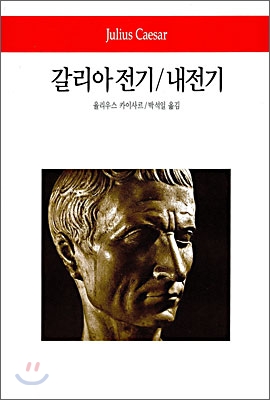
Gallic Wars / Civil Wars
 |
Description
Book Introduction
Caesar, considered the greatest soldier and politician in history, and his "Gallic Wars" and "Civil Wars" are war narratives that are highly regarded as literary works.
These two books are arguably the only ones in which the greatest generals in history tell their military exploits in an unvarnished manner.
Both books are classics of war literature and are still widely read around the world two thousand years later.
It holds significance for us as a valuable historical resource that allows us to glimpse the life of a great hero who boldly faced fate, and the turbulent times of Rome that also resemble the dizzying state of modern society.
These two books are arguably the only ones in which the greatest generals in history tell their military exploits in an unvarnished manner.
Both books are classics of war literature and are still widely read around the world two thousand years later.
It holds significance for us as a valuable historical resource that allows us to glimpse the life of a great hero who boldly faced fate, and the turbulent times of Rome that also resemble the dizzying state of modern society.
- You can preview some of the book's contents.
Preview
index
Gallic Chronicles
Book 1 (58 BC)
1.
Geography and Race of Gaul
2.
War with the Helvetii
3.
War with Ariovistus the German
Book 2 (57 BC)
1.
War with the Belgae
2.
Submission of the coastal tribes of the ocean
Book 3 (57–56 BC)
1.
War with the Mountain Tribes (57 BC)
2.
War with the coastal tribes of the ocean
3.
War with the Aquitanians
4.
War with the Northern Tribes
Book IV (55 BC)
1.
War with the Germans
2.
The Last Germanic Expedition
3.
The First Expedition to Britannia
4.
War with the northern peoples
Book 5 (54 BC)
1.
Second Britannia Expedition
2.
Destruction of the 14th Legion by the Ebrones
3.
The Nervii attack Cicero's camp
4.
The expansion of the rebellion of the northern peoples
Book 6 (53 BC)
1.
The spread of rebellion throughout Gaul
2.
Second Germanic Expedition
3.
The institutions and customs of the Galli
4.
The institutions and customs of the Germans
5.
Subjugation of the Ebrones
Book 7 (52 BC)
1.
Vercingetorix, the leader and conspirator of all Gauls
2.
Attack and capture of Avaricum
3.
Abandoning the Battle and Conquest of Gergovia
4.
The Gallic uprising
5.
Alessia's final battle
6.
Surrender of the Hadui and Arverni tribes
Book 8 (51–50 BC)
1.
introduction
2.
Revolt of the Bituriges, Carnutes, and Bellovaci
3.
The Siege and Occupation of Uxelodunum
4.
The Shadow of Civil War: The Conflict Between Caesar and the Senate
Civil War
Book 1 (49 BC)
The political situation in Rome/Caesar's counterattack/Conquest of Corpinium/Pompey escapes Rome/Caesar and the Senate/Clash of the Massilia/Battle of the Ilerda/Battle of the Massilia/Caesar's victory, Battle of Hispania/Surrender of the Aphranius army
Book 2 (49 BC)
The conquest of Massilia/Final control of Hispania/Surrender of Massilia/Curios's Battle of Africa/Curios's death, the beginning of defeat
Book 3 (48 BC)
Caesar becomes dictator, Pompey prepares for war / Negotiations in Epirus / Caelius's rebellion / Antony's ordeal / Spicius's entry into the war / The siege of Dyrrachium / Caesar's frustration / Caesar moves to Thessaly / Pompey's pursuit / The greatest battle, the Battle of Pharsalus / Pompey's end / Caesar in Alexandria
About the Gallic Wars and the Civil Wars
Caesar, the hero of ancient Roman tragedy
Caesar's Annals
Roman History (Republic) Chronology
Index of the Gallic Wars
Index of the Civil War
Book 1 (58 BC)
1.
Geography and Race of Gaul
2.
War with the Helvetii
3.
War with Ariovistus the German
Book 2 (57 BC)
1.
War with the Belgae
2.
Submission of the coastal tribes of the ocean
Book 3 (57–56 BC)
1.
War with the Mountain Tribes (57 BC)
2.
War with the coastal tribes of the ocean
3.
War with the Aquitanians
4.
War with the Northern Tribes
Book IV (55 BC)
1.
War with the Germans
2.
The Last Germanic Expedition
3.
The First Expedition to Britannia
4.
War with the northern peoples
Book 5 (54 BC)
1.
Second Britannia Expedition
2.
Destruction of the 14th Legion by the Ebrones
3.
The Nervii attack Cicero's camp
4.
The expansion of the rebellion of the northern peoples
Book 6 (53 BC)
1.
The spread of rebellion throughout Gaul
2.
Second Germanic Expedition
3.
The institutions and customs of the Galli
4.
The institutions and customs of the Germans
5.
Subjugation of the Ebrones
Book 7 (52 BC)
1.
Vercingetorix, the leader and conspirator of all Gauls
2.
Attack and capture of Avaricum
3.
Abandoning the Battle and Conquest of Gergovia
4.
The Gallic uprising
5.
Alessia's final battle
6.
Surrender of the Hadui and Arverni tribes
Book 8 (51–50 BC)
1.
introduction
2.
Revolt of the Bituriges, Carnutes, and Bellovaci
3.
The Siege and Occupation of Uxelodunum
4.
The Shadow of Civil War: The Conflict Between Caesar and the Senate
Civil War
Book 1 (49 BC)
The political situation in Rome/Caesar's counterattack/Conquest of Corpinium/Pompey escapes Rome/Caesar and the Senate/Clash of the Massilia/Battle of the Ilerda/Battle of the Massilia/Caesar's victory, Battle of Hispania/Surrender of the Aphranius army
Book 2 (49 BC)
The conquest of Massilia/Final control of Hispania/Surrender of Massilia/Curios's Battle of Africa/Curios's death, the beginning of defeat
Book 3 (48 BC)
Caesar becomes dictator, Pompey prepares for war / Negotiations in Epirus / Caelius's rebellion / Antony's ordeal / Spicius's entry into the war / The siege of Dyrrachium / Caesar's frustration / Caesar moves to Thessaly / Pompey's pursuit / The greatest battle, the Battle of Pharsalus / Pompey's end / Caesar in Alexandria
About the Gallic Wars and the Civil Wars
Caesar, the hero of ancient Roman tragedy
Caesar's Annals
Roman History (Republic) Chronology
Index of the Gallic Wars
Index of the Civil War
Publisher's Review
Let us go where the gods await.
The die is cast!
Caesar, the immortal hero who shook the ancient world
Boldly draw your sword against the fate that stands in your way!
Caesar, the hero of Roman tragedy!
Caesar, an outstanding soldier, politician, writer, and orator representing ancient Rome.
As a general, he demonstrated outstanding combat ability, and as a politician, he was a populist politician who accurately grasped public sentiment and boldly promoted social reform.
There are conflicting opinions about him: one theory is that he was a destroyer of the republic whose ultimate goal was monarchy, and the other is that he laid the foundation for the empire.
His works, "Gallic Wars" and "Civil Wars," are considered masterpieces of Latin literature for their concise style and accurate understanding of the contemporary world.
Caesar's life, a storm that shook ancient Rome, captured the attention of later generations for its rich humanity and tragic ending, leading many writers and artists, including Shakespeare, to reexamine his life from various perspectives.
Ambition for hegemony, take that great first step!
"The Gallic Wars" is a book that objectively describes the achievements Caesar made while conquering Gaul from 58 to 51 BC.
The first seven books were written by Caesar himself, and the eighth book was written by his subordinate Hirtius after his death.
Book 1 describes the wars of 58 BC (the war with the Helvetii and the war with Ariovistus the Germanicus), Book 2 the war of 57 BC (the war with the Belgae), Book 3 the wars of 57–56 BC (the wars with the Alpine tribes, the coastal tribes, and the Aquitanians), Book 4 the wars with the Germanic tribes of 55 BC, Book 5 the expedition to Britain in 54 BC, the Germanic tribes, and the second war with the Belgae, Book 6 the war with the Belgae that followed in 53 BC, the Gaul's factions, classes, priests, gods, and customs, and the Germanic society and customs, and Book 7 the full-scale war with the Gauls in 52 BC.
The description is concise and majestic, and not only is it excellent as a work of literature, but it also serves as a valuable source for the study of the history of the Gallic and Germanic peoples.
Cicero, a contemporary writer, was a sharp opponent of Caesar.
Even he, after reading "The Gallic Wars," was overwhelmed by its sentences and could not help but praise it.
“This is a sentence that is like a pure naked body that has taken off all its clothes.
Caesar prepared material for historians, but no reasonable person would have thought of adding any additional embellishments to it, unless he were content to add unnecessary embellishments to it.”
Traitor Caesar, cast the dice of fate!
In 50 BC, at the end of the Gallic Wars, the situation in Rome was very unfavorable for Caesar.
The conflict between Caesar and Pompey, two heroes who were once comrades, became inevitable.
In the midst of the growing civil war, the Senate was sharply divided between Caesar's faction and Pompey's faction.
The consuls, who were opposed to Caesar, nevertheless sided with Pompey, believing that he would be of greater help to Rome.
In late 50 BC, Pompey accepted the request of the consul Marcellus to serve as a shield to protect Rome from Caesar, who was threatening the Roman Republic.
Following the Senate's final recommendation, Caesar is ultimately in danger of being branded a traitor. The Civil War begins at this point.
Caesar, too, a proud, true Roman, hesitates for a moment about marching on his homeland.
Will you become a leader in the rebellion, or will you hold onto a glimmer of hope and seek a peaceful solution?
But the tide of the times inevitably opened only one path for him.
There is no choice!
On January 12, 49 BC, he finally crossed the Rubicon River.
“If I cross this river, misfortune will come to the world, and if I don’t cross it, I will be destroyed.
Let us go to where the gods await.
“The die is cast!”
The Civil Wars describes the civil war from January 12, 49 BC, when Caesar crossed the Rubicon River and declared war on the Senate and Pompey, to the Battle of Alexandria in Africa in 48 BC.
It calmly describes why he had to point his sword at his country and how he came to have Roman hegemony.
"The Civil War" consists of three volumes, but was left unfinished due to Caesar's assassination.
The material in this book is based on the records of Caesar's military command, and is generally highly reliable, making it an important historical document for the study of the history of the late Republic.
Why did Caesar leave this book behind?
The reason Caesar wrote "The Gallic Wars" is as follows.
First, he wanted to leave behind basic data so that the Gallic expedition, the greatest achievement in Roman history, could be accurately passed down to future generations by historians.
With that intention, I objectively described my achievements.
He also intended to make his brilliant achievements known to the Romans once again, to win the hearts of the people over to his side, and thereby to lead the political struggles to his advantage after returning home.
It may reveal his own reasons for starting the Gallic War without the Senate's permission, or it may be a sign of his intention to promote himself in order to run for the consulship in 49 BC.
So to speak, it was conscious of the Romans at the time.
Likewise, in the "Civil History" titled "Records," the intention to justify and propagandize why he turned his sword against Pompey and the Senate is clearly and earnestly revealed.
Caesar did his best to prevent civil wars between his own people, pushing for peace negotiations until the very end.
But Pompey and the Senate wanted only one thing: Caesar's destruction.
The Senate, which did not give up on the dream of a small number of nobles ruling Rome, was so stubborn and selfish that they were jealous of Caesar's brilliant achievements and popularity that they tried to bring him down from his high position.
Caesar wanted to reveal all of this and make a strong appeal to the ancient Roman world that the cause of the civil war was entirely theirs.
This is why he wrote "My Life".
The shining legacy of an unparalleled general who was both literary and martial!
Caesar, considered the greatest soldier and politician in history, and his "Gallic Wars" and "Civil Wars" are war narratives that are highly regarded as literary works.
These two books are arguably the only ones in which the greatest generals in history tell their military exploits in an unvarnished manner.
Both books are classics of war literature and are still widely read around the world two thousand years later.
Caesar's writing style, even as he explains his position, is remarkably calm and restrained. Even his depiction of the historical moment of crossing the Rubicon in "The Civil Wars" is remarkably calm and composed, unlike the more compelling descriptions of other ancient historians.
Yet, it is surprising how it captures the reader's interest without being boring or monotonous.
It is particularly noteworthy that he attempted to maintain objectivity by referring to himself as “Caesar…”
Caesar, who was an outstanding writer who picked up his pen whenever he had the chance even on the battlefield, is said to have left behind many books and writings, but most of them have disappeared as the turbulent times passed.
Only these two books, "The Gallic Wars" and "The Civil Wars," are handed down as masterpieces that allow us to appreciate his outstanding writing style.
The writings of Caesar, who was both a brilliant soldier and a man of exceptional ability, will forever remain as valuable historical resources, providing a glimpse into the life of a great hero who boldly confronted fate, and the turbulent times of Rome that also resemble the chaotic state of modern society.
The die is cast!
Caesar, the immortal hero who shook the ancient world
Boldly draw your sword against the fate that stands in your way!
Caesar, the hero of Roman tragedy!
Caesar, an outstanding soldier, politician, writer, and orator representing ancient Rome.
As a general, he demonstrated outstanding combat ability, and as a politician, he was a populist politician who accurately grasped public sentiment and boldly promoted social reform.
There are conflicting opinions about him: one theory is that he was a destroyer of the republic whose ultimate goal was monarchy, and the other is that he laid the foundation for the empire.
His works, "Gallic Wars" and "Civil Wars," are considered masterpieces of Latin literature for their concise style and accurate understanding of the contemporary world.
Caesar's life, a storm that shook ancient Rome, captured the attention of later generations for its rich humanity and tragic ending, leading many writers and artists, including Shakespeare, to reexamine his life from various perspectives.
Ambition for hegemony, take that great first step!
"The Gallic Wars" is a book that objectively describes the achievements Caesar made while conquering Gaul from 58 to 51 BC.
The first seven books were written by Caesar himself, and the eighth book was written by his subordinate Hirtius after his death.
Book 1 describes the wars of 58 BC (the war with the Helvetii and the war with Ariovistus the Germanicus), Book 2 the war of 57 BC (the war with the Belgae), Book 3 the wars of 57–56 BC (the wars with the Alpine tribes, the coastal tribes, and the Aquitanians), Book 4 the wars with the Germanic tribes of 55 BC, Book 5 the expedition to Britain in 54 BC, the Germanic tribes, and the second war with the Belgae, Book 6 the war with the Belgae that followed in 53 BC, the Gaul's factions, classes, priests, gods, and customs, and the Germanic society and customs, and Book 7 the full-scale war with the Gauls in 52 BC.
The description is concise and majestic, and not only is it excellent as a work of literature, but it also serves as a valuable source for the study of the history of the Gallic and Germanic peoples.
Cicero, a contemporary writer, was a sharp opponent of Caesar.
Even he, after reading "The Gallic Wars," was overwhelmed by its sentences and could not help but praise it.
“This is a sentence that is like a pure naked body that has taken off all its clothes.
Caesar prepared material for historians, but no reasonable person would have thought of adding any additional embellishments to it, unless he were content to add unnecessary embellishments to it.”
Traitor Caesar, cast the dice of fate!
In 50 BC, at the end of the Gallic Wars, the situation in Rome was very unfavorable for Caesar.
The conflict between Caesar and Pompey, two heroes who were once comrades, became inevitable.
In the midst of the growing civil war, the Senate was sharply divided between Caesar's faction and Pompey's faction.
The consuls, who were opposed to Caesar, nevertheless sided with Pompey, believing that he would be of greater help to Rome.
In late 50 BC, Pompey accepted the request of the consul Marcellus to serve as a shield to protect Rome from Caesar, who was threatening the Roman Republic.
Following the Senate's final recommendation, Caesar is ultimately in danger of being branded a traitor. The Civil War begins at this point.
Caesar, too, a proud, true Roman, hesitates for a moment about marching on his homeland.
Will you become a leader in the rebellion, or will you hold onto a glimmer of hope and seek a peaceful solution?
But the tide of the times inevitably opened only one path for him.
There is no choice!
On January 12, 49 BC, he finally crossed the Rubicon River.
“If I cross this river, misfortune will come to the world, and if I don’t cross it, I will be destroyed.
Let us go to where the gods await.
“The die is cast!”
The Civil Wars describes the civil war from January 12, 49 BC, when Caesar crossed the Rubicon River and declared war on the Senate and Pompey, to the Battle of Alexandria in Africa in 48 BC.
It calmly describes why he had to point his sword at his country and how he came to have Roman hegemony.
"The Civil War" consists of three volumes, but was left unfinished due to Caesar's assassination.
The material in this book is based on the records of Caesar's military command, and is generally highly reliable, making it an important historical document for the study of the history of the late Republic.
Why did Caesar leave this book behind?
The reason Caesar wrote "The Gallic Wars" is as follows.
First, he wanted to leave behind basic data so that the Gallic expedition, the greatest achievement in Roman history, could be accurately passed down to future generations by historians.
With that intention, I objectively described my achievements.
He also intended to make his brilliant achievements known to the Romans once again, to win the hearts of the people over to his side, and thereby to lead the political struggles to his advantage after returning home.
It may reveal his own reasons for starting the Gallic War without the Senate's permission, or it may be a sign of his intention to promote himself in order to run for the consulship in 49 BC.
So to speak, it was conscious of the Romans at the time.
Likewise, in the "Civil History" titled "Records," the intention to justify and propagandize why he turned his sword against Pompey and the Senate is clearly and earnestly revealed.
Caesar did his best to prevent civil wars between his own people, pushing for peace negotiations until the very end.
But Pompey and the Senate wanted only one thing: Caesar's destruction.
The Senate, which did not give up on the dream of a small number of nobles ruling Rome, was so stubborn and selfish that they were jealous of Caesar's brilliant achievements and popularity that they tried to bring him down from his high position.
Caesar wanted to reveal all of this and make a strong appeal to the ancient Roman world that the cause of the civil war was entirely theirs.
This is why he wrote "My Life".
The shining legacy of an unparalleled general who was both literary and martial!
Caesar, considered the greatest soldier and politician in history, and his "Gallic Wars" and "Civil Wars" are war narratives that are highly regarded as literary works.
These two books are arguably the only ones in which the greatest generals in history tell their military exploits in an unvarnished manner.
Both books are classics of war literature and are still widely read around the world two thousand years later.
Caesar's writing style, even as he explains his position, is remarkably calm and restrained. Even his depiction of the historical moment of crossing the Rubicon in "The Civil Wars" is remarkably calm and composed, unlike the more compelling descriptions of other ancient historians.
Yet, it is surprising how it captures the reader's interest without being boring or monotonous.
It is particularly noteworthy that he attempted to maintain objectivity by referring to himself as “Caesar…”
Caesar, who was an outstanding writer who picked up his pen whenever he had the chance even on the battlefield, is said to have left behind many books and writings, but most of them have disappeared as the turbulent times passed.
Only these two books, "The Gallic Wars" and "The Civil Wars," are handed down as masterpieces that allow us to appreciate his outstanding writing style.
The writings of Caesar, who was both a brilliant soldier and a man of exceptional ability, will forever remain as valuable historical resources, providing a glimpse into the life of a great hero who boldly confronted fate, and the turbulent times of Rome that also resemble the chaotic state of modern society.
GOODS SPECIFICS
- Date of issue: September 10, 2008
- Format: Hardcover book binding method guide
- Page count, weight, size: 520 pages | 937g | 153*224*35mm
- ISBN13: 9788949704999
- ISBN10: 8949704994
You may also like
카테고리
korean


korean

![GQ KOREA Mark (Monthly): December [2025]](http://librairie.coreenne.fr/cdn/shop/files/8ef265dbbfbf186523ed75ba7319009d.jpg?v=1765340328&width=3840)


