

Manguri Epitaph
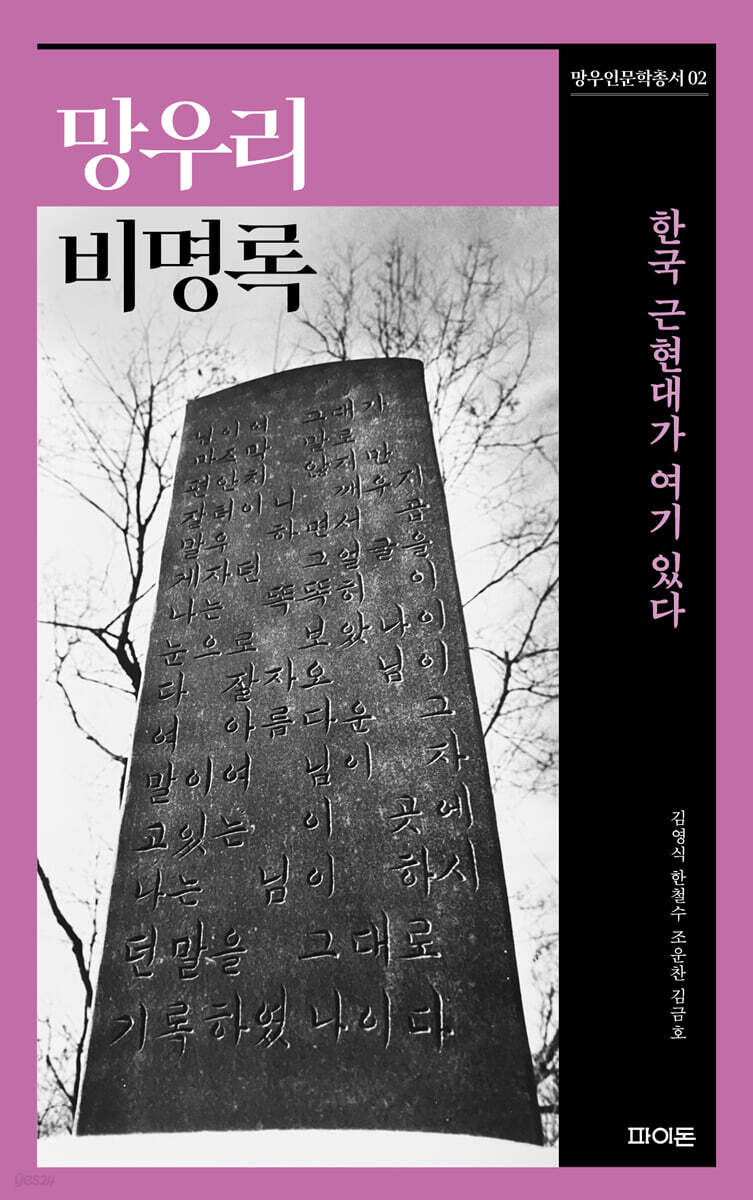 |
Description
Book Introduction
Reading Modern and Contemporary Korean History Through the Inscriptions at Mangwoori Park
The former Mangwoo-ri Public Cemetery, now called Mangwoo History and Culture Park, opened in 1933 and closed in 1973.
Therefore, Mangwooli Park is a space where the most turbulent period of Korean society, from the Japanese colonial period to liberation and the beginning of the rapid advancement of modernization and industrialization, is preserved, as if in a frame.
The history of this era and the stories of the lives and deaths of people from all walks of life are recorded on none other than tombstones.
This book reads the fervent will to resist and the fierce nature of struggle in the epitaphs of patriots, confirms the roots of the Republic of Korea through the epitaphs of pioneers in various fields who opened the dawn of modern times and were labeled as "firsts," and glimpses into the vibrant lives and works of poets, novelists, painters, and other cultural and artistic figures through the epitaphs.
Also, in the epitaphs of common people whose names were not recorded in history, we hear the stories of our parents and grandparents, who lived through turbulent times and devoted themselves to their families.
The former Mangwoo-ri Public Cemetery, now called Mangwoo History and Culture Park, opened in 1933 and closed in 1973.
Therefore, Mangwooli Park is a space where the most turbulent period of Korean society, from the Japanese colonial period to liberation and the beginning of the rapid advancement of modernization and industrialization, is preserved, as if in a frame.
The history of this era and the stories of the lives and deaths of people from all walks of life are recorded on none other than tombstones.
This book reads the fervent will to resist and the fierce nature of struggle in the epitaphs of patriots, confirms the roots of the Republic of Korea through the epitaphs of pioneers in various fields who opened the dawn of modern times and were labeled as "firsts," and glimpses into the vibrant lives and works of poets, novelists, painters, and other cultural and artistic figures through the epitaphs.
Also, in the epitaphs of common people whose names were not recorded in history, we hear the stories of our parents and grandparents, who lived through turbulent times and devoted themselves to their families.
- You can preview some of the book's contents.
Preview
index
Recommendation
preface
Part 1: Walking Between Him and Me - Monuments to Patriots and Independence Fighters
1 Kang Hak-rin
2 Kim Ki-man
3 Kim Seung-min
4 Kim Jin-seong
5 Moon Myeong-hwan
6. Moon Il-pyeong
7 Park Chan-ik
8 Seo Gwang-jo
9 Seo Dong-il
10 Seo Byeong-ho
11 Ahn Chang-ho
12 Ogiman
13 Oh Se-chang
14 Oh Jae-young
15 Yu Gwan-sun
16 Yoo Sang-gyu
17 Lee Byeong-hong
18 Lee Young-hak
19 Lee Tak
20 Han Yong-un
21 13 Dochang's Military Tower
Part 2: Make Your Voice Scream, Beat My Drum - Epitaphs of Literary and Artistic Figures
1 Kang So-cheon
2 Gye Yong-muk
3 Kim Mal-bong
4 Kim Sang-yong
5 Kim Young-rang
6 Kim Yi-seok
7 Park In-hwan
8 Bang Jeong-hwan
9 Lee In-seong
10 Lee Jung-seop
11 Cha Jung-rak
12 Latest Clothes
13 Choi Hak-song
14 Ham Se-deok
Part 3: Every Life is Remembered by Someone - A Monument to a Modern Korean Pioneer
1 National Bond Table
2 Kim Bun-ok
3 Kim Ho-jik
4 Princess Myeongon · Kim Hyeon-geun
5 Park Seung-bin
6 Park Eun-hye
7 Park Hyun-sik
8 Park Hee-do
9 Seol Tae-hee
10 Takumi Asakawa
11 An Bong-ik
12 Oh Geung-seon
13 Lee Kyung-sook
14 Lee Young-jun
15 Jang Deok-su
16 Jang Hyeong-du
17 Jo Bong-am
18 Ji Seok-yeong
19 Cha Sook-kyung
20 Choi Byeong-seok
21 Gyeongseo Nogosan Cheongolchuijangbi
Part 4: Your Soul is with Us - Commoner's Tombstone
1 Kang Chang-ryong, Ahn Hwa-chun
2 Kwon Young-wook
3 Kim Gyu-oh
4 Kim Lip-bun
5 Kim Chan-il
6 Kim Hwa-seon
7 Ryu Eun-kyung
8 Park Dong-hoon
9 Park Eun-hee
10 Park Chun-geun, Lim Gwang-chun
11 Park Ho-yeol
12 Baek Yun-jin
13 Song Won-seop
14 Yangcheon Heo clan
15 Oh Soon-ae
16 Oh Ok-hee
17 Won Jong-jae
18 Lee Gwi-hee
19 Im Yong-gyu
20 Jeong Gyeong-seong
21 Jeong Yun-ok
22 Jo Jae-hee
23 Choi Cheol-woo
24 Haeju Oh
25 Hyunik
preface
Part 1: Walking Between Him and Me - Monuments to Patriots and Independence Fighters
1 Kang Hak-rin
2 Kim Ki-man
3 Kim Seung-min
4 Kim Jin-seong
5 Moon Myeong-hwan
6. Moon Il-pyeong
7 Park Chan-ik
8 Seo Gwang-jo
9 Seo Dong-il
10 Seo Byeong-ho
11 Ahn Chang-ho
12 Ogiman
13 Oh Se-chang
14 Oh Jae-young
15 Yu Gwan-sun
16 Yoo Sang-gyu
17 Lee Byeong-hong
18 Lee Young-hak
19 Lee Tak
20 Han Yong-un
21 13 Dochang's Military Tower
Part 2: Make Your Voice Scream, Beat My Drum - Epitaphs of Literary and Artistic Figures
1 Kang So-cheon
2 Gye Yong-muk
3 Kim Mal-bong
4 Kim Sang-yong
5 Kim Young-rang
6 Kim Yi-seok
7 Park In-hwan
8 Bang Jeong-hwan
9 Lee In-seong
10 Lee Jung-seop
11 Cha Jung-rak
12 Latest Clothes
13 Choi Hak-song
14 Ham Se-deok
Part 3: Every Life is Remembered by Someone - A Monument to a Modern Korean Pioneer
1 National Bond Table
2 Kim Bun-ok
3 Kim Ho-jik
4 Princess Myeongon · Kim Hyeon-geun
5 Park Seung-bin
6 Park Eun-hye
7 Park Hyun-sik
8 Park Hee-do
9 Seol Tae-hee
10 Takumi Asakawa
11 An Bong-ik
12 Oh Geung-seon
13 Lee Kyung-sook
14 Lee Young-jun
15 Jang Deok-su
16 Jang Hyeong-du
17 Jo Bong-am
18 Ji Seok-yeong
19 Cha Sook-kyung
20 Choi Byeong-seok
21 Gyeongseo Nogosan Cheongolchuijangbi
Part 4: Your Soul is with Us - Commoner's Tombstone
1 Kang Chang-ryong, Ahn Hwa-chun
2 Kwon Young-wook
3 Kim Gyu-oh
4 Kim Lip-bun
5 Kim Chan-il
6 Kim Hwa-seon
7 Ryu Eun-kyung
8 Park Dong-hoon
9 Park Eun-hee
10 Park Chun-geun, Lim Gwang-chun
11 Park Ho-yeol
12 Baek Yun-jin
13 Song Won-seop
14 Yangcheon Heo clan
15 Oh Soon-ae
16 Oh Ok-hee
17 Won Jong-jae
18 Lee Gwi-hee
19 Im Yong-gyu
20 Jeong Gyeong-seong
21 Jeong Yun-ok
22 Jo Jae-hee
23 Choi Cheol-woo
24 Haeju Oh
25 Hyunik
Into the book
It appears that Jeong In-bo's decision to write the epitaph for Moon Il-pyeong was due to a sense of solidarity between them as comrades in the study of history.
Although 'The Art of Munhoham Myogi' written by Jeong In-bo is a short piece, it condenses and shows the personal history of Mun Il-pyeong.
It can be said that this is a display of a sense of responsibility as a historian who considers it his mission to record the lives and achievements of important figures and pass them on to future generations.
--- p.67
One of the pleasures of Mangwooli Park is finding the calligraphy of famous people on the inscriptions.
Just like Oh Se-chang's monument, renowned calligraphers also participated in the creation of Ahn Chang-ho's monument.
The inscription on the front of Dosan's stele was written by Son Jae-hyeong, and the inscriptions on the left and right back were written by Kim Ki-seung.
Oh Se-chang, who had a unique talent for calligraphy, was famous for not hesitating to write for people when they asked him to do so.
… The epitaph of Lee Byeong-hong, who served as a member of the Special Committee on Anti-National Activities and a member of the National Assembly after liberation, is the work of Haegong Shin Ik-hee, who was famous for his boldness, and Yu Dal-yeong, an agricultural scientist and social activist, wrote the epitaph and calligraphy for his student Lee Gyeong-suk.
--- pp.113-114
When Socheon was attending Gowon Elementary School, he had a girlfriend named Sooni.
The two were very close.
Later, he published the children's song "Sooni's Grave," and Sooni appears in many of his subsequent works.
Socheon was also a disciple and friend of the poet Baek Seok.
--- p.163
The title of Kim Mal-bong's serialized work "Rose of Sharon" in the Chosun Ilbo in 1937 was taken from the Japanese song "Rose of Sharon" that her first husband, Jeon Sang-beom, enjoyed singing.
When her husband sang this song, Kim Mal-bong would play the piano accompaniment.
Her husband died in 1936, and she published this novel the following year, so she chose Song of Memories as the title of the novel.
… In our literary climate that despises popular novels, Malbong, who consciously emphasized popularity, lived like the protagonist of his novel.
--- pp.173-174
One of Lee In-seong's representative works is "Sunflower" (1944).
It has grown a lot and now blooms every year.
The stone in front of the tomb is shaped like a palette.
The hole where you put your finger is where you put the flower.
As such, a graveyard is a cultural heritage site where one can experience the scent of the deceased more closely than anywhere else, as it is a place filled with symbols that remind one of the deceased.
--- p.209
They say that there is a constant flow of fresh flowers in front of the graves of artists in the Paris cemetery, but here, the tombstone of the 'national painter' is covered only with artificial flowers from volunteers.
Even this is a recent thing. A few years ago, there was nothing, so whenever I visited, I would pick some wildflowers nearby and put them in a vase.
The sculpture also has a hole for holding a flower.
Painter Lee Jung-seop is waiting for your visit.
--- p.214
Among the many princesses, King Sunjo's love for Princess Myeongon seems to have been particularly special.
As the eldest daughter, she was not only intelligent and wise, but she also did not lose the royal code after getting married, so her father could not have found a daughter as good as her.
When King Sunjo heard the news of his daughter's death, he personally wrote a funeral oration, feeling more like a father than like a king.
--- p.265
Dr. Yu Dal-young's judgment that our history is sustained and will continue to develop by people unknown to the world, and that he was right when he built a tomb in Manguri and left an epitaph in the old days, was correct.
Although Lee Gyeong-suk did not leave a distinct mark on society like other famous people from Mangwoo-ri, the tombstone left by Dr. Yoo Dal-young makes us think about the life of an ordinary woman who lived beautifully through the power of faith.
--- p.324
I don't know how my grandson ended up growing up in his grandmother's hands.
However, if we estimate that the grandmother was in her mid-50s when she first saw her grandson, we can guess that her grandson Gyeongseop was born in the mid-1930s to early 1940s.
What happened to his parents? Looking back at his estimated birth and upbringing, we see they endured difficult times, including the Japanese colonial period, the division of the country, and the Korean War.
I can only guess that the absence of Gyeongseop's parents was also mixed in with the sad reality that was prevalent.
--- p.389
‘Our young mother’ engraved on the front of the tombstone.
The deceased's daughter hints at another sibling through the tombstone.
It is not known whether she, who was adopted to the United States at a young age, was reunited with her biological sister or brother.
--- p.402
“I’ll be fine, so don’t wake me up.” This is the desperate cry of a mother leaving her young children behind, afraid that if she breaks her promise, they might wake up.
Unfortunately, the whereabouts of Park Eun-hee's tombstone are currently unknown.
A tombstone that can no longer be found after 70 years.
Even now, somewhere, a vivid sadness may be flowing on the cold stone.
The inscriptions on the tombs are like indelible tattoos engraved not in stone but in flesh.
Although 'The Art of Munhoham Myogi' written by Jeong In-bo is a short piece, it condenses and shows the personal history of Mun Il-pyeong.
It can be said that this is a display of a sense of responsibility as a historian who considers it his mission to record the lives and achievements of important figures and pass them on to future generations.
--- p.67
One of the pleasures of Mangwooli Park is finding the calligraphy of famous people on the inscriptions.
Just like Oh Se-chang's monument, renowned calligraphers also participated in the creation of Ahn Chang-ho's monument.
The inscription on the front of Dosan's stele was written by Son Jae-hyeong, and the inscriptions on the left and right back were written by Kim Ki-seung.
Oh Se-chang, who had a unique talent for calligraphy, was famous for not hesitating to write for people when they asked him to do so.
… The epitaph of Lee Byeong-hong, who served as a member of the Special Committee on Anti-National Activities and a member of the National Assembly after liberation, is the work of Haegong Shin Ik-hee, who was famous for his boldness, and Yu Dal-yeong, an agricultural scientist and social activist, wrote the epitaph and calligraphy for his student Lee Gyeong-suk.
--- pp.113-114
When Socheon was attending Gowon Elementary School, he had a girlfriend named Sooni.
The two were very close.
Later, he published the children's song "Sooni's Grave," and Sooni appears in many of his subsequent works.
Socheon was also a disciple and friend of the poet Baek Seok.
--- p.163
The title of Kim Mal-bong's serialized work "Rose of Sharon" in the Chosun Ilbo in 1937 was taken from the Japanese song "Rose of Sharon" that her first husband, Jeon Sang-beom, enjoyed singing.
When her husband sang this song, Kim Mal-bong would play the piano accompaniment.
Her husband died in 1936, and she published this novel the following year, so she chose Song of Memories as the title of the novel.
… In our literary climate that despises popular novels, Malbong, who consciously emphasized popularity, lived like the protagonist of his novel.
--- pp.173-174
One of Lee In-seong's representative works is "Sunflower" (1944).
It has grown a lot and now blooms every year.
The stone in front of the tomb is shaped like a palette.
The hole where you put your finger is where you put the flower.
As such, a graveyard is a cultural heritage site where one can experience the scent of the deceased more closely than anywhere else, as it is a place filled with symbols that remind one of the deceased.
--- p.209
They say that there is a constant flow of fresh flowers in front of the graves of artists in the Paris cemetery, but here, the tombstone of the 'national painter' is covered only with artificial flowers from volunteers.
Even this is a recent thing. A few years ago, there was nothing, so whenever I visited, I would pick some wildflowers nearby and put them in a vase.
The sculpture also has a hole for holding a flower.
Painter Lee Jung-seop is waiting for your visit.
--- p.214
Among the many princesses, King Sunjo's love for Princess Myeongon seems to have been particularly special.
As the eldest daughter, she was not only intelligent and wise, but she also did not lose the royal code after getting married, so her father could not have found a daughter as good as her.
When King Sunjo heard the news of his daughter's death, he personally wrote a funeral oration, feeling more like a father than like a king.
--- p.265
Dr. Yu Dal-young's judgment that our history is sustained and will continue to develop by people unknown to the world, and that he was right when he built a tomb in Manguri and left an epitaph in the old days, was correct.
Although Lee Gyeong-suk did not leave a distinct mark on society like other famous people from Mangwoo-ri, the tombstone left by Dr. Yoo Dal-young makes us think about the life of an ordinary woman who lived beautifully through the power of faith.
--- p.324
I don't know how my grandson ended up growing up in his grandmother's hands.
However, if we estimate that the grandmother was in her mid-50s when she first saw her grandson, we can guess that her grandson Gyeongseop was born in the mid-1930s to early 1940s.
What happened to his parents? Looking back at his estimated birth and upbringing, we see they endured difficult times, including the Japanese colonial period, the division of the country, and the Korean War.
I can only guess that the absence of Gyeongseop's parents was also mixed in with the sad reality that was prevalent.
--- p.389
‘Our young mother’ engraved on the front of the tombstone.
The deceased's daughter hints at another sibling through the tombstone.
It is not known whether she, who was adopted to the United States at a young age, was reunited with her biological sister or brother.
--- p.402
“I’ll be fine, so don’t wake me up.” This is the desperate cry of a mother leaving her young children behind, afraid that if she breaks her promise, they might wake up.
Unfortunately, the whereabouts of Park Eun-hee's tombstone are currently unknown.
A tombstone that can no longer be found after 70 years.
Even now, somewhere, a vivid sadness may be flowing on the cold stone.
The inscriptions on the tombs are like indelible tattoos engraved not in stone but in flesh.
--- p.409
Publisher's Review
"Manguri Epitaph": A New Milestone in Documentary Literature
According to author Kim Young-sik, who wrote the preface to the book, the Mangwuri Stele is a cultural ensemble that contains our modern and contemporary history, philosophy, literature, and art, and has endured for at least 50 years, meeting the basic conditions for being a nationally registered cultural heritage.
However, there are many gravestones that have long since disappeared, such as those of Dosan Ahn Chang-ho and poet Kim Young-rang, and there are also gravestones that are buried in the ground and impossible to find.
Therefore, author Kim Young-sik explains the planning intention of this book in the preface as follows:
“Many gravestones have disappeared, and even now, gravestones are disappearing one by one without us knowing.
Since stone lasts longer than paper, words are engraved on stone to pass on, but now that the tombstones of Mangwuri are disappearing one by one, we want to transfer the words engraved on the tombstones onto paper to preserve the stories, spirit, and mind of that era, or in short, the landscape of our modern and contemporary times.
We live in a world where paper and digital data are preserved for as long as stones.
We erect a paper monument by transferring the inscription of Manguri to this book.”
Every life is remembered by someone
Even now, there are approximately 6,500 graves remaining in Mangwooli Park.
For example, among the historical figures buried in Manguri Park, Songchon Ji Seok-yeong, who entered in 1935, is the senior, and sculptor Kwon Jin-gyu, who entered in 1973, is the junior.
As an exception, poet Kim Young-rang returned again in 2024.
In Part 1 of the book, “Walking Between Him and Me,” the inscriptions of patriotic and independence fighters, including Kang Hak-rin, Moon Il-pyeong, Ahn Chang-ho, Oh Se-chang, Han Yong-un, and the 13th Provincial Army Monument, are read and commented on.
The significance of Manguri Park in the history of the independence movement is very large.
There is a tower commemorating the 13th Provincial Army, which was formed in 1907 and launched an operation to advance on Seoul in January 1908, and there are statues of three of the 33 people of the March 1st Movement (Han Yong-un, Oh Se-chang, and Park Hee-do) according to their religion.
If we count the number of people who participated in the March 1st Movement, including patriots, there are more than 20 people.
The graves of nine patriotic martyrs have already been designated as nationally registered cultural heritage.
Part 2, “Speak Up, Beat My Drum,” contains inscriptions and commentaries from 14 literary and artistic figures, including Kang So-cheon, Kim Mal-bong, Kim Yeong-rang, Park In-hwan, and Ham Se-deok.
Mangwooli Park is a place where you can view the spectrum of modern and contemporary Korean art, as it houses the remains of many literary and artistic figures whose names alone stir hearts, having lived through the Japanese colonial period, the liberation period, and the Korean War.
Those who have testified to the turbulent and chaotic times that Korean society has experienced through writing, painting, theater, and song have gathered in one place, creating a constellation reminiscent of the history of modern and contemporary Korean art.
Meanwhile, the period in which the historical figures of Mangwooli Park lived was a time of chaos and turmoil, with openness, reform, and transformation all coming at once, but also a time when the framework of modernity was being established in politics, society, culture, and education.
Part 3, “Every Life is Remembered by Someone,” is the story of people who opened the door to modern Korea and lived pioneering lives in their respective fields.
Most of them have studied abroad and used their experience to become leaders in society.
As they lived the life of pioneers, their names were often preceded by modifiers such as ‘first’, ‘initial’, ‘pioneer’, and ‘pioneer’.
The protagonists of Part 3 include Kook Chae-pyo, the head of the Korea Meteorological Administration who established an advanced weather forecasting system; Kim Bun-ok, the first female police chief; Kim Ho-jik, the ‘bean doctor’ who laid the foundation for food and nutrition; Park Seung-bin who proposed a unique Korean grammar and spelling system; Seol Tae-hee who led the Confucian reform movement; Ji Seok-yeong and Oh Geung-seon, pioneers of Korean medicine and modern hospitals; Jang Deok-su and Jo Bong-am, unfortunate politicians who were unable to realize their dreams of new politics; Jang Hyeong-du, a pioneer in plant taxonomy; and Park Eun-hye and Cha Sook-kyung, who led the way in the expansion of women’s rights.
Here, Princess Myeongon, who loved culture and the arts, her husband Kim Hyeon-geun, who lived a dignified life as a son-in-law of the Joseon royal family, and folk art researcher Asakawa Takumi, who loved Korean nature and folklore more than Koreans, are also beautiful people who spread their fragrance to Mangwoo-ri Park.
In Part 4, “Your Soul Is With Us,” the sorrow and sorrow over the death of an ordinary citizen who sleeps in Mangwooli Park are read through the epitaph.
Unlike the epitaphs of famous people whose achievements are fully inscribed or whose records are abundant, it is not easy to introduce the epitaphs of common people.
Because it is difficult to extract the lives of common people from just a short scream.
Author Kim Geum-ho (Director of the Korea National Trust), who was in charge of writing Part 4, said, “I wanted to reveal, above all, the human sorrow over death that does not change with the passage of time through the epitaphs of ordinary people, and I wanted to find the social meaning of the death of an ordinary person.
…it is made up of tombstones that contain the primal sorrow of death, social meaning, and personal value assigned by the author.”
According to author Kim Young-sik, who wrote the preface to the book, the Mangwuri Stele is a cultural ensemble that contains our modern and contemporary history, philosophy, literature, and art, and has endured for at least 50 years, meeting the basic conditions for being a nationally registered cultural heritage.
However, there are many gravestones that have long since disappeared, such as those of Dosan Ahn Chang-ho and poet Kim Young-rang, and there are also gravestones that are buried in the ground and impossible to find.
Therefore, author Kim Young-sik explains the planning intention of this book in the preface as follows:
“Many gravestones have disappeared, and even now, gravestones are disappearing one by one without us knowing.
Since stone lasts longer than paper, words are engraved on stone to pass on, but now that the tombstones of Mangwuri are disappearing one by one, we want to transfer the words engraved on the tombstones onto paper to preserve the stories, spirit, and mind of that era, or in short, the landscape of our modern and contemporary times.
We live in a world where paper and digital data are preserved for as long as stones.
We erect a paper monument by transferring the inscription of Manguri to this book.”
Every life is remembered by someone
Even now, there are approximately 6,500 graves remaining in Mangwooli Park.
For example, among the historical figures buried in Manguri Park, Songchon Ji Seok-yeong, who entered in 1935, is the senior, and sculptor Kwon Jin-gyu, who entered in 1973, is the junior.
As an exception, poet Kim Young-rang returned again in 2024.
In Part 1 of the book, “Walking Between Him and Me,” the inscriptions of patriotic and independence fighters, including Kang Hak-rin, Moon Il-pyeong, Ahn Chang-ho, Oh Se-chang, Han Yong-un, and the 13th Provincial Army Monument, are read and commented on.
The significance of Manguri Park in the history of the independence movement is very large.
There is a tower commemorating the 13th Provincial Army, which was formed in 1907 and launched an operation to advance on Seoul in January 1908, and there are statues of three of the 33 people of the March 1st Movement (Han Yong-un, Oh Se-chang, and Park Hee-do) according to their religion.
If we count the number of people who participated in the March 1st Movement, including patriots, there are more than 20 people.
The graves of nine patriotic martyrs have already been designated as nationally registered cultural heritage.
Part 2, “Speak Up, Beat My Drum,” contains inscriptions and commentaries from 14 literary and artistic figures, including Kang So-cheon, Kim Mal-bong, Kim Yeong-rang, Park In-hwan, and Ham Se-deok.
Mangwooli Park is a place where you can view the spectrum of modern and contemporary Korean art, as it houses the remains of many literary and artistic figures whose names alone stir hearts, having lived through the Japanese colonial period, the liberation period, and the Korean War.
Those who have testified to the turbulent and chaotic times that Korean society has experienced through writing, painting, theater, and song have gathered in one place, creating a constellation reminiscent of the history of modern and contemporary Korean art.
Meanwhile, the period in which the historical figures of Mangwooli Park lived was a time of chaos and turmoil, with openness, reform, and transformation all coming at once, but also a time when the framework of modernity was being established in politics, society, culture, and education.
Part 3, “Every Life is Remembered by Someone,” is the story of people who opened the door to modern Korea and lived pioneering lives in their respective fields.
Most of them have studied abroad and used their experience to become leaders in society.
As they lived the life of pioneers, their names were often preceded by modifiers such as ‘first’, ‘initial’, ‘pioneer’, and ‘pioneer’.
The protagonists of Part 3 include Kook Chae-pyo, the head of the Korea Meteorological Administration who established an advanced weather forecasting system; Kim Bun-ok, the first female police chief; Kim Ho-jik, the ‘bean doctor’ who laid the foundation for food and nutrition; Park Seung-bin who proposed a unique Korean grammar and spelling system; Seol Tae-hee who led the Confucian reform movement; Ji Seok-yeong and Oh Geung-seon, pioneers of Korean medicine and modern hospitals; Jang Deok-su and Jo Bong-am, unfortunate politicians who were unable to realize their dreams of new politics; Jang Hyeong-du, a pioneer in plant taxonomy; and Park Eun-hye and Cha Sook-kyung, who led the way in the expansion of women’s rights.
Here, Princess Myeongon, who loved culture and the arts, her husband Kim Hyeon-geun, who lived a dignified life as a son-in-law of the Joseon royal family, and folk art researcher Asakawa Takumi, who loved Korean nature and folklore more than Koreans, are also beautiful people who spread their fragrance to Mangwoo-ri Park.
In Part 4, “Your Soul Is With Us,” the sorrow and sorrow over the death of an ordinary citizen who sleeps in Mangwooli Park are read through the epitaph.
Unlike the epitaphs of famous people whose achievements are fully inscribed or whose records are abundant, it is not easy to introduce the epitaphs of common people.
Because it is difficult to extract the lives of common people from just a short scream.
Author Kim Geum-ho (Director of the Korea National Trust), who was in charge of writing Part 4, said, “I wanted to reveal, above all, the human sorrow over death that does not change with the passage of time through the epitaphs of ordinary people, and I wanted to find the social meaning of the death of an ordinary person.
…it is made up of tombstones that contain the primal sorrow of death, social meaning, and personal value assigned by the author.”
GOODS SPECIFICS
- Date of issue: December 3, 2025
- Page count, weight, size: 460 pages | 135*215*30mm
- ISBN13: 9791199104785
- ISBN10: 1199104787
You may also like
카테고리
korean


korean

![GQ KOREA Mark (Monthly): December [2025]](http://librairie.coreenne.fr/cdn/shop/files/8ef265dbbfbf186523ed75ba7319009d.jpg?v=1765340328&width=3840)


