

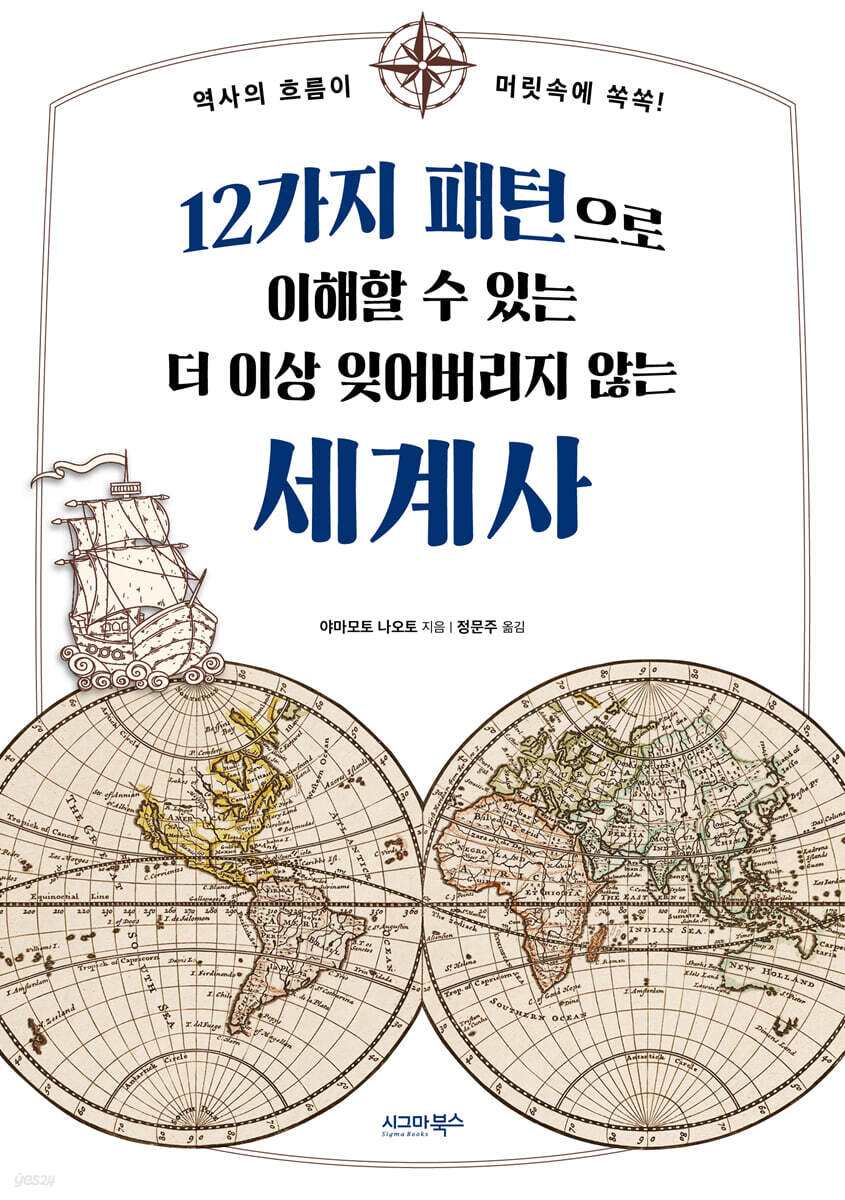
A world history you'll never forget, understood through 12 patterns.
 |
Description
Book Introduction
20 keywords and
Reading World History in 12 Patterns
This book clearly organizes world history using 20 keywords and 12 patterns.
The author pondered how to organize, memorize, and systematize information in order to naturally internalize vast knowledge, and as a result, he realized that ① 'understanding the definitions of historical terms' and ② 'understanding the patterns of history' are the core of studying world history.
Chapter 1 of this book explores 20 key keywords in world history, and Chapter 2 examines 12 patterns that recur throughout world history.
This book will help you understand world history more easily.
Reading World History in 12 Patterns
This book clearly organizes world history using 20 keywords and 12 patterns.
The author pondered how to organize, memorize, and systematize information in order to naturally internalize vast knowledge, and as a result, he realized that ① 'understanding the definitions of historical terms' and ② 'understanding the patterns of history' are the core of studying world history.
Chapter 1 of this book explores 20 key keywords in world history, and Chapter 2 examines 12 patterns that recur throughout world history.
This book will help you understand world history more easily.
- You can preview some of the book's contents.
Preview
index
prolog
World history is easily forgotten, so here's a tip for memorizing it.
Chapter 0: What is 'Politics'?
From hunting and gathering to farming
Definition of politics
Let's look at world history from the perspective of political principles.
Chapter 1: 20 Essential Keywords for Understanding World History
Keyword 1: 'Class' and 'Ruler'
Keyword 2: 'letter' and 'civilization'
Keyword 3: 'Power' and 'Authority'
Keywords 4: 'Society' and 'Economy'
Keyword 5: 'Instinct' and 'Reason'
Keyword 6 'Religion'
Keywords 7: 'Monarchy', 'Republic', 'Democracy'
Keywords 8: 'Dynasty' and 'Hereditary'
Keyword 9 'Revolution'
Keywords 10: 'Kingdom' and 'Empire'
Keyword 11: 'Agriculture' and 'Commerce'
Keywords 12: 'Feudalism' and 'Centralization'
Keyword 13: "Sovereign State" and "Absolute Monarchy"
Keyword 14: 'Constitution' and 'Parliament'
Keywords 15: 'Right-Wing' and 'Left-Wing'
Keyword 16: 'Modernization' and 'Liberalism'
Keyword 17: 'Industrial Revolution' and 'Capitalism'
Keyword 18 'Socialism'
Keyword 19: 'Nationalism'
Keywords 20: 'Colonialism' and 'Imperialism'
Basic Periods of World History That Are Helpful to Know
Basic Place Names in World History That Are Useful to Know
Chapter 2: Let's Explore the 12 "Patterns" That Shaped World History
A means to maintain the Pattern 1 system - aid comes from the Sumerians
Pattern 2: The Inevitability of Territorial Expansion - Why Do Wars Happen?
Pattern 3: Movements Against Corruption, Revolutions—Organizations Inevitably Corrupt
Pattern 4: Politics Uses Religion—Why? Because the structure is identical!
Pattern 5: Power Secures Legitimacy Through Authority - The Essence of State Administration
Pattern 6: The Migration of Peoples Changes History - In Search of Utopia
Pattern 7: There is no perfect system - the trap of rules
Pattern 8: Charismatic Leaders Who Respond to the Demands of History - Which Comes First: People or History?
Pattern 9: The Hegemonic Nation and State - Pax ○○○
Pattern 10 Politics Moves at the Will of Sponsors - Who Controls Politics?
Pattern 11: The Masses Are Incited - The Weakness of Democracy
Pattern 12: It's Harder to Break Down Than to Create - People Who Tried to Break the System
References
World history is easily forgotten, so here's a tip for memorizing it.
Chapter 0: What is 'Politics'?
From hunting and gathering to farming
Definition of politics
Let's look at world history from the perspective of political principles.
Chapter 1: 20 Essential Keywords for Understanding World History
Keyword 1: 'Class' and 'Ruler'
Keyword 2: 'letter' and 'civilization'
Keyword 3: 'Power' and 'Authority'
Keywords 4: 'Society' and 'Economy'
Keyword 5: 'Instinct' and 'Reason'
Keyword 6 'Religion'
Keywords 7: 'Monarchy', 'Republic', 'Democracy'
Keywords 8: 'Dynasty' and 'Hereditary'
Keyword 9 'Revolution'
Keywords 10: 'Kingdom' and 'Empire'
Keyword 11: 'Agriculture' and 'Commerce'
Keywords 12: 'Feudalism' and 'Centralization'
Keyword 13: "Sovereign State" and "Absolute Monarchy"
Keyword 14: 'Constitution' and 'Parliament'
Keywords 15: 'Right-Wing' and 'Left-Wing'
Keyword 16: 'Modernization' and 'Liberalism'
Keyword 17: 'Industrial Revolution' and 'Capitalism'
Keyword 18 'Socialism'
Keyword 19: 'Nationalism'
Keywords 20: 'Colonialism' and 'Imperialism'
Basic Periods of World History That Are Helpful to Know
Basic Place Names in World History That Are Useful to Know
Chapter 2: Let's Explore the 12 "Patterns" That Shaped World History
A means to maintain the Pattern 1 system - aid comes from the Sumerians
Pattern 2: The Inevitability of Territorial Expansion - Why Do Wars Happen?
Pattern 3: Movements Against Corruption, Revolutions—Organizations Inevitably Corrupt
Pattern 4: Politics Uses Religion—Why? Because the structure is identical!
Pattern 5: Power Secures Legitimacy Through Authority - The Essence of State Administration
Pattern 6: The Migration of Peoples Changes History - In Search of Utopia
Pattern 7: There is no perfect system - the trap of rules
Pattern 8: Charismatic Leaders Who Respond to the Demands of History - Which Comes First: People or History?
Pattern 9: The Hegemonic Nation and State - Pax ○○○
Pattern 10 Politics Moves at the Will of Sponsors - Who Controls Politics?
Pattern 11: The Masses Are Incited - The Weakness of Democracy
Pattern 12: It's Harder to Break Down Than to Create - People Who Tried to Break the System
References
Detailed image

Into the book
This book defines ‘concentration and distribution of wealth’ as ‘politics.’
All of the events in world history that will be introduced below can be explained according to this political principle.
‘Once you’ve accumulated wealth, share it.’
Even in modern society, people pay taxes and receive administrative services in return.
This is a fundamental principle that has remained unchanged since the beginning of agriculture to the present.
With this in mind, let us embark on a deep and wide journey through world history.
--- From Chapter 0: What is 'Politics'?
Religion is ‘a belief that maintains the social system.’
Let's take Buddha's thought as an example.
Buddhism, which was born in a movement to reform the corrupt Brahmanical society, taught its followers to live ascetically.
Jesus' teachings, which emphasized God's absolute love, also spread among the masses who were suffering amidst the contradictions of Jewish society.
Both Buddhism and Christianity have been used in national governance due to their emphasis on norms and discipline.
Confucianism, founded by Confucius, can also be considered close to religion in that it is a powerful political ideology that promotes social stability.
Confucianism was adopted as the state religion of many Chinese dynasties for the purpose of stabilizing the political system.
In this way, religion contains a lot of political elements.
--- From "Chapter 1: 20 Keyword Words You Must Know to Understand World History"
Likewise, the premise of all social activities, such as farming, commerce, or the start time of a company's work or the start time of a train, is that 'we all keep to the time.'
So, to help people keep track of time, countries created a common calendar.
The Sumerians created a lunar calendar.
This is a calendar based on the waxing and waning of the moon.
Since the cycle is about 29.5 days, a year is not 365 days.
So the Sumerians adjusted for the difference by creating an intercalary month.
It appears that during the First Dynasty of Babylon, a lunisolar calendar was used that included the solar cycle.
In any case, astronomy developed in Mesopotamia because the movements of the sun and moon had to be carefully observed to create a calendar.
--- From "Chapter 2: Let's Learn About the 12 'Patterns' That Moved World History_Pattern 1: Means to Maintain the System"
The reason politics has tried to get closer to religion is to use the hierarchies of religious groups for governance.
This is an intention to run the country by utilizing the structure of religious organizations as is.
Religion could also be used to raise massive amounts of national funds.
So, throughout world history, countless countries have protected and encouraged religion, and even converted to it or made it their state religion.
--- From "Chapter 2: Let's Learn About the 12 'Patterns' That Moved World History_Pattern 4: Politics Uses Religion"
As the cold weather left less pasture for their livestock, the horse-riding nomads began to look outside.
From the steppes of the Caspian and Black Seas, the Huns embarked on expeditions to the west.
The Huns are a nomadic people of Mongolian and Turkic descent.
They left Central Asia around the 4th century and invaded Europe several times.
And he oppressed the Ostrogoths and Visigoths, Germanic tribes living along the Black Sea coast.
First, as the Ostrogoths were pushed westward, the pressure caused the Visigoths to begin moving south in 375, and the following year they crossed the Danube and invaded the Roman Empire.
This is the cause of the great migration of the Germanic peoples.
--- From "Chapter 2: Let's Learn About the 12 'Patterns' That Moved World History_Pattern 6: The Migration of Peoples Changes History"
Although several tyrants appeared afterward, the national power of the Roman Empire remained stable.
In particular, from the end of the 1st century to the 2nd century, it reached its golden age called 'Pax Romana (Roman Peace)'.
The capable Five Sage Emperors ascended the throne one after another and, with the abundant agricultural production as a backdrop, exquisitely redistributed wealth.
Talent and supplies flocked to Rome, the capital of the empire, from all over the provinces.
The densely packed transportation network gave rise to the saying, "All roads lead to Rome."
Especially during the reign of Emperor Trajan, the empire reached its greatest extent and enjoyed unprecedented prosperity.
The 2nd century can be considered the Roman era.
All of the events in world history that will be introduced below can be explained according to this political principle.
‘Once you’ve accumulated wealth, share it.’
Even in modern society, people pay taxes and receive administrative services in return.
This is a fundamental principle that has remained unchanged since the beginning of agriculture to the present.
With this in mind, let us embark on a deep and wide journey through world history.
--- From Chapter 0: What is 'Politics'?
Religion is ‘a belief that maintains the social system.’
Let's take Buddha's thought as an example.
Buddhism, which was born in a movement to reform the corrupt Brahmanical society, taught its followers to live ascetically.
Jesus' teachings, which emphasized God's absolute love, also spread among the masses who were suffering amidst the contradictions of Jewish society.
Both Buddhism and Christianity have been used in national governance due to their emphasis on norms and discipline.
Confucianism, founded by Confucius, can also be considered close to religion in that it is a powerful political ideology that promotes social stability.
Confucianism was adopted as the state religion of many Chinese dynasties for the purpose of stabilizing the political system.
In this way, religion contains a lot of political elements.
--- From "Chapter 1: 20 Keyword Words You Must Know to Understand World History"
Likewise, the premise of all social activities, such as farming, commerce, or the start time of a company's work or the start time of a train, is that 'we all keep to the time.'
So, to help people keep track of time, countries created a common calendar.
The Sumerians created a lunar calendar.
This is a calendar based on the waxing and waning of the moon.
Since the cycle is about 29.5 days, a year is not 365 days.
So the Sumerians adjusted for the difference by creating an intercalary month.
It appears that during the First Dynasty of Babylon, a lunisolar calendar was used that included the solar cycle.
In any case, astronomy developed in Mesopotamia because the movements of the sun and moon had to be carefully observed to create a calendar.
--- From "Chapter 2: Let's Learn About the 12 'Patterns' That Moved World History_Pattern 1: Means to Maintain the System"
The reason politics has tried to get closer to religion is to use the hierarchies of religious groups for governance.
This is an intention to run the country by utilizing the structure of religious organizations as is.
Religion could also be used to raise massive amounts of national funds.
So, throughout world history, countless countries have protected and encouraged religion, and even converted to it or made it their state religion.
--- From "Chapter 2: Let's Learn About the 12 'Patterns' That Moved World History_Pattern 4: Politics Uses Religion"
As the cold weather left less pasture for their livestock, the horse-riding nomads began to look outside.
From the steppes of the Caspian and Black Seas, the Huns embarked on expeditions to the west.
The Huns are a nomadic people of Mongolian and Turkic descent.
They left Central Asia around the 4th century and invaded Europe several times.
And he oppressed the Ostrogoths and Visigoths, Germanic tribes living along the Black Sea coast.
First, as the Ostrogoths were pushed westward, the pressure caused the Visigoths to begin moving south in 375, and the following year they crossed the Danube and invaded the Roman Empire.
This is the cause of the great migration of the Germanic peoples.
--- From "Chapter 2: Let's Learn About the 12 'Patterns' That Moved World History_Pattern 6: The Migration of Peoples Changes History"
Although several tyrants appeared afterward, the national power of the Roman Empire remained stable.
In particular, from the end of the 1st century to the 2nd century, it reached its golden age called 'Pax Romana (Roman Peace)'.
The capable Five Sage Emperors ascended the throne one after another and, with the abundant agricultural production as a backdrop, exquisitely redistributed wealth.
Talent and supplies flocked to Rome, the capital of the empire, from all over the provinces.
The densely packed transportation network gave rise to the saying, "All roads lead to Rome."
Especially during the reign of Emperor Trajan, the empire reached its greatest extent and enjoyed unprecedented prosperity.
The 2nd century can be considered the Roman era.
--- From "Chapter 2: Let's Learn About the 12 'Patterns' That Moved World History_Pattern 9: Nations and States That Gained Hegemony"
Publisher's Review
If you know the 'formula' of world history
There is no need to memorize it blindly
World history is easily forgotten, so here's a tip for memorizing it easily!
When studying world history, there are difficulties that everyone faces.
The problem is that there are too many terms, it is difficult to understand the cause of the events that occurred, and I only remember the episodes and not the flow.
This book contains the secret to overcoming the walls of world history.
This book summarizes essential terms into 'keywords' and then categorizes the principles of world history into 'patterns'.
In other words, the ‘branches’ are cut off and only the ‘trunk’ is explained.
In world history, it is important to first accurately understand the fundamental meaning of historical terms, that is, their definitions.
If you only know the definitions, you cannot understand the essence of history.
Therefore, this book explains historical terms that are absolutely essential when discussing world history, such as the definition of 'politics' in Chapter 0, and the definitions of 'authority', 'power', 'society', and 'religion' in Chapter 1.
There are also certain patterns in world history, like mathematical 'formulas'.
Understanding this makes it easier to understand world history.
Even events that appear to be different at first glance due to different locations or times can be understood in the same context.
An example of this is that 'the state uses myths to maintain the system.'
Myths were born from the same principles not only in Mesopotamian civilization and ancient Rome, but also everywhere else.
This book will show you how patterning can help you memorize.
It is also important to be aware of important periods in world history.
If you have a rough idea of the era in which a country or power took the lead, or the duration of the existence of a representative state, even the most easily forgotten events in world history will be easily understood as the image of that era comes to mind.
For example, it is understood that 'the golden age of the ancient Roman Empire was in the 2nd century!'
Moreover, remembering the images of places makes it much easier to understand world history.
Basic place names and country names should be understood in conjunction with locations on the map.
For example, if there is an explanation that says, 'King Ashoka spread Buddhism on the island of Sri Lanka,' if you don't know where Sri Lanka is, the content won't stick in your head.
Events in world history can only be understood if we know 'where they occurred.'
Output is essential to make knowledge your own.
The quickest and most effective way is to explain it to someone.
Let's explain to others the characters and events that appear in world history, starting with the background.
You will come to understand world history better and better.
There is no need to memorize it blindly
World history is easily forgotten, so here's a tip for memorizing it easily!
When studying world history, there are difficulties that everyone faces.
The problem is that there are too many terms, it is difficult to understand the cause of the events that occurred, and I only remember the episodes and not the flow.
This book contains the secret to overcoming the walls of world history.
This book summarizes essential terms into 'keywords' and then categorizes the principles of world history into 'patterns'.
In other words, the ‘branches’ are cut off and only the ‘trunk’ is explained.
In world history, it is important to first accurately understand the fundamental meaning of historical terms, that is, their definitions.
If you only know the definitions, you cannot understand the essence of history.
Therefore, this book explains historical terms that are absolutely essential when discussing world history, such as the definition of 'politics' in Chapter 0, and the definitions of 'authority', 'power', 'society', and 'religion' in Chapter 1.
There are also certain patterns in world history, like mathematical 'formulas'.
Understanding this makes it easier to understand world history.
Even events that appear to be different at first glance due to different locations or times can be understood in the same context.
An example of this is that 'the state uses myths to maintain the system.'
Myths were born from the same principles not only in Mesopotamian civilization and ancient Rome, but also everywhere else.
This book will show you how patterning can help you memorize.
It is also important to be aware of important periods in world history.
If you have a rough idea of the era in which a country or power took the lead, or the duration of the existence of a representative state, even the most easily forgotten events in world history will be easily understood as the image of that era comes to mind.
For example, it is understood that 'the golden age of the ancient Roman Empire was in the 2nd century!'
Moreover, remembering the images of places makes it much easier to understand world history.
Basic place names and country names should be understood in conjunction with locations on the map.
For example, if there is an explanation that says, 'King Ashoka spread Buddhism on the island of Sri Lanka,' if you don't know where Sri Lanka is, the content won't stick in your head.
Events in world history can only be understood if we know 'where they occurred.'
Output is essential to make knowledge your own.
The quickest and most effective way is to explain it to someone.
Let's explain to others the characters and events that appear in world history, starting with the background.
You will come to understand world history better and better.
GOODS SPECIFICS
- Date of issue: December 8, 2025
- Page count, weight, size: 288 pages | 478g | 150*210*17mm
- ISBN13: 9791168624290
- ISBN10: 1168624290
You may also like
카테고리
korean


korean

![GQ KOREA Mark (Monthly): December [2025]](http://librairie.coreenne.fr/cdn/shop/files/8ef265dbbfbf186523ed75ba7319009d.jpg?v=1765340328&width=3840)


