

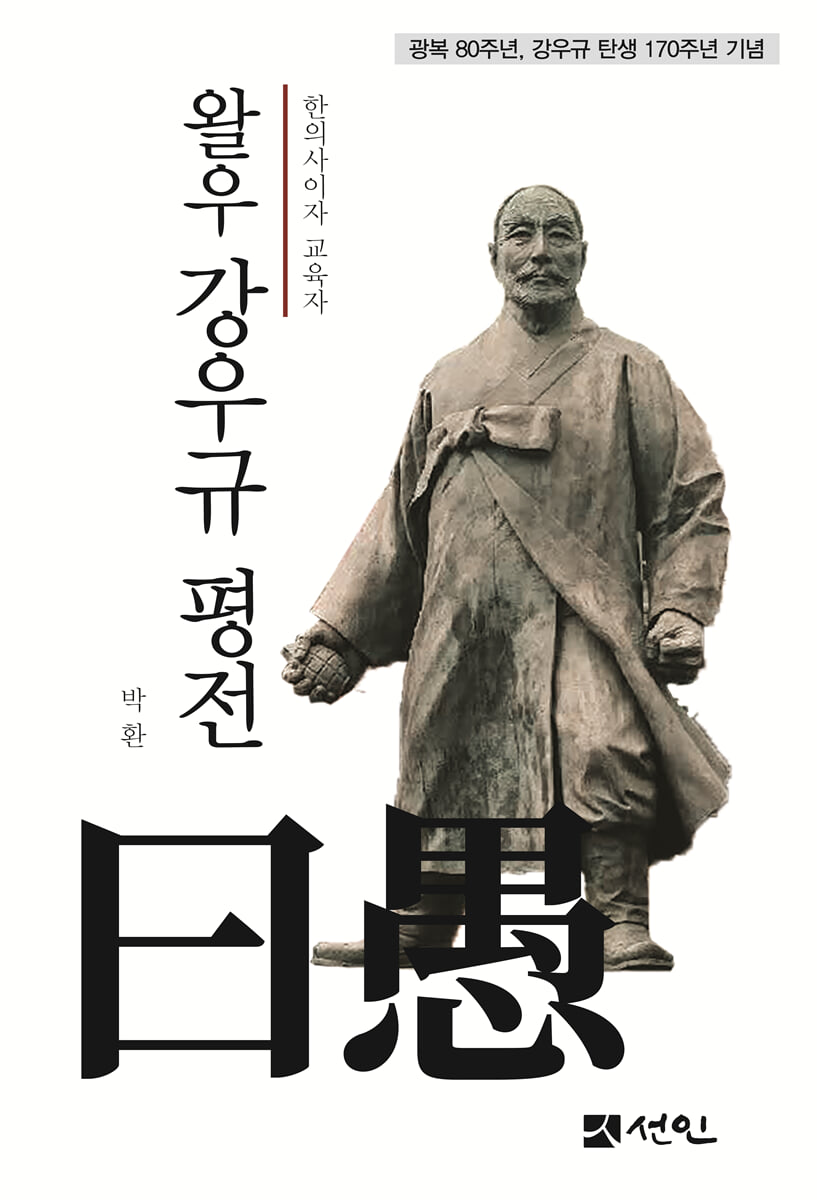
Wow, Kang Woo-gyu's biography
 |
Description
Book Introduction
The fact that Kang Woo-gyu remains an unfamiliar name to the public makes us reflect on the wrong current state of our society.
Compared to his historical status, Kang Woo-gyu has not been given much attention in later generations.
This is largely due to the unfortunate nature of our society.
The current position of a person who has made a great contribution to history can be strengthened or weakened depending on the presence or absence of his descendants and their economic circumstances.
This is truly unfortunate, but Kang Woo-gyu's case is an example of the latter.
In addition, I think that the fact that our society only recognizes 'success' has become a factor that has made Kang Woo-gyu's righteous deeds even more forgotten.
Kang Woo-gyu's uprising was a failure by normal standards because its purpose was to assassinate the governor-general.
However, even though he was unable to directly assassinate the governor, the impact of his righteous deed was a historical reality no less significant than that of a successful righteous deed.
However, I believe that the flawed standards of our society, which only values success and being number one, have gradually erased the figure of Kang Woo-gyu from our history over time.
Just looking at these few points, it becomes clearer why we must remember the name of this unfamiliar old man named Kang Woo-gyu.
After closing the last chapter of this book, I hope that the name we have forgotten, but must not forget, 'Kang Woo-gyu' will come to mind in front of the 'Yun Bong-gil and Lee Bong-chang' that we remember.
This year marks the 80th anniversary of liberation and the 170th anniversary of Kang Woo-gyu's birth.
Still, it was heartbreaking to see that his figure seemed to have become a forgotten legend for us.
Accordingly, I revised and supplemented the out-of-print biography of Kang Woo-gyu (Seonin, 2010).
I hope that through the publication of this book, the true face of Dr. Kang Woo-gyu will become a small opportunity to deeply move the hearts of everyone.
- From the author's words
Compared to his historical status, Kang Woo-gyu has not been given much attention in later generations.
This is largely due to the unfortunate nature of our society.
The current position of a person who has made a great contribution to history can be strengthened or weakened depending on the presence or absence of his descendants and their economic circumstances.
This is truly unfortunate, but Kang Woo-gyu's case is an example of the latter.
In addition, I think that the fact that our society only recognizes 'success' has become a factor that has made Kang Woo-gyu's righteous deeds even more forgotten.
Kang Woo-gyu's uprising was a failure by normal standards because its purpose was to assassinate the governor-general.
However, even though he was unable to directly assassinate the governor, the impact of his righteous deed was a historical reality no less significant than that of a successful righteous deed.
However, I believe that the flawed standards of our society, which only values success and being number one, have gradually erased the figure of Kang Woo-gyu from our history over time.
Just looking at these few points, it becomes clearer why we must remember the name of this unfamiliar old man named Kang Woo-gyu.
After closing the last chapter of this book, I hope that the name we have forgotten, but must not forget, 'Kang Woo-gyu' will come to mind in front of the 'Yun Bong-gil and Lee Bong-chang' that we remember.
This year marks the 80th anniversary of liberation and the 170th anniversary of Kang Woo-gyu's birth.
Still, it was heartbreaking to see that his figure seemed to have become a forgotten legend for us.
Accordingly, I revised and supplemented the out-of-print biography of Kang Woo-gyu (Seonin, 2010).
I hope that through the publication of this book, the true face of Dr. Kang Woo-gyu will become a small opportunity to deeply move the hearts of everyone.
- From the author's words
- You can preview some of the book's contents.
Preview
index
In publishing a book
Chapter 1: How was Kang Woo-gyu's national consciousness formed?
Before meeting Lee Dong-hwi
After meeting Lee Dong-hwi
Chapter 2: Kang Woo-gyu Jumps into the National Movement
Migration to Manchuria and Russia and the Development of the Nationalist Movement in the 1910s
Join the Senior Citizens' Alliance
Chapter 3: New Governor-General Saito Arrives in Joseon
Saito's arrival at Seoul Station and preparations for welcoming him
A look at that day through the eyes of a Korean reporter
Chapter 4: A 65-Year-Old Man Throws a Bomb at the Governor-General of Korea
Kang Woo-gyu's bombshell and the Maeil Shinbo's reporting tone
The moment of rebellion seen from various perspectives
Chapter 5: The Birth Story of Kang Woo-gyu's Uprising
A look at the entire process up to the point of independence
How the bomb was purchased
How did you raise the funds?
Who are the people who participated in the uprising?
Who is the 'hidden' mastermind behind the uprising? - Lee Dong-hwi, Kim Gyu-myeon, and Jeong Jae-gwan
Chapter 6: The Story After the Uprising
The process from immediately after the claim to the trial
Trial scene
The pain of the families left behind
Chapter 7: Analysis of Kang Woo-gyu's Appeal Statement
Background of the Righteous Struggle
Choi Ja-nam's claim of indifference
Request for judgment according to public opinion
Criticism of the actions of the first and second trial courts
Advocating for Eastern peace theory
Chapter 8: The Force That Led Kang Woo-gyu to Uprising
Youth Education
Independence based on Christianity
Advocating peace theory through the Oriental Peace Theory
Chapter 9: What Dr. Kang Woo-gyu Left Behind
After Kang Woo-gyu's death
Significance in the history of the national movement
Appendix: Testimony of Kang Young-jae, granddaughter of Dr. Kang Woo-gyu
Chapter 1: How was Kang Woo-gyu's national consciousness formed?
Before meeting Lee Dong-hwi
After meeting Lee Dong-hwi
Chapter 2: Kang Woo-gyu Jumps into the National Movement
Migration to Manchuria and Russia and the Development of the Nationalist Movement in the 1910s
Join the Senior Citizens' Alliance
Chapter 3: New Governor-General Saito Arrives in Joseon
Saito's arrival at Seoul Station and preparations for welcoming him
A look at that day through the eyes of a Korean reporter
Chapter 4: A 65-Year-Old Man Throws a Bomb at the Governor-General of Korea
Kang Woo-gyu's bombshell and the Maeil Shinbo's reporting tone
The moment of rebellion seen from various perspectives
Chapter 5: The Birth Story of Kang Woo-gyu's Uprising
A look at the entire process up to the point of independence
How the bomb was purchased
How did you raise the funds?
Who are the people who participated in the uprising?
Who is the 'hidden' mastermind behind the uprising? - Lee Dong-hwi, Kim Gyu-myeon, and Jeong Jae-gwan
Chapter 6: The Story After the Uprising
The process from immediately after the claim to the trial
Trial scene
The pain of the families left behind
Chapter 7: Analysis of Kang Woo-gyu's Appeal Statement
Background of the Righteous Struggle
Choi Ja-nam's claim of indifference
Request for judgment according to public opinion
Criticism of the actions of the first and second trial courts
Advocating for Eastern peace theory
Chapter 8: The Force That Led Kang Woo-gyu to Uprising
Youth Education
Independence based on Christianity
Advocating peace theory through the Oriental Peace Theory
Chapter 9: What Dr. Kang Woo-gyu Left Behind
After Kang Woo-gyu's death
Significance in the history of the national movement
Appendix: Testimony of Kang Young-jae, granddaughter of Dr. Kang Woo-gyu
Publisher's Review
The names ‘Yun Bong-gil’ and ‘Lee Bong-chang’ are very familiar to us.
It's like the name of a famous celebrity that you've never met in person, but are familiar with through TV.
But what about the name "Kang Woo-gyu"? Like the ambiguity you feel when you accidentally run into an unpopular celebrity on the street, most people feel a sense of unfamiliarity, a sense of familiarity that feels both familiar and unfamiliar.
This is truly unfortunate and ironic.
In a way, Kang Woo-gyu is the person who made the above characters familiar to us even now, or who we can remember as heroes.
In short, Kang Woo-gyu's uprising against Governor-General Saito Makoto in 1919 can be seen as the trigger for this uprising.
Kang Woo-gyu's righteous struggle was the first righteous struggle since the March 1st Movement, and it led to many righteous struggles including theirs.
The Kang Woo-gyu Uprising, which directly and indirectly influenced the large and small uprisings that followed the March 1st Movement, took place at Seoul Station (Namdaemun Station) at 5:00 PM on September 2, 1919.
Despite the fervent independence movements that raged at home and abroad, starting with the March 1st Movement, Japan never gave up its rule over Joseon.
Accordingly, some Koreans in Manchuria, Russia, and other places attempted to launch an armed struggle to drive the Japanese out of our land.
Among their plans was one to convey the Korean people's will for independence to Japan and the world by assassinating the Governor-General of Korea.
The person who put that plan into practice was Korean medicine doctor Kang Woo-gyu.
Even under the strict security of the Japanese, Kang Woo-gyu boldly threw a bomb to assassinate Saito Makoto, who was taking office as the third Governor-General of Korea.
The bomb thrown by Kang Woo-gyu unfortunately did not reach its intended target, Saito Makoto, but it was so powerful that it seriously injured 37 Japanese officials and their followers who had come out to welcome the new governor-general.
Kang Woo-gyu's uprising is notable simply because he was the 'first'.
This is noteworthy enough given his age at the time.
He was 65 years old when he shot Makoto Saito.
Considering that the ages of Ahn Jung-geun, Yun Bong-gil, and Lee Bong-chang, whom we all know well, were 20, 24, and 32, respectively, Kang Woo-gyu's deed can be considered quite an interesting and remarkable event simply because it was carried out by an elderly person.
Kang Woo-gyu's uprising, which was significant in many ways, not only served as a great warning to Saito, who was taking office as Governor-General of Korea, but also contributed greatly to raising the national consciousness of Koreans both at home and abroad.
In particular, he impressed Koreans deeply until the very end by maintaining a dignified appearance in front of the Japanese during the trial, imprisonment, and execution after the uprising.
In this way, Kang Woo-gyu's righteous deed occupies a very important position in our national movement.
Therefore, although it is a somewhat unfamiliar name to the general public, it has received relatively much attention in academic circles.
As a result, some specific facts about his actions were revealed.
However, it cannot be said that the character of Korean medicine doctor Kang Woo-gyu and the overall picture of his anti-Japanese movement have been properly illuminated and revealed.
Therefore, this book aims to reveal aspects of Kang Woo-gyu and his righteous actions that have not been properly illuminated or revealed until now by examining them from various angles.
That is, the small purpose of writing this book is to examine his actions comprehensively so that his name can find its rightful place in academia and the general public.
Specifically, we will examine the formation of Kang Woo-gyu's national consciousness, the development and ideology of the national movement, the influence of his righteous deeds and martyrdom, and the historical significance of his activities in the history of the Korean national movement.
In particular, in terms of ideology, I believe that the core of his thought is Christian thought and Eastern peace theory, but I believe that this point has been overlooked in academia and the general public up to now.
Therefore, I would like to highlight that Korean medicine doctor Kang Woo-gyu was not just an activist, but a person who, like Ahn Jung-geun, engaged in his activities with a clear understanding of the times.
Kang Woo-gyu is a person for whom I personally feel great affection and respect.
This is not only because his righteousness holds a significant place in our history.
Kang Woo-gyu is a person who gives us a lot of insight from a human and social perspective.
Humans are animals whose obsession with life grows stronger as they age.
It's easy to talk about death, but as we get older, death becomes a greater fear.
Isn't it much more difficult for an old person to give up his life for his country than for a young person to give up his life for his country?
At the time, he was 65 years old. Nowadays, with the advancement of medicine, people in their 60s are considered young elderly people, but in their 60s, he was already past the average life expectancy and was biologically at the crossroads of death.
I think he deserves to be highlighted precisely because he was a man who transcended these very human fears.
On the one hand, the fact that Kang Woo-gyu remains an unfamiliar name to the public makes us reflect on the wrong current state of our society.
Kang Woo-gyu can be seen as not receiving much attention in later generations compared to his historical status.
This is largely due to the unfortunate nature of our society.
The current position of a person who has made a great contribution to history can be strengthened or weakened depending on the presence or absence of his descendants and their economic circumstances.
This is truly unfortunate, but Kang Woo-gyu's case is an example of the latter.
In addition, I think that the fact that our society only recognizes 'success' has become a factor that has made Kang Woo-gyu's righteous deeds even more forgotten.
Kang Woo-gyu's uprising was a failure by normal standards because its purpose was to assassinate the governor-general.
However, even though he was unable to directly assassinate the governor, the impact of his righteous deed was a historical reality no less significant than that of a successful righteous deed.
However, I believe that the flawed standards of our society, which only values success and being number one, have gradually erased the figure of Kang Woo-gyu from our history over time.
Just looking at these few points, it becomes clearer why we must remember the name of this unfamiliar old man named Kang Woo-gyu.
After closing the last chapter of this book, I hope that the name we have forgotten, but must not forget, 'Kang Woo-gyu' will come to mind in front of the 'Yun Bong-gil and Lee Bong-chang' that we remember.
This year marks the 80th anniversary of liberation and the 170th anniversary of Kang Woo-gyu's birth.
Still, it was heartbreaking to see that his figure seemed to have become a forgotten legend for us.
Accordingly, I revised and supplemented the out-of-print biography of Kang Woo-gyu (Seonin, 2010).
I hope that through the publication of this book, the true face of Dr. Kang Woo-gyu will become a small opportunity to deeply move the hearts of everyone.
At the Cultural Center in November 2025
Cheongheon Park Hwan
It's like the name of a famous celebrity that you've never met in person, but are familiar with through TV.
But what about the name "Kang Woo-gyu"? Like the ambiguity you feel when you accidentally run into an unpopular celebrity on the street, most people feel a sense of unfamiliarity, a sense of familiarity that feels both familiar and unfamiliar.
This is truly unfortunate and ironic.
In a way, Kang Woo-gyu is the person who made the above characters familiar to us even now, or who we can remember as heroes.
In short, Kang Woo-gyu's uprising against Governor-General Saito Makoto in 1919 can be seen as the trigger for this uprising.
Kang Woo-gyu's righteous struggle was the first righteous struggle since the March 1st Movement, and it led to many righteous struggles including theirs.
The Kang Woo-gyu Uprising, which directly and indirectly influenced the large and small uprisings that followed the March 1st Movement, took place at Seoul Station (Namdaemun Station) at 5:00 PM on September 2, 1919.
Despite the fervent independence movements that raged at home and abroad, starting with the March 1st Movement, Japan never gave up its rule over Joseon.
Accordingly, some Koreans in Manchuria, Russia, and other places attempted to launch an armed struggle to drive the Japanese out of our land.
Among their plans was one to convey the Korean people's will for independence to Japan and the world by assassinating the Governor-General of Korea.
The person who put that plan into practice was Korean medicine doctor Kang Woo-gyu.
Even under the strict security of the Japanese, Kang Woo-gyu boldly threw a bomb to assassinate Saito Makoto, who was taking office as the third Governor-General of Korea.
The bomb thrown by Kang Woo-gyu unfortunately did not reach its intended target, Saito Makoto, but it was so powerful that it seriously injured 37 Japanese officials and their followers who had come out to welcome the new governor-general.
Kang Woo-gyu's uprising is notable simply because he was the 'first'.
This is noteworthy enough given his age at the time.
He was 65 years old when he shot Makoto Saito.
Considering that the ages of Ahn Jung-geun, Yun Bong-gil, and Lee Bong-chang, whom we all know well, were 20, 24, and 32, respectively, Kang Woo-gyu's deed can be considered quite an interesting and remarkable event simply because it was carried out by an elderly person.
Kang Woo-gyu's uprising, which was significant in many ways, not only served as a great warning to Saito, who was taking office as Governor-General of Korea, but also contributed greatly to raising the national consciousness of Koreans both at home and abroad.
In particular, he impressed Koreans deeply until the very end by maintaining a dignified appearance in front of the Japanese during the trial, imprisonment, and execution after the uprising.
In this way, Kang Woo-gyu's righteous deed occupies a very important position in our national movement.
Therefore, although it is a somewhat unfamiliar name to the general public, it has received relatively much attention in academic circles.
As a result, some specific facts about his actions were revealed.
However, it cannot be said that the character of Korean medicine doctor Kang Woo-gyu and the overall picture of his anti-Japanese movement have been properly illuminated and revealed.
Therefore, this book aims to reveal aspects of Kang Woo-gyu and his righteous actions that have not been properly illuminated or revealed until now by examining them from various angles.
That is, the small purpose of writing this book is to examine his actions comprehensively so that his name can find its rightful place in academia and the general public.
Specifically, we will examine the formation of Kang Woo-gyu's national consciousness, the development and ideology of the national movement, the influence of his righteous deeds and martyrdom, and the historical significance of his activities in the history of the Korean national movement.
In particular, in terms of ideology, I believe that the core of his thought is Christian thought and Eastern peace theory, but I believe that this point has been overlooked in academia and the general public up to now.
Therefore, I would like to highlight that Korean medicine doctor Kang Woo-gyu was not just an activist, but a person who, like Ahn Jung-geun, engaged in his activities with a clear understanding of the times.
Kang Woo-gyu is a person for whom I personally feel great affection and respect.
This is not only because his righteousness holds a significant place in our history.
Kang Woo-gyu is a person who gives us a lot of insight from a human and social perspective.
Humans are animals whose obsession with life grows stronger as they age.
It's easy to talk about death, but as we get older, death becomes a greater fear.
Isn't it much more difficult for an old person to give up his life for his country than for a young person to give up his life for his country?
At the time, he was 65 years old. Nowadays, with the advancement of medicine, people in their 60s are considered young elderly people, but in their 60s, he was already past the average life expectancy and was biologically at the crossroads of death.
I think he deserves to be highlighted precisely because he was a man who transcended these very human fears.
On the one hand, the fact that Kang Woo-gyu remains an unfamiliar name to the public makes us reflect on the wrong current state of our society.
Kang Woo-gyu can be seen as not receiving much attention in later generations compared to his historical status.
This is largely due to the unfortunate nature of our society.
The current position of a person who has made a great contribution to history can be strengthened or weakened depending on the presence or absence of his descendants and their economic circumstances.
This is truly unfortunate, but Kang Woo-gyu's case is an example of the latter.
In addition, I think that the fact that our society only recognizes 'success' has become a factor that has made Kang Woo-gyu's righteous deeds even more forgotten.
Kang Woo-gyu's uprising was a failure by normal standards because its purpose was to assassinate the governor-general.
However, even though he was unable to directly assassinate the governor, the impact of his righteous deed was a historical reality no less significant than that of a successful righteous deed.
However, I believe that the flawed standards of our society, which only values success and being number one, have gradually erased the figure of Kang Woo-gyu from our history over time.
Just looking at these few points, it becomes clearer why we must remember the name of this unfamiliar old man named Kang Woo-gyu.
After closing the last chapter of this book, I hope that the name we have forgotten, but must not forget, 'Kang Woo-gyu' will come to mind in front of the 'Yun Bong-gil and Lee Bong-chang' that we remember.
This year marks the 80th anniversary of liberation and the 170th anniversary of Kang Woo-gyu's birth.
Still, it was heartbreaking to see that his figure seemed to have become a forgotten legend for us.
Accordingly, I revised and supplemented the out-of-print biography of Kang Woo-gyu (Seonin, 2010).
I hope that through the publication of this book, the true face of Dr. Kang Woo-gyu will become a small opportunity to deeply move the hearts of everyone.
At the Cultural Center in November 2025
Cheongheon Park Hwan
GOODS SPECIFICS
- Date of issue: November 29, 2025
- Format: Hardcover book binding method guide
- Page count, weight, size: 296 pages | 420g | 128*188*20mm
- ISBN13: 9791160689976
- ISBN10: 1160689970
You may also like
카테고리
korean


korean

![GQ KOREA Mark (Monthly): December [2025]](http://librairie.coreenne.fr/cdn/shop/files/8ef265dbbfbf186523ed75ba7319009d.jpg?v=1765340328&width=3840)


