

Daegu Independence Movement Sites Tour 4
 |
Description
Book Introduction
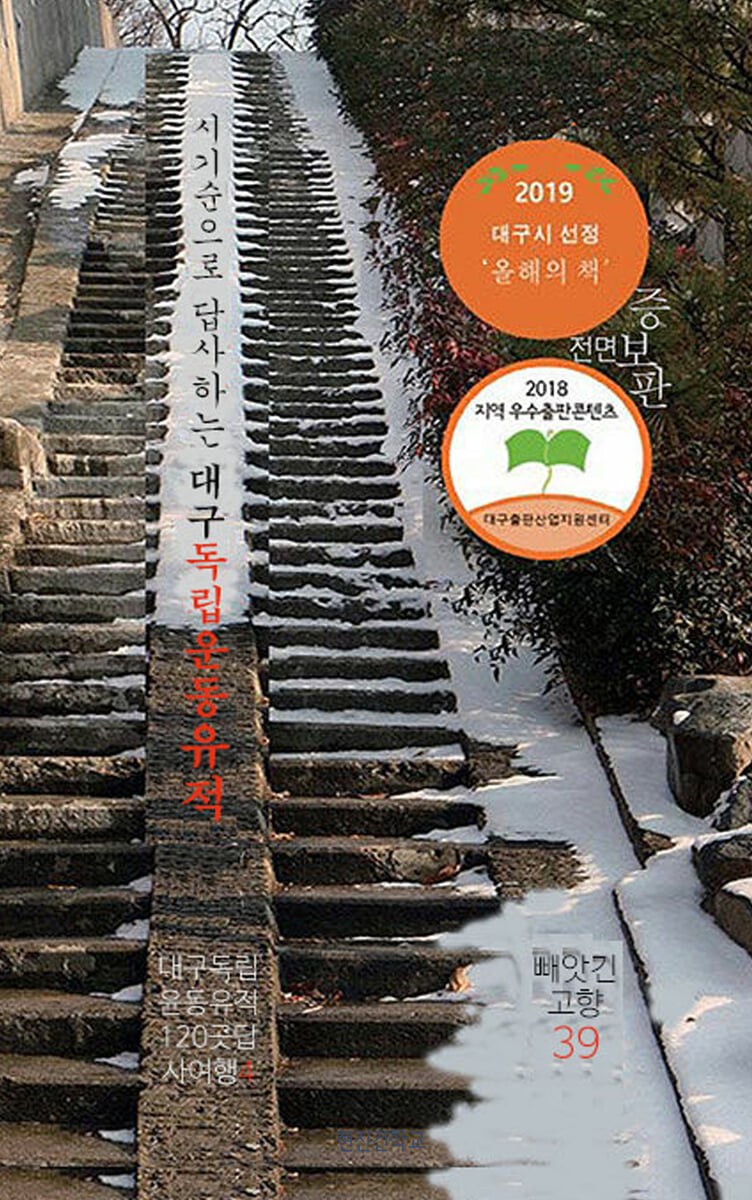
This is one of four volumes of the expanded edition of "A Field Trip to 100 Sites of the Daegu Independence Movement," selected as the "Book of the Year" by Daegu City in 2019.
As Gunwi County was incorporated into Daegu Metropolitan City, and new and lost relics were discovered in Daegu City, the need arose to supplement and refine the existing manuscript, and so a comprehensive expansion was made. However, the book became so thick that it was divided into three volumes by region.
Volume 1 covers Dalseo-gu and Nam-gu, Volume 2 covers Dong-gu, Buk-gu, Suseong-gu, and Dalseong-gun, and Volume 3 covers Jung-gu and Gunwi-gun.
The fourth volume, published this time, presents a summary of Daegu's independence movement sites in chronological order, showing a more history-like aspect compared to volumes 1-3, which emphasized the function of a field trip guide.
As Gunwi County was incorporated into Daegu Metropolitan City, and new and lost relics were discovered in Daegu City, the need arose to supplement and refine the existing manuscript, and so a comprehensive expansion was made. However, the book became so thick that it was divided into three volumes by region.
Volume 1 covers Dalseo-gu and Nam-gu, Volume 2 covers Dong-gu, Buk-gu, Suseong-gu, and Dalseong-gun, and Volume 3 covers Jung-gu and Gunwi-gun.
The fourth volume, published this time, presents a summary of Daegu's independence movement sites in chronological order, showing a more history-like aspect compared to volumes 1-3, which emphasized the function of a field trip guide.
- You can preview some of the book's contents.
Preview
index
1.
Choi Je-woo
2.
Daegu Righteous Army and the National Restoration Movement
Moon Seok-bong, Woo Jae-ryong, Im Yong-sang, Jang Yoon-deok, Heo Wi, Lee Sang-ryong, Woo Hyeon-seo-ru, Kim Gwang-je, Seo Sang-don, Sunjong, Gu Chan-hoe
3.
Joseon National Restoration Corps and Daehan Liberation Association
△Yoon Sang-tae △Lee Si-young △Kim Jin-man? Jin-woo brothers △Seo Sang-il △Gwangbokhoe
4.
Daegu's March 1st Movement
△March 8-10, 1919, Daegu Independence Movement △March 1st Movement at Namsan Church △March 1st Movement at Gyeseong School △March 1st Movement at Donghwasa Local Academy △March 1st Movement at Art University △Seo Geon-su
5.
Daegu's independence movement in the 1920s
△Lee Jong-am △Lee Kyung-hee △Son Yang-yoon △Cho Ki-hong △Park Hee-kwang △Song Doo-hwan △Lee Hyun-soo and his son △K Party △Choi Jong-eung △Yang Do-il △Jinwoo Federation △Yoon Woo-yeol △Lee Sang-hwa and Lee Sang-jeong △Jang Jin-hong △Daegu High School strike
6.
Daegu's independence movement in the 1930s
△Lee Yuk-sa △Jeong Hak-i △Daegu Normal School student struggle
7.
Daegu's independence movement in the 1940s
△Seo Bo-in △Lee Yun-jae △Daegu Commercial School Taegeuk Team struggle
8.
Hyunjin Geon School member's post
△Some translations of Hyun Jin-geon's novel 'Equator', including English translations and executive translations
Choi Je-woo
2.
Daegu Righteous Army and the National Restoration Movement
Moon Seok-bong, Woo Jae-ryong, Im Yong-sang, Jang Yoon-deok, Heo Wi, Lee Sang-ryong, Woo Hyeon-seo-ru, Kim Gwang-je, Seo Sang-don, Sunjong, Gu Chan-hoe
3.
Joseon National Restoration Corps and Daehan Liberation Association
△Yoon Sang-tae △Lee Si-young △Kim Jin-man? Jin-woo brothers △Seo Sang-il △Gwangbokhoe
4.
Daegu's March 1st Movement
△March 8-10, 1919, Daegu Independence Movement △March 1st Movement at Namsan Church △March 1st Movement at Gyeseong School △March 1st Movement at Donghwasa Local Academy △March 1st Movement at Art University △Seo Geon-su
5.
Daegu's independence movement in the 1920s
△Lee Jong-am △Lee Kyung-hee △Son Yang-yoon △Cho Ki-hong △Park Hee-kwang △Song Doo-hwan △Lee Hyun-soo and his son △K Party △Choi Jong-eung △Yang Do-il △Jinwoo Federation △Yoon Woo-yeol △Lee Sang-hwa and Lee Sang-jeong △Jang Jin-hong △Daegu High School strike
6.
Daegu's independence movement in the 1930s
△Lee Yuk-sa △Jeong Hak-i △Daegu Normal School student struggle
7.
Daegu's independence movement in the 1940s
△Seo Bo-in △Lee Yun-jae △Daegu Commercial School Taegeuk Team struggle
8.
Hyunjin Geon School member's post
△Some translations of Hyun Jin-geon's novel 'Equator', including English translations and executive translations
Into the book
Choi Je-woo's Stele: There is a 'Donghak cult founder Suun Choi Je-woo's Stele' on the sidewalk in front of the Hyundai Department Store in Banwoldang, Daegu.
It was planned to be built on the site of Gwandeokdang, the execution site, but it was not successful and was instead built nearby in 2017.
Gwandeokjeong, located on the hill of Amisan behind Sundobi, has no relation to Choi Je-woo.
Gwandeokjeong is a ‘martyrdom memorial hall’ built by the Catholic Church in 1991.
--- p.10
Moon Seok-bong's birthplace: Located at 313 Seongha-ri, Hyeonpung-gun, Dalseong-gun.
Moon Seok-bong is a person who “has great significance in the history of the independence movement as he was the first person in the country to raise an army (after the Eulmi Incident (the assassination of Empress Myeongseong)) and served as a catalyst for spreading the independence movement nationwide (according to the Ministry of Patriots and Veterans Affairs’ Records of Meritorious Service to Independence Activists).”
But when you go to the site, there is not a single sign.
--- p.14
Woohyun Seoru: The late Joseon Dynasty was a time of resistance by righteous armies against the Japanese with guns and swords, and at the same time, it was a time of national salvation movement with active enlightenment movements.
Opened in 1905, Uhyeonseoru, considered the first private library in Korea, was located at 101-11 Suchang-dong, Jung-gu, Daegu (currently the Daegu Bank Bukseong-ro branch).
The Japanese could not leave Uhyeonseoru alone, which produced many independence activists, including Governor Kim Ji-seop, who threw a bomb at the Japanese palace in 1924.
Ultimately, Uhyeonseoru was forcibly closed in 1911.
Uhyeonseoru also performed the function of a school, and at that time it was called Simuhakdang.
Uhyeonseoru was also used as the office of the Daegu Optical Society, which, along with Gwangmunsa, was one of the two main axes of the national debt redemption movement.
Lee Il-woo, who led the Daegu Optical Society, was Lee Sang-hwa's uncle.
It was planned to be built on the site of Gwandeokdang, the execution site, but it was not successful and was instead built nearby in 2017.
Gwandeokjeong, located on the hill of Amisan behind Sundobi, has no relation to Choi Je-woo.
Gwandeokjeong is a ‘martyrdom memorial hall’ built by the Catholic Church in 1991.
--- p.10
Moon Seok-bong's birthplace: Located at 313 Seongha-ri, Hyeonpung-gun, Dalseong-gun.
Moon Seok-bong is a person who “has great significance in the history of the independence movement as he was the first person in the country to raise an army (after the Eulmi Incident (the assassination of Empress Myeongseong)) and served as a catalyst for spreading the independence movement nationwide (according to the Ministry of Patriots and Veterans Affairs’ Records of Meritorious Service to Independence Activists).”
But when you go to the site, there is not a single sign.
--- p.14
Woohyun Seoru: The late Joseon Dynasty was a time of resistance by righteous armies against the Japanese with guns and swords, and at the same time, it was a time of national salvation movement with active enlightenment movements.
Opened in 1905, Uhyeonseoru, considered the first private library in Korea, was located at 101-11 Suchang-dong, Jung-gu, Daegu (currently the Daegu Bank Bukseong-ro branch).
The Japanese could not leave Uhyeonseoru alone, which produced many independence activists, including Governor Kim Ji-seop, who threw a bomb at the Japanese palace in 1924.
Ultimately, Uhyeonseoru was forcibly closed in 1911.
Uhyeonseoru also performed the function of a school, and at that time it was called Simuhakdang.
Uhyeonseoru was also used as the office of the Daegu Optical Society, which, along with Gwangmunsa, was one of the two main axes of the national debt redemption movement.
Lee Il-woo, who led the Daegu Optical Society, was Lee Sang-hwa's uncle.
--- p.24
GOODS SPECIFICS
- Date of issue: August 1, 2025
- Page count, weight, size: 152 pages | 210g | 130*210*10mm
- ISBN13: 9791188701711
- ISBN10: 1188701711
You may also like
카테고리
korean


korean

![GQ KOREA Mark (Monthly): December [2025]](http://librairie.coreenne.fr/cdn/shop/files/8ef265dbbfbf186523ed75ba7319009d.jpg?v=1765340328&width=3840)


