

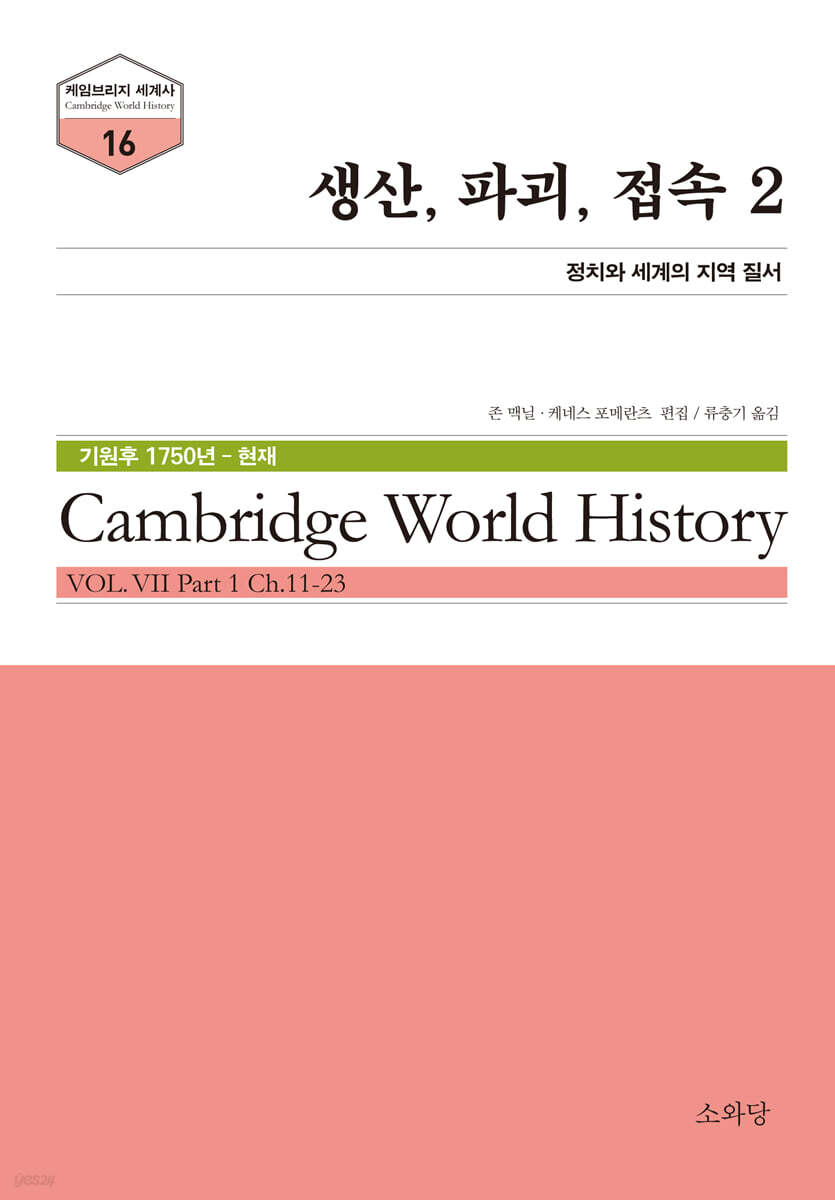
Production, Destruction, Connection 2
 |
Description
Book Introduction
Volumes 15-18 of the Cambridge World History series examine the changing world since 1750 as it has become increasingly interconnected.
First, volumes 15 and 16 deal with the structure, space, and process by which the modern world was created.
It covers a wide range of topics, including the environment, energy, technology, population, disease, law, industrialization, imperialism, decolonization, nationalism, socialism, and the history of major regions.
Additionally, volumes 17 and 18 examine social phenomena such as urbanization, population movement (migration), and changes in family and gender.
It also covers various cultural exchanges such as religion, science, music, and sports.
We also looked at the history of rubber, drugs, and automobiles, which are key elements of globalization.
First, volumes 15 and 16 deal with the structure, space, and process by which the modern world was created.
It covers a wide range of topics, including the environment, energy, technology, population, disease, law, industrialization, imperialism, decolonization, nationalism, socialism, and the history of major regions.
Additionally, volumes 17 and 18 examine social phenomena such as urbanization, population movement (migration), and changes in family and gender.
It also covers various cultural exchanges such as religion, science, music, and sports.
We also looked at the history of rubber, drugs, and automobiles, which are key elements of globalization.
- You can preview some of the book's contents.
Preview
index
PART 3 POLITICS
CHAPTER 11 THE DEVELOPMENT OF INTERNATIONAL LAW
CHAPTER 12 On Nationalism
CHAPTER 13 On Imperialism
CHAPTER 14 Political Responses to European Expansion
CHAPTER 15: Colonial Dissolution and Its Legacy
CHAPTER 16 Genocide
CHAPTER 17 Communism and Fascism
PART 4: THE WORLD'S REGIONAL ORDER
CHAPTER 18 The Middle East in World History
CHAPTER 19 East Asia in World History
CHAPTER 20 Latin America in World History
CHAPTER 21 Africa in World History
CHAPTER 22 America in World History
CHAPTER 23: Pacific Economic History
CHAPTER 11 THE DEVELOPMENT OF INTERNATIONAL LAW
CHAPTER 12 On Nationalism
CHAPTER 13 On Imperialism
CHAPTER 14 Political Responses to European Expansion
CHAPTER 15: Colonial Dissolution and Its Legacy
CHAPTER 16 Genocide
CHAPTER 17 Communism and Fascism
PART 4: THE WORLD'S REGIONAL ORDER
CHAPTER 18 The Middle East in World History
CHAPTER 19 East Asia in World History
CHAPTER 20 Latin America in World History
CHAPTER 21 Africa in World History
CHAPTER 22 America in World History
CHAPTER 23: Pacific Economic History
Publisher's Review
The 16th book in the Cambridge World History series (18 volumes)
The Cambridge World History Series is a vast world history series in which over 200 scholars from around the world have participated.
The Korean version is scheduled to be published in 18 volumes.
This book is the 16th and the second of four volumes that discuss the modern and contemporary period.
Part 3 deals with changes in world politics.
In modern times, there has been a flood of unique political attempts.
Although it has a long history, nationalism has never been as prominent as in modern times.
It combined with imperialism to reorganize the world order, and political movements against it arose in all parts of the world.
In the process, colonies were created and also dismantled, and tragedies such as genocide were born.
This book examines each topic closely, even going so far as to trace the rise of communism and fascism.
Part 4 examines the world's regional order.
As political changes in the modern and contemporary world unfolded, changes in the order of each region of the world were also inevitable.
The Middle East, in particular, is a key region in international relations, where nationalism, religion, and energy issues are intricately intertwined.
In East Asia, the traditionally Sino-centric order was collapsing, but China gradually grew its power as the center.
As America emerged from colonialism, it became the center of a new world order.
Africa also became a stage for complex struggles during the colonial period and after liberation.
The Cambridge World History Series is a vast world history series in which over 200 scholars from around the world have participated.
The Korean version is scheduled to be published in 18 volumes.
This book is the 16th and the second of four volumes that discuss the modern and contemporary period.
Part 3 deals with changes in world politics.
In modern times, there has been a flood of unique political attempts.
Although it has a long history, nationalism has never been as prominent as in modern times.
It combined with imperialism to reorganize the world order, and political movements against it arose in all parts of the world.
In the process, colonies were created and also dismantled, and tragedies such as genocide were born.
This book examines each topic closely, even going so far as to trace the rise of communism and fascism.
Part 4 examines the world's regional order.
As political changes in the modern and contemporary world unfolded, changes in the order of each region of the world were also inevitable.
The Middle East, in particular, is a key region in international relations, where nationalism, religion, and energy issues are intricately intertwined.
In East Asia, the traditionally Sino-centric order was collapsing, but China gradually grew its power as the center.
As America emerged from colonialism, it became the center of a new world order.
Africa also became a stage for complex struggles during the colonial period and after liberation.
GOODS SPECIFICS
- Date of issue: October 25, 2025
- Page count, weight, size: 620 pages | 150*215*35mm
- ISBN13: 9788967220440
- ISBN10: 8967220448
You may also like
카테고리
korean


korean

![GQ KOREA Mark (Monthly): December [2025]](http://librairie.coreenne.fr/cdn/shop/files/8ef265dbbfbf186523ed75ba7319009d.jpg?v=1765340328&width=3840)


