

A Walk Through Modern Korean History: 1940s Part 1
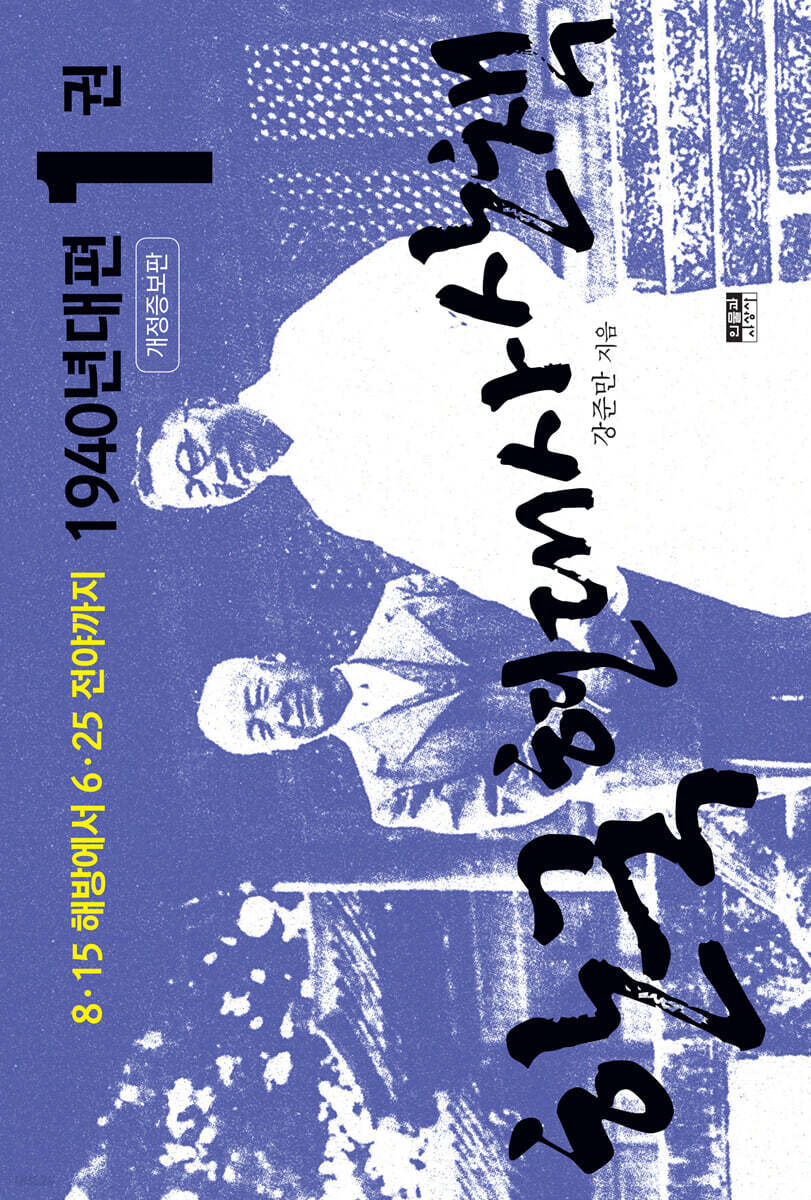 |
Description
Book Introduction
How have Korea's politics, economy, society, and culture evolved over the past 10 years?
Establishing a culture of recording and evaluating modern Korean history
The modern history of Korea, in which we have lived and in which we live now, is the starting point and the finishing point of history.
Because I have to live in a world where I have to make constant choices.
However, modern history has often been treated as a cold meal in the field of historical studies.
Because these are sensitive topics.
Kang Jun-man presents various positions on controversial issues while also offering his own perspective, thereby providing readers with accurate information and a variety of opportunities for participation.
In that respect, the ‘A Walk Through Modern Korean History’ series is unparalleled.
It is like a Korean's 'treasure trove' that contains everything about the Republic of Korea that made up the 'me' of today.
The "A Walk Through Modern Korean History" series, which meticulously captures 75 years of history from noon on August 15, 1945, to Bong Joon-ho's "Parasite," covers a wide range of fields, from politics, economy, and society to popular culture and sports.
And it brought to life the life and historical stage that modern Koreans had to face.
To this end, the 'A Walk Through Modern Korean History' series attempted a three-dimensional approach through extensive annotations, photographs capturing scenes from the time, and a 'History Walk' corner.
The 'A Walk Through Modern Korean History' series is not limited to a simple listing of events.
'Explosion of Han (恨) and Desire' (1940s), 'Age of Extremes' (1950s), 'Birth of an Opportunist Republic' (1960s), 'Nationalization of Exports' (1970s), 'Gwangju Massacre and the Seoul Olympics' (1980s), 'Division is Our Destiny, Solidarity is My Destiny' (1990s), 'The Light and Shadow of the Roh Moo-hyun Era' (2000s), 'The Age of Hatred and Loathing' (2010s), etc. Numerous events and topics are persistently explored amidst a fierce sense of crisis about the emotions and structures that dominated each era.
And he emphasizes that just as the new generation can seize new values in the name of 'progress', it must also embrace the 'pain' of past generations who had to survive times of extremes and poverty.
Kang Jun-man recognizes that modern Korean history is a history that has excluded 'humanity', and is attempting to restore 'humanity' and, on that basis, to achieve a new reconciliation between ideologies and generations.
The 'A Walk Through Modern Korean History' series can be considered the first Korean book series to establish a culture of recording and evaluating modern Korean history.
Establishing a culture of recording and evaluating modern Korean history
The modern history of Korea, in which we have lived and in which we live now, is the starting point and the finishing point of history.
Because I have to live in a world where I have to make constant choices.
However, modern history has often been treated as a cold meal in the field of historical studies.
Because these are sensitive topics.
Kang Jun-man presents various positions on controversial issues while also offering his own perspective, thereby providing readers with accurate information and a variety of opportunities for participation.
In that respect, the ‘A Walk Through Modern Korean History’ series is unparalleled.
It is like a Korean's 'treasure trove' that contains everything about the Republic of Korea that made up the 'me' of today.
The "A Walk Through Modern Korean History" series, which meticulously captures 75 years of history from noon on August 15, 1945, to Bong Joon-ho's "Parasite," covers a wide range of fields, from politics, economy, and society to popular culture and sports.
And it brought to life the life and historical stage that modern Koreans had to face.
To this end, the 'A Walk Through Modern Korean History' series attempted a three-dimensional approach through extensive annotations, photographs capturing scenes from the time, and a 'History Walk' corner.
The 'A Walk Through Modern Korean History' series is not limited to a simple listing of events.
'Explosion of Han (恨) and Desire' (1940s), 'Age of Extremes' (1950s), 'Birth of an Opportunist Republic' (1960s), 'Nationalization of Exports' (1970s), 'Gwangju Massacre and the Seoul Olympics' (1980s), 'Division is Our Destiny, Solidarity is My Destiny' (1990s), 'The Light and Shadow of the Roh Moo-hyun Era' (2000s), 'The Age of Hatred and Loathing' (2010s), etc. Numerous events and topics are persistently explored amidst a fierce sense of crisis about the emotions and structures that dominated each era.
And he emphasizes that just as the new generation can seize new values in the name of 'progress', it must also embrace the 'pain' of past generations who had to survive times of extremes and poverty.
Kang Jun-man recognizes that modern Korean history is a history that has excluded 'humanity', and is attempting to restore 'humanity' and, on that basis, to achieve a new reconciliation between ideologies and generations.
The 'A Walk Through Modern Korean History' series can be considered the first Korean book series to establish a culture of recording and evaluating modern Korean history.
- You can preview some of the book's contents.
Preview
index
Preface: The chilling resemblance between the liberation period and the present
"The Republic of Korea today is more dangerous than it was immediately after liberation." · 4 "When that day comes" · 6 Was it truly an ideological struggle? · 8 "Struggle for vested interests" and "Struggle for indulgences" · 10 The art of packaging called ideology · 13 The price of truth is still cheap · 15 For true "optimism and positivity" · 17
Part 1 1945: The Explosion of 36 Years of Anger
Chapter 1: Liberation on August 15th: A Thief's End
Liberation, which came as if it were a lie · 31 The thrill and joy of liberation · 33 The four to five hours it took for the great explosion · 35 Was it "Division Day" rather than "Liberation Day"? · 36 Negotiations between the Japanese Government-General of Korea and Yeo Un-hyeong · 38 The launch of the National Foundation Preparatory Committee · 41 "Liberation lasted only one day, the 16th" · 43 Song Jin-woo's reason for not attending the National Foundation Preparatory Committee · 45
Chapter 2: Was the 38th parallel really drawn in 30 minutes?
The Cairo and Tehran Conferences · 47 The Yalta Conference of the US, UK, and Soviet Union · 50 Did the US Sell Korea to the Soviets at Yalta? · 52 From Roosevelt to Truman · 54 Korea as a Substitute for the Division of Japan · 57 "Happiness is in Your Hands" · 59 Wariness and Contempt for the Soviet Army · 62 Rape and Looting by the Soviet Army · 63
Historical Walk 1: The Sinking of the Ukishima Maru · 67
Chapter 3: Proclamation of the People's Republic of Korea and the Entry of US Forces into Seoul
Park Hon-yong's Reconstruction of the Korean Communist Party · 69 The Leftward Bending of the Korean War Corps After Ahn Jae-hong's Departure · 71 The Communist Party's Leftist Hegemony · 72 The US Military's 'Pro-Japan, Anti-Korean' Stance · 74 Raising the Stars and Stripes in Place of the Lowered Japanese Flag · 76 John Hodge, Commander of the Occupying Forces · 78 The 'Unpreparedness Theory' Debate · 80 The US Military's Insults to Koreans · 82 Japanese Rule in US Military Clothing · 83 The US Military's Racism · 85 The Indiscriminate Spraying of DDT · 87
Chapter 4: The Founding of the Korean Democratic Party and the Politics of Interpretation
"Overthrow the artificial" · 90 "A powder keg that will explode immediately if ignited" · 91 The founding of the Korean Democratic Party · 92 The Korean Democratic Party = 『Dong-A Ilbo』 · 94 The Korean Democratic Party's monopoly on military administration advisory positions · 95 The harm of 'interpretation politics' · 96 The US military government's denial of artificiality · 98 The US military government's goal is 'crushing artificiality' · 99 Hunger for politics · 101 Cho Byeong-ok and Jang Taek-sang's control of the police · 103 The reason Cho Byeong-ok employed Japanese police officers · 104 'An efficient tool of tyranny' · 106 "A serious threat to democracy" · 107 The practice of 'investigation = torture' · 108
A Walk Through History 2: "Red Mountain" and the Return of 900,000 Japanese · 110
Chapter 5: The Controversy Over the Appearance of a Fake Kim Il-sung
Establishment of the North Korean Branch of the Communist Party of Korea · 113 The Emergence of Kim Il-sung, a 33-Year-Old · 115 Was Kim Il-sung Really a Fake? · 117 Haji's Welcome to Syngman Rhee · 119 Syngman Rhee's Popularity and Political Funding · 122 Organization of the Central Council for the Promotion of Independence · 124 Syngman Rhee's Attack on the Communist Party · 125 The Self-Management Movement and the Formation of the Korean Council for the Promotion of Independence · 127 The US Military Government's Ban on the Self-Management Movement · 129 Yeo Un-hyeong's Founding of the Korean People's Party · 130 Controversy over the Establishment of the Provisional Government · 131
Chapter 6: Kim Gu's Return to Korea and the Division of the Provisional Government
The Chongqing Provisional Government's Return to Korea as Individuals · 133 Kim Gu: "Salt for Stew" · 136 The Provisional Government's Refusal of Independence and Tribute · 140 The Relationship between the Provisional Government and the Korean Democratic Party · 142 The Provisional Government's Internal Strife and Jang Jun-ha's "Vocal Bomb" · 145 The "Provisional Government = Korean Independence Party = Kim Gu" Strategy · 147 The Demand for Compensation That Ignored the People's Livelihood · 149 The "Sinuiju Incident" and Kim Il-sung's "Democratic Base Theory" · 150
Chapter 7: Conflict and Struggle over the Trusteeship
The Man-made Empire, a Public Enemy of the US Military Government · 153 The Trusteeship Controversy Rises to the Surface · 154 The Distortion of the Moscow Decision · 155 The Media's Instigation of Indignation · 157 "Those Who Obey the Trusteeship Will Be Treated as Traitors" · 159 The Methodological Clash Between the Provisional Government Faction and the Korean Democratic Party Faction · 161 The Assassination of Song Jin-woo, Senior Secretary of the Korean Democratic Party · 162 The Failed Provisional Government Coup Plan · 164 The 75-Year-Old Controversy Over 'Distorted' Reporting · 166
A Walk Through History 3: English is Your Ultimate Survival Weapon · 168
Chapter 8: "The Media's Dam Has Broken"
"Sucked into the paper, starved for news" · 171 The Chosun Ilbo and the Dong-A Ilbo's continued publications · 173 Blatant partisanship and newspaper terrorism · 176 Left-wing dominance in newspapers · 177 Broadcasting and US military government publicity · 179 "Children of the new nation wake up early" · 182 The thirst for Korean and 'smuggled goods from the 38th parallel' · 184 The introduction of the 6-3-3-4 school system · 185 US military occupation of educational facilities · 186
Chapter 9: The "Cultural Dam" Has Also Burst
US Military Dance Parties and the "Dance Wind" Culture · 188 "National Disgrace Defiles the Streets of Seoul"? · 191 "The Men of This Land Cry with Chokes" · 193 Population Explosion and Skyrocketing Prices · 195 Japanese Currency Abuse · 196 The Deformed Structure of the South Korean Economy · 198 The Excess of Politics Ignoring the Economy · 199
A Walk Through History 4: The Women's Movement in the Liberation Era · 202
Part 2, 1946: The Explosion of Left-Right Conflict
Chapter 1: The 'Trusteeship' Conflict Was a War
'A complete act of treason, a betrayal of the nation' · 207 The Park Hon-yong Remarks Controversy · 210 Agreement between the Korean Democratic Party, the National Party, the Communist Party, and the Korean People's Party · 212 Clashes between Left and Right Students · 214 Counterattack on the Soviet Union's 'Distorted Media Reporting' · 217 'Pro-Trust = Treason, Anti-Trust = Patriotism' · 218
Chapter 2: The Creation of the National Defense Guard and the Collapse of the Free Market System
Disbandment of the Korean National Army Reserve Forces · 221 Establishment of the Military English School · 223 Is the National Defense Guard a Police Reserve Force? · 224 The Collapse of the US Military Government's Free Market System · 225 Harsh Response to Tenant Farmers · 227 "Give Me Rice or Give Me Death!" · 229
Chapter 3: Launch of the Democratic National Assembly and the Democratic National Front
Goodfellow and Syngman Rhee's "Ingenious Operation" · 232 "Don't Trust the Americans, Don't Be Fooled by the Soviets" · 235 The Formation of the Democratic National Front · 236 Separate March 1st Independence Movement Day Ceremonies Held by the Left and Right · 237
Chapter 4: Kim Il-sung's Assassination Attempt and the US-Soviet Joint Commission
The Provisional Government's Attempted Assassination of Kim Il-sung · 239 Land Reform and the Strengthening of the Communist Party · 241 Anti-Soviet and Anti-Communist Propaganda Ahead of the US-Soviet Joint Commission · 243 The Failure of the US-Soviet Joint Commission · 245 Soviet Army's Looting and Rape? · 247 "Let's Be Fighters Like Me" · 248
A Walk Through History 5: The Last Gyeongpyeong Soccer Match · 251
Chapter 5: The Joseon Jeongpansa Counterfeiting Case and the Left's "Going Underground"
The US Army Counterintelligence Corps' "Incheon Operation" · 253 Did the Korean Communist Party Print 12 Million Won in Counterfeit Banknotes? · 254 Was the Joseon Jeongpansa Counterfeit Banknote Case a "Political Incident"? · 256 Controlling Left-Wing Media through the Newspaper Licensing System · 258
Chapter 6: Kim Kyu-sik and Yeo Un-hyeong's Left-Right Collaboration Movement and Syngman Rhee's Theory of Independence
Kim Kyu-sik's "Left-Wing Aversion" · 259 Syngman Rhee's Attempt to Persuade Kim Kyu-sik · 261 Birch's Persuading Operation for Yeo Un-hyeong · 262 Syngman Rhee's Jeongeup Remarks · 264 The Conflict Between Syngman Rhee and the US Military Government · 266 Was It Due to Kim Gu's Personal Loyalty? · 268
A Walk Through History 6: Newspapers Suspended Due to Paper Shortage · 271
Chapter 7: The Golden Age of Right-Wing Youth Groups
The Korean Democratic Youth League, Kim Du-han, and Yeom Dong-jin · 273 The Seeds of Terror Sowed by the Japanese · 275 The National Student Federation and Lee Cheol-seung · 276 The Northwest Youth Association and the Seonwoo Ki-seong Movement · 277 Seonwoo Hwi's Defense of the Seocheong Movement · 279 The Korean National Youth League and Lee Beom-seok · 280 Collusion Between Political Leaders and Right-Wing Youth Organizations · 282 Why Are Photos of Syngman Rhee Posted in Police Stations? · 284
Chapter 8: The "Seoul National University Plan" Controversy and the Spread of "Educational Success Theory"
Politicization of Education · 286 Opposition to the National Alternative Plan · 288 Kim Du-han's "Saving the National Alternative Plan" Conspiracy · 290 The Influx of 3,600 Seocheong Members into Schools · 292 "Education is the Shortcut to Success" · 294
History Walk 7: Why There's Red Pepper Powder on Recycled Paper · 297
Chapter 9: Left-Right Collaboration, the General Strike of the Korean Confederation of Trade Unions, and the Daegu Uprising
The Founding of the North Korean Workers' Party · 299 Park Hon-yong's Opposition to Left-Right Collaboration · 301 The Five Left Principles and the Eight Right Principles · 302 Agreement on the Founding of the South Korean Workers' Party · 304 "If You Don't Have Rice, Eat Meat" · 305 "Suppressing Strikes Was War" · 307 "Comrade Kim Du-han! You Saved the Country" · 308 "The Federation of Korean Trade Unions is a Terrorist Organization" · 310 "The Gift of Liberation is Famine" · 311 Bloodshed in Daegu · 313 "People Only Brave in Civil War" · 316 The Beginning of Conservative Movement among Farmers · 318
History Walk 8: Shin Bul-chul's "Taegeukgi Desecration" and "Ttol-ttol's Adventure" · 320
Chapter 10: The Transitional Legislature, the Frustration of Yeo Un-hyeong and Kim Kyu-sik, and Syngman Rhee's Visit to the United States
Seven Principles of Left-Right Cooperation · 323 The Failure of Police Reform · 324 The South Korean Interim Legislative Assembly Election · 326 The Legislative Assembly Without Leftists and Center-Leftists · 328 The Creation of the South Korean Workers' Party · 329 Changing the Signboard from 'Communist Party' to 'Labor Party' · 331 "The Left and the Right Are Wasting Time Fighting" · 332 The Diverging Dreams of Syngman Rhee and Hodge · 335 The Rhee Travel Expense Collection Controversy · 337 "Hodge is a Communist Tool" · 338
A Walk Through History 9: The Popularity of Musical Theater and the Tyranny of the Profiteers · 340
Week 343
"The Republic of Korea today is more dangerous than it was immediately after liberation." · 4 "When that day comes" · 6 Was it truly an ideological struggle? · 8 "Struggle for vested interests" and "Struggle for indulgences" · 10 The art of packaging called ideology · 13 The price of truth is still cheap · 15 For true "optimism and positivity" · 17
Part 1 1945: The Explosion of 36 Years of Anger
Chapter 1: Liberation on August 15th: A Thief's End
Liberation, which came as if it were a lie · 31 The thrill and joy of liberation · 33 The four to five hours it took for the great explosion · 35 Was it "Division Day" rather than "Liberation Day"? · 36 Negotiations between the Japanese Government-General of Korea and Yeo Un-hyeong · 38 The launch of the National Foundation Preparatory Committee · 41 "Liberation lasted only one day, the 16th" · 43 Song Jin-woo's reason for not attending the National Foundation Preparatory Committee · 45
Chapter 2: Was the 38th parallel really drawn in 30 minutes?
The Cairo and Tehran Conferences · 47 The Yalta Conference of the US, UK, and Soviet Union · 50 Did the US Sell Korea to the Soviets at Yalta? · 52 From Roosevelt to Truman · 54 Korea as a Substitute for the Division of Japan · 57 "Happiness is in Your Hands" · 59 Wariness and Contempt for the Soviet Army · 62 Rape and Looting by the Soviet Army · 63
Historical Walk 1: The Sinking of the Ukishima Maru · 67
Chapter 3: Proclamation of the People's Republic of Korea and the Entry of US Forces into Seoul
Park Hon-yong's Reconstruction of the Korean Communist Party · 69 The Leftward Bending of the Korean War Corps After Ahn Jae-hong's Departure · 71 The Communist Party's Leftist Hegemony · 72 The US Military's 'Pro-Japan, Anti-Korean' Stance · 74 Raising the Stars and Stripes in Place of the Lowered Japanese Flag · 76 John Hodge, Commander of the Occupying Forces · 78 The 'Unpreparedness Theory' Debate · 80 The US Military's Insults to Koreans · 82 Japanese Rule in US Military Clothing · 83 The US Military's Racism · 85 The Indiscriminate Spraying of DDT · 87
Chapter 4: The Founding of the Korean Democratic Party and the Politics of Interpretation
"Overthrow the artificial" · 90 "A powder keg that will explode immediately if ignited" · 91 The founding of the Korean Democratic Party · 92 The Korean Democratic Party = 『Dong-A Ilbo』 · 94 The Korean Democratic Party's monopoly on military administration advisory positions · 95 The harm of 'interpretation politics' · 96 The US military government's denial of artificiality · 98 The US military government's goal is 'crushing artificiality' · 99 Hunger for politics · 101 Cho Byeong-ok and Jang Taek-sang's control of the police · 103 The reason Cho Byeong-ok employed Japanese police officers · 104 'An efficient tool of tyranny' · 106 "A serious threat to democracy" · 107 The practice of 'investigation = torture' · 108
A Walk Through History 2: "Red Mountain" and the Return of 900,000 Japanese · 110
Chapter 5: The Controversy Over the Appearance of a Fake Kim Il-sung
Establishment of the North Korean Branch of the Communist Party of Korea · 113 The Emergence of Kim Il-sung, a 33-Year-Old · 115 Was Kim Il-sung Really a Fake? · 117 Haji's Welcome to Syngman Rhee · 119 Syngman Rhee's Popularity and Political Funding · 122 Organization of the Central Council for the Promotion of Independence · 124 Syngman Rhee's Attack on the Communist Party · 125 The Self-Management Movement and the Formation of the Korean Council for the Promotion of Independence · 127 The US Military Government's Ban on the Self-Management Movement · 129 Yeo Un-hyeong's Founding of the Korean People's Party · 130 Controversy over the Establishment of the Provisional Government · 131
Chapter 6: Kim Gu's Return to Korea and the Division of the Provisional Government
The Chongqing Provisional Government's Return to Korea as Individuals · 133 Kim Gu: "Salt for Stew" · 136 The Provisional Government's Refusal of Independence and Tribute · 140 The Relationship between the Provisional Government and the Korean Democratic Party · 142 The Provisional Government's Internal Strife and Jang Jun-ha's "Vocal Bomb" · 145 The "Provisional Government = Korean Independence Party = Kim Gu" Strategy · 147 The Demand for Compensation That Ignored the People's Livelihood · 149 The "Sinuiju Incident" and Kim Il-sung's "Democratic Base Theory" · 150
Chapter 7: Conflict and Struggle over the Trusteeship
The Man-made Empire, a Public Enemy of the US Military Government · 153 The Trusteeship Controversy Rises to the Surface · 154 The Distortion of the Moscow Decision · 155 The Media's Instigation of Indignation · 157 "Those Who Obey the Trusteeship Will Be Treated as Traitors" · 159 The Methodological Clash Between the Provisional Government Faction and the Korean Democratic Party Faction · 161 The Assassination of Song Jin-woo, Senior Secretary of the Korean Democratic Party · 162 The Failed Provisional Government Coup Plan · 164 The 75-Year-Old Controversy Over 'Distorted' Reporting · 166
A Walk Through History 3: English is Your Ultimate Survival Weapon · 168
Chapter 8: "The Media's Dam Has Broken"
"Sucked into the paper, starved for news" · 171 The Chosun Ilbo and the Dong-A Ilbo's continued publications · 173 Blatant partisanship and newspaper terrorism · 176 Left-wing dominance in newspapers · 177 Broadcasting and US military government publicity · 179 "Children of the new nation wake up early" · 182 The thirst for Korean and 'smuggled goods from the 38th parallel' · 184 The introduction of the 6-3-3-4 school system · 185 US military occupation of educational facilities · 186
Chapter 9: The "Cultural Dam" Has Also Burst
US Military Dance Parties and the "Dance Wind" Culture · 188 "National Disgrace Defiles the Streets of Seoul"? · 191 "The Men of This Land Cry with Chokes" · 193 Population Explosion and Skyrocketing Prices · 195 Japanese Currency Abuse · 196 The Deformed Structure of the South Korean Economy · 198 The Excess of Politics Ignoring the Economy · 199
A Walk Through History 4: The Women's Movement in the Liberation Era · 202
Part 2, 1946: The Explosion of Left-Right Conflict
Chapter 1: The 'Trusteeship' Conflict Was a War
'A complete act of treason, a betrayal of the nation' · 207 The Park Hon-yong Remarks Controversy · 210 Agreement between the Korean Democratic Party, the National Party, the Communist Party, and the Korean People's Party · 212 Clashes between Left and Right Students · 214 Counterattack on the Soviet Union's 'Distorted Media Reporting' · 217 'Pro-Trust = Treason, Anti-Trust = Patriotism' · 218
Chapter 2: The Creation of the National Defense Guard and the Collapse of the Free Market System
Disbandment of the Korean National Army Reserve Forces · 221 Establishment of the Military English School · 223 Is the National Defense Guard a Police Reserve Force? · 224 The Collapse of the US Military Government's Free Market System · 225 Harsh Response to Tenant Farmers · 227 "Give Me Rice or Give Me Death!" · 229
Chapter 3: Launch of the Democratic National Assembly and the Democratic National Front
Goodfellow and Syngman Rhee's "Ingenious Operation" · 232 "Don't Trust the Americans, Don't Be Fooled by the Soviets" · 235 The Formation of the Democratic National Front · 236 Separate March 1st Independence Movement Day Ceremonies Held by the Left and Right · 237
Chapter 4: Kim Il-sung's Assassination Attempt and the US-Soviet Joint Commission
The Provisional Government's Attempted Assassination of Kim Il-sung · 239 Land Reform and the Strengthening of the Communist Party · 241 Anti-Soviet and Anti-Communist Propaganda Ahead of the US-Soviet Joint Commission · 243 The Failure of the US-Soviet Joint Commission · 245 Soviet Army's Looting and Rape? · 247 "Let's Be Fighters Like Me" · 248
A Walk Through History 5: The Last Gyeongpyeong Soccer Match · 251
Chapter 5: The Joseon Jeongpansa Counterfeiting Case and the Left's "Going Underground"
The US Army Counterintelligence Corps' "Incheon Operation" · 253 Did the Korean Communist Party Print 12 Million Won in Counterfeit Banknotes? · 254 Was the Joseon Jeongpansa Counterfeit Banknote Case a "Political Incident"? · 256 Controlling Left-Wing Media through the Newspaper Licensing System · 258
Chapter 6: Kim Kyu-sik and Yeo Un-hyeong's Left-Right Collaboration Movement and Syngman Rhee's Theory of Independence
Kim Kyu-sik's "Left-Wing Aversion" · 259 Syngman Rhee's Attempt to Persuade Kim Kyu-sik · 261 Birch's Persuading Operation for Yeo Un-hyeong · 262 Syngman Rhee's Jeongeup Remarks · 264 The Conflict Between Syngman Rhee and the US Military Government · 266 Was It Due to Kim Gu's Personal Loyalty? · 268
A Walk Through History 6: Newspapers Suspended Due to Paper Shortage · 271
Chapter 7: The Golden Age of Right-Wing Youth Groups
The Korean Democratic Youth League, Kim Du-han, and Yeom Dong-jin · 273 The Seeds of Terror Sowed by the Japanese · 275 The National Student Federation and Lee Cheol-seung · 276 The Northwest Youth Association and the Seonwoo Ki-seong Movement · 277 Seonwoo Hwi's Defense of the Seocheong Movement · 279 The Korean National Youth League and Lee Beom-seok · 280 Collusion Between Political Leaders and Right-Wing Youth Organizations · 282 Why Are Photos of Syngman Rhee Posted in Police Stations? · 284
Chapter 8: The "Seoul National University Plan" Controversy and the Spread of "Educational Success Theory"
Politicization of Education · 286 Opposition to the National Alternative Plan · 288 Kim Du-han's "Saving the National Alternative Plan" Conspiracy · 290 The Influx of 3,600 Seocheong Members into Schools · 292 "Education is the Shortcut to Success" · 294
History Walk 7: Why There's Red Pepper Powder on Recycled Paper · 297
Chapter 9: Left-Right Collaboration, the General Strike of the Korean Confederation of Trade Unions, and the Daegu Uprising
The Founding of the North Korean Workers' Party · 299 Park Hon-yong's Opposition to Left-Right Collaboration · 301 The Five Left Principles and the Eight Right Principles · 302 Agreement on the Founding of the South Korean Workers' Party · 304 "If You Don't Have Rice, Eat Meat" · 305 "Suppressing Strikes Was War" · 307 "Comrade Kim Du-han! You Saved the Country" · 308 "The Federation of Korean Trade Unions is a Terrorist Organization" · 310 "The Gift of Liberation is Famine" · 311 Bloodshed in Daegu · 313 "People Only Brave in Civil War" · 316 The Beginning of Conservative Movement among Farmers · 318
History Walk 8: Shin Bul-chul's "Taegeukgi Desecration" and "Ttol-ttol's Adventure" · 320
Chapter 10: The Transitional Legislature, the Frustration of Yeo Un-hyeong and Kim Kyu-sik, and Syngman Rhee's Visit to the United States
Seven Principles of Left-Right Cooperation · 323 The Failure of Police Reform · 324 The South Korean Interim Legislative Assembly Election · 326 The Legislative Assembly Without Leftists and Center-Leftists · 328 The Creation of the South Korean Workers' Party · 329 Changing the Signboard from 'Communist Party' to 'Labor Party' · 331 "The Left and the Right Are Wasting Time Fighting" · 332 The Diverging Dreams of Syngman Rhee and Hodge · 335 The Rhee Travel Expense Collection Controversy · 337 "Hodge is a Communist Tool" · 338
A Walk Through History 9: The Popularity of Musical Theater and the Tyranny of the Profiteers · 340
Week 343
Into the book
On the morning of August 15, 1945, posters reading, "Today's noon company broadcast, 100 million people must listen" were posted all over Seoul.
At noon, the trembling voice of Emperor Hirohito announcing Japan's unconditional surrender was relayed by the Gyeongseong Central Broadcasting Station and could be heard in Korea for 4 minutes and 10 seconds via radio.
Although Hirohito did not use the word “surrender,” his statement that “I have caused the Imperial Government to notify the four powers of the United States, Great Britain, the Soviet Union, and China of my intention to accept the joint declaration” was a declaration of surrender.
In Japan, there were successive suicides by seppuku by right-wing extremists and those who had been causing a ruckus the day before in an attempt to steal the Emperor's recording of the surrender declaration.
Army General Anami Korechika (1887-1945) was already dead, his stomach cut open at dawn, and five generals committed seppuku, while more than 100 officers and 30 civilians committed suicide in defeat.
--- From "Part 1, Chapter 1: The Liberation of August 15th That Came Like a Thief"
On September 16, 1945, the Korean Democratic Party, which already had significant influence over the US military government, held its founding convention at the Cheondoist lecture hall with approximately 1,600 founding members in attendance.
Outside the convention hall where the party was founded, farmers, armed with pickaxes and shovels, are said to have been indignant, saying, “Those who own land have exploited us for generations, and now they are creating a party again. It’s ridiculous.”
In its founding declaration, the Korean Democratic Party pledged to welcome the Chongqing Provisional Government as the “official government.”
Regarding the reason, Kim Jae-myung said, “For the Democratic Party of Korea, which does not have anyone with anti-Japanese experience to put forward, it was a natural need to feel the need to link its existence with the provisional government in order to survive politically in a situation where the left wing was gaining momentum and ‘purge of pro-Japanese collaborators’ was being discussed.”
The Korean Democratic Party also elected officials of the Provisional Government and anti-Japanese independence activists as leaders without the permission of the parties involved, just like the people.
They include Syngman Rhee, Seo Jae-pil, Kim Gu, Lee Si-young, Moon Chang-beom, Kwon Dong-jin, and Oh Se-chang.
Five people were still overseas, and Kwon Dong-jin and Oh Se-chang, who were in the country, did not accept the leadership position.
--- From "Part 1, Chapter 4: The Founding of the Korean Democratic Party and 'Interpretation Politics'"
Several newspapers were launched around the time of the continuation of the Chosun Ilbo and the Dong-A Ilbo.
On November 25, 1945, the Daedong Shinmun was founded with Lee Jong-hyung at its center, on February 26, 1946, the Hansung Ilbo was founded with Ahn Jae-hong at its center, on March 25, the Hyundai Ilbo was founded, on April 19, the Jungoe Shinbo was founded, and on May 1, the Independent Shinbo was founded.
In the extremely chaotic political situation surrounding the pro- and anti-trusteeship debates, newspapers frequently revealed their blatant partisanship, leading to frequent outbreaks of violence.
At that time, whenever there was a protest, newspapers were usually the target of terrorism.
On December 31, 1945, right-wing youths attacked the headquarters of the Korean People's Newspaper and beat about 20 civil servants. On January 2, 1946, they threw a grenade into the headquarters of the Korean People's Newspaper, destroying part of the facility.
The Chosun People's Daily republished its January 20th issue and reported the full story of the incident under the title, "Ignorant White Terrorists: The Rotary Press Turns in the Cold Night Ruins."
--- From Chapter 8 of Part 1, “The Media’s Dam Has Broken”
The conflict between the Democratic Party and the People's Front was expressed on March 1st.
The right-wing's March 1st Independence Declaration National Convention was held at Seoul Stadium, and the left-wing's March 1st Independence Declaration National Committee was held at Namsan Park.
On the morning of March 1st, a fierce competition to attract crowds took place between the left and right factions at the entrances of Namdaemun and Euljiro.
The leftist arts group held a citizens' comfort meeting at Changgyeongwon, and the event was packed with people, with comedian Shin Bul-chul, dancer Choi Seung-hee, actors Hwang Chul, and Moon Ye-bong appearing.
Students from the National Student Federation for Anti-Trusteeship stood on trucks near the entrance to Namsan and Changgyeongwon and made this appeal into a microphone.
“You are being deceived.
This is where the communist traitors who advocate for the establishment of a nation gather, so let's turn around and go to Seoul Stadium.
There, our leaders, Dr. Syngman Rhee and Mr. Kim Gu, are waiting for you.
Let us hear their noble words there.
Let us commemorate the spirit of March 1st there.”
--- From “Part 2, Chapter 3: Launch of the Democratic National Assembly and the Democratic People’s Front”
In fact, after Syngman Rhee encouraged Kim Kyu-sik to participate in the left-right cooperation movement, he made a speech in Jeongeup on June 3rd, arguing for the establishment of a separate government through a separate election in South Korea.
Why did Syngman Rhee ask Kim Kyu-sik to join the left-right coalition movement? Some argue that it was a cunning political maneuver by Syngman Rhee to bury a political rival.
However, considering that Syngman Rhee even told Kim Kyu-sik, “Wouldn’t it be proof that we shouldn’t try what the Americans tell us to do for independence?”, it seems difficult to see it that way.
Syngman Rhee actually asked Kim Kyu-sik to help him with that, and it can also be seen that Kim Kyu-sik accepted Syngman Rhee's request despite knowing this.
It is surprising that Syngman Rhee would ask Kim Kyu-sik to do such a wasteful job.
--- From "Part 2, Chapter 6, Kim Kyu-sik and Yeo Un-hyeong's Left-Right Collaboration Movement, and Syngman Rhee's Theory of Independence"
As a result of the September general strike, strikes occurred in 295 factories in Seoul alone, with approximately 30,000 workers and 16,000 students participating.
The total number of workers participating across South Korea reached approximately 250,000.
A total of 11,624 people were arrested during the general strike in September, and about 150 of them, including strike leaders, were brought to military courts.
As a result of the September strike, the Korean Confederation of Trade Unions (KCTU) declined due to the mass arrests of its executives, and in its place, the KCTU began to grow.
The Federation of Korean Trade Unions was founded on March 10, 1946, by the Korean Independence Promotion and Construction Youth Federation, and its official name was the Korean Independence Promotion and Labor Federation.
Right-wing politicians such as Kim Gu, Ahn Jae-hong, Jo So-ang, and Eom Hang-seop attended the founding ceremony as guests.
From its inception, the Korean Confederation of Trade Unions was not simply a workers' organization.
The Federation of Korean Trade Unions was not a government-sponsored union, but rather a "right-wing political group and a kind of terrorist organization."
At noon, the trembling voice of Emperor Hirohito announcing Japan's unconditional surrender was relayed by the Gyeongseong Central Broadcasting Station and could be heard in Korea for 4 minutes and 10 seconds via radio.
Although Hirohito did not use the word “surrender,” his statement that “I have caused the Imperial Government to notify the four powers of the United States, Great Britain, the Soviet Union, and China of my intention to accept the joint declaration” was a declaration of surrender.
In Japan, there were successive suicides by seppuku by right-wing extremists and those who had been causing a ruckus the day before in an attempt to steal the Emperor's recording of the surrender declaration.
Army General Anami Korechika (1887-1945) was already dead, his stomach cut open at dawn, and five generals committed seppuku, while more than 100 officers and 30 civilians committed suicide in defeat.
--- From "Part 1, Chapter 1: The Liberation of August 15th That Came Like a Thief"
On September 16, 1945, the Korean Democratic Party, which already had significant influence over the US military government, held its founding convention at the Cheondoist lecture hall with approximately 1,600 founding members in attendance.
Outside the convention hall where the party was founded, farmers, armed with pickaxes and shovels, are said to have been indignant, saying, “Those who own land have exploited us for generations, and now they are creating a party again. It’s ridiculous.”
In its founding declaration, the Korean Democratic Party pledged to welcome the Chongqing Provisional Government as the “official government.”
Regarding the reason, Kim Jae-myung said, “For the Democratic Party of Korea, which does not have anyone with anti-Japanese experience to put forward, it was a natural need to feel the need to link its existence with the provisional government in order to survive politically in a situation where the left wing was gaining momentum and ‘purge of pro-Japanese collaborators’ was being discussed.”
The Korean Democratic Party also elected officials of the Provisional Government and anti-Japanese independence activists as leaders without the permission of the parties involved, just like the people.
They include Syngman Rhee, Seo Jae-pil, Kim Gu, Lee Si-young, Moon Chang-beom, Kwon Dong-jin, and Oh Se-chang.
Five people were still overseas, and Kwon Dong-jin and Oh Se-chang, who were in the country, did not accept the leadership position.
--- From "Part 1, Chapter 4: The Founding of the Korean Democratic Party and 'Interpretation Politics'"
Several newspapers were launched around the time of the continuation of the Chosun Ilbo and the Dong-A Ilbo.
On November 25, 1945, the Daedong Shinmun was founded with Lee Jong-hyung at its center, on February 26, 1946, the Hansung Ilbo was founded with Ahn Jae-hong at its center, on March 25, the Hyundai Ilbo was founded, on April 19, the Jungoe Shinbo was founded, and on May 1, the Independent Shinbo was founded.
In the extremely chaotic political situation surrounding the pro- and anti-trusteeship debates, newspapers frequently revealed their blatant partisanship, leading to frequent outbreaks of violence.
At that time, whenever there was a protest, newspapers were usually the target of terrorism.
On December 31, 1945, right-wing youths attacked the headquarters of the Korean People's Newspaper and beat about 20 civil servants. On January 2, 1946, they threw a grenade into the headquarters of the Korean People's Newspaper, destroying part of the facility.
The Chosun People's Daily republished its January 20th issue and reported the full story of the incident under the title, "Ignorant White Terrorists: The Rotary Press Turns in the Cold Night Ruins."
--- From Chapter 8 of Part 1, “The Media’s Dam Has Broken”
The conflict between the Democratic Party and the People's Front was expressed on March 1st.
The right-wing's March 1st Independence Declaration National Convention was held at Seoul Stadium, and the left-wing's March 1st Independence Declaration National Committee was held at Namsan Park.
On the morning of March 1st, a fierce competition to attract crowds took place between the left and right factions at the entrances of Namdaemun and Euljiro.
The leftist arts group held a citizens' comfort meeting at Changgyeongwon, and the event was packed with people, with comedian Shin Bul-chul, dancer Choi Seung-hee, actors Hwang Chul, and Moon Ye-bong appearing.
Students from the National Student Federation for Anti-Trusteeship stood on trucks near the entrance to Namsan and Changgyeongwon and made this appeal into a microphone.
“You are being deceived.
This is where the communist traitors who advocate for the establishment of a nation gather, so let's turn around and go to Seoul Stadium.
There, our leaders, Dr. Syngman Rhee and Mr. Kim Gu, are waiting for you.
Let us hear their noble words there.
Let us commemorate the spirit of March 1st there.”
--- From “Part 2, Chapter 3: Launch of the Democratic National Assembly and the Democratic People’s Front”
In fact, after Syngman Rhee encouraged Kim Kyu-sik to participate in the left-right cooperation movement, he made a speech in Jeongeup on June 3rd, arguing for the establishment of a separate government through a separate election in South Korea.
Why did Syngman Rhee ask Kim Kyu-sik to join the left-right coalition movement? Some argue that it was a cunning political maneuver by Syngman Rhee to bury a political rival.
However, considering that Syngman Rhee even told Kim Kyu-sik, “Wouldn’t it be proof that we shouldn’t try what the Americans tell us to do for independence?”, it seems difficult to see it that way.
Syngman Rhee actually asked Kim Kyu-sik to help him with that, and it can also be seen that Kim Kyu-sik accepted Syngman Rhee's request despite knowing this.
It is surprising that Syngman Rhee would ask Kim Kyu-sik to do such a wasteful job.
--- From "Part 2, Chapter 6, Kim Kyu-sik and Yeo Un-hyeong's Left-Right Collaboration Movement, and Syngman Rhee's Theory of Independence"
As a result of the September general strike, strikes occurred in 295 factories in Seoul alone, with approximately 30,000 workers and 16,000 students participating.
The total number of workers participating across South Korea reached approximately 250,000.
A total of 11,624 people were arrested during the general strike in September, and about 150 of them, including strike leaders, were brought to military courts.
As a result of the September strike, the Korean Confederation of Trade Unions (KCTU) declined due to the mass arrests of its executives, and in its place, the KCTU began to grow.
The Federation of Korean Trade Unions was founded on March 10, 1946, by the Korean Independence Promotion and Construction Youth Federation, and its official name was the Korean Independence Promotion and Labor Federation.
Right-wing politicians such as Kim Gu, Ahn Jae-hong, Jo So-ang, and Eom Hang-seop attended the founding ceremony as guests.
From its inception, the Korean Confederation of Trade Unions was not simply a workers' organization.
The Federation of Korean Trade Unions was not a government-sponsored union, but rather a "right-wing political group and a kind of terrorist organization."
--- From "Part 2, Chapter 9: Left-Right Collaboration, the General Strike of the Korean Confederation of Trade Unions, and the Daegu Uprising"
Publisher's Review
The revised and expanded edition of the "A Walk Through Modern Korean History" series, covering the 1940s, has been published!
The political situation after liberation in 1945 was a battlefield where neither side could give in.
Compromise and reconciliation were only possible for people living normal lives in normal times.
Only the extreme fighting spirit to push through one's own claims stood out, and no middle ground was allowed.
The preliminary rehearsals for the massacres committed during the Korean War were already well underway in the late 1940s.
There was only a difference in scale, but no difference in brutality.
At that time, the submissive consciousness and behavior of the masses, accustomed to the legacy of the violent state, which could be called a remnant of Japanese imperialism, had not yet been overcome.
Such a clash of polar opposites unfolded on a new stage called the liberation period.
Of course, the extreme political situation after liberation in 1945 can be said to be the responsibility of both the left and the right, who refused to compromise.
However, the right wing, which was more focused on 'desire', probably bears greater responsibility.
The right wing compromised with Japan, but not with the left wing.
The moderate right wing was a minority and had no power.
For the hard-line right wing, compromise with Japan could bring them power and money, but compromise with the left wing was a compromise that threatened their ability to seize power and money or required them to share it.
It is precisely these interests that may have taken precedence over ideology or been mixed with it.
The people jumped into the 'Crucible of Chaos' with fire in their eyes for a spoonful of rice, some for better food and advancement.
The revised and expanded edition of 『A Walk Through Modern Korean History, 1940s: From Liberation on August 15 to the Eve of the Korean War on June 25』 consists of two volumes.
Volume 1 covers the years 1945 and 1946, and Volume 2 covers the years 1947, 1948, and 1949.
Kang Jun-man says that there is no country whose modern history needs constant rewriting, revision, and supplementation as much as Korea, and that he is publishing a revised and expanded edition of "A Walk Through Modern Korean History: The 1940s," which was published 21 years ago, at a time when secret documents from countries that had a great influence on Korea's fate are being declassified, and the truth about the tragic past is being belatedly revealed, leading to discussions about compensation and reparations.
Was the 38th parallel really drawn in 30 minutes?
The summit meeting between the United States, the United Kingdom, and the Soviet Union held in Potsdam, Germany on July 22, 1945, discussed the unconditional surrender of Japan and the Soviet Union's entry into the war.
The Potsdam Declaration, announced the following day, reaffirmed the Cairo Declaration's content that "Korea should become independent in due course."
However, the United States' refusal to discuss the Korean issue itself created confusion over the trusteeship issue after the war.
It was after the Soviet Union declared war on Japan that the United States began to ponder its policy toward the Korean Peninsula.
It was realized belatedly that the Soviet occupation of the Korean Peninsula would have a very significant military impact on Japan and the entire East Asia in the future.
Japan notified the United States that it was willing to accept the Potsdam Declaration.
Late that afternoon, he urgently ordered the War Department's Operations Bureau's Strategic Policy Division to draft "General Order No. 1," which contained the terms of the Japanese military's surrender.
The task of drafting the portion of this 'General Order No. 1' relating to the Korean Peninsula and the Far East was assigned to Colonels Charles Bonsteel and Dean Rusk, who were in charge of policy and division.
At that time, the Soviet army launched a simultaneous attack on northwestern China, Manchuria, southern Sakhalin, and the Kuril Islands, and some troops were preparing a landing operation in the northeastern region of the northernmost part of the Korean Peninsula.
Meanwhile, US troops were stationed in Okinawa, 1,000 kilometers south of the Korean Peninsula.
Charles Bonesteel and Dean Rusk were given only 30 minutes to study the map and write a report that identified the 38th parallel as the dividing line.
They presented this division plan to Major General George Lincoln, who ultimately reported it to the President.
And it was finally confirmed as 'General Order No. 1' and delivered to Douglas MacArthur.
This map, which determined the fate of the Korean Peninsula, remains in the U.S. National Archives.
Conflict and struggle over the 'trusteeship'
From December 16, 1945, the foreign ministers of the United States, the United Kingdom, and the Soviet Union held a trilateral conference in Moscow to deal with post-war issues, and the issue of trusteeship over Korea was discussed at this conference.
This sparked a fierce debate in the country between pros and cons of trusteeship.
John Hodge said, "The Korean people want independence above all else, and independence now, and if the trusteeship plan is announced, they will actually mount a physical resistance."
The word 'trust' was used to justify Japan's colonial rule in Korea, and so it created a strong psychological backlash among Koreans.
So, the term trust itself was impossible to rationally debate.
At that time, all political parties and social groups, regardless of political affiliation, expressed their absolute opposition to the trusteeship.
On December 27, 1945, the Dong-A Ilbo reported an article titled, “The Soviet Union insists on trusteeship, the United States insists on immediate independence, and the Soviet Union’s excuse is division and occupation at the 38th parallel.”
This article was an observational report published a day before the Moscow Tripartite Conference decision was announced and two days before the US Forces Korea Command received the decision.
This article not only reported the positions and claims of both sides in direct opposition, but was also the worst kind of misreporting, completely different from the content of the decision.
After the Dong-A Ilbo report, South Korean society was literally in an uproar, as if a hornet's nest had been stirred, and the people's anger seethed.
The National Mobilization Committee Against Trusteeship was formed jointly by the left and right wings and issued a statement opposing the trusteeship on December 28.
On the night of December 28, the provisional government officials held an all-night emergency cabinet meeting at Gyeonggyojang, centered around Chairman Kim Gu, and decided to oppose the trusteeship.
On the night of December 29, a meeting was held at Gyeonggyojang with representatives from various political parties and social groups in attendance. At this meeting, the "Provisional Government Faction", which advocated for the Provisional Government to take over the US military government, and the "Korean Democratic Party Faction", which advocated for a national convention to inform the United States of public opinion against the United States, clashed.
The Joseon Jeongpansa Counterfeiting Case and the Left's "Groundbreaking"
The US military government announced that after the liberation on August 15, 1945, the Korean Communist Party learned that the Joseon Jeongpansa had original banknotes to raise funds for the party and propaganda campaigns. After taking over the Joseon Jeongpansa by sending Communist Party member Park Nak-jong, they printed counterfeit banknotes totaling 12 million won in six batches.
Joseon Jeongpansa was originally a printing house for the Bank of Joseon under the name of Geuntaek Printing House during the Japanese colonial period. After liberation, the Joseon Communist Party took over the place, hung a sign saying "the party headquarters" and published its organ, the "Liberation Daily."
The US military government searched the headquarters of the Korean Communist Party and indefinitely suspended publication of its organ, the Liberation Daily.
When the first trial was held on July 29, the court sentenced the 16 Communists arrested as criminals to sentences ranging from life imprisonment to a minimum of 10 years.
The Joseon Jeongpansa counterfeiting case, which can be said to be the most suspicious case during the US military government, raised many suspicions, and as the activities of the Joseon Communist Party were made illegal as a result of this incident, the truth could no longer be determined and it ended up being covered up.
At the time, the US military government attempted to “break away from the extreme right by forming a joint left-right committee and planning an elected transitional legislature,” and by blaming the problems of the right wing on left-wing influence, it took the form of “policy decisions aimed at eradicating the roots of the South Korean left.”
The Central Committee of the Communist Party of Korea directly denied the US military government's announcement that the Communist Party of Korea was involved in the Joseon Jeongpansa counterfeiting case, and issued a statement of protest, stating that this was a simple counterfeiting case that was fabricated and exaggerated to suppress leftist forces.
The US military government promulgated the "Regarding the Permission of Newspapers and Other Periodicals" and did not permit applications for new periodicals from left-wing groups.
In other words, they began to control left-wing media through the newspaper publishing licensing system.
And it was decided to close the Soviet Consulate General in Seoul, which was judged to be a stronghold behind the Korean Communist Party.
The heyday of right-wing youth groups
The right-wing youth organization was reorganized into the National Youth Federation for the Promotion of Korean Independence on December 21, 1945, and then merged into the Korean Democratic Youth League (Daehanmincheong) in the spring of 1946.
On July 31, 1946, the National Student Federation (National Student Federation) was formed.
The National Student Federation maintained a close cooperative relationship with Kim Du-han's Korean Youth League.
The Northwest Youth Association (Seocheong), which was the most prominent right-wing youth group in the post-liberation period, was formed on November 30, 1946, by integrating youth associations from the North, including the Daehan Revolutionary Youth Association, the Hambuk Youth Association, the Hwanghae Youth Department, the Bukseon Youth Association, and the Pyeongan Youth Association.
The West Cheong armed themselves with religious-level anti-communist consciousness and carried out brutal violence.
The activities of the Seocheong during the suppression of the Jeju April 3rd Uprising were brutal.
However, anti-communists regarded the violence of the Western Youth as a 'necessary evil'.
The US military government secretly provided about $5 million and US military equipment to form the Korean National Youth Corps (Jokcheong) on October 9, 1946.
Although the Jokcheong received direct support from the US military government, it was passive in violent anti-communist activities, advocating for “non-political, non-military, national-first, and state-first.”
Most right-wing youth groups supported Syngman Rhee and Kim Gu.
These included the Syngman Rhee-affiliated Korean Independence Promotion National Youth League, the Korean Independence Youth Corps of the Korean Democratic Party, the Korean Liberation Youth Association of the Korean Independence Party, the Joseon National Construction Youth Association, the Korean Youth Association of the Joseon Youth Party, the Northwest Youth Association, the Korean Democratic Youth League, the Pyongyang Youth Association of the Joseon Democratic Party, and the Northwest Student League comprised of Vietnamese groups.
The reason there were so many right-wing youth groups was because of the large-scale unemployment and economic crisis that was sweeping Korean society at the time.
Since both political groups and political leaders needed young people, the interests of both sides aligned.
Many youth groups survived by extorting donations from all walks of life, while receiving some funding from politicians and resorting to violence under the protection of the police.
Highly violent terrorism could also generate high profits.
The violence of right-wing youth groups appeared to be an ideological struggle, but in reality, it was more of a means to solve hunger.
The political situation after liberation in 1945 was a battlefield where neither side could give in.
Compromise and reconciliation were only possible for people living normal lives in normal times.
Only the extreme fighting spirit to push through one's own claims stood out, and no middle ground was allowed.
The preliminary rehearsals for the massacres committed during the Korean War were already well underway in the late 1940s.
There was only a difference in scale, but no difference in brutality.
At that time, the submissive consciousness and behavior of the masses, accustomed to the legacy of the violent state, which could be called a remnant of Japanese imperialism, had not yet been overcome.
Such a clash of polar opposites unfolded on a new stage called the liberation period.
Of course, the extreme political situation after liberation in 1945 can be said to be the responsibility of both the left and the right, who refused to compromise.
However, the right wing, which was more focused on 'desire', probably bears greater responsibility.
The right wing compromised with Japan, but not with the left wing.
The moderate right wing was a minority and had no power.
For the hard-line right wing, compromise with Japan could bring them power and money, but compromise with the left wing was a compromise that threatened their ability to seize power and money or required them to share it.
It is precisely these interests that may have taken precedence over ideology or been mixed with it.
The people jumped into the 'Crucible of Chaos' with fire in their eyes for a spoonful of rice, some for better food and advancement.
The revised and expanded edition of 『A Walk Through Modern Korean History, 1940s: From Liberation on August 15 to the Eve of the Korean War on June 25』 consists of two volumes.
Volume 1 covers the years 1945 and 1946, and Volume 2 covers the years 1947, 1948, and 1949.
Kang Jun-man says that there is no country whose modern history needs constant rewriting, revision, and supplementation as much as Korea, and that he is publishing a revised and expanded edition of "A Walk Through Modern Korean History: The 1940s," which was published 21 years ago, at a time when secret documents from countries that had a great influence on Korea's fate are being declassified, and the truth about the tragic past is being belatedly revealed, leading to discussions about compensation and reparations.
Was the 38th parallel really drawn in 30 minutes?
The summit meeting between the United States, the United Kingdom, and the Soviet Union held in Potsdam, Germany on July 22, 1945, discussed the unconditional surrender of Japan and the Soviet Union's entry into the war.
The Potsdam Declaration, announced the following day, reaffirmed the Cairo Declaration's content that "Korea should become independent in due course."
However, the United States' refusal to discuss the Korean issue itself created confusion over the trusteeship issue after the war.
It was after the Soviet Union declared war on Japan that the United States began to ponder its policy toward the Korean Peninsula.
It was realized belatedly that the Soviet occupation of the Korean Peninsula would have a very significant military impact on Japan and the entire East Asia in the future.
Japan notified the United States that it was willing to accept the Potsdam Declaration.
Late that afternoon, he urgently ordered the War Department's Operations Bureau's Strategic Policy Division to draft "General Order No. 1," which contained the terms of the Japanese military's surrender.
The task of drafting the portion of this 'General Order No. 1' relating to the Korean Peninsula and the Far East was assigned to Colonels Charles Bonsteel and Dean Rusk, who were in charge of policy and division.
At that time, the Soviet army launched a simultaneous attack on northwestern China, Manchuria, southern Sakhalin, and the Kuril Islands, and some troops were preparing a landing operation in the northeastern region of the northernmost part of the Korean Peninsula.
Meanwhile, US troops were stationed in Okinawa, 1,000 kilometers south of the Korean Peninsula.
Charles Bonesteel and Dean Rusk were given only 30 minutes to study the map and write a report that identified the 38th parallel as the dividing line.
They presented this division plan to Major General George Lincoln, who ultimately reported it to the President.
And it was finally confirmed as 'General Order No. 1' and delivered to Douglas MacArthur.
This map, which determined the fate of the Korean Peninsula, remains in the U.S. National Archives.
Conflict and struggle over the 'trusteeship'
From December 16, 1945, the foreign ministers of the United States, the United Kingdom, and the Soviet Union held a trilateral conference in Moscow to deal with post-war issues, and the issue of trusteeship over Korea was discussed at this conference.
This sparked a fierce debate in the country between pros and cons of trusteeship.
John Hodge said, "The Korean people want independence above all else, and independence now, and if the trusteeship plan is announced, they will actually mount a physical resistance."
The word 'trust' was used to justify Japan's colonial rule in Korea, and so it created a strong psychological backlash among Koreans.
So, the term trust itself was impossible to rationally debate.
At that time, all political parties and social groups, regardless of political affiliation, expressed their absolute opposition to the trusteeship.
On December 27, 1945, the Dong-A Ilbo reported an article titled, “The Soviet Union insists on trusteeship, the United States insists on immediate independence, and the Soviet Union’s excuse is division and occupation at the 38th parallel.”
This article was an observational report published a day before the Moscow Tripartite Conference decision was announced and two days before the US Forces Korea Command received the decision.
This article not only reported the positions and claims of both sides in direct opposition, but was also the worst kind of misreporting, completely different from the content of the decision.
After the Dong-A Ilbo report, South Korean society was literally in an uproar, as if a hornet's nest had been stirred, and the people's anger seethed.
The National Mobilization Committee Against Trusteeship was formed jointly by the left and right wings and issued a statement opposing the trusteeship on December 28.
On the night of December 28, the provisional government officials held an all-night emergency cabinet meeting at Gyeonggyojang, centered around Chairman Kim Gu, and decided to oppose the trusteeship.
On the night of December 29, a meeting was held at Gyeonggyojang with representatives from various political parties and social groups in attendance. At this meeting, the "Provisional Government Faction", which advocated for the Provisional Government to take over the US military government, and the "Korean Democratic Party Faction", which advocated for a national convention to inform the United States of public opinion against the United States, clashed.
The Joseon Jeongpansa Counterfeiting Case and the Left's "Groundbreaking"
The US military government announced that after the liberation on August 15, 1945, the Korean Communist Party learned that the Joseon Jeongpansa had original banknotes to raise funds for the party and propaganda campaigns. After taking over the Joseon Jeongpansa by sending Communist Party member Park Nak-jong, they printed counterfeit banknotes totaling 12 million won in six batches.
Joseon Jeongpansa was originally a printing house for the Bank of Joseon under the name of Geuntaek Printing House during the Japanese colonial period. After liberation, the Joseon Communist Party took over the place, hung a sign saying "the party headquarters" and published its organ, the "Liberation Daily."
The US military government searched the headquarters of the Korean Communist Party and indefinitely suspended publication of its organ, the Liberation Daily.
When the first trial was held on July 29, the court sentenced the 16 Communists arrested as criminals to sentences ranging from life imprisonment to a minimum of 10 years.
The Joseon Jeongpansa counterfeiting case, which can be said to be the most suspicious case during the US military government, raised many suspicions, and as the activities of the Joseon Communist Party were made illegal as a result of this incident, the truth could no longer be determined and it ended up being covered up.
At the time, the US military government attempted to “break away from the extreme right by forming a joint left-right committee and planning an elected transitional legislature,” and by blaming the problems of the right wing on left-wing influence, it took the form of “policy decisions aimed at eradicating the roots of the South Korean left.”
The Central Committee of the Communist Party of Korea directly denied the US military government's announcement that the Communist Party of Korea was involved in the Joseon Jeongpansa counterfeiting case, and issued a statement of protest, stating that this was a simple counterfeiting case that was fabricated and exaggerated to suppress leftist forces.
The US military government promulgated the "Regarding the Permission of Newspapers and Other Periodicals" and did not permit applications for new periodicals from left-wing groups.
In other words, they began to control left-wing media through the newspaper publishing licensing system.
And it was decided to close the Soviet Consulate General in Seoul, which was judged to be a stronghold behind the Korean Communist Party.
The heyday of right-wing youth groups
The right-wing youth organization was reorganized into the National Youth Federation for the Promotion of Korean Independence on December 21, 1945, and then merged into the Korean Democratic Youth League (Daehanmincheong) in the spring of 1946.
On July 31, 1946, the National Student Federation (National Student Federation) was formed.
The National Student Federation maintained a close cooperative relationship with Kim Du-han's Korean Youth League.
The Northwest Youth Association (Seocheong), which was the most prominent right-wing youth group in the post-liberation period, was formed on November 30, 1946, by integrating youth associations from the North, including the Daehan Revolutionary Youth Association, the Hambuk Youth Association, the Hwanghae Youth Department, the Bukseon Youth Association, and the Pyeongan Youth Association.
The West Cheong armed themselves with religious-level anti-communist consciousness and carried out brutal violence.
The activities of the Seocheong during the suppression of the Jeju April 3rd Uprising were brutal.
However, anti-communists regarded the violence of the Western Youth as a 'necessary evil'.
The US military government secretly provided about $5 million and US military equipment to form the Korean National Youth Corps (Jokcheong) on October 9, 1946.
Although the Jokcheong received direct support from the US military government, it was passive in violent anti-communist activities, advocating for “non-political, non-military, national-first, and state-first.”
Most right-wing youth groups supported Syngman Rhee and Kim Gu.
These included the Syngman Rhee-affiliated Korean Independence Promotion National Youth League, the Korean Independence Youth Corps of the Korean Democratic Party, the Korean Liberation Youth Association of the Korean Independence Party, the Joseon National Construction Youth Association, the Korean Youth Association of the Joseon Youth Party, the Northwest Youth Association, the Korean Democratic Youth League, the Pyongyang Youth Association of the Joseon Democratic Party, and the Northwest Student League comprised of Vietnamese groups.
The reason there were so many right-wing youth groups was because of the large-scale unemployment and economic crisis that was sweeping Korean society at the time.
Since both political groups and political leaders needed young people, the interests of both sides aligned.
Many youth groups survived by extorting donations from all walks of life, while receiving some funding from politicians and resorting to violence under the protection of the police.
Highly violent terrorism could also generate high profits.
The violence of right-wing youth groups appeared to be an ideological struggle, but in reality, it was more of a means to solve hunger.
GOODS SPECIFICS
- Date of issue: August 18, 2025
- Page count, weight, size: 388 pages | 152*225*30mm
- ISBN13: 9788959068067
- ISBN10: 8959068063
You may also like
카테고리
korean


korean

![GQ KOREA Mark (Monthly): December [2025]](http://librairie.coreenne.fr/cdn/shop/files/8ef265dbbfbf186523ed75ba7319009d.jpg?v=1765340328&width=3840)


