

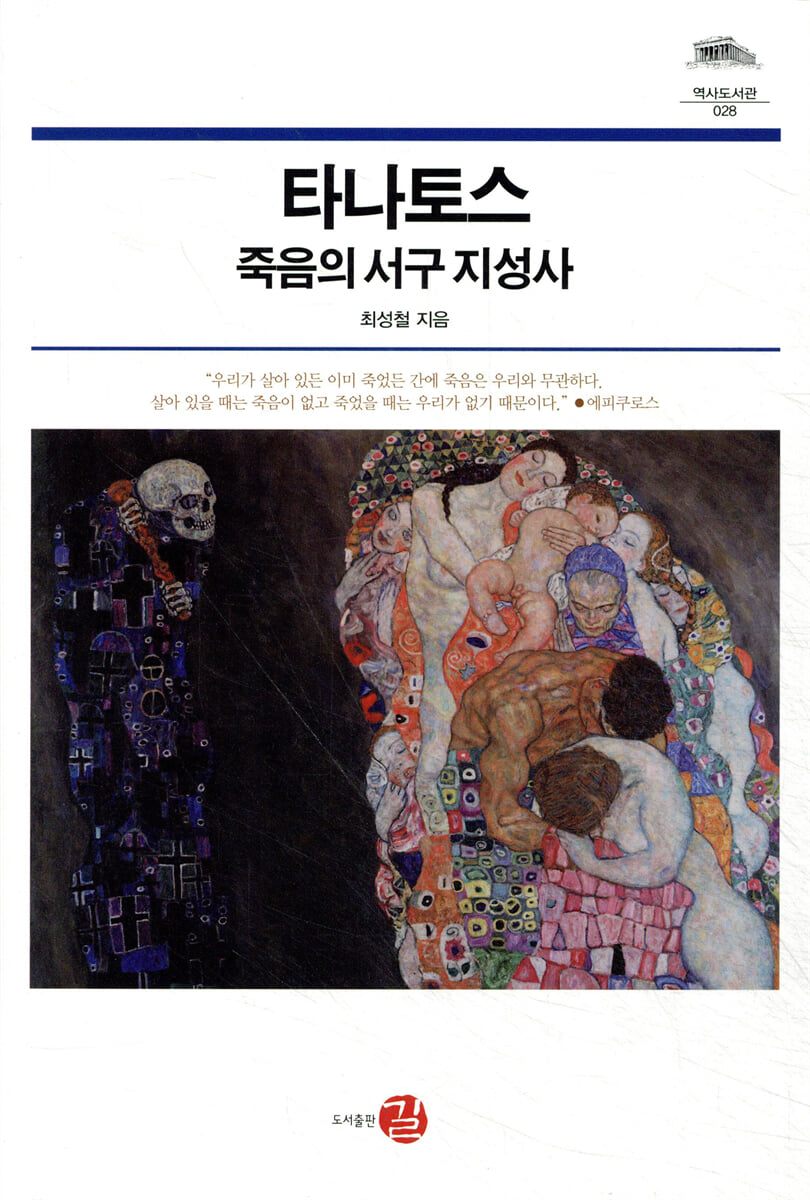
Thanatos, the Western Intellectual History of Death
 |
Description
Book Introduction
How has death been perceived in Western historiography?
Since the beginning of time, 'death' has been the most fearful, anxious, and avoidable event that has plagued all humans, yet it is an inevitable event that must be faced.
Therefore, every human being wants to shake off death from life.
Moreover, as Freud said, our unconscious mind has a tendency to reject death.
Nevertheless, in modern times, some say that actively thinking about death can actually be a way to avoid death.
So how has death been academically contemplated and studied? Death has long been a major topic of humanistic reflection and thought. Indeed, it has gone beyond that, to the point where, following the teachings of Socrates, "philosophizing" itself has been understood as "practicing death."
Perhaps for this reason, the research achievements in the field of 'philosophy' on the subject of death are truly enormous.
Among all academic fields, including the humanities, the field of philosophy has produced an almost overwhelming amount of research results.
This trend continues in ‘literature’ as well.
The situation is similar in other fields such as social sciences, medicine, and natural sciences.
So what about history? Unfortunately, the situation is completely different in history. While "death" frequently appears as a topic, it has rarely been studied as an academic subject.
At best, it is something like French historian Philippe Aries's 'History of Death'.
Even this is actually close to a 'death psychology' and does not deal with the issue of death in depth.
Considering this overall situation, it can be said that there have been few studies, both domestically and internationally, on the "intellectual history of death"—how past Western intellectuals viewed death in interaction with the social and historical environment.
This book aims to construct a so-called "intellectual history of death in the West," by analyzing the thoughts and records on death of Western intellectuals from ancient to modern times in relation to contemporary historical studies and organizing them by topic.
Since the beginning of time, 'death' has been the most fearful, anxious, and avoidable event that has plagued all humans, yet it is an inevitable event that must be faced.
Therefore, every human being wants to shake off death from life.
Moreover, as Freud said, our unconscious mind has a tendency to reject death.
Nevertheless, in modern times, some say that actively thinking about death can actually be a way to avoid death.
So how has death been academically contemplated and studied? Death has long been a major topic of humanistic reflection and thought. Indeed, it has gone beyond that, to the point where, following the teachings of Socrates, "philosophizing" itself has been understood as "practicing death."
Perhaps for this reason, the research achievements in the field of 'philosophy' on the subject of death are truly enormous.
Among all academic fields, including the humanities, the field of philosophy has produced an almost overwhelming amount of research results.
This trend continues in ‘literature’ as well.
The situation is similar in other fields such as social sciences, medicine, and natural sciences.
So what about history? Unfortunately, the situation is completely different in history. While "death" frequently appears as a topic, it has rarely been studied as an academic subject.
At best, it is something like French historian Philippe Aries's 'History of Death'.
Even this is actually close to a 'death psychology' and does not deal with the issue of death in depth.
Considering this overall situation, it can be said that there have been few studies, both domestically and internationally, on the "intellectual history of death"—how past Western intellectuals viewed death in interaction with the social and historical environment.
This book aims to construct a so-called "intellectual history of death in the West," by analyzing the thoughts and records on death of Western intellectuals from ancient to modern times in relation to contemporary historical studies and organizing them by topic.
index
Introduction 5
Part 1 Before Death
Chapter 1: Death as the Other Side of Life: The Dialectic of Life and Death 21
Chapter 2: Leading Causes of Death: Disease and Natural Disasters 65
Chapter 3: The Journey to Death: Aging and Old Age 107
Chapter 4 Death and Dying: Accepting Death, End-of-Life Care (Hospice), and Near-Death Experiences 139
Part 2 Death Itself
Chapter 5: Nature's Wonderful Gift: The Traditional View of Death 167
Chapter 6: The Unexperiential Taboo: The Modern World's View of Death 238
Chapter 7: Eliminating Your Own Life: Suicide 326
Chapter 8: Other Deaths: Various Kinds of Death, Subject and Species Death 373
Part 3 After Death
Chapter 9: Is Death Real?: Body and Soul 423
Chapter 10: Life After Death: The Afterlife and the Afterlife 492
Chapter 11: Transcending Death: Eternal Life, Immortality, Salvation, and Resurrection (536)
Chapter 12: Death Rituals: Funerals and Mourning 569
Conclusion 609
Reference 615
Search for people 637
Find details 644
Part 1 Before Death
Chapter 1: Death as the Other Side of Life: The Dialectic of Life and Death 21
Chapter 2: Leading Causes of Death: Disease and Natural Disasters 65
Chapter 3: The Journey to Death: Aging and Old Age 107
Chapter 4 Death and Dying: Accepting Death, End-of-Life Care (Hospice), and Near-Death Experiences 139
Part 2 Death Itself
Chapter 5: Nature's Wonderful Gift: The Traditional View of Death 167
Chapter 6: The Unexperiential Taboo: The Modern World's View of Death 238
Chapter 7: Eliminating Your Own Life: Suicide 326
Chapter 8: Other Deaths: Various Kinds of Death, Subject and Species Death 373
Part 3 After Death
Chapter 9: Is Death Real?: Body and Soul 423
Chapter 10: Life After Death: The Afterlife and the Afterlife 492
Chapter 11: Transcending Death: Eternal Life, Immortality, Salvation, and Resurrection (536)
Chapter 12: Death Rituals: Funerals and Mourning 569
Conclusion 609
Reference 615
Search for people 637
Find details 644
Publisher's Review
Death as a historical process that has transformed from an object of fear and avoidance to an object of active thought.
First, if we look at how Western intellectuals have thought about death over time, we can see that in the discourse on death among intellectuals active in ancient Greece, including up to the Hellenistic period, the views of the two philosophers, Socrates and Epicurus, represent the era like a two-horse carriage.
Socrates believed that “philosophizing” was like “practicing death,” and Epicurus argued that “death is nothing to us.”
Both emphasized that it is foolish to fear death.
These two classical views on death later dominated Western intellectual circles, and ancient Roman intellectuals also agreed with the views of these two Greek philosophers, supplementing and expanding upon their views.
When we enter the Middle Ages, when Christianity was dominant, the view on death changed religiously and theologically. Above all, death, as perceived by intellectuals at the time, was neither a particularly terrifying event nor a phenomenon to be feared.
Because they had a strong belief in an afterlife such as hell, purgatory, and heaven.
Even according to Augustine and Meister Eckhart, humans must first die in order to be saved and resurrected.
The characteristics of these Christian thinkers are that they recognized death as a kind of punishment from God for humanity based on the consciousness of original sin, regarded death as a means to enter heaven and welcome God, and therefore understood death not as the end or finality, but as a new beginning for eternal life.
During the Renaissance and Reformation, the Western intellectuals' view of death began to gradually change.
Of course, the Christian perspective was still dominant, but a secular stance began to appear.
For example, this can be clearly seen by looking at the view of death of Thomas More, who broke with the Christian tradition that tabooed suicide and euthanasia and accepted so-called euthanasia or assisted suicide, which helps suffering patients die without pain.
As we enter modern times, Westerners' discourse on death becomes more secularized.
At the starting point, the author calls upon the British poet John Donne, who directly challenged death with the line, “Death, show off!”
He goes beyond mere provocation or challenge to the point of killing death, displaying an extreme and radical nature that clearly shows that he is no longer the traditional Christian spirit that was accustomed to death.
This viewpoint has been changing more and more rapidly over the centuries, reaching Nietzsche, who advises, “Let one die at the right time,” and even goes so far as to speak of the death of God, not just of human death.
And then he says that death is the completion of life.
After Nietzsche, existentialist philosophers and phenomenologists such as Jaspers, Heidegger, Sartre, and Levinas actively preached the futility, purposelessness, meaninglessness, and absurdity of death.
Even scholars like Jeffrey Gorer have compared death to pornography, like sex.
In other words, sex and death are two taboos and mysteries with different names.
Rather than questioning death itself, it is time to consider how to face it.
Based on the historical development of the discourse on death among these Western intellectuals, the author first addresses the topic of ‘before death’ in Part 1.
This category includes various factors and causes that cause death, ways of understanding life as a concept contrasting with death before death, attitudes, and various mindsets for accepting death before death. These are ultimately organized into four core concepts: 'life and death', 'disease', 'aging', and 'acceptance of death'.
'Life and Death', which is covered in Chapter 1, is in fact a philosophical topic, introducing the discourses of philosophers of each era.
Chapter 2 deals with 'disease' as the primary cause of death, introducing infectious diseases such as plague, smallpox, measles, cholera, typhoid, and syphilis, as well as incurable diseases such as various cancers, AIDS, and Ebola in the 20th century.
Chapter 3 deals with 'aging' or 'old age', examining the flow from the ancient Cice to Montaigne to the modern German philosopher Odo Markwart, ultimately seeing that old age means a complete lack of hope.
Chapter 4 focuses on Elisabeth Kübler-Ross's so-called 'five stages of death acceptance theory', which is most widely known in relation to 'acceptance of death'.
She was a Swiss-born American psychiatrist, and is well known as a scholar who has academically synthesized human attitudes toward death and dying, including the five-stage death acceptance theory. She also published the clinical results of her reflections while meeting and communicating with numerous dying patients in hospital beds in a medical report format called “Death and Dying.”
Part 2 deals with ‘death itself’, and within this category the discourse of ‘death’ is included first and foremost.
Moreover, various types of death are addressed here, such as suicide, murder, capital punishment, assassination, mass murder, abortion, infanticide, euthanasia, death with dignity, individual death and the death of humanity, etc.
Chapter 3 in particular deals with a unique type of death: 'suicide'.
Albert Camus's The Myth of Sisyphus begins with the words, "There is only one truly serious philosophical problem, and that is suicide," and it shows that there have been a wide variety of philosophical views on suicide, which is often called "free death" (Freitod) in German-speaking countries.
The final third part examines the thoughts and ideas of Western intellectuals on various topics of 'after death'. The main subjects of the study include discourses on the 'soul' as an entity separate from the body, the 'afterlife' and 'life after death' including heaven, purgatory, and hell, 'immortality and eternal life' or 'salvation and resurrection' as the dream and hope of humanity, and 'funerals and mourning' as rituals after death.
What conclusion does the author draw from this discussion? He suggests that, since the topic of "death" itself is so abstract, perhaps more important than simply asking what death is is seriously considering how we will face it.
First, if we look at how Western intellectuals have thought about death over time, we can see that in the discourse on death among intellectuals active in ancient Greece, including up to the Hellenistic period, the views of the two philosophers, Socrates and Epicurus, represent the era like a two-horse carriage.
Socrates believed that “philosophizing” was like “practicing death,” and Epicurus argued that “death is nothing to us.”
Both emphasized that it is foolish to fear death.
These two classical views on death later dominated Western intellectual circles, and ancient Roman intellectuals also agreed with the views of these two Greek philosophers, supplementing and expanding upon their views.
When we enter the Middle Ages, when Christianity was dominant, the view on death changed religiously and theologically. Above all, death, as perceived by intellectuals at the time, was neither a particularly terrifying event nor a phenomenon to be feared.
Because they had a strong belief in an afterlife such as hell, purgatory, and heaven.
Even according to Augustine and Meister Eckhart, humans must first die in order to be saved and resurrected.
The characteristics of these Christian thinkers are that they recognized death as a kind of punishment from God for humanity based on the consciousness of original sin, regarded death as a means to enter heaven and welcome God, and therefore understood death not as the end or finality, but as a new beginning for eternal life.
During the Renaissance and Reformation, the Western intellectuals' view of death began to gradually change.
Of course, the Christian perspective was still dominant, but a secular stance began to appear.
For example, this can be clearly seen by looking at the view of death of Thomas More, who broke with the Christian tradition that tabooed suicide and euthanasia and accepted so-called euthanasia or assisted suicide, which helps suffering patients die without pain.
As we enter modern times, Westerners' discourse on death becomes more secularized.
At the starting point, the author calls upon the British poet John Donne, who directly challenged death with the line, “Death, show off!”
He goes beyond mere provocation or challenge to the point of killing death, displaying an extreme and radical nature that clearly shows that he is no longer the traditional Christian spirit that was accustomed to death.
This viewpoint has been changing more and more rapidly over the centuries, reaching Nietzsche, who advises, “Let one die at the right time,” and even goes so far as to speak of the death of God, not just of human death.
And then he says that death is the completion of life.
After Nietzsche, existentialist philosophers and phenomenologists such as Jaspers, Heidegger, Sartre, and Levinas actively preached the futility, purposelessness, meaninglessness, and absurdity of death.
Even scholars like Jeffrey Gorer have compared death to pornography, like sex.
In other words, sex and death are two taboos and mysteries with different names.
Rather than questioning death itself, it is time to consider how to face it.
Based on the historical development of the discourse on death among these Western intellectuals, the author first addresses the topic of ‘before death’ in Part 1.
This category includes various factors and causes that cause death, ways of understanding life as a concept contrasting with death before death, attitudes, and various mindsets for accepting death before death. These are ultimately organized into four core concepts: 'life and death', 'disease', 'aging', and 'acceptance of death'.
'Life and Death', which is covered in Chapter 1, is in fact a philosophical topic, introducing the discourses of philosophers of each era.
Chapter 2 deals with 'disease' as the primary cause of death, introducing infectious diseases such as plague, smallpox, measles, cholera, typhoid, and syphilis, as well as incurable diseases such as various cancers, AIDS, and Ebola in the 20th century.
Chapter 3 deals with 'aging' or 'old age', examining the flow from the ancient Cice to Montaigne to the modern German philosopher Odo Markwart, ultimately seeing that old age means a complete lack of hope.
Chapter 4 focuses on Elisabeth Kübler-Ross's so-called 'five stages of death acceptance theory', which is most widely known in relation to 'acceptance of death'.
She was a Swiss-born American psychiatrist, and is well known as a scholar who has academically synthesized human attitudes toward death and dying, including the five-stage death acceptance theory. She also published the clinical results of her reflections while meeting and communicating with numerous dying patients in hospital beds in a medical report format called “Death and Dying.”
Part 2 deals with ‘death itself’, and within this category the discourse of ‘death’ is included first and foremost.
Moreover, various types of death are addressed here, such as suicide, murder, capital punishment, assassination, mass murder, abortion, infanticide, euthanasia, death with dignity, individual death and the death of humanity, etc.
Chapter 3 in particular deals with a unique type of death: 'suicide'.
Albert Camus's The Myth of Sisyphus begins with the words, "There is only one truly serious philosophical problem, and that is suicide," and it shows that there have been a wide variety of philosophical views on suicide, which is often called "free death" (Freitod) in German-speaking countries.
The final third part examines the thoughts and ideas of Western intellectuals on various topics of 'after death'. The main subjects of the study include discourses on the 'soul' as an entity separate from the body, the 'afterlife' and 'life after death' including heaven, purgatory, and hell, 'immortality and eternal life' or 'salvation and resurrection' as the dream and hope of humanity, and 'funerals and mourning' as rituals after death.
What conclusion does the author draw from this discussion? He suggests that, since the topic of "death" itself is so abstract, perhaps more important than simply asking what death is is seriously considering how we will face it.
GOODS SPECIFICS
- Date of issue: June 9, 2025
- Format: Hardcover book binding method guide
- Page count, weight, size: 652 pages | 153*224*35mm
- ISBN13: 9788964452981
- ISBN10: 8964452984
You may also like
카테고리
korean


korean

![GQ KOREA Mark (Monthly): December [2025]](http://librairie.coreenne.fr/cdn/shop/files/8ef265dbbfbf186523ed75ba7319009d.jpg?v=1765340328&width=3840)


