

Tim Ingold
 |
Description
Book Introduction
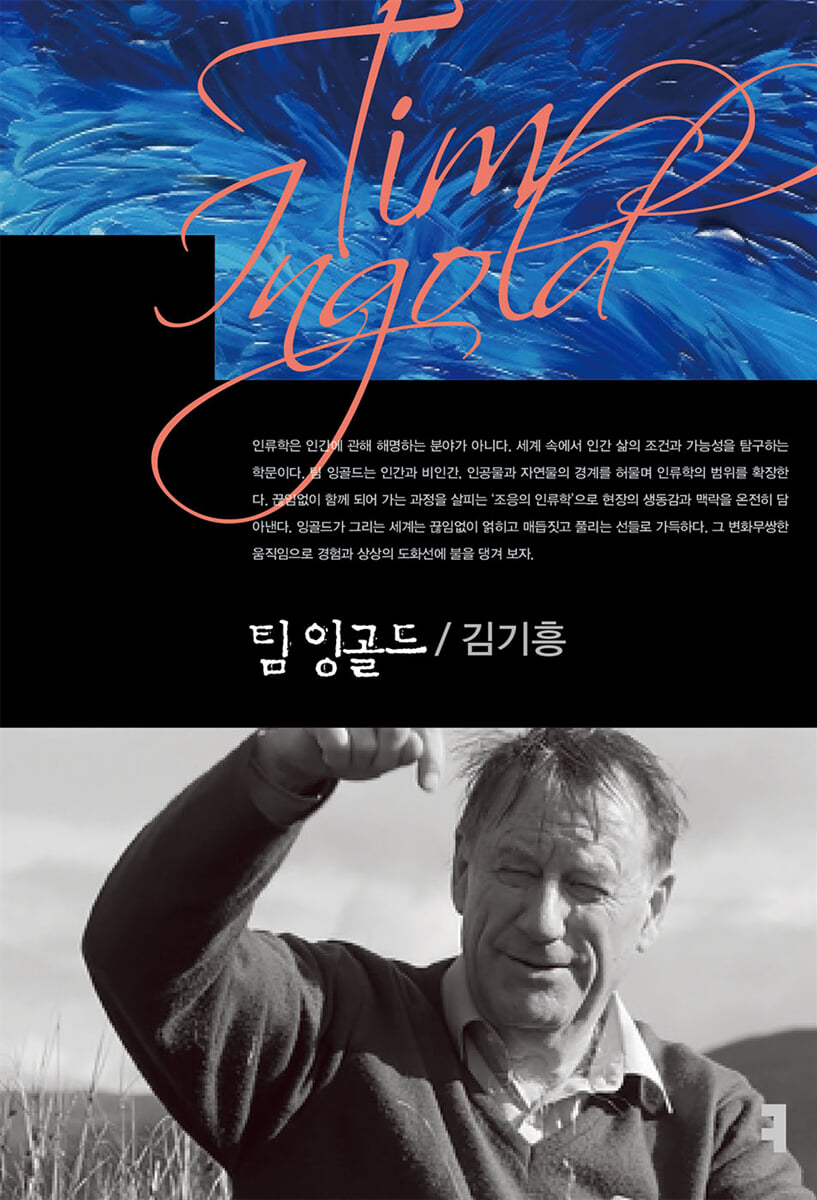
Tim Ingold is an anthropologist who explores the conditions and possibilities of human life in the world.
It expands the scope of anthropology by breaking down the boundaries between humans and non-humans, artificial and natural objects.
The vividness and context of the field are fully captured through the 'anthropology of correspondence' that examines the process of constantly becoming together.
The world Ingold draws is full of lines that are constantly entangled, knotted, and unraveled.
Let this ever-changing movement ignite the fuse of experience and imagination.
It expands the scope of anthropology by breaking down the boundaries between humans and non-humans, artificial and natural objects.
The vividness and context of the field are fully captured through the 'anthropology of correspondence' that examines the process of constantly becoming together.
The world Ingold draws is full of lines that are constantly entangled, knotted, and unraveled.
Let this ever-changing movement ignite the fuse of experience and imagination.
- You can preview some of the book's contents.
Preview
index
Anthropology as a semi-discipline
01 The entangled relationship between humans and animals
02 Sociality
03 Anthropology of Correspondence
04 Participant Observation and Ethnography
05 Anthropology of Place, Landscape, and Good
06 Create
07 Animism
08 From the Anthropology of Lumps to the Anthropology of Good
09 Coordination and Interpenetration
10 Lines, Weather, Atmosphere
01 The entangled relationship between humans and animals
02 Sociality
03 Anthropology of Correspondence
04 Participant Observation and Ethnography
05 Anthropology of Place, Landscape, and Good
06 Create
07 Animism
08 From the Anthropology of Lumps to the Anthropology of Good
09 Coordination and Interpenetration
10 Lines, Weather, Atmosphere
Into the book
All animals are not just living creatures.
All animals must be understood for the way they live.
Language is not a uniquely human characteristic, and all language is a process in itself, so it must be considered beyond linguistic fundamentalism.
Language is a way of expressing one's existence.
Humans only express their existence through words, and dogs only express their existence through barking.
Ingold strongly dissatisfied with the traditional linguistic fundamentalism that distinguishes humans from animals based on their use of symbolic language, arguing that the difference between humans and animals lies solely in how they express symbolic language, nothing more or less than that.
--- From "01 The Intertwined Relationship Between Humans and Animals"
How can we communicate difference and entanglement beyond the reliance on symbolic language, the language of the spokesperson? Ingold proposes a way to refer to actors as verbs, based on the way we act, rather than as pronouns.
The reason humans can have agency is because humans perform human actions.
To put it more simply, humans do 'human things' (which Ingold calls 'humaning' in English).
Baboons do babooning and reindeer do reindeer reindeer.
This narrative sees animals not simply as material-semiotic surrogates for humans, but as beings with their own lives and stories.
--- From "02 Sociality"
Creating something does not mean projecting the conception and design of an active subject onto a passive object and realizing it in material form.
If the relationship between the subject and object that creates is called interaction, the closed subject and object will not be clearly distinguished, and the connections that appear between them or the constant qualitative changes that occur between them will not be able to be explained.
But if we call that relationship a correspondence, the picture changes completely.
Ingold focuses on the entangled relationships between subjects open to change, relationships that dance, coordinating and adapting to one another, and in the process creating something new.
--- From "Creating 06"
Ingold's focus on lines is due to their dynamic nature and the effect of lines constantly intertwining and unraveling.
Moreover, lines are intertwined and knotted with other lines while maintaining their own characteristics.
A line has no beginning or end.
A line is a continuous process of creation, a continuous movement of entangling, knotting, and untangling.
As Haraway said, the thread continues and its pattern continues to change as long as the participants do not stop.
In this way, social life, which is made up of 'lines', maintains its individual characteristics, but its form continuously changes as time passes and circumstances change.
Ingold argues that this process is one of constant movement, and that this is the very characteristic of 'social life' and 'life'.
--- From "08 From the Anthropology of Lumps to the Anthropology of Good"
If you go outside, stop for a moment, and look around at the world, it won't be difficult to understand the 'world made of lines.'
You will understand that the world that appears fixed and stable is actually made up of lines and their traces that are constantly moving and flowing.
If we recognize that we too are within it, in a relationship of correspondence that is constantly being incorporated, entangled, and unraveled, we will be able to understand the fundamental principles of the 'anthropology of good' that Ingold seeks to demonstrate.
All animals must be understood for the way they live.
Language is not a uniquely human characteristic, and all language is a process in itself, so it must be considered beyond linguistic fundamentalism.
Language is a way of expressing one's existence.
Humans only express their existence through words, and dogs only express their existence through barking.
Ingold strongly dissatisfied with the traditional linguistic fundamentalism that distinguishes humans from animals based on their use of symbolic language, arguing that the difference between humans and animals lies solely in how they express symbolic language, nothing more or less than that.
--- From "01 The Intertwined Relationship Between Humans and Animals"
How can we communicate difference and entanglement beyond the reliance on symbolic language, the language of the spokesperson? Ingold proposes a way to refer to actors as verbs, based on the way we act, rather than as pronouns.
The reason humans can have agency is because humans perform human actions.
To put it more simply, humans do 'human things' (which Ingold calls 'humaning' in English).
Baboons do babooning and reindeer do reindeer reindeer.
This narrative sees animals not simply as material-semiotic surrogates for humans, but as beings with their own lives and stories.
--- From "02 Sociality"
Creating something does not mean projecting the conception and design of an active subject onto a passive object and realizing it in material form.
If the relationship between the subject and object that creates is called interaction, the closed subject and object will not be clearly distinguished, and the connections that appear between them or the constant qualitative changes that occur between them will not be able to be explained.
But if we call that relationship a correspondence, the picture changes completely.
Ingold focuses on the entangled relationships between subjects open to change, relationships that dance, coordinating and adapting to one another, and in the process creating something new.
--- From "Creating 06"
Ingold's focus on lines is due to their dynamic nature and the effect of lines constantly intertwining and unraveling.
Moreover, lines are intertwined and knotted with other lines while maintaining their own characteristics.
A line has no beginning or end.
A line is a continuous process of creation, a continuous movement of entangling, knotting, and untangling.
As Haraway said, the thread continues and its pattern continues to change as long as the participants do not stop.
In this way, social life, which is made up of 'lines', maintains its individual characteristics, but its form continuously changes as time passes and circumstances change.
Ingold argues that this process is one of constant movement, and that this is the very characteristic of 'social life' and 'life'.
--- From "08 From the Anthropology of Lumps to the Anthropology of Good"
If you go outside, stop for a moment, and look around at the world, it won't be difficult to understand the 'world made of lines.'
You will understand that the world that appears fixed and stable is actually made up of lines and their traces that are constantly moving and flowing.
If we recognize that we too are within it, in a relationship of correspondence that is constantly being incorporated, entangled, and unraveled, we will be able to understand the fundamental principles of the 'anthropology of good' that Ingold seeks to demonstrate.
--- From "09 Correspondence and Interpenetration"
Publisher's Review
Drawing the world with tangled lines
A New Anthropology that 'Corresponds' with Nonhumans
Anthropology is not a field that explains human beings.
It is a discipline that explores the conditions and possibilities of life in the world 'together with humans'.
Tim Ingold expands the scope of anthropology by blurring the boundaries between human and non-human, artificial and natural.
The 'anthropology of correspondence', which examines the process of constantly becoming together, fully captures the liveliness and context of the field.
For example, the intertwined relationship between Finland's indigenous Sami pastoralists and their reindeer herds, captured in Ingold's fieldwork, completely overturns stereotypes about humans and animals.
The world, which appears fixed and stable, is actually made up of lines and their traces that are constantly moving and flowing.
Ingold's anthropology clearly shows that we too are within it, in a relationship of correspondence that is repeatedly incorporated, entangled, and unraveled.
This book explains Ingold's research and thinking, which transcended academic boundaries and made anthropology a comprehensive and holistic discipline.
You can gain a deeper understanding of how 'correspondence', the core of Ingold's anthropology, differs from 'interaction', which we often talk about; why Ingold pursued the exploration of 'the good', which seems somewhat distant from anthropological subjects; why he criticized ethnography and emphasized participant observation; and how familiar concepts such as 'making' and 'animism' are reinterpreted in Ingold's anthropology.
Let's follow Ingold as he looks at the world from a different perspective and ignite the fuse of experience and imagination.
Tim Ingold (1948∼)
He is currently the most popular scholar in anthropology.
It goes beyond the limitations of traditional anthropology's exploration of modernity and pre-modernity, imperialism and colonialism, and non-Western social issues, and addresses diverse issues such as weather, climate, and the relationship between animals and humans.
Studied social anthropology at the University of Cambridge, England.
Fieldwork among Finland's indigenous Sami pastoralists in the early 1970s shed a completely new light on the relationship between people living in the Arctic region and nonhuman animals, particularly reindeer.
After serving as a professor in the Department of Anthropology at the University of Manchester, he played a pioneering role in breaking down the boundaries between disciplines by developing the 4A (anthropology, archaeology, art, architecture) program at the Department of Anthropology at the University of Aberdeen in Scotland.
So far, 18 research papers have been published.
The scope of anthropological research has expanded through concepts such as ‘accommodation’ and ‘affordance’.
In his recent trilogy of lines, ≪Lines≫ (2007), ≪Making≫ (2013), and ≪Everything Makes Line≫ (2015), he developed a unique ‘anthropology of correspondence’ by absorbing the latest theoretical movements such as phenomenology, new materialism, and actor-network theory.
A New Anthropology that 'Corresponds' with Nonhumans
Anthropology is not a field that explains human beings.
It is a discipline that explores the conditions and possibilities of life in the world 'together with humans'.
Tim Ingold expands the scope of anthropology by blurring the boundaries between human and non-human, artificial and natural.
The 'anthropology of correspondence', which examines the process of constantly becoming together, fully captures the liveliness and context of the field.
For example, the intertwined relationship between Finland's indigenous Sami pastoralists and their reindeer herds, captured in Ingold's fieldwork, completely overturns stereotypes about humans and animals.
The world, which appears fixed and stable, is actually made up of lines and their traces that are constantly moving and flowing.
Ingold's anthropology clearly shows that we too are within it, in a relationship of correspondence that is repeatedly incorporated, entangled, and unraveled.
This book explains Ingold's research and thinking, which transcended academic boundaries and made anthropology a comprehensive and holistic discipline.
You can gain a deeper understanding of how 'correspondence', the core of Ingold's anthropology, differs from 'interaction', which we often talk about; why Ingold pursued the exploration of 'the good', which seems somewhat distant from anthropological subjects; why he criticized ethnography and emphasized participant observation; and how familiar concepts such as 'making' and 'animism' are reinterpreted in Ingold's anthropology.
Let's follow Ingold as he looks at the world from a different perspective and ignite the fuse of experience and imagination.
Tim Ingold (1948∼)
He is currently the most popular scholar in anthropology.
It goes beyond the limitations of traditional anthropology's exploration of modernity and pre-modernity, imperialism and colonialism, and non-Western social issues, and addresses diverse issues such as weather, climate, and the relationship between animals and humans.
Studied social anthropology at the University of Cambridge, England.
Fieldwork among Finland's indigenous Sami pastoralists in the early 1970s shed a completely new light on the relationship between people living in the Arctic region and nonhuman animals, particularly reindeer.
After serving as a professor in the Department of Anthropology at the University of Manchester, he played a pioneering role in breaking down the boundaries between disciplines by developing the 4A (anthropology, archaeology, art, architecture) program at the Department of Anthropology at the University of Aberdeen in Scotland.
So far, 18 research papers have been published.
The scope of anthropological research has expanded through concepts such as ‘accommodation’ and ‘affordance’.
In his recent trilogy of lines, ≪Lines≫ (2007), ≪Making≫ (2013), and ≪Everything Makes Line≫ (2015), he developed a unique ‘anthropology of correspondence’ by absorbing the latest theoretical movements such as phenomenology, new materialism, and actor-network theory.
GOODS SPECIFICS
- Date of issue: July 11, 2025
- Page count, weight, size: 153 pages | 128*188*7mm
- ISBN13: 9791143007384
You may also like
카테고리
korean


korean

![GQ KOREA Mark (Monthly): December [2025]](http://librairie.coreenne.fr/cdn/shop/files/8ef265dbbfbf186523ed75ba7319009d.jpg?v=1765340328&width=3840)


