

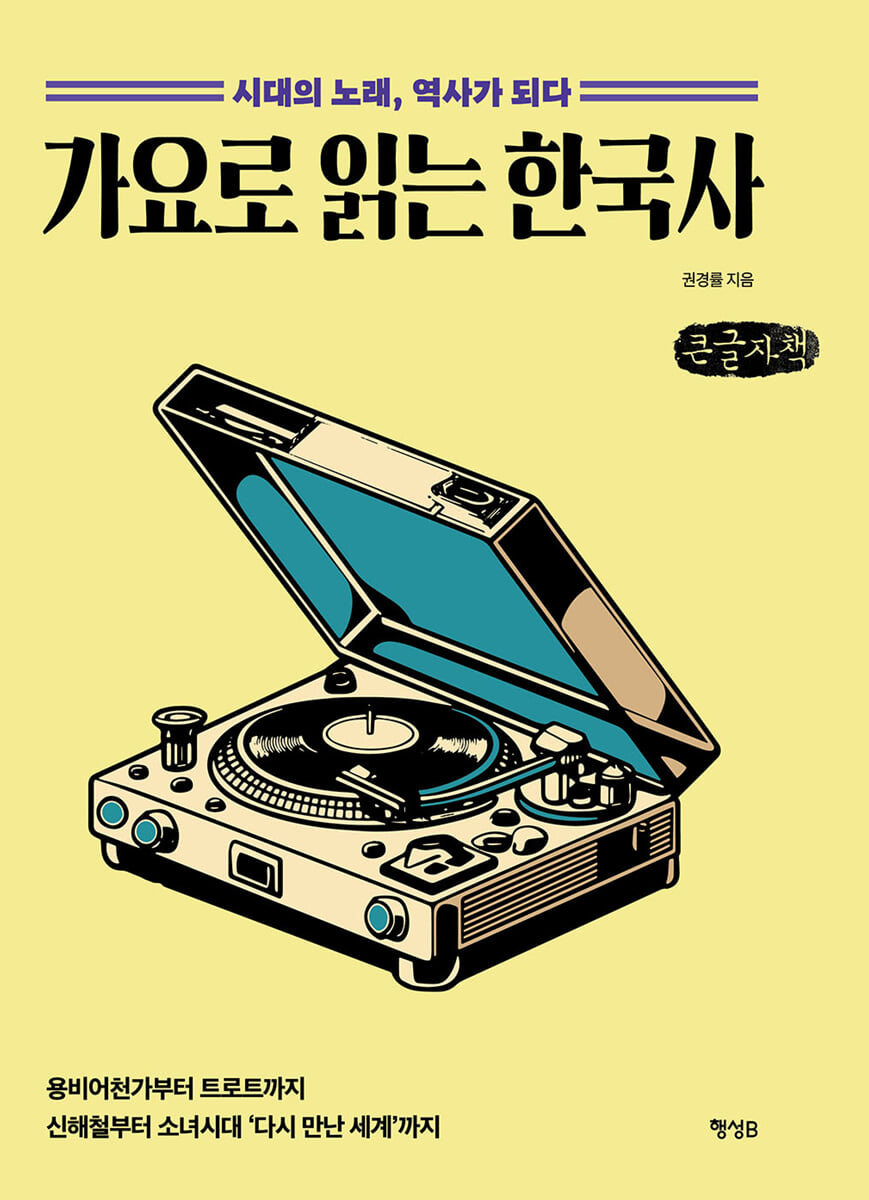
Korean History Through Songs (Large Print Book)
 |
Description
Book Introduction
A playlist of Korean history spanning the modern history of banned songs and national anthems.
From Yongbieocheonga to trot, from Shin Hae-chul to Girls' Generation's "Into the New World"
Songs communicate with the times.
When a song touches on something that contemporaries dream of or are heartbroken about, it expands its meaning and shakes the world.
“I love you, this feeling, this way / The end of the wandering I’ve been dreaming of” In December 2024, Girls’ Generation’s [Into the New World] resonated throughout Seoul.
It was at a rally calling for the impeachment of the president.
This song, which is said to give strength when sung together, has been popular at rallies since the 2010s.
'Songs of the times' are born when people's wishes and desires are reflected, and these songs are another 'door' into history.
《Reading Korean History through Songs》 looks into Korean history through the 'songs' loved by Koreans.
From ancient songs like Yongbieocheonga, to Arirang, which encapsulates the essence of the nation, to "Be Strong, Geumsoon," which captures humanity in the midst of war, to folk songs from the 70s and 80s and K-pop from the 2000s, history is explored through songs that reveal the breath and pulse of the times.
We also examine the dark side of songs such as banned songs and military anthems, which were persecuted and exploited.
From Yongbieocheonga to trot, from Shin Hae-chul to Girls' Generation's "Into the New World"
Songs communicate with the times.
When a song touches on something that contemporaries dream of or are heartbroken about, it expands its meaning and shakes the world.
“I love you, this feeling, this way / The end of the wandering I’ve been dreaming of” In December 2024, Girls’ Generation’s [Into the New World] resonated throughout Seoul.
It was at a rally calling for the impeachment of the president.
This song, which is said to give strength when sung together, has been popular at rallies since the 2010s.
'Songs of the times' are born when people's wishes and desires are reflected, and these songs are another 'door' into history.
《Reading Korean History through Songs》 looks into Korean history through the 'songs' loved by Koreans.
From ancient songs like Yongbieocheonga, to Arirang, which encapsulates the essence of the nation, to "Be Strong, Geumsoon," which captures humanity in the midst of war, to folk songs from the 70s and 80s and K-pop from the 2000s, history is explored through songs that reveal the breath and pulse of the times.
We also examine the dark side of songs such as banned songs and military anthems, which were persecuted and exploited.
index
Publishing a Book: Songs of the Times, Becoming History
Part 1.
Singing the spirit of the times
K-pop is a fruit of Korean democracy - "Into the New World" and the power of chanting.
Shin Hae-chul's "Devil King" Cheering Method - "Fly, Chick" and the New Millennium Era
Children's Songs That Encouraged Heartbroken Adults - The Original Children's Song "Half Moon" and the Children's Movement During the Japanese Colonial Period
The Two Faces of Colonial Korea Reflected in Popular Songs: The Golden Age of Trot and the Japanese War of Invasion
The Independence Army's Yongjin Law and the Bravery of the Anti-Japanese Movement - Independence Army Songs and Anti-Japanese Songs
Did Jeong Mong-ju really stand against Yi Seong-gye to protect Goryeo? - "Dansimga" and the secret history of the fall of Goryeo
The Six Flying Dragons Received Heaven's Mandate and Founded a Nation - The History of Joseon's Founding in "Yongbieocheonga"
Part 2.
Power and Song
Why was President Park Chung-hee's song request banned? - "Camellia Lady" and the normalization of diplomatic relations between Korea and Japan
Why did "My Dear Brother" board the North Korean Repatriation Ship? - Visits to the Motherland by Zainichi Koreans and "Return to Busan Port"
The Godfather of Korean Rock, Targeted by the "Purification of the Music Industry" - "Beauty" and the Yushin Constitution's Emergency Measures
A Regime Obsessed with the Olympics and the 3S Policy - "Ah! Republic of Korea" and the Fifth Republic
Songs of Resistance That Fueled the Democratization Movement - Folk Songs That Flow Through the Blood of the 86 Generation
The jealousy of a rival who killed the "genius poet" Jeong Ji-sang - "Song In" and the Seogyeongcheon Movement
Lady Suro was a rain-calling priestess - "Haega" and the Silla Rain-Ceremony
Part 3.
War and Song
Songs of Comfort and Hope in the Time of War - A Look Back at the Korean War Through Popular Songs "The Captain's Mia-ri Pass" / "Stay Strong, Geum-soon" / "Busan Station of Farewell"
Silla's decisive move at the crossroads of survival: the Taipyeong Song and the Silla-Tang alliance
King Munmu's "Decision to Separate" for the Unification of the Three Kingdoms - The Song of Mojukjiranga and the Silla-Tang War
The Prelude to a Great War: The Fox-Chinese Poem and the Battle of Yeosu (Part 1)
Eulji Mundeok's Attempt to Conquer the Sui Dynasty - The "Fox and the Liao River" and the Battle of Yeosu (Part 2)
Part 4.
Life story in song
How Gangnam Came to Become a Gangnam Style: The Upper-Class Fantasy
A companion for the people, unraveling their stories and resolving their frustrations - Arirang, a platform for Korean improvisation.
Goryeo's daughters, held by their "Father of the Huihui" - "Ssanghwajeom" and the controversy over polygamy
Marriage between Old Bachelors and Old Maid Is a National Matter - "Old Maid" and Marriage Relief
The Love of the "Great" Hwang Jin-i - The Life and Song of a 16th-Century Female Entertainer
How did people in Seoul play 200 years ago? - "Hanyangga" and 19th-century female port customs
King Jeongjo, the "Famous Judge," punishes fake news with a single blow - Nongyo, the song of the people spreading across the fields
Part 1.
Singing the spirit of the times
K-pop is a fruit of Korean democracy - "Into the New World" and the power of chanting.
Shin Hae-chul's "Devil King" Cheering Method - "Fly, Chick" and the New Millennium Era
Children's Songs That Encouraged Heartbroken Adults - The Original Children's Song "Half Moon" and the Children's Movement During the Japanese Colonial Period
The Two Faces of Colonial Korea Reflected in Popular Songs: The Golden Age of Trot and the Japanese War of Invasion
The Independence Army's Yongjin Law and the Bravery of the Anti-Japanese Movement - Independence Army Songs and Anti-Japanese Songs
Did Jeong Mong-ju really stand against Yi Seong-gye to protect Goryeo? - "Dansimga" and the secret history of the fall of Goryeo
The Six Flying Dragons Received Heaven's Mandate and Founded a Nation - The History of Joseon's Founding in "Yongbieocheonga"
Part 2.
Power and Song
Why was President Park Chung-hee's song request banned? - "Camellia Lady" and the normalization of diplomatic relations between Korea and Japan
Why did "My Dear Brother" board the North Korean Repatriation Ship? - Visits to the Motherland by Zainichi Koreans and "Return to Busan Port"
The Godfather of Korean Rock, Targeted by the "Purification of the Music Industry" - "Beauty" and the Yushin Constitution's Emergency Measures
A Regime Obsessed with the Olympics and the 3S Policy - "Ah! Republic of Korea" and the Fifth Republic
Songs of Resistance That Fueled the Democratization Movement - Folk Songs That Flow Through the Blood of the 86 Generation
The jealousy of a rival who killed the "genius poet" Jeong Ji-sang - "Song In" and the Seogyeongcheon Movement
Lady Suro was a rain-calling priestess - "Haega" and the Silla Rain-Ceremony
Part 3.
War and Song
Songs of Comfort and Hope in the Time of War - A Look Back at the Korean War Through Popular Songs "The Captain's Mia-ri Pass" / "Stay Strong, Geum-soon" / "Busan Station of Farewell"
Silla's decisive move at the crossroads of survival: the Taipyeong Song and the Silla-Tang alliance
King Munmu's "Decision to Separate" for the Unification of the Three Kingdoms - The Song of Mojukjiranga and the Silla-Tang War
The Prelude to a Great War: The Fox-Chinese Poem and the Battle of Yeosu (Part 1)
Eulji Mundeok's Attempt to Conquer the Sui Dynasty - The "Fox and the Liao River" and the Battle of Yeosu (Part 2)
Part 4.
Life story in song
How Gangnam Came to Become a Gangnam Style: The Upper-Class Fantasy
A companion for the people, unraveling their stories and resolving their frustrations - Arirang, a platform for Korean improvisation.
Goryeo's daughters, held by their "Father of the Huihui" - "Ssanghwajeom" and the controversy over polygamy
Marriage between Old Bachelors and Old Maid Is a National Matter - "Old Maid" and Marriage Relief
The Love of the "Great" Hwang Jin-i - The Life and Song of a 16th-Century Female Entertainer
How did people in Seoul play 200 years ago? - "Hanyangga" and 19th-century female port customs
King Jeongjo, the "Famous Judge," punishes fake news with a single blow - Nongyo, the song of the people spreading across the fields
Into the book
“I love you, this feeling, this way / The end of the wandering I’ve been drawing / The sadness that repeats itself in this world / Now goodbye” was the song “Into the New World” by the girl group Girls’ Generation.
A 2000s idol song became the title song of the rally to impeach President Yoon Seok-yeol.
It was the young people in their twenties and thirties who led the new protest culture.
K-pop hit songs such as “Apartment,” “Crooked,” and “Fire” spread as chants.
(Omitted) At the rally, the older generation learned and sang songs from the younger generation, and the younger generation sang along to existing folk songs.
These are songs that made the blood of the parents' generation boil, such as "Morning Dew," "March for the Beloved," and "When That Day Comes."
These two surprisingly got along well.
While K-pop raised the energy of the plaza with its exciting tempo and beat, folk songs held the center of gravity of the rally with their solemn and solemn messages.
---From "K-POP is the fruit of Korean democracy"
"Half Moon" is a monumental children's song.
A white boat crossing the Milky Way ‘without a mast or a pole’… .
The beautiful lyrics and heartbreaking melody comfort the sorrow of Koreans who have lost their country and lead them to a world of pure innocence.
It is said that Yun Geuk-yeong, who was grieving over his sister's death, was inspired by the crescent moon rising alone in broad daylight.
The fate of a people wandering aimlessly with their sister on a long journey must have been daunting.
"Half Moon" quickly became a favorite song among Koreans.
---From "Children's Songs That Supported Heartbroken Adults"
In 1935, Lee Nan-young's song "Tears of Mokpo" was greatly loved.
(Omitted) However, this album had to go through many twists and turns before being released.
Japanese police summoned and questioned Oke Records officials, claiming that the song had "impure intentions."
Among the lyrics written by the elected official, Moon Il-seok, the phrase "Sam Baek-yeon Won An-pung (三栢淵願安風) is beneath Nojeokbong Peak" was taken issue with.
If you sing the song, it sounds like 'Under the Nojeokbong Peak, where a grudge of three hundred years has been held'.
Okerecord interpreted the Chinese characters to mean, 'The wind wishing for peace in Sambaekyeon Pond blows beneath Nojeokbong Peak.'
The song finally saw the light of day after going through many hardships.
In fact, the original lyrics were 'Under the old peak that holds a grudge for three hundred years'.
(Omitted) It was revived as a ‘camouflage lyric’ like General Yi Sun-sin’s tactic.
---From "The Two Faces of Colonial Korea Reflected in Popular Songs"
Cultural and artistic figures who turned pro-Japanese especially emphasized 'blood.'
The idea was that the blood of Koreans shed in the war of aggression would become the foundation for Japan-Korea unity and Greater East Asia Co-Prosperity.
Popular music also played a part.
Popular singers Baek Nyeon-seol, Nam In-su, and Park Hyang-rim released “Blood Letter Support” on Oke Records in 1943.
It was the so-called 'military song'.
The content was about biting off his ring finger (fourth finger) and drawing the Japanese flag with the red blood, and singing “Seongsu Manse” (the age of the king is endless) and wishing to become a Japanese soldier.
The wish for the immortality of the Emperor is called the "Manse Seongsu."
---From "The Two Faces of Colonial Korea Reflected in Popular Songs"
One year and five months before King Sejong promulgated Hunminjeongeum, he first published a collection of Korean songs, Chinese-language poems, and historical records.
The famous chapter 2 shows how beautiful poetry and rhythm can be created when pure Korean language meets Hangul.
Sejong's teachings are fully contained here.
Deep-rooted trees and deep-water springs help us realize that everything has a source.
'Hunminjeongeum' means 'the correct sounds to teach the people.'
The first thing King Sejong wanted to teach his people was the song of Joseon's founding, which praised the virtues of his predecessors and widely spread the legitimacy of the founding of the nation.
That is [Yongbieocheonga].
---From "The Six Flying Dragons, Received the Mandate of Heaven and Founded a Nation"
"Come Back to Busan Port" gained popularity in 1972 as the atmosphere of reconciliation between South and North Korea was created by the July 4th North-South Joint Statement, and as a result, many Koreans living in Japan began visiting their homeland.
Cho Yong-pil incorporated public interest into his songs.
The song “Come Back to Busan Port” was rewritten and arranged to suit the mood of the times.
I changed 'You left' to 'Brother left', and 'My lover whom I miss' to 'My brother whom I miss'.
Here, brothers refer to Koreans living in Japan.
---From "Why did 'My Dear Brother' board the North Korean Repatriation Ship?"
National pride and confidence reached their peak after successfully hosting the 1986 Asian Games and the 1988 Seoul Olympics.
As the lyrics of the second verse say, it seemed like all of our dreams were reaching out to the world.
On the other hand, the democratic forces that resisted the dictatorship dug into the corruption that had spread like mushrooms in the shadow of the economic boom, and showed solidarity with the displaced people, street vendors, and urban poor who had lost their homes because of the Asian Games and the Seoul Olympics.
To them, "Ah! Republic of Korea" was seen as a "government-controlled song" that criticized social reality.
In fact, this song was included in an omnibus album promoting healthy songs organized by the Social Purification Committee and the Korean Broadcasting Association.
College students who had strong antipathy toward the Fifth Republic ridiculed "Ah! Republic of Korea" by singing "Nogaba" (changing the lyrics) and criticized the dictatorship.
"Tear gas explodes in the sky / Factory wastewater flows in the river / A place where everyone's rights / are always trampled upon."
---From "The Regime Clinging to the Olympics and the 3S Policy"
“Stepping over the corpses of our comrades, forward, forward / Farewell, Nakdong River, we advance” UN Commander-in-Chief MacArthur finally made a decisive move.
It was the Incheon Landing Operation.
On September 15, 261 Allied ships and 75,000 troops advanced into Incheon.
At the same time, the South Korean and US forces at the Nakdong River defense line also switched to a full-scale offensive.
As the song says, I stepped over the corpses of my comrades and moved forward.
They crossed the Nakdong River and advanced to Chupungnyeong (section 2), Seoul (section 3), and the 38th parallel (section 4).
---From "A Song of Comfort and Hope in the Time of Trouble"
On July 27, 1953, the armistice agreement was finally signed.
The clock of war stopped and the capital was returned to Seoul.
It is time to say goodbye to the life of refugee, which teetered precariously between hope and despair.
“Busan Station of Farewell, silently falling rain / Goodbye, goodbye / The miracle of tears cries / The sorrow of a life of refuge is also great” “Busan Station of Farewell,” released in 1954, became a huge hit when sung by singer Nam In-su.
The album sold like hotcakes, with 100,000 copies sold.
Unlike the sad lyrics of the song about parting, the rhythm is somewhat exciting and cheerful.
It was a heart-pounding experience to end my life as a refugee and return home.
The thump thump, the cheerful rhythm was that hopeful heartbeat.
---From "A Song of Comfort and Hope in the Time of Trouble"
Psy introduced the song in an interview with American broadcaster ABC in August 2012.
“Gangnam is an upper-class neighborhood in Korea, similar to Beverly Hills in the United States.
But I'm not meant to live in Beverly Hills, and the music video doesn't fit that description.
Yet, the fact that they insist on calling it the Beverly Hills style is a point that defies reality.” People in the world have been cursing Gangnam, but everyone would be eager to become a Gangnam resident if given the chance.
(Omitted) As you walk down the street, an upper-class fantasy of desire and temptation unfolds.
This is the starting point of "Gangnam Style" sung by Psy.
---From "How was Gangnam born?"
Hulbert, who recorded the Arirang song, added an interesting explanation.
“Arirang is a song that the Joseon people, who are masters of improvisation, value as much as rice.”
The Joseon people spontaneously sang about the joys and sorrows of life, the spirit of the times, and regional characteristics to the unique refrain of Arirang.
(Omitted) As the Japanese colonial period began in 1910, Arirang embraced the suffering of the people.
The people who lost their country complained, “He who abandons me will fall ill before he can even go ten miles.”
Im is my country.
It wasn't a complaint, but rather a plea.
It was the beginning of a desperate wait to get my country back as soon as possible.
A 2000s idol song became the title song of the rally to impeach President Yoon Seok-yeol.
It was the young people in their twenties and thirties who led the new protest culture.
K-pop hit songs such as “Apartment,” “Crooked,” and “Fire” spread as chants.
(Omitted) At the rally, the older generation learned and sang songs from the younger generation, and the younger generation sang along to existing folk songs.
These are songs that made the blood of the parents' generation boil, such as "Morning Dew," "March for the Beloved," and "When That Day Comes."
These two surprisingly got along well.
While K-pop raised the energy of the plaza with its exciting tempo and beat, folk songs held the center of gravity of the rally with their solemn and solemn messages.
---From "K-POP is the fruit of Korean democracy"
"Half Moon" is a monumental children's song.
A white boat crossing the Milky Way ‘without a mast or a pole’… .
The beautiful lyrics and heartbreaking melody comfort the sorrow of Koreans who have lost their country and lead them to a world of pure innocence.
It is said that Yun Geuk-yeong, who was grieving over his sister's death, was inspired by the crescent moon rising alone in broad daylight.
The fate of a people wandering aimlessly with their sister on a long journey must have been daunting.
"Half Moon" quickly became a favorite song among Koreans.
---From "Children's Songs That Supported Heartbroken Adults"
In 1935, Lee Nan-young's song "Tears of Mokpo" was greatly loved.
(Omitted) However, this album had to go through many twists and turns before being released.
Japanese police summoned and questioned Oke Records officials, claiming that the song had "impure intentions."
Among the lyrics written by the elected official, Moon Il-seok, the phrase "Sam Baek-yeon Won An-pung (三栢淵願安風) is beneath Nojeokbong Peak" was taken issue with.
If you sing the song, it sounds like 'Under the Nojeokbong Peak, where a grudge of three hundred years has been held'.
Okerecord interpreted the Chinese characters to mean, 'The wind wishing for peace in Sambaekyeon Pond blows beneath Nojeokbong Peak.'
The song finally saw the light of day after going through many hardships.
In fact, the original lyrics were 'Under the old peak that holds a grudge for three hundred years'.
(Omitted) It was revived as a ‘camouflage lyric’ like General Yi Sun-sin’s tactic.
---From "The Two Faces of Colonial Korea Reflected in Popular Songs"
Cultural and artistic figures who turned pro-Japanese especially emphasized 'blood.'
The idea was that the blood of Koreans shed in the war of aggression would become the foundation for Japan-Korea unity and Greater East Asia Co-Prosperity.
Popular music also played a part.
Popular singers Baek Nyeon-seol, Nam In-su, and Park Hyang-rim released “Blood Letter Support” on Oke Records in 1943.
It was the so-called 'military song'.
The content was about biting off his ring finger (fourth finger) and drawing the Japanese flag with the red blood, and singing “Seongsu Manse” (the age of the king is endless) and wishing to become a Japanese soldier.
The wish for the immortality of the Emperor is called the "Manse Seongsu."
---From "The Two Faces of Colonial Korea Reflected in Popular Songs"
One year and five months before King Sejong promulgated Hunminjeongeum, he first published a collection of Korean songs, Chinese-language poems, and historical records.
The famous chapter 2 shows how beautiful poetry and rhythm can be created when pure Korean language meets Hangul.
Sejong's teachings are fully contained here.
Deep-rooted trees and deep-water springs help us realize that everything has a source.
'Hunminjeongeum' means 'the correct sounds to teach the people.'
The first thing King Sejong wanted to teach his people was the song of Joseon's founding, which praised the virtues of his predecessors and widely spread the legitimacy of the founding of the nation.
That is [Yongbieocheonga].
---From "The Six Flying Dragons, Received the Mandate of Heaven and Founded a Nation"
"Come Back to Busan Port" gained popularity in 1972 as the atmosphere of reconciliation between South and North Korea was created by the July 4th North-South Joint Statement, and as a result, many Koreans living in Japan began visiting their homeland.
Cho Yong-pil incorporated public interest into his songs.
The song “Come Back to Busan Port” was rewritten and arranged to suit the mood of the times.
I changed 'You left' to 'Brother left', and 'My lover whom I miss' to 'My brother whom I miss'.
Here, brothers refer to Koreans living in Japan.
---From "Why did 'My Dear Brother' board the North Korean Repatriation Ship?"
National pride and confidence reached their peak after successfully hosting the 1986 Asian Games and the 1988 Seoul Olympics.
As the lyrics of the second verse say, it seemed like all of our dreams were reaching out to the world.
On the other hand, the democratic forces that resisted the dictatorship dug into the corruption that had spread like mushrooms in the shadow of the economic boom, and showed solidarity with the displaced people, street vendors, and urban poor who had lost their homes because of the Asian Games and the Seoul Olympics.
To them, "Ah! Republic of Korea" was seen as a "government-controlled song" that criticized social reality.
In fact, this song was included in an omnibus album promoting healthy songs organized by the Social Purification Committee and the Korean Broadcasting Association.
College students who had strong antipathy toward the Fifth Republic ridiculed "Ah! Republic of Korea" by singing "Nogaba" (changing the lyrics) and criticized the dictatorship.
"Tear gas explodes in the sky / Factory wastewater flows in the river / A place where everyone's rights / are always trampled upon."
---From "The Regime Clinging to the Olympics and the 3S Policy"
“Stepping over the corpses of our comrades, forward, forward / Farewell, Nakdong River, we advance” UN Commander-in-Chief MacArthur finally made a decisive move.
It was the Incheon Landing Operation.
On September 15, 261 Allied ships and 75,000 troops advanced into Incheon.
At the same time, the South Korean and US forces at the Nakdong River defense line also switched to a full-scale offensive.
As the song says, I stepped over the corpses of my comrades and moved forward.
They crossed the Nakdong River and advanced to Chupungnyeong (section 2), Seoul (section 3), and the 38th parallel (section 4).
---From "A Song of Comfort and Hope in the Time of Trouble"
On July 27, 1953, the armistice agreement was finally signed.
The clock of war stopped and the capital was returned to Seoul.
It is time to say goodbye to the life of refugee, which teetered precariously between hope and despair.
“Busan Station of Farewell, silently falling rain / Goodbye, goodbye / The miracle of tears cries / The sorrow of a life of refuge is also great” “Busan Station of Farewell,” released in 1954, became a huge hit when sung by singer Nam In-su.
The album sold like hotcakes, with 100,000 copies sold.
Unlike the sad lyrics of the song about parting, the rhythm is somewhat exciting and cheerful.
It was a heart-pounding experience to end my life as a refugee and return home.
The thump thump, the cheerful rhythm was that hopeful heartbeat.
---From "A Song of Comfort and Hope in the Time of Trouble"
Psy introduced the song in an interview with American broadcaster ABC in August 2012.
“Gangnam is an upper-class neighborhood in Korea, similar to Beverly Hills in the United States.
But I'm not meant to live in Beverly Hills, and the music video doesn't fit that description.
Yet, the fact that they insist on calling it the Beverly Hills style is a point that defies reality.” People in the world have been cursing Gangnam, but everyone would be eager to become a Gangnam resident if given the chance.
(Omitted) As you walk down the street, an upper-class fantasy of desire and temptation unfolds.
This is the starting point of "Gangnam Style" sung by Psy.
---From "How was Gangnam born?"
Hulbert, who recorded the Arirang song, added an interesting explanation.
“Arirang is a song that the Joseon people, who are masters of improvisation, value as much as rice.”
The Joseon people spontaneously sang about the joys and sorrows of life, the spirit of the times, and regional characteristics to the unique refrain of Arirang.
(Omitted) As the Japanese colonial period began in 1910, Arirang embraced the suffering of the people.
The people who lost their country complained, “He who abandons me will fall ill before he can even go ten miles.”
Im is my country.
It wasn't a complaint, but rather a plea.
It was the beginning of a desperate wait to get my country back as soon as possible.
---From "A Companion of the Nation Who Unravels Stories and Resentments"
Publisher's Review
Popular music is shaped by the times; songs are the people's will.
National songs are created by the times.
Imja's representative song, "Camellia Lady," was greatly loved for its poignant portrayal of innocence tarnished by industrialization in the 1960s, but was banned after being judged a pro-Japanese song, and then lifted.
The song that made Cho Yong-pil, the 'King of Singers', famously called 'Come Back to Busan Port' became a huge hit in the mid-1970s, riding the wave of Koreans in Japan visiting their homeland.
Shin Hae-chul's "Fly, Chick" and other songs that support the younger generation have become symbols of the new millennium.
In this way, songs made the times, and the songs of the times became history.
Also, songs that were popular in an era can give us a three-dimensional look at the situation at that time.
The 1980s were "Ah! Korea," a time when anyone could get anything they wanted. For others, it was "March for the Beloved," a time when they had to live their entire lives without leaving behind love, honor, or even their name.
At the height of the independence movement, Dosan Ahn Chang-ho left for overseas and wrote “A Journey to the Nation” with a heavy heart, but on the other hand, “A Blood Letter” wishing for the immortality of the Emperor resonated.
This dizzying contrast in the song fosters a multi-faceted perspective on history.
《Reading Korean History through Songs》 looks into the voices of history and the times through these three-dimensional 'songs.'
This book focuses particularly on modern and contemporary history, examining in detail how 21st-century Koreans came to possess such sentiments through politics, economics, war history, and life history.
From ancient songs to K-pop, Korean history through 60 songs
There are about 60 songs in “Reading Korean History through Songs.”
From the ancient song "Sunset" that sang of rain in the distant past to K-pop songs such as "Gangnam Style" and "Into the New World," we took a fresh look at Korean history by searching through the songs of the times.
The people hummed and sang songs while working.
When one person sang, ten people responded and spread the song, and people's hearts were deeply filled with such songs.
The Silla hyangga “Mojukjirangga” contains the spirit of the Hwarang who repelled the invasion of the Tang Dynasty, the March 1st Movement song “Daehan is Alive” contains the spirit of independence that endures suffering and creates hope, and the 1950s popular song “Be Strong, Geumsoon-ah” contains the sorrows of refugees who lost their hometown and blood relatives in the Korean War.
In this way, the voices of people not recorded in history books flow through the song.
It vividly captures the dreams, emotions, pain, and hopes of an era that cannot be perceived through events alone.
This book introduces about 60 'popular songs', including farming songs, children's songs, and folk songs, set to the rhythm of history.
The ancients believed that the public sentiment was contained in 'yo'.
Because it was a story of the people carried on a melody.
National songs are created by the times.
Imja's representative song, "Camellia Lady," was greatly loved for its poignant portrayal of innocence tarnished by industrialization in the 1960s, but was banned after being judged a pro-Japanese song, and then lifted.
The song that made Cho Yong-pil, the 'King of Singers', famously called 'Come Back to Busan Port' became a huge hit in the mid-1970s, riding the wave of Koreans in Japan visiting their homeland.
Shin Hae-chul's "Fly, Chick" and other songs that support the younger generation have become symbols of the new millennium.
In this way, songs made the times, and the songs of the times became history.
Also, songs that were popular in an era can give us a three-dimensional look at the situation at that time.
The 1980s were "Ah! Korea," a time when anyone could get anything they wanted. For others, it was "March for the Beloved," a time when they had to live their entire lives without leaving behind love, honor, or even their name.
At the height of the independence movement, Dosan Ahn Chang-ho left for overseas and wrote “A Journey to the Nation” with a heavy heart, but on the other hand, “A Blood Letter” wishing for the immortality of the Emperor resonated.
This dizzying contrast in the song fosters a multi-faceted perspective on history.
《Reading Korean History through Songs》 looks into the voices of history and the times through these three-dimensional 'songs.'
This book focuses particularly on modern and contemporary history, examining in detail how 21st-century Koreans came to possess such sentiments through politics, economics, war history, and life history.
From ancient songs to K-pop, Korean history through 60 songs
There are about 60 songs in “Reading Korean History through Songs.”
From the ancient song "Sunset" that sang of rain in the distant past to K-pop songs such as "Gangnam Style" and "Into the New World," we took a fresh look at Korean history by searching through the songs of the times.
The people hummed and sang songs while working.
When one person sang, ten people responded and spread the song, and people's hearts were deeply filled with such songs.
The Silla hyangga “Mojukjirangga” contains the spirit of the Hwarang who repelled the invasion of the Tang Dynasty, the March 1st Movement song “Daehan is Alive” contains the spirit of independence that endures suffering and creates hope, and the 1950s popular song “Be Strong, Geumsoon-ah” contains the sorrows of refugees who lost their hometown and blood relatives in the Korean War.
In this way, the voices of people not recorded in history books flow through the song.
It vividly captures the dreams, emotions, pain, and hopes of an era that cannot be perceived through events alone.
This book introduces about 60 'popular songs', including farming songs, children's songs, and folk songs, set to the rhythm of history.
The ancients believed that the public sentiment was contained in 'yo'.
Because it was a story of the people carried on a melody.
GOODS SPECIFICS
- Date of issue: May 9, 2025
- Page count, weight, size: 340 pages | 210*290*30mm
- ISBN13: 9791164712939
- ISBN10: 1164712934
You may also like
카테고리
korean


korean

![GQ KOREA Mark (Monthly): December [2025]](http://librairie.coreenne.fr/cdn/shop/files/8ef265dbbfbf186523ed75ba7319009d.jpg?v=1765340328&width=3840)


