

German History in 30 Cities
 |
Description
Book Introduction
“Einstein, Bach, Goethe, Nietzsche, Marx, Gutenberg, Luther……”
How did all these great minds come from Germany?
When we think of German history, the first thing that comes to mind is the World War.
How did Germany, twice defeated in wars that shook the world, regain its rapid growth and become a leader in Europe? Germany, a balanced, advanced nation where philosophy, art, and science thrive.
This book is a historical textbook that uncovers the secrets of Germany we never knew about, from the Roman Empire to the present day, and even stories of beer, sausages, and soccer, by exploring the city's alleyways.
'Was this person German too?' This thought often comes to mind when looking into German history.
German history is also a history of people.
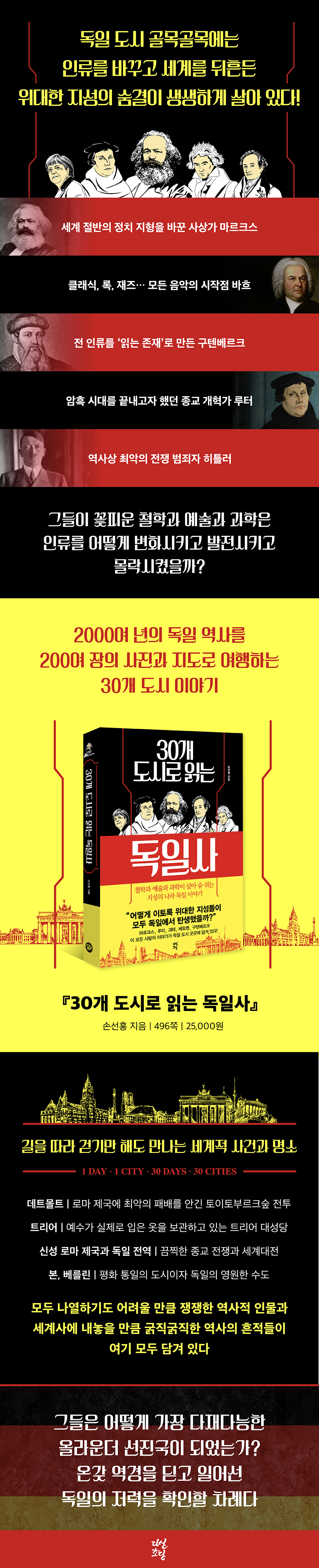
World-renowned scholars like Einstein and Nietzsche, as well as the religious reformer Luther who ended the Dark Ages and ushered in the modern era, Gutenberg who made all of humanity into “reading beings,” Bach, the starting point of all music, the thinker Marx who turned half the world’s political landscape upside down, and even Hitler, the worst war criminal in history.
This book captures the essence of historical figures spanning religion, philosophy, art, and politics.
Meanwhile, even major world history is intertwined with the history of German cities.
Nuremberg, the city where war criminals were tried; Regensburg, a Roman military base; Münster, the city where the Treaty of Westphalia was signed; Leipzig, the city of the peaceful revolution that brought down the Berlin Wall; Potsdam, the city of the Potsdam Conference.
The city that we have all heard of at least once while learning about world history is integrated into German cities.
This book will be an intellectually satisfying read for both travelers seeking a lighthearted journey and readers seeking a quick overview of German history and a deeper understanding of world affairs.
All the German people and events we know are gathered here.
Let's go to Germany, currently the hippest country in the world.
How did all these great minds come from Germany?
When we think of German history, the first thing that comes to mind is the World War.
How did Germany, twice defeated in wars that shook the world, regain its rapid growth and become a leader in Europe? Germany, a balanced, advanced nation where philosophy, art, and science thrive.
This book is a historical textbook that uncovers the secrets of Germany we never knew about, from the Roman Empire to the present day, and even stories of beer, sausages, and soccer, by exploring the city's alleyways.
'Was this person German too?' This thought often comes to mind when looking into German history.
German history is also a history of people.
World-renowned scholars like Einstein and Nietzsche, as well as the religious reformer Luther who ended the Dark Ages and ushered in the modern era, Gutenberg who made all of humanity into “reading beings,” Bach, the starting point of all music, the thinker Marx who turned half the world’s political landscape upside down, and even Hitler, the worst war criminal in history.
This book captures the essence of historical figures spanning religion, philosophy, art, and politics.
Meanwhile, even major world history is intertwined with the history of German cities.
Nuremberg, the city where war criminals were tried; Regensburg, a Roman military base; Münster, the city where the Treaty of Westphalia was signed; Leipzig, the city of the peaceful revolution that brought down the Berlin Wall; Potsdam, the city of the Potsdam Conference.
The city that we have all heard of at least once while learning about world history is integrated into German cities.
This book will be an intellectually satisfying read for both travelers seeking a lighthearted journey and readers seeking a quick overview of German history and a deeper understanding of world affairs.
All the German people and events we know are gathered here.
Let's go to Germany, currently the hippest country in the world.
- You can preview some of the book's contents.
Preview
index
At the beginning of the book
Part 1: Western Cities of the Roman Empire
Chapter 1 Trier - 'Little Rome' and Germany's oldest city
Chapter 2 Aachen - The City of Charlemagne, the 'Father of Europe'
Chapter 3: Saarbrücken - A Microcosm of 1,000 Years of German and French History
Part 2: Cities along the Rhine, military bases of the Roman Empire
Chapter 4: Cologne - City of the Roman Empire, City of Cathedrals, City of Carnival
Chapter 5 Düsseldorf - From Fishing Village to State Capital
Chapter 6 - Beethoven's city, the capital of West Germany
Chapter 7 Mainz - Mainz Cathedral and the City of Gutenberg
Chapter 8: Worms - City of the Nibelungs, City of Luther
Part 3 Cities in the South Central Region
Chapter 9 Frankfurt - From the City of Emperor Elections and Coronations to an International Financial City
Chapter 10: Heidelberg - The City of Ancient Castles and Universities
Chapter 11: Stuttgart - From Capital of the Kingdom of Württemberg to City of the Automotive Industry
Part 4 Cities in Southern Bavaria
Chapter 12 Augsburg - City of Emperor Augustus, City of Religious Harmony
Chapter 13: Munich - The Center of Bavarian Politics and Culture
Chapter 14: Nuremberg - The Imperial City Where the Nazi War Criminal Trials Held
Chapter 15: Regensburg - A Danube Border City of the Roman Empire
Part 5: Northern Cities of the Liberty and Hanseatic League
Chapter 16 Hamburg - City of Freedom, City of the Hanseatic League
Chapter 17: Lübeck - A leader in the Hanseatic League and a city that produced three Nobel Prize winners
Chapter 18 Kiel - the largest city on the Baltic coast
Chapter 19 Rostock - City of the Hanseatic League, University City
Chapter 20: Bremen - The City of the Bremen Town Musicians
Part 6 Cities in the Central and Northern Regions
Chapter 21: Münster - The City of Peace That Ended the Thirty Years' War
Chapter 22 Hanover - The city that founded the British Hanoverian dynasty
Part 7 Cities in Eastern Germany
Chapter 23: Dresden - Capital of the Treasure Kingdom of Saxony
Chapter 24: Leipzig - Birthplace of the Peaceful Revolution that Tore Down the Berlin Wall
Chapter 25: Magdeburg - The city of Otto I, the first Holy Roman Emperor
Chapter 26: Halle - The City of Five Towers, Handel's City
Chapter 27: Erfurt - Martin Luther's Spiritual Hometown
Chapter 28: Weimar - The city of Goethe and Schiller, the birthplace of the Weimar Republic
Part 8: Centers of German Politics: The Spirit of Prussia
Chapter 29 Potsdam - City of Frederick the Great, City of the Potsdam Conference
Chapter 30 Berlin - Germany's Eternal Capital, Where Prussian Spirit Lives
German History in One Line
Photo source
References and Homepage
Part 1: Western Cities of the Roman Empire
Chapter 1 Trier - 'Little Rome' and Germany's oldest city
Chapter 2 Aachen - The City of Charlemagne, the 'Father of Europe'
Chapter 3: Saarbrücken - A Microcosm of 1,000 Years of German and French History
Part 2: Cities along the Rhine, military bases of the Roman Empire
Chapter 4: Cologne - City of the Roman Empire, City of Cathedrals, City of Carnival
Chapter 5 Düsseldorf - From Fishing Village to State Capital
Chapter 6 - Beethoven's city, the capital of West Germany
Chapter 7 Mainz - Mainz Cathedral and the City of Gutenberg
Chapter 8: Worms - City of the Nibelungs, City of Luther
Part 3 Cities in the South Central Region
Chapter 9 Frankfurt - From the City of Emperor Elections and Coronations to an International Financial City
Chapter 10: Heidelberg - The City of Ancient Castles and Universities
Chapter 11: Stuttgart - From Capital of the Kingdom of Württemberg to City of the Automotive Industry
Part 4 Cities in Southern Bavaria
Chapter 12 Augsburg - City of Emperor Augustus, City of Religious Harmony
Chapter 13: Munich - The Center of Bavarian Politics and Culture
Chapter 14: Nuremberg - The Imperial City Where the Nazi War Criminal Trials Held
Chapter 15: Regensburg - A Danube Border City of the Roman Empire
Part 5: Northern Cities of the Liberty and Hanseatic League
Chapter 16 Hamburg - City of Freedom, City of the Hanseatic League
Chapter 17: Lübeck - A leader in the Hanseatic League and a city that produced three Nobel Prize winners
Chapter 18 Kiel - the largest city on the Baltic coast
Chapter 19 Rostock - City of the Hanseatic League, University City
Chapter 20: Bremen - The City of the Bremen Town Musicians
Part 6 Cities in the Central and Northern Regions
Chapter 21: Münster - The City of Peace That Ended the Thirty Years' War
Chapter 22 Hanover - The city that founded the British Hanoverian dynasty
Part 7 Cities in Eastern Germany
Chapter 23: Dresden - Capital of the Treasure Kingdom of Saxony
Chapter 24: Leipzig - Birthplace of the Peaceful Revolution that Tore Down the Berlin Wall
Chapter 25: Magdeburg - The city of Otto I, the first Holy Roman Emperor
Chapter 26: Halle - The City of Five Towers, Handel's City
Chapter 27: Erfurt - Martin Luther's Spiritual Hometown
Chapter 28: Weimar - The city of Goethe and Schiller, the birthplace of the Weimar Republic
Part 8: Centers of German Politics: The Spirit of Prussia
Chapter 29 Potsdam - City of Frederick the Great, City of the Potsdam Conference
Chapter 30 Berlin - Germany's Eternal Capital, Where Prussian Spirit Lives
German History in One Line
Photo source
References and Homepage
Detailed image
Into the book
The Roman army was ambushed by Germanic warriors who had been lying in wait.
The Roman army, which was surrounded by dense forests and dark terrain, was virtually annihilated.
This battle is called the Battle of the Teutoburg Forest or the Battle of Hermann.
Hermann's victory saved Germany from Roman rule.
The year 9 AD, when the Roman army was defeated, is considered the beginning of German history.
The Roman army was defeated in the Teutoburg Forest, but later crossed the river and took revenge by subduing the Germanic tribes several times.
However, the successor emperor Tiberius Caesar Augustus (reigned 14–37) made the Rhine River the border.
Despite his powerful army, why did Tiberius maintain his Rhine border? He believed that the Germanic resistance was so strong that it would be difficult to completely conquer and rule the Germanic region.
Tiberius's passive personality, which included spending the last 11 years of his reign on the island of Capri rather than in Rome, also played a role.
--- p.62
The invention of metal movable type brought about great changes in medieval society.
Hundreds of printing houses were established.
Books have become cheaper and knowledge has spread more quickly.
One of the factors that allowed Martin Luther's religious reform to gain widespread support 60 years later was the widespread availability of movable metal type printing.
Luther's writings on the 95 Theses and the need for religious reform were quickly and widely disseminated, greatly increasing the number of people who agreed with Luther's arguments.
There is a Gutenberg Museum in Mainz.
This museum was established by citizens in 1900 to commemorate the 500th anniversary of Gutenberg's birth.
The museum's most prized possession is undoubtedly the four volumes of the 42-line Bible.
Two volumes are manuscripts and two volumes are printed copies.
It has 1282 pages, but was divided into two volumes due to its weight.
The pattern on the corner of the book was additionally done according to the buyer's request.
The 42-Line Bible is considered one of the most beautifully printed books in the world.
Of the 180 copies printed, only 49 remain today.
--- p.109
The Reformation, along with the Renaissance, was the most important event that ended the Middle Ages.
The turning point of the Reformation occurred in Worms.
In April 1521, Martin Luther (1483–1546), a professor and priest at the University of Wittenberg, appeared before Emperor Charles V (reigned 1519–1556, also King Charles I of Spain).
Why did Luther, an ordinary priest, stand before the emperor? In the 15th and 16th centuries, the pope sold indulgences.
It was to recapture Constantinople, stop the expansion of Islamic power, and raise funds for the construction of St. Peter's Basilica.
Archbishop Albrecht of Mainz also sold indulgences to pay off the money he borrowed to become archbishop.
The church agitated people by saying that if they bought indulgences, they could be forgiven and go to heaven without being punished for their sins.
Believers bought parchment, wrote their names and sins on it, and took it to the priest to receive forgiveness for their sins through a ceremony of absolution.
The amount of money varied depending on the severity of the sin.
The church is corrupt and depraved.
--- p.120
The world's largest beer festival, 'Oktoberfest', is being held.
Oktoberfest, which means 'October Festival', originated from a horse race to celebrate the wedding of Bavarian Prince Ludwig in October 1810.
Free food and beer were provided to attendees during the five-day festival.
Since then, a festival called Oktoberfest has been held every year.
Since 1950, the tradition of the Munich mayor opening a large beer keg has continued at the Oktoberfest opening ceremony, which takes place every year for two weeks from mid-September to early October.
Oktoberfest, the pride of Bavaria, is the world's most popular beer festival.
There are 1,507 breweries in Germany (as of 2022).
The beers that Germans enjoy drinking are Pilsner and Weizenbier, a wheat beer.
There are also regional specialties such as Kölschbier (Cologne), Altbier (Düsseldorf), Weissbier (Munich), and Rauchbier (Bamberg).
Although beer consumption is gradually decreasing, the consumption of non-alcoholic beer is on the rise in Germany, with consumption expected to increase from 240 million liters in 2014 to 403 million liters in 2023.
--- p.199
On August 17, 1786, Frederick II died in his office chair in the Sanssouci Palace at the age of 74.
King Frederick William II disobeyed his will and placed his remains in the garrison church in Potsdam, where the coffin of his father, Frederick the Great, was kept.
During World War II, the coffin of Frederick the Great was moved to Hohenzollern Castle (in Hechingen, near Tübingen) to prevent it from falling into the hands of the enemy.
Frederick the Great's will was not fulfilled until 17 August 1991, over 200 years later.
As per his will, his remains were buried next to his dog's grave at the Sanssouci Palace at midnight.
There is no mound or tombstone, only the words 'Friedrich der Grosse (Friedrich the Great)' written on a flat stone.
One of the reasons Germany is so strong is the frugality of its politicians.
Sanssouci Palace became a UNESCO World Heritage Site in 1990.
--- p.443
The Nazis established concentration camps not only in Germany but also in Poland, starting with Dachau near Munich in March 1933, and then Buchenwald and Sachsenhausen in Weimar, immediately after Hitler became chancellor.
The largest concentration camp was Auschwitz in Poland.
Jews were rounded up in German-occupied European countries and sent to concentration camps.
The sick, the elderly, and women with infants or children were deemed unfit for work and were sent to the gas chambers.
Those who were able to work were forced into labor.
Of the at least 1.33 million people imprisoned at Auschwitz, more than 1.1 million died and only about 230,000 survived.
In 1944 alone, 8 million foreigners from 26 countries were forced into labor.
Germans are reflecting on this shameful history through their actions.
In 2005, Germany erected the Memorial to the Murdered Jews of Europe near Berlin's Brandenburg Gate.
There are 2,711 concrete memorial stones on an area the size of two soccer fields.
The width is 0.95 meters and the height is 2.3 meters, but the height is different, ranging from 20 centimeters to 4.7 meters.
In the underground memorial, the names of the six million murdered Jews are called out one by one.
The Roman army, which was surrounded by dense forests and dark terrain, was virtually annihilated.
This battle is called the Battle of the Teutoburg Forest or the Battle of Hermann.
Hermann's victory saved Germany from Roman rule.
The year 9 AD, when the Roman army was defeated, is considered the beginning of German history.
The Roman army was defeated in the Teutoburg Forest, but later crossed the river and took revenge by subduing the Germanic tribes several times.
However, the successor emperor Tiberius Caesar Augustus (reigned 14–37) made the Rhine River the border.
Despite his powerful army, why did Tiberius maintain his Rhine border? He believed that the Germanic resistance was so strong that it would be difficult to completely conquer and rule the Germanic region.
Tiberius's passive personality, which included spending the last 11 years of his reign on the island of Capri rather than in Rome, also played a role.
--- p.62
The invention of metal movable type brought about great changes in medieval society.
Hundreds of printing houses were established.
Books have become cheaper and knowledge has spread more quickly.
One of the factors that allowed Martin Luther's religious reform to gain widespread support 60 years later was the widespread availability of movable metal type printing.
Luther's writings on the 95 Theses and the need for religious reform were quickly and widely disseminated, greatly increasing the number of people who agreed with Luther's arguments.
There is a Gutenberg Museum in Mainz.
This museum was established by citizens in 1900 to commemorate the 500th anniversary of Gutenberg's birth.
The museum's most prized possession is undoubtedly the four volumes of the 42-line Bible.
Two volumes are manuscripts and two volumes are printed copies.
It has 1282 pages, but was divided into two volumes due to its weight.
The pattern on the corner of the book was additionally done according to the buyer's request.
The 42-Line Bible is considered one of the most beautifully printed books in the world.
Of the 180 copies printed, only 49 remain today.
--- p.109
The Reformation, along with the Renaissance, was the most important event that ended the Middle Ages.
The turning point of the Reformation occurred in Worms.
In April 1521, Martin Luther (1483–1546), a professor and priest at the University of Wittenberg, appeared before Emperor Charles V (reigned 1519–1556, also King Charles I of Spain).
Why did Luther, an ordinary priest, stand before the emperor? In the 15th and 16th centuries, the pope sold indulgences.
It was to recapture Constantinople, stop the expansion of Islamic power, and raise funds for the construction of St. Peter's Basilica.
Archbishop Albrecht of Mainz also sold indulgences to pay off the money he borrowed to become archbishop.
The church agitated people by saying that if they bought indulgences, they could be forgiven and go to heaven without being punished for their sins.
Believers bought parchment, wrote their names and sins on it, and took it to the priest to receive forgiveness for their sins through a ceremony of absolution.
The amount of money varied depending on the severity of the sin.
The church is corrupt and depraved.
--- p.120
The world's largest beer festival, 'Oktoberfest', is being held.
Oktoberfest, which means 'October Festival', originated from a horse race to celebrate the wedding of Bavarian Prince Ludwig in October 1810.
Free food and beer were provided to attendees during the five-day festival.
Since then, a festival called Oktoberfest has been held every year.
Since 1950, the tradition of the Munich mayor opening a large beer keg has continued at the Oktoberfest opening ceremony, which takes place every year for two weeks from mid-September to early October.
Oktoberfest, the pride of Bavaria, is the world's most popular beer festival.
There are 1,507 breweries in Germany (as of 2022).
The beers that Germans enjoy drinking are Pilsner and Weizenbier, a wheat beer.
There are also regional specialties such as Kölschbier (Cologne), Altbier (Düsseldorf), Weissbier (Munich), and Rauchbier (Bamberg).
Although beer consumption is gradually decreasing, the consumption of non-alcoholic beer is on the rise in Germany, with consumption expected to increase from 240 million liters in 2014 to 403 million liters in 2023.
--- p.199
On August 17, 1786, Frederick II died in his office chair in the Sanssouci Palace at the age of 74.
King Frederick William II disobeyed his will and placed his remains in the garrison church in Potsdam, where the coffin of his father, Frederick the Great, was kept.
During World War II, the coffin of Frederick the Great was moved to Hohenzollern Castle (in Hechingen, near Tübingen) to prevent it from falling into the hands of the enemy.
Frederick the Great's will was not fulfilled until 17 August 1991, over 200 years later.
As per his will, his remains were buried next to his dog's grave at the Sanssouci Palace at midnight.
There is no mound or tombstone, only the words 'Friedrich der Grosse (Friedrich the Great)' written on a flat stone.
One of the reasons Germany is so strong is the frugality of its politicians.
Sanssouci Palace became a UNESCO World Heritage Site in 1990.
--- p.443
The Nazis established concentration camps not only in Germany but also in Poland, starting with Dachau near Munich in March 1933, and then Buchenwald and Sachsenhausen in Weimar, immediately after Hitler became chancellor.
The largest concentration camp was Auschwitz in Poland.
Jews were rounded up in German-occupied European countries and sent to concentration camps.
The sick, the elderly, and women with infants or children were deemed unfit for work and were sent to the gas chambers.
Those who were able to work were forced into labor.
Of the at least 1.33 million people imprisoned at Auschwitz, more than 1.1 million died and only about 230,000 survived.
In 1944 alone, 8 million foreigners from 26 countries were forced into labor.
Germans are reflecting on this shameful history through their actions.
In 2005, Germany erected the Memorial to the Murdered Jews of Europe near Berlin's Brandenburg Gate.
There are 2,711 concrete memorial stones on an area the size of two soccer fields.
The width is 0.95 meters and the height is 2.3 meters, but the height is different, ranging from 20 centimeters to 4.7 meters.
In the underground memorial, the names of the six million murdered Jews are called out one by one.
--- p.480
Publisher's Review
Einstein, Nietzsche, of course
Luther, Goethe, Bach, Beethoven, Marx, Gutenberg, Hitler, etc.
Stories from 30 cities where world-moving figures lived and breathed.
The beginning of German history can be said to be the Battle of the Teutoburg Forest.
In 9 AD, when the Roman Empire attacked, Hermann, one of the Germanic leaders, lured the Roman army into the Teutoburg Forest.
The Roman army, unfamiliar with geography, was ambushed by Germanic warriors and virtually annihilated.
This victory enabled Germany to escape Roman rule.
Near the city of Detmold stands a statue of Hermann, the hero of the Battle of the Teutoburg Forest.
Looking at this 26.57-meter-tall statue holding a sword aloft, one feels a thrill of courageous German spirit.
By looking at the cities and the buildings, artifacts, and stories left behind in them, we can learn about the history and spirit of that country.
"Reading German History in 30 Cities" explores over 2,000 years of German history through 30 cities, from Trier, Germany's oldest city, known as "Little Rome," to Berlin, Germany's eternal capital.
As you walk through the city's alleyways, following this book as if you were traveling, you will naturally acquire historical knowledge.
For example, Germany is also famous as a country of music.
There are many brilliant musicians, including Bach, who is called the father of music, Handel, Mendelssohn, Beethoven, Wagner, and Schumann.
Why is that? Let's take a look at the city they lived in.
There were many electors and princes in Germany.
So there were many palaces and churches.
Music was also needed for major events such as the coronation of electors or princes, birthdays, and visits by princes from other countries.
So, the palace created an orchestra and hired talented musicians.
Bach, Beethoven, Handel, and Mendelssohn all played in court orchestras in their youth.
Also, as there were churches in every city, church music developed.
So, there are four world-class boys' choirs that were founded in Germany over 800 years ago.
By visiting and strolling through these 30 cities, you will discover how world-renowned thinkers, writers, and musicians were born and raised.
We follow their journey from their starting point to their burial place.
Sometimes, you can feel their thoughts.
In this way, this book helps us understand the complex history of Germany naturally by conveying the stories of various German people and cities in an exciting way.
‘Why is that coming out of there…?’
From Jesus's diaper to the robe he wore when he was crucified,
Every single name of the 6 million murdered Jews
How Germany Remembers History
There is a cathedral that became Germany's first UNESCO World Heritage Site.
This is the Aachen Cathedral, the symbol of Aachen and the cathedral where Charlemagne rests.
This cathedral contains a reliquary of the Virgin Mary, containing her garments, Jesus' diadem, and the veil Jesus wore around his waist.
Also, the Trier Cathedral in Trier, also known as 'Little Rome', preserves the clothes Jesus wore when he carried the cross up the hill.
But why is Jesus' robe in Germany? It was brought from Jerusalem in 325 by Helena, the devout mother of Constantine the Great.
That's why so many Christians are coming to Germany on pilgrimage.
Germany also erected the Memorial to the Murdered Jews of Europe near Berlin's Brandenburg Gate in 2005.
There are 2,711 concrete memorial stones on an area the size of two soccer fields.
In the underground memorial, the names of the six million murdered Jews are called out one by one.
Germany has many special historical buildings, symbols, monuments, and relics.
We treasure our brilliant history more preciously, and we painfully engrave the painful past that requires reflection.
The birthplaces of world-famous figures are well preserved and operated as museums.
There are many special statues and a hall of fame called 'Valhalla' was built to commemorate the very few Germans.
It seems like the government and the people are writing history together.
And politicians take the lead in reflecting on the past.
Chancellor Willy Brandt knelt before the Warsaw Jewish Memorial, and Chancellor Angela Merkel visited the Auschwitz concentration camp to apologize.
Helmut Schmidt and Helmut Kohl also visited Auschwitz and laid flowers while serving as chancellors.
Perhaps the reason Germany was able to flourish not only economically but also culturally was because it treasured its history and always dreamed of a better future through the past. This book covers the electoral cities that elected the Holy Roman Emperor, the major kingdoms, cities associated with Luther and the Reformation, Beethoven's hometown, Goethe's city, the city of the war criminal trials, and the city of the peaceful revolution that brought down the Berlin Wall.
By visiting these places one by one, we can learn about the history of Germany and Europe, and at the same time, learn how to have a correct understanding of history.
Luther, Goethe, Bach, Beethoven, Marx, Gutenberg, Hitler, etc.
Stories from 30 cities where world-moving figures lived and breathed.
The beginning of German history can be said to be the Battle of the Teutoburg Forest.
In 9 AD, when the Roman Empire attacked, Hermann, one of the Germanic leaders, lured the Roman army into the Teutoburg Forest.
The Roman army, unfamiliar with geography, was ambushed by Germanic warriors and virtually annihilated.
This victory enabled Germany to escape Roman rule.
Near the city of Detmold stands a statue of Hermann, the hero of the Battle of the Teutoburg Forest.
Looking at this 26.57-meter-tall statue holding a sword aloft, one feels a thrill of courageous German spirit.
By looking at the cities and the buildings, artifacts, and stories left behind in them, we can learn about the history and spirit of that country.
"Reading German History in 30 Cities" explores over 2,000 years of German history through 30 cities, from Trier, Germany's oldest city, known as "Little Rome," to Berlin, Germany's eternal capital.
As you walk through the city's alleyways, following this book as if you were traveling, you will naturally acquire historical knowledge.
For example, Germany is also famous as a country of music.
There are many brilliant musicians, including Bach, who is called the father of music, Handel, Mendelssohn, Beethoven, Wagner, and Schumann.
Why is that? Let's take a look at the city they lived in.
There were many electors and princes in Germany.
So there were many palaces and churches.
Music was also needed for major events such as the coronation of electors or princes, birthdays, and visits by princes from other countries.
So, the palace created an orchestra and hired talented musicians.
Bach, Beethoven, Handel, and Mendelssohn all played in court orchestras in their youth.
Also, as there were churches in every city, church music developed.
So, there are four world-class boys' choirs that were founded in Germany over 800 years ago.
By visiting and strolling through these 30 cities, you will discover how world-renowned thinkers, writers, and musicians were born and raised.
We follow their journey from their starting point to their burial place.
Sometimes, you can feel their thoughts.
In this way, this book helps us understand the complex history of Germany naturally by conveying the stories of various German people and cities in an exciting way.
‘Why is that coming out of there…?’
From Jesus's diaper to the robe he wore when he was crucified,
Every single name of the 6 million murdered Jews
How Germany Remembers History
There is a cathedral that became Germany's first UNESCO World Heritage Site.
This is the Aachen Cathedral, the symbol of Aachen and the cathedral where Charlemagne rests.
This cathedral contains a reliquary of the Virgin Mary, containing her garments, Jesus' diadem, and the veil Jesus wore around his waist.
Also, the Trier Cathedral in Trier, also known as 'Little Rome', preserves the clothes Jesus wore when he carried the cross up the hill.
But why is Jesus' robe in Germany? It was brought from Jerusalem in 325 by Helena, the devout mother of Constantine the Great.
That's why so many Christians are coming to Germany on pilgrimage.
Germany also erected the Memorial to the Murdered Jews of Europe near Berlin's Brandenburg Gate in 2005.
There are 2,711 concrete memorial stones on an area the size of two soccer fields.
In the underground memorial, the names of the six million murdered Jews are called out one by one.
Germany has many special historical buildings, symbols, monuments, and relics.
We treasure our brilliant history more preciously, and we painfully engrave the painful past that requires reflection.
The birthplaces of world-famous figures are well preserved and operated as museums.
There are many special statues and a hall of fame called 'Valhalla' was built to commemorate the very few Germans.
It seems like the government and the people are writing history together.
And politicians take the lead in reflecting on the past.
Chancellor Willy Brandt knelt before the Warsaw Jewish Memorial, and Chancellor Angela Merkel visited the Auschwitz concentration camp to apologize.
Helmut Schmidt and Helmut Kohl also visited Auschwitz and laid flowers while serving as chancellors.
Perhaps the reason Germany was able to flourish not only economically but also culturally was because it treasured its history and always dreamed of a better future through the past. This book covers the electoral cities that elected the Holy Roman Emperor, the major kingdoms, cities associated with Luther and the Reformation, Beethoven's hometown, Goethe's city, the city of the war criminal trials, and the city of the peaceful revolution that brought down the Berlin Wall.
By visiting these places one by one, we can learn about the history of Germany and Europe, and at the same time, learn how to have a correct understanding of history.
GOODS SPECIFICS
- Date of issue: February 28, 2025
- Page count, weight, size: 496 pages | 774g | 148*210*30mm
- ISBN13: 9791130664309
- ISBN10: 1130664309
You may also like
카테고리
korean


korean

![GQ KOREA Mark (Monthly): December [2025]](http://librairie.coreenne.fr/cdn/shop/files/8ef265dbbfbf186523ed75ba7319009d.jpg?v=1765340328&width=3840)


