

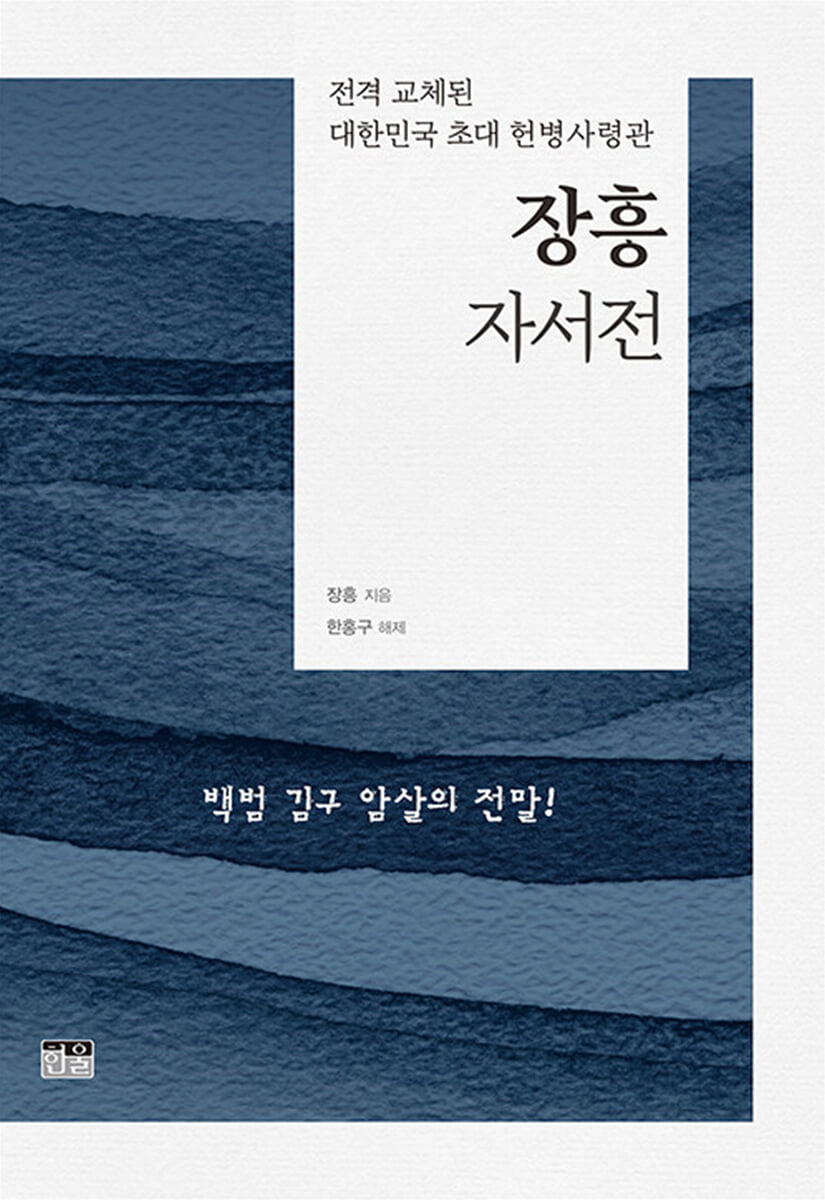
Jangheung's Autobiography (Hardcover)
 |
Description
Book Introduction
According to the testimony of the first military police commander
The Kim Gu assassination case is being reexamined!
The closely coordinated 'June Offensive' by pro-Japanese collaborators
This book is a translation of the autobiography written in both Korean and Chinese characters by General Jang Heung, the first commander of the Military Police of the Republic of Korea, after his retirement.
Until now, only the existence of the autobiography or some of its contents had been reported in the newspapers, but on the 80th anniversary of liberation, the family's determination allowed the entire book to see the light of day.
Jang Heung was the first public official to be purged after the death of Baekbeom.
The position of Military Police Commander, who was supposed to investigate the murderer Ahn Doo-hee, had to be given to Jeon Bong-deok, a pro-Japanese collaborator who was hiding in the military police at the request of Chief of the General Staff Chae Byeong-deok.
This book is valuable simply because it is the autobiography of a person who was a close associate of Baekbeom Kim Gu and who was able to vaguely observe the movements of the assassination plotters from the center of their power.
Although the collected and recorded data was lost in a bombing raid during the Korean War and the book is written solely from memory, the message it conveys is clear.
In the political climate after liberation, when the conflict between the left and right was reaching its peak, Jang Heung calmly tells the story of the pro-Japanese faction's "June Offensive" in June 1949, which disintegrated the independence movement forces.
The Kim Gu assassination case is being reexamined!
The closely coordinated 'June Offensive' by pro-Japanese collaborators
This book is a translation of the autobiography written in both Korean and Chinese characters by General Jang Heung, the first commander of the Military Police of the Republic of Korea, after his retirement.
Until now, only the existence of the autobiography or some of its contents had been reported in the newspapers, but on the 80th anniversary of liberation, the family's determination allowed the entire book to see the light of day.
Jang Heung was the first public official to be purged after the death of Baekbeom.
The position of Military Police Commander, who was supposed to investigate the murderer Ahn Doo-hee, had to be given to Jeon Bong-deok, a pro-Japanese collaborator who was hiding in the military police at the request of Chief of the General Staff Chae Byeong-deok.
This book is valuable simply because it is the autobiography of a person who was a close associate of Baekbeom Kim Gu and who was able to vaguely observe the movements of the assassination plotters from the center of their power.
Although the collected and recorded data was lost in a bombing raid during the Korean War and the book is written solely from memory, the message it conveys is clear.
In the political climate after liberation, when the conflict between the left and right was reaching its peak, Jang Heung calmly tells the story of the pro-Japanese faction's "June Offensive" in June 1949, which disintegrated the independence movement forces.
index
Release (Han Hong-gu)
Jang Heung's autobiography in Monthly Chosun, which erased Jeon Bong-deok
The power struggle after Baekbeom's assassination
The worst villain, Shin Sung-mo and the 88 Club
Pro-Japanese police officers take refuge in the military police
The National Assembly spy incident was aimed at eliminating the Kim Gu supporters, not the South Korean Workers' Party.
Shin Sung-mo: Incompetence and irresponsibility bordering on treason
The significance of the publication of "Jang Heung's Autobiography (The First Commander of the Military Police of the Republic of Korea, Who Was Suddenly Replaced)"
[Illuminating the Future through the Mirror of the Past]
Preface
Part 1 My Memoirs: My Years in Exile
1.
Origin of the Jang family
2.
The circumstances of the clan
3.
Neighborhood situation
4.
The situation of the local youth
5.
My family situation
6.
Motive for exile
7.
Early circumstances of exile
8.
Status of Koreans living in China
9.
After joining the military
10.
During my time as a cadet at the military academy
11.
After graduating from Hwangpo Military Academy
12.
After re-entering the Senior Military Officers' Corps and completing training
13.
After resigning from his post as head of the Military Police Department
14.
Marriage problems
15.
The circumstances before and after the Sino-Japanese War
16.
The Tianjin Incident
17.
Declaration of the Sino-Japanese War
18.
Sending his family to Shanghai during a military mission
19.
The incident in which President Kim Gu was shot
20.
The situation after the fall of Hangu and Jangsa
21.
Meeting my long-lost wife and my eldest daughter, Hanok, for the first time since birth.
22.
Korean soldier escape incident
23.
Action after the enemy declares surrender
24.
The beginning and end of the Chinese Communist Party
25.
Communist Party activities within the military
26.
Guangdong Communist Riots and Korean Students
27.
From the suppression of the Communist Party to the declaration of war
28.
The rise of the Communist Party during the war against Japan
29.
Results of the Chinese Civil War
30.
What caused the defeat in the Great Patriotic War?
31.
Why China Failed in the Anti-Communist War
32.
All failures stem from a breakdown in the mental front.
Part 2 My Reflections: After Returning to Korea
1.
Whereabouts after returning home
2.
Syngman Rhee's efforts to prevent communism in South Korea
3.
The emergence of Jeon Bong-deok, the first commander of the Military Police of the Republic of Korea Armed Forces
4.
My Relationship with the So-Called National Assembly 'Spy' Incident
5.
The full story of Baekbeom Kim Gu's assassination
6.
Jeon Bong-deok, a vicious pro-Japanese collaborator who became an assassination investigator
7.
The relationship between President Syngman Rhee and Kim Gu
8.
International situation before the Korean War
9.
Military officer situation before the Korean War
10.
Situation during the Korean War
11.
Political trends during the Korean War
12.
In the words of political figures during the Korean War
13.
The process of retiring from the military
14.
conclusion
Appendix 1
A copy of my resume as written in the family register
General Woo Seok Jangheung's funeral
I recited this song alone on the day I was discharged from the military.
The Taesanggyeongpa Jongmunhoe's Purpose Statement
Appendix 2: Collected scattered records.
Eulogy (Kim Gu)
Eulogy (Lee Si-young)
Investigation (Lee Beom-seok)
technology
declaration
resume
Rules on funeral rites and ancestral rites
Introduction to the plan written at the time of the ink painting exhibition
brief history
Draft inscription on the relics
In memory of my father (Jang Seok-wi)
Original autobiography
Jang Heung's autobiography in Monthly Chosun, which erased Jeon Bong-deok
The power struggle after Baekbeom's assassination
The worst villain, Shin Sung-mo and the 88 Club
Pro-Japanese police officers take refuge in the military police
The National Assembly spy incident was aimed at eliminating the Kim Gu supporters, not the South Korean Workers' Party.
Shin Sung-mo: Incompetence and irresponsibility bordering on treason
The significance of the publication of "Jang Heung's Autobiography (The First Commander of the Military Police of the Republic of Korea, Who Was Suddenly Replaced)"
[Illuminating the Future through the Mirror of the Past]
Preface
Part 1 My Memoirs: My Years in Exile
1.
Origin of the Jang family
2.
The circumstances of the clan
3.
Neighborhood situation
4.
The situation of the local youth
5.
My family situation
6.
Motive for exile
7.
Early circumstances of exile
8.
Status of Koreans living in China
9.
After joining the military
10.
During my time as a cadet at the military academy
11.
After graduating from Hwangpo Military Academy
12.
After re-entering the Senior Military Officers' Corps and completing training
13.
After resigning from his post as head of the Military Police Department
14.
Marriage problems
15.
The circumstances before and after the Sino-Japanese War
16.
The Tianjin Incident
17.
Declaration of the Sino-Japanese War
18.
Sending his family to Shanghai during a military mission
19.
The incident in which President Kim Gu was shot
20.
The situation after the fall of Hangu and Jangsa
21.
Meeting my long-lost wife and my eldest daughter, Hanok, for the first time since birth.
22.
Korean soldier escape incident
23.
Action after the enemy declares surrender
24.
The beginning and end of the Chinese Communist Party
25.
Communist Party activities within the military
26.
Guangdong Communist Riots and Korean Students
27.
From the suppression of the Communist Party to the declaration of war
28.
The rise of the Communist Party during the war against Japan
29.
Results of the Chinese Civil War
30.
What caused the defeat in the Great Patriotic War?
31.
Why China Failed in the Anti-Communist War
32.
All failures stem from a breakdown in the mental front.
Part 2 My Reflections: After Returning to Korea
1.
Whereabouts after returning home
2.
Syngman Rhee's efforts to prevent communism in South Korea
3.
The emergence of Jeon Bong-deok, the first commander of the Military Police of the Republic of Korea Armed Forces
4.
My Relationship with the So-Called National Assembly 'Spy' Incident
5.
The full story of Baekbeom Kim Gu's assassination
6.
Jeon Bong-deok, a vicious pro-Japanese collaborator who became an assassination investigator
7.
The relationship between President Syngman Rhee and Kim Gu
8.
International situation before the Korean War
9.
Military officer situation before the Korean War
10.
Situation during the Korean War
11.
Political trends during the Korean War
12.
In the words of political figures during the Korean War
13.
The process of retiring from the military
14.
conclusion
Appendix 1
A copy of my resume as written in the family register
General Woo Seok Jangheung's funeral
I recited this song alone on the day I was discharged from the military.
The Taesanggyeongpa Jongmunhoe's Purpose Statement
Appendix 2: Collected scattered records.
Eulogy (Kim Gu)
Eulogy (Lee Si-young)
Investigation (Lee Beom-seok)
technology
declaration
resume
Rules on funeral rites and ancestral rites
Introduction to the plan written at the time of the ink painting exhibition
brief history
Draft inscription on the relics
In memory of my father (Jang Seok-wi)
Original autobiography
Detailed image
.jpg)
Into the book
Our people were gradually driven out to Manchuria and the Russian Maritime Province, and after they settled down, so-called garrisons were dispatched into the Manchurian region under the pretext of protecting them, and rogue Koreans were put forward as front men to seize or confiscate the land and property of the Chinese, creating a reality in which the peoples of China and Korea were treated as enemies.
While racing to destroy the traditional friendship between Korea and China, they are also becoming more and more blatant in their ambition to annex Manchuria under the slogan of a so-called Japan-Korea-Manchuria community. Their consistent practice is to deliberately create and escalate incidents using every means and method possible, and then dispatch troops to foment armed conflict.
--- p.57
This woodpecker diplomacy is like a woodpecker pecking at every tree it lands on, making a dent in it. The Japanese, wherever they go, will always find fault with something and create a major incident. They initially pretend to negotiate diplomatically, but when they fail to achieve their intended goal, they ultimately resort to military force. There have been countless instances of this.
In carrying out such vicious policies, the consistently vicious strategy was to always put the soldiers and civilians in the back and always put the scoundrel Koreans in front.
--- p.58
At that time, I was putting all my effort into the revival work in the recovered Gamju and was eagerly anticipating the defeat of the enemy army. Then, at midnight on the 9th of the same month, I was invited by Mr. Zeng, the local general manager of the Chamber of Commerce. While I was enjoying a drink, suddenly, in the middle of the city, firecrackers were set off and shouts of "hurrah" shook the heavens and earth.
I mistook it for some kind of riot and called the unit to ask, and the officer on duty said that the enemy had declared surrender and that the citizens were marching through the streets, cheering enthusiastically.
When I heard this, I was so overcome with joy that I couldn't tell if it was a dream or reality. I ran straight home, hugged my wife and children, and was so happy to see the mountains and rivers of my homeland that I had missed for 30 years, and to see my parents and siblings that I almost went crazy.
--- p.74
Being in charge of public security in this vast area and entering as an advance unit in this land that had been occupied by the enemy for 7-8 years was not only welcomed by the people, but also, looking back on my past, as someone who had lived in exile because I could not endure the tyranny of the Japanese military police, I was indescribably exhilarated to be in charge of disarming these people. However, I deeply regret not being able to show this reality to my people, my relatives, and my relatives.
--- p.75
I was returning to Seoul around 4 p.m. after receiving an invitation to a welcome luncheon from the residents.
As I walked through Seodaemun Street, the streets were chaotic, and in front of the residence of Baekbeom, a sea of people and the sound of wailing shook the heavens and the earth.
At that moment, there were many of our military police vehicles parked on the roadside, and Captain Kim Byeong-sam, the chief of the patrol division, was guarding them, so I got out immediately and asked what had happened. I was told that Mr. Baekbeom had been shot dead by the vicious Ahn Du-hee. When I asked what had happened to the criminal, I was told that he had been arrested on the spot and taken to the military police headquarters and imprisoned.
--- p.102~103
If we analyze the masterminds of the incident, we can point out that the group is the newly organized '88 Club' of the Democratic Party of Korea and the Northwest Youth Association, and the individual is the Minister of National Defense, Shin Sung-mo.
Because after Baekbeom was shot, the Korean Democratic Party's executive committee declared Baekbeom a traitor to the country and even published it in the newspaper, and launched a movement to release the vicious bastard Ahn Doo-hee, calling him a loyal subject of the Republic of Korea.
--- p.109
After the death of Baekbeom, public opinion was divided, and there were even rumors that this president had ordered it, but in reality, it was a tragedy that resulted from pro-Japanese elements who had been promoted through flattery trying to solidify their political lives, and it can be proven through the historical actions of the two people that this president absolutely did not instruct them.
While racing to destroy the traditional friendship between Korea and China, they are also becoming more and more blatant in their ambition to annex Manchuria under the slogan of a so-called Japan-Korea-Manchuria community. Their consistent practice is to deliberately create and escalate incidents using every means and method possible, and then dispatch troops to foment armed conflict.
--- p.57
This woodpecker diplomacy is like a woodpecker pecking at every tree it lands on, making a dent in it. The Japanese, wherever they go, will always find fault with something and create a major incident. They initially pretend to negotiate diplomatically, but when they fail to achieve their intended goal, they ultimately resort to military force. There have been countless instances of this.
In carrying out such vicious policies, the consistently vicious strategy was to always put the soldiers and civilians in the back and always put the scoundrel Koreans in front.
--- p.58
At that time, I was putting all my effort into the revival work in the recovered Gamju and was eagerly anticipating the defeat of the enemy army. Then, at midnight on the 9th of the same month, I was invited by Mr. Zeng, the local general manager of the Chamber of Commerce. While I was enjoying a drink, suddenly, in the middle of the city, firecrackers were set off and shouts of "hurrah" shook the heavens and earth.
I mistook it for some kind of riot and called the unit to ask, and the officer on duty said that the enemy had declared surrender and that the citizens were marching through the streets, cheering enthusiastically.
When I heard this, I was so overcome with joy that I couldn't tell if it was a dream or reality. I ran straight home, hugged my wife and children, and was so happy to see the mountains and rivers of my homeland that I had missed for 30 years, and to see my parents and siblings that I almost went crazy.
--- p.74
Being in charge of public security in this vast area and entering as an advance unit in this land that had been occupied by the enemy for 7-8 years was not only welcomed by the people, but also, looking back on my past, as someone who had lived in exile because I could not endure the tyranny of the Japanese military police, I was indescribably exhilarated to be in charge of disarming these people. However, I deeply regret not being able to show this reality to my people, my relatives, and my relatives.
--- p.75
I was returning to Seoul around 4 p.m. after receiving an invitation to a welcome luncheon from the residents.
As I walked through Seodaemun Street, the streets were chaotic, and in front of the residence of Baekbeom, a sea of people and the sound of wailing shook the heavens and the earth.
At that moment, there were many of our military police vehicles parked on the roadside, and Captain Kim Byeong-sam, the chief of the patrol division, was guarding them, so I got out immediately and asked what had happened. I was told that Mr. Baekbeom had been shot dead by the vicious Ahn Du-hee. When I asked what had happened to the criminal, I was told that he had been arrested on the spot and taken to the military police headquarters and imprisoned.
--- p.102~103
If we analyze the masterminds of the incident, we can point out that the group is the newly organized '88 Club' of the Democratic Party of Korea and the Northwest Youth Association, and the individual is the Minister of National Defense, Shin Sung-mo.
Because after Baekbeom was shot, the Korean Democratic Party's executive committee declared Baekbeom a traitor to the country and even published it in the newspaper, and launched a movement to release the vicious bastard Ahn Doo-hee, calling him a loyal subject of the Republic of Korea.
--- p.109
After the death of Baekbeom, public opinion was divided, and there were even rumors that this president had ordered it, but in reality, it was a tragedy that resulted from pro-Japanese elements who had been promoted through flattery trying to solidify their political lives, and it can be proven through the historical actions of the two people that this president absolutely did not instruct them.
--- p.113
Publisher's Review
Moments of history recorded by Jang Heung, a close associate of Kim Gu!
And, teacher! There is just one thing I am ashamed of, sorry for, and resentful about.
It has only been a little over 20 years since liberation, but somehow we have become a generation that despises and persecutes anyone and everything that has the word “independence” in it, including the spirit of independence and the idea of independence.
Teacher, I don't know why this country and this generation have become like this.
When I think about it, it might actually have been a good thing for the teacher that he passed away earlier.
But then again, if you had stayed longer, would we have become a generation that dares to disdain the spirit of independence and the path to independence? _? Eulogy: 19th Anniversary of Baekbeom's Death, June 22, 1968, pp. 191-192
Currently, Korea is suffering from an extreme historical war.
As New Right figures are appointed to positions at various government agencies, including the Independence Hall of Korea, the National Institute of Korean History, the Northeast Asian History Foundation, and the Truth and Reconciliation Commission, efforts to restore the honor of pro-Japanese collaborators are becoming increasingly blatant.
The term “Kim Gu terrorist” is being used openly, and as Commissioner Kim Yong-man, the great-grandson of Kim Gu, said, the Ministry of Patriots and Veterans Affairs has reached the point where it “selects cases in which representative pro-Japanese figures such as Kim Hwal-lan and Kim Seong-su were active, excluding representative independence movements such as the righteous deeds of Ahn Jung-geun, Lee Bong-chang, and Yun Bong-gil, and the Battles of Bongodong and Cheongsanri.”
This book is the autobiography of a man who went into exile in Shanghai in 1925, received education at the Whampoa Military Academy, joined the Republic of China Army, worked to protect independence fighters, worked for the safe return of overseas Koreans after liberation, and dedicated his life to his country as a member of the Republic of Korea Army upon his return.
Jang Heung, the first commander of the Military Police of the Republic of Korea, recorded historical moments that he experienced or heard about from close quarters.
It is rare for an independence activist and close associate of Kim Gu to leave behind such a detailed autobiography.
Moreover, this book holds great value simply because it is an autobiography written by a person who was suddenly replaced from his position as commander of the Military Police by the forces that plotted the assassination of Mr. Kim Gu.
Shin Seong-mo, Chae Byeong-deok, Jeon Bong-deok, 88 Club, Korean Democratic Party...
A planned conspiracy by a group of vicious pro-Japanese collaborators!
It is said that on June 27, 1949, the day after Baekbeom Kim Gu was assassinated, Jang Heung received a personnel order with the wording of dismissal on Shin Seong-mo's business card and was dismissed.
The person who took his place as commander of the military police by order of the Shinsungmo was Jeon Bong-deok, a former high-ranking police officer from the Japanese colonial period who had hidden in the military police to avoid the blade of the Special Committee on Anti-National Activities with the help of Chae Byeong-deok.
In this autobiography, Jang Heung points out the 88 Club, newly formed by the Korean Democratic Party, the Northwest Youth Association, and Minister of National Defense Shin Seong-mo as the people behind the assassination of Baekbeom.
It is said that a group of pro-Japanese collaborators who regarded Mr. Baekbeom as their enemy plotted to seize key positions and orchestrated this tragedy by instigating Ahn Du-hee.
He also wrote about those who were rewarded for their service after the assassination:
The Director of the Intelligence Service, Baek Seon-yeop, was promoted to Brigadier General and made Commander of the 5th Division of the Army for his contribution in fabricating the incident as a rebellion by the Korean Independence Party. Moon Bong-jae (a typo for Moon Bong-je) of the Northwest Youth Association was promoted from Chief of the Public Security Bureau to Minister of Transportation. The perpetrator, Ahn, was released immediately after the incident and returned to the military after being promoted to Major from his original rank of Lieutenant. However, this became an issue in the National Assembly, and Minister of National Defense Shin Seong-mo and Chief of Staff Chae Byeong-deok were held accountable. As a result, he was inevitably expelled from the military again and allowed to run a military soy sauce factory to protect his livelihood.
Page 110
The “conspiracy of a group of vicious pro-Japanese collaborators,” which Jang Heung emphasized several times in his autobiography, is still ongoing even after 80 years.
I hope that the publication of this book will serve as an opportunity to bring an end to the reckless historical war that defies history.
Putting together the scattered puzzle pieces to give it historical meaning!
Professor Han Hong-gu, a historian, discovered the value of this autobiography by piecing together the scattered pieces of the book.
It can be said that the pro-Japanese and anti-communist forces, with Shinsungmo at the top, united and fought against a common enemy, Baekbeom Kim Gu, who advocated for the liquidation of pro-Japanese and anti-national collaborators, and achieved a 'victory'.
Page 11
The flow of the June Offensive can be read through the text of the autobiography, but because the items are different, it may be perceived as only individual events.
Professor Han Hong-gu fills in the gaps and, through his "Explanation," focuses on how each incident formed a larger flow and distorted modern Korean history.
The 'June Offensive' that was intensively carried out in June 1949 consisted of three major parts: ① the attack on the Special Committee on Anti-National Activities, ② the National Assembly spy incident, and ③ the assassination of Baekbeom Kim Gu. Among them, ① the attack on the Special Committee on Anti-National Activities was handled by pro-Japanese police who were the subject of the Special Committee's intensive investigation under the command of Seoul Metropolitan Police Agency Chief Kim Tae-seon, ② the National Assembly spy incident was handled by Jeon Bong-deok, the commander of the Military Police Department who was a former Japanese high-ranking police officer, and ③ the assassination of Baekbeom Kim Gu was handled by Jang Eun-san, an artillery commander who was a former Manchurian Army officer.
At the top of all this machinations was Minister of National Defense Shin Sung-mo.
Page 18
He fills in the gaps in history not only by finding clues about the June Offensive but also by finding other clues in his autobiography.
One of the unsolved problems that the compilation committee of the 『Biographies of Anti-Constitutional Acts』 was tracing the activities of Jeon Bong-deok was that after serving as the commander of the Military Police, Jeon Bong-deok was promoted to the Chief of Staff to the Prime Minister when Shin Seong-mo concurrently assumed the position of Acting Prime Minister.
At first, this career was thought to be continuous, but a closer examination of the records revealed that Jeon Bong-deok resigned as the commander of the Military Police on November 27, 1949, and became the Chief of Staff to the Prime Minister on April 27, 1950, a gap of five months.
I was deeply curious as to why Jeon Bong-deok, who played a crucial role in the National Assembly spy incident and the assassination of Baekbeom, was forced out of the military and forced to live as a wild man for five months. This book has clearly answered that question.
_Page 10
I hope that this book, one of the few records written directly by an independence activist, will not only bring the assassination of Mr. Kim Gu back into the public sphere, but also establish itself as a valuable source of historical information that fills in the blanks of history.
And, teacher! There is just one thing I am ashamed of, sorry for, and resentful about.
It has only been a little over 20 years since liberation, but somehow we have become a generation that despises and persecutes anyone and everything that has the word “independence” in it, including the spirit of independence and the idea of independence.
Teacher, I don't know why this country and this generation have become like this.
When I think about it, it might actually have been a good thing for the teacher that he passed away earlier.
But then again, if you had stayed longer, would we have become a generation that dares to disdain the spirit of independence and the path to independence? _? Eulogy: 19th Anniversary of Baekbeom's Death, June 22, 1968, pp. 191-192
Currently, Korea is suffering from an extreme historical war.
As New Right figures are appointed to positions at various government agencies, including the Independence Hall of Korea, the National Institute of Korean History, the Northeast Asian History Foundation, and the Truth and Reconciliation Commission, efforts to restore the honor of pro-Japanese collaborators are becoming increasingly blatant.
The term “Kim Gu terrorist” is being used openly, and as Commissioner Kim Yong-man, the great-grandson of Kim Gu, said, the Ministry of Patriots and Veterans Affairs has reached the point where it “selects cases in which representative pro-Japanese figures such as Kim Hwal-lan and Kim Seong-su were active, excluding representative independence movements such as the righteous deeds of Ahn Jung-geun, Lee Bong-chang, and Yun Bong-gil, and the Battles of Bongodong and Cheongsanri.”
This book is the autobiography of a man who went into exile in Shanghai in 1925, received education at the Whampoa Military Academy, joined the Republic of China Army, worked to protect independence fighters, worked for the safe return of overseas Koreans after liberation, and dedicated his life to his country as a member of the Republic of Korea Army upon his return.
Jang Heung, the first commander of the Military Police of the Republic of Korea, recorded historical moments that he experienced or heard about from close quarters.
It is rare for an independence activist and close associate of Kim Gu to leave behind such a detailed autobiography.
Moreover, this book holds great value simply because it is an autobiography written by a person who was suddenly replaced from his position as commander of the Military Police by the forces that plotted the assassination of Mr. Kim Gu.
Shin Seong-mo, Chae Byeong-deok, Jeon Bong-deok, 88 Club, Korean Democratic Party...
A planned conspiracy by a group of vicious pro-Japanese collaborators!
It is said that on June 27, 1949, the day after Baekbeom Kim Gu was assassinated, Jang Heung received a personnel order with the wording of dismissal on Shin Seong-mo's business card and was dismissed.
The person who took his place as commander of the military police by order of the Shinsungmo was Jeon Bong-deok, a former high-ranking police officer from the Japanese colonial period who had hidden in the military police to avoid the blade of the Special Committee on Anti-National Activities with the help of Chae Byeong-deok.
In this autobiography, Jang Heung points out the 88 Club, newly formed by the Korean Democratic Party, the Northwest Youth Association, and Minister of National Defense Shin Seong-mo as the people behind the assassination of Baekbeom.
It is said that a group of pro-Japanese collaborators who regarded Mr. Baekbeom as their enemy plotted to seize key positions and orchestrated this tragedy by instigating Ahn Du-hee.
He also wrote about those who were rewarded for their service after the assassination:
The Director of the Intelligence Service, Baek Seon-yeop, was promoted to Brigadier General and made Commander of the 5th Division of the Army for his contribution in fabricating the incident as a rebellion by the Korean Independence Party. Moon Bong-jae (a typo for Moon Bong-je) of the Northwest Youth Association was promoted from Chief of the Public Security Bureau to Minister of Transportation. The perpetrator, Ahn, was released immediately after the incident and returned to the military after being promoted to Major from his original rank of Lieutenant. However, this became an issue in the National Assembly, and Minister of National Defense Shin Seong-mo and Chief of Staff Chae Byeong-deok were held accountable. As a result, he was inevitably expelled from the military again and allowed to run a military soy sauce factory to protect his livelihood.
Page 110
The “conspiracy of a group of vicious pro-Japanese collaborators,” which Jang Heung emphasized several times in his autobiography, is still ongoing even after 80 years.
I hope that the publication of this book will serve as an opportunity to bring an end to the reckless historical war that defies history.
Putting together the scattered puzzle pieces to give it historical meaning!
Professor Han Hong-gu, a historian, discovered the value of this autobiography by piecing together the scattered pieces of the book.
It can be said that the pro-Japanese and anti-communist forces, with Shinsungmo at the top, united and fought against a common enemy, Baekbeom Kim Gu, who advocated for the liquidation of pro-Japanese and anti-national collaborators, and achieved a 'victory'.
Page 11
The flow of the June Offensive can be read through the text of the autobiography, but because the items are different, it may be perceived as only individual events.
Professor Han Hong-gu fills in the gaps and, through his "Explanation," focuses on how each incident formed a larger flow and distorted modern Korean history.
The 'June Offensive' that was intensively carried out in June 1949 consisted of three major parts: ① the attack on the Special Committee on Anti-National Activities, ② the National Assembly spy incident, and ③ the assassination of Baekbeom Kim Gu. Among them, ① the attack on the Special Committee on Anti-National Activities was handled by pro-Japanese police who were the subject of the Special Committee's intensive investigation under the command of Seoul Metropolitan Police Agency Chief Kim Tae-seon, ② the National Assembly spy incident was handled by Jeon Bong-deok, the commander of the Military Police Department who was a former Japanese high-ranking police officer, and ③ the assassination of Baekbeom Kim Gu was handled by Jang Eun-san, an artillery commander who was a former Manchurian Army officer.
At the top of all this machinations was Minister of National Defense Shin Sung-mo.
Page 18
He fills in the gaps in history not only by finding clues about the June Offensive but also by finding other clues in his autobiography.
One of the unsolved problems that the compilation committee of the 『Biographies of Anti-Constitutional Acts』 was tracing the activities of Jeon Bong-deok was that after serving as the commander of the Military Police, Jeon Bong-deok was promoted to the Chief of Staff to the Prime Minister when Shin Seong-mo concurrently assumed the position of Acting Prime Minister.
At first, this career was thought to be continuous, but a closer examination of the records revealed that Jeon Bong-deok resigned as the commander of the Military Police on November 27, 1949, and became the Chief of Staff to the Prime Minister on April 27, 1950, a gap of five months.
I was deeply curious as to why Jeon Bong-deok, who played a crucial role in the National Assembly spy incident and the assassination of Baekbeom, was forced out of the military and forced to live as a wild man for five months. This book has clearly answered that question.
_Page 10
I hope that this book, one of the few records written directly by an independence activist, will not only bring the assassination of Mr. Kim Gu back into the public sphere, but also establish itself as a valuable source of historical information that fills in the blanks of history.
GOODS SPECIFICS
- Date of issue: January 14, 2025
- Format: Hardcover book binding method guide
- Page count, weight, size: 432 pages | 778g | 153*224*30mm
- ISBN13: 9788946083646
- ISBN10: 8946083646
You may also like
카테고리
korean


korean

![GQ KOREA Mark (Monthly): December [2025]](http://librairie.coreenne.fr/cdn/shop/files/8ef265dbbfbf186523ed75ba7319009d.jpg?v=1765340328&width=3840)


