

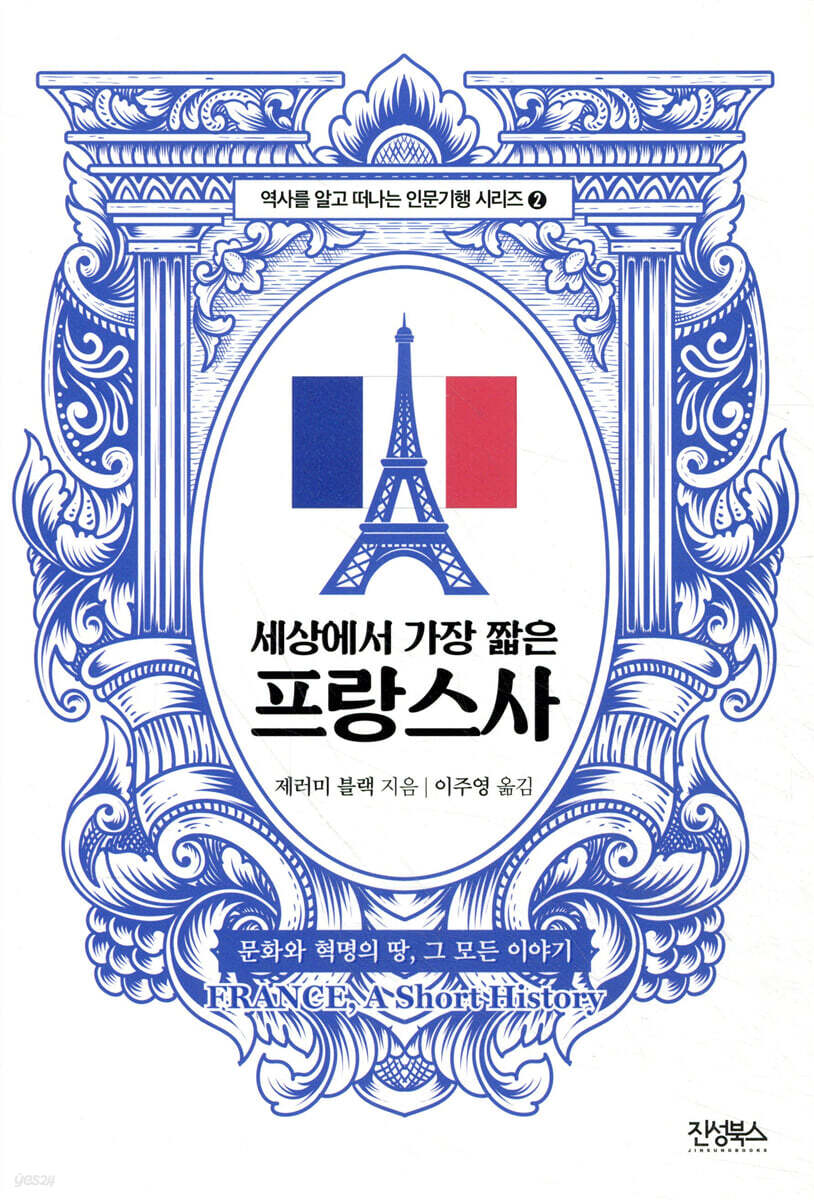
The shortest French history in the world
 |
Description
Book Introduction
A land of revolution, a center of culture and art...
Discover the history of France, more splendid and intense than any other country!
“Everyone has two homelands.
“One is my country, the other is France.”
_Thomas Jefferson
There are many words that symbolize France.
A country of liberty, equality, and fraternity, a republic, a country of democracy and human rights, art and revolution, a hexagon, castles and wine, a city of light... France can be said to be a central country that has played a very symbolic and leading role not only in European history but also in world history.
"The World's Shortest History of France" is a book that examines the history of France, which has always been at the center of European history, from a new perspective.
From prehistoric times, when humans first created tools and left cave paintings, through the Middle Ages, the era of feudalism and absolute monarchy, to the fierce flames of revolution, Napoleon's challenges and failures, and today, as France serves as the heart of the European Union, this book captures various moments in French history.
The Korean edition of 『The World's Shortest History of France』 includes a section titled "History in History," which provides detailed context for the major figures and historical events mentioned in the book, in order to delve deeper into their meaning.
Additionally, we provided the "Essential Guide for Travelers to France" as an appendix, which includes France's UNESCO World Heritage Sites, recommended travel routes, and recommended cities to visit.
This is a valuable collection of information that anyone traveling to France will want to explore.
Discover the history of France, more splendid and intense than any other country!
“Everyone has two homelands.
“One is my country, the other is France.”
_Thomas Jefferson
There are many words that symbolize France.
A country of liberty, equality, and fraternity, a republic, a country of democracy and human rights, art and revolution, a hexagon, castles and wine, a city of light... France can be said to be a central country that has played a very symbolic and leading role not only in European history but also in world history.
"The World's Shortest History of France" is a book that examines the history of France, which has always been at the center of European history, from a new perspective.
From prehistoric times, when humans first created tools and left cave paintings, through the Middle Ages, the era of feudalism and absolute monarchy, to the fierce flames of revolution, Napoleon's challenges and failures, and today, as France serves as the heart of the European Union, this book captures various moments in French history.
The Korean edition of 『The World's Shortest History of France』 includes a section titled "History in History," which provides detailed context for the major figures and historical events mentioned in the book, in order to delve deeper into their meaning.
Additionally, we provided the "Essential Guide for Travelers to France" as an appendix, which includes France's UNESCO World Heritage Sites, recommended travel routes, and recommended cities to visit.
This is a valuable collection of information that anyone traveling to France will want to explore.
- You can preview some of the book's contents.
Preview
index
introduction
Preface to the Korean edition
Introduction
1.
Prehistoric heritage
2.
Roman France
3.
Early Middle Ages
4.
medieval France
5.
Renaissance France, 1494–1598
6.
From Henry IV to Louis XIV, 1598–1715
7.
Ancien Régime, 1715–1789
8.
The French Revolution, 1789–1799
9.
From Napoleon I to Napoleon III, 1799–1870
10.
Third Republic, 1870–1939
11.
World War II, 1939–1945
12.
The New France, 1945–1969
13.
Modern France, 1969–2000
14.
France today, 2001~
15.
conclusion
In conclusion
Acknowledgements
Further Reading
Special Appendix: Essential Guide for Travelers to France
Preface to the Korean edition
Introduction
1.
Prehistoric heritage
2.
Roman France
3.
Early Middle Ages
4.
medieval France
5.
Renaissance France, 1494–1598
6.
From Henry IV to Louis XIV, 1598–1715
7.
Ancien Régime, 1715–1789
8.
The French Revolution, 1789–1799
9.
From Napoleon I to Napoleon III, 1799–1870
10.
Third Republic, 1870–1939
11.
World War II, 1939–1945
12.
The New France, 1945–1969
13.
Modern France, 1969–2000
14.
France today, 2001~
15.
conclusion
In conclusion
Acknowledgements
Further Reading
Special Appendix: Essential Guide for Travelers to France
Detailed image

Into the book
A key element in politics is war.
The war proved that the nation's environmental determinism was wrong.
In other words, the key indicator that shows that the land and boundaries occupied by a country were not fixed from the beginning is 'war'.
--- p.19
A statue of Vercingetorix stands tall in the ruins of Alesia.
This statue was commissioned by Napoleon III with the intention of showing France before Rome.
The resistance of the divided tribes to unite and fight against the conquering Romans is remembered as the courageous resistance of the Gallic people.
--- p.42
At first glance, the French monarchy seemed to be in good shape, but there were shackles weighing on it.
The problem was that the government's functions were not smooth.
France was much more extensive than England, so internal communications were greatly restricted.
--- p.99
But French society in the 18th century was very different from French society today.
18th-century French society was rife with discrimination between men and women and between classes.
From a modern perspective, 18th-century France was a very unequal society, to the point where the French Revolution seems natural.
But if we step back and observe, the unequal French society of the 18th century was not the direct cause of the revolution that began in 1789.
--- p.184
Supporters of the Third Republic favored Gaul as the origin of France.
Conservatives, on the other hand, emphasized the Catholic identity of the sectarian alliance, citing the Germanic invaders who overthrew the Roman Empire, especially Clovis, who was baptized as the first Catholic monarch of France.
--- p.283
The period after World War II, known as the "Glorious Thirty Years," saw rapid economic development, massive mechanization, and the active use of new technologies.
These changes led to people leaving their native lands and migrating to other places, and France was increasingly shedding its peasant society.
--- p.322
De Gaulle presented France as the leader of Europe, and presented this in French political and cultural dimensions.
With the Élysée Treaty of 1963, France forged closer ties with West Germany.
It was the result of de Gaulle's determination to exclude Britain from Europe and his intention to attack American hegemony.
--- p.327
France continued to play a key role in the EU, with extensive international activities, and became a central country benefiting from the EU.
In 2001, France received 22% of CAP (agricultural aid) subsidies, and in 2002, it reached a bilateral agreement with Germany on the future of CAP, ignoring the critical British position.
This bilateral agreement became the basis of subsequent EU policy.
The war proved that the nation's environmental determinism was wrong.
In other words, the key indicator that shows that the land and boundaries occupied by a country were not fixed from the beginning is 'war'.
--- p.19
A statue of Vercingetorix stands tall in the ruins of Alesia.
This statue was commissioned by Napoleon III with the intention of showing France before Rome.
The resistance of the divided tribes to unite and fight against the conquering Romans is remembered as the courageous resistance of the Gallic people.
--- p.42
At first glance, the French monarchy seemed to be in good shape, but there were shackles weighing on it.
The problem was that the government's functions were not smooth.
France was much more extensive than England, so internal communications were greatly restricted.
--- p.99
But French society in the 18th century was very different from French society today.
18th-century French society was rife with discrimination between men and women and between classes.
From a modern perspective, 18th-century France was a very unequal society, to the point where the French Revolution seems natural.
But if we step back and observe, the unequal French society of the 18th century was not the direct cause of the revolution that began in 1789.
--- p.184
Supporters of the Third Republic favored Gaul as the origin of France.
Conservatives, on the other hand, emphasized the Catholic identity of the sectarian alliance, citing the Germanic invaders who overthrew the Roman Empire, especially Clovis, who was baptized as the first Catholic monarch of France.
--- p.283
The period after World War II, known as the "Glorious Thirty Years," saw rapid economic development, massive mechanization, and the active use of new technologies.
These changes led to people leaving their native lands and migrating to other places, and France was increasingly shedding its peasant society.
--- p.322
De Gaulle presented France as the leader of Europe, and presented this in French political and cultural dimensions.
With the Élysée Treaty of 1963, France forged closer ties with West Germany.
It was the result of de Gaulle's determination to exclude Britain from Europe and his intention to attack American hegemony.
--- p.327
France continued to play a key role in the EU, with extensive international activities, and became a central country benefiting from the EU.
In 2001, France received 22% of CAP (agricultural aid) subsidies, and in 2002, it reached a bilateral agreement with Germany on the future of CAP, ignoring the critical British position.
This bilateral agreement became the basis of subsequent EU policy.
--- p.363
Publisher's Review
From prehistoric ruins to the Renaissance, the Revolution, and the modern era,
A dynamic and powerful history of France in one volume!
『The World's Shortest History of France』 is a book written by historian Jeremy Black that presents all of French history from a new perspective, starting from the ruins of France's prehistoric times, through Roman France, the Renaissance, the era of absolute monarchy, the French Revolution and the Napoleonic Empire after the break from the Ancien Régime, and up to the present day.
The author chronicles the gradual transformation of France, originally a geographically, culturally, and administratively diverse group, into a single nation, while also delving into the wars that were essential to this transformation.
Through war, a key element in politics, it reveals how the nation of France interacted with various environments and human societies to reach its present state.
splendid court culture, Christian culture, or political revolution
What makes France French?
When and where did ancient France begin? How did France evolve after the Roman era? How was the splendid court culture of absolute monarchy, epitomized by Louis XIV and the Palace of Versailles, developed? Why was Joan of Arc, the patron saint of France and a saint who received divine revelations, betrayed by Charles VII? How did Napoleon, a native of Corsica, conquer not only France but also Europe? And how did the France we know today, synonymous with "liberty, equality, fraternity," come to be? Why did France lose to Prussia? What accounted for its poor response during World War II?
From ancient France to the present, "The World's Shortest History of France" explores the cultural and political identity of France as a nation and its people through a variety of historical events, and seeks to define them.
What makes a nation a nation is not simply its borders or its form, but rather its shared and defined diversity of consciousness, ideas, and history.
Through this book, readers will come face to face with a more concrete and truthful history of France, rather than the vague and illusory image of the nation they have been imagining.
"History within History" and "The Essential Guide for Travelers to France" for readers unfamiliar with France
For readers unfamiliar with Western history, the Korean edition includes "History in History," which provides a more detailed look at historical events and figures, and "The Essential Guide for Travelers to France," which includes information on France's UNESCO World Heritage Sites and various travel information.
As you delve into the splendid and dynamic story of France, you'll gradually internalize historical knowledge through the "History within History" section that follows the text, and as you read through the guide filled with countless heritage sites and travel destinations, you'll find yourself becoming more familiar with France.
A dynamic and powerful history of France in one volume!
『The World's Shortest History of France』 is a book written by historian Jeremy Black that presents all of French history from a new perspective, starting from the ruins of France's prehistoric times, through Roman France, the Renaissance, the era of absolute monarchy, the French Revolution and the Napoleonic Empire after the break from the Ancien Régime, and up to the present day.
The author chronicles the gradual transformation of France, originally a geographically, culturally, and administratively diverse group, into a single nation, while also delving into the wars that were essential to this transformation.
Through war, a key element in politics, it reveals how the nation of France interacted with various environments and human societies to reach its present state.
splendid court culture, Christian culture, or political revolution
What makes France French?
When and where did ancient France begin? How did France evolve after the Roman era? How was the splendid court culture of absolute monarchy, epitomized by Louis XIV and the Palace of Versailles, developed? Why was Joan of Arc, the patron saint of France and a saint who received divine revelations, betrayed by Charles VII? How did Napoleon, a native of Corsica, conquer not only France but also Europe? And how did the France we know today, synonymous with "liberty, equality, fraternity," come to be? Why did France lose to Prussia? What accounted for its poor response during World War II?
From ancient France to the present, "The World's Shortest History of France" explores the cultural and political identity of France as a nation and its people through a variety of historical events, and seeks to define them.
What makes a nation a nation is not simply its borders or its form, but rather its shared and defined diversity of consciousness, ideas, and history.
Through this book, readers will come face to face with a more concrete and truthful history of France, rather than the vague and illusory image of the nation they have been imagining.
"History within History" and "The Essential Guide for Travelers to France" for readers unfamiliar with France
For readers unfamiliar with Western history, the Korean edition includes "History in History," which provides a more detailed look at historical events and figures, and "The Essential Guide for Travelers to France," which includes information on France's UNESCO World Heritage Sites and various travel information.
As you delve into the splendid and dynamic story of France, you'll gradually internalize historical knowledge through the "History within History" section that follows the text, and as you read through the guide filled with countless heritage sites and travel destinations, you'll find yourself becoming more familiar with France.
GOODS SPECIFICS
- Date of issue: January 21, 2025
- Page count, weight, size: 472 pages | 682g | 152*225*24mm
- ISBN13: 9788997743681
- ISBN10: 8997743686
You may also like
카테고리
korean


korean

![GQ KOREA Mark (Monthly): December [2025]](http://librairie.coreenne.fr/cdn/shop/files/8ef265dbbfbf186523ed75ba7319009d.jpg?v=1765340328&width=3840)


