

History of Siberia
 |
Description
Book Introduction
The history of Siberia, a harsh but beautiful land
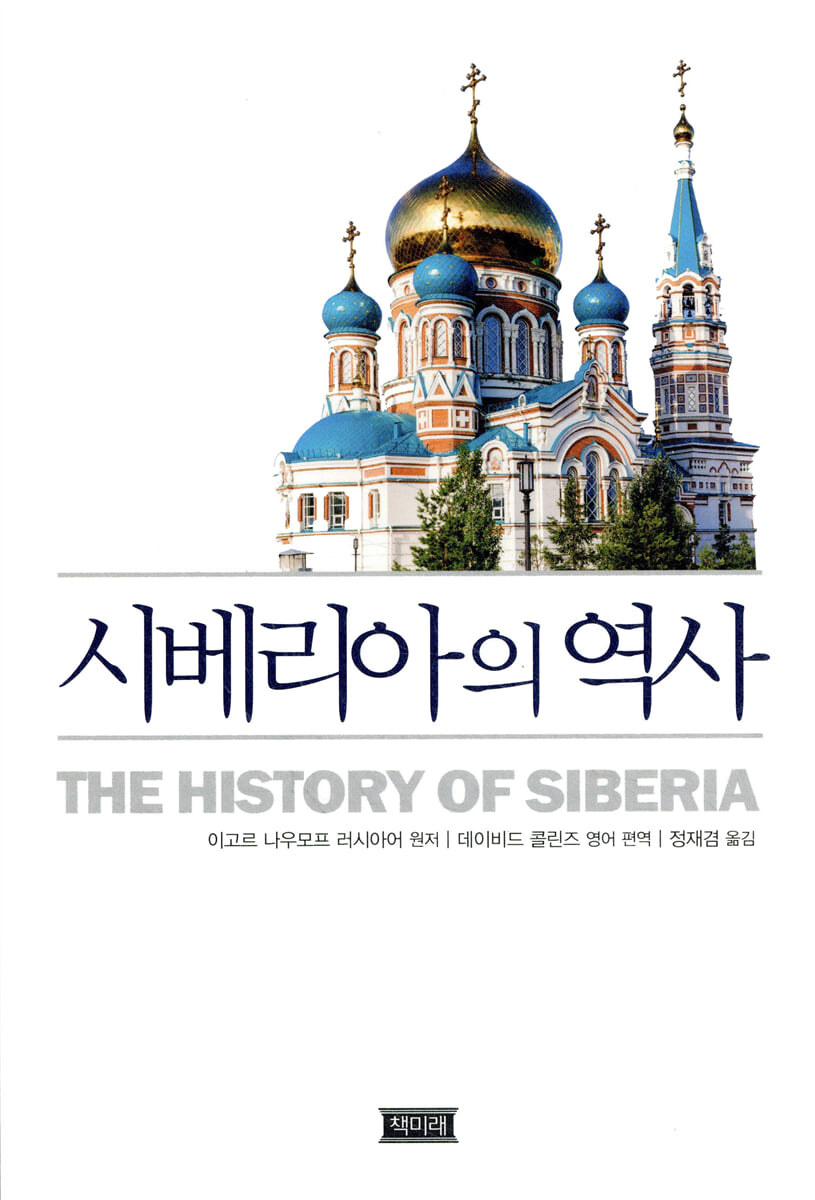
This book is a history of Siberia selected for Western scholars and readers by Professor David Collins, head of the Russian Studies Department at the University of Leeds in the UK.
One of the biggest reasons Professor Collins chose it was that the original author, Russian scholar Professor Igor Naumov, was a native Siberian and has lived and conducted research in Siberia.
Siberian history has been treated mostly from a European Russian perspective as part of Russian history.
However, this book is viewed entirely from a Siberian perspective by Siberians.
This book is a history of Siberia selected for Western scholars and readers by Professor David Collins, head of the Russian Studies Department at the University of Leeds in the UK.
One of the biggest reasons Professor Collins chose it was that the original author, Russian scholar Professor Igor Naumov, was a native Siberian and has lived and conducted research in Siberia.
Siberian history has been treated mostly from a European Russian perspective as part of Russian history.
However, this book is viewed entirely from a Siberian perspective by Siberians.
index
Preface by the editor
Preface by the Russian original author
English translator's preface
Part 1: The region known as 'Siberia'
Chapter 1 General Information
Chapter 2: Studies in Siberian History
Part 2: Ancient Siberia
Chapter 3: The Stone Age
Chapter 4: The Bronze Age
Chapter 5: The Scythian Period
Chapter 6: Siberia during the Xiongnu Period
Part 3: Siberia in the First and First Half of the Second Millennium AD
Chapter 7: The Turkic Peoples of Siberia - The Yenisei Kyrgyz State
Chapter 8: The Mongols of Siberia and the Siberian Khaganate
Chapter 9: Siberian Peoples Before Russian Subjugation
Part 4: Siberia under Russian control
Chapter 10: The Russian Invasion of Siberia
Chapter 11: The Yermak Expedition and the Subjugation of Siberia
Chapter 12: The Russian-Qing Conflict, 1685-1689
Chapter 13: Rule of Siberia
Chapter 14: Exploring Siberia
Part 5: Siberia in the 18th and early 19th centuries
Chapter 15: The Foreign Policy Situation in Siberia
Chapter 16: Administration of Siberia: The Reforms of 1822
Chapter 17 Socio-Economic Development
Chapter 18: Cultural Development and Scientific Exploration
Part 6 Siberia in the Late 19th and Early 20th Centuries
Chapter 19: The Foreign Policy Situation in Siberia
Chapter 20 Socio-Economic Development
Chapter 21: The Development of Culture and Science
Chapter 22 Social Life in Siberia: Siberia during the Revolution, 1905-1907
Part 7: Siberia during the Revolution and Civil War (1917–1922)
Chapter 23: Siberia in 1917 254
Chapter 24: The Red-White Civil War (1918-1921) 267
Chapter 25: The Far Eastern Republic (1920–1922) 290
Part 8: Siberia, 1920-1922 and Beyond
Chapter 26: The Foreign Policy Situation in Siberia
Chapter 27: Administration of Siberia
Chapter 28: Socio-Economic and Cultural Developments of the 1920s–1940s
Chapter 29: Socio-Economic and Cultural Developments 1950-1985
Chapter 30: Siberia, 1985-Early 21st Century
Translator's Note
References suggested by translator David Collins
Search
Preface by the Russian original author
English translator's preface
Part 1: The region known as 'Siberia'
Chapter 1 General Information
Chapter 2: Studies in Siberian History
Part 2: Ancient Siberia
Chapter 3: The Stone Age
Chapter 4: The Bronze Age
Chapter 5: The Scythian Period
Chapter 6: Siberia during the Xiongnu Period
Part 3: Siberia in the First and First Half of the Second Millennium AD
Chapter 7: The Turkic Peoples of Siberia - The Yenisei Kyrgyz State
Chapter 8: The Mongols of Siberia and the Siberian Khaganate
Chapter 9: Siberian Peoples Before Russian Subjugation
Part 4: Siberia under Russian control
Chapter 10: The Russian Invasion of Siberia
Chapter 11: The Yermak Expedition and the Subjugation of Siberia
Chapter 12: The Russian-Qing Conflict, 1685-1689
Chapter 13: Rule of Siberia
Chapter 14: Exploring Siberia
Part 5: Siberia in the 18th and early 19th centuries
Chapter 15: The Foreign Policy Situation in Siberia
Chapter 16: Administration of Siberia: The Reforms of 1822
Chapter 17 Socio-Economic Development
Chapter 18: Cultural Development and Scientific Exploration
Part 6 Siberia in the Late 19th and Early 20th Centuries
Chapter 19: The Foreign Policy Situation in Siberia
Chapter 20 Socio-Economic Development
Chapter 21: The Development of Culture and Science
Chapter 22 Social Life in Siberia: Siberia during the Revolution, 1905-1907
Part 7: Siberia during the Revolution and Civil War (1917–1922)
Chapter 23: Siberia in 1917 254
Chapter 24: The Red-White Civil War (1918-1921) 267
Chapter 25: The Far Eastern Republic (1920–1922) 290
Part 8: Siberia, 1920-1922 and Beyond
Chapter 26: The Foreign Policy Situation in Siberia
Chapter 27: Administration of Siberia
Chapter 28: Socio-Economic and Cultural Developments of the 1920s–1940s
Chapter 29: Socio-Economic and Cultural Developments 1950-1985
Chapter 30: Siberia, 1985-Early 21st Century
Translator's Note
References suggested by translator David Collins
Search
Publisher's Review
The history of Siberia, a harsh but beautiful land
This book is a history of Siberia selected for Western scholars and readers by Professor David Collins, head of the Russian Studies Department at the University of Leeds in the UK.
One of the biggest reasons Professor Collins chose it was that the original author, Russian scholar Professor Igor Naumov, was a native Siberian and has lived and conducted research in Siberia.
Siberian history has been treated mostly from a European Russian perspective as part of Russian history.
However, this book is viewed entirely from a Siberian perspective by Siberians.
Therefore, the order of the book is also characterized by containing the complete history of Siberia, from the time when humans first appeared in Siberia (Stone Age 1 million years ago - 100,000 years ago), to the Bronze Age (Apanashevo culture - Glazkovo culture), the Scythian era (Tagar culture - Stone Tombs culture), the era of the Xiongnu Empire, the era of the Turkic peoples (Turkic Khaganate - Yenisei Kyrgyz Khaganate), the era of the Mongols (Mongol Empire), the era of the Russian conquest of Siberia, the era of the border demarcation between Russia and the Qing Dynasty, the era of the Communist Revolution and the Red-White Civil War, and the modern era of the birth and dissolution of the Soviet Union and the birth of the new Russian Federation.
There are many Russian history books available in Korea, but this is the only one that covers Siberian history in its entirety.
This book covers in detail issues that are either lightly covered or not covered at all in other Russian history books.
For example, secret clauses in the 1907 Russo-Japanese Petersburg Agreement, which dealt with the scope of Russian and Japanese interests, were made public, including one that explicitly identified Korea as a special Japanese area of interest.
This indicates that a secret agreement had already been reached between Russia and Japan before the Japan-Korea Annexation Treaty in 1910.
The book also reveals that Siberia was a hotbed of decentralization.
That is, in 1882, Yadrintsev, in his work “Siberia as a Colony,” articulated the main ideology of Siberian decentralization, arguing that since Russia had been using Siberia as a colony and hindering its development, Siberia needed political autonomy for its development.
Potanin, another Siberian regionalist leader, was imprisoned on charges of trying to separate Siberia from Russia.
Then, on April 6, 1920, a very special political system, the Far Eastern Republic, emerged.
This Far Eastern republic stretched west to Lake Baikal and the Selenga River, east to Vladivostok, and its capital was Verkhneudinsk (Ulan-Ude). Although nominally independent from Soviet Russia, it was backed by Bolshevik forces.
At that time, with the Russian Civil War still ongoing, Soviet Russia was facing a military conflict with Poland and also had the intention of creating a buffer state in the Far East to avoid war with Japan, a military power.
Japan, too, revealed its ambitions for territorial expansion, favoring the creation of a democratic buffer state between itself and Soviet Russia.
Under these circumstances, a special buffer state, the Far Eastern Republic, emerged.
However, due to the intervention of the Anglo-American Allied Powers, the Japanese army withdrew from Siberia, and the Far Eastern Republic was naturally annexed to Soviet Russia on November 16, 1922.
Although it was a Bolshevik puppet state, the Far Eastern Republic briefly existed as a state that nominally represented almost all of Siberia.
The book also presents a critical perspective by unvarnishedly describing the suffering that Siberia endured as it developed under communist rule.
The Bolshevik communists who seized power in 1917 nationalized everything and issued orders to requisition agricultural products, banning all food trade. This resulted in economic paralysis with food shortages, rising prices, and collapse of production. In response, the Siberian people rose up in resistance, actively participating in the Red-White Civil War and becoming one of its epicenters.
The Red-White Civil War began with the Irkutsk Uprising in December 1917, and in 1918, the Cossack Semyonov, with support from Japan, formed a special Manchurian region and revolted in Transbaikalia. In addition, the Siberian Provisional Government was formed around the Socialist Revolutionary Party led by Deryabin and revolted with an anti-Bolshevik underground organization army. It was also in Siberia that the Red-White Civil War ended in October 1922.
The communists, victorious in the Chinese Civil War, introduced a compromise known as the New Economic Policy, but soon after, socialist construction accelerated, leading to extreme collectivization of industry and the Cultural Revolution.
In particular, when the policy of agricultural collectivization was implemented and forced requisition of grain was carried out, Siberian peasants staged large-scale uprisings in 1930-1933 in protest, but these uprisings were suppressed by the authorities and the peasants were imprisoned or shot.
This collectivization led to the destruction of agriculture, which did not fully recover until the end of the 20th century, resulting in serious food shortages.
In 1946-1947, after World War II, Siberia became one of the famine regions.
This was due to the failure of food policy resulting in increased grain requisition.
In the 1950s and 1960s, the authorities made new attempts to revive agriculture, but the urbanization that followed industrialization in Siberia led to a continuous decline in the peasant population and agricultural ratio, making Siberia no longer self-sufficient in food. In the 1980s, Siberia accounted for over 10% of the total Soviet Union's GDP, but resource exports accounted for over 50% of the Soviet Union's foreign exchange earnings. Today, Siberia is the backbone of the Russian economy, producing over 70% of Russia's oil, 90% of its gas, and 40% of its electricity.
However, Siberia has not been able to escape its resource-dependent economy, and has become a resource colony that relies on primary industries and imports consumer goods from European Russia. The standard of living is inferior to that of European Russia, and air pollution has increased by 1.5 times.
Most of Siberia has become an inconvenient place to live, and migration to other regions continues.
In 2002, Siberia's population had fallen to 31 million, and industrialization and urbanization had led to 72.5% of the population living in cities at the beginning of the 21st century.
If the Russian government does not pay more attention to the development of Siberia in the future, Russia may fall back to being a backward country.
Today, President Putin's focus on developing Vladivostok, as he shifts Russia's focus from Europe to the Far East, is drawing attention to whether this could provide a new opportunity to develop underdeveloped Siberia.
The book also describes the negative impact of the compilation of Siberian history during the Soviet communist era.
In other words, the Marxist theory of class struggle was applied indiscriminately, causing many distortions.
For example, he applied such theories even to the few indigenous peoples living in clans in the sparsely populated Arctic, and he ignored and belittled the role of the church, which had played a constructive role in the economic and cultural development of Siberia.
In this way, this book demonstrates a critical awareness that while Soviet historians have made some progress in many areas of historical research, they have also revealed limitations within the framework of Marxism.
At a time when most Koreans have a vague impression of Siberia as just a frozen land, the idea of a complete history of Siberia for Siberians may seem like a distant dream.
But now, in this age of upheaval, the era of unification is approaching, and with climate change, the Korean Peninsula is becoming subtropical and Siberia is becoming temperate, transforming Manchuria and Siberia into regions suitable for human habitation. Furthermore, the Arctic ice sheet is melting, opening up the Arctic shipping route.
After unification, we will be facing the border with Siberia.
We need to accumulate research on Siberia in advance.
It is difficult to predict what Russia's future will hold.
It is unclear how Russia's fate will change depending on the outcome of the ongoing Russian invasion of Ukraine.
Perhaps it is not possible to conclude that Siberia has no chance of separating from Russia, as happened with the emergence of the Far Eastern republics in the past.
Siberia is a region that is both far and close to us.
It is so vast that it feels distant, but historically it has an inseparable relationship with Koreans.
Representative examples include the Scytho-Siberian culture represented by the Altai Pazyryk tombs, the Silla tombs, the shamanistic culture such as the totem poles and jangseung, and the Burkhanism culture - Bulham culture.
Only by breaking away from the existing historical view of a sedentary people, who were isolated like an island in the southern part of the Korean Peninsula and considered to be an agricultural people with no connection to the Eurasian continent, and viewing our ancient history from a new perspective of a nomadic people on horseback, can we truly see the identity of the Korean people.
In this respect, Siberia is a region that can teach us a lot.
Siberia is no longer a frozen land, but a treasure trove of historical and cultural heritage that holds the key to many enigmas and mysteries in the history and culture of our Korean people.
Additionally, Siberia is expected to become a bright future land where people can live better, with the possibility of it becoming a temperate region in the future due to climate change.
I think we are now at a point where we need to approach Siberia with a new perspective.
Siberia has been a place where humans have lived since prehistoric times and historical times, establishing a nomadic migration civilization that formed a separate axis from the agricultural settlement civilization.
The fact that it was not a region marginalized in the history of human civilization, but rather played a role in a nomadic civilization, despite its sparse population, is gradually being revealed through the excavation of relics and ruins.
For example, the recent discovery of the large Arzhan Kurgan in Altai has shocked the academic world by revealing that Scythian culture is older than that of the Black Sea region.
This fact may also have some influence on the Scythian-Siberian culture of the Korean Peninsula, which is not free from Scythian culture.
During the subsequent Xiongnu period, Siberia remained the main stage.
As shown in the Stele of King Munmu of Silla, it was revealed that the royal family of Silla's Kim clan were descendants of Kim Il-je of the Huns, revealing that the Korean Peninsula was not unrelated to Siberia.
Even during the subsequent period of the Turkic Empire, the Kyrgyz Empire, and the Uyghur Empire, Siberia remained the main stage for nomadic peoples.
Of course, we can know through historical relics that the Korean kingdoms of Buyeo, Goguryeo, and Baekje also interacted with Central Asia through Siberia.
For example, Goguryeo exchanged envoys with the Turkic Empire and the Sogdian Kingdom (Goguryeo envoys depicted on the murals of the Afrasiab Palace in present-day Uzbekistan).
After the Mongol Empire and the Russian Empire took over Siberia, the nomadic culture of Siberia disappeared and European-style settled culture was introduced.
From the perspective of European Russians, Siberia was nothing more than a colony, but as Siberia developed, Siberian Russians became more self-aware and briefly argued for decentralization, and for political purposes, they temporarily enjoyed the nominal status of a Far Eastern Republic.
In modern times, Siberia has become increasingly important as it forms the backbone of the Russian economy.
This book is a history of Siberia selected for Western scholars and readers by Professor David Collins, head of the Russian Studies Department at the University of Leeds in the UK.
One of the biggest reasons Professor Collins chose it was that the original author, Russian scholar Professor Igor Naumov, was a native Siberian and has lived and conducted research in Siberia.
Siberian history has been treated mostly from a European Russian perspective as part of Russian history.
However, this book is viewed entirely from a Siberian perspective by Siberians.
Therefore, the order of the book is also characterized by containing the complete history of Siberia, from the time when humans first appeared in Siberia (Stone Age 1 million years ago - 100,000 years ago), to the Bronze Age (Apanashevo culture - Glazkovo culture), the Scythian era (Tagar culture - Stone Tombs culture), the era of the Xiongnu Empire, the era of the Turkic peoples (Turkic Khaganate - Yenisei Kyrgyz Khaganate), the era of the Mongols (Mongol Empire), the era of the Russian conquest of Siberia, the era of the border demarcation between Russia and the Qing Dynasty, the era of the Communist Revolution and the Red-White Civil War, and the modern era of the birth and dissolution of the Soviet Union and the birth of the new Russian Federation.
There are many Russian history books available in Korea, but this is the only one that covers Siberian history in its entirety.
This book covers in detail issues that are either lightly covered or not covered at all in other Russian history books.
For example, secret clauses in the 1907 Russo-Japanese Petersburg Agreement, which dealt with the scope of Russian and Japanese interests, were made public, including one that explicitly identified Korea as a special Japanese area of interest.
This indicates that a secret agreement had already been reached between Russia and Japan before the Japan-Korea Annexation Treaty in 1910.
The book also reveals that Siberia was a hotbed of decentralization.
That is, in 1882, Yadrintsev, in his work “Siberia as a Colony,” articulated the main ideology of Siberian decentralization, arguing that since Russia had been using Siberia as a colony and hindering its development, Siberia needed political autonomy for its development.
Potanin, another Siberian regionalist leader, was imprisoned on charges of trying to separate Siberia from Russia.
Then, on April 6, 1920, a very special political system, the Far Eastern Republic, emerged.
This Far Eastern republic stretched west to Lake Baikal and the Selenga River, east to Vladivostok, and its capital was Verkhneudinsk (Ulan-Ude). Although nominally independent from Soviet Russia, it was backed by Bolshevik forces.
At that time, with the Russian Civil War still ongoing, Soviet Russia was facing a military conflict with Poland and also had the intention of creating a buffer state in the Far East to avoid war with Japan, a military power.
Japan, too, revealed its ambitions for territorial expansion, favoring the creation of a democratic buffer state between itself and Soviet Russia.
Under these circumstances, a special buffer state, the Far Eastern Republic, emerged.
However, due to the intervention of the Anglo-American Allied Powers, the Japanese army withdrew from Siberia, and the Far Eastern Republic was naturally annexed to Soviet Russia on November 16, 1922.
Although it was a Bolshevik puppet state, the Far Eastern Republic briefly existed as a state that nominally represented almost all of Siberia.
The book also presents a critical perspective by unvarnishedly describing the suffering that Siberia endured as it developed under communist rule.
The Bolshevik communists who seized power in 1917 nationalized everything and issued orders to requisition agricultural products, banning all food trade. This resulted in economic paralysis with food shortages, rising prices, and collapse of production. In response, the Siberian people rose up in resistance, actively participating in the Red-White Civil War and becoming one of its epicenters.
The Red-White Civil War began with the Irkutsk Uprising in December 1917, and in 1918, the Cossack Semyonov, with support from Japan, formed a special Manchurian region and revolted in Transbaikalia. In addition, the Siberian Provisional Government was formed around the Socialist Revolutionary Party led by Deryabin and revolted with an anti-Bolshevik underground organization army. It was also in Siberia that the Red-White Civil War ended in October 1922.
The communists, victorious in the Chinese Civil War, introduced a compromise known as the New Economic Policy, but soon after, socialist construction accelerated, leading to extreme collectivization of industry and the Cultural Revolution.
In particular, when the policy of agricultural collectivization was implemented and forced requisition of grain was carried out, Siberian peasants staged large-scale uprisings in 1930-1933 in protest, but these uprisings were suppressed by the authorities and the peasants were imprisoned or shot.
This collectivization led to the destruction of agriculture, which did not fully recover until the end of the 20th century, resulting in serious food shortages.
In 1946-1947, after World War II, Siberia became one of the famine regions.
This was due to the failure of food policy resulting in increased grain requisition.
In the 1950s and 1960s, the authorities made new attempts to revive agriculture, but the urbanization that followed industrialization in Siberia led to a continuous decline in the peasant population and agricultural ratio, making Siberia no longer self-sufficient in food. In the 1980s, Siberia accounted for over 10% of the total Soviet Union's GDP, but resource exports accounted for over 50% of the Soviet Union's foreign exchange earnings. Today, Siberia is the backbone of the Russian economy, producing over 70% of Russia's oil, 90% of its gas, and 40% of its electricity.
However, Siberia has not been able to escape its resource-dependent economy, and has become a resource colony that relies on primary industries and imports consumer goods from European Russia. The standard of living is inferior to that of European Russia, and air pollution has increased by 1.5 times.
Most of Siberia has become an inconvenient place to live, and migration to other regions continues.
In 2002, Siberia's population had fallen to 31 million, and industrialization and urbanization had led to 72.5% of the population living in cities at the beginning of the 21st century.
If the Russian government does not pay more attention to the development of Siberia in the future, Russia may fall back to being a backward country.
Today, President Putin's focus on developing Vladivostok, as he shifts Russia's focus from Europe to the Far East, is drawing attention to whether this could provide a new opportunity to develop underdeveloped Siberia.
The book also describes the negative impact of the compilation of Siberian history during the Soviet communist era.
In other words, the Marxist theory of class struggle was applied indiscriminately, causing many distortions.
For example, he applied such theories even to the few indigenous peoples living in clans in the sparsely populated Arctic, and he ignored and belittled the role of the church, which had played a constructive role in the economic and cultural development of Siberia.
In this way, this book demonstrates a critical awareness that while Soviet historians have made some progress in many areas of historical research, they have also revealed limitations within the framework of Marxism.
At a time when most Koreans have a vague impression of Siberia as just a frozen land, the idea of a complete history of Siberia for Siberians may seem like a distant dream.
But now, in this age of upheaval, the era of unification is approaching, and with climate change, the Korean Peninsula is becoming subtropical and Siberia is becoming temperate, transforming Manchuria and Siberia into regions suitable for human habitation. Furthermore, the Arctic ice sheet is melting, opening up the Arctic shipping route.
After unification, we will be facing the border with Siberia.
We need to accumulate research on Siberia in advance.
It is difficult to predict what Russia's future will hold.
It is unclear how Russia's fate will change depending on the outcome of the ongoing Russian invasion of Ukraine.
Perhaps it is not possible to conclude that Siberia has no chance of separating from Russia, as happened with the emergence of the Far Eastern republics in the past.
Siberia is a region that is both far and close to us.
It is so vast that it feels distant, but historically it has an inseparable relationship with Koreans.
Representative examples include the Scytho-Siberian culture represented by the Altai Pazyryk tombs, the Silla tombs, the shamanistic culture such as the totem poles and jangseung, and the Burkhanism culture - Bulham culture.
Only by breaking away from the existing historical view of a sedentary people, who were isolated like an island in the southern part of the Korean Peninsula and considered to be an agricultural people with no connection to the Eurasian continent, and viewing our ancient history from a new perspective of a nomadic people on horseback, can we truly see the identity of the Korean people.
In this respect, Siberia is a region that can teach us a lot.
Siberia is no longer a frozen land, but a treasure trove of historical and cultural heritage that holds the key to many enigmas and mysteries in the history and culture of our Korean people.
Additionally, Siberia is expected to become a bright future land where people can live better, with the possibility of it becoming a temperate region in the future due to climate change.
I think we are now at a point where we need to approach Siberia with a new perspective.
Siberia has been a place where humans have lived since prehistoric times and historical times, establishing a nomadic migration civilization that formed a separate axis from the agricultural settlement civilization.
The fact that it was not a region marginalized in the history of human civilization, but rather played a role in a nomadic civilization, despite its sparse population, is gradually being revealed through the excavation of relics and ruins.
For example, the recent discovery of the large Arzhan Kurgan in Altai has shocked the academic world by revealing that Scythian culture is older than that of the Black Sea region.
This fact may also have some influence on the Scythian-Siberian culture of the Korean Peninsula, which is not free from Scythian culture.
During the subsequent Xiongnu period, Siberia remained the main stage.
As shown in the Stele of King Munmu of Silla, it was revealed that the royal family of Silla's Kim clan were descendants of Kim Il-je of the Huns, revealing that the Korean Peninsula was not unrelated to Siberia.
Even during the subsequent period of the Turkic Empire, the Kyrgyz Empire, and the Uyghur Empire, Siberia remained the main stage for nomadic peoples.
Of course, we can know through historical relics that the Korean kingdoms of Buyeo, Goguryeo, and Baekje also interacted with Central Asia through Siberia.
For example, Goguryeo exchanged envoys with the Turkic Empire and the Sogdian Kingdom (Goguryeo envoys depicted on the murals of the Afrasiab Palace in present-day Uzbekistan).
After the Mongol Empire and the Russian Empire took over Siberia, the nomadic culture of Siberia disappeared and European-style settled culture was introduced.
From the perspective of European Russians, Siberia was nothing more than a colony, but as Siberia developed, Siberian Russians became more self-aware and briefly argued for decentralization, and for political purposes, they temporarily enjoyed the nominal status of a Far Eastern Republic.
In modern times, Siberia has become increasingly important as it forms the backbone of the Russian economy.
GOODS SPECIFICS
- Date of issue: December 10, 2024
- Page count, weight, size: 398 pages | 153*225*30mm
- ISBN13: 9791185134765
- ISBN10: 118513476X
You may also like
카테고리
korean


korean

![GQ KOREA Mark (Monthly): December [2025]](http://librairie.coreenne.fr/cdn/shop/files/8ef265dbbfbf186523ed75ba7319009d.jpg?v=1765340328&width=3840)


