

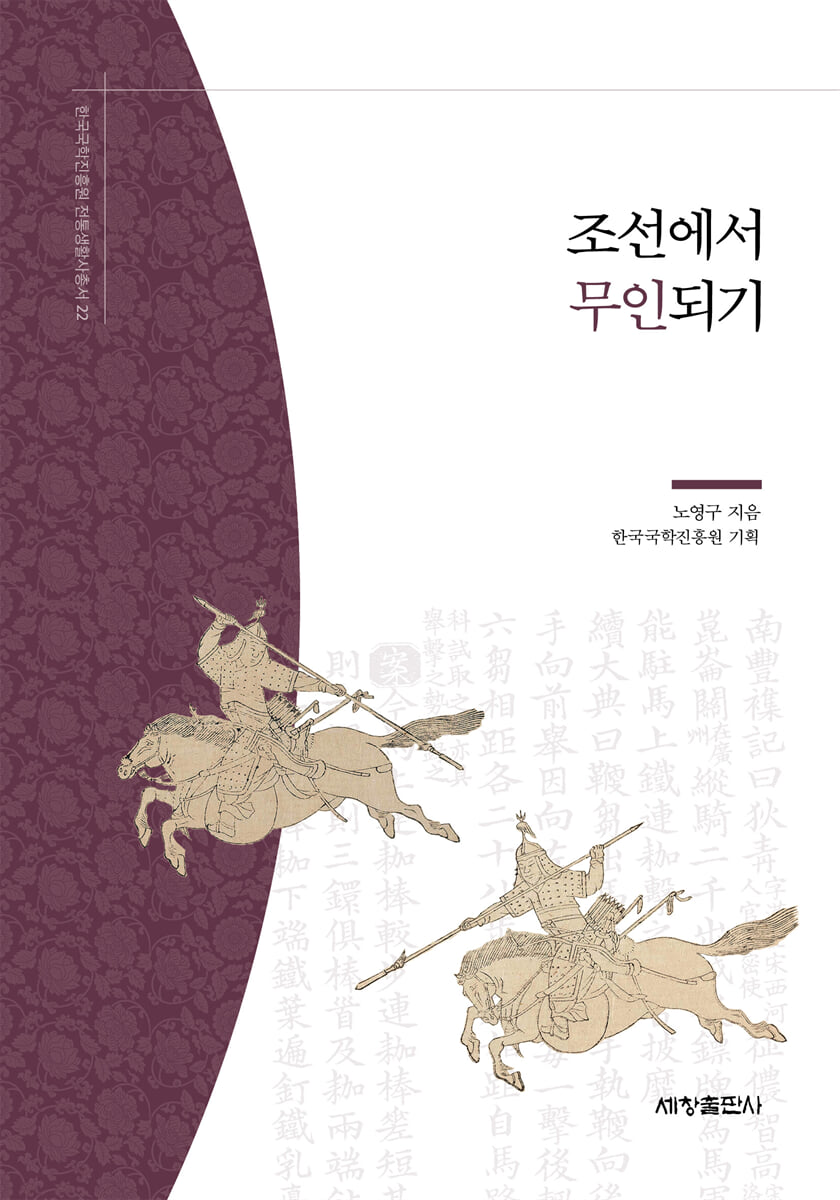
Becoming a warrior in Joseon
 |
Description
Book Introduction
※ Traditional Life History Series
We will discover, reconstruct, and introduce one by one the hidden cases in various historical sites and figures of Korea's traditional era.
By closely examining the daily lives of people at the time, it conveys to the public a variety of previously unknown or lesser-known material in an interesting way.
In particular, it contributes to understanding the living historical facts of each region by reproducing the content through records produced by the private sector rather than central government-centered materials.
Every year, we select experts in the field as authors and improve the quality of the manuscript through continuous feedback.
I hope that this series will lead to a revival of the boom in life history, microhistory, and new cultural history.
There seems to be a prejudice among modern people that Joseon society was a weak society based on civil service.
The very understanding of the Yangban class also generally brings to mind the literati.
However, civil service is different from the ‘weakness in writing’ that people think of.
In other words, civil service rule refers to governance based on systems and laws.
In this respect, it shows a similar context to the rule of law in today's terms.
However, the specific content and scope of the laws and systems are different from today.
Yet, where does the perception that Joseon society was so uniquely weak originate? Contrary to our perception, even in Joseon, the perceptions of the importance of civil and military affairs diversified over the course of history, and the perception of their necessity also diversified.
At times, 'Moon' was revered, and problems arose as military service examinations were administered indiscriminately during various wars.
This book reconsiders the balance between the civil and military branches of Joseon, which experienced such diversification, and the correct perception of Joseon society.
The Joseon yangban were not biased towards ‘civil affairs’, but both ‘civil affairs’ and ‘military affairs’ coexisted.
It seeks to promote a correct understanding of the Joseon yangban, who were skilled in both civil and military affairs.
We will discover, reconstruct, and introduce one by one the hidden cases in various historical sites and figures of Korea's traditional era.
By closely examining the daily lives of people at the time, it conveys to the public a variety of previously unknown or lesser-known material in an interesting way.
In particular, it contributes to understanding the living historical facts of each region by reproducing the content through records produced by the private sector rather than central government-centered materials.
Every year, we select experts in the field as authors and improve the quality of the manuscript through continuous feedback.
I hope that this series will lead to a revival of the boom in life history, microhistory, and new cultural history.
There seems to be a prejudice among modern people that Joseon society was a weak society based on civil service.
The very understanding of the Yangban class also generally brings to mind the literati.
However, civil service is different from the ‘weakness in writing’ that people think of.
In other words, civil service rule refers to governance based on systems and laws.
In this respect, it shows a similar context to the rule of law in today's terms.
However, the specific content and scope of the laws and systems are different from today.
Yet, where does the perception that Joseon society was so uniquely weak originate? Contrary to our perception, even in Joseon, the perceptions of the importance of civil and military affairs diversified over the course of history, and the perception of their necessity also diversified.
At times, 'Moon' was revered, and problems arose as military service examinations were administered indiscriminately during various wars.
This book reconsiders the balance between the civil and military branches of Joseon, which experienced such diversification, and the correct perception of Joseon society.
The Joseon yangban were not biased towards ‘civil affairs’, but both ‘civil affairs’ and ‘military affairs’ coexisted.
It seeks to promote a correct understanding of the Joseon yangban, who were skilled in both civil and military affairs.
- You can preview some of the book's contents.
Preview
index
4 at the beginning of the book
Introductory Remarks 10
1.
The Joseon Dynasty's recognition of civil and military affairs and the establishment of the military service examination system 13
Civil and military awareness in the early Joseon Dynasty 15
Understanding Civil and Military Affairs in the Late Joseon Dynasty and the Theory of Civil and Military Unity 21
Establishment of the early Joseon Dynasty Military Service Examination and Examination Regulations 27
Procedure for conducting military service examinations in the Gyeongguk Daejeon, Part 31
2.
Creating a Military Affiliate Through Educational Institutions 37
39 training centers for military officers at the Joseon Dynasty
Martial Arts and Neungma Acheong of the Late Joseon Dynasty 44
3.
Types and Subjects of the Military Service Examination 53
Type 55 of martial arts
Military examination procedure 70
73 Subjects for the Military Service Examination and Various Civil Service Exams
4.
Joseon Dynasty Military Service Exam Preparation 85
The Case of Yi Sun-sin in the Late 16th Century 87
Late 18th century, case study 92
Words that come out 169
Note 175
Reference 179
Introductory Remarks 10
1.
The Joseon Dynasty's recognition of civil and military affairs and the establishment of the military service examination system 13
Civil and military awareness in the early Joseon Dynasty 15
Understanding Civil and Military Affairs in the Late Joseon Dynasty and the Theory of Civil and Military Unity 21
Establishment of the early Joseon Dynasty Military Service Examination and Examination Regulations 27
Procedure for conducting military service examinations in the Gyeongguk Daejeon, Part 31
2.
Creating a Military Affiliate Through Educational Institutions 37
39 training centers for military officers at the Joseon Dynasty
Martial Arts and Neungma Acheong of the Late Joseon Dynasty 44
3.
Types and Subjects of the Military Service Examination 53
Type 55 of martial arts
Military examination procedure 70
73 Subjects for the Military Service Examination and Various Civil Service Exams
4.
Joseon Dynasty Military Service Exam Preparation 85
The Case of Yi Sun-sin in the Late 16th Century 87
Late 18th century, case study 92
Words that come out 169
Note 175
Reference 179
Into the book
As mentioned above, King Jeongjo basically recognized the civil and military arts as the same, but in reality, he recognized the military arts as having practical value more actively.
Based on this recognition, King Jeongjo actively sought to recruit people from the northwestern region, which is today Pyeongan Province, who excelled in martial arts.
--- p.25
In 1583, just before the Imjin War, Yi I, the Minister of War, began to significantly expand the number of military service examination candidates and increase the number of irregular examinations, including special examinations, in response to the Jurchen tribe's Nitanggae (泥湯介) rebellion that attacked the six garrisons of Hamgyeong Province.
The trend of significantly increasing the number of military service examination candidates and frequently conducting various special examinations continued during the Imjin War in the late 16th century and during the reign of King Gwanghaegun in the early 17th century to cope with external difficulties.
The emergence of the so-called Man-gwa (萬科), which is pointed out as an evil of the military service examination in the late Joseon Dynasty, is one of them.
--- p.44
The fact that Yi Sun-sin's family moved to Asan, where his maternal family lived, also played a significant role in his transition to a military officer.
Yi Sun-sin's father, Yi Jeong, moved to Asan, where his wife's family lived, because Asan was a remote rural area at the time, and a proper noble society had not yet been formed. Confucian influence was not as strong as in other regions.
Instead, it can be said to be a favorable region for learning martial arts.
--- p.89
The anecdote is about a man who does not even know the meaning of the basic Confucian etiquette of honjeongsinseong, that is, watching over his parents at night and asking about their well-being early in the morning.
Also, the following example, in which three warriors give nonsensical answers during the military examination, shows a part of the academic level of the warriors at the time.
--- p.124
Jeong Yak-yong's plan to improve the military service examination was to significantly add the Gangseo subject to the existing martial arts subject.
The subject of Gangseo was designed to be tested by focusing on content related to 'martial arts'.
This measure was intended not only to verify that the applicants for the military service examination possessed martial arts skills, but also to confirm that they had a sufficient understanding of tactics and strategy to actually solve national defense problems.
He organically linked the selection of military service examination applicants, the selection of successful candidates, and their advancement to government posts into the 'Siknyeonsi'.
By limiting the number of successful candidates and examinees in proportion to the number of government posts, the government attempted to guarantee at least a minimum opportunity for competent local nobles and commoners to advance to government posts and be appointed to high-ranking public offices.
Based on this recognition, King Jeongjo actively sought to recruit people from the northwestern region, which is today Pyeongan Province, who excelled in martial arts.
--- p.25
In 1583, just before the Imjin War, Yi I, the Minister of War, began to significantly expand the number of military service examination candidates and increase the number of irregular examinations, including special examinations, in response to the Jurchen tribe's Nitanggae (泥湯介) rebellion that attacked the six garrisons of Hamgyeong Province.
The trend of significantly increasing the number of military service examination candidates and frequently conducting various special examinations continued during the Imjin War in the late 16th century and during the reign of King Gwanghaegun in the early 17th century to cope with external difficulties.
The emergence of the so-called Man-gwa (萬科), which is pointed out as an evil of the military service examination in the late Joseon Dynasty, is one of them.
--- p.44
The fact that Yi Sun-sin's family moved to Asan, where his maternal family lived, also played a significant role in his transition to a military officer.
Yi Sun-sin's father, Yi Jeong, moved to Asan, where his wife's family lived, because Asan was a remote rural area at the time, and a proper noble society had not yet been formed. Confucian influence was not as strong as in other regions.
Instead, it can be said to be a favorable region for learning martial arts.
--- p.89
The anecdote is about a man who does not even know the meaning of the basic Confucian etiquette of honjeongsinseong, that is, watching over his parents at night and asking about their well-being early in the morning.
Also, the following example, in which three warriors give nonsensical answers during the military examination, shows a part of the academic level of the warriors at the time.
--- p.124
Jeong Yak-yong's plan to improve the military service examination was to significantly add the Gangseo subject to the existing martial arts subject.
The subject of Gangseo was designed to be tested by focusing on content related to 'martial arts'.
This measure was intended not only to verify that the applicants for the military service examination possessed martial arts skills, but also to confirm that they had a sufficient understanding of tactics and strategy to actually solve national defense problems.
He organically linked the selection of military service examination applicants, the selection of successful candidates, and their advancement to government posts into the 'Siknyeonsi'.
By limiting the number of successful candidates and examinees in proportion to the number of government posts, the government attempted to guarantee at least a minimum opportunity for competent local nobles and commoners to advance to government posts and be appointed to high-ranking public offices.
--- p.167
Publisher's Review
※ How did the people of Joseon live? When we think of "Joseon," images of noblemen and scholars usually come to mind.
However, in Joseon, people from various classes lived, including not only the yangban and scholars, but also merchants and farmers.
So, in order to understand how the Joseon people lived, we must look at the lives of not only the nobles, but also the merchants and farmers.
It is also clear that the lives of the Yangban cannot be fully discussed solely through their activities in central politics.
However, it is difficult to find their daily lives in official records compiled by the state, such as the Annals of the Joseon Dynasty or the Diaries of the Royal Secretariat.
Fortunately, with the discovery of various personal records, such as personal diaries and letters, we are now able to guess what they were like.
Of course, since those who left behind diaries and letters were mostly intellectuals, there are some limitations. However, because these intellectuals left behind stories about their surroundings while also leaving behind stories about themselves, we were able to confirm the lives of those around us that were previously difficult to know about.
The Traditional Life History Series aims to introduce the lives of people who lived during the Joseon Dynasty.
As we read through these books, we will be able to gain insight into the lives of Joseon people that we were unaware of.
Unlike Japan, which had a militaristic tradition and created a political culture that prioritized the military, which ultimately led to its invasion and defeat in East Asia, Korea, which retained the tradition of a military leader with both civil and military skills in the late Joseon Dynasty, ultimately achieved liberation and prosperity despite briefly falling into Japanese colonial rule. This cannot be explained simply by a specific leader, class, or foreign country.
Along with the existence of scholars depicted as swordsmen, I dare to suggest that our attitude toward military personnel, rather than simply understanding them as beings in opposition to scholars or in a superior-subordinate or senior-subordinate relationship, should be portrayed as another form of 'intellectuals who pursued practical intelligence that was both literary and martial', even though this may change with the times.
However, in Joseon, people from various classes lived, including not only the yangban and scholars, but also merchants and farmers.
So, in order to understand how the Joseon people lived, we must look at the lives of not only the nobles, but also the merchants and farmers.
It is also clear that the lives of the Yangban cannot be fully discussed solely through their activities in central politics.
However, it is difficult to find their daily lives in official records compiled by the state, such as the Annals of the Joseon Dynasty or the Diaries of the Royal Secretariat.
Fortunately, with the discovery of various personal records, such as personal diaries and letters, we are now able to guess what they were like.
Of course, since those who left behind diaries and letters were mostly intellectuals, there are some limitations. However, because these intellectuals left behind stories about their surroundings while also leaving behind stories about themselves, we were able to confirm the lives of those around us that were previously difficult to know about.
The Traditional Life History Series aims to introduce the lives of people who lived during the Joseon Dynasty.
As we read through these books, we will be able to gain insight into the lives of Joseon people that we were unaware of.
Unlike Japan, which had a militaristic tradition and created a political culture that prioritized the military, which ultimately led to its invasion and defeat in East Asia, Korea, which retained the tradition of a military leader with both civil and military skills in the late Joseon Dynasty, ultimately achieved liberation and prosperity despite briefly falling into Japanese colonial rule. This cannot be explained simply by a specific leader, class, or foreign country.
Along with the existence of scholars depicted as swordsmen, I dare to suggest that our attitude toward military personnel, rather than simply understanding them as beings in opposition to scholars or in a superior-subordinate or senior-subordinate relationship, should be portrayed as another form of 'intellectuals who pursued practical intelligence that was both literary and martial', even though this may change with the times.
GOODS SPECIFICS
- Date of issue: December 2, 2024
- Page count, weight, size: 184 pages | 140*200*12mm
- ISBN13: 9791166843655
You may also like
카테고리
korean


korean

![GQ KOREA Mark (Monthly): December [2025]](http://librairie.coreenne.fr/cdn/shop/files/8ef265dbbfbf186523ed75ba7319009d.jpg?v=1765340328&width=3840)


