

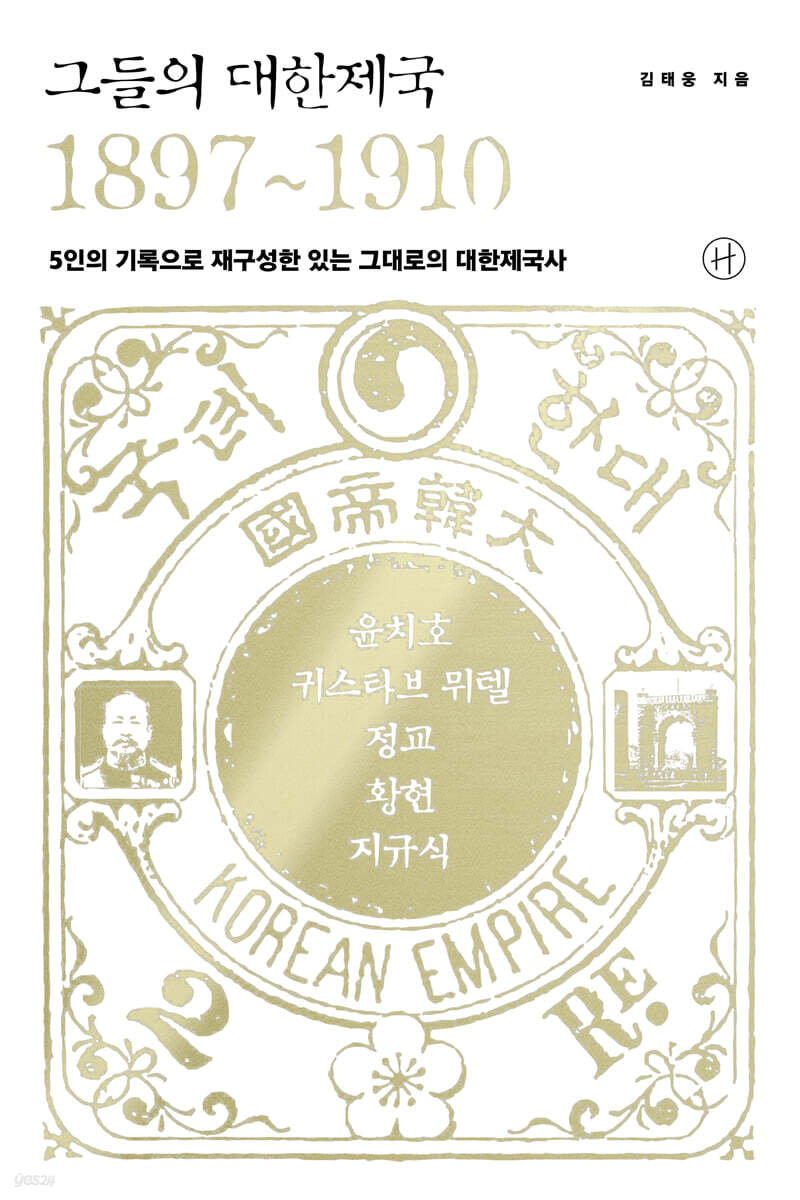
Their Korean Empire 1897-1910
 |
Description
Book Introduction
- A word from MD
-
Encounter the History of the Korean EmpirePolitician Yun Chi-ho, missionary Gustave Mutel, intellectual Jeong Gyo, journalist Hwang Hyeon, and businessman Ji Gyu-sik.
A book that reconstructs the history of the Korean Empire, which has received mixed reviews, through the records of five people.
The records of those who lived through the twists and turns and turbulent times that led to the end of the nation, each in their own position, still raise profound questions about the meaning of the nation today.
December 13, 2024. History PD Ahn Hyun-jae
Throw away your prejudice against the Korean Empire!
Politicians, missionaries, intellectuals, journalists, and businessmen
Records of five different people who lived in that era
A fresh look at the history of the Korean Empire, free from prejudice and embellishment.
Redrawing the History of the Korean Empire
―The history of the Korean Empire as it was reconstructed from the records of five people who lived during that time.
The 'Korean Empire', a page of our history that is always summoned to the court of history.
The academic community's position is largely divided.
One is that it deserves criticism for failing to wisely overcome the era of the law of the jungle in a rapidly changing world situation, which led to the downfall of the nation. The other is that it should be evaluated positively for its efforts to modernize despite failing to overcome the limitations of the era called imperialism.
With the debate surrounding the Korean Empire raging like a bonfire, how should we view it? The best way to understand is to meet the people who lived during that era and hear their stories firsthand.
Accordingly, the author recruited five people from all walks of life who lived at the time.
The main characters include Yun Chi-ho, a representative intellectual who took the lead in accepting Western civilization and a politician who engaged in a wide range of activities while meeting with figures at home and abroad; Gustave Mutel, a French priest who observed the political situation from close range of the power of the Korean Empire while spreading Catholicism; Jeong Gyo, an intellectual who keenly observed the people and events of the time and left behind history books from his own perspective; and Ji Gyu-sik, a businessman who vividly conveyed the perspectives of the common people.
What was the "Korean Empire" like as experienced, felt, and perceived by these five individuals, whose worldviews and approaches varied according to their diverse circumstances? The author argues, "Just as history requires contextual understanding before present-day evaluation, we must also understand the diverse circumstances, aspirations, and desires of the actors of the time in a multi-layered manner."
“We need to understand and reflect on what they thought and why they had to act that way at the time,” he says.
Through the unbiased and unadorned 'Their Korean Empire' told through the mouths of five people, you will be able to draw a new 'My Own Korean Empire'.
“I felt the need to create a space where readers, regardless of the research of other scholars including myself, could ride a time machine to the era of the Korean Empire, become a person of that era, and experience and reflect on the times.
This is why I sought to find a way to approach the historical context while observing the era objectively, without being swayed by the opinions of others or blindly pushing forward my own views without any basis.
“If this happens, I hope that it will allow me to critically reflect on the claims of various scholars while broadening the scope for communication with those who hold different historical and worldviews.”
---From "Publishing a Book"
I tried to interconnect them as much as possible within the same context so that the main characters' speech would not be scattered.
Even though their living spaces were somewhat separated and their reactions to major events differed, the protagonists showed characteristic tendencies or trends in that they shared a common atmosphere amidst rapid political upheaval.
…I wanted to bring them into a historical event, but also show their words and actions, as well as their inner world, down to the microscopic details.
This is because I wanted to look back with readers on the meaning of their lives within the context of the times, moving away from causal or teleological explanations.
---From "Publishing a Book"
Politicians, missionaries, intellectuals, journalists, and businessmen
Records of five different people who lived in that era
A fresh look at the history of the Korean Empire, free from prejudice and embellishment.
Redrawing the History of the Korean Empire
―The history of the Korean Empire as it was reconstructed from the records of five people who lived during that time.
The 'Korean Empire', a page of our history that is always summoned to the court of history.
The academic community's position is largely divided.
One is that it deserves criticism for failing to wisely overcome the era of the law of the jungle in a rapidly changing world situation, which led to the downfall of the nation. The other is that it should be evaluated positively for its efforts to modernize despite failing to overcome the limitations of the era called imperialism.
With the debate surrounding the Korean Empire raging like a bonfire, how should we view it? The best way to understand is to meet the people who lived during that era and hear their stories firsthand.
Accordingly, the author recruited five people from all walks of life who lived at the time.
The main characters include Yun Chi-ho, a representative intellectual who took the lead in accepting Western civilization and a politician who engaged in a wide range of activities while meeting with figures at home and abroad; Gustave Mutel, a French priest who observed the political situation from close range of the power of the Korean Empire while spreading Catholicism; Jeong Gyo, an intellectual who keenly observed the people and events of the time and left behind history books from his own perspective; and Ji Gyu-sik, a businessman who vividly conveyed the perspectives of the common people.
What was the "Korean Empire" like as experienced, felt, and perceived by these five individuals, whose worldviews and approaches varied according to their diverse circumstances? The author argues, "Just as history requires contextual understanding before present-day evaluation, we must also understand the diverse circumstances, aspirations, and desires of the actors of the time in a multi-layered manner."
“We need to understand and reflect on what they thought and why they had to act that way at the time,” he says.
Through the unbiased and unadorned 'Their Korean Empire' told through the mouths of five people, you will be able to draw a new 'My Own Korean Empire'.
“I felt the need to create a space where readers, regardless of the research of other scholars including myself, could ride a time machine to the era of the Korean Empire, become a person of that era, and experience and reflect on the times.
This is why I sought to find a way to approach the historical context while observing the era objectively, without being swayed by the opinions of others or blindly pushing forward my own views without any basis.
“If this happens, I hope that it will allow me to critically reflect on the claims of various scholars while broadening the scope for communication with those who hold different historical and worldviews.”
---From "Publishing a Book"
I tried to interconnect them as much as possible within the same context so that the main characters' speech would not be scattered.
Even though their living spaces were somewhat separated and their reactions to major events differed, the protagonists showed characteristic tendencies or trends in that they shared a common atmosphere amidst rapid political upheaval.
…I wanted to bring them into a historical event, but also show their words and actions, as well as their inner world, down to the microscopic details.
This is because I wanted to look back with readers on the meaning of their lives within the context of the times, moving away from causal or teleological explanations.
---From "Publishing a Book"
- You can preview some of the book's contents.
Preview
index
Introducing the book / Profiles and records of five people
Part 1: From the Aguan Pacheon to the Establishment of the Korean Empire
1.
The aftermath of the short hair order and the Aguan Pacheon
The Danbalryeong Order Infuriates Joseon | The Uprising of the Righteous Army and the Movement of the Russian Legation | The Agwanbacheol Incident: How Was It Possible? | Various Assessments of the Agwanbacheol Incident | "The Eulmi Righteous Army Was No Different from a Bandit Group" | Keep Pro-Russian Forces in Check | The Great Powers' Struggle for Power Begins
2.
Emperor Gojong's return to the palace and the state funeral of Queen Myeongseong
Gojong Plans to Return to the Palace | Seeks to Restore Royal Authority by Preparing for Queen Myeongseong's State Funeral | Criticism and Response Surrounding the State Funeral | Return to the Palace, But Powers Lost to Western Powers
3.
The Road to the Establishment of the Korean Empire
The Independence Newspaper is launched and the Independence Association is formed. | The international situation deteriorates. | A glimmer of hope appears despite a series of disasters. | Emperor Gojong becomes the Emperor of the Korean Empire.
Part 2: From the Establishment of the Korean Empire to the Dissolution of the Manmin Common Association
1.
Conflict between the Gwangmu regime and the Independence Association
Yun Chi-ho's antagonism of Emperor Gojong's associates | The Korean Empire's urban renewal projects | The conflict between the government and the Independence Association | The growing influence of Russia | The Gapsin Reform Party and Yun Chi-ho's dilemma | The government and the Independence Association finally split | Individuals seeking vested interests between the great powers
2.
Conflict between the Gwangmu regime and the Manmin Common Assembly
The Government and the Manmin Common Assembly's Power Struggle | The Conflict Surrounding Seo Jae-pil's Departure | The So-Called Tangpyeong Political Situation | The Independence Association's Split and the Manmin Common Assembly's Challenge | The Government and the Independence Association: At a Crossroads of Compromise | The Resurrection of the Guilt-By-Association System and the Slavery Law | A Dramatic Compromise: Article 6 of the Constitution | Compromise Again on the Brink of Fizzle
3.
Political breakdown
The Independence Association's division and the political turmoil | The clash between the Manmin Common Association and the Imperial Association | The rising wall of distrust | Another turning point: Kim Deok-gu's funeral | The counterattack of the pro-royal forces | The Manmin Common Association's challenge and internal strife | Emperor Gojong's ultimatum and the Manmin Common Association's forced dissolution
Part 3: From the Dissolution of the People's Assembly to the Eve of the Russo-Japanese War
1.
unstable political situation
The Empire's Uneasy Resurgence | Yun Chi-ho's Unsettled Life in Wonsan | Catholicism's Active Missionary Work and Teachings | Mutel's Obsessive Intervention in Trials | The Light and Shadow of Industrialization and Urban Redevelopment Projects
2.
The arduous road to becoming a sovereign nation
The Birth of the Korean Empire's Constitution | Political Unrest and the Vicious Cycle of Retaliation | The Spark of the Boxer Rebellion in China | Full-scale Urban Redevelopment Projects
3.
The dark clouds of disaster and war
Local officials' exploitation and Japanese merchants' schemes | The Jeju Uprising | Disaster and civil unrest shake the political landscape | A glimpse of hope in a teacher | Mutel's continued political pursuits | Cholera outbreak | Controversy surrounding Lee Yong-ik | Catholicism's dwindling influence day by day | The Yongampo Incident and the eve of the Russo-Japanese War
Part 4: From the Outbreak of the Russo-Japanese War to the Conclusion of the Eulsa Treaty
1.
The Russo-Japanese War broke out off the coast of Incheon.
Who Started the War? | The Real Victims of the Russo-Japanese War
2.
The aftermath of the Russo-Japanese War and the Japanese invasion
The Lee Yong-ik Deportation Incident and the Signing of the Korea-Japan Protocol | The Rise of Ito Hirobumi and the Gyeongungung Palace Fire | Japanese Attempts to Seize Wasteland Reclamation Rights and the Opposition Movement | Japanese Railway Manpower Requisition
3.
The consequences of torture and war
The Beginning of Torture | The Rise and Growth of the Iljinhoe | Choi Ik-hyeon's Petition | Japan's Victory and the Treaty of Portsmouth | The U.S. President's Daughter Visits Korea
4.
Resistance and oppression surrounding the Eulsa Treaty
Movement to Stop the Protectorate | The Eulsa Treaty Signed at 1:30 AM | Struggle to Nullify the Treaty | A Series of Martyrs | Emperor Gojong's Movement to Protect National Sovereignty | Reactions from All Sectors to the Eulsa Treaty
Part 5: From the Lee Yong-ik Sniper Incident to the Disbandment of the Army
1.
Twilight of the Empire
The Mystery of Lee Yong-ik's Assassination | Son Byeong-hui's Entry into the United States | The Iljinhoe Severing Emperor Gojong's Left Arm | Kick-Off the New Year with the National Debt Redemption Movement
2.
The movement to defend national sovereignty is frustrated
Raising a volunteer army and punishing pro-Japanese collaborators | The Eulsa Five Traitors Movement | The Hague Envoy Incident | Emperor Gojong's forced abdication | The signing of the Jeongmi Treaty | Japan disbands the Korean army
Part 6: From the Righteous Army War to the Forced Annexation
1.
The barbarism of the invaders and the crossroads of the people
The Scandals and Greed of Pro-Japanese Collaborators | The Righteous Army War and the Atrocities of the Japanese Army | Between the Righteous Army and the Japanese Army | The Honam Righteous Army and the Southern Suppression Operation
2.
An Jung-geun assassinates Ito Hirobumi
The Age of Righteousness Dawns | Ahn Jung-geun's Assassination of Ito | The Noisy Condolences and Mutel's Denial of Ahn Jung-geun | Ahn Jung-geun's Trial Struggle | Lee Jae-myeong Stung Yi Wan-yong's Heart
3.
Japanese exploitation and cultural invasion
Theft of Imperial Secret Fund Documents | Japanese Exploitation and the People's Economic Struggle | Japanese Cultural Invasion
4.
The road to merger
Even judicial and police powers are in Japanese hands | The pro-Japanese confrontation between Iljinhoe and Yi Wan-yong | Still, dawn comes
Image Source and Location / References / Search
Part 1: From the Aguan Pacheon to the Establishment of the Korean Empire
1.
The aftermath of the short hair order and the Aguan Pacheon
The Danbalryeong Order Infuriates Joseon | The Uprising of the Righteous Army and the Movement of the Russian Legation | The Agwanbacheol Incident: How Was It Possible? | Various Assessments of the Agwanbacheol Incident | "The Eulmi Righteous Army Was No Different from a Bandit Group" | Keep Pro-Russian Forces in Check | The Great Powers' Struggle for Power Begins
2.
Emperor Gojong's return to the palace and the state funeral of Queen Myeongseong
Gojong Plans to Return to the Palace | Seeks to Restore Royal Authority by Preparing for Queen Myeongseong's State Funeral | Criticism and Response Surrounding the State Funeral | Return to the Palace, But Powers Lost to Western Powers
3.
The Road to the Establishment of the Korean Empire
The Independence Newspaper is launched and the Independence Association is formed. | The international situation deteriorates. | A glimmer of hope appears despite a series of disasters. | Emperor Gojong becomes the Emperor of the Korean Empire.
Part 2: From the Establishment of the Korean Empire to the Dissolution of the Manmin Common Association
1.
Conflict between the Gwangmu regime and the Independence Association
Yun Chi-ho's antagonism of Emperor Gojong's associates | The Korean Empire's urban renewal projects | The conflict between the government and the Independence Association | The growing influence of Russia | The Gapsin Reform Party and Yun Chi-ho's dilemma | The government and the Independence Association finally split | Individuals seeking vested interests between the great powers
2.
Conflict between the Gwangmu regime and the Manmin Common Assembly
The Government and the Manmin Common Assembly's Power Struggle | The Conflict Surrounding Seo Jae-pil's Departure | The So-Called Tangpyeong Political Situation | The Independence Association's Split and the Manmin Common Assembly's Challenge | The Government and the Independence Association: At a Crossroads of Compromise | The Resurrection of the Guilt-By-Association System and the Slavery Law | A Dramatic Compromise: Article 6 of the Constitution | Compromise Again on the Brink of Fizzle
3.
Political breakdown
The Independence Association's division and the political turmoil | The clash between the Manmin Common Association and the Imperial Association | The rising wall of distrust | Another turning point: Kim Deok-gu's funeral | The counterattack of the pro-royal forces | The Manmin Common Association's challenge and internal strife | Emperor Gojong's ultimatum and the Manmin Common Association's forced dissolution
Part 3: From the Dissolution of the People's Assembly to the Eve of the Russo-Japanese War
1.
unstable political situation
The Empire's Uneasy Resurgence | Yun Chi-ho's Unsettled Life in Wonsan | Catholicism's Active Missionary Work and Teachings | Mutel's Obsessive Intervention in Trials | The Light and Shadow of Industrialization and Urban Redevelopment Projects
2.
The arduous road to becoming a sovereign nation
The Birth of the Korean Empire's Constitution | Political Unrest and the Vicious Cycle of Retaliation | The Spark of the Boxer Rebellion in China | Full-scale Urban Redevelopment Projects
3.
The dark clouds of disaster and war
Local officials' exploitation and Japanese merchants' schemes | The Jeju Uprising | Disaster and civil unrest shake the political landscape | A glimpse of hope in a teacher | Mutel's continued political pursuits | Cholera outbreak | Controversy surrounding Lee Yong-ik | Catholicism's dwindling influence day by day | The Yongampo Incident and the eve of the Russo-Japanese War
Part 4: From the Outbreak of the Russo-Japanese War to the Conclusion of the Eulsa Treaty
1.
The Russo-Japanese War broke out off the coast of Incheon.
Who Started the War? | The Real Victims of the Russo-Japanese War
2.
The aftermath of the Russo-Japanese War and the Japanese invasion
The Lee Yong-ik Deportation Incident and the Signing of the Korea-Japan Protocol | The Rise of Ito Hirobumi and the Gyeongungung Palace Fire | Japanese Attempts to Seize Wasteland Reclamation Rights and the Opposition Movement | Japanese Railway Manpower Requisition
3.
The consequences of torture and war
The Beginning of Torture | The Rise and Growth of the Iljinhoe | Choi Ik-hyeon's Petition | Japan's Victory and the Treaty of Portsmouth | The U.S. President's Daughter Visits Korea
4.
Resistance and oppression surrounding the Eulsa Treaty
Movement to Stop the Protectorate | The Eulsa Treaty Signed at 1:30 AM | Struggle to Nullify the Treaty | A Series of Martyrs | Emperor Gojong's Movement to Protect National Sovereignty | Reactions from All Sectors to the Eulsa Treaty
Part 5: From the Lee Yong-ik Sniper Incident to the Disbandment of the Army
1.
Twilight of the Empire
The Mystery of Lee Yong-ik's Assassination | Son Byeong-hui's Entry into the United States | The Iljinhoe Severing Emperor Gojong's Left Arm | Kick-Off the New Year with the National Debt Redemption Movement
2.
The movement to defend national sovereignty is frustrated
Raising a volunteer army and punishing pro-Japanese collaborators | The Eulsa Five Traitors Movement | The Hague Envoy Incident | Emperor Gojong's forced abdication | The signing of the Jeongmi Treaty | Japan disbands the Korean army
Part 6: From the Righteous Army War to the Forced Annexation
1.
The barbarism of the invaders and the crossroads of the people
The Scandals and Greed of Pro-Japanese Collaborators | The Righteous Army War and the Atrocities of the Japanese Army | Between the Righteous Army and the Japanese Army | The Honam Righteous Army and the Southern Suppression Operation
2.
An Jung-geun assassinates Ito Hirobumi
The Age of Righteousness Dawns | Ahn Jung-geun's Assassination of Ito | The Noisy Condolences and Mutel's Denial of Ahn Jung-geun | Ahn Jung-geun's Trial Struggle | Lee Jae-myeong Stung Yi Wan-yong's Heart
3.
Japanese exploitation and cultural invasion
Theft of Imperial Secret Fund Documents | Japanese Exploitation and the People's Economic Struggle | Japanese Cultural Invasion
4.
The road to merger
Even judicial and police powers are in Japanese hands | The pro-Japanese confrontation between Iljinhoe and Yi Wan-yong | Still, dawn comes
Image Source and Location / References / Search
Detailed image

Into the book
Yun Chi-ho wrote the following in his diary on February 11, the day of the Gwanghwamun massacre.
“It is a joy that Your Majesty is free from the enemy’s land.
It is a joyous thing that those involved in the November 28 incident [the Chunsaengmun incident] have now been cleared of the charge of being traitors.
However, unless His Majesty decides to push for reform in earnest, there is no possibility that these changes will truly improve the welfare of the country.” Yun Chi-ho is relieved to see that Emperor Gojong has escaped from Japanese influence through the Russian Legation Retreat and that those involved in the Chunsaengmun Incident, including Lee Jae-sun, have been released from exile.
---「Part 1 Chapter 1.
From “The Aftermath of the Short Hair Order and the A-Gwan Pa-Cheon”
Even Mutel, who had been friendly to the Joseon government, is presenting a pessimistic outlook.
“In any case, Joseon will not be able to remain an independent country.
It's just a matter of time.
“It is difficult to see the current crown prince ascending to the throne if the current king disappears,” he said.
Furthermore, Russia even suggested that it might hand over Korea to Japan in order to protect Manchuria.
Of course, Mutel did not want to believe Speyer's prediction, but he had something to agree with.
As will be described later, the seeds of the Manchurian-Korean exchange theory have already been seen.
---「Part 1 Chapter 3.
From “The Road to the Establishment of the Korean Empire”
Yun Chi-ho highly evaluated the Seoul urban redevelopment project promoted by Lee Chae-yeon, the mayor of Seoul.
At that time, Lee Chae-yeon installed electric streetlights on main roads under the orders of King Gojong.
Yun Chi-ho wrote about his impressions of that scene as follows:
“Thanks to Lee Chae-yeon’s progressive views, people living on main roads were instructed to light up in front of their houses.
That's a good thing.
“The night view of the town from my window is beautiful, decorated with electric lights.” It was a very generous score for Yun Chi-ho, who was known to be harsh towards the government.
He also expressed his agreement with the Gwangmu regime's efforts to civilize.
---「Part 2 Chapter 1.
From “The Conflict Lines Between the Gwangmu Regime and the Independence Association”
In his “Maecheon Diary,” Hwang Hyeon not only harshly criticized the tyranny of the Catholic Church after the Jeju teachings in 1901, but also criticized the tyranny of the Catholic Church in other teachings.
“The Daejeong County Governor Chae Gu-seok was detained in Seoul Prison.
Since the uprising of 1901, the number of Catholics in Jeju has increased day by day, making it difficult for the people to live in peace.
When the French minister Plancy arrived, the believers falsely entrapped him and fabricated a story to have him arrested, collect compensation, and imprison him for three years before finally releasing him.
In addition, when Plancy threatened our government to select and provide burial sites for the Jeju believers, the believers competed to occupy the fertile land.
“It is the avenging of their old grudge.”
---「Part 3, Chapter 3.
From “The Dark Clouds of Disaster and War”
Unlike Mutel, Hwang Hyeon wanted Russia to lose, but he was also uneasy about Japan's victory.
This was because they were concerned that a Japanese victory would be a disaster for the Korean people.
Yun Chi-ho also stated in his diary on October 20 that Korea would not be able to revive regardless of who won the war.
“What breaks my heart is the utter despair that there is no chance of Korea’s revival, no matter which side wins the war.
… All other things being equal, the Japanese have more reason to bring peace and prosperity to Koreans than the Russians.” Unlike Hwang Hyeon, Yun Chi-ho cannot give up the expectation that if Japan pursues civilization and enlightenment, it will ultimately bring peace and prosperity to Koreans.
---「Part 4 Chapter 1.
From "The Russo-Japanese War Breaks Out in the Sea of Incheon"
Hwang Hyeon, citing a report in the Daehan Maeil Shinbo dated April 2, 1908, informs us that the public identified Song Byeong-jun, Jo Jung-eung, and Shin Gi-seon as the three most loyal slaves of Japan.
…The people’s anger reached its peak.
Hwang Hyeon-do conveys the humor and anger of the people as follows:
“The surnames of Lee Wan-yong and Park Je-sun were often written on the toilets of people in Seoul.
“The words ‘Lee Park’s Restaurant’ are written in large letters, indicating that it is the same as a dog.”
---「Part 6 Chapter 1.
From “The Barbarism of the Invaders and the Crossroads of the People”
Japan buried the remains secretly and did not reveal the location.
This is because they wanted to prevent the fervor for commemorating Ahn Jung-geun from growing explosively.
… However, after Ahn Jung-geun’s death, the public sentiment for his remembrance actually grew.
Although it was not possible to do so domestically, it was possible to pay tribute in Vladivostok.
Hwang Hyeon wrote that Koreans in the area held several memorial services.
In addition, Jeonggyo conveyed the atmosphere at the time when he tried to make money by taking advantage of the excitement surrounding Ahn Jung-geun's memorial, based on an article in the Daehan Maeil Shinbo dated March 31, 1910.
“At that time, the Japanese printed Ahn Jung-geun’s picture on postcards and sold them in Seoul, and the people fought to buy them.
On March 28, the Ministry of the Interior banned it, saying it was a disruption of public order.”
---「Part 6, Chapter 2.
From "An Jung-geun Shot Ito in the Heart"
The news of the merger reached Mutel earlier than the general public.
Mutel wrote in his diary on August 26th:
“Thanks to Mr. Van Birbright, I was able to hear that Korea was being annexed and that the treaty would be promulgated on the 29th.
Negotiations like these clearly reveal how helpless both the former and current emperors were.
Wouldn't it be better to die than to become a vassal state? May God protect us from this sad situation!” Mutel, who had constantly contacted the imperial family to secure freedom of missionary work during the Korean Empire, now criticizes the imperial family of the Korean Empire and writes mockingly, suggesting that death would be better.
For foreigners, the future of Catholicism was more of a concern than the national ruin of Korea.
“It is a joy that Your Majesty is free from the enemy’s land.
It is a joyous thing that those involved in the November 28 incident [the Chunsaengmun incident] have now been cleared of the charge of being traitors.
However, unless His Majesty decides to push for reform in earnest, there is no possibility that these changes will truly improve the welfare of the country.” Yun Chi-ho is relieved to see that Emperor Gojong has escaped from Japanese influence through the Russian Legation Retreat and that those involved in the Chunsaengmun Incident, including Lee Jae-sun, have been released from exile.
---「Part 1 Chapter 1.
From “The Aftermath of the Short Hair Order and the A-Gwan Pa-Cheon”
Even Mutel, who had been friendly to the Joseon government, is presenting a pessimistic outlook.
“In any case, Joseon will not be able to remain an independent country.
It's just a matter of time.
“It is difficult to see the current crown prince ascending to the throne if the current king disappears,” he said.
Furthermore, Russia even suggested that it might hand over Korea to Japan in order to protect Manchuria.
Of course, Mutel did not want to believe Speyer's prediction, but he had something to agree with.
As will be described later, the seeds of the Manchurian-Korean exchange theory have already been seen.
---「Part 1 Chapter 3.
From “The Road to the Establishment of the Korean Empire”
Yun Chi-ho highly evaluated the Seoul urban redevelopment project promoted by Lee Chae-yeon, the mayor of Seoul.
At that time, Lee Chae-yeon installed electric streetlights on main roads under the orders of King Gojong.
Yun Chi-ho wrote about his impressions of that scene as follows:
“Thanks to Lee Chae-yeon’s progressive views, people living on main roads were instructed to light up in front of their houses.
That's a good thing.
“The night view of the town from my window is beautiful, decorated with electric lights.” It was a very generous score for Yun Chi-ho, who was known to be harsh towards the government.
He also expressed his agreement with the Gwangmu regime's efforts to civilize.
---「Part 2 Chapter 1.
From “The Conflict Lines Between the Gwangmu Regime and the Independence Association”
In his “Maecheon Diary,” Hwang Hyeon not only harshly criticized the tyranny of the Catholic Church after the Jeju teachings in 1901, but also criticized the tyranny of the Catholic Church in other teachings.
“The Daejeong County Governor Chae Gu-seok was detained in Seoul Prison.
Since the uprising of 1901, the number of Catholics in Jeju has increased day by day, making it difficult for the people to live in peace.
When the French minister Plancy arrived, the believers falsely entrapped him and fabricated a story to have him arrested, collect compensation, and imprison him for three years before finally releasing him.
In addition, when Plancy threatened our government to select and provide burial sites for the Jeju believers, the believers competed to occupy the fertile land.
“It is the avenging of their old grudge.”
---「Part 3, Chapter 3.
From “The Dark Clouds of Disaster and War”
Unlike Mutel, Hwang Hyeon wanted Russia to lose, but he was also uneasy about Japan's victory.
This was because they were concerned that a Japanese victory would be a disaster for the Korean people.
Yun Chi-ho also stated in his diary on October 20 that Korea would not be able to revive regardless of who won the war.
“What breaks my heart is the utter despair that there is no chance of Korea’s revival, no matter which side wins the war.
… All other things being equal, the Japanese have more reason to bring peace and prosperity to Koreans than the Russians.” Unlike Hwang Hyeon, Yun Chi-ho cannot give up the expectation that if Japan pursues civilization and enlightenment, it will ultimately bring peace and prosperity to Koreans.
---「Part 4 Chapter 1.
From "The Russo-Japanese War Breaks Out in the Sea of Incheon"
Hwang Hyeon, citing a report in the Daehan Maeil Shinbo dated April 2, 1908, informs us that the public identified Song Byeong-jun, Jo Jung-eung, and Shin Gi-seon as the three most loyal slaves of Japan.
…The people’s anger reached its peak.
Hwang Hyeon-do conveys the humor and anger of the people as follows:
“The surnames of Lee Wan-yong and Park Je-sun were often written on the toilets of people in Seoul.
“The words ‘Lee Park’s Restaurant’ are written in large letters, indicating that it is the same as a dog.”
---「Part 6 Chapter 1.
From “The Barbarism of the Invaders and the Crossroads of the People”
Japan buried the remains secretly and did not reveal the location.
This is because they wanted to prevent the fervor for commemorating Ahn Jung-geun from growing explosively.
… However, after Ahn Jung-geun’s death, the public sentiment for his remembrance actually grew.
Although it was not possible to do so domestically, it was possible to pay tribute in Vladivostok.
Hwang Hyeon wrote that Koreans in the area held several memorial services.
In addition, Jeonggyo conveyed the atmosphere at the time when he tried to make money by taking advantage of the excitement surrounding Ahn Jung-geun's memorial, based on an article in the Daehan Maeil Shinbo dated March 31, 1910.
“At that time, the Japanese printed Ahn Jung-geun’s picture on postcards and sold them in Seoul, and the people fought to buy them.
On March 28, the Ministry of the Interior banned it, saying it was a disruption of public order.”
---「Part 6, Chapter 2.
From "An Jung-geun Shot Ito in the Heart"
The news of the merger reached Mutel earlier than the general public.
Mutel wrote in his diary on August 26th:
“Thanks to Mr. Van Birbright, I was able to hear that Korea was being annexed and that the treaty would be promulgated on the 29th.
Negotiations like these clearly reveal how helpless both the former and current emperors were.
Wouldn't it be better to die than to become a vassal state? May God protect us from this sad situation!” Mutel, who had constantly contacted the imperial family to secure freedom of missionary work during the Korean Empire, now criticizes the imperial family of the Korean Empire and writes mockingly, suggesting that death would be better.
For foreigners, the future of Catholicism was more of a concern than the national ruin of Korea.
---「Part 6, Chapter 4.
From “The Road to Merger”
From “The Road to Merger”
Publisher's Review
What makes the record of 5 people special?
―Aspects of the Korean Empire not found in official records
Why did the author choose these five individuals? The introduction to their lives and records at the beginning of this book offers a glimpse into the author's reasons.
First of all, there is the “Yun Chi-ho Diary” written from the 1880s to the 1940s.
This diary is already highly regarded as a historical document, as it records domestic and international affairs and local social trends in detail.
In addition, Yun Chi-ho's personal perception of the situation, his complex and nuanced views on Japan's ruling policy in Korea, his not-at-all-positive judgments on various independence movements, and his perception of Korean history, culture, and Korean people are all clearly revealed, allowing us to explore the inner world of Yun Chi-ho, who lived as a prominent figure and intellectual under Japanese colonial rule.
The author also arouses readers' curiosity by introducing stories behind various incidents that were rumored at the time, such as the theory of Emperor Gojong's poisoning and Yu Gil-jun's involvement in the Eulmi Incident, which cannot be found in newspapers or magazines.
The following is the Diary of Bishop Gustave Mutel, written from 1890, when he was appointed Bishop of Joseon, to 1933.
While Mutel worked to expand the influence of Catholicism, he was also deeply involved in politics, and his diary frequently mentions the activities of Joseon political figures and the movements of foreign powers.
Additionally, it contains content that cannot be found in the Annals of the Joseon Dynasty or records produced by various government offices, such as conversations with King Gojong and officials, allowing us to examine the other side of Korea's modern political and diplomatic history.
Jeonggyo's "Daehan Gyeonyeonsa" and Hwang Hyeon's "Maecheon Yarok" are not diaries written on a daily basis like Yun Chi-ho and Mutel's diaries, but are unofficial histories that meet the requirements of historical books written by making maximum use of contemporary newspaper materials and other official records.
《Daehan Gyeonnyeonsa》 is able to approach historical truths that could not be revealed in the two previous diaries because it was compiled by reviewing and organizing materials that could not be organized at the time while Jeonggyo looked back on the past with a time difference.
Hwang Hyeon wrote "Maecheon Diary" by incorporating not only the events he personally witnessed but also newspapers he regularly read or collected, eyewitness accounts, and other materials. His method of selecting and describing events helps us understand the context and meaning of contemporary events.
Above all, it is interesting to compare the different historical views and perceptions of reality of these two people: Hwang Hyeon, who was closer to a rural Confucian scholar, and Jeong Gyo, who could be considered an urban enlightened intellectual.
Lastly, there is Ji Gyu-sik's "Hajae Diary".
Ji Gyu-sik was a commoner who supplied porcelain to the royal family and government offices, and he kept a diary every day from 1891, when he was 41, to 1911.
The worries and suffering of an ordinary person living in an era of extreme political turmoil and prominent foreign invasion are clearly revealed, and through his worldview and perception of reality, we can glimpse, however fragmentarily, the social consciousness and national view of the common people.
A Comprehensive Look at the Korean Empire: A Fierce and Sad History
―A Comprehensive History of the Korean Empire, from its Birth to its Fall, Written by a Domestic Expert Researcher
The author gives the book a chronological aspect by narrating the history of the Korean Empire in the process of reconstructing 'their Korean Empire.'
As a researcher of modern and contemporary Korean history and an expert on the history of the Korean Empire, he traces the historical events from the Gwanghwamun Incident and the establishment of the Korean Empire, to the activities of the Independence Association and the Manmin Public Association, the Russo-Japanese War and the Eulsa Treaty, the dispatch of the Hague envoy and the disbandment of the military, the Righteous Army War, and the forced annexation by Japan.
And by revealing the five commentaries without reservation and evaluating them directly on this foundation, the major events in the history of the Korean Empire are revealed more clearly.
This book will serve as an excellent introductory text for readers who wish to understand the chronological flow and major issues of the history of the Korean Empire (1897-1910).
―Aspects of the Korean Empire not found in official records
Why did the author choose these five individuals? The introduction to their lives and records at the beginning of this book offers a glimpse into the author's reasons.
First of all, there is the “Yun Chi-ho Diary” written from the 1880s to the 1940s.
This diary is already highly regarded as a historical document, as it records domestic and international affairs and local social trends in detail.
In addition, Yun Chi-ho's personal perception of the situation, his complex and nuanced views on Japan's ruling policy in Korea, his not-at-all-positive judgments on various independence movements, and his perception of Korean history, culture, and Korean people are all clearly revealed, allowing us to explore the inner world of Yun Chi-ho, who lived as a prominent figure and intellectual under Japanese colonial rule.
The author also arouses readers' curiosity by introducing stories behind various incidents that were rumored at the time, such as the theory of Emperor Gojong's poisoning and Yu Gil-jun's involvement in the Eulmi Incident, which cannot be found in newspapers or magazines.
The following is the Diary of Bishop Gustave Mutel, written from 1890, when he was appointed Bishop of Joseon, to 1933.
While Mutel worked to expand the influence of Catholicism, he was also deeply involved in politics, and his diary frequently mentions the activities of Joseon political figures and the movements of foreign powers.
Additionally, it contains content that cannot be found in the Annals of the Joseon Dynasty or records produced by various government offices, such as conversations with King Gojong and officials, allowing us to examine the other side of Korea's modern political and diplomatic history.
Jeonggyo's "Daehan Gyeonyeonsa" and Hwang Hyeon's "Maecheon Yarok" are not diaries written on a daily basis like Yun Chi-ho and Mutel's diaries, but are unofficial histories that meet the requirements of historical books written by making maximum use of contemporary newspaper materials and other official records.
《Daehan Gyeonnyeonsa》 is able to approach historical truths that could not be revealed in the two previous diaries because it was compiled by reviewing and organizing materials that could not be organized at the time while Jeonggyo looked back on the past with a time difference.
Hwang Hyeon wrote "Maecheon Diary" by incorporating not only the events he personally witnessed but also newspapers he regularly read or collected, eyewitness accounts, and other materials. His method of selecting and describing events helps us understand the context and meaning of contemporary events.
Above all, it is interesting to compare the different historical views and perceptions of reality of these two people: Hwang Hyeon, who was closer to a rural Confucian scholar, and Jeong Gyo, who could be considered an urban enlightened intellectual.
Lastly, there is Ji Gyu-sik's "Hajae Diary".
Ji Gyu-sik was a commoner who supplied porcelain to the royal family and government offices, and he kept a diary every day from 1891, when he was 41, to 1911.
The worries and suffering of an ordinary person living in an era of extreme political turmoil and prominent foreign invasion are clearly revealed, and through his worldview and perception of reality, we can glimpse, however fragmentarily, the social consciousness and national view of the common people.
A Comprehensive Look at the Korean Empire: A Fierce and Sad History
―A Comprehensive History of the Korean Empire, from its Birth to its Fall, Written by a Domestic Expert Researcher
The author gives the book a chronological aspect by narrating the history of the Korean Empire in the process of reconstructing 'their Korean Empire.'
As a researcher of modern and contemporary Korean history and an expert on the history of the Korean Empire, he traces the historical events from the Gwanghwamun Incident and the establishment of the Korean Empire, to the activities of the Independence Association and the Manmin Public Association, the Russo-Japanese War and the Eulsa Treaty, the dispatch of the Hague envoy and the disbandment of the military, the Righteous Army War, and the forced annexation by Japan.
And by revealing the five commentaries without reservation and evaluating them directly on this foundation, the major events in the history of the Korean Empire are revealed more clearly.
This book will serve as an excellent introductory text for readers who wish to understand the chronological flow and major issues of the history of the Korean Empire (1897-1910).
GOODS SPECIFICS
- Date of issue: December 2, 2024
- Page count, weight, size: 928 pages | 1,166g | 143*211*55mm
- ISBN13: 9791170872658
- ISBN10: 1170872654
You may also like
카테고리
korean


korean

![GQ KOREA Mark (Monthly): December [2025]](http://librairie.coreenne.fr/cdn/shop/files/8ef265dbbfbf186523ed75ba7319009d.jpg?v=1765340328&width=3840)


