

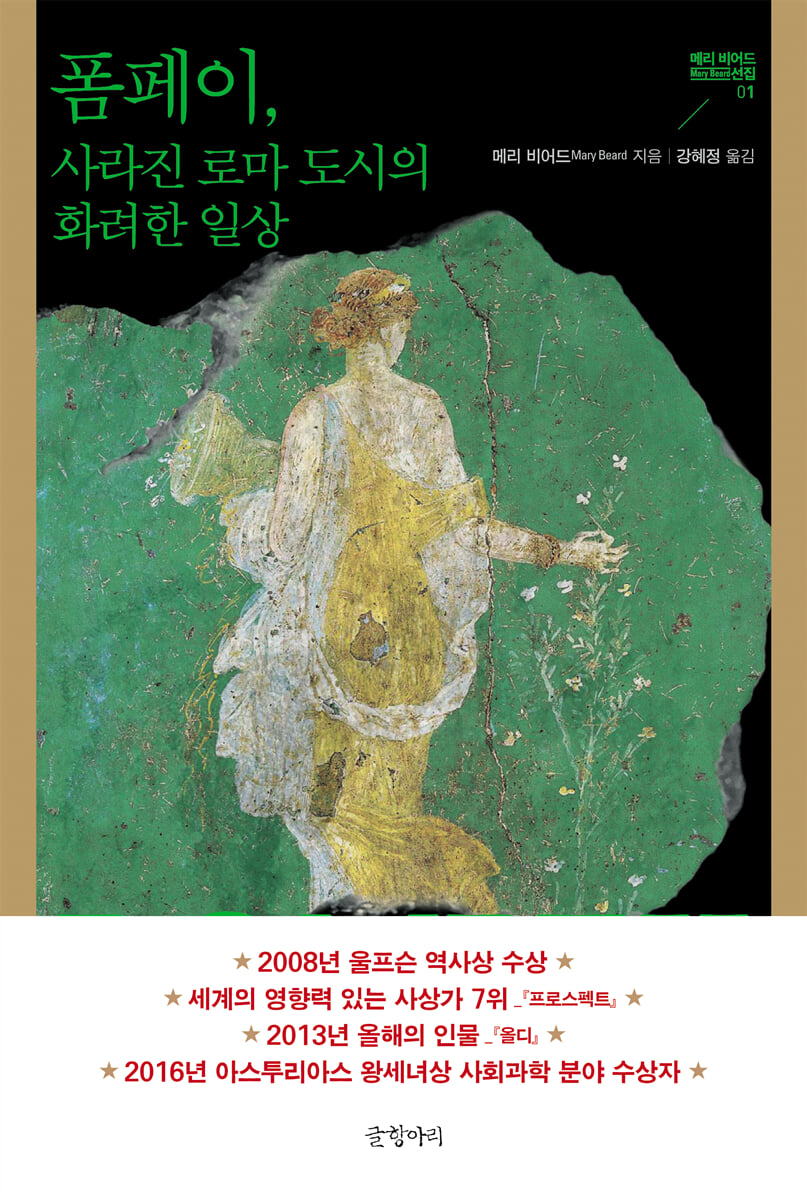
Pompeii, the Glamorous Life of a Lost Roman City
 |
Description
Book Introduction
Starting with a group of fugitives escaping from a deadly volcanic eruption.
Ending with a very practical guide to the ruins of Pompeii
An excellent history book and travel guide!
The masterpiece of Mary Beard, the most famous and original Greek and Roman scholar
*2008 Wolfson History Award
*7th Most Influential Thinker in the World_『Prospect』
*2013 Person of the Year_『Oldie』
*2016 Crown Princess of Asturias Award Winner in the Social Sciences category
*The world's top 10 feminists_ 『Guardian』
The author of this book, Mary Beard, is a researcher in the fields of Greek and Roman language, literature, and history. Her talent for writing and communication in a way that appeals to the general public has earned her the title of "Britain's most famous classicist."
In addition to teaching and conducting research at the university, she is active on television, radio, various magazines, and blogs, and is also the presenter of a BBC documentary series.
Despite his fame, his translated works have rarely been introduced in Korea, but this time, Glahangari is introducing a collection of Mary Beard's works.
The reason Beard has achieved such remarkable success in the male-dominated field of classics is that her greatest strength is her ability to write in a way that is accessible to the general public without losing her scholarly expertise.
Evaluations of such authors include, for example:
“Beard’s easy-going and relaxed writing style makes me think he really cares about his readers.
“This is unusual among orthodox scholars.” (Michael Bywater)
Many historical and literary works about Pompeii have focused on the final days of the eruption, emphasizing the extreme tragedy.
On the other hand, this book focuses on “dealing with the everyday” and traces the daily lives of the people of Pompeii through the remaining ruins and their splendid aspects.
In fact, research, history, and popular books on Pompeii have made many excessive assumptions based on the ruins.
Among these, this book is notable for being written as an interesting historical text based on a solid academic research foundation, and in particular, it contains many arguments that overturn existing common sense.
The story progresses through the city as if exploring the back alleys of Rome.
There are also stories about the one-way streets of Pompeii for carriages, the mixed houses of the wealthy and the poor, the tastes in interior design, the livelihoods of bakers, financiers, and garum manufacturers, and the food, wine, sex, bathing, entertainment, and games that come to mind when thinking of Rome.
From the unrequited love of a Pompeian youth seen through graffiti left on a building to a guest complaining about the lack of a chamber pot in his inn room, the daily lives of ancient people are vividly portrayed, sometimes relatable because they are similar to ours today, and sometimes fascinating because they are so different.
Beard's characteristically quirky and unexpected twists, such as wondering where the spectators went to relieve themselves in the amphitheater, which could hold 20,000 people, and seeing the tartar stuck in the teeth of the excavated skeletons, and guessing that Pompeii must have been a city with bad breath, add to the fun of reading.
Of course, it also touches on major controversies surrounding plaster statues that capture the agony of ancient people dying buried in volcanic ash, the history of Pompeii, its destruction, and the use of excavated remains.
Readers may think they know a lot about Pompeii, but the author reveals things they hadn't thought of, posing the "Pompeii paradox": knowing but simultaneously knowing very little.
Thus, readers who read this book will gain a thorough understanding of the various aspects of Pompeii and acquire vivid intellectual weapons that will shatter the Pompeii paradox!
Ending with a very practical guide to the ruins of Pompeii
An excellent history book and travel guide!
The masterpiece of Mary Beard, the most famous and original Greek and Roman scholar
*2008 Wolfson History Award
*7th Most Influential Thinker in the World_『Prospect』
*2013 Person of the Year_『Oldie』
*2016 Crown Princess of Asturias Award Winner in the Social Sciences category
*The world's top 10 feminists_ 『Guardian』
The author of this book, Mary Beard, is a researcher in the fields of Greek and Roman language, literature, and history. Her talent for writing and communication in a way that appeals to the general public has earned her the title of "Britain's most famous classicist."
In addition to teaching and conducting research at the university, she is active on television, radio, various magazines, and blogs, and is also the presenter of a BBC documentary series.
Despite his fame, his translated works have rarely been introduced in Korea, but this time, Glahangari is introducing a collection of Mary Beard's works.
The reason Beard has achieved such remarkable success in the male-dominated field of classics is that her greatest strength is her ability to write in a way that is accessible to the general public without losing her scholarly expertise.
Evaluations of such authors include, for example:
“Beard’s easy-going and relaxed writing style makes me think he really cares about his readers.
“This is unusual among orthodox scholars.” (Michael Bywater)
Many historical and literary works about Pompeii have focused on the final days of the eruption, emphasizing the extreme tragedy.
On the other hand, this book focuses on “dealing with the everyday” and traces the daily lives of the people of Pompeii through the remaining ruins and their splendid aspects.
In fact, research, history, and popular books on Pompeii have made many excessive assumptions based on the ruins.
Among these, this book is notable for being written as an interesting historical text based on a solid academic research foundation, and in particular, it contains many arguments that overturn existing common sense.
The story progresses through the city as if exploring the back alleys of Rome.
There are also stories about the one-way streets of Pompeii for carriages, the mixed houses of the wealthy and the poor, the tastes in interior design, the livelihoods of bakers, financiers, and garum manufacturers, and the food, wine, sex, bathing, entertainment, and games that come to mind when thinking of Rome.
From the unrequited love of a Pompeian youth seen through graffiti left on a building to a guest complaining about the lack of a chamber pot in his inn room, the daily lives of ancient people are vividly portrayed, sometimes relatable because they are similar to ours today, and sometimes fascinating because they are so different.
Beard's characteristically quirky and unexpected twists, such as wondering where the spectators went to relieve themselves in the amphitheater, which could hold 20,000 people, and seeing the tartar stuck in the teeth of the excavated skeletons, and guessing that Pompeii must have been a city with bad breath, add to the fun of reading.
Of course, it also touches on major controversies surrounding plaster statues that capture the agony of ancient people dying buried in volcanic ash, the history of Pompeii, its destruction, and the use of excavated remains.
Readers may think they know a lot about Pompeii, but the author reveals things they hadn't thought of, posing the "Pompeii paradox": knowing but simultaneously knowing very little.
Thus, readers who read this book will gain a thorough understanding of the various aspects of Pompeii and acquire vivid intellectual weapons that will shatter the Pompeii paradox!
- You can preview some of the book's contents.
Preview
index
prolog
A city where life has stopped
A city with complex traces
Pompeii, Lived Twice
The amazing city of Pompeii
Chapter 1: The Historic City of Pompeii
A glimpse into Pompeii's past
Pre-Roman
Becoming Rome
Pompeii in the Roman World
Chapter 2 Road
Watch your feet
What is the purpose of the road?
Main streets and back alleys
water supply facilities
one-way street
India: A space that is both public and private
people on the street
The city that never sleeps?
Chapter 3 Housing and Home
The Tragic Poet's House
Restoration technology
The upper and lower floors of a house
Show houses
Rich and poor: There's no such thing as a "Pompeian house."
Name and address
79 AD: All kinds of repairs and renovations
Chapter 4 Murals and Decorations
The chemical workers at work
The Colors of Pompeii
Interior decoration rules
Filling the room with myths
A room with a good view?
Chapter 5: Making a Living: Bakers, Financiers, and Garum Makers
Pursuit of profit
Rome's economy
Suburban life and agricultural products
City life and various jobs
bakery owner
financiers
Garum manufacturer
Chapter 6 Who Ruled the City?
Vote, vote, vote
The burdens of public office?
A list of successful people
It wasn't all upper-class men?
Chapter 7: Pleasures of the Body: Food, Wine, Sex, and Bathing
Dormouse for appetizers
Pompeii's diet
cafe culture
Tour the brothel
A pleasant bath
Chapter 8 Entertainment and Games
dice game
Falling for a Star? Theater and Actors
Bloody game
Women's Idol? The Life of a Gladiator
Chapter 9: The Gods Who Filled the City
Another resident of Pompeii
Religion without scriptures
Temple of the City
Worship of God
Politics and Religion: Emperors, Believers, and Priests
Isis worship
Epilogue: City of the Dead
Ashes to ashes
Records of strife engraved on the tomb
Visit Pompeii
Reference books
Expressing my gratitude
Translator's Note
Search
A city where life has stopped
A city with complex traces
Pompeii, Lived Twice
The amazing city of Pompeii
Chapter 1: The Historic City of Pompeii
A glimpse into Pompeii's past
Pre-Roman
Becoming Rome
Pompeii in the Roman World
Chapter 2 Road
Watch your feet
What is the purpose of the road?
Main streets and back alleys
water supply facilities
one-way street
India: A space that is both public and private
people on the street
The city that never sleeps?
Chapter 3 Housing and Home
The Tragic Poet's House
Restoration technology
The upper and lower floors of a house
Show houses
Rich and poor: There's no such thing as a "Pompeian house."
Name and address
79 AD: All kinds of repairs and renovations
Chapter 4 Murals and Decorations
The chemical workers at work
The Colors of Pompeii
Interior decoration rules
Filling the room with myths
A room with a good view?
Chapter 5: Making a Living: Bakers, Financiers, and Garum Makers
Pursuit of profit
Rome's economy
Suburban life and agricultural products
City life and various jobs
bakery owner
financiers
Garum manufacturer
Chapter 6 Who Ruled the City?
Vote, vote, vote
The burdens of public office?
A list of successful people
It wasn't all upper-class men?
Chapter 7: Pleasures of the Body: Food, Wine, Sex, and Bathing
Dormouse for appetizers
Pompeii's diet
cafe culture
Tour the brothel
A pleasant bath
Chapter 8 Entertainment and Games
dice game
Falling for a Star? Theater and Actors
Bloody game
Women's Idol? The Life of a Gladiator
Chapter 9: The Gods Who Filled the City
Another resident of Pompeii
Religion without scriptures
Temple of the City
Worship of God
Politics and Religion: Emperors, Believers, and Priests
Isis worship
Epilogue: City of the Dead
Ashes to ashes
Records of strife engraved on the tomb
Visit Pompeii
Reference books
Expressing my gratitude
Translator's Note
Search
Publisher's Review
The author of this book, Mary Beard, is a researcher in the fields of Greek and Roman language, literature, and history. Her talent for writing and communication in a way that appeals to the general public has earned her the title of "Britain's most famous classicist."
In addition to teaching and conducting research at the university, she is active on television, radio, various magazines, and blogs, and is also the presenter of a BBC documentary series.
Despite his fame, his translated works have rarely been introduced in Korea, but this time, Glahangari is introducing a collection of Mary Beard's works.
The reason Beard has achieved such remarkable success in the male-dominated field of classics is that her greatest strength is her ability to write in a way that is accessible to the general public without losing her scholarly expertise.
Evaluations of such authors include, for example:
“Beard’s easy-going and relaxed writing style makes me think he really cares about his readers.
“This is unusual among orthodox scholars.” (Michael Bywater)
Many historical and literary works about Pompeii have focused on the final days of the eruption, emphasizing the extreme tragedy.
On the other hand, this book focuses on “dealing with the everyday” and traces the daily lives of the people of Pompeii through the remaining ruins and their splendid aspects.
In fact, research, history, and popular books on Pompeii have made many excessive assumptions based on the ruins.
Among these, this book is notable for being written as an interesting historical text based on a solid academic research foundation, and in particular, it contains many arguments that overturn existing common sense.
The story progresses through the city as if exploring the back alleys of Rome.
There are also stories about the one-way streets of Pompeii for carriages, the mixed houses of the wealthy and the poor, the tastes in interior design, the livelihoods of bakers, financiers, and garum manufacturers, and the food, wine, sex, bathing, entertainment, and games that come to mind when thinking of Rome.
From the unrequited love of a Pompeian youth seen through graffiti left on a building to a guest complaining about the lack of a chamber pot in his inn room, the daily lives of ancient people are vividly portrayed, sometimes relatable because they are similar to ours today, and sometimes fascinating because they are so different.
Beard's characteristically quirky and unexpected twists, such as wondering where the spectators went to relieve themselves in the amphitheater, which could hold 20,000 people, and seeing the tartar stuck in the teeth of the excavated skeletons, and guessing that Pompeii must have been a city with bad breath, add to the fun of reading.
Of course, it also touches on major controversies surrounding plaster statues that capture the agony of ancient people dying buried in volcanic ash, the history of Pompeii, its destruction, and the use of excavated remains.
Readers may think they know a lot about Pompeii, but the author reveals things they hadn't thought of, posing the "Pompeii paradox": knowing but simultaneously knowing very little.
Thus, readers who read this book will gain a thorough understanding of the various aspects of Pompeii and acquire vivid intellectual weapons that will shatter the Pompeii paradox!
A city with complex traces
Pompeii in the early hours of August 25, 79 AD.
Through the victims of the Vesuvius eruption, we feel a powerful connection to the ancient world, spanning thousands of years.
The stories of people who actually existed at the time, reconstructed through remains and plaster statues, their choices, decisions, and the vain hopes they harbored… … .
Although we are not archaeologists, we can understand the feelings of those who ran out of their homes with only the bare necessities when the volcano erupted.
Fortunately, our ability to extract various personal information from excavated remains has advanced compared to the past, allowing us to see more concretely and richly the stories of the people of Pompeii we meet.
Beard delves deep into everyday life, noting what people overlook and reconstructing grand histories.
In particular, you will feel a sense of exhilaration and empathy when your previous common sense about Pompeii is shattered.
Let's look at some Beard-style reversals.
· Pompeii is a city with bad breath?
Most of the people of Pompeii had ring-shaped marks on the enamel of their teeth, indicating that they had suffered several infectious diseases during their childhood.
This is a good example of the dire situation faced by infants in Roman times, as half of all children born then are said to have died before the age of ten.
Although less severe than in modern Westerners, the evidence of dental decay is clear, suggesting a diet high in sugar and starch, and what is striking is the presence of tartar on all of the skeletons' teeth.
Beard wittily suggests that the reason why there was so much tartar was because there were no toothbrushes, and that Pompeii must have been a city with bad breath.
· Pompeii is a city where 'everything stopped for a moment'?
Most people think of Pompeii as a city where life was going on as usual until the moment of the volcanic eruption, when everything came to a halt.
Is that really true? Most guidebooks and travel books describe it that way, but this isn't true.
The author suggests that Pompeii is a much more complex and therefore more interesting space.
Contrary to what we know, it has been repeatedly destroyed and ravaged, its inhabitants have withdrawn, and it has been looted, leaving complex traces and scars.
In this book, the author presents the 'Pompeii Paradox' by addressing such traces and wounds.
· Pompey died twice?
This is an old joke among archaeologists.
The first death refers to the sudden death caused by the eruption of Mount Vesuvius, while the second, which we learn about in this book, refers to the death that has been slowly progressing in the city since excavations began in the mid-18th century.
Despite the efforts of the Pompeii archaeological community, the city is slowly being destroyed by various causes.
The area where tourists are prohibited from entering is overgrown with weeds, and the murals that were not taken to the museum after excavation have faded to the point where it is difficult to even discern their shapes, let alone their original vibrant colors.
Unlike a volcanic eruption, this is a gradual process of destruction, with frequent earthquakes and a constant stream of tourists hastening the process of death.
Thieves and vandals of public property who had been at the site are also cited as contributing factors to the second death.
Because a large ruins site like Pompeii is difficult to monitor, it is bound to be subject to their concentrated attacks.
The author also argues that the Roman ruins visitors see today are not miraculously preserved but are the result of work done, as evidenced by the fact that most of Pompeii's place names and zoning are modern.
A glimpse into everyday life in Pompeii
What was daily life like in Pompeii when it teemed with life? We were overwhelmed by the mystery that marked the city's history, the scene of people fleeing the city in a hurry after a volcanic eruption, unable to escape death, and the city covered in ash.
But before it was covered in ash, a peek into everyday life in Pompeii reveals things that deserve even more attention.
· Pompeii had no district divisions?
The author reports that Pompeii as a whole is characterized by much more similarities than regional differences.
This is in stark contrast to the prominent tendency in modern Western cities that social geographers describe as 'zoning'.
Modern cities tend to have concentrated commercial, industrial, and residential activities in certain areas, creating distinct regional divides between the rich and the poor, and sometimes even between races.
However, Pompeii was a city without the zoning that modern people think of, that is, without a clear distinction between upper-class and lower-class residences.
Another example of this is the toilet space.
There is only one toilet, regardless of the size of the house, and it is usually found in the kitchen.
There is a partial partition, but no sign of a door.
While modern people want complete privacy, at least in the bathroom, the Romans did not seem to want that.
· Did the Romans enjoy formal dinners every day?
The kitchens of Pompeian houses are so small and unassuming that tourists often pass them by, but the dining rooms are definitely eye-catching spaces.
Because one of the most elaborate and elegantly decorated spaces by the Pompeians was the dining room.
In Latin, the word for a restaurant is 'triclinium', which literally means 'three long benches'.
This name reflects the common form of formal Roman banquets, where three attendees sit side by side and eat.
However, the author says that the Romans did not enjoy such formal dinners every day.
This is a fallacy of generalization based on a few fragmentary cases and weak evidence.
In fact, most Pompeian houses did not have a triclinium at all, and even in wealthy homes, triclinium banquets were an unusual rather than routine event.
· Were there freed slaves in Rome?
Unlike Greece, in Rome, slaves who had served a long term were often granted freedom.
This was a generous disposition resulting from a combination of the owner's sympathy for humanitarian reasons and economic interests.
By releasing old slaves who were unable to perform household chores, the number of mouths to feed could be reduced, and the other slaves could be encouraged to work diligently and obey.
It is also said that most freed slaves maintained a subordinate relationship in various ways.
For example, there were many cases where they helped their master's business activities or continued to stay in their former master's house even after starting a proper family.
So, the Latin word 'familia' does not mean 'family' as we know it today, but rather a broad category of household that includes slaves and freed slaves.
· Pompeii was teeming with gods and goddesses?
In fact, images of the various gods that exist in Pompeii take on thousands of forms, regardless of gender.
If we were to count all the gods depicted through various means of expression, it could be more than the number of citizens living at the time.
We tend to think of images of ancient gods in a stereotypical way, usually focusing only on identifying key characteristics that identify a god and not paying much attention to them.
The author points out that this attitude underestimates the cultural and religious role that images of the gods played in the ancient world.
At that time, no one doubted the existence of a divine power in the world, and atheism was an unacceptable view, whether from an intellectual or religious point of view.
The images of the various gods and goddesses that the people of Pompeii encountered in their daily lives had much more diverse meanings, and we can see that they placed importance on visible images by expressing their physical forms differently.
The Pleasures of the Flesh in Pompeii
I'm curious about the physical pleasures they pursued in Pompeii, including food, sex, and bathing! A pair of silver cups discovered in Pompeii depict skeletons enjoying a merry party, and are inscribed with the names of Greek philosophers and even philosophical phrases.
“Pleasure is the goal of life!”
· Are Roman women lewd and free-spirited?
The stories told by Roman poets and historians of the libidinous, lascivious, and promiscuous Roman women are largely fictional and apply only to a very select few, members of the imperial family.
At that time, it was not a society where women could control their own lives, fate, and sexuality.
The author suggests that there are two main roles for a respectable married woman.
First, the perilous task of giving birth (a major cause of death in ancient Rome, as in all pre-modern times); second, the task of building a home and a family.
A famous epitaph from the Roman era accurately describes this state of affairs.
The gist of the inscription was, “She bore two sons, (…) kept a good household, and wove woolen cloth.”
· Did upper-class Roman men think that sex was directly linked to pleasure and power?
Yes, that's right.
It is said that upper-class Roman men basically thought that genital penetration was directly connected to pleasure and power.
Sexual partners were of either gender, male-male sex was common, and there is little evidence that homosexuality was considered an exclusive lifestyle.
Roman men were all married, except in the case of young deaths, and fidelity to a married man was not considered valuable or particularly honorable.
However, as far as the pursuit of pleasure was concerned, the wives, daughters, and sons of other upper-class men were off-limits, and slaves and those of lower social status were the first to take, regardless of whether they were male or female.
It is said that it was not a problem for a man to sleep with his slave, and that this was partly the reason for the existence of slaves.
Poor citizens who could not afford to have sex with slaves would have gone out and found prostitutes.
· Did Roman bathing culture coexist with contradictory views on morality?
In Rome, bathing represented 'Roman culture', and it is said that Romans bathed wherever they went.
Bathing was not just a means of cleanliness, but a combination of various activities.
Therefore, we can see that the bathhouse building was one of the most elaborate and advanced buildings in Rome.
The bathhouse was a medium that created social equality, but it was also a place where the inequality of Roman society was clearly revealed.
When bathing, it was a place that showed raw Rome without decoration or signage, so it was, as one modern historian put it, “a hole in the ozone layer of the social class system.”
Yet, strong suspicions were raised that bathing was a morally depraved habit.
At the time, there were no methods of disinfection such as chlorine to alleviate contamination from urine or human waste, so it would have been a breeding ground for a large number of bacteria.
The baths were a wondrous place for the common people of Pompeii, a place where they could experience wonder, pleasure, and splendid beauty, but they were also dangerous places that could kill them.
· Slaughtered for a Roman holiday?
It is said that the holiday outings of the residents of Pompeii were often to watch fights between gladiators and wild beasts, or between gladiators and gladiators.
Although sometimes a brutal spectacle that ended only when one side died, watching gladiator fights was clearly an important leisure activity for the Romans.
The amphitheater, where gladiator fights and animal hunts were held, is still considered one of the most impressive ruins in all of Pompeii.
But contrary to popular belief, Pompeii doesn't have many exotic animals.
The author suggests that, based on the available evidence, the animals used in the Pompeii shows were sourced locally, and even then, dogs and goats were used more often than bulls or bears.
The animal hunts at the Pompeii Coliseum were said to have been conducted in an atmosphere closer to a 'children's zoo' than a 'wild animal sanctuary' today.
In addition to teaching and conducting research at the university, she is active on television, radio, various magazines, and blogs, and is also the presenter of a BBC documentary series.
Despite his fame, his translated works have rarely been introduced in Korea, but this time, Glahangari is introducing a collection of Mary Beard's works.
The reason Beard has achieved such remarkable success in the male-dominated field of classics is that her greatest strength is her ability to write in a way that is accessible to the general public without losing her scholarly expertise.
Evaluations of such authors include, for example:
“Beard’s easy-going and relaxed writing style makes me think he really cares about his readers.
“This is unusual among orthodox scholars.” (Michael Bywater)
Many historical and literary works about Pompeii have focused on the final days of the eruption, emphasizing the extreme tragedy.
On the other hand, this book focuses on “dealing with the everyday” and traces the daily lives of the people of Pompeii through the remaining ruins and their splendid aspects.
In fact, research, history, and popular books on Pompeii have made many excessive assumptions based on the ruins.
Among these, this book is notable for being written as an interesting historical text based on a solid academic research foundation, and in particular, it contains many arguments that overturn existing common sense.
The story progresses through the city as if exploring the back alleys of Rome.
There are also stories about the one-way streets of Pompeii for carriages, the mixed houses of the wealthy and the poor, the tastes in interior design, the livelihoods of bakers, financiers, and garum manufacturers, and the food, wine, sex, bathing, entertainment, and games that come to mind when thinking of Rome.
From the unrequited love of a Pompeian youth seen through graffiti left on a building to a guest complaining about the lack of a chamber pot in his inn room, the daily lives of ancient people are vividly portrayed, sometimes relatable because they are similar to ours today, and sometimes fascinating because they are so different.
Beard's characteristically quirky and unexpected twists, such as wondering where the spectators went to relieve themselves in the amphitheater, which could hold 20,000 people, and seeing the tartar stuck in the teeth of the excavated skeletons, and guessing that Pompeii must have been a city with bad breath, add to the fun of reading.
Of course, it also touches on major controversies surrounding plaster statues that capture the agony of ancient people dying buried in volcanic ash, the history of Pompeii, its destruction, and the use of excavated remains.
Readers may think they know a lot about Pompeii, but the author reveals things they hadn't thought of, posing the "Pompeii paradox": knowing but simultaneously knowing very little.
Thus, readers who read this book will gain a thorough understanding of the various aspects of Pompeii and acquire vivid intellectual weapons that will shatter the Pompeii paradox!
A city with complex traces
Pompeii in the early hours of August 25, 79 AD.
Through the victims of the Vesuvius eruption, we feel a powerful connection to the ancient world, spanning thousands of years.
The stories of people who actually existed at the time, reconstructed through remains and plaster statues, their choices, decisions, and the vain hopes they harbored… … .
Although we are not archaeologists, we can understand the feelings of those who ran out of their homes with only the bare necessities when the volcano erupted.
Fortunately, our ability to extract various personal information from excavated remains has advanced compared to the past, allowing us to see more concretely and richly the stories of the people of Pompeii we meet.
Beard delves deep into everyday life, noting what people overlook and reconstructing grand histories.
In particular, you will feel a sense of exhilaration and empathy when your previous common sense about Pompeii is shattered.
Let's look at some Beard-style reversals.
· Pompeii is a city with bad breath?
Most of the people of Pompeii had ring-shaped marks on the enamel of their teeth, indicating that they had suffered several infectious diseases during their childhood.
This is a good example of the dire situation faced by infants in Roman times, as half of all children born then are said to have died before the age of ten.
Although less severe than in modern Westerners, the evidence of dental decay is clear, suggesting a diet high in sugar and starch, and what is striking is the presence of tartar on all of the skeletons' teeth.
Beard wittily suggests that the reason why there was so much tartar was because there were no toothbrushes, and that Pompeii must have been a city with bad breath.
· Pompeii is a city where 'everything stopped for a moment'?
Most people think of Pompeii as a city where life was going on as usual until the moment of the volcanic eruption, when everything came to a halt.
Is that really true? Most guidebooks and travel books describe it that way, but this isn't true.
The author suggests that Pompeii is a much more complex and therefore more interesting space.
Contrary to what we know, it has been repeatedly destroyed and ravaged, its inhabitants have withdrawn, and it has been looted, leaving complex traces and scars.
In this book, the author presents the 'Pompeii Paradox' by addressing such traces and wounds.
· Pompey died twice?
This is an old joke among archaeologists.
The first death refers to the sudden death caused by the eruption of Mount Vesuvius, while the second, which we learn about in this book, refers to the death that has been slowly progressing in the city since excavations began in the mid-18th century.
Despite the efforts of the Pompeii archaeological community, the city is slowly being destroyed by various causes.
The area where tourists are prohibited from entering is overgrown with weeds, and the murals that were not taken to the museum after excavation have faded to the point where it is difficult to even discern their shapes, let alone their original vibrant colors.
Unlike a volcanic eruption, this is a gradual process of destruction, with frequent earthquakes and a constant stream of tourists hastening the process of death.
Thieves and vandals of public property who had been at the site are also cited as contributing factors to the second death.
Because a large ruins site like Pompeii is difficult to monitor, it is bound to be subject to their concentrated attacks.
The author also argues that the Roman ruins visitors see today are not miraculously preserved but are the result of work done, as evidenced by the fact that most of Pompeii's place names and zoning are modern.
A glimpse into everyday life in Pompeii
What was daily life like in Pompeii when it teemed with life? We were overwhelmed by the mystery that marked the city's history, the scene of people fleeing the city in a hurry after a volcanic eruption, unable to escape death, and the city covered in ash.
But before it was covered in ash, a peek into everyday life in Pompeii reveals things that deserve even more attention.
· Pompeii had no district divisions?
The author reports that Pompeii as a whole is characterized by much more similarities than regional differences.
This is in stark contrast to the prominent tendency in modern Western cities that social geographers describe as 'zoning'.
Modern cities tend to have concentrated commercial, industrial, and residential activities in certain areas, creating distinct regional divides between the rich and the poor, and sometimes even between races.
However, Pompeii was a city without the zoning that modern people think of, that is, without a clear distinction between upper-class and lower-class residences.
Another example of this is the toilet space.
There is only one toilet, regardless of the size of the house, and it is usually found in the kitchen.
There is a partial partition, but no sign of a door.
While modern people want complete privacy, at least in the bathroom, the Romans did not seem to want that.
· Did the Romans enjoy formal dinners every day?
The kitchens of Pompeian houses are so small and unassuming that tourists often pass them by, but the dining rooms are definitely eye-catching spaces.
Because one of the most elaborate and elegantly decorated spaces by the Pompeians was the dining room.
In Latin, the word for a restaurant is 'triclinium', which literally means 'three long benches'.
This name reflects the common form of formal Roman banquets, where three attendees sit side by side and eat.
However, the author says that the Romans did not enjoy such formal dinners every day.
This is a fallacy of generalization based on a few fragmentary cases and weak evidence.
In fact, most Pompeian houses did not have a triclinium at all, and even in wealthy homes, triclinium banquets were an unusual rather than routine event.
· Were there freed slaves in Rome?
Unlike Greece, in Rome, slaves who had served a long term were often granted freedom.
This was a generous disposition resulting from a combination of the owner's sympathy for humanitarian reasons and economic interests.
By releasing old slaves who were unable to perform household chores, the number of mouths to feed could be reduced, and the other slaves could be encouraged to work diligently and obey.
It is also said that most freed slaves maintained a subordinate relationship in various ways.
For example, there were many cases where they helped their master's business activities or continued to stay in their former master's house even after starting a proper family.
So, the Latin word 'familia' does not mean 'family' as we know it today, but rather a broad category of household that includes slaves and freed slaves.
· Pompeii was teeming with gods and goddesses?
In fact, images of the various gods that exist in Pompeii take on thousands of forms, regardless of gender.
If we were to count all the gods depicted through various means of expression, it could be more than the number of citizens living at the time.
We tend to think of images of ancient gods in a stereotypical way, usually focusing only on identifying key characteristics that identify a god and not paying much attention to them.
The author points out that this attitude underestimates the cultural and religious role that images of the gods played in the ancient world.
At that time, no one doubted the existence of a divine power in the world, and atheism was an unacceptable view, whether from an intellectual or religious point of view.
The images of the various gods and goddesses that the people of Pompeii encountered in their daily lives had much more diverse meanings, and we can see that they placed importance on visible images by expressing their physical forms differently.
The Pleasures of the Flesh in Pompeii
I'm curious about the physical pleasures they pursued in Pompeii, including food, sex, and bathing! A pair of silver cups discovered in Pompeii depict skeletons enjoying a merry party, and are inscribed with the names of Greek philosophers and even philosophical phrases.
“Pleasure is the goal of life!”
· Are Roman women lewd and free-spirited?
The stories told by Roman poets and historians of the libidinous, lascivious, and promiscuous Roman women are largely fictional and apply only to a very select few, members of the imperial family.
At that time, it was not a society where women could control their own lives, fate, and sexuality.
The author suggests that there are two main roles for a respectable married woman.
First, the perilous task of giving birth (a major cause of death in ancient Rome, as in all pre-modern times); second, the task of building a home and a family.
A famous epitaph from the Roman era accurately describes this state of affairs.
The gist of the inscription was, “She bore two sons, (…) kept a good household, and wove woolen cloth.”
· Did upper-class Roman men think that sex was directly linked to pleasure and power?
Yes, that's right.
It is said that upper-class Roman men basically thought that genital penetration was directly connected to pleasure and power.
Sexual partners were of either gender, male-male sex was common, and there is little evidence that homosexuality was considered an exclusive lifestyle.
Roman men were all married, except in the case of young deaths, and fidelity to a married man was not considered valuable or particularly honorable.
However, as far as the pursuit of pleasure was concerned, the wives, daughters, and sons of other upper-class men were off-limits, and slaves and those of lower social status were the first to take, regardless of whether they were male or female.
It is said that it was not a problem for a man to sleep with his slave, and that this was partly the reason for the existence of slaves.
Poor citizens who could not afford to have sex with slaves would have gone out and found prostitutes.
· Did Roman bathing culture coexist with contradictory views on morality?
In Rome, bathing represented 'Roman culture', and it is said that Romans bathed wherever they went.
Bathing was not just a means of cleanliness, but a combination of various activities.
Therefore, we can see that the bathhouse building was one of the most elaborate and advanced buildings in Rome.
The bathhouse was a medium that created social equality, but it was also a place where the inequality of Roman society was clearly revealed.
When bathing, it was a place that showed raw Rome without decoration or signage, so it was, as one modern historian put it, “a hole in the ozone layer of the social class system.”
Yet, strong suspicions were raised that bathing was a morally depraved habit.
At the time, there were no methods of disinfection such as chlorine to alleviate contamination from urine or human waste, so it would have been a breeding ground for a large number of bacteria.
The baths were a wondrous place for the common people of Pompeii, a place where they could experience wonder, pleasure, and splendid beauty, but they were also dangerous places that could kill them.
· Slaughtered for a Roman holiday?
It is said that the holiday outings of the residents of Pompeii were often to watch fights between gladiators and wild beasts, or between gladiators and gladiators.
Although sometimes a brutal spectacle that ended only when one side died, watching gladiator fights was clearly an important leisure activity for the Romans.
The amphitheater, where gladiator fights and animal hunts were held, is still considered one of the most impressive ruins in all of Pompeii.
But contrary to popular belief, Pompeii doesn't have many exotic animals.
The author suggests that, based on the available evidence, the animals used in the Pompeii shows were sourced locally, and even then, dogs and goats were used more often than bulls or bears.
The animal hunts at the Pompeii Coliseum were said to have been conducted in an atmosphere closer to a 'children's zoo' than a 'wild animal sanctuary' today.
GOODS SPECIFICS
- Date of issue: November 15, 2024
- Format: Hardcover book binding method guide
- Page count, weight, size: 588 pages | 152*224*40mm
- ISBN13: 9791169093194
You may also like
카테고리
korean


korean

![GQ KOREA Mark (Monthly): December [2025]](http://librairie.coreenne.fr/cdn/shop/files/8ef265dbbfbf186523ed75ba7319009d.jpg?v=1765340328&width=3840)


