

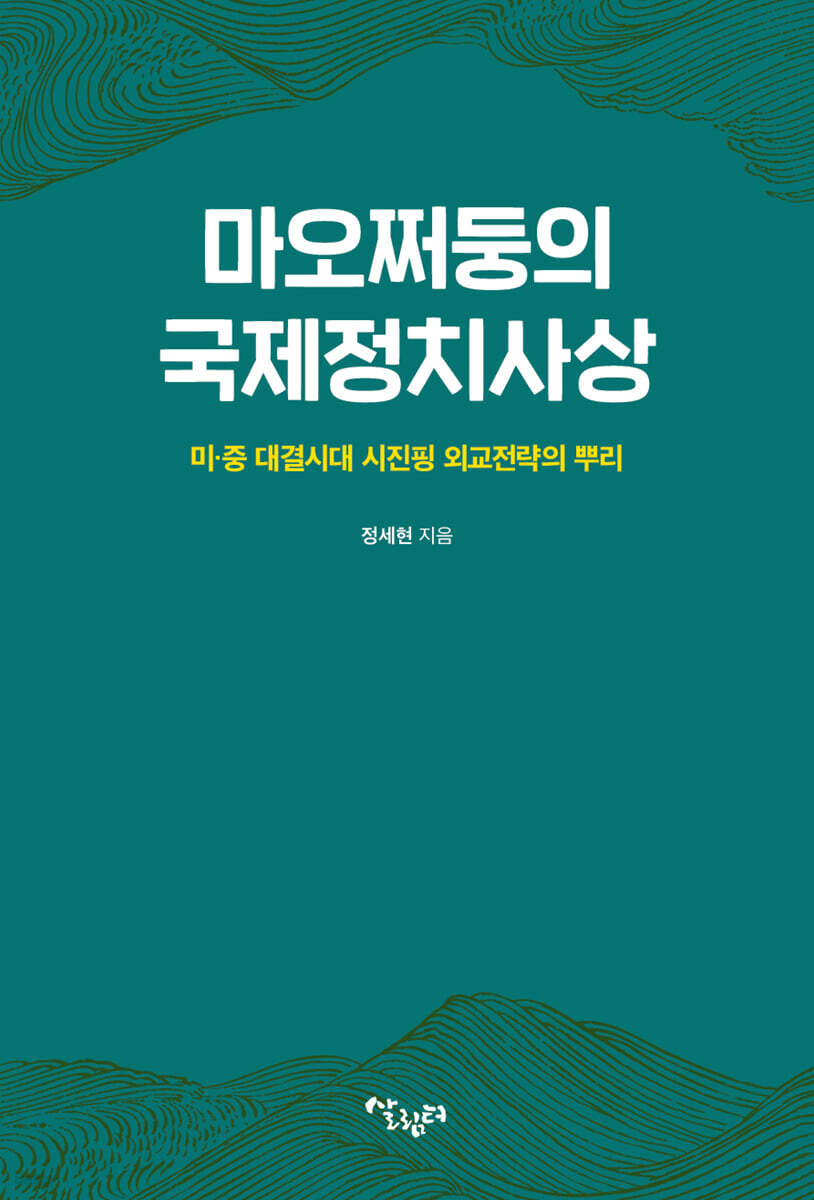
Mao Zedong's International Political Thought
 |
Description
Book Introduction
Trump's second term: Conflict and tensions escalate with the China Dream and the "East-West" movement.
What are our country's diplomatic coordinates and diplomatic strategy?
“When China sneezes, North Korea catches a cold.” This is a joke that succinctly summarizes the reality of the South Korea-China relationship.
It may be said that this saying is no longer valid today, as our country's national power has grown and its international status has risen. However, the reality is that we cannot be completely free from this saying in the international situation where sharp conflicts of interest exist.
With Trump's recent election as the next president and the prospect of a second term looming, various predictions about the future of US-China relations are making us very nervous.
How will China "respond" to Xi Jinping's "Dongseongsogang" (the East rising and the West declining, a key concept in China's "century-long transformation" to overtake the United States)? The Trump administration pursued the "Indo-Pacific Strategy," which was more of an encirclement strategy than the Obama administration's strategy of containing China. Since the change of government, the Biden administration has also strengthened and promoted the "Indo-Pacific Strategy."
This means that the United States, regardless of whether it is a Democratic or Republican party, is trying to block China's increase in national power and international political influence.
With Trump back as US president, the intensity of his Indo-Pacific strategy may intensify.
In such a case, the conflict between the US and China surrounding the "Indo-Pacific Strategy" and the "Belt and Road Strategy" will intensify further.
Although the changing international situation is heightening the concerns of people around the world, the "great revival of the Chinese nation," or the "Chinese Dream," is the unwavering hope and aspiration of Xi Jinping and the 1.4 billion Chinese people.
Although China may not be able to match the economic power of the United States by 2049, the year of the People's Republic of China's centennial, the likelihood of China's prosperity and military power becoming a reality is quite high.
The problem is, “How should we set our country’s diplomatic coordinates and what diplomatic strategies should we establish and pursue?”
Will we habitually recite the Korea-US alliance? Will we pursue diplomacy that maximizes national interests by establishing a US-centric approach and actively pursuing equidistant diplomacy with the US and China?
What are our country's diplomatic coordinates and diplomatic strategy?
“When China sneezes, North Korea catches a cold.” This is a joke that succinctly summarizes the reality of the South Korea-China relationship.
It may be said that this saying is no longer valid today, as our country's national power has grown and its international status has risen. However, the reality is that we cannot be completely free from this saying in the international situation where sharp conflicts of interest exist.
With Trump's recent election as the next president and the prospect of a second term looming, various predictions about the future of US-China relations are making us very nervous.
How will China "respond" to Xi Jinping's "Dongseongsogang" (the East rising and the West declining, a key concept in China's "century-long transformation" to overtake the United States)? The Trump administration pursued the "Indo-Pacific Strategy," which was more of an encirclement strategy than the Obama administration's strategy of containing China. Since the change of government, the Biden administration has also strengthened and promoted the "Indo-Pacific Strategy."
This means that the United States, regardless of whether it is a Democratic or Republican party, is trying to block China's increase in national power and international political influence.
With Trump back as US president, the intensity of his Indo-Pacific strategy may intensify.
In such a case, the conflict between the US and China surrounding the "Indo-Pacific Strategy" and the "Belt and Road Strategy" will intensify further.
Although the changing international situation is heightening the concerns of people around the world, the "great revival of the Chinese nation," or the "Chinese Dream," is the unwavering hope and aspiration of Xi Jinping and the 1.4 billion Chinese people.
Although China may not be able to match the economic power of the United States by 2049, the year of the People's Republic of China's centennial, the likelihood of China's prosperity and military power becoming a reality is quite high.
The problem is, “How should we set our country’s diplomatic coordinates and what diplomatic strategies should we establish and pursue?”
Will we habitually recite the Korea-US alliance? Will we pursue diplomacy that maximizes national interests by establishing a US-centric approach and actively pursuing equidistant diplomacy with the US and China?
- You can preview some of the book's contents.
Preview
index
ㆍOn the publication of the book - Why should we learn about Mao Zedong again?
I The environment in which Mao Zedong's international political thought sprouted
The situation during Mao Zedong's growth period
Mao Zedong's ideological roots
Ⅱ The theoretical framework of Mao Zedong's international political thought
Semi-colonialism
contradiction theory
Anti-imperialism united front theory
Ⅲ The Evolution of Mao Zedong's International Political Thought
International political thought during the anti-Japanese war
International political thought during the pre-Chinese civil war
International political thought in the post-Chinese civil war
International political thought during the founding of the People's Republic of China
International political thought in the period of socialist reform
International political thought during the period of socialist construction
International political thought since the Cultural Revolution
Ⅳ The Three Worlds Theory and China's Foreign Relations After Mao Zedong's Death
Deng Xiaoping's Three Worlds Theory
The politics and economics of the Three Worlds theory
The Three Worlds Theory and Asia
V. The Influence of Mao Zedong's Thought on International Politics on China's Diplomacy
Characteristics of Mao Zedong's international political thought
Mao Zedong's International Political Thought and Chinese Diplomacy
Ⅵ China's diplomatic strategy and goals after Deng Xiaoping
Deng Xiaoping and Jiang Zemin's "Taoguanganghui" and "Liu Xiaozhuowei"
Hu Jintao's "Peaceful Rise," "Reconciled World," and "China's Revival"
Xi Jinping's 'Chinese Dream'
I The environment in which Mao Zedong's international political thought sprouted
The situation during Mao Zedong's growth period
Mao Zedong's ideological roots
Ⅱ The theoretical framework of Mao Zedong's international political thought
Semi-colonialism
contradiction theory
Anti-imperialism united front theory
Ⅲ The Evolution of Mao Zedong's International Political Thought
International political thought during the anti-Japanese war
International political thought during the pre-Chinese civil war
International political thought in the post-Chinese civil war
International political thought during the founding of the People's Republic of China
International political thought in the period of socialist reform
International political thought during the period of socialist construction
International political thought since the Cultural Revolution
Ⅳ The Three Worlds Theory and China's Foreign Relations After Mao Zedong's Death
Deng Xiaoping's Three Worlds Theory
The politics and economics of the Three Worlds theory
The Three Worlds Theory and Asia
V. The Influence of Mao Zedong's Thought on International Politics on China's Diplomacy
Characteristics of Mao Zedong's international political thought
Mao Zedong's International Political Thought and Chinese Diplomacy
Ⅵ China's diplomatic strategy and goals after Deng Xiaoping
Deng Xiaoping and Jiang Zemin's "Taoguanganghui" and "Liu Xiaozhuowei"
Hu Jintao's "Peaceful Rise," "Reconciled World," and "China's Revival"
Xi Jinping's 'Chinese Dream'
Into the book
By defining the opposition of contradictions as fluid rather than fixed and by insisting that no uniform formula should be applied to resolving contradictions, Mao Zedong concludes that there are no eternal enemies or eternal allies.
The very first section of Volume 1 of Selected Works of Mao Zedong asks, "Who is our enemy? Who is our friend? This is the most crucial question in revolution." The answer to this question is that enemies and comrades are distinguished depending on the situation.
--- From "On Contradiction"
Just as it is difficult to acknowledge the originality of "Theory of Contradiction" in terms of philosophical dimension, but there is an evaluation that it was developed into a dialectic of revolution by applying it to Chinese reality, "Theory of the Anti-Imperialist United Front" is not an original work of Mao Zedong, but it should be seen as containing new content that Lenin and Stalin were unable to present in the process of applying it to Chinese reality.
In Mao Zedong's international political thought and strategic theory, the principles of cooperating with the middle ground to isolate the main enemy and seeking a "united front with the peoples of the world" are original principles that originated from Mao Zedong's "anti-imperialist united front theory" that was formed in the wake of the "Anti-Japanese National United Front."
This is because these are elements that were not valued by Lenin or Stalin.
--- From "Anti-Imperialist United Front Theory"
If the two-part international political ideology was a pro-Soviet stance and a two-faced approach, the three-part international political ideology emerged from a situation where relations with the Soviet Union were not smooth.
By clearly distinguishing between 'enemy' and 'comrade', we emphasized that we should not drift into leftist alliance, which was a demand to abandon illusions about the Soviet Union and to clearly establish the contradictory relationship of changing the position of 'oneself'.
Even after that, the close relationship between the Soviet Union and the United States led Mao Zedong to choose either the two-part theory or the three-part theory.
In this light, the tripartite international political thought can be said to contain the meaning of 'self-reliance' and 'self-reliance against the Soviet Union' or 'resistance against the Soviet Union.'
--- From “International Political Thought in the Pre-Civil War”
Regardless of the motive for China's participation in the Korean War, it had a significant impact on Mao Zedong's international political thought.
First, it created constraints on China's foreign activities.
The diplomatic relations with the United States, which had been pursued since 1948, had become a difficult problem to maintain, and thus the scope of activities in the international community could not help but be greatly restricted.
The reason Mao Zedong had no choice but to adhere to the theory of the two camps until the theory of peaceful coexistence was replaced by the theory of the two camps by the Soviet Union after the "Aid to Resist American Aggression" was because he had no alternative in the situation where he was accused of being an expansionist and aggressive force by non-communist countries after the Korean War.
Second, however, it can be said that China benefited both domestically and internationally from its participation in the Korean War.
--- From “International Political Thought in the Founding of the People’s Republic of China”
The Korean Peninsula is an important region not only for the United States, the Soviet Union, and Japan, but also for China.
It may be the most important region for China.
However, since the US, the Soviet Union, Japan, and China all have interests in the Korean Peninsula, China's policy on the Korean Peninsula immediately has the meaning of a countermeasure against the US, Japan, and the Soviet Union.
In other words, the international political position of the Korean Peninsula is such that China cannot pursue its own interests independently of the United States, the Soviet Union, and Japan.
--- From "Three Worlds Theory and Asia"
The concept of contradiction in Deng Xiaoping's Three Worlds Theory has a similar structure to the concept of contradiction in Mao Zedong's 'Two Middle Zones Theory'.
In his "Two Middle Ground Theory," Mao Zedong defined the contradictions between American imperialism and the people of the world, and between American imperialism and other imperialisms, as the "focus of contradictions," thereby emphasizing the contradictions encompassing national contradictions and class contradictions.
Deng Xiaoping can also be said to have summarized national and class contradictions by saying that the most serious contradictions were between the two superpowers, the United States and the Soviet Union, and the peoples of each country in the world.
Moreover, the contradiction between the two superpowers, the United States and the Soviet Union, that he points out can be said to be a new form of the contradiction between American imperialism and other imperialisms.
--- From "Mao Zedong's International Political Thought and Chinese Diplomacy"
After Hu Jintao proposed the "revival of China" as China's diplomatic goal, when Xi Jinping said that the "Chinese dream" was "the greatest dream since modern times," it seems necessary to point out that its roots and source are Mao Zedong.
This is because Mao Zedong insisted that China must "build a new China" in order to avoid being humiliated and despised by the great powers, and emphasized that to build a new China, one must follow the "Chinese road."
And Mao Zedong argued that the 'Chinese path' to establishing a 'new China' must fundamentally be found in breaking away from the status quo.
He argued that in order to break the status quo, the demands of the world's powers that were in a dominant position in international politics had to arise, and to achieve this, Mao Zedong always tried to keep China on the side of the majority.
The very first section of Volume 1 of Selected Works of Mao Zedong asks, "Who is our enemy? Who is our friend? This is the most crucial question in revolution." The answer to this question is that enemies and comrades are distinguished depending on the situation.
--- From "On Contradiction"
Just as it is difficult to acknowledge the originality of "Theory of Contradiction" in terms of philosophical dimension, but there is an evaluation that it was developed into a dialectic of revolution by applying it to Chinese reality, "Theory of the Anti-Imperialist United Front" is not an original work of Mao Zedong, but it should be seen as containing new content that Lenin and Stalin were unable to present in the process of applying it to Chinese reality.
In Mao Zedong's international political thought and strategic theory, the principles of cooperating with the middle ground to isolate the main enemy and seeking a "united front with the peoples of the world" are original principles that originated from Mao Zedong's "anti-imperialist united front theory" that was formed in the wake of the "Anti-Japanese National United Front."
This is because these are elements that were not valued by Lenin or Stalin.
--- From "Anti-Imperialist United Front Theory"
If the two-part international political ideology was a pro-Soviet stance and a two-faced approach, the three-part international political ideology emerged from a situation where relations with the Soviet Union were not smooth.
By clearly distinguishing between 'enemy' and 'comrade', we emphasized that we should not drift into leftist alliance, which was a demand to abandon illusions about the Soviet Union and to clearly establish the contradictory relationship of changing the position of 'oneself'.
Even after that, the close relationship between the Soviet Union and the United States led Mao Zedong to choose either the two-part theory or the three-part theory.
In this light, the tripartite international political thought can be said to contain the meaning of 'self-reliance' and 'self-reliance against the Soviet Union' or 'resistance against the Soviet Union.'
--- From “International Political Thought in the Pre-Civil War”
Regardless of the motive for China's participation in the Korean War, it had a significant impact on Mao Zedong's international political thought.
First, it created constraints on China's foreign activities.
The diplomatic relations with the United States, which had been pursued since 1948, had become a difficult problem to maintain, and thus the scope of activities in the international community could not help but be greatly restricted.
The reason Mao Zedong had no choice but to adhere to the theory of the two camps until the theory of peaceful coexistence was replaced by the theory of the two camps by the Soviet Union after the "Aid to Resist American Aggression" was because he had no alternative in the situation where he was accused of being an expansionist and aggressive force by non-communist countries after the Korean War.
Second, however, it can be said that China benefited both domestically and internationally from its participation in the Korean War.
--- From “International Political Thought in the Founding of the People’s Republic of China”
The Korean Peninsula is an important region not only for the United States, the Soviet Union, and Japan, but also for China.
It may be the most important region for China.
However, since the US, the Soviet Union, Japan, and China all have interests in the Korean Peninsula, China's policy on the Korean Peninsula immediately has the meaning of a countermeasure against the US, Japan, and the Soviet Union.
In other words, the international political position of the Korean Peninsula is such that China cannot pursue its own interests independently of the United States, the Soviet Union, and Japan.
--- From "Three Worlds Theory and Asia"
The concept of contradiction in Deng Xiaoping's Three Worlds Theory has a similar structure to the concept of contradiction in Mao Zedong's 'Two Middle Zones Theory'.
In his "Two Middle Ground Theory," Mao Zedong defined the contradictions between American imperialism and the people of the world, and between American imperialism and other imperialisms, as the "focus of contradictions," thereby emphasizing the contradictions encompassing national contradictions and class contradictions.
Deng Xiaoping can also be said to have summarized national and class contradictions by saying that the most serious contradictions were between the two superpowers, the United States and the Soviet Union, and the peoples of each country in the world.
Moreover, the contradiction between the two superpowers, the United States and the Soviet Union, that he points out can be said to be a new form of the contradiction between American imperialism and other imperialisms.
--- From "Mao Zedong's International Political Thought and Chinese Diplomacy"
After Hu Jintao proposed the "revival of China" as China's diplomatic goal, when Xi Jinping said that the "Chinese dream" was "the greatest dream since modern times," it seems necessary to point out that its roots and source are Mao Zedong.
This is because Mao Zedong insisted that China must "build a new China" in order to avoid being humiliated and despised by the great powers, and emphasized that to build a new China, one must follow the "Chinese road."
And Mao Zedong argued that the 'Chinese path' to establishing a 'new China' must fundamentally be found in breaking away from the status quo.
He argued that in order to break the status quo, the demands of the world's powers that were in a dominant position in international politics had to arise, and to achieve this, Mao Zedong always tried to keep China on the side of the majority.
--- From "Xi Jinping's 'Chinese Dream'"
Publisher's Review
Why Should We Understand Mao Zedong, the "Ideological Father of the Chinese People"?
─The author's detailed analysis and clear diagnosis
The author has been interested in Chinese characters and Chinese things since childhood.
So, starting from my master's course, my academic interest naturally turned to Chinese issues.
He studied abroad at National Chengchi University in Taiwan and frequently visited China even before the establishment of diplomatic relations between Korea and China.
Every time, I thought to myself, 'Mao Zedong still holds his place as the ideological father of China's political leaders and people today.'
As a result, I began to question whether the roots of the Chinese revival and the Chinese dream might lie in Mao Zedong's international political thought.
Today, the international political conflict and competitive relationship between the US and China are unfolding in a very complex manner. This book starts from the awareness that in order to assess the direction of Xi Jinping's China's foreign policy and establish our own countermeasures, we must properly understand Mao Zedong's international political thought, which inevitably had a significant impact on Xi Jinping's upbringing.
In this book, we provide an overview of the environment and theoretical framework in which Mao Zedong's international political thought emerged, focusing on theories such as semi-colonialism, contradiction theory, and anti-imperialist united front. We also examine in detail the evolution of Mao Zedong's international political thought from the period of the Anti-Japanese War through the Chinese Civil War, the period of socialist construction, and the Cultural Revolution.
In the latter part of the book, the author provides an easy-to-understand summary of the changes in China's foreign policy direction, strategy, and tactics from Mao Zedong's death to Deng Xiaoping and Xi Jinping.
The author emphasizes that, for geopolitical reasons alone, our country, located in close proximity to China, must anticipate the direction of Xi Jinping's foreign policy and the development of strategies and tactics and prepare countermeasures in advance.
It is short-sighted and foolish to try to find our own countermeasures by only analyzing China's foreign policy and strategy unfolding before our eyes.
This is why we need to understand Xi Jinping's diplomatic strategy and its ideological and theoretical roots to properly analyze and reduce errors.
─The author's detailed analysis and clear diagnosis
The author has been interested in Chinese characters and Chinese things since childhood.
So, starting from my master's course, my academic interest naturally turned to Chinese issues.
He studied abroad at National Chengchi University in Taiwan and frequently visited China even before the establishment of diplomatic relations between Korea and China.
Every time, I thought to myself, 'Mao Zedong still holds his place as the ideological father of China's political leaders and people today.'
As a result, I began to question whether the roots of the Chinese revival and the Chinese dream might lie in Mao Zedong's international political thought.
Today, the international political conflict and competitive relationship between the US and China are unfolding in a very complex manner. This book starts from the awareness that in order to assess the direction of Xi Jinping's China's foreign policy and establish our own countermeasures, we must properly understand Mao Zedong's international political thought, which inevitably had a significant impact on Xi Jinping's upbringing.
In this book, we provide an overview of the environment and theoretical framework in which Mao Zedong's international political thought emerged, focusing on theories such as semi-colonialism, contradiction theory, and anti-imperialist united front. We also examine in detail the evolution of Mao Zedong's international political thought from the period of the Anti-Japanese War through the Chinese Civil War, the period of socialist construction, and the Cultural Revolution.
In the latter part of the book, the author provides an easy-to-understand summary of the changes in China's foreign policy direction, strategy, and tactics from Mao Zedong's death to Deng Xiaoping and Xi Jinping.
The author emphasizes that, for geopolitical reasons alone, our country, located in close proximity to China, must anticipate the direction of Xi Jinping's foreign policy and the development of strategies and tactics and prepare countermeasures in advance.
It is short-sighted and foolish to try to find our own countermeasures by only analyzing China's foreign policy and strategy unfolding before our eyes.
This is why we need to understand Xi Jinping's diplomatic strategy and its ideological and theoretical roots to properly analyze and reduce errors.
GOODS SPECIFICS
- Date of issue: November 30, 2024
- Page count, weight, size: 328 pages | 426g | 153*224*30mm
- ISBN13: 9791159302947
- ISBN10: 1159302944
You may also like
카테고리
korean


korean

![GQ KOREA Mark (Monthly): December [2025]](http://librairie.coreenne.fr/cdn/shop/files/8ef265dbbfbf186523ed75ba7319009d.jpg?v=1765340328&width=3840)


