

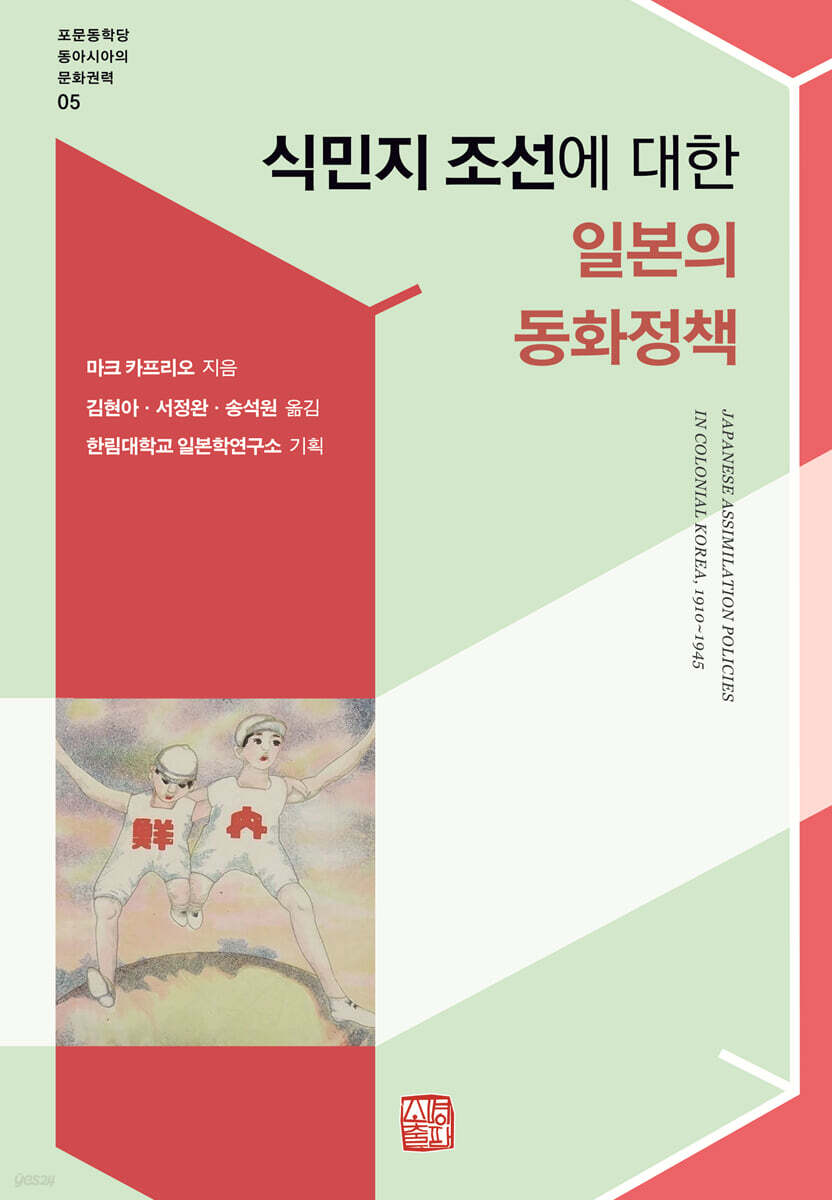
Japan's assimilation policy toward colonial Korea
 |
Description
Book Introduction
This book compares the assimilation policies of European imperialist countries with those of Japan's other colonies and analyzes Korea's assimilation policies by period.
This study is significant in that it is viewed from the perspective of a third party, neither Korean nor Japanese, and will contribute to a more objective understanding of the history of the Japanese colonial period.
This study is significant in that it is viewed from the perspective of a third party, neither Korean nor Japanese, and will contribute to a more objective understanding of the history of the Japanese colonial period.
- You can preview some of the book's contents.
Preview
index
Author's Preface to the Korean Edition
Translator's Preface
Acknowledgements
letter
1.
Colonial management decisions
2.
Structure of this book
3.
Colonial expansion into the country, surrounding areas, and abroad
4.
Japan's expansion and assimilation
Chapter 1: The Western Policy of Assimilation
1.
Assimilation as a colonial policy
2.
Motive of the fairy tale
3.
The Means of Fairy Tales - Educating the 'Uncivilized'
4.
Imagine the people of the surrounding territories
5.
The reaction of the ruled
6.
conclusion
Chapter 2: The Development of Internal and Peripheral Assimilation by Japan
1.
The Iwakura Mission and Japan's territorial expansion
2.
Expansion of surrounding colonies in the early Meiji period
3.
Ezo's Ainu assimilation policy
4.
From the Ryukyu Kingdom to Okinawa
5.
Taiwanese Assimilation - Rhetoric and Practice
6.
conclusion
Chapter 3: Establishing the Joseon-Korea Assimilation Policy
1.
Justification of Joseon fairy tales
2.
Forming the image of Joseon
3.
Japanese education policy under military rule
4.
Social Education and Maeil Shinbo
5.
conclusion
Chapter 4 Policy Reform and Assimilation Policy after March 1
1.
Challenges to assimilation policy
2.
Confirmation of the image of Joseon
3.
Takashi Hara, Makoto Saito, cultural politics
4.
Progress of Japanese and Koreans in Engineering
5.
social and political participation
6.
conclusion
Chapter 5: Radical Assimilation Policies During Wartime
1.
A Sign of Optimism Amidst Dark Clouds
2.
Movement to strengthen internal integration
3.
'National Education' and the Policy of Strengthening National Integration
4.
Images of Koreans during the war from a Japanese perspective
5.
conclusion
Chapter 6: Joseon's Criticism of Japan's Assimilation Policy
1.
Koreans' response to Japan's assimilation policy
2.
Cultural nationalists' critique of assimilation
3.
Criticism of Korean "collaborators"
4.
conclusion
Evaluating the colonization around the end zone
1.
A cautious step towards a fairy tale
2.
Mistakes and Oversights in Japan's Assimilation Policy
3.
Assimilation of surrounding peoples
References
Search
Translator's Preface
Acknowledgements
letter
1.
Colonial management decisions
2.
Structure of this book
3.
Colonial expansion into the country, surrounding areas, and abroad
4.
Japan's expansion and assimilation
Chapter 1: The Western Policy of Assimilation
1.
Assimilation as a colonial policy
2.
Motive of the fairy tale
3.
The Means of Fairy Tales - Educating the 'Uncivilized'
4.
Imagine the people of the surrounding territories
5.
The reaction of the ruled
6.
conclusion
Chapter 2: The Development of Internal and Peripheral Assimilation by Japan
1.
The Iwakura Mission and Japan's territorial expansion
2.
Expansion of surrounding colonies in the early Meiji period
3.
Ezo's Ainu assimilation policy
4.
From the Ryukyu Kingdom to Okinawa
5.
Taiwanese Assimilation - Rhetoric and Practice
6.
conclusion
Chapter 3: Establishing the Joseon-Korea Assimilation Policy
1.
Justification of Joseon fairy tales
2.
Forming the image of Joseon
3.
Japanese education policy under military rule
4.
Social Education and Maeil Shinbo
5.
conclusion
Chapter 4 Policy Reform and Assimilation Policy after March 1
1.
Challenges to assimilation policy
2.
Confirmation of the image of Joseon
3.
Takashi Hara, Makoto Saito, cultural politics
4.
Progress of Japanese and Koreans in Engineering
5.
social and political participation
6.
conclusion
Chapter 5: Radical Assimilation Policies During Wartime
1.
A Sign of Optimism Amidst Dark Clouds
2.
Movement to strengthen internal integration
3.
'National Education' and the Policy of Strengthening National Integration
4.
Images of Koreans during the war from a Japanese perspective
5.
conclusion
Chapter 6: Joseon's Criticism of Japan's Assimilation Policy
1.
Koreans' response to Japan's assimilation policy
2.
Cultural nationalists' critique of assimilation
3.
Criticism of Korean "collaborators"
4.
conclusion
Evaluating the colonization around the end zone
1.
A cautious step towards a fairy tale
2.
Mistakes and Oversights in Japan's Assimilation Policy
3.
Assimilation of surrounding peoples
References
Search
Publisher's Review
The final volume of the 10-volume study on "Cultural Power in the Post-Imperial World"
The Institute of Japanese Studies at Hallym University carried out a research agenda of “Imperial Japan’s Cultural Power - Academic Journals and Cultural Media” under the National Research Foundation of Korea’s Key Research Institute support project for nine years starting in 2008, and immediately thereafter carried out a research agenda of “Post-Imperial Cultural Power and East Asia” under the Humanities Korea Plus support project for seven years starting in 2017, and during this time, presented numerous research results related to “cultural power” to the world.
This book is one of them, and since it deals with Japan's assimilation policy during the Japanese colonial period, at first glance it appears to be a book closer to a study of 'imperial Japanese cultural power'. However, if you look at its contents, you can see that the colonial policy of assimilation is also reflected in the current relationship between Korea and Japan, so it can be said to lead to a study of 'post-imperial cultural power'.
In other words, it is one of the ten volumes published by the Institute of Japanese Studies at Hallym University in its final year as it concluded its Humanities Korea Plus project, which had been conducting research on "cultural power" as a national project for 16 years.
The author of this book, Professor Mark Caprio, had a personal relationship with the translator and researcher, Jeong-Wan Seo of the Institute for Japanese Studies. However, in 2020, when the world was in the midst of a noisy and difficult time due to COVID-19, it was the opportunity to conduct research together for a year at the Institute of Japanese Studies at Hallym University using the Rikkyo University research year that led to the publication of this book, “Japan’s Assimilation Policy toward Colonial Korea.”
The perspective and balance of a researcher who seeks to look at things objectively and calmly from a neutral standpoint.
The most significant feature of this book is that it was written by an American researcher who studied in the United States, worked as a professor in Japan, and actively participated in academic conferences held around the world, researching the assimilation policy of the colonial power during the Japanese colonial period.
Sometimes, it may feel like a slightly unfamiliar perspective to domestic readers.
However, I think we will be able to achieve better balance if we accept that this is the perspective of a researcher who is neither Korean nor Japanese and who is trying to look at things objectively and calmly.
This is because when we acknowledge and share the differences that exist within the basic homogeneity and the detailed heterogeneity, the sense of empathy becomes stronger.
The four layers that make up Japan's assimilation policy toward colonial Korea
Looking at the structure of this book, it is largely composed of four layers.
The first level is the introduction and Chapter 1, which mainly deals with colonial expansion and Western assimilation policies.
This paper begins by outlining the colonial assimilation policies of European imperialist countries, including Britain and France, which had expanded numerous colonies overseas before Japan, and by outlining the reasons for adopting such assimilation policies, their specific development process, and their results.
By examining each European country, it suggests that the characteristics of Japan's colonial assimilation policy, which are often viewed solely in the context of Imperial Japan, can be understood in a much more three-dimensional, deeper, and more detailed way when viewed within a broader framework.
The second level, Chapter 2, divides colonies into domestic colonies, peripheral colonies, and overseas colonies, and reveals the aspects of Japan's assimilation policy according to the type of colony. In the process, by providing a bird's-eye view of the assimilation policy targeting the Ainu of Ezo, Ryukyus, Taiwanese, and Koreans, it highlights the general aspects and overall characteristics of the assimilation policy adopted by the Japanese Empire.
The third level consists of chapters 3, 4, and 5, which divide Japan's assimilation policy toward colonial Korea into periods and analyze the establishment of the assimilation policy in Korea, the policy reform from military politics to cultural politics after the March 1st Movement in 1919 and the assimilation policy implemented during that process, and the radical assimilation policy during wartime.
Finally, the fourth level, Chapter 6 and the concluding chapter, presents an evaluation of Japan's assimilation policy by Korea and Koreans, as well as an evaluation of colonization in general.
By sequentially arranging and organizing Japan's assimilation policy toward colonial Korea in the following order: first, the assimilation policies of other imperialist countries; second, Japan's assimilation policies toward other colonies; and third, the characteristics of Imperial Japan's assimilation policy toward Korea by period, the book allows readers to understand Japan's assimilation policy toward Korea within a much broader framework.
Therefore, it would be good for readers to keep in mind the reality of the assimilation policy, commonly referred to as the imperialization policy, and the evaluations surrounding it.
The Institute of Japanese Studies at Hallym University carried out a research agenda of “Imperial Japan’s Cultural Power - Academic Journals and Cultural Media” under the National Research Foundation of Korea’s Key Research Institute support project for nine years starting in 2008, and immediately thereafter carried out a research agenda of “Post-Imperial Cultural Power and East Asia” under the Humanities Korea Plus support project for seven years starting in 2017, and during this time, presented numerous research results related to “cultural power” to the world.
This book is one of them, and since it deals with Japan's assimilation policy during the Japanese colonial period, at first glance it appears to be a book closer to a study of 'imperial Japanese cultural power'. However, if you look at its contents, you can see that the colonial policy of assimilation is also reflected in the current relationship between Korea and Japan, so it can be said to lead to a study of 'post-imperial cultural power'.
In other words, it is one of the ten volumes published by the Institute of Japanese Studies at Hallym University in its final year as it concluded its Humanities Korea Plus project, which had been conducting research on "cultural power" as a national project for 16 years.
The author of this book, Professor Mark Caprio, had a personal relationship with the translator and researcher, Jeong-Wan Seo of the Institute for Japanese Studies. However, in 2020, when the world was in the midst of a noisy and difficult time due to COVID-19, it was the opportunity to conduct research together for a year at the Institute of Japanese Studies at Hallym University using the Rikkyo University research year that led to the publication of this book, “Japan’s Assimilation Policy toward Colonial Korea.”
The perspective and balance of a researcher who seeks to look at things objectively and calmly from a neutral standpoint.
The most significant feature of this book is that it was written by an American researcher who studied in the United States, worked as a professor in Japan, and actively participated in academic conferences held around the world, researching the assimilation policy of the colonial power during the Japanese colonial period.
Sometimes, it may feel like a slightly unfamiliar perspective to domestic readers.
However, I think we will be able to achieve better balance if we accept that this is the perspective of a researcher who is neither Korean nor Japanese and who is trying to look at things objectively and calmly.
This is because when we acknowledge and share the differences that exist within the basic homogeneity and the detailed heterogeneity, the sense of empathy becomes stronger.
The four layers that make up Japan's assimilation policy toward colonial Korea
Looking at the structure of this book, it is largely composed of four layers.
The first level is the introduction and Chapter 1, which mainly deals with colonial expansion and Western assimilation policies.
This paper begins by outlining the colonial assimilation policies of European imperialist countries, including Britain and France, which had expanded numerous colonies overseas before Japan, and by outlining the reasons for adopting such assimilation policies, their specific development process, and their results.
By examining each European country, it suggests that the characteristics of Japan's colonial assimilation policy, which are often viewed solely in the context of Imperial Japan, can be understood in a much more three-dimensional, deeper, and more detailed way when viewed within a broader framework.
The second level, Chapter 2, divides colonies into domestic colonies, peripheral colonies, and overseas colonies, and reveals the aspects of Japan's assimilation policy according to the type of colony. In the process, by providing a bird's-eye view of the assimilation policy targeting the Ainu of Ezo, Ryukyus, Taiwanese, and Koreans, it highlights the general aspects and overall characteristics of the assimilation policy adopted by the Japanese Empire.
The third level consists of chapters 3, 4, and 5, which divide Japan's assimilation policy toward colonial Korea into periods and analyze the establishment of the assimilation policy in Korea, the policy reform from military politics to cultural politics after the March 1st Movement in 1919 and the assimilation policy implemented during that process, and the radical assimilation policy during wartime.
Finally, the fourth level, Chapter 6 and the concluding chapter, presents an evaluation of Japan's assimilation policy by Korea and Koreans, as well as an evaluation of colonization in general.
By sequentially arranging and organizing Japan's assimilation policy toward colonial Korea in the following order: first, the assimilation policies of other imperialist countries; second, Japan's assimilation policies toward other colonies; and third, the characteristics of Imperial Japan's assimilation policy toward Korea by period, the book allows readers to understand Japan's assimilation policy toward Korea within a much broader framework.
Therefore, it would be good for readers to keep in mind the reality of the assimilation policy, commonly referred to as the imperialization policy, and the evaluations surrounding it.
GOODS SPECIFICS
- Date of issue: October 31, 2024
- Page count, weight, size: 470 pages | 152*223*23mm
- ISBN13: 9791159059865
You may also like
카테고리
korean


korean

![GQ KOREA Mark (Monthly): December [2025]](http://librairie.coreenne.fr/cdn/shop/files/8ef265dbbfbf186523ed75ba7319009d.jpg?v=1765340328&width=3840)


