

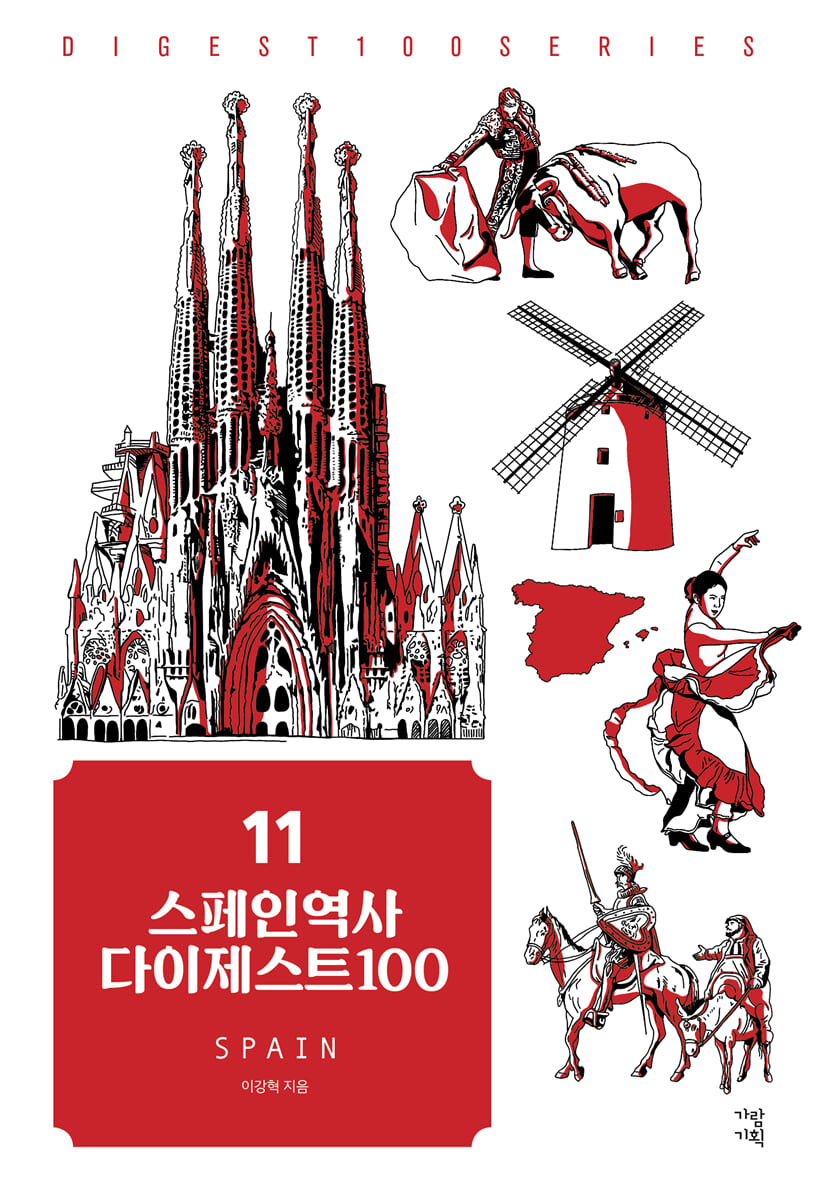
Spanish History Digest 100
 |
Description
Book Introduction
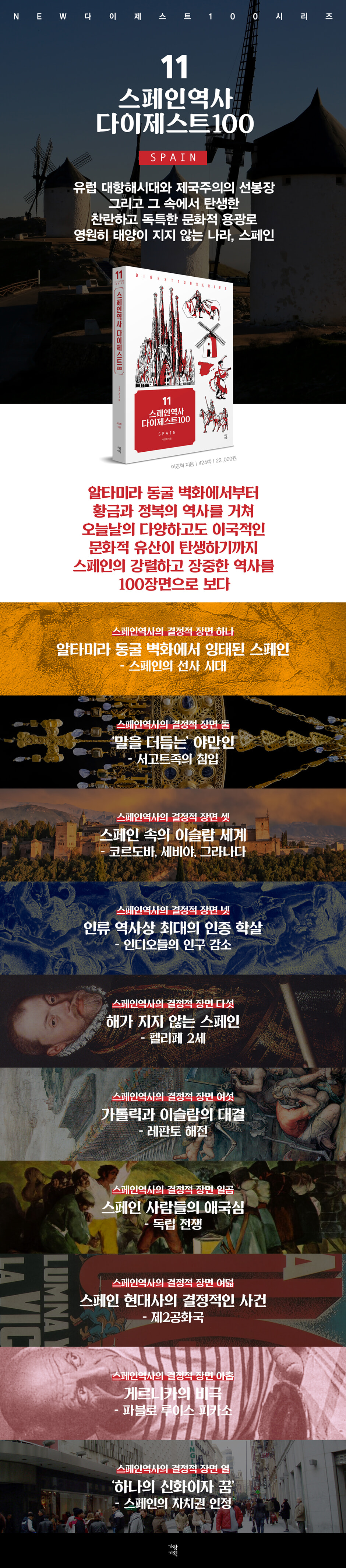
From the Altamira cave paintings to a history of gold and conquest,
The birth of today's diverse and exotic cultural heritage
A look at Spain's intense and profound history in 100 scenes.
Spain, familiar to us as the country that gave birth to bullfighting, flamenco, Don Quixote, and Guernica, is a country that has created a unique culture by blending its Catholic culture with other cultures.
Spain, with its strong and unique cultural traditions, holds a history of joys and sorrows.
The Iberian Peninsula, which embraces Spain at the southern tip of the European continent, boasts a long history dating back to the late Paleolithic era, as evidenced by the Altamira cave paintings.
Due to the geographical characteristics of the Iberian Peninsula, where diverse civilizations intersect, Spain has experienced thousands of years of conquest and coexistence, including the conflict between Catholicism and Islam, the conquest of Latin America, and the Spanish Civil War and Franco's dictatorship in the 20th century.
Spain once enjoyed its heyday as a maritime empire, even being called the "country on which the sun never sets," but the glory of its golden age has faded, and in the 21st century, Spain faces a formidable enemy: the economic crisis.
《Spanish History Digest 100》selects 100 scenes as intense as flamenco from the splendid and majestic history of Spain, and unfolds a panorama of Spain today, building on the glory of its splendid past and sprouting the spirit of reconstruction in the midst of crisis.
Moreover, this book will serve as a foundation for understanding not only Spain but also Latin America, where the dynamism of ancient indigenous civilizations and Spanish culture coexist.
The birth of today's diverse and exotic cultural heritage
A look at Spain's intense and profound history in 100 scenes.
Spain, familiar to us as the country that gave birth to bullfighting, flamenco, Don Quixote, and Guernica, is a country that has created a unique culture by blending its Catholic culture with other cultures.
Spain, with its strong and unique cultural traditions, holds a history of joys and sorrows.
The Iberian Peninsula, which embraces Spain at the southern tip of the European continent, boasts a long history dating back to the late Paleolithic era, as evidenced by the Altamira cave paintings.
Due to the geographical characteristics of the Iberian Peninsula, where diverse civilizations intersect, Spain has experienced thousands of years of conquest and coexistence, including the conflict between Catholicism and Islam, the conquest of Latin America, and the Spanish Civil War and Franco's dictatorship in the 20th century.
Spain once enjoyed its heyday as a maritime empire, even being called the "country on which the sun never sets," but the glory of its golden age has faded, and in the 21st century, Spain faces a formidable enemy: the economic crisis.
《Spanish History Digest 100》selects 100 scenes as intense as flamenco from the splendid and majestic history of Spain, and unfolds a panorama of Spain today, building on the glory of its splendid past and sprouting the spirit of reconstruction in the midst of crisis.
Moreover, this book will serve as a foundation for understanding not only Spain but also Latin America, where the dynamism of ancient indigenous civilizations and Spanish culture coexist.
- You can preview some of the book's contents.
Preview
index
Preface·4
I.
From prehistoric times to the Visigothic invasions
1.
Witnesses of World History - Spain, Spain, and Spain / 2.
Spain's Prehistory: Inspired by the Altamira Cave Paintings
3.
The meeting of two peoples - the Iberians and the Celts / 4.
Mare Nostrum - Phoenicians and Greeks
5.
Battle of Elephants and Sailing Ships - Punic Wars / 6.
The True Master of the Mediterranean - The Roman Empire's Conquest of the Iberian Peninsula
7.
Becoming One with the Roman Empire - Romanization of the Iberian Peninsula / 8.
What the Roman Empire Left in Spain 1 - Politics, Economics, and Society
9.
What the Roman Empire Left in Spain 2 - Architecture, Thought, and Law / 10.
The 'Stuttering' Barbarians - The Visigothic Invasion
11.
32 Changes of Government - Transition from Slave Society to Feudal Society / 12.
Conversion to Catholicism - Saint Isidore of Seville
II.
Muslim rule
13.
The Irresistible Temptation - The Muslim Invasion of the Iberian Peninsula / 14.
Muslim Rule - From Tariq's Invasion to the Fall of the Kingdom of Granada / 15.
Patterns that Embroidered the Iberian Peninsula - The Catholic Kingdoms of the Middle Ages
16.
Battle of Covadonga - The beginning of the national recovery movement / 17.
The Blossoming of Medieval Spanish Culture - King Alfonso X
18.
The Archetype of the Medieval Knight - The Song of El Cid / 19.
Society and Economy under Islamic Rule - The Transition from Agriculture to Crafts and Commerce / 20.
The Islamic World in Spain - Cordoba, Seville, Granada / 21.
Memories of the Alhambra - The Influence of Islamic Culture / 22.
Salad Bowls in Spain - Toledo / 23.
A pure and human union - the union of Aragon and Castile
24.
The Punishment of Heretics - The Inquisition / 25.
The Second Most Powerful and Wealthy Person in Medieval Spain: The Church
III.
Habsburg dynasty
26.
Expulsion of Muslims - Completion of the Homeland Recovery Movement / 27.
The Development of the Spanish Language - Publication of a Spanish Grammar Book
28.
Ambition Buried in the Sand - Archbishop Cisneros's North African Conquest Policy / 29.
Hot Potato - The Evils of the Lower Noble Hidalgo / 30.
Brain Drain - Expulsion of the Jews / 31.
The man who changed world history - Christopher Columbus
32.
The Greatest Genocide in Human History - The Depopulation of the Indians / 33.
Why is only Brazil speaking Portuguese? - Treaty of Tordesillas / 34.
Spain's first love story - "La Celestina" / 35.
French Isolation Policy - King Ferdinand's Foreign Policy
36.
The Madwoman Juana and Charles V - The Beginning of the Habsburg Dynasty / 37.
The world in your hands! - Charles V
38.
Increasing International Trade and Soaring Prices - The Economy under Carlos V / 39.
“Are you saying that Indians are not human?” - The Cry of the Priests / 40.
Whitebeard and the Knight on a White Horse - Cortés' Conquest of the Aztec Empire
41.
Conquest through the Inca's internal strife - Pizarro's Conquest of the Inca Empire / 42.
Catholic Military Academy - Jesuit
43.
A unique literary genre in Spain - the novel "Lazarillo del Tormes" / 44.
Spain on which the sun never sets - Felipe II
45.
The Problem of Heresy - Pureblood Spirit / 46.
The Pagan Threat - The Alpujarras Rebellion / 47.
The Golden City of El Dorado - The Greed of the Conquistadors / 48.
Remote Control of Colonies - Viceroyal Decree / 49.
Encomiendas and Haciendas - Economic Policy in the New World
50.
Economic crisis during the reign of Felipe II - Declaration of bankruptcy / 51.
Unification of the Iberian Peninsula - Annexation of Portugal
52.
The Battle of Lepanto - Catholicism vs. Islam / 53.
The Land Where the Sun Sets - The Defeat of the Invincible Armada
54.
Meeting Joseon - Father Gregorio de Cespedes / 55.
Felipe II's Dilemma: War with the Low Countries
56.
Economic wealth and abundant literary activity - The Golden Century / 57.
The immortal classic - Don Quixote
58.
Barrel Politics - Felipe III / 59.
A Weak King, a Brilliant Subject - Philip IV and the Count of Olivares
60.
The turbulent end of the Habsburg dynasty - the independence movements of Catalonia and Portugal / 61.
Carlos II ascended the throne at the age of four
IV.
Bourbon dynasty
62.
The Fall of the Habsburg Dynasty - War of the Succession / 63.
The first king of the Bourbon dynasty - Philip V
64.
Tricorne hat and short cloak - Esquilache Nan / 65.
Enlightened Absolutism - Charles III
66.
The Exile of the King of Spain - Napoleon's Invasion of Spain / 67.
Spanish Patriotism - The War of Independence
68.
Revolutionary or careerist - Francisco de Goya / 69.
The first democratic constitution - the Cádiz Parliament
70.
Criollo, the standard-bearer of the independence movement - Independence of the Latin American Empire / 71.
The Problem of Succession - The Regency of Maria Christina / 72.
The Conflict Between Absolutists and Liberals - The First Civil War / 73.
Coming of Age 11 Months Early - Isabella II's Freedom
74.
The Glorious Revolution of Spain - The Dethronement of Isabella II / 75.
11 Months of Heaven - First Republic /76.
The Fall of an Empire - The Spanish-American War
V.
Spain in the early 0th century
77.
The Skeleton Giant - Generation 98 / 78.
A Good Politician - Alfonso XIII
79.
The Crisis of the Constitutional Monarchy - Primo de Rivera's Military Dictatorship / 80.
A defining event in modern Spanish history - the Second Republic
81.
The Spanish Labor Movement - The Asturian Revolution
VI.
Franco and Spain
82.
Popular Front's general election victory - Spanish Civil War 1/83.
The Two Spains - Spanish Civil War 2
84.
Young Men of the Spanish Civil War - International Brigades / 85.
The Spanish Civil War and Three Writers - Lorca, Hemingway, and Orwell
86.
The Tragedy of Guernica - Pablo Ruiz Picasso / 87.
"Responsible only before God and history" - Francisco Franco
88.
Economic decline to 19th-century levels - The Age of Poverty / 89.
Cultural Wasteland: The Culture of Avoidance in the Franco Era
90.
Franco's Delusion - Conflict with the Working Class / 91.
Franco's Fury - Conflict with the Church and Student Protests
92.
The end of 36 years of iron rule - Franco's death / 93.
The Spanish Spring - Democratization after Franco's Death
VII.
Modern Spain
94.
Guardian of Spanish Democracy - Juan Carlos I / /95.
'A Myth and a Dream' - Recognition of Spanish Autonomy
96.
Basque separatist movement - ETA / 97.
Catalan Pride - Catalonia's Desire for Independence
98.
Podemos, 'We Can' - Contemporary Politics in Spain / 99.
The Ascension of a New King - Felipe VI
100.
The Land of the Sun - Spain's Economy
I.
From prehistoric times to the Visigothic invasions
1.
Witnesses of World History - Spain, Spain, and Spain / 2.
Spain's Prehistory: Inspired by the Altamira Cave Paintings
3.
The meeting of two peoples - the Iberians and the Celts / 4.
Mare Nostrum - Phoenicians and Greeks
5.
Battle of Elephants and Sailing Ships - Punic Wars / 6.
The True Master of the Mediterranean - The Roman Empire's Conquest of the Iberian Peninsula
7.
Becoming One with the Roman Empire - Romanization of the Iberian Peninsula / 8.
What the Roman Empire Left in Spain 1 - Politics, Economics, and Society
9.
What the Roman Empire Left in Spain 2 - Architecture, Thought, and Law / 10.
The 'Stuttering' Barbarians - The Visigothic Invasion
11.
32 Changes of Government - Transition from Slave Society to Feudal Society / 12.
Conversion to Catholicism - Saint Isidore of Seville
II.
Muslim rule
13.
The Irresistible Temptation - The Muslim Invasion of the Iberian Peninsula / 14.
Muslim Rule - From Tariq's Invasion to the Fall of the Kingdom of Granada / 15.
Patterns that Embroidered the Iberian Peninsula - The Catholic Kingdoms of the Middle Ages
16.
Battle of Covadonga - The beginning of the national recovery movement / 17.
The Blossoming of Medieval Spanish Culture - King Alfonso X
18.
The Archetype of the Medieval Knight - The Song of El Cid / 19.
Society and Economy under Islamic Rule - The Transition from Agriculture to Crafts and Commerce / 20.
The Islamic World in Spain - Cordoba, Seville, Granada / 21.
Memories of the Alhambra - The Influence of Islamic Culture / 22.
Salad Bowls in Spain - Toledo / 23.
A pure and human union - the union of Aragon and Castile
24.
The Punishment of Heretics - The Inquisition / 25.
The Second Most Powerful and Wealthy Person in Medieval Spain: The Church
III.
Habsburg dynasty
26.
Expulsion of Muslims - Completion of the Homeland Recovery Movement / 27.
The Development of the Spanish Language - Publication of a Spanish Grammar Book
28.
Ambition Buried in the Sand - Archbishop Cisneros's North African Conquest Policy / 29.
Hot Potato - The Evils of the Lower Noble Hidalgo / 30.
Brain Drain - Expulsion of the Jews / 31.
The man who changed world history - Christopher Columbus
32.
The Greatest Genocide in Human History - The Depopulation of the Indians / 33.
Why is only Brazil speaking Portuguese? - Treaty of Tordesillas / 34.
Spain's first love story - "La Celestina" / 35.
French Isolation Policy - King Ferdinand's Foreign Policy
36.
The Madwoman Juana and Charles V - The Beginning of the Habsburg Dynasty / 37.
The world in your hands! - Charles V
38.
Increasing International Trade and Soaring Prices - The Economy under Carlos V / 39.
“Are you saying that Indians are not human?” - The Cry of the Priests / 40.
Whitebeard and the Knight on a White Horse - Cortés' Conquest of the Aztec Empire
41.
Conquest through the Inca's internal strife - Pizarro's Conquest of the Inca Empire / 42.
Catholic Military Academy - Jesuit
43.
A unique literary genre in Spain - the novel "Lazarillo del Tormes" / 44.
Spain on which the sun never sets - Felipe II
45.
The Problem of Heresy - Pureblood Spirit / 46.
The Pagan Threat - The Alpujarras Rebellion / 47.
The Golden City of El Dorado - The Greed of the Conquistadors / 48.
Remote Control of Colonies - Viceroyal Decree / 49.
Encomiendas and Haciendas - Economic Policy in the New World
50.
Economic crisis during the reign of Felipe II - Declaration of bankruptcy / 51.
Unification of the Iberian Peninsula - Annexation of Portugal
52.
The Battle of Lepanto - Catholicism vs. Islam / 53.
The Land Where the Sun Sets - The Defeat of the Invincible Armada
54.
Meeting Joseon - Father Gregorio de Cespedes / 55.
Felipe II's Dilemma: War with the Low Countries
56.
Economic wealth and abundant literary activity - The Golden Century / 57.
The immortal classic - Don Quixote
58.
Barrel Politics - Felipe III / 59.
A Weak King, a Brilliant Subject - Philip IV and the Count of Olivares
60.
The turbulent end of the Habsburg dynasty - the independence movements of Catalonia and Portugal / 61.
Carlos II ascended the throne at the age of four
IV.
Bourbon dynasty
62.
The Fall of the Habsburg Dynasty - War of the Succession / 63.
The first king of the Bourbon dynasty - Philip V
64.
Tricorne hat and short cloak - Esquilache Nan / 65.
Enlightened Absolutism - Charles III
66.
The Exile of the King of Spain - Napoleon's Invasion of Spain / 67.
Spanish Patriotism - The War of Independence
68.
Revolutionary or careerist - Francisco de Goya / 69.
The first democratic constitution - the Cádiz Parliament
70.
Criollo, the standard-bearer of the independence movement - Independence of the Latin American Empire / 71.
The Problem of Succession - The Regency of Maria Christina / 72.
The Conflict Between Absolutists and Liberals - The First Civil War / 73.
Coming of Age 11 Months Early - Isabella II's Freedom
74.
The Glorious Revolution of Spain - The Dethronement of Isabella II / 75.
11 Months of Heaven - First Republic /76.
The Fall of an Empire - The Spanish-American War
V.
Spain in the early 0th century
77.
The Skeleton Giant - Generation 98 / 78.
A Good Politician - Alfonso XIII
79.
The Crisis of the Constitutional Monarchy - Primo de Rivera's Military Dictatorship / 80.
A defining event in modern Spanish history - the Second Republic
81.
The Spanish Labor Movement - The Asturian Revolution
VI.
Franco and Spain
82.
Popular Front's general election victory - Spanish Civil War 1/83.
The Two Spains - Spanish Civil War 2
84.
Young Men of the Spanish Civil War - International Brigades / 85.
The Spanish Civil War and Three Writers - Lorca, Hemingway, and Orwell
86.
The Tragedy of Guernica - Pablo Ruiz Picasso / 87.
"Responsible only before God and history" - Francisco Franco
88.
Economic decline to 19th-century levels - The Age of Poverty / 89.
Cultural Wasteland: The Culture of Avoidance in the Franco Era
90.
Franco's Delusion - Conflict with the Working Class / 91.
Franco's Fury - Conflict with the Church and Student Protests
92.
The end of 36 years of iron rule - Franco's death / 93.
The Spanish Spring - Democratization after Franco's Death
VII.
Modern Spain
94.
Guardian of Spanish Democracy - Juan Carlos I / /95.
'A Myth and a Dream' - Recognition of Spanish Autonomy
96.
Basque separatist movement - ETA / 97.
Catalan Pride - Catalonia's Desire for Independence
98.
Podemos, 'We Can' - Contemporary Politics in Spain / 99.
The Ascension of a New King - Felipe VI
100.
The Land of the Sun - Spain's Economy
Detailed image
Into the book
The girl's father was Don Marcelino Sautuola, Viscount of Santander, northern Spain, where the cave is located.
The discoverer of cave paintings, the greatest art in human history, was Maria, the young daughter of a viscount.
The discovery of this girl was the catalyst that revealed to the world Spain, conceived in cave paintings.
---「2.
From "Spain Conceived in the Altamira Cave Paintings: Prehistory in Spain (40,000-30,000 BC)"
The Quran prohibits the representation of the human body in images.
Therefore, the Alhambra Palace is also decorated with curves based on the geometry of delicate workmanship, which are celestial symbols that allow one to experience the joy of art and love.
The Mexican critic Francisco de Isaca praised the Alhambra so highly in his poem that he said, “There is no greater punishment in Granada than to be blind.”
---「21.
From "Memories of the Alhambra: The Influence of Islamic Culture"
"Are these people not human? And shouldn't the conquerors be punished as criminals for destroying nature? Can we say that all European nations are free from responsibility for their actions in destroying nature? If this is true, then no one has the moral right to conquer the Indians."
---「39.
“Are you saying that the Indians are not human?”: From “The Cry of the Priests (16th century)”
Cervantes, the author of [Don Quixote], also lost his left arm while participating in the Battle of Lepanto.
Cervantes called this naval battle, in which Catholic civilization won, "the noblest moment that men of the past and present have ever seen, and that men of the future may wish to see."
---「52.
From "The Battle of Lepanto (1571): The Confrontation Between Catholicism and Islam"
As the sole being who rules and governs everything, he is always right and always wise, so everyone had to obey his commands unconditionally.
Franco, who dominated not only politics but also the daily lives of all citizens, was the final decision maker on everything and on every policy.
In short, all the cards were 'in his hand'.
The discoverer of cave paintings, the greatest art in human history, was Maria, the young daughter of a viscount.
The discovery of this girl was the catalyst that revealed to the world Spain, conceived in cave paintings.
---「2.
From "Spain Conceived in the Altamira Cave Paintings: Prehistory in Spain (40,000-30,000 BC)"
The Quran prohibits the representation of the human body in images.
Therefore, the Alhambra Palace is also decorated with curves based on the geometry of delicate workmanship, which are celestial symbols that allow one to experience the joy of art and love.
The Mexican critic Francisco de Isaca praised the Alhambra so highly in his poem that he said, “There is no greater punishment in Granada than to be blind.”
---「21.
From "Memories of the Alhambra: The Influence of Islamic Culture"
"Are these people not human? And shouldn't the conquerors be punished as criminals for destroying nature? Can we say that all European nations are free from responsibility for their actions in destroying nature? If this is true, then no one has the moral right to conquer the Indians."
---「39.
“Are you saying that the Indians are not human?”: From “The Cry of the Priests (16th century)”
Cervantes, the author of [Don Quixote], also lost his left arm while participating in the Battle of Lepanto.
Cervantes called this naval battle, in which Catholic civilization won, "the noblest moment that men of the past and present have ever seen, and that men of the future may wish to see."
---「52.
From "The Battle of Lepanto (1571): The Confrontation Between Catholicism and Islam"
As the sole being who rules and governs everything, he is always right and always wise, so everyone had to obey his commands unconditionally.
Franco, who dominated not only politics but also the daily lives of all citizens, was the final decision maker on everything and on every policy.
In short, all the cards were 'in his hand'.
---「87.
From "Responsible Only Before God and History": Dictator Francisco Franco (1892-1975)
From "Responsible Only Before God and History": Dictator Francisco Franco (1892-1975)
Publisher's Review
A representative tourist destination and a crossroads of diverse civilizations
And Spanish, spoken by 500 million people
A history of barbarism hidden behind a powerful cultural influence
Spain has one of the longest histories in Europe, but its history is also incredibly complex.
Perhaps it is because the Iberian Peninsula's geographical features have allowed various cultures to intersect here.
Perhaps because of this, Spain, which has a unique culture different from other European countries, has grown into a leading tourist destination today, and Spanish is spoken by approximately 500 million people.
But behind the history of Spain, which has created such a huge cultural ripple effect, there is also a history of innocent sacrifices due to the desire for conquest.
Some scholars even use the term "mass extermination" to describe the rapid decline in the number of indigenous peoples in the 100 years or so after Europeans arrived in America in the 16th and 17th centuries.
The book also tells the story of the lonely struggle of Father Las Casas, who exposed the numerous crimes committed against the Indians by the Spanish conquistadors.
Spain's colonial rule was a 'barbarism' committed in the name of 'civilization'.
The result of Spanish conquest, mass suicides resulting from the clash with Western civilization, harsh labor, and above all, deaths from the spread of European pathogens, hundreds of years of rule provided ample time for Latin American history, culture, and religion to be shaped by the Spanish.
It is undeniable that Columbus changed the course of world history, but it is also clear that Spain's barbaric colonial rule, carried out under the guise of civilization, became a painful part of Latin America's history.
Born from a history of bloody civil war
Masterpieces of genius artists
The masterpieces of geniuses are often born in times of hardship and adversity.
Spain has a history of suffering, not only from numerous wars of conquest but also from civil wars.
Representative examples include the Spanish Civil War, which condensed the characteristics of the 1930s, which were characterized by the three ideologies of democracy, fascism, and communism, and the bombing of Guernica in 1937, which was a conspiracy by Franco and the German Air Force.
This has made domestic and international relations and political situations very complicated.
《Spanish History Digest 100》 introduces several masterpieces of the century that were born in this situation.
Ernest Hemingway expressed his own experience of participating in the Spanish Civil War and the strong sense of solidarity of all mankind for freedom in his novel, “For Whom the Bell Tolls.” George Orwell wrote “Animal Farm,” an allegorical depiction of a betrayed revolution, and “1984,” a satire on totalitarianism.
Also, Picasso's [Guernica] was intended to criticize and denounce the atrocities of Franco's fascist government during the Spanish Civil War, and is a representative work expressing the tragedy and devastation of war.
Through this book, you will be able to see what political and ideological influence the Spanish Civil War had on the artists of that era, and how the tragedy of that era is conveyed to us today.
And Spanish, spoken by 500 million people
A history of barbarism hidden behind a powerful cultural influence
Spain has one of the longest histories in Europe, but its history is also incredibly complex.
Perhaps it is because the Iberian Peninsula's geographical features have allowed various cultures to intersect here.
Perhaps because of this, Spain, which has a unique culture different from other European countries, has grown into a leading tourist destination today, and Spanish is spoken by approximately 500 million people.
But behind the history of Spain, which has created such a huge cultural ripple effect, there is also a history of innocent sacrifices due to the desire for conquest.
Some scholars even use the term "mass extermination" to describe the rapid decline in the number of indigenous peoples in the 100 years or so after Europeans arrived in America in the 16th and 17th centuries.
The book also tells the story of the lonely struggle of Father Las Casas, who exposed the numerous crimes committed against the Indians by the Spanish conquistadors.
Spain's colonial rule was a 'barbarism' committed in the name of 'civilization'.
The result of Spanish conquest, mass suicides resulting from the clash with Western civilization, harsh labor, and above all, deaths from the spread of European pathogens, hundreds of years of rule provided ample time for Latin American history, culture, and religion to be shaped by the Spanish.
It is undeniable that Columbus changed the course of world history, but it is also clear that Spain's barbaric colonial rule, carried out under the guise of civilization, became a painful part of Latin America's history.
Born from a history of bloody civil war
Masterpieces of genius artists
The masterpieces of geniuses are often born in times of hardship and adversity.
Spain has a history of suffering, not only from numerous wars of conquest but also from civil wars.
Representative examples include the Spanish Civil War, which condensed the characteristics of the 1930s, which were characterized by the three ideologies of democracy, fascism, and communism, and the bombing of Guernica in 1937, which was a conspiracy by Franco and the German Air Force.
This has made domestic and international relations and political situations very complicated.
《Spanish History Digest 100》 introduces several masterpieces of the century that were born in this situation.
Ernest Hemingway expressed his own experience of participating in the Spanish Civil War and the strong sense of solidarity of all mankind for freedom in his novel, “For Whom the Bell Tolls.” George Orwell wrote “Animal Farm,” an allegorical depiction of a betrayed revolution, and “1984,” a satire on totalitarianism.
Also, Picasso's [Guernica] was intended to criticize and denounce the atrocities of Franco's fascist government during the Spanish Civil War, and is a representative work expressing the tragedy and devastation of war.
Through this book, you will be able to see what political and ideological influence the Spanish Civil War had on the artists of that era, and how the tragedy of that era is conveyed to us today.
GOODS SPECIFICS
- Date of issue: October 18, 2024
- Page count, weight, size: 424 pages | 646g | 153*225*21mm
- ISBN13: 9788984356184
- ISBN10: 8984356182
You may also like
카테고리
korean


korean

![GQ KOREA Mark (Monthly): December [2025]](http://librairie.coreenne.fr/cdn/shop/files/8ef265dbbfbf186523ed75ba7319009d.jpg?v=1765340328&width=3840)


