

War in Russia
 |
Description
Book Introduction
The direction of World War II was decided
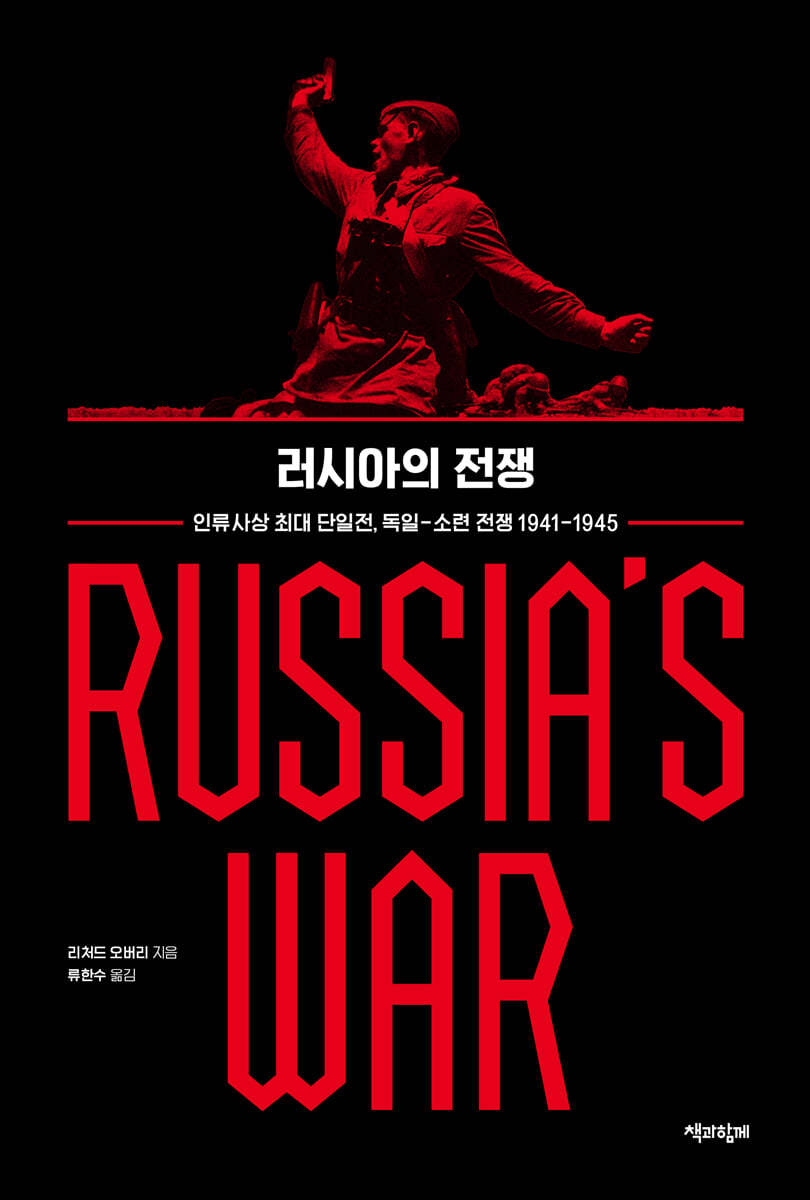
A vivid account of the German-Soviet War
With Soviet estimates of at least 25 million deaths, the German-Soviet War was the single largest war and worst tragedy in human history.
It was also the fiercest battle on the European front, with 80 percent of all German casualties occurring here during World War II.
Interestingly, the more researchers look into the war, the more they see that the Soviet Union seemed incapable of winning.
In June 1941, when Germany invaded with an army of 3 million, the Soviet Union suffered a series of crushing defeats and was quickly attacked all the way to its capital, Moscow.
Even its allies, Britain and the United States, expected the Soviet Union to collapse soon.
How did the Soviet Union overcome this crisis and emerge victorious?
Richard Overy, a leading World War II scholar, delves into the full extent of the German-Soviet War, drawing on new material released after the Soviet Union's "glasnost" in 1985.
In particular, it analyzes the factors of victory within the Soviet Union from a balanced and multifaceted perspective, including not only strategy and combat, but also the characteristics of Stalin and the communist system he created, and the Soviet mentality that had been formed since the time of Imperial Russia.
This shatters the prejudice that the Soviet victory was solely due to the natural environment and vast human resources, while also revealing the two-faced nature of the Stalinist regime and the Soviet Union.
The Korean edition published in 2003 was republished with translation errors and foreign word spellings corrected and sentences refined.
A vivid account of the German-Soviet War
With Soviet estimates of at least 25 million deaths, the German-Soviet War was the single largest war and worst tragedy in human history.
It was also the fiercest battle on the European front, with 80 percent of all German casualties occurring here during World War II.
Interestingly, the more researchers look into the war, the more they see that the Soviet Union seemed incapable of winning.
In June 1941, when Germany invaded with an army of 3 million, the Soviet Union suffered a series of crushing defeats and was quickly attacked all the way to its capital, Moscow.
Even its allies, Britain and the United States, expected the Soviet Union to collapse soon.
How did the Soviet Union overcome this crisis and emerge victorious?
Richard Overy, a leading World War II scholar, delves into the full extent of the German-Soviet War, drawing on new material released after the Soviet Union's "glasnost" in 1985.
In particular, it analyzes the factors of victory within the Soviet Union from a balanced and multifaceted perspective, including not only strategy and combat, but also the characteristics of Stalin and the communist system he created, and the Soviet mentality that had been formed since the time of Imperial Russia.
This shatters the prejudice that the Soviet victory was solely due to the natural environment and vast human resources, while also revealing the two-faced nature of the Stalinist regime and the Soviet Union.
The Korean edition published in 2003 was republished with translation errors and foreign word spellings corrected and sentences refined.
- You can preview some of the book's contents.
Preview
index
Entering
prolog
Chapter 1: Darkness Falls: 1917-1937
Chapter 2: The Time Before Midnight: 1937-1941
Chapter 3: The Goths Travail the East: Operation Barbarossa, 1941
Chapter 4 Between Life and Death: Leningrad and Moscow
Chapter 5: The Fight from Within: Collaboration, Terror, and Resistance
Chapter 6: The Bubbling Cauldron: The Battle of Stalingrad, 1942–1943
Chapter 7 Operation Citadel: The Battle of Kursk, 1943
Chapter 8: The False Dawn: 1943-1944
Chapter 9: The Fall of the Swastika: 1945
Chapter 10: The Cult of Personality: Stalin and the Legacy of the German-Soviet War
Epilogue: Russia's War, Myth and Reality
Appendix 1: Comparison of the Size of the Main Commands of the German and Soviet Armies During the German-Soviet War
Appendix 2 Biographies of Key Figures
Translator's Note
main
References
Search
prolog
Chapter 1: Darkness Falls: 1917-1937
Chapter 2: The Time Before Midnight: 1937-1941
Chapter 3: The Goths Travail the East: Operation Barbarossa, 1941
Chapter 4 Between Life and Death: Leningrad and Moscow
Chapter 5: The Fight from Within: Collaboration, Terror, and Resistance
Chapter 6: The Bubbling Cauldron: The Battle of Stalingrad, 1942–1943
Chapter 7 Operation Citadel: The Battle of Kursk, 1943
Chapter 8: The False Dawn: 1943-1944
Chapter 9: The Fall of the Swastika: 1945
Chapter 10: The Cult of Personality: Stalin and the Legacy of the German-Soviet War
Epilogue: Russia's War, Myth and Reality
Appendix 1: Comparison of the Size of the Main Commands of the German and Soviet Armies During the German-Soviet War
Appendix 2 Biographies of Key Figures
Translator's Note
main
References
Search
Into the book
The revolutionaries of 1917 inherited a rather complex legacy, and the state they built on the ruins of tsarism owed more to that legacy than they had hoped.
Modernization continued during the 1920s and 1930s.
In fact, if modernization had not taken place, the war with Germany would have proceeded quite differently.
The Russian war between 1941 and 1945 is a rich mix of the modern and the ancient.
The war Stalin chose was not a war simply an expression of socialist patriotism.
---From the "Prologue"
The legacy of the civil war helps explain why the entire Soviet society, civilian and military, mobilized in 1941 to fight the German attack, but it also explains why the initial fight was so ineffective and costly.
---From "Chapter 1 Darkness Falls"
Why was Stalin so blind? The Soviet Union had the world's largest intelligence network.
Why did Stalin completely ignore it? He was a man who was almost inherently distrustful of others.
Why did he so conspicuously trust Hitler, the most cunning of politicians?
---From "Chapter 2, The Time Before Midnight"
The Soviet military had far more capabilities than its enemies and allies assumed.
The Soviet army was not a victim of Bolshevik primitiveness, but of surprise.
There were no even the most basic precautions, as Stalin insisted that Germany would not attack in the summer.
The aircraft were lined up in attractive rows, uncamouflaged, at the main air base.
---From "Chapter 3: The Goths Trampling the East"
Hitler defined the war against the Soviet Union as a Vernichtungskrieg, or war of annihilation.
In his view, the Soviet Union was a pure agglomeration of Jews, Bolsheviks, and Slavs, the main enemies of German and European civilization.
This war was a war to the death between two different world systems, not a mere fight for power or territory.
Whatever the actual strategic rationale for the 1941 invasion, Hitler made no secret of the fact that the fight had ideological motives.
---From "Chapter 3: The Goths Trampling the East"
The whole of Leningrad was frantically trying to find more food.
They even stole or traded ration cards.
There was even one who snatched bread from the hand of the weakest person and ate it in front of him.
People caught birds, dogs, and cats, ate them for medicine, and made soup with their glue and hides.
Hunger separates the good from the bad among people.
The mother sacrificed herself to save her child.
When their mother died, her children shivered beside her, starved to death, and a desperate neighbor stole their ration cards.
Hunger created a new moral code.
It's a matter of life or death.
---From "Chapter 4 Between Life and Death"
The most notorious of these crimes was the massacre of 33,771 Jews in just two days in a valley near Babi Yar (present-day Babyn Yar, Ukraine), outside Kiev.
Shortly after the German occupation, partisans blew up the Continental Hotel in the city center, which served as headquarters for the German 6th Army.
The authorities decided to 'get even'.
On September 26, 1941, notices were posted in the city demanding that all Jews register their residence within three days.
Over 30,000 Jews showed up, most of whom believed that the German authorities were trying to get them to register their re-entry.
They were taken to a valley outside the city.
The ravine was a mile-long anti-tank ditch dug between sand dunes.
There they split into small groups, carried their loads, and went to the cliff of the valley.
A pit about 60 yards long and 8 feet deep was dug into the valley floor.
The victims were stripped naked and robbed of their valuables.
They were then placed on planks on the edge of a valley and shot in the neck.
---From "Chapter 5: The Fight from Within"
It is impossible to explain militarily how the Red Army survived Stalingrad.
Chuikov inspired his subordinates.
Even though his headquarters was bombed once in September and burning oil poured into his bunker in October, Chuikov remained where he was, on the front lines, among his men.
His determination spread to others.
Another commander might not have asked so much of his subordinates, but Chuikov did not forgive those who could not withstand the harsh challenges of Stalingrad.
During the battle, it has been claimed that 13,500 men were executed for lack of courage, although not all of them were regular soldiers.
Almost certainly not all of them were cowards.
Chuikov displayed a resolute fatalism, which was reflected in the morale of those under his command.
---From "Chapter 6: The Bubbling Cauldron"
Both sides felt that the fight ahead would be decisive.
The Red Army had 40 percent of its manpower and 75 percent of its armored forces in the combat zone.
Losing this power would have been disastrous.
For Hitler, the success of Operation Citadel was crucial, which is why he postponed the start of the operation until he had greater confidence in the strength of the German army.
---From "Chapter 7: Citadel Operation"
If the term 'total war' has any real meaning, it must have been used to describe the Soviet Union at the height of its war with Germany.
No nation has ever committed so many of its citizens to the labor of waging war, nor has any nation demanded such arduous and prolonged sacrifices from its people.
The life of the people in the rear was a struggle that resembled the painful fighting on the front lines of war.
Many of the victories since 1943 came at a great cost.
Stalin's promise to turn the Soviet Union into a single wartime barracks was not mere rhetoric.
War dominated every area of daily life.
---From "Chapter 8: False Dawn"
Hitler had his last meal the next day at lunchtime, with two secretaries and his personal chef, although he almost certainly had no reason to eat.
Then he shook hands earnestly with the people in the bunker and went into his room with his bride and did not come out.
At 3:30 p.m., while Soviet soldiers fought to gain control of the upper floors of the Reichstag building and Soviet tanks raced down the streets surrounding the Reichstag, Eva Braun took poison and Hitler shot himself in the head.
---From "Chapter 9: The Fall of the Swastika"
The later evaluation of Stalin as a monster of history was possible only for those who lived and survived in his direct shadow.
Stalin has become a literal idol, and this is difficult for Westerners to understand.
For the soldiers who fought in Russia's wars, Stalin was the man who led them against a foe worthy of being remembered for eternity to a victory unparalleled in Russian history.
There was truth there, but it was only partial truth.
Victory was achieved at absurdly high and enormous cost to both the victors and the vanquished.
The sacrifices Stalin's people had to make continued until his death.
Like the civil war that grew out of the war of 1914–1918, the Soviet war dragged on long after the political situation had settled on the battlefield in 1945.
---From "Chapter 10: Personality Cult"
Germany lost the war, not the Soviet Union.
This view does not quite line up with the facts.
In 1941, German generals went into battle confident that victory was only a matter of time (eight to ten weeks at most) against the Russians, 'ignorant, half-Asiatic' warriors, and against Soviet commanders who were 'far less threatening than the imperial Russian generals.'
This judgment has been largely confirmed by the events that have occurred.
For the German army to be defeated, something completely unexpected by the German leaders was needed.
The Soviet Union had to restore its economic power, reform its military, and develop leaders of outstanding quality.
Without this, Germany would not have been able to lose.
The Soviet Union had to win the war.
It is now more common to seek answers deep within the Soviet citizen.
---From the "Epilogue"
The success of the Soviet Union owes something to all these factors.
These factors included the patriotism and innate patience of the masses, the role of Stalin, the political environment of planning and mobilization, and temporary bursts of creativity and effort.
The last factor was so powerful that it was enough to overcome the dark sentiment that had plagued society since the Great Purge: that people were born with a destiny of obedience.
The war effort was not sustained solely by the efforts of those who rebelled against the system they lived under, nor was it a product of the Soviet state, its leaders, or its party.
The two elements worked together in an uneasy symbiosis, bound together by the mutual necessity imposed by the German offensive, without fully trusting each other.
No one doubts that victory could have been achieved at a lower cost, with less oppression, and without the deaths of countless people.
But that was precisely the tragedy of the war fought by the Soviet Union.
The sacrifice of a suffering people brought victory, but it did not bring liberation from slavery.
In a moment of sweet yet bitter victory in a long history of loss.
Modernization continued during the 1920s and 1930s.
In fact, if modernization had not taken place, the war with Germany would have proceeded quite differently.
The Russian war between 1941 and 1945 is a rich mix of the modern and the ancient.
The war Stalin chose was not a war simply an expression of socialist patriotism.
---From the "Prologue"
The legacy of the civil war helps explain why the entire Soviet society, civilian and military, mobilized in 1941 to fight the German attack, but it also explains why the initial fight was so ineffective and costly.
---From "Chapter 1 Darkness Falls"
Why was Stalin so blind? The Soviet Union had the world's largest intelligence network.
Why did Stalin completely ignore it? He was a man who was almost inherently distrustful of others.
Why did he so conspicuously trust Hitler, the most cunning of politicians?
---From "Chapter 2, The Time Before Midnight"
The Soviet military had far more capabilities than its enemies and allies assumed.
The Soviet army was not a victim of Bolshevik primitiveness, but of surprise.
There were no even the most basic precautions, as Stalin insisted that Germany would not attack in the summer.
The aircraft were lined up in attractive rows, uncamouflaged, at the main air base.
---From "Chapter 3: The Goths Trampling the East"
Hitler defined the war against the Soviet Union as a Vernichtungskrieg, or war of annihilation.
In his view, the Soviet Union was a pure agglomeration of Jews, Bolsheviks, and Slavs, the main enemies of German and European civilization.
This war was a war to the death between two different world systems, not a mere fight for power or territory.
Whatever the actual strategic rationale for the 1941 invasion, Hitler made no secret of the fact that the fight had ideological motives.
---From "Chapter 3: The Goths Trampling the East"
The whole of Leningrad was frantically trying to find more food.
They even stole or traded ration cards.
There was even one who snatched bread from the hand of the weakest person and ate it in front of him.
People caught birds, dogs, and cats, ate them for medicine, and made soup with their glue and hides.
Hunger separates the good from the bad among people.
The mother sacrificed herself to save her child.
When their mother died, her children shivered beside her, starved to death, and a desperate neighbor stole their ration cards.
Hunger created a new moral code.
It's a matter of life or death.
---From "Chapter 4 Between Life and Death"
The most notorious of these crimes was the massacre of 33,771 Jews in just two days in a valley near Babi Yar (present-day Babyn Yar, Ukraine), outside Kiev.
Shortly after the German occupation, partisans blew up the Continental Hotel in the city center, which served as headquarters for the German 6th Army.
The authorities decided to 'get even'.
On September 26, 1941, notices were posted in the city demanding that all Jews register their residence within three days.
Over 30,000 Jews showed up, most of whom believed that the German authorities were trying to get them to register their re-entry.
They were taken to a valley outside the city.
The ravine was a mile-long anti-tank ditch dug between sand dunes.
There they split into small groups, carried their loads, and went to the cliff of the valley.
A pit about 60 yards long and 8 feet deep was dug into the valley floor.
The victims were stripped naked and robbed of their valuables.
They were then placed on planks on the edge of a valley and shot in the neck.
---From "Chapter 5: The Fight from Within"
It is impossible to explain militarily how the Red Army survived Stalingrad.
Chuikov inspired his subordinates.
Even though his headquarters was bombed once in September and burning oil poured into his bunker in October, Chuikov remained where he was, on the front lines, among his men.
His determination spread to others.
Another commander might not have asked so much of his subordinates, but Chuikov did not forgive those who could not withstand the harsh challenges of Stalingrad.
During the battle, it has been claimed that 13,500 men were executed for lack of courage, although not all of them were regular soldiers.
Almost certainly not all of them were cowards.
Chuikov displayed a resolute fatalism, which was reflected in the morale of those under his command.
---From "Chapter 6: The Bubbling Cauldron"
Both sides felt that the fight ahead would be decisive.
The Red Army had 40 percent of its manpower and 75 percent of its armored forces in the combat zone.
Losing this power would have been disastrous.
For Hitler, the success of Operation Citadel was crucial, which is why he postponed the start of the operation until he had greater confidence in the strength of the German army.
---From "Chapter 7: Citadel Operation"
If the term 'total war' has any real meaning, it must have been used to describe the Soviet Union at the height of its war with Germany.
No nation has ever committed so many of its citizens to the labor of waging war, nor has any nation demanded such arduous and prolonged sacrifices from its people.
The life of the people in the rear was a struggle that resembled the painful fighting on the front lines of war.
Many of the victories since 1943 came at a great cost.
Stalin's promise to turn the Soviet Union into a single wartime barracks was not mere rhetoric.
War dominated every area of daily life.
---From "Chapter 8: False Dawn"
Hitler had his last meal the next day at lunchtime, with two secretaries and his personal chef, although he almost certainly had no reason to eat.
Then he shook hands earnestly with the people in the bunker and went into his room with his bride and did not come out.
At 3:30 p.m., while Soviet soldiers fought to gain control of the upper floors of the Reichstag building and Soviet tanks raced down the streets surrounding the Reichstag, Eva Braun took poison and Hitler shot himself in the head.
---From "Chapter 9: The Fall of the Swastika"
The later evaluation of Stalin as a monster of history was possible only for those who lived and survived in his direct shadow.
Stalin has become a literal idol, and this is difficult for Westerners to understand.
For the soldiers who fought in Russia's wars, Stalin was the man who led them against a foe worthy of being remembered for eternity to a victory unparalleled in Russian history.
There was truth there, but it was only partial truth.
Victory was achieved at absurdly high and enormous cost to both the victors and the vanquished.
The sacrifices Stalin's people had to make continued until his death.
Like the civil war that grew out of the war of 1914–1918, the Soviet war dragged on long after the political situation had settled on the battlefield in 1945.
---From "Chapter 10: Personality Cult"
Germany lost the war, not the Soviet Union.
This view does not quite line up with the facts.
In 1941, German generals went into battle confident that victory was only a matter of time (eight to ten weeks at most) against the Russians, 'ignorant, half-Asiatic' warriors, and against Soviet commanders who were 'far less threatening than the imperial Russian generals.'
This judgment has been largely confirmed by the events that have occurred.
For the German army to be defeated, something completely unexpected by the German leaders was needed.
The Soviet Union had to restore its economic power, reform its military, and develop leaders of outstanding quality.
Without this, Germany would not have been able to lose.
The Soviet Union had to win the war.
It is now more common to seek answers deep within the Soviet citizen.
---From the "Epilogue"
The success of the Soviet Union owes something to all these factors.
These factors included the patriotism and innate patience of the masses, the role of Stalin, the political environment of planning and mobilization, and temporary bursts of creativity and effort.
The last factor was so powerful that it was enough to overcome the dark sentiment that had plagued society since the Great Purge: that people were born with a destiny of obedience.
The war effort was not sustained solely by the efforts of those who rebelled against the system they lived under, nor was it a product of the Soviet state, its leaders, or its party.
The two elements worked together in an uneasy symbiosis, bound together by the mutual necessity imposed by the German offensive, without fully trusting each other.
No one doubts that victory could have been achieved at a lower cost, with less oppression, and without the deaths of countless people.
But that was precisely the tragedy of the war fought by the Soviet Union.
The sacrifice of a suffering people brought victory, but it did not bring liberation from slavery.
In a moment of sweet yet bitter victory in a long history of loss.
---From the "Epilogue"
Publisher's Review
The whole story of the war between the two countries that was lost in a labyrinth
A clear introduction
《The Russian War》 is a history of the German-Soviet War (June 1941 - May 1945) centered on the Soviet Union (Russia), written by Richard Overy, a leading scholar of World War II, as the title suggests.
This book can provide a new perspective for Korean readers who are familiar with the expansion of Nazi Germany, the Pacific War between Japan and the United States, and the Allied counteroffensive that began with the Normandy Landings.
It is based on a British-Russian TV documentary of the same name, using new material released after the Soviet Union's "glasnost" in 1985, including materials from the Soviet Presidential Archive and the KGB (Committee for State Security).
The German-Soviet War was analyzed comprehensively, covering not only strategy and tactics, but also related topics such as Soviet politics, economy, society, diplomacy, culture, and character.
The Russian War possesses all the virtues that an introductory book should possess.
First, it faithfully describes the basic facts, and then provides maps to help readers understand the complex situation, strategies, and tactics at a glance, so that even readers new to the German-Soviet War can easily grasp the full story.
And not only are the existing research results accumulated through the efforts of numerous scholars to date clearly organized, but also various issues are addressed.
The book was well-received by experts for its concise argumentation, but it also gained immense popularity among the general public in English-speaking countries due to its compelling narrative.
In particular, it vividly depicts the diverse aspects of humanity in the midst of the tremendous historical turmoil of the German-Soviet War, making one's heart ache.
The prejudice attached to the German-Soviet war
A reason not unrelated to us
The common perception of the German-Soviet War known to us is full of extreme prejudice.
This is because, so far, more attention has been paid to the factors that prevented Germany from winning, rather than the factors that led to the Soviet Union's victory.
The Germans expected an easy victory over the Russians, who were 'ignorant, half-Asiatic' warriors, but after their defeat they were busy finding excuses.
Like Napoleon, who was frustrated by the harsh cold of the Soviet winter, or like Germany, who had superior manpower and equipment, but was defeated by the massive Soviet offensive.
This common perception is a myth, a mistaken perception that civilized Germany was defeated by the Soviet Union, which was behind in civilization and had strengths.
This prejudice is closely related to us as well.
This is because it stems from a racist viewpoint towards Asia.
In other words, it is a prejudice that looks down on cultures other than Western Europe as being far from civilization, or, to put it more provocatively, that people living in Asia are inferior beings who have not been baptized in civilization.
This is why we need to know the true factors of victory, not the excuses of losers.
Stalin's leadership and Soviet citizens
An 'unstable' combination brings victory
Author Richard Overy says the Soviet victory was the result of a "precarious" combination of factors.
Above all, it highlights the temporary coexistence and cooperation between the system and forces not yet fully tamed by it, among many other factors, and draws a comprehensive picture from the perspective of everyone from Stalin and the communist party system he established to ordinary citizens and their responses.
The Stalinist regime succeeded in unleashing some of its potential, but at the same time its repressive nature seriously hindered its full potential.
The Stalinist regime that had been oppressing Soviet society was weakened by the war, and the Soviet leadership realized that the rigid system could not guarantee the survival of the Soviet Union, so they allowed for change.
Soviet citizens, though extremely painful, harbored the hope that the war could change the system, and this hope gave them the strength to endure unprecedented suffering.
This explanatory framework deciphers the enigma of the Soviet victory far more precisely than the polarizing, linear explanations that the victory was driven by the heroic patriotism of Soviet citizens united under the leadership of the Communist Party, or by the terror of the Stalinist regime that forced countless people to risk their lives.
If we look into these factors of the Soviet Union's victory and the details within them, we naturally discover the true nature of the Stalinist Communist Party system.
Tragically, after the devastating war, the Stalinist regime only became more entrenched.
The ultimate result was a bankrupt Soviet Union, contrasting with a prosperous West.
The true tragedy of the German-Soviet War lies right here.
Soviet citizens shed enormous blood in the war and won, but that victory did not bring freedom and liberation.
These results will allow us to move beyond the vague image of the Soviet Union as a barbaric system that ruthlessly drove people to its knees, and to understand the historical path and meaning that led the Soviet system to its inevitable path.
A clear introduction
《The Russian War》 is a history of the German-Soviet War (June 1941 - May 1945) centered on the Soviet Union (Russia), written by Richard Overy, a leading scholar of World War II, as the title suggests.
This book can provide a new perspective for Korean readers who are familiar with the expansion of Nazi Germany, the Pacific War between Japan and the United States, and the Allied counteroffensive that began with the Normandy Landings.
It is based on a British-Russian TV documentary of the same name, using new material released after the Soviet Union's "glasnost" in 1985, including materials from the Soviet Presidential Archive and the KGB (Committee for State Security).
The German-Soviet War was analyzed comprehensively, covering not only strategy and tactics, but also related topics such as Soviet politics, economy, society, diplomacy, culture, and character.
The Russian War possesses all the virtues that an introductory book should possess.
First, it faithfully describes the basic facts, and then provides maps to help readers understand the complex situation, strategies, and tactics at a glance, so that even readers new to the German-Soviet War can easily grasp the full story.
And not only are the existing research results accumulated through the efforts of numerous scholars to date clearly organized, but also various issues are addressed.
The book was well-received by experts for its concise argumentation, but it also gained immense popularity among the general public in English-speaking countries due to its compelling narrative.
In particular, it vividly depicts the diverse aspects of humanity in the midst of the tremendous historical turmoil of the German-Soviet War, making one's heart ache.
The prejudice attached to the German-Soviet war
A reason not unrelated to us
The common perception of the German-Soviet War known to us is full of extreme prejudice.
This is because, so far, more attention has been paid to the factors that prevented Germany from winning, rather than the factors that led to the Soviet Union's victory.
The Germans expected an easy victory over the Russians, who were 'ignorant, half-Asiatic' warriors, but after their defeat they were busy finding excuses.
Like Napoleon, who was frustrated by the harsh cold of the Soviet winter, or like Germany, who had superior manpower and equipment, but was defeated by the massive Soviet offensive.
This common perception is a myth, a mistaken perception that civilized Germany was defeated by the Soviet Union, which was behind in civilization and had strengths.
This prejudice is closely related to us as well.
This is because it stems from a racist viewpoint towards Asia.
In other words, it is a prejudice that looks down on cultures other than Western Europe as being far from civilization, or, to put it more provocatively, that people living in Asia are inferior beings who have not been baptized in civilization.
This is why we need to know the true factors of victory, not the excuses of losers.
Stalin's leadership and Soviet citizens
An 'unstable' combination brings victory
Author Richard Overy says the Soviet victory was the result of a "precarious" combination of factors.
Above all, it highlights the temporary coexistence and cooperation between the system and forces not yet fully tamed by it, among many other factors, and draws a comprehensive picture from the perspective of everyone from Stalin and the communist party system he established to ordinary citizens and their responses.
The Stalinist regime succeeded in unleashing some of its potential, but at the same time its repressive nature seriously hindered its full potential.
The Stalinist regime that had been oppressing Soviet society was weakened by the war, and the Soviet leadership realized that the rigid system could not guarantee the survival of the Soviet Union, so they allowed for change.
Soviet citizens, though extremely painful, harbored the hope that the war could change the system, and this hope gave them the strength to endure unprecedented suffering.
This explanatory framework deciphers the enigma of the Soviet victory far more precisely than the polarizing, linear explanations that the victory was driven by the heroic patriotism of Soviet citizens united under the leadership of the Communist Party, or by the terror of the Stalinist regime that forced countless people to risk their lives.
If we look into these factors of the Soviet Union's victory and the details within them, we naturally discover the true nature of the Stalinist Communist Party system.
Tragically, after the devastating war, the Stalinist regime only became more entrenched.
The ultimate result was a bankrupt Soviet Union, contrasting with a prosperous West.
The true tragedy of the German-Soviet War lies right here.
Soviet citizens shed enormous blood in the war and won, but that victory did not bring freedom and liberation.
These results will allow us to move beyond the vague image of the Soviet Union as a barbaric system that ruthlessly drove people to its knees, and to understand the historical path and meaning that led the Soviet system to its inevitable path.
GOODS SPECIFICS
- Date of issue: August 31, 2024
- Page count, weight, size: 592 pages | 848g | 152*225*30mm
- ISBN13: 9791194263036
- ISBN10: 1194263038
You may also like
카테고리
korean


korean

![GQ KOREA Mark (Monthly): December [2025]](http://librairie.coreenne.fr/cdn/shop/files/8ef265dbbfbf186523ed75ba7319009d.jpg?v=1765340328&width=3840)


