

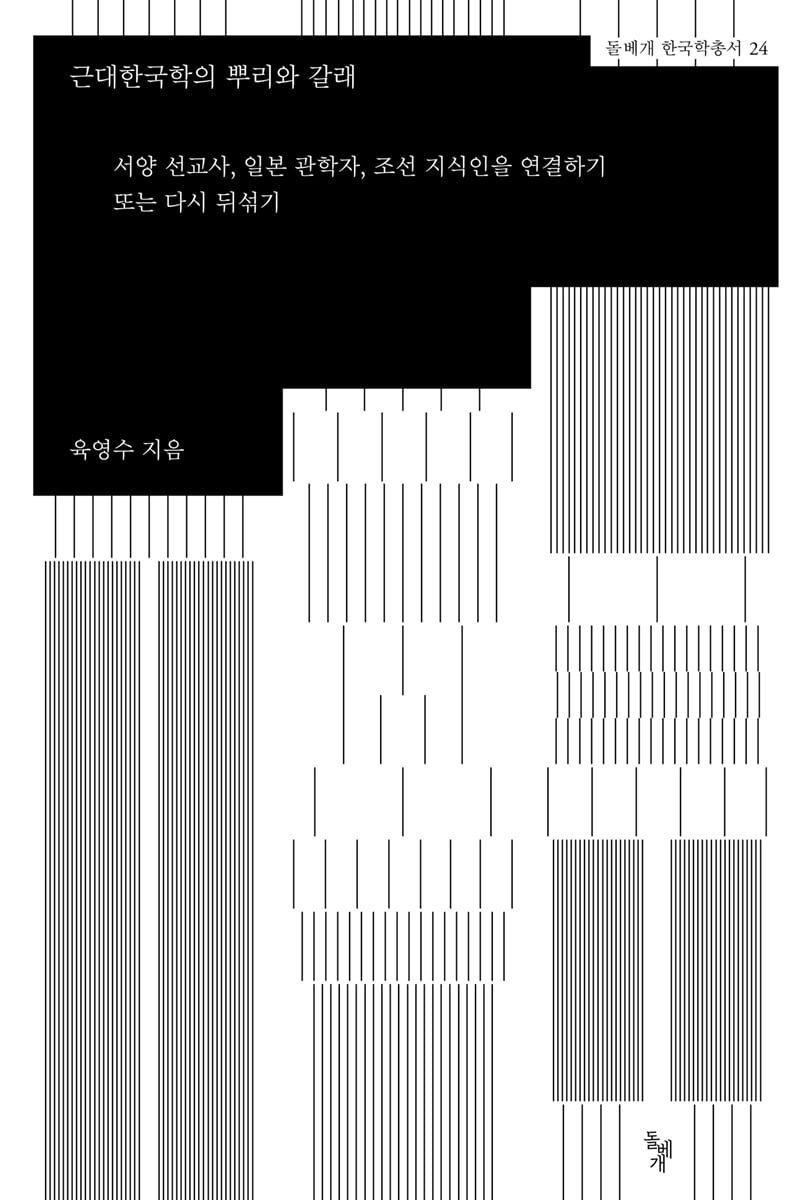
The Roots and Branches of Modern Korean Studies
 |
Description
Book Introduction
How did missionaries, Japanese government officials, and Korean intellectuals create modern Korean studies, separately and together?
An adventure in history to overcome the coloniality of knowledge and understanding!
Modern Korean studies created separately and together by Western missionaries, Japanese government officials, and Joseon intellectuals
"The Roots and Branches of Modern Korean Studies" reveals a new aspect of modern and contemporary Korean history that cannot be captured through theories of colonial modernization and exploitation.
This paper reconstructs, from genealogical and postcolonial perspectives, how Western missionaries who entered Korea in the 19th century understood Korea, how the Japanese Government-General of Korea and Japanese scholars developed Korean studies during the colonial period, and how Korean studies research by Korean intellectuals separately and simultaneously shaped the discourse of modern Korean studies.
An adventure in history to overcome the coloniality of knowledge and understanding!
Modern Korean studies created separately and together by Western missionaries, Japanese government officials, and Joseon intellectuals
"The Roots and Branches of Modern Korean Studies" reveals a new aspect of modern and contemporary Korean history that cannot be captured through theories of colonial modernization and exploitation.
This paper reconstructs, from genealogical and postcolonial perspectives, how Western missionaries who entered Korea in the 19th century understood Korea, how the Japanese Government-General of Korea and Japanese scholars developed Korean studies during the colonial period, and how Korean studies research by Korean intellectuals separately and simultaneously shaped the discourse of modern Korean studies.
- You can preview some of the book's contents.
Preview
index
Acknowledgements
preface
Part 1.
Western missionaries and the first wave of modern Korean studies
Chapter 1.
Western missionaries and the (re)invention of modern Korean studies
1.
Laying the Foundation for Korean Studies in the Mid- to Late 19th Century: Prequel
2.
The Invention of Korean Studies by French Catholic Missionaries: Dallet and Riedel
3.
The Reinvention of Korean Studies by Anglo-American Protestant Missionaries: Ross and Griffiths
Chapter 2.
Forums for the Internationalization of Korean Studies and Content Production and Development: The Korean Repository and Korea Review
1.
Creating an international network of Korean studies in the late 19th century
2.
The nature and characteristics of Korean studies reflected in the Korean Repository
3.
『Korea Review』 and a collection of Korean proverbs and folktales
4.
Modern Korean Studies as a Tool of Knowledge-Power: 'Missionary Imperialism'?
Chapter 3.
Specialization and System Development in Korean Studies, 1900–1940: The Korean Branch of the Royal Asiatic Society
1.
The establishment of the Korean branch of the Royal Asiatic Society and the strengthening of the Anglo-American network.
2.
Content and main characteristics of 『Transaction』
3.
Exploring and Expanding Research Topics: History of Ecology and the Environment
4.
New formats and writing strategies for research papers
5.
Incubator for future Korean studies experts
Chapter 4.
The creation of Korean cultural and artistic discourse by Western missionaries in the late 19th and early 20th centuries
1.
The Origins and Character of Korean Literature: The Gale-Hulbert Debate
2.
Second-Generation Missionary Criticism of Korean Art and Music
3.
Division of Korean Cultural and Art History and the Creation of a Canon
Chapter 5.
Western missionaries and the first wave of modern Korean folklore studies
1.
Early pioneering of folklore studies by Western missionaries
2.
Jones and Hulbert, Expanding and Deepening Folklore Studies
3.
The Grains and Chaff of the First Wave of Korean Folklore Studies
Part 2.
Genealogy of Korean Studies in the Colonial Period
Chapter 6.
Imperial Japan's "Will to Know" and the First and Fifth Wave of Modern Korean Studies
1.
The Invention of the Modern 'Japanese Empire' and Colonial Studies
2.
Interfering with the Japanese Empire's knowledge-power production process for Joseon studies.
3.
Establishing the framework for Joseon studies at the Government-General of Korea
4.
A topographical map of the first and fifth wave of modern Korean studies, a metaphorical signifier
Chapter 7.
Imperial Japan's colonial rule reexamined through a comparative historical perspective
1.
Western imperial colonial rule model
2.
Applying Western colonial governance methods to the Japanese Empire
[Reading] A Guide to Korean Studies by the Government-General of Korea
Chapter 8.
The First Generation of Joseon Studies Researchers and the Birth of Modern Korean Intellectuals
1.
First Generation of Joseon Studies: Lee Neung-hwa, Choi Nam-seon, and Ahn Hwak
2.
Beyond 'Colonial Enlightenment'
3.
The Birth of Modern Korean Intellectuals and the Generational Shift in Joseon Studies
Chapter 9.
Institutionalization and Distinction of Academic Korean Studies: Keijo Imperial University
1.
Looking back on the 100th anniversary of the school's founding
2.
The Establishment of the Imperial University and the Emergence of Japanese Civil Servants and Intellectuals
3.
Building Colonial Knowledge and Power at Gyeongseong Imperial University
4.
Korean graduates of Keijo Imperial University and Korean Studies Research
Chapter 10.
The Second Wave of Joseon Art History Research: A Visit to Go Yu-seop
1.
Korean art history reflected in the mirror of Japanese art history
2.
Korean Art Through the Eyes of a Foreign Art Critic: Yanagi Muneyoshi and Andreas Eckardt
3.
A Declaration of Independent Delineation of Joseon Art History?: Go Yu-seop
4.
Connect or reshuffle
Conclusion
References
Search
preface
Part 1.
Western missionaries and the first wave of modern Korean studies
Chapter 1.
Western missionaries and the (re)invention of modern Korean studies
1.
Laying the Foundation for Korean Studies in the Mid- to Late 19th Century: Prequel
2.
The Invention of Korean Studies by French Catholic Missionaries: Dallet and Riedel
3.
The Reinvention of Korean Studies by Anglo-American Protestant Missionaries: Ross and Griffiths
Chapter 2.
Forums for the Internationalization of Korean Studies and Content Production and Development: The Korean Repository and Korea Review
1.
Creating an international network of Korean studies in the late 19th century
2.
The nature and characteristics of Korean studies reflected in the Korean Repository
3.
『Korea Review』 and a collection of Korean proverbs and folktales
4.
Modern Korean Studies as a Tool of Knowledge-Power: 'Missionary Imperialism'?
Chapter 3.
Specialization and System Development in Korean Studies, 1900–1940: The Korean Branch of the Royal Asiatic Society
1.
The establishment of the Korean branch of the Royal Asiatic Society and the strengthening of the Anglo-American network.
2.
Content and main characteristics of 『Transaction』
3.
Exploring and Expanding Research Topics: History of Ecology and the Environment
4.
New formats and writing strategies for research papers
5.
Incubator for future Korean studies experts
Chapter 4.
The creation of Korean cultural and artistic discourse by Western missionaries in the late 19th and early 20th centuries
1.
The Origins and Character of Korean Literature: The Gale-Hulbert Debate
2.
Second-Generation Missionary Criticism of Korean Art and Music
3.
Division of Korean Cultural and Art History and the Creation of a Canon
Chapter 5.
Western missionaries and the first wave of modern Korean folklore studies
1.
Early pioneering of folklore studies by Western missionaries
2.
Jones and Hulbert, Expanding and Deepening Folklore Studies
3.
The Grains and Chaff of the First Wave of Korean Folklore Studies
Part 2.
Genealogy of Korean Studies in the Colonial Period
Chapter 6.
Imperial Japan's "Will to Know" and the First and Fifth Wave of Modern Korean Studies
1.
The Invention of the Modern 'Japanese Empire' and Colonial Studies
2.
Interfering with the Japanese Empire's knowledge-power production process for Joseon studies.
3.
Establishing the framework for Joseon studies at the Government-General of Korea
4.
A topographical map of the first and fifth wave of modern Korean studies, a metaphorical signifier
Chapter 7.
Imperial Japan's colonial rule reexamined through a comparative historical perspective
1.
Western imperial colonial rule model
2.
Applying Western colonial governance methods to the Japanese Empire
[Reading] A Guide to Korean Studies by the Government-General of Korea
Chapter 8.
The First Generation of Joseon Studies Researchers and the Birth of Modern Korean Intellectuals
1.
First Generation of Joseon Studies: Lee Neung-hwa, Choi Nam-seon, and Ahn Hwak
2.
Beyond 'Colonial Enlightenment'
3.
The Birth of Modern Korean Intellectuals and the Generational Shift in Joseon Studies
Chapter 9.
Institutionalization and Distinction of Academic Korean Studies: Keijo Imperial University
1.
Looking back on the 100th anniversary of the school's founding
2.
The Establishment of the Imperial University and the Emergence of Japanese Civil Servants and Intellectuals
3.
Building Colonial Knowledge and Power at Gyeongseong Imperial University
4.
Korean graduates of Keijo Imperial University and Korean Studies Research
Chapter 10.
The Second Wave of Joseon Art History Research: A Visit to Go Yu-seop
1.
Korean art history reflected in the mirror of Japanese art history
2.
Korean Art Through the Eyes of a Foreign Art Critic: Yanagi Muneyoshi and Andreas Eckardt
3.
A Declaration of Independent Delineation of Joseon Art History?: Go Yu-seop
4.
Connect or reshuffle
Conclusion
References
Search
Detailed image
Publisher's Review
The First, First and Second Waves of Modern Korean Studies: Too Hybrid
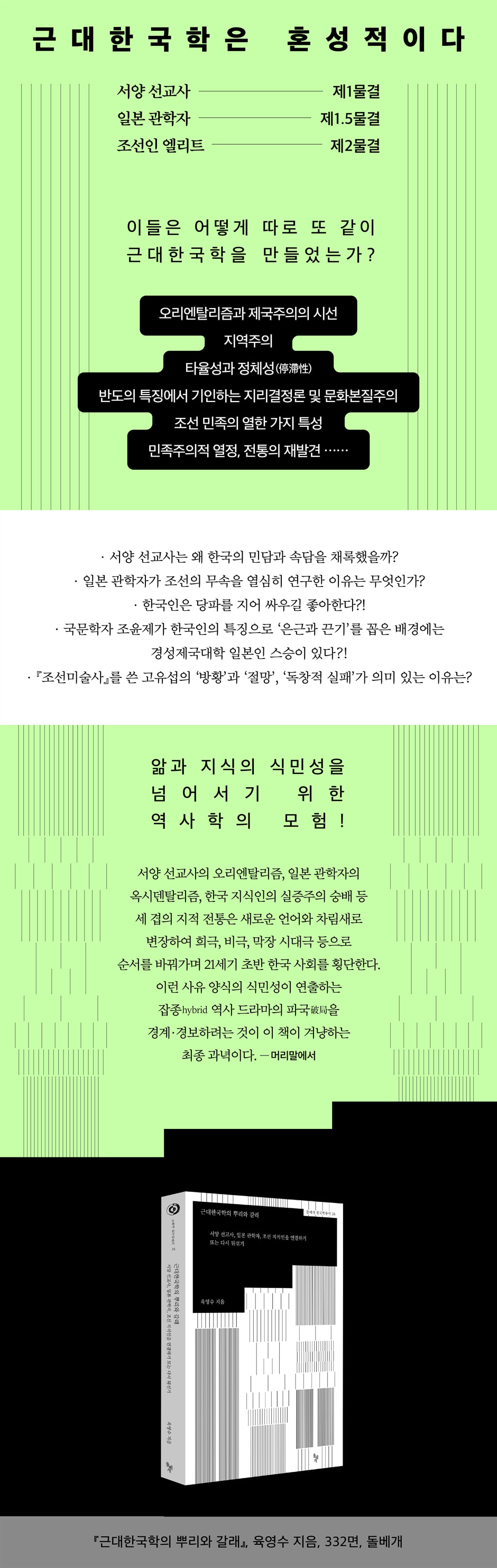
This book refers to the will of Western missionaries to know Korea for the purpose of missionary work as the first wave of modern Korean studies, the study of Korean studies by Japanese scholars as knowledge-power to justify Japan's colonial rule of Korea as the first and fifth waves, and the study of Korean studies by Korean scholars as the second wave. It depicts the form and pattern of modern Korean studies created by the overlapping and mutually pushing and pulling of these three waves.
Not only was modern Korean studies not shaped solely by the unique perspective of Koreans, but the genealogy of modern Korean studies, which sought to understand Korea and Koreans, is also engraved with the Orientalism and imperialism of Western missionaries, the colonial view of history of Japanese scholars, and the obsession with “scientific methodology” (positivism) of Korean scholars who were not free from these, imitating the West and Japan, and intellectual wandering.
The Origins of Modern Korean Studies: A History Marked by Orientalism and Western Supremacy
The main players in inventing modern Korean studies were French Catholic missionaries.
Charles Dallet's 『History of the Catholic Church in Korea』 is a book that records the stories of suffering and martyrdom of French missionaries and Korean Catholics. In the introduction, it briefly introduces Korean history and culture to help French readers understand.
We can see that Charles Dallet's understanding of Joseon was influenced by Orientalism, the superiority of Christian civilization, and the perspective of 'missionary imperialism' (the person who guided the French fleet in the Byeong-in Yangyo was the French missionary Ridel), and the reason this is problematic is that Japanese government scholars during the colonial period transformed and repeated this view into colonial historical views such as heteronomy theory, identity theory, and partisanship theory.
Protestant missionaries, too, were unable to escape Western superiority and Orientalism based on their progressive historical perspective in understanding Korea.
Academic journals, which functioned as an international network of Christian missionaries, actively exchanged knowledge and information about Korea with Japanese media outlets.
Furthermore, by incorporating not only Korean language and culture but also nature and the environment into the universal system of Western science, it manifested the modern 'will to know and be knowledgeable.'
The author argues that Korean studies, invented by Western missionaries, were the starting point and a key element of modern Korean studies, as they were later referenced by Japanese government officials and Joseon intellectuals, and thus cannot be ignored.
'Knowledge and Knowledge' that Underpinned Colonial Rule
Paradoxically, the research on Korean folk beliefs by Japanese imperial anthropologists and folklorists contributed to supporting the empire's mission of "colonial modernization."
And one of the representative achievements of the collaboration between the Government-General of Korea and the government-run academy was the publication of 『History of Joseon』 by the Joseon History Compilation Committee (1932-1938).
『History of Joseon』 is “a study of Joseon studies created and accumulated by Japanese government scholars,” and it embodies the methodology of positivist history.
Positivist history was a research methodology maintained by Japanese government officials during the colonial period, passed down to their Korean students at Keijo Imperial University, and had a long-lasting influence on Korean historical academia after liberation.
However, positivism has clearly revealed its limitations as a methodology for the humanities and social sciences, and the positivist history of the colonial era is particularly problematic in that it promoted scientific methodology, suppressed a historical consciousness that engaged with reality, and solidified a colonial view of history.
The Union and Collusion of Japanese Government Scholars and Korean Intellectuals: The Coloniality of Knowledge and Knowledge
Takahashi Toru's "Koreans" (1921) and Suematsu Yasukazu's "Guide to Korean History" (1936) are the definitive versions of "colonial Korean studies" commissioned by the Japanese Government-General of Korea and practiced by Japanese government scholars, and are "guides to knowledge and power for ruling Korea."
Takahashi Toru evaluates that the geographical characteristics of the Korean Peninsula gave rise to a lack of originality in thought, subservience to the great powers, stagnation, and a sense of obedience. However, it is not a simple matter to consider that later Korean scholars followed this geographical determinism and cultural essentialism.
Cho Yun-je, a student of Takahashi Toru at Keijo Imperial University, defined Koreans as “subtle and persistent,” as if to reenact the characteristics of Koreans that his teacher categorized in “Koreans.”
Suematsu Yasukazu's "A Guide to Joseon History" is a condensed version of colonial historiography that "synthesizes Joseon's five thousand years of history as an inevitable process toward 'development' and 'enlightenment.'"
This book shows the surprising fate of life not ending with the defeat of Japan, but continuing about 20 years later.
This 『Guide to Joseon History』, planned and published by the Japanese Government-General of Korea, is the original version of 『A Short History of Korea』, published by UNESCO, a United Nations international organization in 1963 to introduce Korean history to the world, and was translated and reused.
Author Yuk Young-su questions the silence of Korean academia on this matter and suspects a tacit collusion between Japanese scholars at Keijo Imperial University and Korean scholars who studied under them.
This tacit complicity is a stark reality of modern Korean studies discourse.
Properly understanding and reflecting on the discourse of modern Korean studies will be the starting point for overcoming the “coloniality of knowledge and knowledge.”
This book refers to the will of Western missionaries to know Korea for the purpose of missionary work as the first wave of modern Korean studies, the study of Korean studies by Japanese scholars as knowledge-power to justify Japan's colonial rule of Korea as the first and fifth waves, and the study of Korean studies by Korean scholars as the second wave. It depicts the form and pattern of modern Korean studies created by the overlapping and mutually pushing and pulling of these three waves.
Not only was modern Korean studies not shaped solely by the unique perspective of Koreans, but the genealogy of modern Korean studies, which sought to understand Korea and Koreans, is also engraved with the Orientalism and imperialism of Western missionaries, the colonial view of history of Japanese scholars, and the obsession with “scientific methodology” (positivism) of Korean scholars who were not free from these, imitating the West and Japan, and intellectual wandering.
The Origins of Modern Korean Studies: A History Marked by Orientalism and Western Supremacy
The main players in inventing modern Korean studies were French Catholic missionaries.
Charles Dallet's 『History of the Catholic Church in Korea』 is a book that records the stories of suffering and martyrdom of French missionaries and Korean Catholics. In the introduction, it briefly introduces Korean history and culture to help French readers understand.
We can see that Charles Dallet's understanding of Joseon was influenced by Orientalism, the superiority of Christian civilization, and the perspective of 'missionary imperialism' (the person who guided the French fleet in the Byeong-in Yangyo was the French missionary Ridel), and the reason this is problematic is that Japanese government scholars during the colonial period transformed and repeated this view into colonial historical views such as heteronomy theory, identity theory, and partisanship theory.
Protestant missionaries, too, were unable to escape Western superiority and Orientalism based on their progressive historical perspective in understanding Korea.
Academic journals, which functioned as an international network of Christian missionaries, actively exchanged knowledge and information about Korea with Japanese media outlets.
Furthermore, by incorporating not only Korean language and culture but also nature and the environment into the universal system of Western science, it manifested the modern 'will to know and be knowledgeable.'
The author argues that Korean studies, invented by Western missionaries, were the starting point and a key element of modern Korean studies, as they were later referenced by Japanese government officials and Joseon intellectuals, and thus cannot be ignored.
'Knowledge and Knowledge' that Underpinned Colonial Rule
Paradoxically, the research on Korean folk beliefs by Japanese imperial anthropologists and folklorists contributed to supporting the empire's mission of "colonial modernization."
And one of the representative achievements of the collaboration between the Government-General of Korea and the government-run academy was the publication of 『History of Joseon』 by the Joseon History Compilation Committee (1932-1938).
『History of Joseon』 is “a study of Joseon studies created and accumulated by Japanese government scholars,” and it embodies the methodology of positivist history.
Positivist history was a research methodology maintained by Japanese government officials during the colonial period, passed down to their Korean students at Keijo Imperial University, and had a long-lasting influence on Korean historical academia after liberation.
However, positivism has clearly revealed its limitations as a methodology for the humanities and social sciences, and the positivist history of the colonial era is particularly problematic in that it promoted scientific methodology, suppressed a historical consciousness that engaged with reality, and solidified a colonial view of history.
The Union and Collusion of Japanese Government Scholars and Korean Intellectuals: The Coloniality of Knowledge and Knowledge
Takahashi Toru's "Koreans" (1921) and Suematsu Yasukazu's "Guide to Korean History" (1936) are the definitive versions of "colonial Korean studies" commissioned by the Japanese Government-General of Korea and practiced by Japanese government scholars, and are "guides to knowledge and power for ruling Korea."
Takahashi Toru evaluates that the geographical characteristics of the Korean Peninsula gave rise to a lack of originality in thought, subservience to the great powers, stagnation, and a sense of obedience. However, it is not a simple matter to consider that later Korean scholars followed this geographical determinism and cultural essentialism.
Cho Yun-je, a student of Takahashi Toru at Keijo Imperial University, defined Koreans as “subtle and persistent,” as if to reenact the characteristics of Koreans that his teacher categorized in “Koreans.”
Suematsu Yasukazu's "A Guide to Joseon History" is a condensed version of colonial historiography that "synthesizes Joseon's five thousand years of history as an inevitable process toward 'development' and 'enlightenment.'"
This book shows the surprising fate of life not ending with the defeat of Japan, but continuing about 20 years later.
This 『Guide to Joseon History』, planned and published by the Japanese Government-General of Korea, is the original version of 『A Short History of Korea』, published by UNESCO, a United Nations international organization in 1963 to introduce Korean history to the world, and was translated and reused.
Author Yuk Young-su questions the silence of Korean academia on this matter and suspects a tacit collusion between Japanese scholars at Keijo Imperial University and Korean scholars who studied under them.
This tacit complicity is a stark reality of modern Korean studies discourse.
Properly understanding and reflecting on the discourse of modern Korean studies will be the starting point for overcoming the “coloniality of knowledge and knowledge.”
GOODS SPECIFICS
- Date of issue: July 29, 2024
- Page count, weight, size: 332 pages | 610g | 152*225*20mm
- ISBN13: 9791192836850
- ISBN10: 1192836855
You may also like
카테고리
korean


korean

![GQ KOREA Mark (Monthly): December [2025]](http://librairie.coreenne.fr/cdn/shop/files/8ef265dbbfbf186523ed75ba7319009d.jpg?v=1765340328&width=3840)


