

What should I do?
 |
Description
Book Introduction
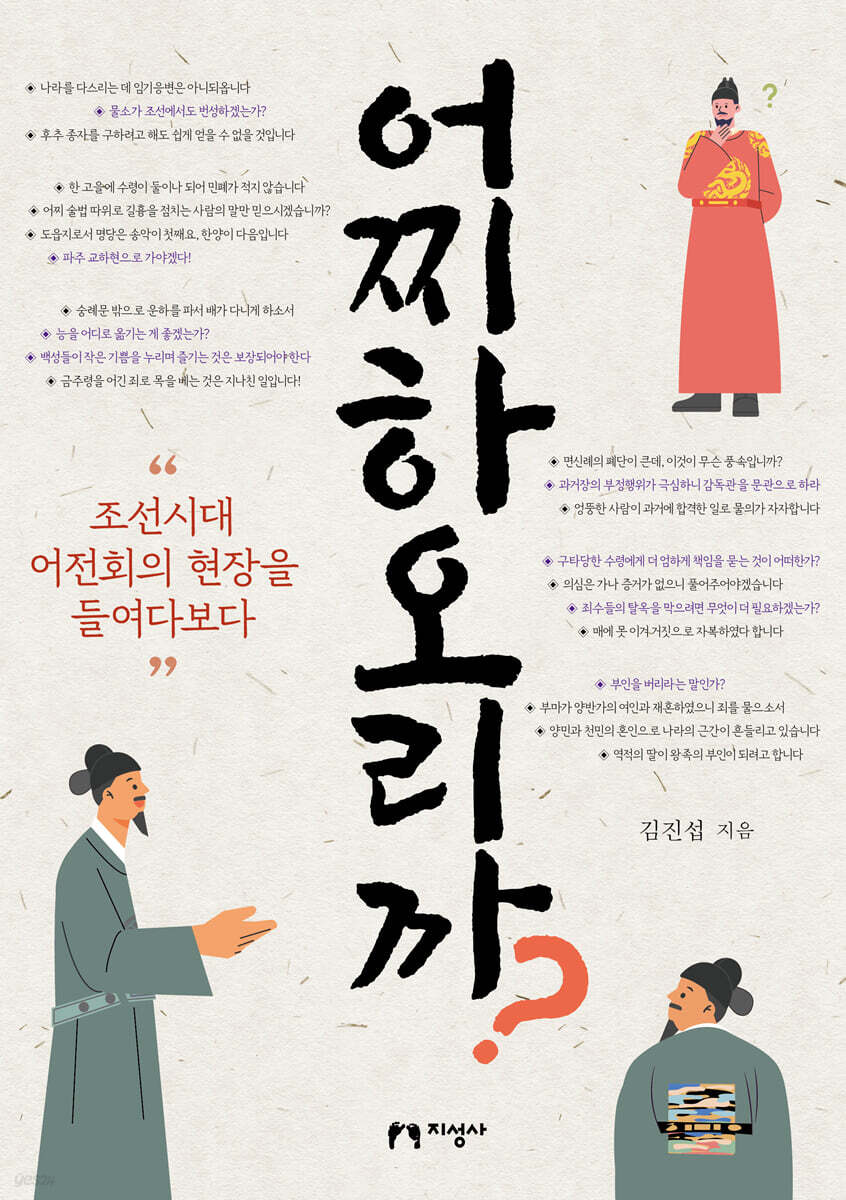
The Annals of the Joseon Dynasty, the most important source and gateway to understanding the Joseon Dynasty.
Among them, a history textbook was published that described and explained in detail the scene of the royal conference, where the king and his ministers met, asked and answered questions, and debated fiercely, as if it were a live broadcast.
This is exactly what author Jinseop Kim, a historical storyteller who connects the past and present, has to say about his work, “What Should We Do?”
The author provides insight into the rise and fall of the Joseon Dynasty through the records of royal meetings in the Annals of the Joseon Dynasty, which cover all aspects of state affairs, including politics, economy, people's livelihood, institutions, law, society, culture, and customs, and reexamines the role and value of history.
Among them, a history textbook was published that described and explained in detail the scene of the royal conference, where the king and his ministers met, asked and answered questions, and debated fiercely, as if it were a live broadcast.
This is exactly what author Jinseop Kim, a historical storyteller who connects the past and present, has to say about his work, “What Should We Do?”
The author provides insight into the rise and fall of the Joseon Dynasty through the records of royal meetings in the Annals of the Joseon Dynasty, which cover all aspects of state affairs, including politics, economy, people's livelihood, institutions, law, society, culture, and customs, and reexamines the role and value of history.
- You can preview some of the book's contents.
Preview
index
Part 1: For a country of kings and subjects: Politics/Diplomacy/Administration
Governing a country cannot be done by improvising.
Will water buffalo thrive in Joseon?
Even if you try to get pepper seeds, they won't be easy to obtain.
There are two magistrates in one county, causing a lot of trouble for the people.
Part 2: From the Capital to the Royal Tomb: What is the Hidden Meaning of Feng Shui?: Geography/Customs
How could you believe the words of someone who uses magic to tell fortunes?
As a capital city, Songak is the most auspicious site, followed by Hanyang.
I have to go to Paju Gyoha-hyeon!
Dig a canal outside Sungnyemun Gate so that ships can sail through it.
Where would be a good place to move the tomb?
Part 3: Prohibition and the Past Passing Story: People's Livelihood/Education
The people must be guaranteed the enjoyment of small pleasures.
It is excessive to behead someone for breaking the prohibition law!
The practice of the rite of passage has serious drawbacks. What kind of custom is this?
The past misconduct was so severe that the supervisor should be a civil official.
There is a lot of controversy over the fact that an illogical person passed the exam in the past.
Part 4: How Were Various Violent Incidents Handled?: Law/System
How about holding the beaten leader more accountable?
There is suspicion, but no evidence, so we must let it go.
What more could be done to prevent prisoners from escaping?
It is said that he confessed falsely because he could not stand the beating.
Part 5: The State's Involvement in Marriage and Divorce: Society/Culture
Are you telling me to abandon my wife?
My husband remarried a woman from a noble family, so please punish him.
The foundations of the country are being shaken by intermarriage between commoners and commoners.
The daughter of a traitor seeks to become a royal wife.
Major government posts in the Joseon Dynasty
Governing a country cannot be done by improvising.
Will water buffalo thrive in Joseon?
Even if you try to get pepper seeds, they won't be easy to obtain.
There are two magistrates in one county, causing a lot of trouble for the people.
Part 2: From the Capital to the Royal Tomb: What is the Hidden Meaning of Feng Shui?: Geography/Customs
How could you believe the words of someone who uses magic to tell fortunes?
As a capital city, Songak is the most auspicious site, followed by Hanyang.
I have to go to Paju Gyoha-hyeon!
Dig a canal outside Sungnyemun Gate so that ships can sail through it.
Where would be a good place to move the tomb?
Part 3: Prohibition and the Past Passing Story: People's Livelihood/Education
The people must be guaranteed the enjoyment of small pleasures.
It is excessive to behead someone for breaking the prohibition law!
The practice of the rite of passage has serious drawbacks. What kind of custom is this?
The past misconduct was so severe that the supervisor should be a civil official.
There is a lot of controversy over the fact that an illogical person passed the exam in the past.
Part 4: How Were Various Violent Incidents Handled?: Law/System
How about holding the beaten leader more accountable?
There is suspicion, but no evidence, so we must let it go.
What more could be done to prevent prisoners from escaping?
It is said that he confessed falsely because he could not stand the beating.
Part 5: The State's Involvement in Marriage and Divorce: Society/Culture
Are you telling me to abandon my wife?
My husband remarried a woman from a noble family, so please punish him.
The foundations of the country are being shaken by intermarriage between commoners and commoners.
The daughter of a traitor seeks to become a royal wife.
Major government posts in the Joseon Dynasty
Into the book
Seongjong firmly stated, “We cannot severely punish those who come forward and complain about grievances and injustices,” and asked about the way things were handled during the reign of King Sejong.
To this, Jeong Chang-son replied, “There was absolutely no such thing during the reign of King Sejong.”
Seongjong asked again, “How was it done during the reign of King Sejo?” This time, Kim Seung-gyeong answered, “There were cases during the reign of King Sejo, but it never reached this level,” and that although there were cases of people complaining of injustice, it was not that severe.
King Seongjong, who received the report, ordered a more detailed review, saying, “Discuss and report on the provisions to be applied to the crime.”
--- p.53~54
As time passed, the water level of the Han River near the Yongsan River gradually dropped, and mud accumulated on the Yeomchang sand dunes, preventing the tide from coming in. As a result, transport ships coming up from each province went downstream to Mapo or Seogang and anchored.
However, King Taejong, upon seeing Ha Ryun's proposal, said, "Our country's land is all sand and rock, so water cannot remain there, so we cannot imitate the Chinese canals.
He said, “I will discuss it tomorrow,” and went out to Gyeonghoeru and said to the ministers of the State Council, “It would be truly fortunate if a canal were dug from Sungnyemun to Yongsan River so that ships could pass through.
However, since it is sandy soil, I doubt that it will always hold water.
“What do you think, sir?” he asked.
The ministers who received Taejong's question answered, "It is possible," and Park Ja-cheong in particular said, "All the land is rice paddies that can be irrigated, so it will not leak.
He responded positively, saying, “The canal digging project will take less than a month if 10,000 people participate, so please try it out.”
--- p.96~97
In addition, the attitude of the ancestors was also a problem.
King Seonjo believed that the Imjin War was caused by the palace's exhaustion of energy, and in the 27th year of King Seonjo's reign (1594), he sought advice from Ye Jeong-guk, a geomancy expert and advisor to a Ming general who had entered Joseon with the Ming army, and even asked for his opinion on the geomancy of the entire country.
When a controversy arose over where to build the tomb of Queen Uiin, who died on June 27 of the same year, King Seonjo also summoned the regency.
--- p.110~111
In 1762, the 38th year of King Yeongjo's reign, Yun Gu-yeon, the Southern Commander, was executed for violating the prohibition on alcohol.
At the time, Yoon Gu-yeon was not caught making or drinking alcohol; all that was found was an empty bottle of alcohol found at his house.
Because of this, the three prime ministers, including the Prime Minister, came forward to try to save Yun Gu-yeon, but King Yeongjo was so angry that he did not respond. Instead, he dismissed them from their posts and went to Sungnyemun himself to execute Yun Gu-yeon.
(…) On this day, Gu Sang reported the following regarding King Yeongjo’s strict prohibition of alcohol.
“His Majesty’s intention in executing those who broke the prohibition order was to prevent anyone from disobeying the spirit.
However, where there is profit, no matter how strict the laws and harsh the punishments, the people will not follow orders, and this is not a crime punishable by death.
However, making it a permanent rule to impose the same punishment on those who kill people does not mean to pass on leniency to future generations.
“I beg you to spare from death those who violate the prohibition order from now on, and to punish them accordingly.”
King Yeongjo accepted Gu Sang's opinion, saying, "The punishment for violating the prohibition should be graded according to the amount of alcohol consumed." The historian recorded the discussion that day, saying, "...the learned men praised Gu Sang because he was able to change the king's mind with just one word and only then did they discuss lowering the level of punishment."
--- p.135~136
The initiation ceremony, or the report ceremony, did not end with just one time.
In severe cases, they would bring alcohol and snacks from home and treat me to food about 10 times before I even started work.
Various terms were created, such as jinggu (徵求), where a senior official asks a new official for money or grains as part of an initiation ceremony; chodo (初度), where new officials are forced to work overnight for ten days or even a month; and myeonsin (免新), where alcohol and snacks are prepared in large quantities during an initiation ceremony.
--- p.141~142
On September 17, 1433, the 15th year of King Sejong's reign, the Ministry of Justice reported to King Sejong the results of its investigation into cases involving runaway slaves, which included the following various cases:
“The Jinju prisoner Daemun was the servant of the household head, Kang Eun, and had already run away for three years. When Kang Eun tried to find Daemun and capture him, Daemun threw a stone at him and ran away. The Seonsan prisoner Kang Dal betrayed his master and entered the house of Yeonchang-gun. There, he grabbed his master by the hair, threw him to the ground, trampled him, kicked his sides and legs, and cursed him, saying, ‘You son of a bitch, am I still your servant?’ The Hamyang prisoner, Lee Suk-beon’s servant Sobi, was 15 years old. When her master tried to commit adultery with her, she resisted and stabbed him in the forehead with a sword, injuring him.
Also, when Cheon-Oi, a prisoner in Jeon-Ok (典獄), was beaten by his master Kim Jong-Hyeok with a stick after grabbing his hair, he pulled out the knife he was carrying and stabbed his master's fingers, forehead, and cheek, causing him to bleed. He also tore his clothes and sleeves in five places. So Cheon-Oi was beaten while being interrogated five times and made to kneel on a sandpit five times while pressing down heavy rocks on top of him. Cheon-Oi said, 'I did that to escape danger, I never had any intention of killing him in the first place.'
--- p.197
Even in the 15th century, there was serious discussion between the king and his ministers about ways to force young women to marry by law, such as “let the state relieve women of the burden of wedding expenses who missed the right time to marry due to poverty and fatherlessness, and let the person who officiated the marriage be punished as prescribed in the law if they did not marry without a special reason.”
However, the idea that men and women should live together as a couple is a basic human principle and does not always apply to everyone.
A representative example is the law prohibiting widows from remarrying during the reign of King Seongjong.
Because of this, on December 12, 1497, the third year of King Yeonsangun's reign, Song Heon-dong, a Danseong instructor, submitted a petition saying, "Some became widows after only three days of marriage, some after a month, and some at the age of 20 or 30... Please allow all widows under the age of 30 with no children to remarry so that they can enjoy life." This led to a debate among the ministers, with opinions divided for and against.
To this, Jeong Chang-son replied, “There was absolutely no such thing during the reign of King Sejong.”
Seongjong asked again, “How was it done during the reign of King Sejo?” This time, Kim Seung-gyeong answered, “There were cases during the reign of King Sejo, but it never reached this level,” and that although there were cases of people complaining of injustice, it was not that severe.
King Seongjong, who received the report, ordered a more detailed review, saying, “Discuss and report on the provisions to be applied to the crime.”
--- p.53~54
As time passed, the water level of the Han River near the Yongsan River gradually dropped, and mud accumulated on the Yeomchang sand dunes, preventing the tide from coming in. As a result, transport ships coming up from each province went downstream to Mapo or Seogang and anchored.
However, King Taejong, upon seeing Ha Ryun's proposal, said, "Our country's land is all sand and rock, so water cannot remain there, so we cannot imitate the Chinese canals.
He said, “I will discuss it tomorrow,” and went out to Gyeonghoeru and said to the ministers of the State Council, “It would be truly fortunate if a canal were dug from Sungnyemun to Yongsan River so that ships could pass through.
However, since it is sandy soil, I doubt that it will always hold water.
“What do you think, sir?” he asked.
The ministers who received Taejong's question answered, "It is possible," and Park Ja-cheong in particular said, "All the land is rice paddies that can be irrigated, so it will not leak.
He responded positively, saying, “The canal digging project will take less than a month if 10,000 people participate, so please try it out.”
--- p.96~97
In addition, the attitude of the ancestors was also a problem.
King Seonjo believed that the Imjin War was caused by the palace's exhaustion of energy, and in the 27th year of King Seonjo's reign (1594), he sought advice from Ye Jeong-guk, a geomancy expert and advisor to a Ming general who had entered Joseon with the Ming army, and even asked for his opinion on the geomancy of the entire country.
When a controversy arose over where to build the tomb of Queen Uiin, who died on June 27 of the same year, King Seonjo also summoned the regency.
--- p.110~111
In 1762, the 38th year of King Yeongjo's reign, Yun Gu-yeon, the Southern Commander, was executed for violating the prohibition on alcohol.
At the time, Yoon Gu-yeon was not caught making or drinking alcohol; all that was found was an empty bottle of alcohol found at his house.
Because of this, the three prime ministers, including the Prime Minister, came forward to try to save Yun Gu-yeon, but King Yeongjo was so angry that he did not respond. Instead, he dismissed them from their posts and went to Sungnyemun himself to execute Yun Gu-yeon.
(…) On this day, Gu Sang reported the following regarding King Yeongjo’s strict prohibition of alcohol.
“His Majesty’s intention in executing those who broke the prohibition order was to prevent anyone from disobeying the spirit.
However, where there is profit, no matter how strict the laws and harsh the punishments, the people will not follow orders, and this is not a crime punishable by death.
However, making it a permanent rule to impose the same punishment on those who kill people does not mean to pass on leniency to future generations.
“I beg you to spare from death those who violate the prohibition order from now on, and to punish them accordingly.”
King Yeongjo accepted Gu Sang's opinion, saying, "The punishment for violating the prohibition should be graded according to the amount of alcohol consumed." The historian recorded the discussion that day, saying, "...the learned men praised Gu Sang because he was able to change the king's mind with just one word and only then did they discuss lowering the level of punishment."
--- p.135~136
The initiation ceremony, or the report ceremony, did not end with just one time.
In severe cases, they would bring alcohol and snacks from home and treat me to food about 10 times before I even started work.
Various terms were created, such as jinggu (徵求), where a senior official asks a new official for money or grains as part of an initiation ceremony; chodo (初度), where new officials are forced to work overnight for ten days or even a month; and myeonsin (免新), where alcohol and snacks are prepared in large quantities during an initiation ceremony.
--- p.141~142
On September 17, 1433, the 15th year of King Sejong's reign, the Ministry of Justice reported to King Sejong the results of its investigation into cases involving runaway slaves, which included the following various cases:
“The Jinju prisoner Daemun was the servant of the household head, Kang Eun, and had already run away for three years. When Kang Eun tried to find Daemun and capture him, Daemun threw a stone at him and ran away. The Seonsan prisoner Kang Dal betrayed his master and entered the house of Yeonchang-gun. There, he grabbed his master by the hair, threw him to the ground, trampled him, kicked his sides and legs, and cursed him, saying, ‘You son of a bitch, am I still your servant?’ The Hamyang prisoner, Lee Suk-beon’s servant Sobi, was 15 years old. When her master tried to commit adultery with her, she resisted and stabbed him in the forehead with a sword, injuring him.
Also, when Cheon-Oi, a prisoner in Jeon-Ok (典獄), was beaten by his master Kim Jong-Hyeok with a stick after grabbing his hair, he pulled out the knife he was carrying and stabbed his master's fingers, forehead, and cheek, causing him to bleed. He also tore his clothes and sleeves in five places. So Cheon-Oi was beaten while being interrogated five times and made to kneel on a sandpit five times while pressing down heavy rocks on top of him. Cheon-Oi said, 'I did that to escape danger, I never had any intention of killing him in the first place.'
--- p.197
Even in the 15th century, there was serious discussion between the king and his ministers about ways to force young women to marry by law, such as “let the state relieve women of the burden of wedding expenses who missed the right time to marry due to poverty and fatherlessness, and let the person who officiated the marriage be punished as prescribed in the law if they did not marry without a special reason.”
However, the idea that men and women should live together as a couple is a basic human principle and does not always apply to everyone.
A representative example is the law prohibiting widows from remarrying during the reign of King Seongjong.
Because of this, on December 12, 1497, the third year of King Yeonsangun's reign, Song Heon-dong, a Danseong instructor, submitted a petition saying, "Some became widows after only three days of marriage, some after a month, and some at the age of 20 or 30... Please allow all widows under the age of 30 with no children to remarry so that they can enjoy life." This led to a debate among the ministers, with opinions divided for and against.
--- p.230~231
Publisher's Review
In the Joseon Dynasty's royal conference, between the king and his ministers
What kind of stories were told?
In the midst of fierce and persistent questions and answers
Finding answers to the rise and fall of the Joseon Dynasty!
The Annals of the Joseon Dynasty, the most important source and gateway to understanding the Joseon Dynasty.
Among them, a history textbook was published that described and explained in detail the scene of the royal conference, where the king and his ministers met, asked and answered questions, and debated fiercely, as if it were a live broadcast.
This is exactly what author Jinseop Kim, a historical storyteller who connects the past and present, has to say about his work, “What Should We Do?”
The author provides insight into the rise and fall of the Joseon Dynasty through the records of royal meetings in the Annals of the Joseon Dynasty, which cover all aspects of state affairs, including politics, economy, people's livelihood, institutions, law, society, culture, and customs, and reexamines the role and value of history.
The collective decision-making system that shook Joseon,
A peek into the royal meeting
To the east of Daejojeon (大造殿) in Changdeokgung Palace, which was the queen's bedroom, there is a small pavilion called Heungbokheon (興福軒), where the last royal meeting of Joseon was held on August 22, 1910.
At that time, in addition to the ministers of state, representatives of the imperial family and senior civil and military officials attended the Imperial Conference to discuss the Japan-Korea Annexation Treaty. It was decided to appoint Yi Wan-yong as a plenipotentiary and have him negotiate an agreement with the Japanese Resident-General. Ultimately, on April 25, 1926, Emperor Sunjong passed away here, and Heungbokheon became the place where the empire met its end.
The Joseon Dynasty's royal council, where the king and his ministers fiercely discussed state affairs while worrying about the country and its people, disappeared into history along with the fate of the empire.
Author Kim Jin-seop, who has consistently uncovered and introduced Korean history and cultural content, focused on the Joseon Dynasty's royal council, which functioned as an absolute decision-making system that could determine the rise and fall of a nation.
The author meticulously examined the Annals of the Joseon Dynasty, which records historical facts in chronological order over 472 years from the reign of King Taejo, the founder of the Joseon Dynasty, to King Cheoljong (the Annals of King Gojong and King Sunjong were compiled by the Japanese during the Japanese colonial period and are therefore not generally included in the Annals of the Joseon Dynasty), and logically and calmly unraveled the various moments of decision-making that appeared in the royal council and the implications contained within them.
From politics to people's livelihood
Words, words, words poured out at the royal meeting
Joseon's royal meetings were mainly held through regular meetings such as the Choehoe (朝會), Chocham (朝參), and Sangcham (常參), where greetings were given to the king, and the Gyeongyeon (經筵) and Baekwan (百官) meetings, where state affairs were discussed.
Among these, the Gyeongyeon, which can be said to be the core of the royal conference, was held two or three times a day unless there was a special reason, so it is evaluated that “the Gyeongyeon of the Joseon Dynasty was also an opportunity for exchange and communication between the king and his subjects, and the success or failure of the Gyeongyeon affected the lives of the people.”
The meeting was attended by high-ranking officials including the Prime Minister and the Minister of State, officials such as the Daegan (Office of Censors) and the Hongmungwan (Office of Royal Decrees), and historians in charge of recording the records. In this book, the author travels across the 500 years of time and space of the Joseon Dynasty, summoning from sage kings like Sejong and famous ministers such as Hwang Hui and Maeng Sa-seong, and dealing with specific examples by topic to show how they made rational decisions and achieved cooperation.
The author delicately portrays the king and his ministers' repeated discussions and communication that lasted from a few days to a year, especially in cases where opinions were sharply divided: the story of Taejo, who tried to force the relocation of the capital that would be a burden on state affairs in the early days of the founding of the country, and Jeong Do-jeon, who tried to stop him (1394); the story of Eun Yeo-rim and Taejong, who did not hesitate to speak out on the issue of Seogyeong, which limited the king's power to appoint personnel (1413); the story of Hwang Hyo-won, a nobleman, who took a slave's daughter as his legitimate wife (1476); and the story of King Yeongjo, who punished those who violated the prohibition on alcohol with death, and Goo Sang, who changed Yeongjo's mind with a single word (1763).
Of course, there were also cases of lack of communication, such as the story of King Seonjo (1594), who insisted on and relied excessively on Ming Dynasty geomancers.
In addition, there is a considerable amount of content that allows us to understand the customs of the time and the lives of the common people revealed in the process of reporting facts to the king. For example, there is a story about the vicious(?) initiation ceremony called 'Myeonsinrye' that anyone who passed the civil service examination had to go through when first taking office, a story about how marriage between men and women of different social status was the main cause of the slave lawsuit, one of the three major lawsuits in Joseon, a story about how the tavern culture was developed to the point where there were night bars that sold alcohol all night, taverns called 'Mokro' where people would stand around a wooden table and drink simply, and 'palttukjips' where the hostess would serve alcohol and snacks by holding out only her forearm without showing her face.
So, let's listen directly to the words of the king, ministers, and officers that poured out at the royal meeting.
“When it comes to governing a country, you can’t just improvise.
“I beg you to follow the words of God and others.”
_What Prime Minister Maeng Sa-seong said to King Sejong, who was agonizing over the charge against Lee Jing-ok for lying to the Ming envoy
“Feng Shui and other geomantic methods are simply explanations of principles, and using them to predict the future is completely unreliable. Furthermore, moving a tomb is meant to pray for the blessings of future generations. If you are a king, what more could you ask for?”
_Seo Geo-jeong's reply to King Sejo, who was trying to move the tombs of his father, King Sejong, and his mother, Queen Soheon, based on feng shui
“…If a lowly commoner is refuted for getting drunk just once, and those who live in luxury and comfort are not refuted for drinking every day, then such a law will be of no benefit even if it is enforced.”
_A word from King Sejo, pointing out fairness and equity in the enforcement of the prohibition, in response to Kim Myeong-jung's statement that the prohibition should be strengthened.
“…(Who would say that it was wrong to punish King Kim)? Yet, the minister, by saying things like ‘a certain official spoke privately’ and ‘a certain person interfered’, bothered the king’s ears and ignored the petty criticism.
“Oh, can you hold someone like me responsible for your own dignity and reputation?”
_The historian's assessment of the Taoist official Kim Wang, who committed corruption to please those in power, and the minister who criticized him.
The royal meeting
What homework is left for us?
In this book, the subjective evaluations and interpretations of events and people by historians, that is, historical reviews, are also worth noting.
The officer not only recorded the facts as they were, but also wrote directly about the right and wrongs, criticism of people, and confidential matters.
In particular, the historical manuscripts, which can be called the first drafts, were not even accessible to the king to ensure the authenticity and independence of the records. This exercised the power to control the king through the records and served the function of constantly checking and monitoring power.
The role of these officers is reminiscent of the function of the media today, which monitors and criticizes power.
The Joseon Dynasty's royal councils have now disappeared, but in today's democratic world where "citizens are reporters," each individual needs to have a watchful eye like a historian.
Readers interested in history and culture are encouraged to take a fascinating time travel into the Joseon Dynasty's royal court through this book.
What kind of stories were told?
In the midst of fierce and persistent questions and answers
Finding answers to the rise and fall of the Joseon Dynasty!
The Annals of the Joseon Dynasty, the most important source and gateway to understanding the Joseon Dynasty.
Among them, a history textbook was published that described and explained in detail the scene of the royal conference, where the king and his ministers met, asked and answered questions, and debated fiercely, as if it were a live broadcast.
This is exactly what author Jinseop Kim, a historical storyteller who connects the past and present, has to say about his work, “What Should We Do?”
The author provides insight into the rise and fall of the Joseon Dynasty through the records of royal meetings in the Annals of the Joseon Dynasty, which cover all aspects of state affairs, including politics, economy, people's livelihood, institutions, law, society, culture, and customs, and reexamines the role and value of history.
The collective decision-making system that shook Joseon,
A peek into the royal meeting
To the east of Daejojeon (大造殿) in Changdeokgung Palace, which was the queen's bedroom, there is a small pavilion called Heungbokheon (興福軒), where the last royal meeting of Joseon was held on August 22, 1910.
At that time, in addition to the ministers of state, representatives of the imperial family and senior civil and military officials attended the Imperial Conference to discuss the Japan-Korea Annexation Treaty. It was decided to appoint Yi Wan-yong as a plenipotentiary and have him negotiate an agreement with the Japanese Resident-General. Ultimately, on April 25, 1926, Emperor Sunjong passed away here, and Heungbokheon became the place where the empire met its end.
The Joseon Dynasty's royal council, where the king and his ministers fiercely discussed state affairs while worrying about the country and its people, disappeared into history along with the fate of the empire.
Author Kim Jin-seop, who has consistently uncovered and introduced Korean history and cultural content, focused on the Joseon Dynasty's royal council, which functioned as an absolute decision-making system that could determine the rise and fall of a nation.
The author meticulously examined the Annals of the Joseon Dynasty, which records historical facts in chronological order over 472 years from the reign of King Taejo, the founder of the Joseon Dynasty, to King Cheoljong (the Annals of King Gojong and King Sunjong were compiled by the Japanese during the Japanese colonial period and are therefore not generally included in the Annals of the Joseon Dynasty), and logically and calmly unraveled the various moments of decision-making that appeared in the royal council and the implications contained within them.
From politics to people's livelihood
Words, words, words poured out at the royal meeting
Joseon's royal meetings were mainly held through regular meetings such as the Choehoe (朝會), Chocham (朝參), and Sangcham (常參), where greetings were given to the king, and the Gyeongyeon (經筵) and Baekwan (百官) meetings, where state affairs were discussed.
Among these, the Gyeongyeon, which can be said to be the core of the royal conference, was held two or three times a day unless there was a special reason, so it is evaluated that “the Gyeongyeon of the Joseon Dynasty was also an opportunity for exchange and communication between the king and his subjects, and the success or failure of the Gyeongyeon affected the lives of the people.”
The meeting was attended by high-ranking officials including the Prime Minister and the Minister of State, officials such as the Daegan (Office of Censors) and the Hongmungwan (Office of Royal Decrees), and historians in charge of recording the records. In this book, the author travels across the 500 years of time and space of the Joseon Dynasty, summoning from sage kings like Sejong and famous ministers such as Hwang Hui and Maeng Sa-seong, and dealing with specific examples by topic to show how they made rational decisions and achieved cooperation.
The author delicately portrays the king and his ministers' repeated discussions and communication that lasted from a few days to a year, especially in cases where opinions were sharply divided: the story of Taejo, who tried to force the relocation of the capital that would be a burden on state affairs in the early days of the founding of the country, and Jeong Do-jeon, who tried to stop him (1394); the story of Eun Yeo-rim and Taejong, who did not hesitate to speak out on the issue of Seogyeong, which limited the king's power to appoint personnel (1413); the story of Hwang Hyo-won, a nobleman, who took a slave's daughter as his legitimate wife (1476); and the story of King Yeongjo, who punished those who violated the prohibition on alcohol with death, and Goo Sang, who changed Yeongjo's mind with a single word (1763).
Of course, there were also cases of lack of communication, such as the story of King Seonjo (1594), who insisted on and relied excessively on Ming Dynasty geomancers.
In addition, there is a considerable amount of content that allows us to understand the customs of the time and the lives of the common people revealed in the process of reporting facts to the king. For example, there is a story about the vicious(?) initiation ceremony called 'Myeonsinrye' that anyone who passed the civil service examination had to go through when first taking office, a story about how marriage between men and women of different social status was the main cause of the slave lawsuit, one of the three major lawsuits in Joseon, a story about how the tavern culture was developed to the point where there were night bars that sold alcohol all night, taverns called 'Mokro' where people would stand around a wooden table and drink simply, and 'palttukjips' where the hostess would serve alcohol and snacks by holding out only her forearm without showing her face.
So, let's listen directly to the words of the king, ministers, and officers that poured out at the royal meeting.
“When it comes to governing a country, you can’t just improvise.
“I beg you to follow the words of God and others.”
_What Prime Minister Maeng Sa-seong said to King Sejong, who was agonizing over the charge against Lee Jing-ok for lying to the Ming envoy
“Feng Shui and other geomantic methods are simply explanations of principles, and using them to predict the future is completely unreliable. Furthermore, moving a tomb is meant to pray for the blessings of future generations. If you are a king, what more could you ask for?”
_Seo Geo-jeong's reply to King Sejo, who was trying to move the tombs of his father, King Sejong, and his mother, Queen Soheon, based on feng shui
“…If a lowly commoner is refuted for getting drunk just once, and those who live in luxury and comfort are not refuted for drinking every day, then such a law will be of no benefit even if it is enforced.”
_A word from King Sejo, pointing out fairness and equity in the enforcement of the prohibition, in response to Kim Myeong-jung's statement that the prohibition should be strengthened.
“…(Who would say that it was wrong to punish King Kim)? Yet, the minister, by saying things like ‘a certain official spoke privately’ and ‘a certain person interfered’, bothered the king’s ears and ignored the petty criticism.
“Oh, can you hold someone like me responsible for your own dignity and reputation?”
_The historian's assessment of the Taoist official Kim Wang, who committed corruption to please those in power, and the minister who criticized him.
The royal meeting
What homework is left for us?
In this book, the subjective evaluations and interpretations of events and people by historians, that is, historical reviews, are also worth noting.
The officer not only recorded the facts as they were, but also wrote directly about the right and wrongs, criticism of people, and confidential matters.
In particular, the historical manuscripts, which can be called the first drafts, were not even accessible to the king to ensure the authenticity and independence of the records. This exercised the power to control the king through the records and served the function of constantly checking and monitoring power.
The role of these officers is reminiscent of the function of the media today, which monitors and criticizes power.
The Joseon Dynasty's royal councils have now disappeared, but in today's democratic world where "citizens are reporters," each individual needs to have a watchful eye like a historian.
Readers interested in history and culture are encouraged to take a fascinating time travel into the Joseon Dynasty's royal court through this book.
GOODS SPECIFICS
- Date of issue: July 19, 2024
- Page count, weight, size: 272 pages | 153*217*13mm
- ISBN13: 9788978895521
You may also like
카테고리
korean


korean

![GQ KOREA Mark (Monthly): December [2025]](http://librairie.coreenne.fr/cdn/shop/files/8ef265dbbfbf186523ed75ba7319009d.jpg?v=1765340328&width=3840)


