

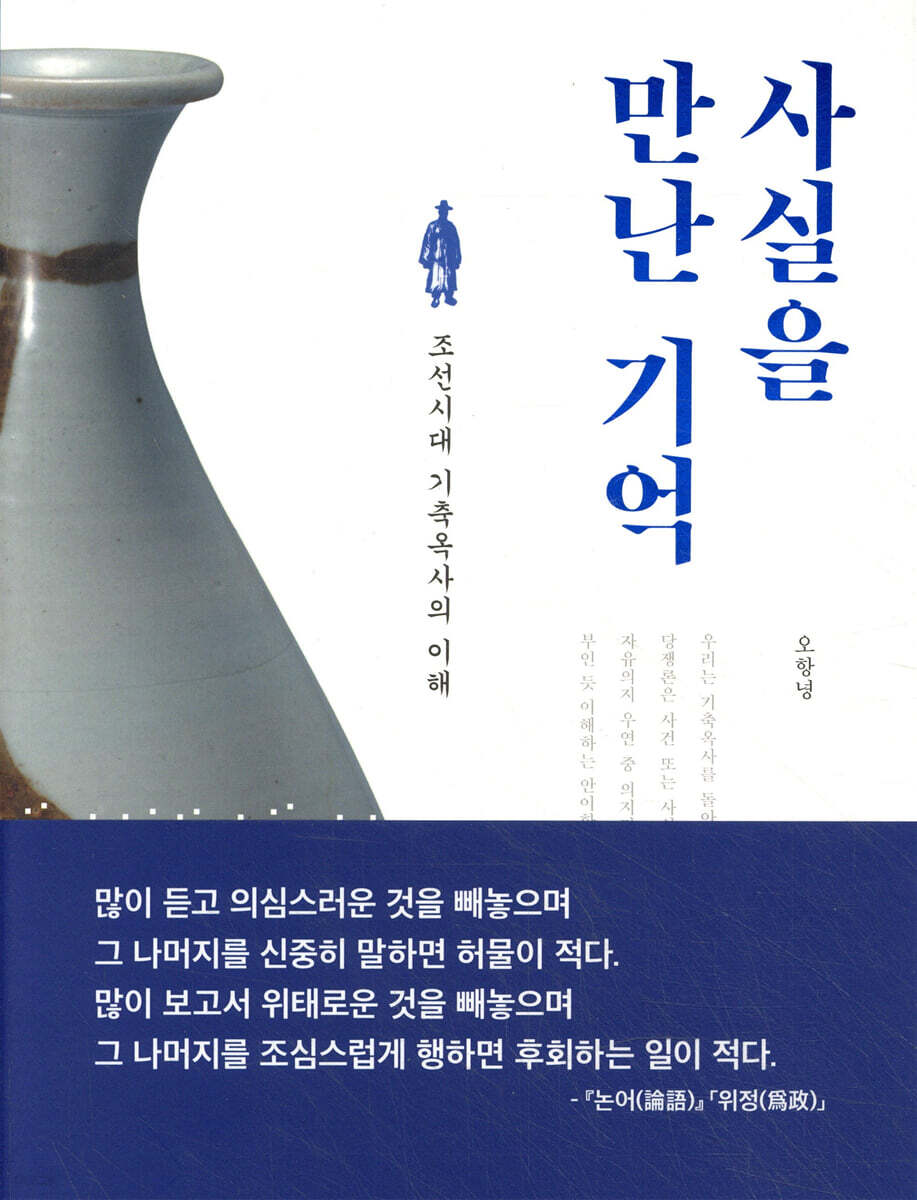
Memories of meeting the truth
 |
Description
Book Introduction
Reflecting on the meaning of historical inquiry while examining the full story of the Gichuk Oksa debate
History is a record of facts.
What is the 'fact' in this case?
The author defines facts as “human activities or their results that take place in space and time, and are composed of three elements: structure, will, and chance.”
This book examines the controversy surrounding the 'Gichuk Oksa' and discusses attitudes toward history.
History is a record of facts.
What is the 'fact' in this case?
The author defines facts as “human activities or their results that take place in space and time, and are composed of three elements: structure, will, and chance.”
This book examines the controversy surrounding the 'Gichuk Oksa' and discusses attitudes toward history.
index
Prologue If in doubt, leave it alone
Part 1: The Origin and Development of the Gichuk Oksa
Chapter 1: Jeong Yeo-rip's Rebellion and Its Development
- An event that everyone fears, treason
- Research trends and issues
- Distance between the feed and the argument
- The many voices of the many people in the palace
- War and political turmoil
- A report from Hwanghae-do
- Could it be Jeong Yeo-rip…
- The transfer and investigation of criminals
- The logic of the Yangcheonhoe petition
- Handle the incident
- Expansion of Oksa
- Jeong Am-su's petition
- The epidemic spread across the country
- appointing meritorious subjects
Chapter II: Contamination: Partisanship and Modernism
- Regrettable doubts
- Conspiracy theory fallacy
- Errors and fabrications are different.
- The fiction of Song Ik-pil's mastermind theory
- Time is not on the side of memory.
- Breaking free from the shackles of partisan strife
- Weaknesses of the Annals of King Seonjo
- Records of the day that disappeared
- The twists and turns of compiling the Annals of King Seonjo
- Direction of revision of the Annals
- Correction of biased opinions
- Reflection on uncritical citation
Unexpected Income: Jeong In-hong's "Confession"
- Counter-evidence against the party frame
- Re-enacting memories: regional discrimination?
- Rebuttal to the regional discrimination theory
- The Reappearance of Memory: Modern Thought?
- A Reexamination of Jeong Yeo-rip's Thought
- The dilemma of explanation and interpretation
- The path to productive discussion
- The lottery of Jeongcheol and Ibal
Part 2: Year 23 of King Seonjo's reign? Year 24 of King Seonjo's reign?
Chapter Ⅲ_ That Era, Songgang and Seoae
- Crossroads of Memory
- Second objection and criticism
- Is treason justified?
- Back to homework
- Song Kang's appearance recorded in the Annals of the Joseon Dynasty
- Seoae's appearance recorded in the Annals of the Joseon Dynasty
Chapter IV_ The 23rd year of King Seonjo's reign, or the 24th year of King Seonjo's reign?
- The wild history is vague
- The spark of conflict has been rekindled
- Replay of distorted memories
- What really happened?
- Repeated, misplaced memories
- Is it over now?
- Another memory and question
- Who would know better?
- Limitations of the Annals of King Seonjo
- The struggles of Lee Sik, the founder of Takdang
- Other meanings of Zhu Moshi
- Records of the Gichuk Oksa in the revised version
- Facts different from later memories
- After the era of the confused monarch
- Tentative conclusion
- Conditions, will, and chance
- Composition of the Chugukcheong
- Case: Discussion on punishment for suspects
- A time when there was no prison sentence
- Confession, and the imperfect human being
- Are you trying to fight me?
Epilogue
supplement
1.
『Song Gang Haengjang』 _Kim Jip Kim Group
2.
『Seoae Haengjang』 _Jeong Gyeong-se
References
Search
Part 1: The Origin and Development of the Gichuk Oksa
Chapter 1: Jeong Yeo-rip's Rebellion and Its Development
- An event that everyone fears, treason
- Research trends and issues
- Distance between the feed and the argument
- The many voices of the many people in the palace
- War and political turmoil
- A report from Hwanghae-do
- Could it be Jeong Yeo-rip…
- The transfer and investigation of criminals
- The logic of the Yangcheonhoe petition
- Handle the incident
- Expansion of Oksa
- Jeong Am-su's petition
- The epidemic spread across the country
- appointing meritorious subjects
Chapter II: Contamination: Partisanship and Modernism
- Regrettable doubts
- Conspiracy theory fallacy
- Errors and fabrications are different.
- The fiction of Song Ik-pil's mastermind theory
- Time is not on the side of memory.
- Breaking free from the shackles of partisan strife
- Weaknesses of the Annals of King Seonjo
- Records of the day that disappeared
- The twists and turns of compiling the Annals of King Seonjo
- Direction of revision of the Annals
- Correction of biased opinions
- Reflection on uncritical citation
Unexpected Income: Jeong In-hong's "Confession"
- Counter-evidence against the party frame
- Re-enacting memories: regional discrimination?
- Rebuttal to the regional discrimination theory
- The Reappearance of Memory: Modern Thought?
- A Reexamination of Jeong Yeo-rip's Thought
- The dilemma of explanation and interpretation
- The path to productive discussion
- The lottery of Jeongcheol and Ibal
Part 2: Year 23 of King Seonjo's reign? Year 24 of King Seonjo's reign?
Chapter Ⅲ_ That Era, Songgang and Seoae
- Crossroads of Memory
- Second objection and criticism
- Is treason justified?
- Back to homework
- Song Kang's appearance recorded in the Annals of the Joseon Dynasty
- Seoae's appearance recorded in the Annals of the Joseon Dynasty
Chapter IV_ The 23rd year of King Seonjo's reign, or the 24th year of King Seonjo's reign?
- The wild history is vague
- The spark of conflict has been rekindled
- Replay of distorted memories
- What really happened?
- Repeated, misplaced memories
- Is it over now?
- Another memory and question
- Who would know better?
- Limitations of the Annals of King Seonjo
- The struggles of Lee Sik, the founder of Takdang
- Other meanings of Zhu Moshi
- Records of the Gichuk Oksa in the revised version
- Facts different from later memories
- After the era of the confused monarch
- Tentative conclusion
- Conditions, will, and chance
- Composition of the Chugukcheong
- Case: Discussion on punishment for suspects
- A time when there was no prison sentence
- Confession, and the imperfect human being
- Are you trying to fight me?
Epilogue
supplement
1.
『Song Gang Haengjang』 _Kim Jip Kim Group
2.
『Seoae Haengjang』 _Jeong Gyeong-se
References
Search
Into the book
As many experiments have shown, time is often not on the side of memory.
As time passes, people tend to reinforce memories in a way that is advantageous to them and that is pleasing to their peers.
Even in minor car accidents, the two sides often have different memories, so how much more so in an accident involving many people and victims!
--- p.46
If history were written by the victors or by partisanship, historiography would be untenable.
It is the same as how the traces of an incident are neither solely those of the prosecutor nor those of the suspect.
Every event has its own realm of truth, and history, through the efforts of many to find the truth beyond victory or defeat or partisanship, has awakened us to the value of life, or at least prevented us from falling into destructive and unproductive conflict.
--- p.139
All events are caused by a combination of conditions, will, and chance.
History is the study of events, and so in studying any event, we must examine conditions, will, and chance.
If we only consider conditions, we cannot hold people responsible, and if we only consider will, we end up blaming people and falling into the trap of questioning, resenting, and criticizing someone, like a partisan debate.
If you only think of coincidence, you fall into agnosticism and relativism.
--- p.165
Doubt can easily overwhelm the certainty of the data.
Moreover, when data are uncertain, suspicion and memory biases, whether intentional or not, are reinforced.
At this time, if suspicion is accompanied by feelings of injustice, rather than resolving or overcoming the injustice, people tend to keep the wounds alive and worsen them by ruminating on them.
At such times, we need to re-examine our memories and check their health.
--- p.186
When people have different understandings of facts, we can choose to resolve them in a way that fuels conflict or in a way that fosters mutual understanding.
As time passes, people tend to reinforce memories in a way that is advantageous to them and that is pleasing to their peers.
Even in minor car accidents, the two sides often have different memories, so how much more so in an accident involving many people and victims!
--- p.46
If history were written by the victors or by partisanship, historiography would be untenable.
It is the same as how the traces of an incident are neither solely those of the prosecutor nor those of the suspect.
Every event has its own realm of truth, and history, through the efforts of many to find the truth beyond victory or defeat or partisanship, has awakened us to the value of life, or at least prevented us from falling into destructive and unproductive conflict.
--- p.139
All events are caused by a combination of conditions, will, and chance.
History is the study of events, and so in studying any event, we must examine conditions, will, and chance.
If we only consider conditions, we cannot hold people responsible, and if we only consider will, we end up blaming people and falling into the trap of questioning, resenting, and criticizing someone, like a partisan debate.
If you only think of coincidence, you fall into agnosticism and relativism.
--- p.165
Doubt can easily overwhelm the certainty of the data.
Moreover, when data are uncertain, suspicion and memory biases, whether intentional or not, are reinforced.
At this time, if suspicion is accompanied by feelings of injustice, rather than resolving or overcoming the injustice, people tend to keep the wounds alive and worsen them by ruminating on them.
At such times, we need to re-examine our memories and check their health.
--- p.186
When people have different understandings of facts, we can choose to resolve them in a way that fuels conflict or in a way that fosters mutual understanding.
--- p.187
Publisher's Review
1.
Misinterpretations surrounding the Gichuk Oksa incident
The Gichuk Oksa refers to a large-scale Oksa that began in the 22nd year of King Seonjo's reign with the accusation that Jeong Yeo-rip was plotting treason.
During the Oksa Rebellion, which lasted nearly two years, numerous people were implicated and killed.
Jeong Yeo-rip is a figure who belongs to the Dong-in faction.
He was from Jeolla Province and was mainly active in the Jeonju and Jinan areas of North Jeolla Province.
Many of the people killed were from the Dong-in faction and from Jeolla Province.
After hearing this much, words like East-West conflict and regional discrimination automatically come to mind.
The frames of ‘party color’ and ‘region’ are at work.
In fact, arguments have been made and research published that reinforce this framework.
In the series of incidents related to the Gichuk Oksa, perhaps the most provocative, the torture deaths of the mother and young son of the barbershop, the discussion was twisted in the direction of trying to identify the culprit.
The incident, painted with crude accusations, seems to be obvious even without looking into it.
But what was the truth?
The truth about the Gi-Chuk Ok-Sa can be approached only when we focus on the ‘treason’ itself.
If you look at the incident based on theories of partisan strife and regional discrimination, your perspective is likely to fall into reductionism.
If we focus on the 'treason itself' and look at the incident, when the news of the treason was first delivered to the court, we see that they were perplexed and could not believe that Jeong Yeo-rip had attempted to commit treason, regardless of whether they were part of the Dong-in or Seo-in factions.
Jeong Yeo-rip was a person who served as a Hongmungwan Suchan, and he was a close attendant, or Cheongjik, who participated in royal lectures and held seminars with the king.
Looking at his interactions with other people, we can see that people belonging to the so-called Dong-in or Seo-in factions were intertwined with each other.
Moreover, it is impossible to hold a single person responsible for the deaths of the barber's mother and young son at that time.
The Office of the Inspector General is a place where many officials interrogate people.
The Gichuk Oksa was conducted through three stages: Chinguk, where the king personally interrogated the king; Jeongguk, where a minister appointed by the king served as a Wigwan (interrogator); and Samseongchuguk, where the State Council, the Office of the Inspector General, and the Office of the Inspector General jointly interrogated the king.
The will of one particular officer could not have an absolute influence on the decision.
The author analyzes the historical materials surrounding Jeong Cheol and Yu Seong-ryong, the two people who were identified as the perpetrators at the time of the deaths of the barbershop mother and young son, and reconstructs their figures, which had been diminished through the frame of partisan strife, into a three-dimensional form.
Reading various records and biographies about them, one can feel anew that they were people who lived through an era while displaying good intentions in their own way amidst the Gichuk Oksa.
The author also cautions against the prejudice that views the Gichuk Oksa incident as a regional discrimination.
It is true that the people of Jeolla Province suffered great damage due to the Gichuk Oksa, but this was because Jeong Yeo-rip's hometown was Jeolla Province, and to view it as the damage suffered only by Jeolla Province is to make the mistake of confusing cause and effect.
What makes this confusion more problematic is that it assumes a certain ‘will’ to treat Jeolla Province as the cause of the incident rather than the stage of the incident.
This attitude not only makes it difficult to ascertain the truth, but can also provoke people's wounds and cause unnecessary tension and misunderstandings.
The author also disagrees with the view that the Honam Chadae emerged as a result of the Gichuk Oksa incident.
This is because the civil service examination passing rate presented as the basis for this shows a different trend from the claim.
Furthermore, we urge attention to the modernist frame mobilized in the process of praising Jeong Yeo-rip as a representative figure of the region.
Here, modernism means “a viewpoint that regards ideas or ideologies such as republicanism, socialism, and democracy as the ideals or goals of humanity.”
Studies that package Jeong Yeo-rip's ideas as republicanism and compare him to Oliver Cromwell, who established a republic in England, or that emphasize anti-feudal elements and compare Jeong Yeo-rip's rebellion to the French Revolution can be seen as interpretations influenced by the modernist framework.
Modernism has been criticized for its linear historical view centered on Western Europe and for its failure to address the two world wars.
But there is a more fundamental flaw in this interpretation.
Despite the fact that there is very little data available to judge 'Jeong Yeo-rip's thoughts', his 'thoughts' were inferred through unreasonable leaps and inferences.
In this situation, viewing 'Jeong Yeo-rip's ideology' as 'republicanism' or 'socialism' and 'treason' as 'revolution' can be acts of distorting facts due to greed.
2.
For a healthy memory
The facts surrounding the Gichuk Oksa incident have been a subject of controversy since the time of its inception.
What could be the cause of this dyslexia?
No matter what, the first cause is the absence or poor quality of raw materials related to the Gichuk Oksa.
Given the gravity of the matter and the scale of the incident, it seems likely that quality records should remain, but historical materials on the Gichuk Oksa are very scarce.
This is because the Imjin War broke out around the time when Oksa was being concluded, and a significant portion of reference materials, such as historical records and Chugukcheong documents, were lost during the war.
In the midst of this, people's memories began to become distorted as feelings of injustice and ambiguous situations piled on top of each other.
It is difficult to see that this was a misinterpretation intended from the beginning.
It may have started with poor records and the victim's hurt feelings.
In other words, isn't it possible that the resentment and grievances of those involved seeped into the poor records, creating cracks and filling those gaps with false memories mixed with wind?
However, immature claims based on imagination have confused the facts and have resulted in further harm to both the other party and oneself.
As they continued to argue, unintentional mistakes were made, and a vicious cycle of piling on spoiled information was repeated.
So, how can we salvage the "facts" when the original sources themselves are flawed, errors have accumulated over time, and arguments based on those errors have continued, resulting in a conflation of fact and falsehood, memory and oblivion? The author approaches this question with the attitude of "hearing and doubting."
The term “Damun-gwol-i” appears in the “Weizheng” section of the Analects of Confucius and refers to the attitude of “reviewing many historical materials and leaving aside any doubts.”
The author compares and analyzes public historical records such as the Annals of King Seonjo and the Annals of King Seonjo, the memorial of Yang Mong-geo, a Confucian scholar during the reign of King Sukjong, and other memorials that repeatedly refuted his rebuttals, later records of the Gichuk Oksa, and records about the records, to identify inconsistent elements, derive more valid facts, and sort out tangled memories.
3.
The meaning of studying history
But even after going through all this, the eyes that see are diverse and the truth is not perfect.
In the end, we must always live together with the potential for conflict and different memories.
In that respect, there is an example first.
The 『Seonjo Sillok』 compiled during the reign of King Gwanghaegun and the 『Seonjo Sujeong Sillok』 compiled during the reign of King Injo because there were many errors in it are examples.
The Joseon people left behind both historical records.
It is also called 'Zhu Mo Shi (朱墨史)' because both the original and revised records can be known.
This is a cultural and political act that recognizes that even if one records facts, those records can be subject to judgment and interpretation, and reserves that judgment for future generations.
After analyzing the records of Jumoksa and deriving valid facts through a multi-questionnaires' discussion, the author reflects on the 'Spring and Autumn Annals' writing style.
The Spring and Autumn Annals are written in the style and writing method of the Spring and Autumn Annals, which Confucius compiled based on the Spring and Autumn Annals of the State of Lu. They are also called the Spring and Autumn Annals.
'Direct writing' is an attitude or description of wanting to write down facts as they are without being bound by anything.
However, in the Analects of Confucius, when Gong She boasted that there was an honest man in his village who reported his father's crimes, Confucius responded that their village was different and that there was 'uprightness' in children hiding their parents' sins and parents hiding their children's sins.
What if the meaning of 'straightness' is contained in the straightness of the Spring and Autumn Annals?
In a situation where it is not clear what is justice and what is truth, can “justice that transcends human feelings” truly contribute to the peace of humanity and society?
The author says he wrote this book with the hope that “we can understand and resolve our different memories together, and sit down together and solve problems.”
Indeed, between the inevitable 'coincidence' and the solid 'structure', we can adopt an attitude of multi-facetedness, not easily suspecting or hastily judging, but rather fostering affection and curiosity for ourselves and others, and making it our 'will' to seek out truths that we can empathize with.
I conclude with the hope that the historical exploration methods contained in this book will provide readers with tools to “expand a life of solidarity, empathy, and consideration.”
Misinterpretations surrounding the Gichuk Oksa incident
The Gichuk Oksa refers to a large-scale Oksa that began in the 22nd year of King Seonjo's reign with the accusation that Jeong Yeo-rip was plotting treason.
During the Oksa Rebellion, which lasted nearly two years, numerous people were implicated and killed.
Jeong Yeo-rip is a figure who belongs to the Dong-in faction.
He was from Jeolla Province and was mainly active in the Jeonju and Jinan areas of North Jeolla Province.
Many of the people killed were from the Dong-in faction and from Jeolla Province.
After hearing this much, words like East-West conflict and regional discrimination automatically come to mind.
The frames of ‘party color’ and ‘region’ are at work.
In fact, arguments have been made and research published that reinforce this framework.
In the series of incidents related to the Gichuk Oksa, perhaps the most provocative, the torture deaths of the mother and young son of the barbershop, the discussion was twisted in the direction of trying to identify the culprit.
The incident, painted with crude accusations, seems to be obvious even without looking into it.
But what was the truth?
The truth about the Gi-Chuk Ok-Sa can be approached only when we focus on the ‘treason’ itself.
If you look at the incident based on theories of partisan strife and regional discrimination, your perspective is likely to fall into reductionism.
If we focus on the 'treason itself' and look at the incident, when the news of the treason was first delivered to the court, we see that they were perplexed and could not believe that Jeong Yeo-rip had attempted to commit treason, regardless of whether they were part of the Dong-in or Seo-in factions.
Jeong Yeo-rip was a person who served as a Hongmungwan Suchan, and he was a close attendant, or Cheongjik, who participated in royal lectures and held seminars with the king.
Looking at his interactions with other people, we can see that people belonging to the so-called Dong-in or Seo-in factions were intertwined with each other.
Moreover, it is impossible to hold a single person responsible for the deaths of the barber's mother and young son at that time.
The Office of the Inspector General is a place where many officials interrogate people.
The Gichuk Oksa was conducted through three stages: Chinguk, where the king personally interrogated the king; Jeongguk, where a minister appointed by the king served as a Wigwan (interrogator); and Samseongchuguk, where the State Council, the Office of the Inspector General, and the Office of the Inspector General jointly interrogated the king.
The will of one particular officer could not have an absolute influence on the decision.
The author analyzes the historical materials surrounding Jeong Cheol and Yu Seong-ryong, the two people who were identified as the perpetrators at the time of the deaths of the barbershop mother and young son, and reconstructs their figures, which had been diminished through the frame of partisan strife, into a three-dimensional form.
Reading various records and biographies about them, one can feel anew that they were people who lived through an era while displaying good intentions in their own way amidst the Gichuk Oksa.
The author also cautions against the prejudice that views the Gichuk Oksa incident as a regional discrimination.
It is true that the people of Jeolla Province suffered great damage due to the Gichuk Oksa, but this was because Jeong Yeo-rip's hometown was Jeolla Province, and to view it as the damage suffered only by Jeolla Province is to make the mistake of confusing cause and effect.
What makes this confusion more problematic is that it assumes a certain ‘will’ to treat Jeolla Province as the cause of the incident rather than the stage of the incident.
This attitude not only makes it difficult to ascertain the truth, but can also provoke people's wounds and cause unnecessary tension and misunderstandings.
The author also disagrees with the view that the Honam Chadae emerged as a result of the Gichuk Oksa incident.
This is because the civil service examination passing rate presented as the basis for this shows a different trend from the claim.
Furthermore, we urge attention to the modernist frame mobilized in the process of praising Jeong Yeo-rip as a representative figure of the region.
Here, modernism means “a viewpoint that regards ideas or ideologies such as republicanism, socialism, and democracy as the ideals or goals of humanity.”
Studies that package Jeong Yeo-rip's ideas as republicanism and compare him to Oliver Cromwell, who established a republic in England, or that emphasize anti-feudal elements and compare Jeong Yeo-rip's rebellion to the French Revolution can be seen as interpretations influenced by the modernist framework.
Modernism has been criticized for its linear historical view centered on Western Europe and for its failure to address the two world wars.
But there is a more fundamental flaw in this interpretation.
Despite the fact that there is very little data available to judge 'Jeong Yeo-rip's thoughts', his 'thoughts' were inferred through unreasonable leaps and inferences.
In this situation, viewing 'Jeong Yeo-rip's ideology' as 'republicanism' or 'socialism' and 'treason' as 'revolution' can be acts of distorting facts due to greed.
2.
For a healthy memory
The facts surrounding the Gichuk Oksa incident have been a subject of controversy since the time of its inception.
What could be the cause of this dyslexia?
No matter what, the first cause is the absence or poor quality of raw materials related to the Gichuk Oksa.
Given the gravity of the matter and the scale of the incident, it seems likely that quality records should remain, but historical materials on the Gichuk Oksa are very scarce.
This is because the Imjin War broke out around the time when Oksa was being concluded, and a significant portion of reference materials, such as historical records and Chugukcheong documents, were lost during the war.
In the midst of this, people's memories began to become distorted as feelings of injustice and ambiguous situations piled on top of each other.
It is difficult to see that this was a misinterpretation intended from the beginning.
It may have started with poor records and the victim's hurt feelings.
In other words, isn't it possible that the resentment and grievances of those involved seeped into the poor records, creating cracks and filling those gaps with false memories mixed with wind?
However, immature claims based on imagination have confused the facts and have resulted in further harm to both the other party and oneself.
As they continued to argue, unintentional mistakes were made, and a vicious cycle of piling on spoiled information was repeated.
So, how can we salvage the "facts" when the original sources themselves are flawed, errors have accumulated over time, and arguments based on those errors have continued, resulting in a conflation of fact and falsehood, memory and oblivion? The author approaches this question with the attitude of "hearing and doubting."
The term “Damun-gwol-i” appears in the “Weizheng” section of the Analects of Confucius and refers to the attitude of “reviewing many historical materials and leaving aside any doubts.”
The author compares and analyzes public historical records such as the Annals of King Seonjo and the Annals of King Seonjo, the memorial of Yang Mong-geo, a Confucian scholar during the reign of King Sukjong, and other memorials that repeatedly refuted his rebuttals, later records of the Gichuk Oksa, and records about the records, to identify inconsistent elements, derive more valid facts, and sort out tangled memories.
3.
The meaning of studying history
But even after going through all this, the eyes that see are diverse and the truth is not perfect.
In the end, we must always live together with the potential for conflict and different memories.
In that respect, there is an example first.
The 『Seonjo Sillok』 compiled during the reign of King Gwanghaegun and the 『Seonjo Sujeong Sillok』 compiled during the reign of King Injo because there were many errors in it are examples.
The Joseon people left behind both historical records.
It is also called 'Zhu Mo Shi (朱墨史)' because both the original and revised records can be known.
This is a cultural and political act that recognizes that even if one records facts, those records can be subject to judgment and interpretation, and reserves that judgment for future generations.
After analyzing the records of Jumoksa and deriving valid facts through a multi-questionnaires' discussion, the author reflects on the 'Spring and Autumn Annals' writing style.
The Spring and Autumn Annals are written in the style and writing method of the Spring and Autumn Annals, which Confucius compiled based on the Spring and Autumn Annals of the State of Lu. They are also called the Spring and Autumn Annals.
'Direct writing' is an attitude or description of wanting to write down facts as they are without being bound by anything.
However, in the Analects of Confucius, when Gong She boasted that there was an honest man in his village who reported his father's crimes, Confucius responded that their village was different and that there was 'uprightness' in children hiding their parents' sins and parents hiding their children's sins.
What if the meaning of 'straightness' is contained in the straightness of the Spring and Autumn Annals?
In a situation where it is not clear what is justice and what is truth, can “justice that transcends human feelings” truly contribute to the peace of humanity and society?
The author says he wrote this book with the hope that “we can understand and resolve our different memories together, and sit down together and solve problems.”
Indeed, between the inevitable 'coincidence' and the solid 'structure', we can adopt an attitude of multi-facetedness, not easily suspecting or hastily judging, but rather fostering affection and curiosity for ourselves and others, and making it our 'will' to seek out truths that we can empathize with.
I conclude with the hope that the historical exploration methods contained in this book will provide readers with tools to “expand a life of solidarity, empathy, and consideration.”
GOODS SPECIFICS
- Date of issue: June 20, 2024
- Page count, weight, size: 276 pages | 490g | 170*225*20mm
- ISBN13: 9791155223802
- ISBN10: 1155223802
You may also like
카테고리
korean


korean

![GQ KOREA Mark (Monthly): December [2025]](http://librairie.coreenne.fr/cdn/shop/files/8ef265dbbfbf186523ed75ba7319009d.jpg?v=1765340328&width=3840)


