

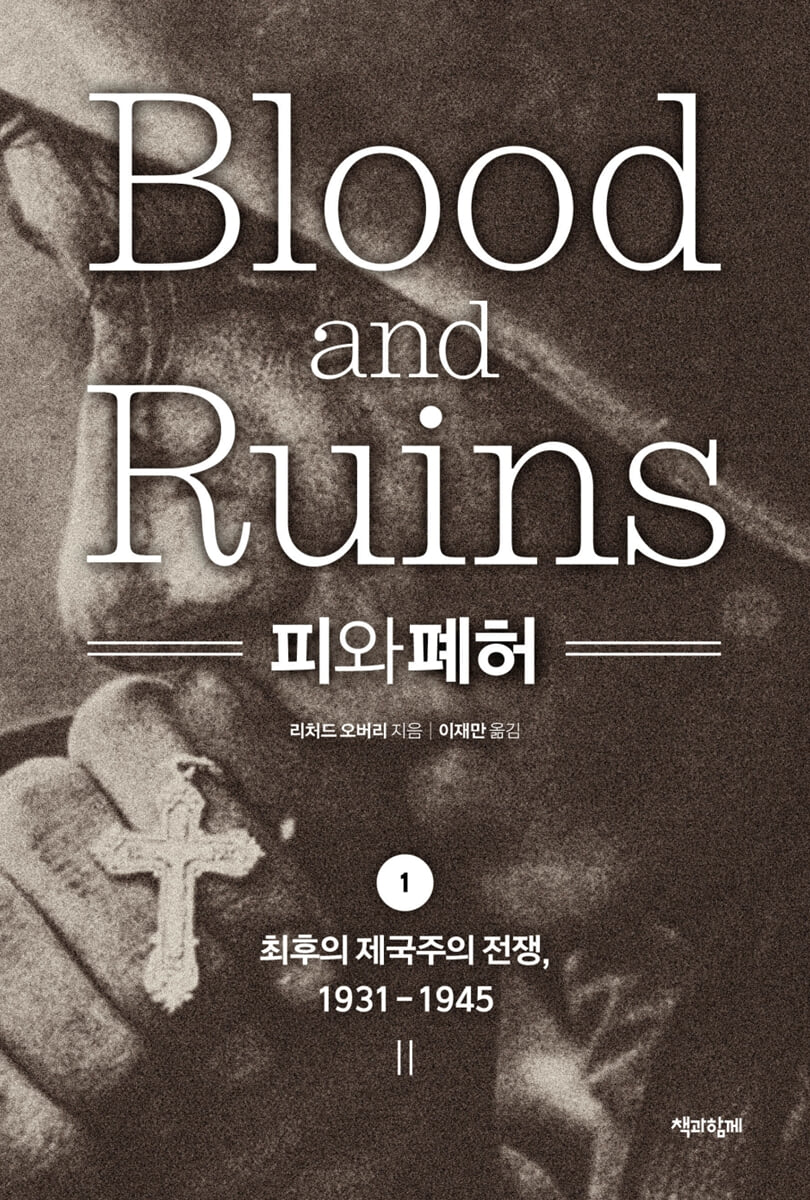
Blood and Ruins 1
 |
Description
Book Introduction
“The long Second World War (1931-1945) was the last imperialist war.”
A new standard work on World War II that has won worldwide acclaim
Richard Overy, a historian who has been a leading scholar of World War II, presents Blood and Ruin in a new light on the origins, course, and aftermath of World War II.
Overley argues that this war was 'the last imperialist war'.
Nearly a century of imperialist expansion around the world culminated in the territorial ambitions of Germany, Italy, and Japan in the 1930s and early 1940s, before escalating into the largest and most costly war in human history, leading to the end of all territorial empires after 1945.
From this perspective, he sheds new light on the 'long World War II' that began in 1931 when the Japanese military caused the Manchurian Incident.
Drawing on a global perspective that is far broader than the traditional focus on the military conflict between the Allies and the Axis, Overy addresses questions such as how the massive scale of the conflict was waged from an imperial perspective, how the materials and money were procured, how the mass mobilization that supported the war was achieved, and what the moral justifications for the war were.
It then describes the harsh toll and psychological impact on civilians as well as soldiers, the particularly severe crimes and atrocities, and the aftermath of the war that continued long after 1945.
Winner of the 2022 Duke of Wellington Medal for Military History and acclaimed by international media and critics, Blood and Ruin is a masterpiece that offers a fresh perspective on World War II.
This book, which illuminates the wartime experiences of both the military and civilians in a three-dimensional manner, will enable us to understand the history of the long World War II from a broader and deeper perspective.
A new standard work on World War II that has won worldwide acclaim
Richard Overy, a historian who has been a leading scholar of World War II, presents Blood and Ruin in a new light on the origins, course, and aftermath of World War II.
Overley argues that this war was 'the last imperialist war'.
Nearly a century of imperialist expansion around the world culminated in the territorial ambitions of Germany, Italy, and Japan in the 1930s and early 1940s, before escalating into the largest and most costly war in human history, leading to the end of all territorial empires after 1945.
From this perspective, he sheds new light on the 'long World War II' that began in 1931 when the Japanese military caused the Manchurian Incident.
Drawing on a global perspective that is far broader than the traditional focus on the military conflict between the Allies and the Axis, Overy addresses questions such as how the massive scale of the conflict was waged from an imperial perspective, how the materials and money were procured, how the mass mobilization that supported the war was achieved, and what the moral justifications for the war were.
It then describes the harsh toll and psychological impact on civilians as well as soldiers, the particularly severe crimes and atrocities, and the aftermath of the war that continued long after 1945.
Winner of the 2022 Duke of Wellington Medal for Military History and acclaimed by international media and critics, Blood and Ruin is a masterpiece that offers a fresh perspective on World War II.
This book, which illuminates the wartime experiences of both the military and civilians in a three-dimensional manner, will enable us to understand the history of the long World War II from a broader and deeper perspective.
- You can preview some of the book's contents.
Preview
index
Entering
Glossary of Terms
abbreviation
Table of Contents
map
Introduction | 'Blood and Ruin': The Age of Imperialist War
Chapter 1 | States-Empires and the Global Crisis, 1931-1940
Chapter 2 | Imperial Fantasy, Imperial Reality, 1940-1943
Chapter 3 | The Death of the Nation-Empire, 1942-1945
Chapter 4 | Mobilizing All Forces
main
Glossary of Terms
abbreviation
Table of Contents
map
Introduction | 'Blood and Ruin': The Age of Imperialist War
Chapter 1 | States-Empires and the Global Crisis, 1931-1940
Chapter 2 | Imperial Fantasy, Imperial Reality, 1940-1943
Chapter 3 | The Death of the Nation-Empire, 1942-1945
Chapter 4 | Mobilizing All Forces
main
Detailed image
Into the book
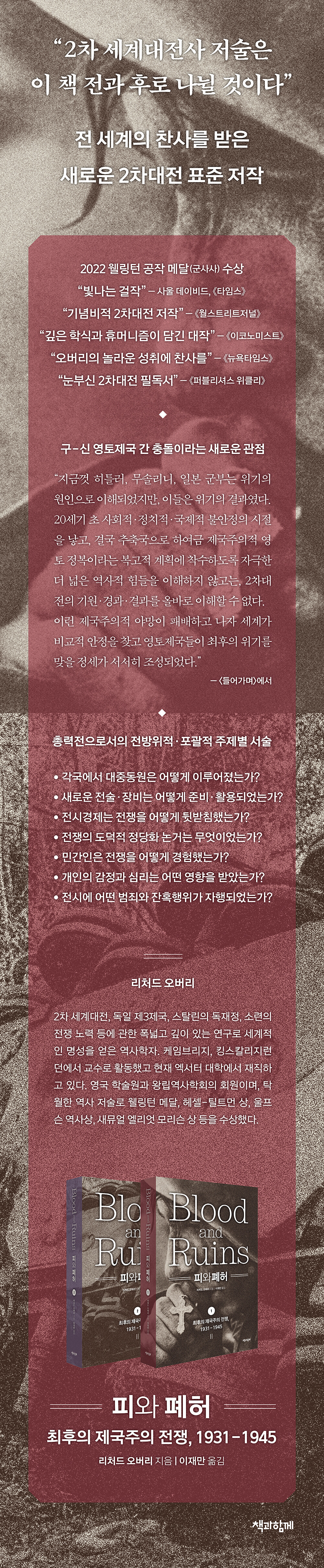
Focusing on the military outcome, while important as this narrative may be, avoids too many questions about the broader crisis that led to the war, the different nature of the various wartime conflicts, the political, economic, social, and cultural contexts of the war, and the destabilizing violence that persisted long after the official end of hostilities in 1945.
Above all, the conventional view of World War II understands Hitler, Mussolini, and the Japanese military as the causes, not the consequences, of the crisis.
But these were the results of the crisis.
The origins, course, and consequences of World War II cannot be properly understood without understanding the broader historical forces that produced a period of social, political, and international instability across the globe in the early decades of the 20th century and ultimately prompted the Axis powers to embark on a retrograde plan of imperialist territorial conquest.
With the defeat of these imperialist ambitions, the world found relative stability, and the situation gradually developed in which the territorial empires faced their final crisis.
---From "Entering"
I intended this history to raise big questions about the war years, and I hoped that understanding the context in which people had to operate within it would make individual experiences more meaningful.
This book is also a history of death, terror, destruction, and deprivation—a history of what Cordell Hull called "the ordeal of bewilderment."
Blood and ruin were a harsh price to pay.
---From "Entering"
The link between attempts to form a modern national identity and attempts to acquire or expand empire was quite common before 1914.
Even the venerable Romanov and Habsburg empires of Eastern Europe harbored imperial aspirations in the Balkans, which ultimately led to war.
For countries seeking to consolidate or build overseas empires, the link between nation-building and imperialism was clear.
The term 'nation-empire', rather than just a country, is used to define these countries that engage in territorial battles.
The so-called 'nationalization of imperialism' continued to have a significant impact until the 1930s and the last wave of violent territorial acquisitions.
Empire served to further define global power by highlighting the contrast between citizen and subject, civilized and primitive, new and old (until the 1940s, this polarity defined how imperialist states viewed the populations and territories they brought under their control).
This worldview, shared by all imperialist powers, almost completely ignored the existing cultures and values of the occupied territories.
From new consumers to converts, expectations of what the Empire could offer were largely exaggerated.
The 'imperial fantasy' that Birte Kundrus speaks of has played a significant role in fueling competition between nations.
This was true even when it was clear that the costs of empire far outweighed the usually limited benefits of holding it.
It was a powerful fantasy: that one could settle an unexplored frontier, discover a golden El Dorado, undertake a "civilizing mission," or realize Manifest Destiny and thus revitalize one's people.
This fantasy influenced how we viewed 'empire' for the next 50 years.
---From the "Introduction"
For Japan, Italy, and Germany, the decisive factor was territory.
Territorial control, exercised in various formal and informal ways, was a core requirement of empire.
The model for this 'territoriality' principle was the violent territorial expansion and pacification that had been underway for four decades before the 1930s, and in some cases was still ongoing.
Only by considering this longer-term context can we understand historically why the decision was made to launch localized invasions in Tokyo, Rome, and Berlin.
The discourse of 'race and space', which has sustained the empire since the late 19th century, is also fully adequate in explaining the generation that came to power in the 1930s.
---From "Chapter 1: States-Empires and the Global Crisis, 1931-1940"
Mass mobilization depended on a contract between the state and the people, which clearly illustrates the overall nature of modern warfare.
The argument that national mobilization was necessary for total war, whether in the military or in the rear, was never seriously questioned.
Those who did not adapt to or understand the impact of total war were bombarded with propaganda by each nation demanding that they contribute something to the war effort, while those who did not contribute were isolated, branded unpatriotic and even traitorous.
For example, there were Soviet workers and managers accused of dereliction of duty, and 18,000 Americans who were reported to the FBI by their compatriots for sabotage.
In any country, total war required the participation of all, but it could only elicit participation to the extent that the people themselves convinced themselves of its necessity.
In 1945, American critic Dwight MacDonald summarized the relationship between citizen and state as revealed in the just-ended war:
“It is precisely in this sphere that the individual is most helpless in reality, and therefore his rulers do their utmost to present the state not merely as a means to his ends, but as an extension of his personality.” Total war demanded that everyone, man or woman, young or old, free or unfree, contribute to the common struggle and labor to the best of their ability.
This period was a unique historical moment, one that had previously been almost impossible and now seems utterly impossible.
Above all, the conventional view of World War II understands Hitler, Mussolini, and the Japanese military as the causes, not the consequences, of the crisis.
But these were the results of the crisis.
The origins, course, and consequences of World War II cannot be properly understood without understanding the broader historical forces that produced a period of social, political, and international instability across the globe in the early decades of the 20th century and ultimately prompted the Axis powers to embark on a retrograde plan of imperialist territorial conquest.
With the defeat of these imperialist ambitions, the world found relative stability, and the situation gradually developed in which the territorial empires faced their final crisis.
---From "Entering"
I intended this history to raise big questions about the war years, and I hoped that understanding the context in which people had to operate within it would make individual experiences more meaningful.
This book is also a history of death, terror, destruction, and deprivation—a history of what Cordell Hull called "the ordeal of bewilderment."
Blood and ruin were a harsh price to pay.
---From "Entering"
The link between attempts to form a modern national identity and attempts to acquire or expand empire was quite common before 1914.
Even the venerable Romanov and Habsburg empires of Eastern Europe harbored imperial aspirations in the Balkans, which ultimately led to war.
For countries seeking to consolidate or build overseas empires, the link between nation-building and imperialism was clear.
The term 'nation-empire', rather than just a country, is used to define these countries that engage in territorial battles.
The so-called 'nationalization of imperialism' continued to have a significant impact until the 1930s and the last wave of violent territorial acquisitions.
Empire served to further define global power by highlighting the contrast between citizen and subject, civilized and primitive, new and old (until the 1940s, this polarity defined how imperialist states viewed the populations and territories they brought under their control).
This worldview, shared by all imperialist powers, almost completely ignored the existing cultures and values of the occupied territories.
From new consumers to converts, expectations of what the Empire could offer were largely exaggerated.
The 'imperial fantasy' that Birte Kundrus speaks of has played a significant role in fueling competition between nations.
This was true even when it was clear that the costs of empire far outweighed the usually limited benefits of holding it.
It was a powerful fantasy: that one could settle an unexplored frontier, discover a golden El Dorado, undertake a "civilizing mission," or realize Manifest Destiny and thus revitalize one's people.
This fantasy influenced how we viewed 'empire' for the next 50 years.
---From the "Introduction"
For Japan, Italy, and Germany, the decisive factor was territory.
Territorial control, exercised in various formal and informal ways, was a core requirement of empire.
The model for this 'territoriality' principle was the violent territorial expansion and pacification that had been underway for four decades before the 1930s, and in some cases was still ongoing.
Only by considering this longer-term context can we understand historically why the decision was made to launch localized invasions in Tokyo, Rome, and Berlin.
The discourse of 'race and space', which has sustained the empire since the late 19th century, is also fully adequate in explaining the generation that came to power in the 1930s.
---From "Chapter 1: States-Empires and the Global Crisis, 1931-1940"
Mass mobilization depended on a contract between the state and the people, which clearly illustrates the overall nature of modern warfare.
The argument that national mobilization was necessary for total war, whether in the military or in the rear, was never seriously questioned.
Those who did not adapt to or understand the impact of total war were bombarded with propaganda by each nation demanding that they contribute something to the war effort, while those who did not contribute were isolated, branded unpatriotic and even traitorous.
For example, there were Soviet workers and managers accused of dereliction of duty, and 18,000 Americans who were reported to the FBI by their compatriots for sabotage.
In any country, total war required the participation of all, but it could only elicit participation to the extent that the people themselves convinced themselves of its necessity.
In 1945, American critic Dwight MacDonald summarized the relationship between citizen and state as revealed in the just-ended war:
“It is precisely in this sphere that the individual is most helpless in reality, and therefore his rulers do their utmost to present the state not merely as a means to his ends, but as an extension of his personality.” Total war demanded that everyone, man or woman, young or old, free or unfree, contribute to the common struggle and labor to the best of their ability.
This period was a unique historical moment, one that had previously been almost impossible and now seems utterly impossible.
---From "Chapter 4 Mobilizing All-Out War"
Publisher's Review
"The writing of World War II will be divided into before and after this book."
A new standard work on World War II that has won worldwide acclaim
When did World War II begin? The conventional answer is September 1, 1939, when Nazi Germany invaded neighboring Poland.
This narrative conforms to the standard historical view and official war history of the countries that participated in World War II, and the implicit premise of this view is that the war that broke out in Europe expanded into a global war.
However, a book has been published that boldly breaks away from this established common understanding.
Richard Overy, a leading World War II scholar, points to 1931, not 1939, as the starting point of World War II in his new book, Blood and Ruin.
1931 was the year when the Japanese Kwantung Army stationed in Manchuria deliberately blew up the Manchurian Railway line, causing the Manchurian Incident.
Overy then goes on to examine the Italian invasion of Ethiopia in 1935, the outbreak of the Sino-Japanese War in 1937, and Germany's rearmament and imperial projects in the 1930s before turning to the German invasion of Poland.
This view deviates from the conventional view that World War II originated from conflicts between European nations, and by extending the war period from 1939–1945 to 1931–1945, it attempts to shed new light on this global conflict as a “long World War II.”
In Europe and the United States, this book is considered the most comprehensive work on World War II and was awarded the 2022 Wellington Medal (Military History).
Richard Overy, a leading figure in World War II research
A definitive edition, published with insights gleaned from a lifetime of work.
Conventional histories of World War II define the conflict as a clash between great powers and analyze its origins, emphasizing factors such as the interwar arms race, diplomatic crises, and ideological conflicts.
In contrast, Overy defines the long Second World War as a conflict between established empires (Britain, France, the Netherlands, Belgium, etc.) and emerging powers (Japan, Italy, Germany) that had brought about a new wave of territorial imperialism in the 1930s, and argues that 'territorial empires' were at the heart of this conflict.
World War II was a conflict between existing territorial empires that had established a global imperial order by holding territories (colonies, protectorates, ports of entry and exit, areas of treaty privilege, etc.) all over the world, and emerging powers that rebelled against that imperial order and sought to become new territorial empires by conquering overseas territories.
This perspective, which challenges the standard histories of World War II, is the result of Overy's long research and reflection.
Overy is a leading figure in World War II research, having devoted his life to this field, having begun writing about World War II as early as 1980 and having published over 30 books and edited works to date.
The topics of his direct research are quite diverse, including the crisis in interwar Europe, the society and economy of Nazi Germany, the dictatorships of Hitler and Stalin, the Soviet war effort, the air wars and bombing campaigns of the Allied and Axis powers, the development of the Royal Air Force, and the postwar interrogation of the Nazi elite.
As can be seen from the considerable number of notes included in Blood and Ruin, he has been interested in and knowledgeable about virtually every topic related to World War II.
In that sense, this book's revisionist view of war, which challenges the established doctrines of academia, is not a mere theory, but rather a view that the old scholar has established throughout his life.
It gives a broader understanding of World War II.
The perspective of 'conflict between old and new territorial empires'
According to Overley, the common denominator among Germany, Italy, and Japan, which would later form the Axis powers, was that they harbored a "will to empire."
The Three Kingdoms recognized that other empires were obstructing and strangling their own people's development, and they held fast to the belief that to save their people, build a strong economy, and cultivate a superior culture, they must seize control of a larger territory and its resources.
For them, the empire was a lifeline ('survival space') necessary for the survival of the nation.
Thus, the three kingdoms embarked on a retrograde plan of imperialistic territorial conquest to establish their own 'new order'.
Looking at it this way, we can understand why Overley chose 1931 as the starting point of the protracted Second World War.
Although the Manchurian Incident did not directly trigger a world war, it was an event that initiated a new decade of imperial expansion.
Japan used Manchuria as a springboard for its invasion and later expanded into mainland China.
In this way, Overley's thesis differs from existing theories in that it defines World War II as an 'imperialist war' and focuses on territorial empires.
This approach has the advantage of providing a longer-term and broader perspective on the factors that led to World War II.
The imperial order did not suddenly emerge in the run-up to World War II, but began to take shape as early as the late 19th century, and its sphere of influence was not limited to Europe but encompassed the entire world.
According to Overley, it was an 'imperialist war' in which empires clashed even before World War I (Britain, France, Russia, Germany, Austria-Hungary, and the Ottoman Empire, which started World War I, were all empires), and World War I and World War II, which lasted from 1914 to 1945, could be considered the 'Thirty Years' War' of the 20th century.
Moreover, Overy's approach allows us to grasp from a macroscopic perspective how imperial concepts and imperial crises formed the framework for the origins and course of World War II, and how the existence of a global imperial order linked the various regions and forms of conflict in World War II.
A comprehensive, all-round, thematic narrative as an all-out war
Another strength of this book that sets it apart from other works is that it describes World War II as a total war.
World War II was a more total war than any other war in that it mobilized all of the nation's available human and material resources, capabilities, and even potential to wage war, and prioritized the needs of the military over those of civilian society.
Nevertheless, World War II is such a vast and thoroughly studied topic in the field of historical scholarship that it would be inconceivable for any historian to attempt to comprehensively examine the conduct of the war by both the military and civilians in a single work.
Because of these difficulties, typical histories of World War II briefly describe the background and crises of the war before moving on to the full-scale military conflict, devoting most of their space to the decisions and strategies of the leadership and military of each country, the development of the war, and the resulting offensive and defensive actions, while only briefly covering other topics.
On the other hand, after concluding the narrative on military conflict up to Chapter 3, "Blood and Ruin" describes the core issues of World War II, which can be grouped under the keyword of total war, from Chapters 4 to 10.
As a total war, the defining characteristic of World War II was the blurring of the lines between combatants on the battlefield and civilians in the rear.
During the war, civilians were regarded as 'production soldiers' fighting alongside soldiers, and in some countries, workers were actually regarded as soldiers, their absence from work being considered 'desertion', while conscientious objectors were treated as deserters.
Furthermore, the belligerents used all means, including military and economic measures, to destroy the will of the enemy to continue the war, making civilians a legitimate target of attack on the grounds that they were part of the war effort.
During World War II, war became 'civilianized' and civilians became 'militarized'.
To describe the total war that encompassed both the military and civilian society during World War II, Overy explores key issues thematically.
This concise and condensed discussion is truly compelling.
The main topics of each chapter are as follows:
Chapter 4: How was mass mobilization achieved in each country?
Chapter 5: How were new tactics and equipment prepared and utilized?
Chapter 6: How Did the War Economy Support the War?
Chapter 7: What were the moral justifications for the war?
Chapter 8: How did civilians experience the war?
Chapter 9: How were individual emotions and psychology affected?
Chapter 10: What crimes and atrocities were committed during the war?
How the global geopolitical order has been transformed
The last eleven chapters of this book depict the world after World War II.
The resolution of the political and ideological conflicts that remained during the war largely took place against the backdrop of waning imperial and superpower ambitions.
Thus, the traditional empires finally collapsed and the world of nation-states we see today was formed.
In the English-speaking world, Blood and Ruin is generally considered the most comprehensive single-volume history of World War II.
This is not an exaggerated assessment.
Overy, a conscientious historian, wrote many books from a young age, but this is the only comprehensive history of World War II he published after he was over 70.
We hope that this book, which illuminates the wartime experiences of both the military and civilians, will help readers gain a broader and deeper understanding of the history of the long-running Second World War.
A new standard work on World War II that has won worldwide acclaim
When did World War II begin? The conventional answer is September 1, 1939, when Nazi Germany invaded neighboring Poland.
This narrative conforms to the standard historical view and official war history of the countries that participated in World War II, and the implicit premise of this view is that the war that broke out in Europe expanded into a global war.
However, a book has been published that boldly breaks away from this established common understanding.
Richard Overy, a leading World War II scholar, points to 1931, not 1939, as the starting point of World War II in his new book, Blood and Ruin.
1931 was the year when the Japanese Kwantung Army stationed in Manchuria deliberately blew up the Manchurian Railway line, causing the Manchurian Incident.
Overy then goes on to examine the Italian invasion of Ethiopia in 1935, the outbreak of the Sino-Japanese War in 1937, and Germany's rearmament and imperial projects in the 1930s before turning to the German invasion of Poland.
This view deviates from the conventional view that World War II originated from conflicts between European nations, and by extending the war period from 1939–1945 to 1931–1945, it attempts to shed new light on this global conflict as a “long World War II.”
In Europe and the United States, this book is considered the most comprehensive work on World War II and was awarded the 2022 Wellington Medal (Military History).
Richard Overy, a leading figure in World War II research
A definitive edition, published with insights gleaned from a lifetime of work.
Conventional histories of World War II define the conflict as a clash between great powers and analyze its origins, emphasizing factors such as the interwar arms race, diplomatic crises, and ideological conflicts.
In contrast, Overy defines the long Second World War as a conflict between established empires (Britain, France, the Netherlands, Belgium, etc.) and emerging powers (Japan, Italy, Germany) that had brought about a new wave of territorial imperialism in the 1930s, and argues that 'territorial empires' were at the heart of this conflict.
World War II was a conflict between existing territorial empires that had established a global imperial order by holding territories (colonies, protectorates, ports of entry and exit, areas of treaty privilege, etc.) all over the world, and emerging powers that rebelled against that imperial order and sought to become new territorial empires by conquering overseas territories.
This perspective, which challenges the standard histories of World War II, is the result of Overy's long research and reflection.
Overy is a leading figure in World War II research, having devoted his life to this field, having begun writing about World War II as early as 1980 and having published over 30 books and edited works to date.
The topics of his direct research are quite diverse, including the crisis in interwar Europe, the society and economy of Nazi Germany, the dictatorships of Hitler and Stalin, the Soviet war effort, the air wars and bombing campaigns of the Allied and Axis powers, the development of the Royal Air Force, and the postwar interrogation of the Nazi elite.
As can be seen from the considerable number of notes included in Blood and Ruin, he has been interested in and knowledgeable about virtually every topic related to World War II.
In that sense, this book's revisionist view of war, which challenges the established doctrines of academia, is not a mere theory, but rather a view that the old scholar has established throughout his life.
It gives a broader understanding of World War II.
The perspective of 'conflict between old and new territorial empires'
According to Overley, the common denominator among Germany, Italy, and Japan, which would later form the Axis powers, was that they harbored a "will to empire."
The Three Kingdoms recognized that other empires were obstructing and strangling their own people's development, and they held fast to the belief that to save their people, build a strong economy, and cultivate a superior culture, they must seize control of a larger territory and its resources.
For them, the empire was a lifeline ('survival space') necessary for the survival of the nation.
Thus, the three kingdoms embarked on a retrograde plan of imperialistic territorial conquest to establish their own 'new order'.
Looking at it this way, we can understand why Overley chose 1931 as the starting point of the protracted Second World War.
Although the Manchurian Incident did not directly trigger a world war, it was an event that initiated a new decade of imperial expansion.
Japan used Manchuria as a springboard for its invasion and later expanded into mainland China.
In this way, Overley's thesis differs from existing theories in that it defines World War II as an 'imperialist war' and focuses on territorial empires.
This approach has the advantage of providing a longer-term and broader perspective on the factors that led to World War II.
The imperial order did not suddenly emerge in the run-up to World War II, but began to take shape as early as the late 19th century, and its sphere of influence was not limited to Europe but encompassed the entire world.
According to Overley, it was an 'imperialist war' in which empires clashed even before World War I (Britain, France, Russia, Germany, Austria-Hungary, and the Ottoman Empire, which started World War I, were all empires), and World War I and World War II, which lasted from 1914 to 1945, could be considered the 'Thirty Years' War' of the 20th century.
Moreover, Overy's approach allows us to grasp from a macroscopic perspective how imperial concepts and imperial crises formed the framework for the origins and course of World War II, and how the existence of a global imperial order linked the various regions and forms of conflict in World War II.
A comprehensive, all-round, thematic narrative as an all-out war
Another strength of this book that sets it apart from other works is that it describes World War II as a total war.
World War II was a more total war than any other war in that it mobilized all of the nation's available human and material resources, capabilities, and even potential to wage war, and prioritized the needs of the military over those of civilian society.
Nevertheless, World War II is such a vast and thoroughly studied topic in the field of historical scholarship that it would be inconceivable for any historian to attempt to comprehensively examine the conduct of the war by both the military and civilians in a single work.
Because of these difficulties, typical histories of World War II briefly describe the background and crises of the war before moving on to the full-scale military conflict, devoting most of their space to the decisions and strategies of the leadership and military of each country, the development of the war, and the resulting offensive and defensive actions, while only briefly covering other topics.
On the other hand, after concluding the narrative on military conflict up to Chapter 3, "Blood and Ruin" describes the core issues of World War II, which can be grouped under the keyword of total war, from Chapters 4 to 10.
As a total war, the defining characteristic of World War II was the blurring of the lines between combatants on the battlefield and civilians in the rear.
During the war, civilians were regarded as 'production soldiers' fighting alongside soldiers, and in some countries, workers were actually regarded as soldiers, their absence from work being considered 'desertion', while conscientious objectors were treated as deserters.
Furthermore, the belligerents used all means, including military and economic measures, to destroy the will of the enemy to continue the war, making civilians a legitimate target of attack on the grounds that they were part of the war effort.
During World War II, war became 'civilianized' and civilians became 'militarized'.
To describe the total war that encompassed both the military and civilian society during World War II, Overy explores key issues thematically.
This concise and condensed discussion is truly compelling.
The main topics of each chapter are as follows:
Chapter 4: How was mass mobilization achieved in each country?
Chapter 5: How were new tactics and equipment prepared and utilized?
Chapter 6: How Did the War Economy Support the War?
Chapter 7: What were the moral justifications for the war?
Chapter 8: How did civilians experience the war?
Chapter 9: How were individual emotions and psychology affected?
Chapter 10: What crimes and atrocities were committed during the war?
How the global geopolitical order has been transformed
The last eleven chapters of this book depict the world after World War II.
The resolution of the political and ideological conflicts that remained during the war largely took place against the backdrop of waning imperial and superpower ambitions.
Thus, the traditional empires finally collapsed and the world of nation-states we see today was formed.
In the English-speaking world, Blood and Ruin is generally considered the most comprehensive single-volume history of World War II.
This is not an exaggerated assessment.
Overy, a conscientious historian, wrote many books from a young age, but this is the only comprehensive history of World War II he published after he was over 70.
We hope that this book, which illuminates the wartime experiences of both the military and civilians, will help readers gain a broader and deeper understanding of the history of the long-running Second World War.
GOODS SPECIFICS
- Date of issue: June 21, 2024
- Page count, weight, size: 724 pages | 152*225*40mm
- ISBN13: 9791192913872
- ISBN10: 1192913876
You may also like
카테고리
korean


korean

![GQ KOREA Mark (Monthly): December [2025]](http://librairie.coreenne.fr/cdn/shop/files/8ef265dbbfbf186523ed75ba7319009d.jpg?v=1765340328&width=3840)


