

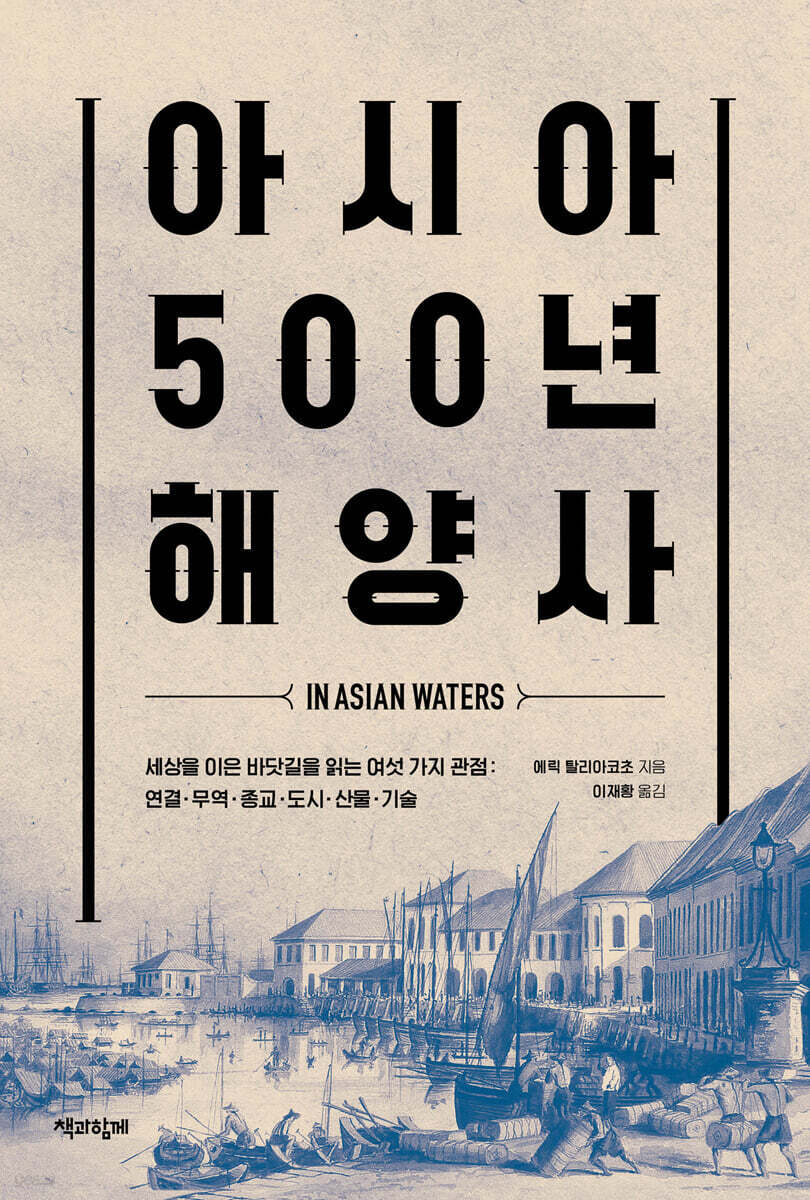
500 Years of Asian Maritime History
 |
Description
Book Introduction
The seas of Asia were never quiet for a moment.
From the Purification Expedition to the Imperial Age and the 21st Century
How have great waterways changed the world and our lives?
The vast seas of Asia, stretching from Korea and Japan through Southeast Asia and India to the Middle East and East Africa, have become one of the world's most dynamic shipping lanes.
As the geopolitical importance of the Asian oceans increases, it is necessary to expand the scope of maritime history research, which has previously focused on the Pacific and Atlantic Oceans, to properly understand the history of the Asian oceans and prepare for the future.
Eric Tagliacozzo, a professor of history at Cornell University who has conducted research throughout Asia, explores the history of Asian maritime exchange from the 15th century, when it began in earnest, to the present day.
Focusing on six keywords: connection, trade, religion, city, product, and technology, it utilizes methodologies from various fields, including history, anthropology, archaeology, art history, and geography.
By providing a macroscopic overview of the flow for each keyword and analyzing specific related cases in detail, it helps to provide a three-dimensional understanding of modern and contemporary Asian maritime history.
In particular, the author's extensive field research is the foundation for vividly showing the traces of history and reality.
Furthermore, based on this exploration, it raises meaningful questions about the future of the Asian seas today, as China pursues expansionism.
The dynamics of Asian maritime history presented in this book will help dispel the misconception and prejudice that Asia was a continent centered on agriculture and nomadism.
From the Purification Expedition to the Imperial Age and the 21st Century
How have great waterways changed the world and our lives?
The vast seas of Asia, stretching from Korea and Japan through Southeast Asia and India to the Middle East and East Africa, have become one of the world's most dynamic shipping lanes.
As the geopolitical importance of the Asian oceans increases, it is necessary to expand the scope of maritime history research, which has previously focused on the Pacific and Atlantic Oceans, to properly understand the history of the Asian oceans and prepare for the future.
Eric Tagliacozzo, a professor of history at Cornell University who has conducted research throughout Asia, explores the history of Asian maritime exchange from the 15th century, when it began in earnest, to the present day.
Focusing on six keywords: connection, trade, religion, city, product, and technology, it utilizes methodologies from various fields, including history, anthropology, archaeology, art history, and geography.
By providing a macroscopic overview of the flow for each keyword and analyzing specific related cases in detail, it helps to provide a three-dimensional understanding of modern and contemporary Asian maritime history.
In particular, the author's extensive field research is the foundation for vividly showing the traces of history and reality.
Furthermore, based on this exploration, it raises meaningful questions about the future of the Asian seas today, as China pursues expansionism.
The dynamics of Asian maritime history presented in this book will help dispel the misconception and prejudice that Asia was a continent centered on agriculture and nomadism.
- You can preview some of the book's contents.
Preview
index
Chapter 1 Introduction: From Nagasaki to the South, from Hormuz to the East
Part 1: Maritime Connections
Chapter 2 From China to Africa
Chapter 3 Vietnam's Maritime Trade Rights
Part 2 sea area
Chapter 4: Smuggling in the South China Sea
Chapter 5: Center and Periphery
Part 3: Religion on the Waves
Chapter 6: The Movement of the Talisman
Chapter 7 Zamboanga, Mindanao
Part 4: City and Sea
Chapter 8: The Formation of Port Cities in Greater Southeast Asia
Chapter 9: From Aden to Mumbai, from Singapore to Busan
Part 5: Products of the Ocean
Chapter 10: Fins, Sea Cucumbers, and Pearls
Chapter 11 At the dock
Part 6: The Technology of the Sea
Chapter 12: Foucault's Other Panopticon, or Unraveling Colonial Southeast Asia
Chapter 13: Maps and Humans
Chapter 14 Conclusion: If China Dominates the Seas
supplement
Acknowledgements
Translator's Note
main
References
Search
Part 1: Maritime Connections
Chapter 2 From China to Africa
Chapter 3 Vietnam's Maritime Trade Rights
Part 2 sea area
Chapter 4: Smuggling in the South China Sea
Chapter 5: Center and Periphery
Part 3: Religion on the Waves
Chapter 6: The Movement of the Talisman
Chapter 7 Zamboanga, Mindanao
Part 4: City and Sea
Chapter 8: The Formation of Port Cities in Greater Southeast Asia
Chapter 9: From Aden to Mumbai, from Singapore to Busan
Part 5: Products of the Ocean
Chapter 10: Fins, Sea Cucumbers, and Pearls
Chapter 11 At the dock
Part 6: The Technology of the Sea
Chapter 12: Foucault's Other Panopticon, or Unraveling Colonial Southeast Asia
Chapter 13: Maps and Humans
Chapter 14 Conclusion: If China Dominates the Seas
supplement
Acknowledgements
Translator's Note
main
References
Search
Into the book
These two ports at opposite ends of Asia—Nagasaki, Japan, and Sur, Oman—had much in common.
Yet, there was nothing in common.
On one side, Arabic was heard, and on the other side, Japanese was heard.
It was the sound of the blackened and shaky dock workers.
But the murmur connecting these regions was distinct.
There was no need to even hear it.
Just looking was enough.
Several dhows set sail from Sur and went out to sea.
Riding the monsoon winds, we headed east towards the vast Indian Ocean.
Looking at that sight, this thought suddenly occurred to me.
'Haven't we seen all these scenes before?' I scribbled on my notes, unable to find an answer to this question.
It was in preparation for writing this book.
--- p.11, from “Chapter 1 Introduction: From Nagasaki to the South, from Hormuz to the East”
I have spent time in the field in all the areas covered in this book over the past 30 years.
And I tried to mix history and experience based on the data.
The latter takes the form of interviews and oral history reports.
Wherever possible, I tried to capture the voices of local people by having them record their stories themselves.
This was accomplished through ethnographic research conducted in markets and ports across these regions.
--- p.23, from “Chapter 1 Introduction”
A modern ship drawing comparing (estimating) the size of the command ship of Jeonghwa and Columbus's Santa Maria, which "discovered" the "New World" 70 years later, gives us an idea of its scale.
The Iberians discovered the world primarily by rowing boats, while the Chinese ships were aircraft carriers by comparison. Unfortunately, the official records of these voyages appear to have been destroyed in 1480, after the Age of Exploration had ceased.
--- p.54, from “Chapter 2 From China to Africa”
One striking trend is that drug trafficking in the South China Sea region still appears to be overwhelmingly ethnically driven, much like the Chinese and Armenian trading networks of the 19th century.
For example, Pakistani gangs are caught selling heroin in Indonesia, and Indonesians are frequently caught smuggling drugs north to Malaysia.
--- p.111, from “Chapter 4 Smuggling in the South China Sea”
The woman recounted her trip to Mecca and put it into the context of how other Filipinos think about performing the pilgrimage.
He also displayed the most calm and serene demeanor when speaking about the future of appropriate and reasonable social justice for the normalization of the southern Philippines.
It was impressive and humble.
As I stood to leave, the woman stared into my eyes for a beat longer than necessary to make sure I had her full attention.
And then he said this.
"Would you please tell the others now? Yes? It's important that everyone hears what we have to say."
--- p.215, from “Chapter 7 Zamboanga, Mindanao”
Russia, for example, tried to make it possible to land in and around the port of Busan.
It was intended to be used as a training ground for the Russian military and also to build low-altitude facilities for the Russian Far East Fleet.
Britain watched this movement with some anxiety.
For example, when the Russian cruiser Manjur arrived in Busan in 1897, British communications about the port call followed immediately.
It was not simply a 'passing voyage' to look at potential base sites, as the admiral's staff of the Russian Far Eastern Fleet was on board.
In fact, Russia told the international community that South Korea "wanted" them to advance militarily into Busan.
It was a wedge against Japan, which already had considerable influence over Korea.
--- p.274, from “Chapter 9: From Aden to Mumbai, from Singapore to Busan”
Sea cucumbers, seahorses, fish bladders, pearl products, various dried fish, abalone, and traditional trade goods still pass through Singapore, but the city's days as an intermediary in this trade may be numbered.
In some ways, Singapore has competed 'too' well in the global economy.
They skipped this trade in the life cycle of their economy.
The merchants I've spoken with over the past few decades will be the last generation to dominate this commerce.
Because it is moving from Singapore to a wider area of the island.
--- p.306~307, from “Chapter 10 Fins, Sea Cucumbers, and Pearls”
Colonial regimes (in this case the British in Malaya and the Dutch in the Dutch East Indies) used science and its machines to dominate their environments and, at the same time, to control the local populations that lived within those environments.
Although this process was obviously carried out on land, the structures of colonial rule required these conveniences of machinery and thought at sea as well.
The charting of maps allowed Western empires to reinterpret, to some extent, the fluid maritime realities of intercultural contact in Southeast Asia and to forcibly reshape the local world into a form far more suited to imperial hegemony.
--- p.401, from “Chapter 13: Maps and Humans”
What will become of the fate of the Asian seas if China becomes a new territorial power with maritime dominance as one of its goals? In short, what will happen if China dominates the seas? It's worth noting that, from a historical perspective, this isn't the first time that large Chinese vessels have left their mainland coasts and ventured out into Asia.
Nearly 600 years ago, Admiral Zheng He's flagship was anchored, with nearly 30,000 men waiting to board numerous ships and join the expedition heading down to Southeast Asia.
The fleet's primary mission was simple.
By waving the Chinese flag, they were signaling to the vassal states along the Asian trade routes that Han China had once again risen as a world power.
Yet, there was nothing in common.
On one side, Arabic was heard, and on the other side, Japanese was heard.
It was the sound of the blackened and shaky dock workers.
But the murmur connecting these regions was distinct.
There was no need to even hear it.
Just looking was enough.
Several dhows set sail from Sur and went out to sea.
Riding the monsoon winds, we headed east towards the vast Indian Ocean.
Looking at that sight, this thought suddenly occurred to me.
'Haven't we seen all these scenes before?' I scribbled on my notes, unable to find an answer to this question.
It was in preparation for writing this book.
--- p.11, from “Chapter 1 Introduction: From Nagasaki to the South, from Hormuz to the East”
I have spent time in the field in all the areas covered in this book over the past 30 years.
And I tried to mix history and experience based on the data.
The latter takes the form of interviews and oral history reports.
Wherever possible, I tried to capture the voices of local people by having them record their stories themselves.
This was accomplished through ethnographic research conducted in markets and ports across these regions.
--- p.23, from “Chapter 1 Introduction”
A modern ship drawing comparing (estimating) the size of the command ship of Jeonghwa and Columbus's Santa Maria, which "discovered" the "New World" 70 years later, gives us an idea of its scale.
The Iberians discovered the world primarily by rowing boats, while the Chinese ships were aircraft carriers by comparison. Unfortunately, the official records of these voyages appear to have been destroyed in 1480, after the Age of Exploration had ceased.
--- p.54, from “Chapter 2 From China to Africa”
One striking trend is that drug trafficking in the South China Sea region still appears to be overwhelmingly ethnically driven, much like the Chinese and Armenian trading networks of the 19th century.
For example, Pakistani gangs are caught selling heroin in Indonesia, and Indonesians are frequently caught smuggling drugs north to Malaysia.
--- p.111, from “Chapter 4 Smuggling in the South China Sea”
The woman recounted her trip to Mecca and put it into the context of how other Filipinos think about performing the pilgrimage.
He also displayed the most calm and serene demeanor when speaking about the future of appropriate and reasonable social justice for the normalization of the southern Philippines.
It was impressive and humble.
As I stood to leave, the woman stared into my eyes for a beat longer than necessary to make sure I had her full attention.
And then he said this.
"Would you please tell the others now? Yes? It's important that everyone hears what we have to say."
--- p.215, from “Chapter 7 Zamboanga, Mindanao”
Russia, for example, tried to make it possible to land in and around the port of Busan.
It was intended to be used as a training ground for the Russian military and also to build low-altitude facilities for the Russian Far East Fleet.
Britain watched this movement with some anxiety.
For example, when the Russian cruiser Manjur arrived in Busan in 1897, British communications about the port call followed immediately.
It was not simply a 'passing voyage' to look at potential base sites, as the admiral's staff of the Russian Far Eastern Fleet was on board.
In fact, Russia told the international community that South Korea "wanted" them to advance militarily into Busan.
It was a wedge against Japan, which already had considerable influence over Korea.
--- p.274, from “Chapter 9: From Aden to Mumbai, from Singapore to Busan”
Sea cucumbers, seahorses, fish bladders, pearl products, various dried fish, abalone, and traditional trade goods still pass through Singapore, but the city's days as an intermediary in this trade may be numbered.
In some ways, Singapore has competed 'too' well in the global economy.
They skipped this trade in the life cycle of their economy.
The merchants I've spoken with over the past few decades will be the last generation to dominate this commerce.
Because it is moving from Singapore to a wider area of the island.
--- p.306~307, from “Chapter 10 Fins, Sea Cucumbers, and Pearls”
Colonial regimes (in this case the British in Malaya and the Dutch in the Dutch East Indies) used science and its machines to dominate their environments and, at the same time, to control the local populations that lived within those environments.
Although this process was obviously carried out on land, the structures of colonial rule required these conveniences of machinery and thought at sea as well.
The charting of maps allowed Western empires to reinterpret, to some extent, the fluid maritime realities of intercultural contact in Southeast Asia and to forcibly reshape the local world into a form far more suited to imperial hegemony.
--- p.401, from “Chapter 13: Maps and Humans”
What will become of the fate of the Asian seas if China becomes a new territorial power with maritime dominance as one of its goals? In short, what will happen if China dominates the seas? It's worth noting that, from a historical perspective, this isn't the first time that large Chinese vessels have left their mainland coasts and ventured out into Asia.
Nearly 600 years ago, Admiral Zheng He's flagship was anchored, with nearly 30,000 men waiting to board numerous ships and join the expedition heading down to Southeast Asia.
The fleet's primary mission was simple.
By waving the Chinese flag, they were signaling to the vassal states along the Asian trade routes that Han China had once again risen as a world power.
--- p.404, from “Chapter 14 Conclusion: If China Dominates the Sea”
Publisher's Review
The seas of Asia were never quiet for a moment.
How has the great waterway flowed for 500 years, and what does the future hold?
Traffic along the Asian sea lanes, which stretch from Japan and Korea through China, Southeast Asia, and India to the Middle East and East Africa, has grown rapidly over the centuries, making it one of the busiest shipping lanes in the world.
With China pursuing expansionism and India and Southeast Asian countries experiencing rapid growth, the Asian seas are facing a new phase.
Despite this situation, our gaze still seems focused on the Pacific Ocean, towards Japan, China, and the United States.
As the geopolitical importance of the Asian oceans grows, it is necessary to properly understand the history of the seas that made us who we are today and prepare for the future.
In this book, Eric Tagliacozzo, a professor of history at Cornell University, examines how the Asian seas have shaped the history of the vast Asian continent over a period of approximately 500 years, from the 15th century, when Asian maritime exchange began in earnest, to the present day.
Although exchanges between East and West Asia began early on through sea routes, it was the expeditions of Zheng He of the Ming Dynasty in the 15th century that particularly promoted this.
Since the 16th century, Western powers such as Portugal, the Netherlands, and England have advanced into Asia, which has led to increased exchanges and a great impact on the seas here.
As pressure from external forces gradually increased, and the indigenous people actively responded to this phenomenon, various changes occurred.
After the imperialist powers withdrew in the mid-20th century, the Asian seas took on the appearance they have today.
By examining these processes, the goal of this book is to discover the traces of the changes that occurred in the Asian seas that remain to this day.
Above all, rather than focusing on power and political history, it focused on the concept of the vast, interconnected ocean, allowing us to vividly experience the lives of people who belong to the ocean.
Focusing on six keywords
A three-dimensional look at Asian maritime history through various methodologies
The most significant feature of this book is that it describes 500 years of Asian maritime history by focusing on six key keywords.
The keywords are connection, trade, religion, city, product, and technology.
And, in addition to history, methodologies from various fields such as anthropology, archaeology, art history, and geography are utilized to fit each keyword.
By freely adjusting the breadth and depth of the perspective, such as by providing a macroscopic overview of the flow of each topic while also analyzing specific related cases in detail, it enables a three-dimensional understanding of modern and contemporary Asian maritime history.
For example, Part 1, which deals with 'connectivity', covers the entire Asian maritime connectivity circuit in Chapter 2, whereas Chapter 3 examines Vietnam in detail, allowing for both a broad framework and detailed individuality.
In addition to this, we analyzed various materials representing each keyword, such as smuggling, pearls, and lighthouses.
By connecting these disparate concepts into a single study through thematic windows, it demonstrates how our thinking changes when we view the world's largest continent and its history from the perspective of the sea rather than the land.
The author's extensive field research is the foundation for vividly showing the traces of history and reality.
The author, who has conducted research in the Asian region, has spent a long time visiting all the regions covered in this book, including Korea, Japan, Southeast Asia, and East Africa, researching and translating local language materials and conducting interviews with local people, which he actively utilized.
Asia is a continent centered on agriculture and nomadism.
Clearing Up Orientalist Misunderstandings
The Asian maritime history presented in this book is very diverse and dynamic, utilizing a variety of keywords, methodologies, and diverse materials.
First of all, maritime trade was so active that not only regular trade but also 'smuggling' was widespread throughout the Asian oceans, including the Indian Ocean and the South China Sea.
It is surprising that various ideas and materials were spread, including religions such as Buddhism, Islam, and Christianity, and various products such as pearls, sea cucumbers, and spices.
By exploring the evolution of cities and ports across the sea, it examines how imperialist powers sought to connect these places and incorporate this vast space into a single system, revealing the efforts that led to the creation of today's sea routes.
And in terms of technological advancement, the way Western powers controlled the seas with lighthouses and outpaced the local knowledge through map development, thereby dominating them more effectively, reveals that the sea was a fiercely competitive arena.
Looking back on the 500 years of Asian maritime history, we realize how much we have underestimated the role of the sea, emphasizing that Asia was a continent centered on agriculture and nomadism.
These misunderstandings and prejudices may originate within us, but they may also be due to Orientalist perceptions transmitted through this sea.
The significance of this book is that it allows us to look again at the sea that unfolds before us and prepare for the future with a new attitude.
In conclusion, the author's significant insight, which finds similarities between the Chinese people's maritime expansion in the early modern period and China's current expansionism, is all the more significant in this respect.
Contents of the book
Chapter 1 Introduction: From Nagasaki to the South, from Hormuz to the East
We discover the importance of the oceans from the geographical poles of research: Japan in East Asia and Oman in West Asia.
Through the appearance of two places that are distant but seemingly different and similar, the necessity of maritime history research is suggested and the research results on maritime history accumulated to date are summarized.
Part 1: Maritime Connections
Using two historical zoom lenses (the widest and the narrowest), we explore the potential to tell us more about how maritime connections along Asia's trade routes evolved and were maintained over time.
Chapter 2 From China to Africa
It covers the entire maritime circuit from China in the 'Far East' to the westernmost tip of the Indian Ocean and the coast of East Africa.
During this period, a true connection was established between the two ends of the Asian seas, but contact was intermittent.
This is the case when the Purification Expedition went to East Africa or when Africans appeared in Guangzhou as merchants and/or mercenaries.
Chapter 3 Vietnam's Maritime Trade Rights
Examines the complex networks that Vietnam created in the early modern period to connect itself with broader oceanic economies.
In Vietnam, internal concerns still seem to be more important, but at times we find points where connections with China and Southeast Asia were important.
Part 2 sea area
We examine the two largest and most important bodies of water in Asia's oceans—the South China Sea and the Indian Ocean—and ask what we can learn about the region's maritime history by viewing them as separate systems.
Chapter 4: Smuggling in the South China Sea
It examines how the histories of different societies in the South China Sea can be connected through 'smuggling'.
Smuggling has existed almost everywhere throughout human history, but the high-risk, high-reward opportunities have been prominent in the South China Sea for centuries.
It examines not only historical perspectives but also contemporary trends in regional maritime smuggling.
Chapter 5: Center and Periphery
The Indian Ocean was once a major trading hub, but the focus is on how Britain ultimately achieved its greatest success during the 18th and 19th centuries, during its imperial era.
New 'centers' and new 'peripheries' were created, but Britain bound these developing regions together through trade and the sowing of interregional relationships on a continental scale.
Part 3: Religion on the Waves
We examine how religion swirled through the oceans of Asia and how faith influenced historical trends.
Chapter 6: The Movement of the Talisman
We examine the spread of Hinduism and Buddhism from South Asia to Southeast Asia in the hundreds of years before the start of the modern era.
These two religions, which came from the 'Old World' India, were transmitted to the 'New World' Southeast Asia mainly through merchants.
The Kraji Strait and its surroundings are believed to have been important transit points for this transmission in early Thailand, and special attention is paid to this area.
Chapter 7 Zamboanga, Mindanao
We take a look at Zamboanga City, located at the southern tip of the Philippines and bordering Malaysia and Indonesia, from a religious perspective.
Here, Muslims and Christians have been at odds, sometimes peacefully, for centuries.
The competition between the two ideas continues even today.
Part 4: City and Sea
It deals with life in a port city, a major location connecting the sea routes of Asia.
Ports were the most important conditions for expanding intercultural contact, as they were where merchants, their goods, and capital gathered, and rulers sought to exploit them.
Additionally, methods were devised to overcome communication limitations, such as the establishment of consulates, and to facilitate the operation of commercial tools.
Chapter 8: The Formation of Port Cities in Greater Southeast Asia
We examine how port cities formed in the "land beneath the wind" across Southeast Asia.
It examines the emergence of cities over time using both historical and more contemporary approaches.
Including today's world.
Chapter 9: From Aden to Mumbai, from Singapore to Busan
We examine the concept of the city in a broader and more inclusive context.
This 'colonial circuit' starts from Istanbul, the gateway to Asia, and travels across Asia to Busan.
It asks how these colonial circuits were created and maintained, and analyzes how empires sought to tie their acquisitions into a single, interconnected web.
Part 5: Products of the Ocean
The seafood trade between China and Southeast Asia is explored through the lens of the spice trade in southern India.
Both categories of products have been traded actively for hundreds of years, but they have also contributed to the lag behind Asian maritime trade routes.
Chapter 10: Fins, Sea Cucumbers, and Pearls
Based in the South China Sea, we explore fish fins, sea cucumbers, and pearls.
From the mid-18th century to the late 19th century, this trade was extremely important, and the native sultanates sought to establish their power by monopolizing this product and distributing it to China.
This caught the attention of Europeans, who again began exporting these goods in an attempt to tap into the vast Chinese economy.
Chapter 11 At the dock
We examine how spices move from southern India into transnational and transregional circuits.
Indian spices such as pepper, turmeric, and cumin have been traded on sea routes since ancient times, but they began to be traded in large quantities only in the early modern period.
Some of them went west and sowed the seeds of the idea of the 'Orient' in classical antiquity, while others went east and settled in the Malay Peninsula, where they engaged in trade for generations, even to this day.
Part 6: The Technology of the Sea
It comprehensively examines the technology related to the sea and the technological norms that have developed in the course of Asian maritime history.
Technology enabled ships to operate, enabled sailors, speculators, and insurers to decide where to send their ships, and influenced commercial exchange and the expression of power.
Chapter 12: Foucault's Other Panopticon, or Unraveling Colonial Southeast Asia
Analyze the roles of lighthouses, watermarks, and buoys.
It is the ‘tool of empire’ that made the conquest of Asia possible.
In particular, the lighthouse made surveillance possible, and was in fact a tool with much in common with Foucault's famous panopticon.
Western powers used these lighthouses to direct the waterways of regional maritime activity for their own purposes.
Chapter 13: Maps and Humans
We examine map development through hydrographic surveying.
This was the most important innovation in the early conquest of the Asian sea routes.
By constantly improving their newly acquired knowledge, the West finally caught up with the knowledge level of these local people.
Through this, the West was able to impose new conditions on Asian countries.
Therefore, Foucault's paradigm of power and knowledge applies to all these cases.
Chapter 14 Conclusion: If China Dominates the Seas
From a long-term perspective, we ask what this history means for our time.
Furthermore, based on this, it poses a meaningful question, examining what the future might hold if China re-emerges as a power in this maritime route and what clues history might offer us.
How has the great waterway flowed for 500 years, and what does the future hold?
Traffic along the Asian sea lanes, which stretch from Japan and Korea through China, Southeast Asia, and India to the Middle East and East Africa, has grown rapidly over the centuries, making it one of the busiest shipping lanes in the world.
With China pursuing expansionism and India and Southeast Asian countries experiencing rapid growth, the Asian seas are facing a new phase.
Despite this situation, our gaze still seems focused on the Pacific Ocean, towards Japan, China, and the United States.
As the geopolitical importance of the Asian oceans grows, it is necessary to properly understand the history of the seas that made us who we are today and prepare for the future.
In this book, Eric Tagliacozzo, a professor of history at Cornell University, examines how the Asian seas have shaped the history of the vast Asian continent over a period of approximately 500 years, from the 15th century, when Asian maritime exchange began in earnest, to the present day.
Although exchanges between East and West Asia began early on through sea routes, it was the expeditions of Zheng He of the Ming Dynasty in the 15th century that particularly promoted this.
Since the 16th century, Western powers such as Portugal, the Netherlands, and England have advanced into Asia, which has led to increased exchanges and a great impact on the seas here.
As pressure from external forces gradually increased, and the indigenous people actively responded to this phenomenon, various changes occurred.
After the imperialist powers withdrew in the mid-20th century, the Asian seas took on the appearance they have today.
By examining these processes, the goal of this book is to discover the traces of the changes that occurred in the Asian seas that remain to this day.
Above all, rather than focusing on power and political history, it focused on the concept of the vast, interconnected ocean, allowing us to vividly experience the lives of people who belong to the ocean.
Focusing on six keywords
A three-dimensional look at Asian maritime history through various methodologies
The most significant feature of this book is that it describes 500 years of Asian maritime history by focusing on six key keywords.
The keywords are connection, trade, religion, city, product, and technology.
And, in addition to history, methodologies from various fields such as anthropology, archaeology, art history, and geography are utilized to fit each keyword.
By freely adjusting the breadth and depth of the perspective, such as by providing a macroscopic overview of the flow of each topic while also analyzing specific related cases in detail, it enables a three-dimensional understanding of modern and contemporary Asian maritime history.
For example, Part 1, which deals with 'connectivity', covers the entire Asian maritime connectivity circuit in Chapter 2, whereas Chapter 3 examines Vietnam in detail, allowing for both a broad framework and detailed individuality.
In addition to this, we analyzed various materials representing each keyword, such as smuggling, pearls, and lighthouses.
By connecting these disparate concepts into a single study through thematic windows, it demonstrates how our thinking changes when we view the world's largest continent and its history from the perspective of the sea rather than the land.
The author's extensive field research is the foundation for vividly showing the traces of history and reality.
The author, who has conducted research in the Asian region, has spent a long time visiting all the regions covered in this book, including Korea, Japan, Southeast Asia, and East Africa, researching and translating local language materials and conducting interviews with local people, which he actively utilized.
Asia is a continent centered on agriculture and nomadism.
Clearing Up Orientalist Misunderstandings
The Asian maritime history presented in this book is very diverse and dynamic, utilizing a variety of keywords, methodologies, and diverse materials.
First of all, maritime trade was so active that not only regular trade but also 'smuggling' was widespread throughout the Asian oceans, including the Indian Ocean and the South China Sea.
It is surprising that various ideas and materials were spread, including religions such as Buddhism, Islam, and Christianity, and various products such as pearls, sea cucumbers, and spices.
By exploring the evolution of cities and ports across the sea, it examines how imperialist powers sought to connect these places and incorporate this vast space into a single system, revealing the efforts that led to the creation of today's sea routes.
And in terms of technological advancement, the way Western powers controlled the seas with lighthouses and outpaced the local knowledge through map development, thereby dominating them more effectively, reveals that the sea was a fiercely competitive arena.
Looking back on the 500 years of Asian maritime history, we realize how much we have underestimated the role of the sea, emphasizing that Asia was a continent centered on agriculture and nomadism.
These misunderstandings and prejudices may originate within us, but they may also be due to Orientalist perceptions transmitted through this sea.
The significance of this book is that it allows us to look again at the sea that unfolds before us and prepare for the future with a new attitude.
In conclusion, the author's significant insight, which finds similarities between the Chinese people's maritime expansion in the early modern period and China's current expansionism, is all the more significant in this respect.
Contents of the book
Chapter 1 Introduction: From Nagasaki to the South, from Hormuz to the East
We discover the importance of the oceans from the geographical poles of research: Japan in East Asia and Oman in West Asia.
Through the appearance of two places that are distant but seemingly different and similar, the necessity of maritime history research is suggested and the research results on maritime history accumulated to date are summarized.
Part 1: Maritime Connections
Using two historical zoom lenses (the widest and the narrowest), we explore the potential to tell us more about how maritime connections along Asia's trade routes evolved and were maintained over time.
Chapter 2 From China to Africa
It covers the entire maritime circuit from China in the 'Far East' to the westernmost tip of the Indian Ocean and the coast of East Africa.
During this period, a true connection was established between the two ends of the Asian seas, but contact was intermittent.
This is the case when the Purification Expedition went to East Africa or when Africans appeared in Guangzhou as merchants and/or mercenaries.
Chapter 3 Vietnam's Maritime Trade Rights
Examines the complex networks that Vietnam created in the early modern period to connect itself with broader oceanic economies.
In Vietnam, internal concerns still seem to be more important, but at times we find points where connections with China and Southeast Asia were important.
Part 2 sea area
We examine the two largest and most important bodies of water in Asia's oceans—the South China Sea and the Indian Ocean—and ask what we can learn about the region's maritime history by viewing them as separate systems.
Chapter 4: Smuggling in the South China Sea
It examines how the histories of different societies in the South China Sea can be connected through 'smuggling'.
Smuggling has existed almost everywhere throughout human history, but the high-risk, high-reward opportunities have been prominent in the South China Sea for centuries.
It examines not only historical perspectives but also contemporary trends in regional maritime smuggling.
Chapter 5: Center and Periphery
The Indian Ocean was once a major trading hub, but the focus is on how Britain ultimately achieved its greatest success during the 18th and 19th centuries, during its imperial era.
New 'centers' and new 'peripheries' were created, but Britain bound these developing regions together through trade and the sowing of interregional relationships on a continental scale.
Part 3: Religion on the Waves
We examine how religion swirled through the oceans of Asia and how faith influenced historical trends.
Chapter 6: The Movement of the Talisman
We examine the spread of Hinduism and Buddhism from South Asia to Southeast Asia in the hundreds of years before the start of the modern era.
These two religions, which came from the 'Old World' India, were transmitted to the 'New World' Southeast Asia mainly through merchants.
The Kraji Strait and its surroundings are believed to have been important transit points for this transmission in early Thailand, and special attention is paid to this area.
Chapter 7 Zamboanga, Mindanao
We take a look at Zamboanga City, located at the southern tip of the Philippines and bordering Malaysia and Indonesia, from a religious perspective.
Here, Muslims and Christians have been at odds, sometimes peacefully, for centuries.
The competition between the two ideas continues even today.
Part 4: City and Sea
It deals with life in a port city, a major location connecting the sea routes of Asia.
Ports were the most important conditions for expanding intercultural contact, as they were where merchants, their goods, and capital gathered, and rulers sought to exploit them.
Additionally, methods were devised to overcome communication limitations, such as the establishment of consulates, and to facilitate the operation of commercial tools.
Chapter 8: The Formation of Port Cities in Greater Southeast Asia
We examine how port cities formed in the "land beneath the wind" across Southeast Asia.
It examines the emergence of cities over time using both historical and more contemporary approaches.
Including today's world.
Chapter 9: From Aden to Mumbai, from Singapore to Busan
We examine the concept of the city in a broader and more inclusive context.
This 'colonial circuit' starts from Istanbul, the gateway to Asia, and travels across Asia to Busan.
It asks how these colonial circuits were created and maintained, and analyzes how empires sought to tie their acquisitions into a single, interconnected web.
Part 5: Products of the Ocean
The seafood trade between China and Southeast Asia is explored through the lens of the spice trade in southern India.
Both categories of products have been traded actively for hundreds of years, but they have also contributed to the lag behind Asian maritime trade routes.
Chapter 10: Fins, Sea Cucumbers, and Pearls
Based in the South China Sea, we explore fish fins, sea cucumbers, and pearls.
From the mid-18th century to the late 19th century, this trade was extremely important, and the native sultanates sought to establish their power by monopolizing this product and distributing it to China.
This caught the attention of Europeans, who again began exporting these goods in an attempt to tap into the vast Chinese economy.
Chapter 11 At the dock
We examine how spices move from southern India into transnational and transregional circuits.
Indian spices such as pepper, turmeric, and cumin have been traded on sea routes since ancient times, but they began to be traded in large quantities only in the early modern period.
Some of them went west and sowed the seeds of the idea of the 'Orient' in classical antiquity, while others went east and settled in the Malay Peninsula, where they engaged in trade for generations, even to this day.
Part 6: The Technology of the Sea
It comprehensively examines the technology related to the sea and the technological norms that have developed in the course of Asian maritime history.
Technology enabled ships to operate, enabled sailors, speculators, and insurers to decide where to send their ships, and influenced commercial exchange and the expression of power.
Chapter 12: Foucault's Other Panopticon, or Unraveling Colonial Southeast Asia
Analyze the roles of lighthouses, watermarks, and buoys.
It is the ‘tool of empire’ that made the conquest of Asia possible.
In particular, the lighthouse made surveillance possible, and was in fact a tool with much in common with Foucault's famous panopticon.
Western powers used these lighthouses to direct the waterways of regional maritime activity for their own purposes.
Chapter 13: Maps and Humans
We examine map development through hydrographic surveying.
This was the most important innovation in the early conquest of the Asian sea routes.
By constantly improving their newly acquired knowledge, the West finally caught up with the knowledge level of these local people.
Through this, the West was able to impose new conditions on Asian countries.
Therefore, Foucault's paradigm of power and knowledge applies to all these cases.
Chapter 14 Conclusion: If China Dominates the Seas
From a long-term perspective, we ask what this history means for our time.
Furthermore, based on this, it poses a meaningful question, examining what the future might hold if China re-emerges as a power in this maritime route and what clues history might offer us.
GOODS SPECIFICS
- Date of issue: May 31, 2024
- Page count, weight, size: 656 pages | 928g | 153*224*32mm
- ISBN13: 9791192913841
- ISBN10: 1192913841
You may also like
카테고리
korean


korean

![GQ KOREA Mark (Monthly): December [2025]](http://librairie.coreenne.fr/cdn/shop/files/8ef265dbbfbf186523ed75ba7319009d.jpg?v=1765340328&width=3840)


