

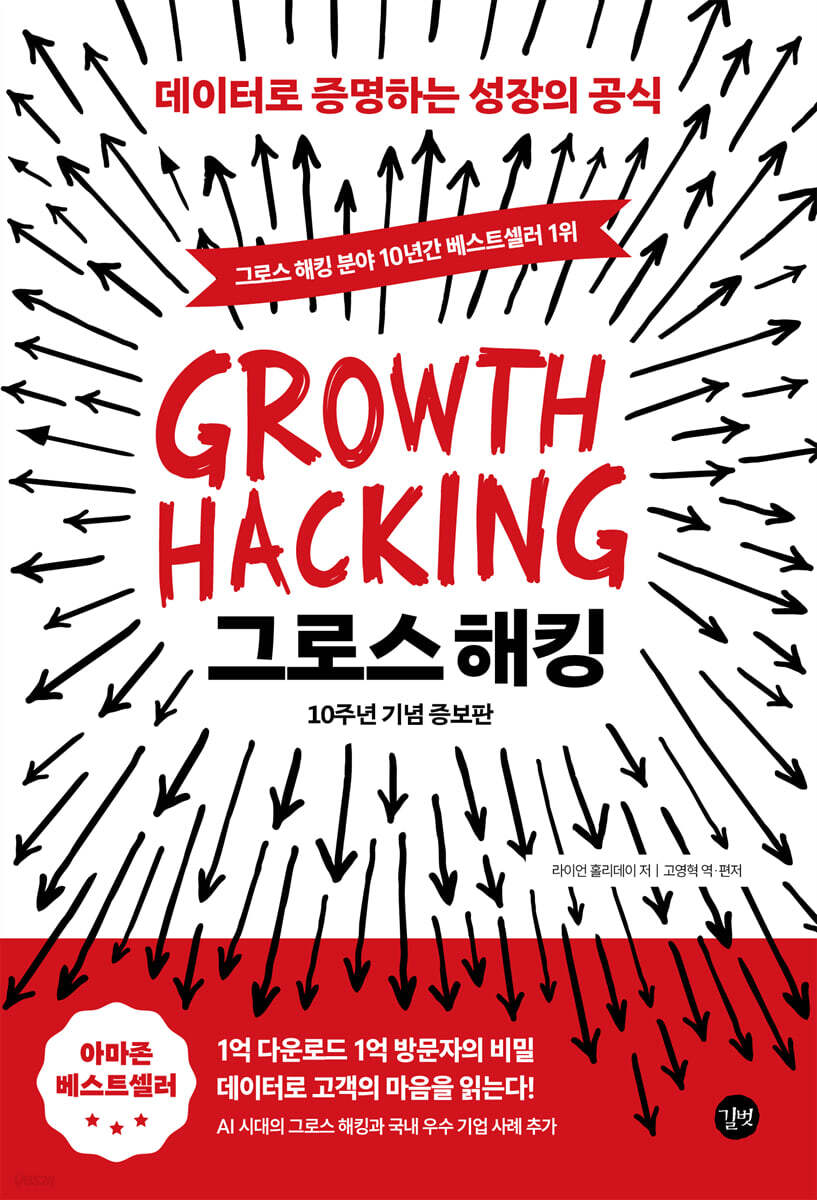
Growth Hacking (10th Anniversary Edition)
 |
Description
Book Introduction
The innovation that 『Growth Hacking』 started 10 years ago,
Now evolving into "Growth Hacking (10th Anniversary Expanded Edition)"
From the basics of growth hacking to growth hacking in the AI era!
Over the past decade, growth hacking has become a universal growth methodology, utilized not only by technology-based startups but also by all companies seeking to grow through data and AI.
Since the first edition was published, the editor, who has experience with various domestic and international companies and projects over the past decade, has comprehensively retranslated the text and added content tailored to the AI era. This book explains the concept of growth hacking in the AI era and provides in-depth, vivid examples of how organizations like LG Electronics and Tomocube leveraged customer experience, personalization, and data to achieve results.
While maintaining the philosophy of growth hacking, it offers practical guidance on where growth hackers should focus and how to grow in the AI era. This is the growth strategy book most needed today for all practitioners seeking sustainable growth in a rapidly changing market.
Now evolving into "Growth Hacking (10th Anniversary Expanded Edition)"
From the basics of growth hacking to growth hacking in the AI era!
Over the past decade, growth hacking has become a universal growth methodology, utilized not only by technology-based startups but also by all companies seeking to grow through data and AI.
Since the first edition was published, the editor, who has experience with various domestic and international companies and projects over the past decade, has comprehensively retranslated the text and added content tailored to the AI era. This book explains the concept of growth hacking in the AI era and provides in-depth, vivid examples of how organizations like LG Electronics and Tomocube leveraged customer experience, personalization, and data to achieve results.
While maintaining the philosophy of growth hacking, it offers practical guidance on where growth hackers should focus and how to grow in the AI era. This is the growth strategy book most needed today for all practitioners seeking sustainable growth in a rapidly changing market.
- You can preview some of the book's contents.
Preview
index
[STEP 1] Growth Hacking Starts with Product-Market Fit
__How can I get PMF?
__Getting acquainted with feedback
[STEP 2] Find Your Own Growth Hack
__Not everyone, just the right person
__Let's get technical
[STEP 3] The Word-of-Mouth Effect That Turns 1 into 2 and 2 into 4
__propaganda
Word-of-mouth growth hacking
[STEP 4] Finalizing the Growth Hacking Process: Maintenance and Optimization
__Always improving performance
__Extend maintenance and optimization
__My Change: Putting What I Learned into Practice
__Product Market Fit (PMF)
__Growth and Interest
__Word of mouth effect
__Optimization and Maintenance
__The Future of Marketing
Reviews
Step 1
Step 2
Step 3
Step 4
__conclusion
Growth Hacking Glossary
Frequently Asked Questions and Answers
Becoming a Growth Hacker: The Next Step
__Blogs and personal websites
__book
__presentations, shows, classes
__Growth Hacker Conference
[Best Growth Hacking Practices from Top Korean Startups]
The translator's story
Growth Hacking: Growing Markets, Services, and Organizations: Jellybus CEO Kim Se-jung
__Finding Customers and Markets Using Growth Hacking
The answer to growth hacking lies in observing how customers use your service.
__Customers are our strongest ally
__The beginning of globalization is localization
Growth Hacking for __Organizations
Effective Marketing: Vice President Park Ji-hee
__A delivery order processing service, not a delivery restaurant advertisement
__Yogiyo, which created a new era in IPTV advertising
Yogiyo's Growth Hacking Revolutionizes the Essence of Service
__Vice President Park Ji-hee and the team
A Growth Hacking Beginner Who Found the Answer in Hard Labor for Customers: Hello Market Co-Founder Han Sang-hyeop
Product-market fit that showed us that mobile was the answer
__The answer to growth hacking is to put yourself in the user's shoes.
__We need to create a space and time to communicate with customers.
__Our attitude toward growth hacking
Continuously improving service details through service use: Wizdom CEO Sangyeop Han
__Successful pivot based on experiments on the foundation of service
A/B testing to determine the core of the __service
__Detail is power, growth hacking realized through details
__Offline is the key to analyzing user responses
What to Learn from an Interview
Growth Hacking in the AI Era and Best Practices
Redefining Growth Hacking in the AI Era
__Introduction: The Death and Rebirth of Growth Hacking
__AI Changes Game Rules
__Agentic AI: From Tool to Colleague
The Future of Growth Hacking Beyond 2025
__Conclusion: Turning Change into Opportunity
TomoCube: Uncovering Customer Needs Through Data: Park Yong-geun, CEO of TomoCube, and Lee Su-min, Managing Director of TomoCube
__Reading Customers' Minds Through Data: Even Customers Don't Know
__Choose a growing market and fail fast.
The Power of Small Data: The First Meeting Drives Conversion Rates
__'It has to be now': Beyond the excuse of being premature
How to Use Data to Open the Hearts of Shy Customers
Growth Hacking in the AI Era: Focus on the Problem, and the Tools Will Follow
__Conclusion: Data-Driven Growth, People-Driven Future
Manufacturing's Subscription Economy Transition: Data Drives Unicorn Success in Two Years: LG Electronics Subscription IT Operations Team Leader Jeon Jae-hyun
The 2 Trillion Won Subscription Economy That Started with Water Purifiers
__The Limitations of Qualitative Analysis: Silencing Counterarguments with Behavioral Data
__Counselor's Chemical: 1st+1st is not the best
__AI adoption that satisfied 99% of care managers
__Data Quality Comes First: Garbage In, Garbage Out
The Future of the Subscription Economy: How to Stay with Your Customers for Life
__How can I get PMF?
__Getting acquainted with feedback
[STEP 2] Find Your Own Growth Hack
__Not everyone, just the right person
__Let's get technical
[STEP 3] The Word-of-Mouth Effect That Turns 1 into 2 and 2 into 4
__propaganda
Word-of-mouth growth hacking
[STEP 4] Finalizing the Growth Hacking Process: Maintenance and Optimization
__Always improving performance
__Extend maintenance and optimization
__My Change: Putting What I Learned into Practice
__Product Market Fit (PMF)
__Growth and Interest
__Word of mouth effect
__Optimization and Maintenance
__The Future of Marketing
Reviews
Step 1
Step 2
Step 3
Step 4
__conclusion
Growth Hacking Glossary
Frequently Asked Questions and Answers
Becoming a Growth Hacker: The Next Step
__Blogs and personal websites
__book
__presentations, shows, classes
__Growth Hacker Conference
[Best Growth Hacking Practices from Top Korean Startups]
The translator's story
Growth Hacking: Growing Markets, Services, and Organizations: Jellybus CEO Kim Se-jung
__Finding Customers and Markets Using Growth Hacking
The answer to growth hacking lies in observing how customers use your service.
__Customers are our strongest ally
__The beginning of globalization is localization
Growth Hacking for __Organizations
Effective Marketing: Vice President Park Ji-hee
__A delivery order processing service, not a delivery restaurant advertisement
__Yogiyo, which created a new era in IPTV advertising
Yogiyo's Growth Hacking Revolutionizes the Essence of Service
__Vice President Park Ji-hee and the team
A Growth Hacking Beginner Who Found the Answer in Hard Labor for Customers: Hello Market Co-Founder Han Sang-hyeop
Product-market fit that showed us that mobile was the answer
__The answer to growth hacking is to put yourself in the user's shoes.
__We need to create a space and time to communicate with customers.
__Our attitude toward growth hacking
Continuously improving service details through service use: Wizdom CEO Sangyeop Han
__Successful pivot based on experiments on the foundation of service
A/B testing to determine the core of the __service
__Detail is power, growth hacking realized through details
__Offline is the key to analyzing user responses
What to Learn from an Interview
Growth Hacking in the AI Era and Best Practices
Redefining Growth Hacking in the AI Era
__Introduction: The Death and Rebirth of Growth Hacking
__AI Changes Game Rules
__Agentic AI: From Tool to Colleague
The Future of Growth Hacking Beyond 2025
__Conclusion: Turning Change into Opportunity
TomoCube: Uncovering Customer Needs Through Data: Park Yong-geun, CEO of TomoCube, and Lee Su-min, Managing Director of TomoCube
__Reading Customers' Minds Through Data: Even Customers Don't Know
__Choose a growing market and fail fast.
The Power of Small Data: The First Meeting Drives Conversion Rates
__'It has to be now': Beyond the excuse of being premature
How to Use Data to Open the Hearts of Shy Customers
Growth Hacking in the AI Era: Focus on the Problem, and the Tools Will Follow
__Conclusion: Data-Driven Growth, People-Driven Future
Manufacturing's Subscription Economy Transition: Data Drives Unicorn Success in Two Years: LG Electronics Subscription IT Operations Team Leader Jeon Jae-hyun
The 2 Trillion Won Subscription Economy That Started with Water Purifiers
__The Limitations of Qualitative Analysis: Silencing Counterarguments with Behavioral Data
__Counselor's Chemical: 1st+1st is not the best
__AI adoption that satisfied 99% of care managers
__Data Quality Comes First: Garbage In, Garbage Out
The Future of the Subscription Economy: How to Stay with Your Customers for Life
Detailed image

Into the book
In the 10 years that are often said to be a time of "change in the world," or perhaps even in the mere year and a half between 2024 and 2025, a huge change has struck the world, so much so that it feels like the world has changed two or three times.
The emergence of AI services that can be directly utilized in reality, such as 'ChatGPT', and their unbelievably rapid development speed.
Despite these changes, the global buzzwords that have dominated the past decade, including the past year and a half, are 'customer experience, personalization, and data.'
That's why growth hacking 10 years ago and growth hacking today are similar yet different.
While an MVP that provides real value to customers remains the foundation for growth, the methodology and perspective for achieving this have changed significantly.
What was once impossible has become possible with the advancement of technology, especially data and personalization technologies, and recently, with the tool called AI, that possibility has become a reality.
In the age of AI, which no one in the world can deny, this revised edition includes the still-applied growth methodology of "growth hacking," the differences from the past, areas to focus on, and the perspective from which human "growth hackers" should view and utilize AI.
In the past, growth hacking was primarily a methodology utilized by technology-based startups. However, after countless companies considered and implemented it over the past decade, growth hacking methodology is now widely applied by mid-sized and large companies as well.
Especially for companies seeking to drive business growth by leveraging data and AI, it's safe to assume they've already mastered and implemented the philosophy and approach of growth hacking, even if they don't know the term.
Accordingly, this revised edition covers not only technology-based, cutting-edge startups like Tomocube, but also how large, established companies like LG Electronics, leaders in well-known fields, have achieved sustained and innovative paradigm shifts.
As a translator, I've worked on various projects with companies, applying growth hacking, data, and AI. I'm delighted to be able to share with readers the challenges, implementations, and achievements I've encountered along the way.
Thanks to AI, or because of AI, the next five years will be a period of massive restructuring, with quantitative and qualitative changes several times greater than the past two years, and with growth and decline coexisting.
Whether you are swept away by this huge wave or ride it and grow depends entirely on your choices and actions.
Change happens in an instant, but it's not too late.
The emergence of AI services that can be directly utilized in reality, such as 'ChatGPT', and their unbelievably rapid development speed.
Despite these changes, the global buzzwords that have dominated the past decade, including the past year and a half, are 'customer experience, personalization, and data.'
That's why growth hacking 10 years ago and growth hacking today are similar yet different.
While an MVP that provides real value to customers remains the foundation for growth, the methodology and perspective for achieving this have changed significantly.
What was once impossible has become possible with the advancement of technology, especially data and personalization technologies, and recently, with the tool called AI, that possibility has become a reality.
In the age of AI, which no one in the world can deny, this revised edition includes the still-applied growth methodology of "growth hacking," the differences from the past, areas to focus on, and the perspective from which human "growth hackers" should view and utilize AI.
In the past, growth hacking was primarily a methodology utilized by technology-based startups. However, after countless companies considered and implemented it over the past decade, growth hacking methodology is now widely applied by mid-sized and large companies as well.
Especially for companies seeking to drive business growth by leveraging data and AI, it's safe to assume they've already mastered and implemented the philosophy and approach of growth hacking, even if they don't know the term.
Accordingly, this revised edition covers not only technology-based, cutting-edge startups like Tomocube, but also how large, established companies like LG Electronics, leaders in well-known fields, have achieved sustained and innovative paradigm shifts.
As a translator, I've worked on various projects with companies, applying growth hacking, data, and AI. I'm delighted to be able to share with readers the challenges, implementations, and achievements I've encountered along the way.
Thanks to AI, or because of AI, the next five years will be a period of massive restructuring, with quantitative and qualitative changes several times greater than the past two years, and with growth and decline coexisting.
Whether you are swept away by this huge wave or ride it and grow depends entirely on your choices and actions.
Change happens in an instant, but it's not too late.
--- From the text
Publisher's Review
What's different about growth hacking in the AI era?
From the Basics of Growth Hacking to Growth Hacking in the AI Era
Let's look at a variety of cases ranging from startups to large corporations.
If 『Growth Hacking』, published ten years ago, changed the "language of growth" to fit a new era, this revised edition is a book that redefines the language of an era where human creativity and insight are combined with AI to expand and grow alongside AI.
Lee Ju-min | LG Electronics DX Center Manager (MBA, Master's in AI and Big Data Engineering)
This book is not a collection of tricks, but a blueprint for a growth system that spans scale and domains.
Here are the details and solutions that only someone who has experienced both the speed of a startup and the sustainability of a large corporation can use.
This book speaks with data, not slogans, and with proven practice, not theory.
Park Chan-yong | CEO & Founder of iHateFlyingBugs/MilDangPT
I was hesitant to write a recommendation because it contained insights I wish my competitors didn't know.
This is a must-read for any marketer struggling to figure out how to get AI to do its job well.
Kang Hye-won, Head of Marketing, Lotte Mart & Supermarket, Managing Director
As someone working in the B2G field that deals with AI technology for public goods, I had a preconceived notion that growth hacking was mainly for startups or B2C.
However, vivid interviews with major corporation LG Electronics and cutting-edge B2B company Tomocube shattered this prejudice.
Kim Seong-hun, Director of the AI Research Center, Korea Water Resources Corporation
If you want to understand how customer experience, data, and personalization through AI have changed over the past decade and are being used as allies rather than tools, I recommend reading this book before it falls into the hands of your competitors.
Choi Jae-hong | Professor at Gachon University's Startup College (Outside Director at KB Financial Group)
From the Basics of Growth Hacking to Growth Hacking in the AI Era
Let's look at a variety of cases ranging from startups to large corporations.
If 『Growth Hacking』, published ten years ago, changed the "language of growth" to fit a new era, this revised edition is a book that redefines the language of an era where human creativity and insight are combined with AI to expand and grow alongside AI.
Lee Ju-min | LG Electronics DX Center Manager (MBA, Master's in AI and Big Data Engineering)
This book is not a collection of tricks, but a blueprint for a growth system that spans scale and domains.
Here are the details and solutions that only someone who has experienced both the speed of a startup and the sustainability of a large corporation can use.
This book speaks with data, not slogans, and with proven practice, not theory.
Park Chan-yong | CEO & Founder of iHateFlyingBugs/MilDangPT
I was hesitant to write a recommendation because it contained insights I wish my competitors didn't know.
This is a must-read for any marketer struggling to figure out how to get AI to do its job well.
Kang Hye-won, Head of Marketing, Lotte Mart & Supermarket, Managing Director
As someone working in the B2G field that deals with AI technology for public goods, I had a preconceived notion that growth hacking was mainly for startups or B2C.
However, vivid interviews with major corporation LG Electronics and cutting-edge B2B company Tomocube shattered this prejudice.
Kim Seong-hun, Director of the AI Research Center, Korea Water Resources Corporation
If you want to understand how customer experience, data, and personalization through AI have changed over the past decade and are being used as allies rather than tools, I recommend reading this book before it falls into the hands of your competitors.
Choi Jae-hong | Professor at Gachon University's Startup College (Outside Director at KB Financial Group)
GOODS SPECIFICS
- Date of issue: November 28, 2025
- Page count, weight, size: 332 pages | 128*188*13mm
- ISBN13: 9791140716807
You may also like
카테고리
korean


korean

![GQ KOREA Mark (Monthly): December [2025]](http://librairie.coreenne.fr/cdn/shop/files/8ef265dbbfbf186523ed75ba7319009d.jpg?v=1765340328&width=3840)


