

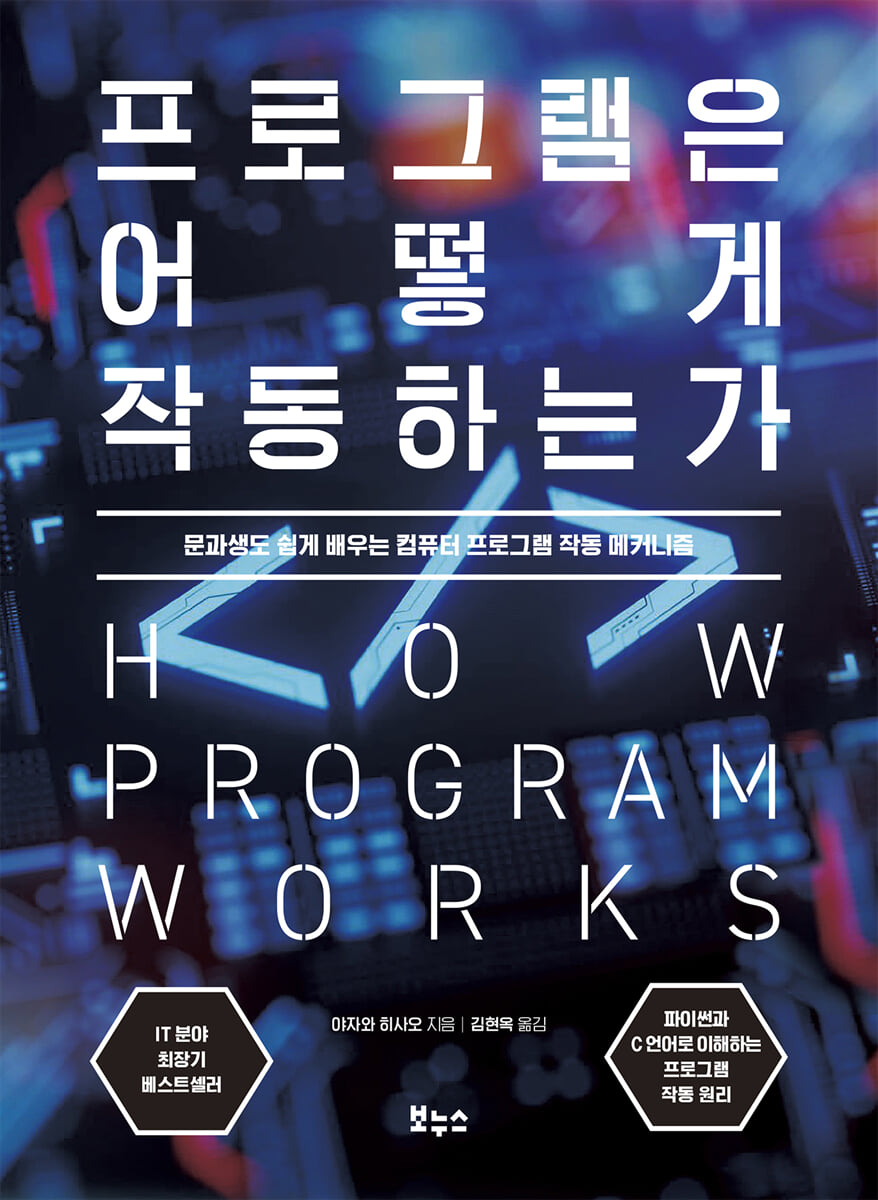
How the program works
 |
Description
Book Introduction
It may sound paradoxical, but the developer skills required in the AI era lie in the fundamentals.
Having a good understanding of how programs work on a computer allows you to create programs that are tailored to your needs and to easily troubleshoot problems when they arise.
This book shows the real process by which a program moves on a computer, that is, the process by which the CPU interprets and executes machine language instructions loaded into memory.
In this course, you will learn how and why computers use binary, the interaction of memory and disk, the compilation and linking stages that convert source code into an executable file, the program's operating environment, and peripheral device control.
It helps beginners in programming or entry-level developers looking to deepen their skills understand the fundamentals of computer systems and develop their application skills.
- You can preview some of the book's contents.
Preview
index
Introduction
Key words to be explained in the book
Chapter 1: What is a CPU to a Programmer?
Let's take a look inside the CPU
The CPU is a collection of registers.
Program counter that determines the flow of the program
Conditional branching and iteration system
Structure of a function call
Implementing arrays with bases and indices
What a CPU can do is extremely simple.
Chapter 2: Let's Imagine Data in Binary
Why computers treat information in binary
By the way, what is binary?
The relationship between shift operations and multiplication and division
'2's complement', which is convenient for computer processing
Difference between logical right shift and arithmetic right shift
Tips for becoming familiar with logical operations
COLUMN How would you describe it?
Explaining CPUs and Binary Numbers to Elementary School Students
Chapter 3: Why Computers Make Miscalculations of Decimal Numbers
Adding 0.1 100 times does not equal 10
To express a decimal number in binary
Why Computers Make Miscalculations
What are floating point numbers?
Regular expressions and excess expressions
Let's actually check it out in the program
To avoid computer calculation errors
Binary and hexadecimal
Chapter 4: Using Square Memory in a Round Shape
The physical structure of memory is simple
The logical image of memory is a building
A really simple pointer
The basis for efficient use of memory is arrays
Stacks, queues, and ring buffers
A list that allows easy addition and deletion of elements
Binary search tree for efficiently finding data
Chapter 5: The Intimate Relationship Between Memory and Disk
Must be read into memory to be executed
'Disk cache' to speed up disk access
Virtual memory that uses disk as part of memory
SSD that uses memory as disk
Programming techniques to save memory
Let's also take a good look at the physical structure of the disk.
Chapter 6: Let's Compress Data with Our Own Power
Files are recorded in bytes
Structure of run-length encoding
Drawbacks of run-length encoding
Checking the Basics of Huffman Coding in Morse Code
Huffman encoding using trees
Huffman coding significantly improves compression ratio
Lossless and lossy compression
COLUMN How would you describe it?
Explaining memory and disks to middle schoolers obsessed with games.
Chapter 7: In what environment does the program operate?
Operating environment = OS + hardware
Windows overcomes differences in hardware other than the CPU
Different APIs for each OS
Install using source code
Java Virtual Machine that provides the same execution environment anywhere
Cloud-provided virtual execution environment
BIOS and Bootstrap
Chapter 8 Creating an executable file from a source file
A computer that can only run native code
Let's check the contents of the native code.
Compiler that converts source code
Compiling alone does not produce an executable file.
Startup and Library Files
DLL files and import libraries
What do I need to run an executable file?
Stack and heap created when loading
Slightly Difficult Q&A
Chapter 9: Relationship between OS and Applications
OS functions through history
Be aware of the existence of the OS
System calls and high-level language portability
OS and high-level languages that abstract hardware
Features of the Windows OS
COLUMN How would you describe it?
Explaining the role of the OS to a high school girl who loves smartphones.
Chapter 10: Understanding the Reality of Programs Through Assembler
Assembler corresponds one-to-one with native code.
Outputting assembler source code with a C compiler
Similar commands and orders
Assembler syntax 'Operation codes and operands'
The most frequently used movl command
Store data on the stack
Structure for calling a function
Structure of the called function
Structure of global and local variables
Structure of iterative processing
Structure of conditional branching
The significance of experiencing assembler
Chapter 11: How to Control Hardware
Applications are hardware independent?
in and out commands that perform input/output with hardware
Peripheral device requesting an interrupt
Real-time processing through interrupts
DMA, which can transfer large amounts of data in a short period of time
A system in which text or graphics are displayed
COLUMN How would you describe it?
Explaining the difference between a display and a TV to the neighborhood grandmother
Chapter 12 How to Teach Computers
What is machine learning?
Support Vector Machine
How to use Python's interactive mode
Preparing training data
Check the contents of handwritten number data
Recognizing Handwritten Characters with Machine Learning
Cross-validate
COLUMN How would you describe it?
Explaining the types of machine learning to a regular bar owner
Appendix 1 Let's challenge the C language!
Features of the C language
Variables and functions
data type
Input, operation, output
Creating/Using Functions
Local and global variables
Arrays and Iteration
Other language syntax
Appendix 2 Let's try Python!
Features of Python
All are objects
data type
Input, operation, output
Creating/Using Functions
Local and global variables
Arrays and Iteration
Other language syntax
Conclusion
Search
Detailed image

Publisher's Review
You have to understand the essence to apply it!
The power of developers who remain competitive even in the AI era
There's a flood of articles about how the rise of artificial intelligence is diminishing the position of developers.
Will developers become redundant in the future? Companies are increasingly seeking developers with "problem-solving skills."
A developer who has the skills to set the right direction for a project, correct hidden errors, and deal with unexpected variables.
So where does real skill come from?
As with everything, solid skills come from the essence, that is, from properly building the fundamentals.
Only by understanding the essence can one apply it, and it becomes relatively easy to identify the cause of a problem or learn new technologies.
Therefore, developers must not only have programming skills but also have a thorough understanding of the program's operating principles behind them.
In other words, you must have a thorough understanding of how a program, which is a collection of data and commands, is input, calculated, output, and stored in a computer.
Beyond coding skills and tricks
Understand the principles of the program
In this sense, "How Programs Work" will be a powerful weapon for aspiring or new developers.
This is because it delves into the details of how source code written in C or Python is translated into machine language that the computer can understand (compile), loaded into memory (loading), and ultimately interpreted and executed by the CPU.
The first question this book poses is this:
What is a CPU to a programmer?
Starting with this question, we witness how a simple line of code like a=1+2; undergoes a dynamic process inside the CPU.
As the author constantly emphasizes, developers do not need to learn all the hardware knowledge.
The only CPU knowledge a developer needs is to understand that the numerous transistors in the CPU are 'registers' that temporarily store instructions and data.
Understand how the program counter points to the address of the next instruction to be executed, the accumulator stores the result of the operation, and the program flow changes depending on the state of the flag register.
This is the essence of what a CPU is for developers.
At this point, we realize that the computer is a calculator.
After all, a computer is a machine that calculates using 0s and 1s.
If you understand how to handle binary numbers,
The essence of how the program works is revealed.
Developers therefore need to delve a little deeper into the world of 'binary', which is the only way computers perceive the world.
As befitting a book that covers the fundamentals and essence of information, the author begins by explaining why computers calculate in binary. IC chips can only express two states per pin: 0V and +5V, and this physical limitation gave birth to the digital world of 0 and 1.
The author goes further than this explanation to introduce how computers handle binary numbers and how we can utilize these computer features.
This process will give you a fundamental answer to why we need the ingenious idea of "two's complement" to represent negative numbers, and why computers, which seem so precise, make the mistake of not being able to produce the result of adding 0.1 100 times (floating point).
I can manipulate memory as I please
The developer is a real talent
Now that you've established an understanding of the CPU and binary data, it's time to turn your attention to the program's main stage: memory.
Developers should know that even though the physical structure of memory is nothing more than an IC chip consisting of address pins and data pins, its limitations can be overcome by changing the logical structure.
The book uses visual aids to explain how basic data structures like arrays are transformed into higher-dimensional data structures like stacks, queues, and ring buffers.
The process of creating completely different uses by changing the order in which data is inserted and removed is enough to make you feel the charm of programming.
In the section explaining data structures, the concept of 'pointers', which is often called a barrier to learning the C language, is also explained, which is also impressive.
A pointer is a variable that remembers the 'address where data is stored', and the key to understanding it lies in the concept of data type. This part will probably help many people shake off the vague fear they have about the concept of pointers.
Comparison of Assembly Language and C Language
Face the real program in action
The highlight of How Programs Work is the section comparing assembly language and the C language.
Because assembler has a one-to-one correspondence with machine language, knowing how assembler works allows you to understand how a program actually operates on a computer.
By directly examining how function calls, loops (for), and conditional branches (if) written in the C language are converted into assembly code when compiled, the reader finally encounters the reality of the program.
The experience of seeing that code written in a high-level language is actually executed as a complex combination of instructions like movl, addl, cmpl, and jmp can dramatically improve your development skills.
The moment you understand the 'real workings of a computer' that were previously unclear, you will clearly understand how the code moves the memory and CPU.
As the author confessed, “I could almost grasp the structure of how the program worked” through his experience comparing assembler and C language code, this experience became an opportunity for him to discover a way to understand programs on a completely different level than before.
Recommended by the top 1% developers
A must-read for beginners in programming
As we enter the AI era, principle-centered learning has become increasingly important.
In a world where AI is replacing repetitive coding tasks, developers must now move beyond simple coding to setting the direction of their work, catching subtle errors, and suggesting creative solutions.
All these capabilities must be based on an understanding of principles, that is, of the essence.
Ultimately, the developers who will survive in the AI era are those who know how to ask questions, understand situations, and solve them.
How Programming Works tells you how to hone your intelligence and insight to find answers to the ever-changing real-world problems.
Let's experience the reality and operating principles of programming code with this book.
Beyond simply acquiring knowledge, it serves as a valuable stepping stone to take a developer's skills to the next level.
GOODS SPECIFICS
- Date of issue: November 5, 2025
- Page count, weight, size: 296 pages | 654g | 172*235*17mm
- ISBN13: 9788964947708
You may also like
카테고리
korean


korean


