

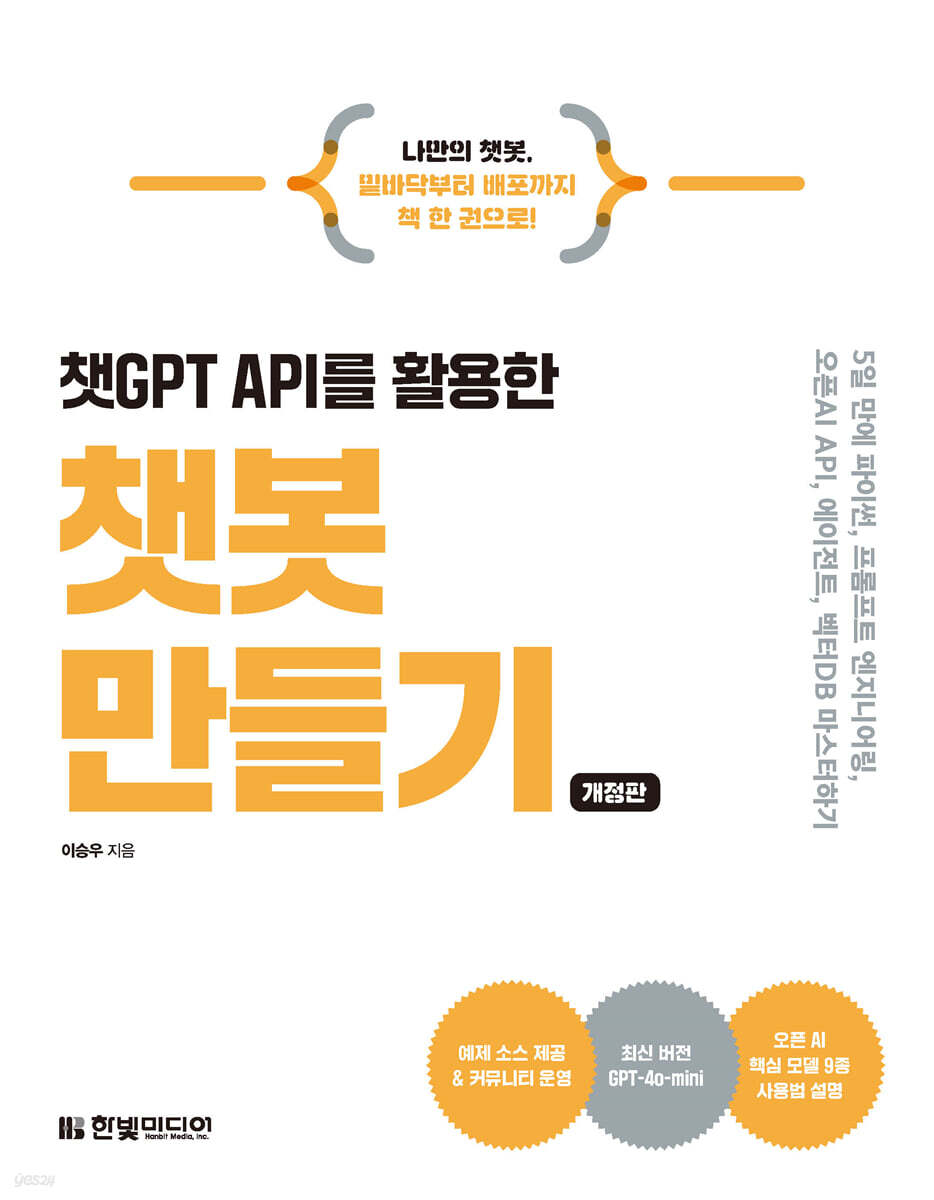
Creating a Chatbot Using the ChatGPT API
 |
Description
Book Introduction
ChatGPT, are you still just 'using' it?
How to Get the Most Out of ChatGPT: A Generative AI Developer's Guide
GPT-4o-mini, LLM, GPT API, GPTs, vector DB…
The proven bestseller is back with an updated version!
This book is designed to help non-majors and non-developers effectively experience the process of developing a chatbot based on an LLM in a short period of time.
We cover Python step-by-step, covering just the right amount of Python, prompt engineering, interacting with language models via APIs, implementing autonomous agents, and using memory devices.
And based on this knowledge, we covered in detail the operating principles and implementation methods of the Assistants API and GPTs announced in November 2023, as well as how to integrate all of this into KakaoTalk.
Rather than simply listing practical examples to follow, the principles and operating methods are explained in detail using pictures and materials.
We carefully examine unfamiliar words and difficult functions from the ground up so that you can understand where and how they are used.
Developers who want to develop their own services using generative AI, planners curious about the process of creating AI products, and anyone who wants to learn AI more deeply and broadly can get started without feeling overwhelmed by this book.
- You can preview some of the book's contents.
Preview
index
Chapter 01 Easily Setting Up a Development Environment
1.
Using the cloud IDE goorm
2.
Upgrading Python version
3.
Apply for KakaoTalk Chatbot
Chapter 02 Learning Python Just Enough to Use It
1.
Why Python is Easy
2.
Basic type data
3.
Collection data
4.
Conditional statements and loops
5.
function
6.
Programming like things
7.
Writing exception handling
8.
Other features to know
Chapter 03 Chatting with ChatGPT and API
1. Understanding the API
2. Apply to use the API
3. Responding to queries using API
Chapter 04: Fundamentals of Prompt Engineering
1.
The meaning of 'prompt' and 'engineering'
2.
Composition of the prompt
3.
Playground
4.
Language model parameters
Chapter 05 Core Techniques of Prompt Engineering
1.
How to Create Good Prompts
2. LLM and In-Context Learning
3.
Few-shot Prompting
4.
CoT technique
5. SC technique
6.
ToT technique
7.
ReAct technique
8. RAG technique
Chapter 06: Designing and Implementing a Chatbot with Prompt Engineering
1.
Context in conversational language models
2.
Designing a Chatbot System
3.
Creating a prompt
4.
Running the prompt
5.
Improving the production results
Chapter 07: Chatting with Chatbots in Web Applications
1.
Examining the operation of the server program
2.
Get familiar with the server operation process
3.
Take a look at application.py
4.
Applying web resources
5.
Chatting on the screen
6.
Connect to a Chatbot object and have a conversation
Chapter 08: Building a Chatbot with Prompt Engineering
1.
Building personas through system roles
2.
Improving system role performance
3.
Transform into my best friend
4.
Managing context capacity
5.
Reflect common issues in advance
Chapter 09 Calling Functions in Human Language
1.
How a language model calls a function
2.
Searching the Internet Using Function Calling
3.
Parallel Function Calling
Chapter 10 Agent Implementation and Prompt Splitting
1.
Understanding the concept of agents
2.
How autonomous agents work
3.
Implementing Autonomous Agents
4.
Splitting complex tasks
5.
How to give your best friend an edge
6.
Implementing WarningAgent
7.
Using WarningAgent
Chapter 11 Saving Conversations
1.
Document DB
2.
Implementing MemoryManager
3.
Using MemoryManager
Chapter 12 Preparing for Memory
1.
How Computers Understand Language
2.
How humans interact with embeddings
3.
Trying an embedding model
4.
The need for vector DB
5.
A taste of PineconeDB
Chapter 13 How to activate memory
1.
Create bulk conversations
2.
How to structure memories
3.
Write to database
4.
Search memories in real time
5.
Recall in real time
6.
Save memories in the background
Chapter 14 Understanding the Assistants API Concept
1.
Assistants API Core Concepts
2.
Try the Assistants API
3.
Implementing a Chatbot Class with the Assistants API
Chapter 15: In-Depth Learning of the Assistants API
1.
Consulting while using tools
2.
Using Assistants in Playgrounds
3.
Unnecessary methods and other considerations
Chapter 16 GPTs and API Usage Strategies
1. Background and significance of the launch of GPTs
2. Creating a Chatbot with GPTs
3.
Comparing Assistants API and GPTs Features
Chapter 17: Uploading a Chatbot to KakaoTalk
1.
A quick look at KakaoTalk chatbots
2.
Develop a KakaoTalk chatbot in 30 minutes
3.
Break the 5-second rule
4.
Connecting the Assistants API
Chapter 18 Applying Multimodal Functions
1.
The meaning of modality and multimodality
2.
Recognize images
3.
Create an image
4.
Respond by voice
As we finalize development
How to Respond to Appendix Upgrades
Check out the OpenAI blog
Check model upgrade
Check price
Context window size
Publisher's Review
From the principles of GPT to LLM, VectorDB, and GPTs
Quickly learn AI from the ground up to deployment by building a chatbot!
Step 1 | Even non-majors can do it! Get started easily with Python & the Goorm IDE.
Even if you are new to programming, learn just enough Python to proceed without any difficulties and set up a development environment with the goorm IDE.
● Step 2 | Advanced Prompt Engineering, from Basic to Advanced
As you become familiar with ChatGPT, you will learn the basic concepts of generative AI, such as GPT and LLM, and design a chatbot.
● Step 3 | Creating an Autonomous Agent with Function Calling
Learn and practice the theory of Function Calling to easily implement agents.
Step 4: Instilling Memories in Your Chatbot with Vector DB
Learn and practice concepts about vector spaces and embeddings to enhance the functionality of your chatbot.
● Step 5 | Completely Understanding the Assistants API and GPTs
Learn and practice the data structures of the Assistants API.
Here we briefly look at the usage strategies for APIs, Assistants API, and GPTs.
Step 6 | Chat with your own chatbot on KakaoTalk
You can use the chatbot development tool that connects with Kakao Channel to create your own chatbot on KakaoTalk.
Target audience for this book
● Anyone interested in applied technologies utilizing generative AI such as ChatGPT, LLM, and API
● Developers who want to develop AI by designing and developing chatbots themselves
● PMs, engineers, and planners who want to understand the overall flow of services utilizing AI
Example Code & Community in This Book
All example code covered in this book can be downloaded from the following URL:
● GitHub link: github.com/minji337/jjinchin/tree/pub-2
Q&A space
Questions and answers regarding this book can be found at the following URL:
Naver Cafe: cafe.naver.com/minji337
GOODS SPECIFICS
- Date of issue: August 27, 2024
- Page count, weight, size: 416 pages | 183*235*17mm
- ISBN13: 9791169212861
- ISBN10: 1169212867
You may also like
카테고리
korean


korean


