

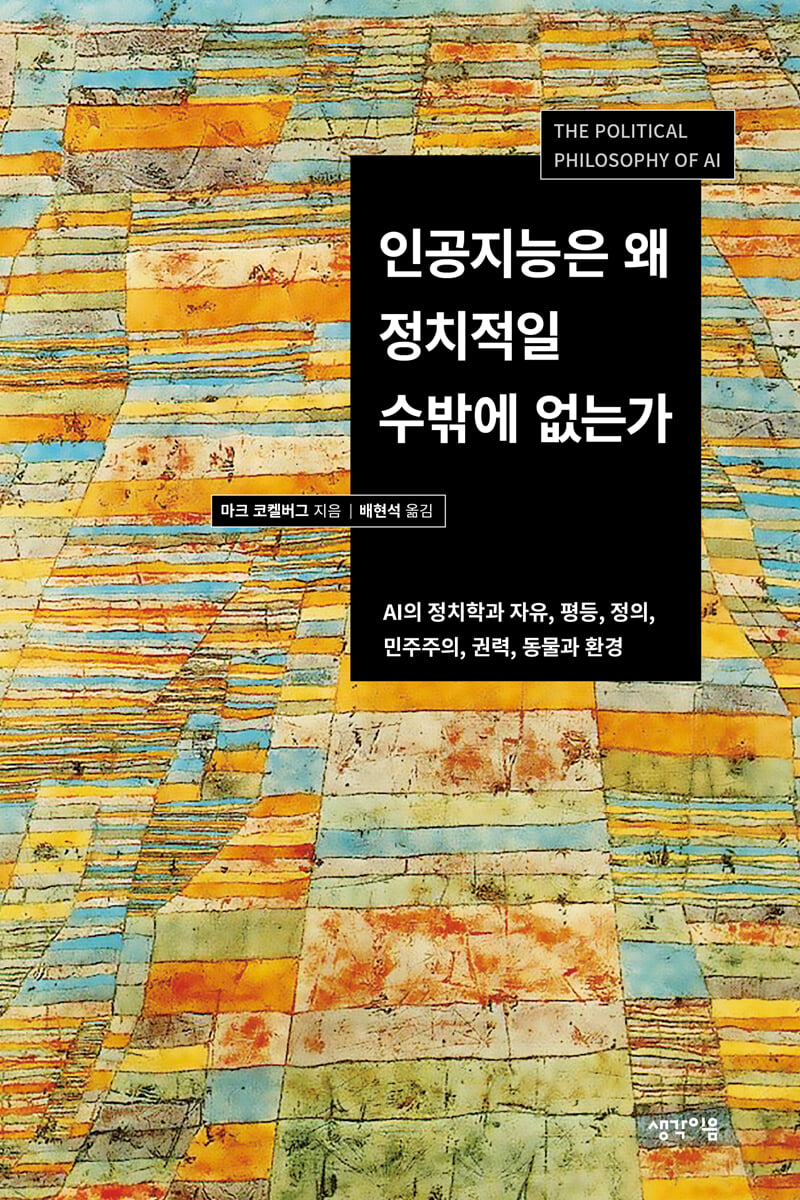
Why AI Must Be Political
 |
Description
Book Introduction
We explore how a new ecosystem in which humans, artificial intelligence, and related technologies like data science and robotics are inextricably linked connects to today's key political issues, including freedom, equality (or inequality), racism, justice, democracy, and climate change.
This book diagnoses the risks and possibilities of artificial intelligence by combining long-standing political philosophy, the philosophy of technology, and ethics, including those of Plato, Rousseau, Hannah Arendt, Michel Foucault, and Marx, to examine how artificial intelligence reinforces racism, inequality, and injustice, and is not value-neutral; how it can manipulate human psychology and infringe on individual freedom; what might happen if it were combined with power; what impact it would have on democracy; and how it could become the source of totalitarianism.
Based on the posthumanism and political and social theories of Peter Singer, Martha Nussbaum, and others, it explores the status of animals, the environment (non-humans), and even robots, demonstrating imagination suited to the age of artificial intelligence.
Rather than providing answers, I propose raising questions that can lead to further research, and to prevent abuse by those who already hold significant power, including high-tech companies, I propose a public discussion of the politics of AI and a consideration of the inseparable relationship between politics and technology.
- You can preview some of the book's contents.
Preview
index
introduction
Chapter 1: Freedom, Manipulation by Artificial Intelligence, and Robot Slavery
A Historic Declaration on Freedom and Modern Slavery
Artificial Intelligence, Surveillance, Law Enforcement, and Deprivation of Negative Liberty
Artificial intelligence and human behavior manipulation, deceiving human autonomy.
Threats to self-realization and liberation, exploitation through artificial intelligence, and the problem of robot slavery
Who Makes Decisions About AI? Freedom as Participation, AI Elections, and Freedom of Expression
Political ideas about freedom and other values
Chapter 2: Equality and Justice, Bias and Discrimination by Artificial Intelligence
Raising issues of equality and justice, bias and discrimination
Why Bias Matters? (1) Equality and Justice in English-Speaking Liberal Political Philosophy
Why is bias a problem? (2) Class and identity theory critical of universalist liberal ideology
AI that is not politically neutral
Chapter 3: Democracy, Echo Chambers, and Machine Totalitarianism
Artificial Intelligence as a Threat to Democracy
Artificial Intelligence Threatens Democracy, Knowledge, and Deliberative Politics
Starting with Plato: Democracy, Knowledge, and Expertise
Beyond majority rule and representation
Deliberative and participatory democracy and competitive and radical democracy
Information Bubbles, Echo Chambers, and Populism
More problems, manipulation, substitution, responsibility, and power
The Origins of Artificial Intelligence and Totalitarianism: Lessons from Arendt
Artificial Intelligence and Totalitarianism
Arendt's Study of the Origins of Totalitarianism and the Banality of Evil
Chapter 4: Power, Data-Driven Surveillance, and Self-Discipline
Power as a Subject of Political Philosophy
Power and Artificial Intelligence: A General Conceptual Framework
Marxism and AI as a Tool for Technocapitalism
Foucault, How Artificial Intelligence Subjugates Humans and Makes Them Subjects
discipline and surveillance
Knowledge and power, the formation and creation of the subject and the self
Technological performance, power, and artificial intelligence
Conclusion and Remaining Questions
Chapter 5: What Happens to Nonhumans? Environmental Politics and Posthumanism
Beyond artificial intelligence and robots, human-centered politics
Humans are not the only ones who are politically important, but the political status of animals and nature as well.
Implications for AI and Robot Politics
The political implications of artificial intelligence's impact on nonhumans and the natural environment
What is the political status of artificial intelligence?
Chapter 6 Political Technology
The role and conclusion of this book
What to do next: a question of political skill
Acknowledgements
References
Search
Into the book
Why did this happen? The New York Times reporter who reported on the case and an expert who consulted speculate that Williams' case "may be the first known instance of an American being wrongfully arrested due to a facial recognition algorithm error."
Facial recognition systems that use machine learning-based artificial intelligence are likely to be flawed and biased.
Because we recognize the faces of white men more accurately than other demographic groups.
So, as in Williams' case, innocent people are perceived as criminals, and when the police don't do their job properly, it can result in people being arrested who haven't even committed a crime.
--- p.11
However, because these AI-powered nudges do not force us to do something or make a decision, they are a threat to positive liberty rather than negative liberty.
In other words, nudges influence the psychology of human subconsciousness, manipulating the human mind rather than respecting it as a rational human being who sets goals and makes choices on his own.
Nudges are not the first way to tap into the human subconscious, as advertising and propaganda do.
But nudges, while posing as liberal, are likely to spread rapidly and have far-reaching implications as they leverage AI.
--- p.41
Digital technologies and media impact not only freedom but also equality and justice.
According to Van Dijk, network technology makes production and distribution more effective and efficient, but at the same time increases inequality. “Network technology tends to promote uneven development along with the solidarity of nations globally, and regionally, it helps to form a dual economy with regions directly connected to the global information infrastructure and those that are not.” (336) This difference in economic development creates societies with different ‘speeds’ of development.
Some people and some countries benefit more from technology and media than others.
--- p.77
From the same perspective, the problem with the biased algorithm in question is not that it is not neutral, but that it structurally disadvantages Black people, thereby reproducing existing inequalities and, above all, contributing to the “linked forms of discrimination” known as racial bias.
Meanwhile, Lee argues that the emergence of many companion robots and smart dolls “normalizes whiteness.”
Thus, while this argument undermines the instrumentalist view that technology is neutral, it also fundamentally challenges the narrative (often from industry sources) that digital and neutral technologies exist as a “level playing field” and even a place where “inequalities are corrected.”
--- pp.106~7
So what does this democracy mean for AI? This form of democracy excludes non-participatory governance methods, such as exclusive technocratic governance by experts and AI, and blind, exclusive reliance on algorithms and AI recommendations.
But as long as citizens have the final say and trust their own judgment and debate, there is room for AI-derived knowledge and expertise to somehow be involved in the democratic process.
However, the exact forms in which AI could potentially be involved are unclear.
--- p.135
If Arendt is right, authoritarianism and totalitarianism do not create broken social structures, but rather grow on top of already broken ones.
From Arendt's perspective, totalitarianism is not, strictly speaking, a political movement, but rather an activity that destroys the political sphere.
It is not only anti-democratic in its authoritarian nature, but also “organized loneliness,” a destruction of trust in one another, and a weakening of faith in truth and facts.
From this perspective, we must re-ask the following questions about technology:
Are modern technologies like artificial intelligence contributing to, or potentially contributing to, the conditions for totalitarianism? If so, what are the reasons?
--- p.169
“Data colonialism” is another term used to express the unacceptability of human life and exploitation through AI from a critical theory perspective, in relation to taking a critical view of AI and power.
This allows us to understand the monopoly of data even through the history of colonialism.
In other words, just as colonialism in the past allowed certain countries and corporations to monopolize the territory and resources of colonies for profit, data colonialism exploits humans through the monopoly of data.
As we saw in Chapter 2, colonialism is also invoked in discussions about artificial intelligence and bias.
--- p.203
I have argued with Parviäinen that artificial intelligence and robots can be used in choreographic contexts to address political concerns and strategic situations.
We argued that our performance with Sophia, a humanoid robot that incorporates artificial intelligence, is connected to the politics of artificial intelligence.
In other words, working with Sophia is not only beneficial to a private company (Hanson Robotics), but also to those who want to expand the technology and the markets associated with it.” This could also be expressed using the term “power”:
--- p.232
As the politics of non-anthropocentric AI shifts away from a technology-centric focus, these attitudes and working methods can be challenged.
This would mean asking artificial intelligence to provide solutions to all problems related to humans.
It would also mean considering the idea of loosening our grip on the planet, rather than increasing it through artificial intelligence and data science.
Once we question technological solutionism, or what Boursard calls “techno-supremacy”—the belief that technology is always the solution—we will no longer see AI as a magic solution to all human problems, and will focus more on the limits of what AI can do for humans and non-humans alike.
--- p.264
Publisher's Review
This book addresses today's most pressing political issues—freedom, racism, slavery, justice, inequality, democracy, power, climate change, and animal rights—by relating them to the challenges posed by artificial intelligence and robots, raising questions about their risks and possibilities.
Artificial intelligence infringes on individual freedom by manipulating human behavior and deceiving autonomy.
In relation to the long-standing political philosophy debate on freedom (negative and positive liberty), we question how libertarian nudges, which refer to gentle interventions that AI uses to guide consumer choices, deprive individuals of their freedom.
We also examine the potential consequences of a future in which artificial intelligence takes over decision-making.
It talks about the use of robots to replace human labor and the risks involved.
It also addresses the issues of freedom of expression and media content moderation by artificial intelligence.
Artificial intelligence is political through and through, and is not politically neutral.
In terms of equality and justice, the political influence of artificial intelligence, data science, and robots, and the inequality and unfairness that may arise through artificial intelligence due to automation and digitalization, as well as bias and discrimination such as sexism and racism, are explained in connection with Rawls's positive discrimination, Marxism, capitalism, identity politics theory, anti-racism, and anti-colonial thought.
Artificial intelligence threatens democracy.
“We are already dominated by giant corporations that use artificial intelligence to manipulate us, a situation that, as Zubov points out, is completely beyond democratic control.
If we are already dominated by Google, Amazon, and other giants, who should rule is merely a theoretical question.
In this respect, there is something inherently anti-democratic about artificial intelligence.” In relation to democracy, we examine the Platonic concept of technocracy, Dewey and Habermas’ ideals of participatory and deliberative democracy, and Mouffe and Rancière’s agonistic and radical democracy, and address issues such as information bubbles and echo chambers created by the combination of social media and artificial intelligence, and populism using artificial intelligence.
The problem of totalitarianism arising from technology, and the concept of what Arendt (2006) called the “banality of evil,” are brought up to point out the dangers of artificial intelligence being used as a tool for corporate manipulation and bureaucratic personnel management.
We bring Foucault's theories on discipline, surveillance, knowledge, and power relations to bear on artificial intelligence and examine their implications.
It introduces Foucault's concept of power, which states that power is spread throughout society, and provides a conceptual framework for thinking about the relationship between power and artificial intelligence.
Through three theories of power—Marxism and critical theory, Foucault and Butler, and a performance-centered approach—we examine the manipulation induced by artificial intelligence and illuminate data science that evaluates, classifies, and monitors people within the context of capitalism.
Humans are not the only politically important things.
Along with the argument that we need to rethink concepts such as freedom, justice, and democracy that include non-humans, we discuss the impact of artificial intelligence on non-human animals and the environment and the political status of animals, the environment, and artificial intelligence, connecting the claims made by animal rights and environmental theory, artificial intelligence and robot ethics, posthumanism, which questions traditional human-centered political perspectives, and transhumanism, which argues that artificial superintelligences will replace humans.
GOODS SPECIFICS
- Date of issue: July 25, 2023
- Page count, weight, size: 320 pages | 500g | 140*210*19mm
- ISBN13: 9791196552565
- ISBN10: 1196552568
You may also like
카테고리
korean


korean


