

Interlacing AI and Humans
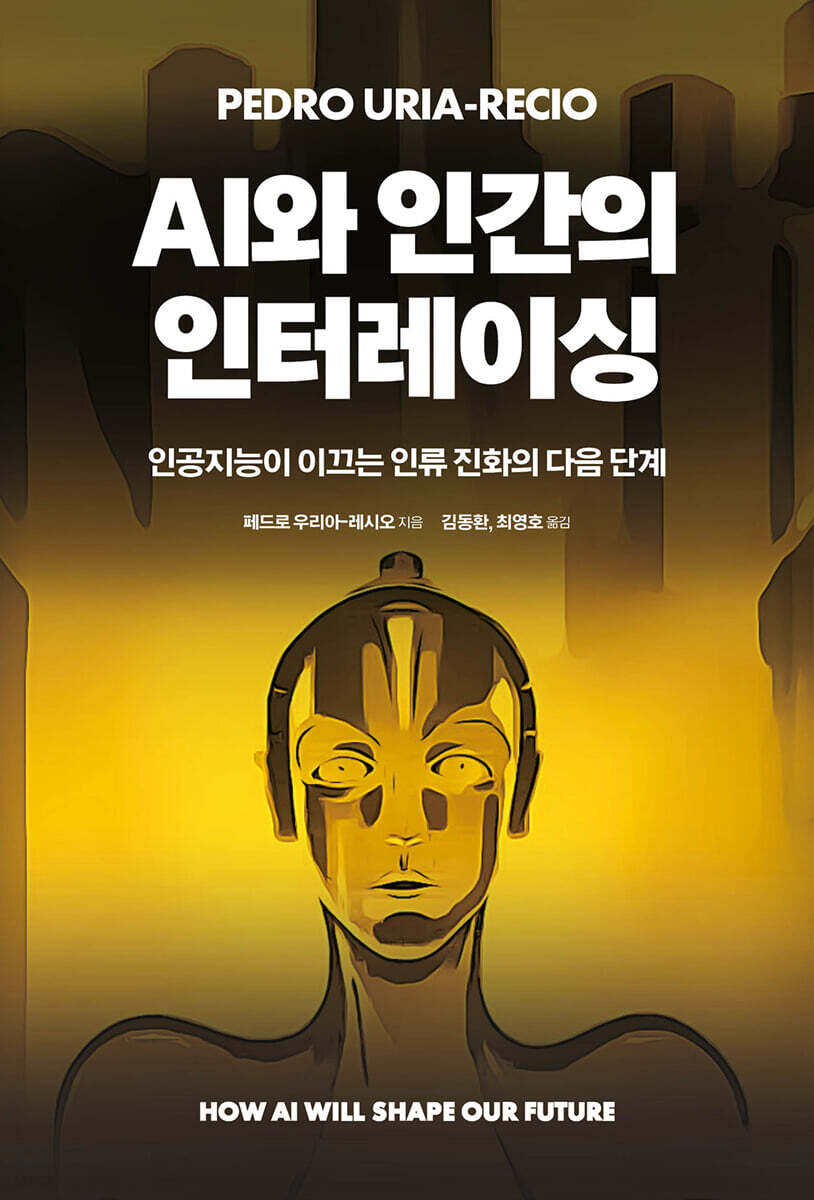 |
Description
Book Introduction
"Who will control the intelligence of the future?"
"What kind of new beings will we be reborn into?"
A book that presents a new evolution in which humans and AI become one!
We have entered an era of 'interlacing,' where humans and artificial intelligence are gradually merging and evolving into entirely new beings.
This book is a humanities book that vividly depicts the grand journey of change in how humans are becoming the 'machines of tomorrow.'
The author, a mathematician and AI expert, analyzes the process from ancient mythology to modern AI, through cyborg technology and synthetic biology, and to the complete fusion of superintelligence, through a multi-layered perspective encompassing mathematics, technology, history, and literature.
And through this, the inferred future is also vividly conveyed.
At this time, the author is not only talking about utopia.
It soberly warns of dystopian dangers such as concentration of power, social inequality, and fundamental changes in human identity.
As we face the greatest turning point in human history, I recommend this book to anyone who wants to understand and prepare for the future.
"What kind of new beings will we be reborn into?"
A book that presents a new evolution in which humans and AI become one!
We have entered an era of 'interlacing,' where humans and artificial intelligence are gradually merging and evolving into entirely new beings.
This book is a humanities book that vividly depicts the grand journey of change in how humans are becoming the 'machines of tomorrow.'
The author, a mathematician and AI expert, analyzes the process from ancient mythology to modern AI, through cyborg technology and synthetic biology, and to the complete fusion of superintelligence, through a multi-layered perspective encompassing mathematics, technology, history, and literature.
And through this, the inferred future is also vividly conveyed.
At this time, the author is not only talking about utopia.
It soberly warns of dystopian dangers such as concentration of power, social inequality, and fundamental changes in human identity.
As we face the greatest turning point in human history, I recommend this book to anyone who wants to understand and prepare for the future.
- You can preview some of the book's contents.
Preview
index
Preface to the Korean edition
Acknowledgements
prolog
Part 1.
Old myth
Entering
__01.
Ancient myths about artificially created beings
__02.
Science Fiction from Frankenstein to the Space Race
Part 2.
new mind
Entering
__03.
Philosophers, mathematicians, and the first computers
__04.
The Dartmouth Conference and the First AI Winter
__05.
Expert Systems and the Second AI Winter
__06.
Machine Learning in the Dot-Com Era and the Third AI Winter
__07.
The Great Financial Crisis and the Long AI Summer
__08.
The rise of artificial creativity
__09.
The Prelude to General Artificial Intelligence
Part 3.
new body
Entering
__10.
From Mechanical Automaton to Industrial Revolution
__11.
The Great Debate: Symbolic or Analog Logic
__12.
Robot arm strength
__13.
The Rising Land of Robots
__14.
The dream of neural networks and robotic mobility
__15.
The Art of War for Robots
__16.
Robots go into space
__17.
Japan's Dilemma: Immigration or Humanoids
__18.
robot in love
Part 4.
conversion
Entering
__19. AI-Human Interlace and Posthumanity
__20.
Robotics Expands to Cyborgs
__21. AI greatly enhances synthetic biology.
__22. AI Utopia: Redistribution, Sustainability, and Equity
__23. AI Dystopia: Authoritarianism, Unemployment, and Class Politics
__24.
China and the AI Cold War
Part 5.
new being
Entering
__25.
Quantum computing: a plausible helper
__26.
superintelligence
__27.
Mind Uploading, Emulation, and Immortality
__28.
Taming the Beast
__29. AI, God
__30.
Will there be a war?
__31.
Target of evolution
Epilogue
Last request
Glossary
About the Author
Translator's Introduction
Translator's Note
References
Search
Acknowledgements
prolog
Part 1.
Old myth
Entering
__01.
Ancient myths about artificially created beings
__02.
Science Fiction from Frankenstein to the Space Race
Part 2.
new mind
Entering
__03.
Philosophers, mathematicians, and the first computers
__04.
The Dartmouth Conference and the First AI Winter
__05.
Expert Systems and the Second AI Winter
__06.
Machine Learning in the Dot-Com Era and the Third AI Winter
__07.
The Great Financial Crisis and the Long AI Summer
__08.
The rise of artificial creativity
__09.
The Prelude to General Artificial Intelligence
Part 3.
new body
Entering
__10.
From Mechanical Automaton to Industrial Revolution
__11.
The Great Debate: Symbolic or Analog Logic
__12.
Robot arm strength
__13.
The Rising Land of Robots
__14.
The dream of neural networks and robotic mobility
__15.
The Art of War for Robots
__16.
Robots go into space
__17.
Japan's Dilemma: Immigration or Humanoids
__18.
robot in love
Part 4.
conversion
Entering
__19. AI-Human Interlace and Posthumanity
__20.
Robotics Expands to Cyborgs
__21. AI greatly enhances synthetic biology.
__22. AI Utopia: Redistribution, Sustainability, and Equity
__23. AI Dystopia: Authoritarianism, Unemployment, and Class Politics
__24.
China and the AI Cold War
Part 5.
new being
Entering
__25.
Quantum computing: a plausible helper
__26.
superintelligence
__27.
Mind Uploading, Emulation, and Immortality
__28.
Taming the Beast
__29. AI, God
__30.
Will there be a war?
__31.
Target of evolution
Epilogue
Last request
Glossary
About the Author
Translator's Introduction
Translator's Note
References
Search
Detailed image

Into the book
Since the publication of the first edition of How AI Will Shape Our Future (2024), the field of artificial intelligence has advanced at an astonishing pace and in unexpected directions.
When I first wrote this book in English, my goal was not to view AI as a mere technological phenomenon, but to provide readers with a clear and balanced perspective on how the convergence of humans and AI will fundamentally reshape today's economy, society, and the future.
In reality, the world is rapidly changing in the direction described in the book, demonstrating the urgency and relevance of the questions I raise in my book.
This Korean edition was published not only worldwide, but also in Asia, where the global AI revolution is unfolding most fiercely, and particularly in South Korea.
I am very excited to share the ideas in this book with the world's most forward-thinking and technologically advanced Korean readers.
The dual potential of AI encompassing automation and augmentation, the geopolitical shifts brought about by AI power, and the structural changes in society, including employment, education, and governance, discussed in this book are all trends unfolding in real time.
The ideas presented in this book are by no means fixed predictions, but rather a living framework designed to help leaders, citizens, and institutions understand, explore, and apply the knowledge that the decisions they make today in an increasingly rapidly evolving environment will shape our collective future tomorrow.
The release of advanced AI models like GPT-4 Turbo, Gemini, Claude 2, and Mistral has unleashed a new wave of innovation.
But what's even more remarkable is that Asia has ushered in the era of "sovereign AI" by capturing the world's attention.
In particular, China's DeepSeek, while standing shoulder to shoulder with leading Western models, demonstrates a clear shift in Asia from AI consumption to AI creation, with development aligned with its own strategic priorities.
In Korea, too, major companies like Naver and Kakao are actively expanding the distribution of generative AI tailored to local language, values, and culture.
Now, Korea has gone beyond simply "adapting" to AI; it has established itself as a nation that "creates" AI and a center of its ecosystem.
The introduction of Seoul's AI Ethics Charter has garnered international acclaim for its forward-looking principles of human-centered governance, elevating Korea's standing in both technological prowess and ethical leadership.
Asia is already using AI in a variety of fields, including commerce, governance, diplomacy, and the arts.
Japan is constantly exploring the philosophical implications of humanoid robotics, Singapore has become a global testing ground for AI regulation and safety standards, and India is also accelerating the spread of AI across diverse sectors, including healthcare and education, through public-private partnerships.
In this way, Asia is no longer a region following the AI trend, but has emerged as a leader and driving force behind the revolution.
When I first wrote this book in English, my goal was not to view AI as a mere technological phenomenon, but to provide readers with a clear and balanced perspective on how the convergence of humans and AI will fundamentally reshape today's economy, society, and the future.
In reality, the world is rapidly changing in the direction described in the book, demonstrating the urgency and relevance of the questions I raise in my book.
This Korean edition was published not only worldwide, but also in Asia, where the global AI revolution is unfolding most fiercely, and particularly in South Korea.
I am very excited to share the ideas in this book with the world's most forward-thinking and technologically advanced Korean readers.
The dual potential of AI encompassing automation and augmentation, the geopolitical shifts brought about by AI power, and the structural changes in society, including employment, education, and governance, discussed in this book are all trends unfolding in real time.
The ideas presented in this book are by no means fixed predictions, but rather a living framework designed to help leaders, citizens, and institutions understand, explore, and apply the knowledge that the decisions they make today in an increasingly rapidly evolving environment will shape our collective future tomorrow.
The release of advanced AI models like GPT-4 Turbo, Gemini, Claude 2, and Mistral has unleashed a new wave of innovation.
But what's even more remarkable is that Asia has ushered in the era of "sovereign AI" by capturing the world's attention.
In particular, China's DeepSeek, while standing shoulder to shoulder with leading Western models, demonstrates a clear shift in Asia from AI consumption to AI creation, with development aligned with its own strategic priorities.
In Korea, too, major companies like Naver and Kakao are actively expanding the distribution of generative AI tailored to local language, values, and culture.
Now, Korea has gone beyond simply "adapting" to AI; it has established itself as a nation that "creates" AI and a center of its ecosystem.
The introduction of Seoul's AI Ethics Charter has garnered international acclaim for its forward-looking principles of human-centered governance, elevating Korea's standing in both technological prowess and ethical leadership.
Asia is already using AI in a variety of fields, including commerce, governance, diplomacy, and the arts.
Japan is constantly exploring the philosophical implications of humanoid robotics, Singapore has become a global testing ground for AI regulation and safety standards, and India is also accelerating the spread of AI across diverse sectors, including healthcare and education, through public-private partnerships.
In this way, Asia is no longer a region following the AI trend, but has emerged as a leader and driving force behind the revolution.
Preface to the Korean edition
GOODS SPECIFICS
- Date of issue: October 29, 2025
- Page count, weight, size: 784 pages | 152*224*36mm
- ISBN13: 9791194409311
- ISBN10: 1194409318
You may also like
카테고리
korean


korean

![ELLE 엘르 A형 (여성월간) : 1월 [2026]](http://librairie.coreenne.fr/cdn/shop/files/3b70e1cf77cf67d6da56e0eb041901e8.jpg?v=1767265322&width=3840)


