

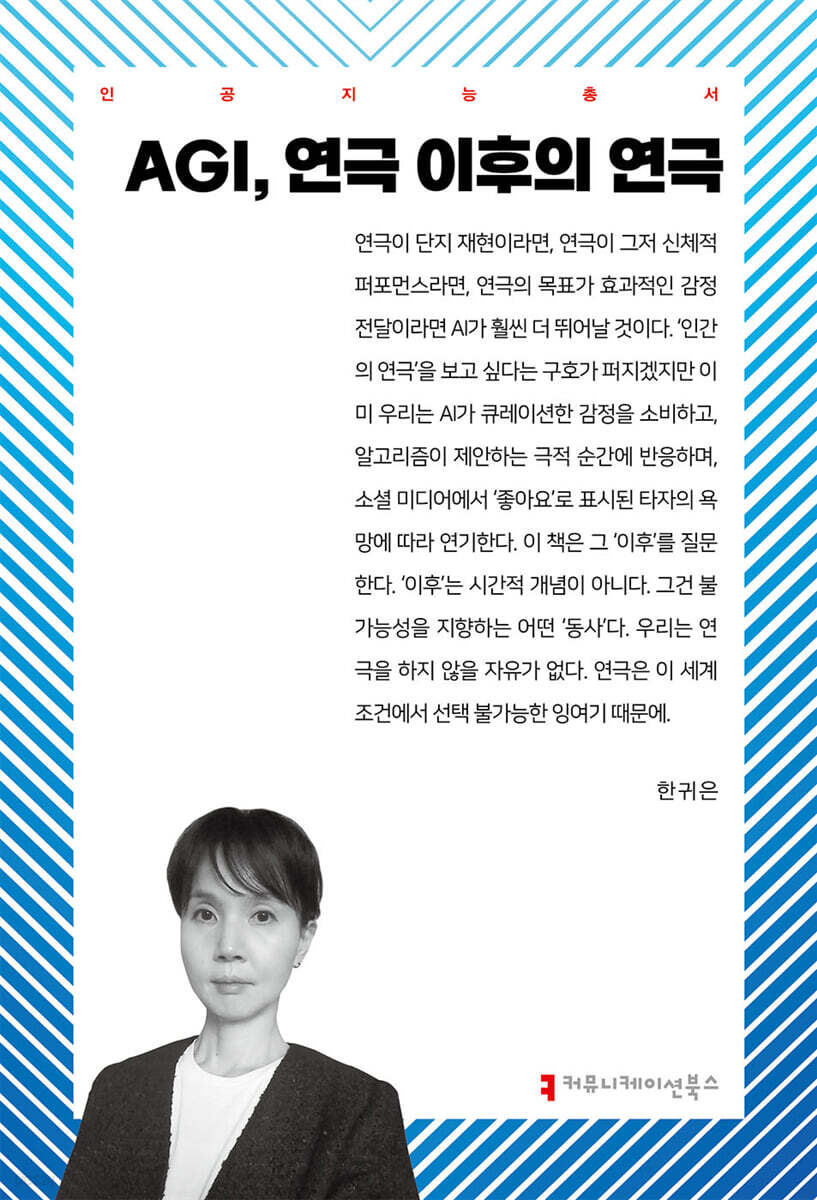
AGI, the play after the play
 |
Description
Book Introduction
In an era where AGI (Artificial General Intelligence) simulates emotions and desires, theater is no longer a human privilege. Now, with AI acting as actors and directors, and calculating audience reactions in real time, theater stands at the crossroads of a new ontological transformation.
This book contains a fervent reflection on theater in the posthuman era, "theater after theater." Will AI herald the end of theater, or will it become a tool that rediscovers the essence of theater?
This book contains a fervent reflection on theater in the posthuman era, "theater after theater." Will AI herald the end of theater, or will it become a tool that rediscovers the essence of theater?
- You can preview some of the book's contents.
Preview
index
Posthuman, postdrama
01 Rewriting/Erasing Theater History
02 Automation of Creation, the Emotion of Algorithms
03 A play without humans, humans without narrative
04 From vicarious experience to simulation of experience
05 A human, all too human play
06 The Age of Post-Truth, the Play of Truth
07 Desire, Fantasy, Ideology and Theatre
08 The ritual of returning to theater
09 Post-Postdrama: The Self-Negativity of Theatre
10 We have no freedom not to perform.
01 Rewriting/Erasing Theater History
02 Automation of Creation, the Emotion of Algorithms
03 A play without humans, humans without narrative
04 From vicarious experience to simulation of experience
05 A human, all too human play
06 The Age of Post-Truth, the Play of Truth
07 Desire, Fantasy, Ideology and Theatre
08 The ritual of returning to theater
09 Post-Postdrama: The Self-Negativity of Theatre
10 We have no freedom not to perform.
Into the book
〈R.
In UR〉, humans cannot survive.
Because the moment their desires are realized, humans as the subjects of those desires are no longer needed.
To conceal the contradiction of this desire, ideology promises 'human progress' and 'a better world'.
And this promise always carries the premise that 'you who are here now are not enough.'
The real fear is not that robots will act like humans, but that humans will want to become like robots.
Now, love may not be the essence of human nature, but some future condition that humans must achieve.
So, a play that speaks of love will always be a play of the future.
--- From "03_A Play Without Humans, Humans Without Narrative"
According to Bruno Latour, the world is a 'network of actors (ANT, Actor-Network Theory)' in which humans and non-humans interact together.
Theatre is not just for humans.
When a human actor performs on stage, it is not a solo act, but a networked event that includes stage lighting, sound equipment, costumes, the physical space of the theater, and even the smartphone screens held by the audience.
The emotion of a play doesn't just come from the actors.
It always arises from a combination of network elements.
The moment the lights change, the moment the music starts, the moment the audience members hold back their tears, the atmosphere of the play changes completely.
It is not just the actors who create emotion, but the entire stage that organizes the emotion.
And this network could also include AI.
--- From "05_Human, All Too Human Play"
AI only sees audience preferences as 'data', but post-play theater sees audience reactions as 'events'.
This "post-theater" opens a gap between ideological fantasy and a named identity. While AI says, "This is who you are," post-theater asks, "Who are you?" While AI dictates desire based on the desires of others, post-theater exposes the fact that, outside of that system of directives, we are being desired without knowing who we are.
In UR〉, humans cannot survive.
Because the moment their desires are realized, humans as the subjects of those desires are no longer needed.
To conceal the contradiction of this desire, ideology promises 'human progress' and 'a better world'.
And this promise always carries the premise that 'you who are here now are not enough.'
The real fear is not that robots will act like humans, but that humans will want to become like robots.
Now, love may not be the essence of human nature, but some future condition that humans must achieve.
So, a play that speaks of love will always be a play of the future.
--- From "03_A Play Without Humans, Humans Without Narrative"
According to Bruno Latour, the world is a 'network of actors (ANT, Actor-Network Theory)' in which humans and non-humans interact together.
Theatre is not just for humans.
When a human actor performs on stage, it is not a solo act, but a networked event that includes stage lighting, sound equipment, costumes, the physical space of the theater, and even the smartphone screens held by the audience.
The emotion of a play doesn't just come from the actors.
It always arises from a combination of network elements.
The moment the lights change, the moment the music starts, the moment the audience members hold back their tears, the atmosphere of the play changes completely.
It is not just the actors who create emotion, but the entire stage that organizes the emotion.
And this network could also include AI.
--- From "05_Human, All Too Human Play"
AI only sees audience preferences as 'data', but post-play theater sees audience reactions as 'events'.
This "post-theater" opens a gap between ideological fantasy and a named identity. While AI says, "This is who you are," post-theater asks, "Who are you?" While AI dictates desire based on the desires of others, post-theater exposes the fact that, outside of that system of directives, we are being desired without knowing who we are.
--- From "07_Desire, Fantasy, Ideology and Theater"
Publisher's Review
Is the belief that only humans perform plays still valid?
In an era where AGIs simulate emotions and desires, make human-like decisions, and appear on theatrical stages, the belief that "theater is an art exclusively for humans" is no longer absolute. On a stage where AI writes scripts, performs emotional performances, and analyzes audience reactions in real time to adjust the production, we are forced to ask ourselves a new question.
What is theater? For whom is it theater?
Is the play over, or is it just beginning?
《AGI, Theatre after Theatre》 goes beyond the simple dichotomy of whether technology replaces theatre and reflects on how the art of theatre is transformed and reconstructed in the posthuman era.
From Deus Ex Machina to AGI actors, Hamlet 3.0 and Nora 3.0, the boundaries between humanity and theatricality are re-examined through the deconstruction and reconstruction of classics.
'Theatre after the theatre' refers to theatre as an unpredictable and imperfect art form, with a human surplus that remains beyond technical perfection.
This book explores the future of theater in moments of human "errors of desire," failure, repetition, division, and non-representation that AI cannot embody.
Through this, we reaffirm the imperfections that only humans possess and the creative possibilities that result from them.
It emphasizes that in an era where humans and technology coexist, theater is not something that will disappear, but rather a practice that must be newly invented.
In an era where AGIs simulate emotions and desires, make human-like decisions, and appear on theatrical stages, the belief that "theater is an art exclusively for humans" is no longer absolute. On a stage where AI writes scripts, performs emotional performances, and analyzes audience reactions in real time to adjust the production, we are forced to ask ourselves a new question.
What is theater? For whom is it theater?
Is the play over, or is it just beginning?
《AGI, Theatre after Theatre》 goes beyond the simple dichotomy of whether technology replaces theatre and reflects on how the art of theatre is transformed and reconstructed in the posthuman era.
From Deus Ex Machina to AGI actors, Hamlet 3.0 and Nora 3.0, the boundaries between humanity and theatricality are re-examined through the deconstruction and reconstruction of classics.
'Theatre after the theatre' refers to theatre as an unpredictable and imperfect art form, with a human surplus that remains beyond technical perfection.
This book explores the future of theater in moments of human "errors of desire," failure, repetition, division, and non-representation that AI cannot embody.
Through this, we reaffirm the imperfections that only humans possess and the creative possibilities that result from them.
It emphasizes that in an era where humans and technology coexist, theater is not something that will disappear, but rather a practice that must be newly invented.
GOODS SPECIFICS
- Date of issue: May 30, 2025
- Page count, weight, size: 131 pages | 128*188*8mm
- ISBN13: 9791143002457
You may also like
카테고리
korean


korean

![GQ KOREA Mark (Monthly): December [2025]](http://librairie.coreenne.fr/cdn/shop/files/8ef265dbbfbf186523ed75ba7319009d.jpg?v=1765340328&width=3840)


