

Image Processing Bible
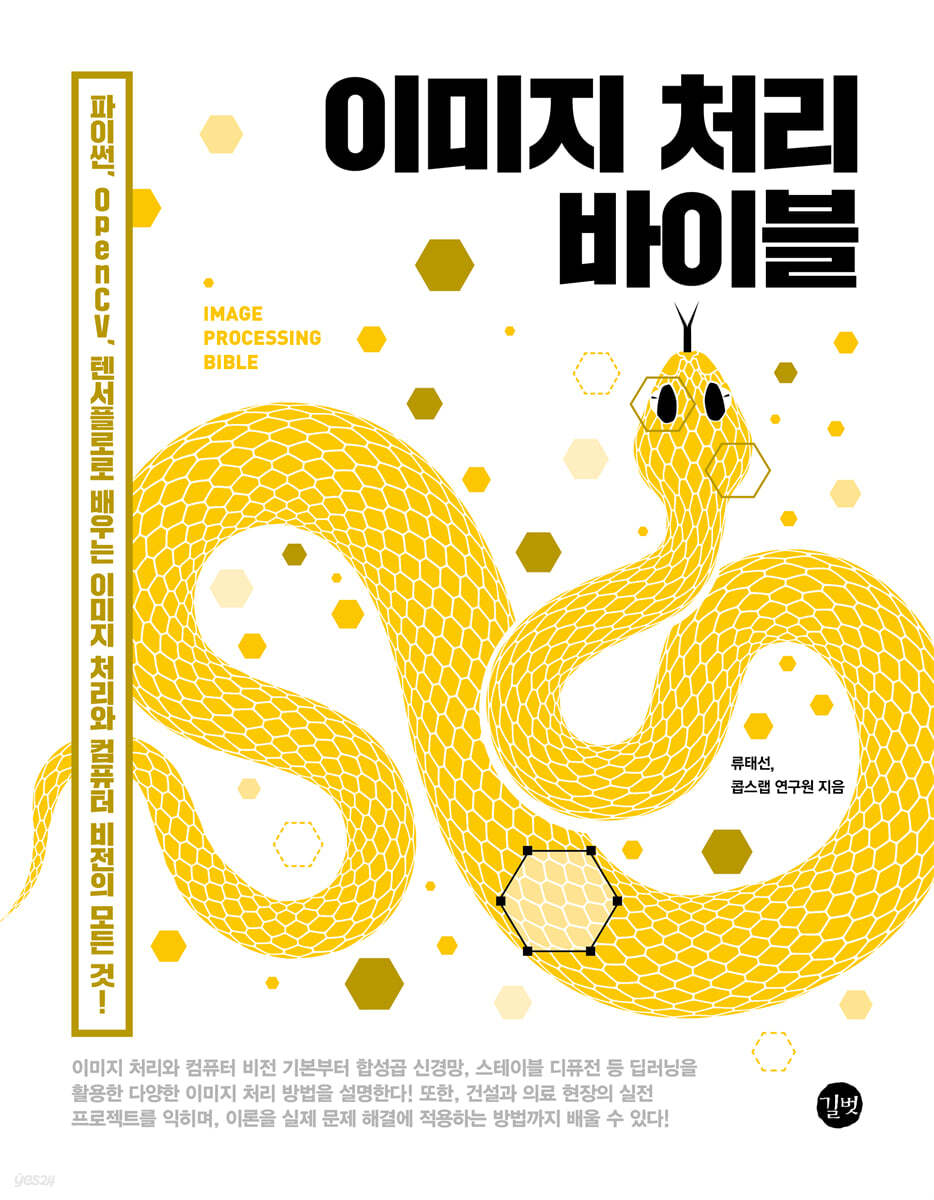 |
Description
Book Introduction
Learn image processing and computer vision with Python, OpenCV, and TensorFlow!
From core theory to the latest paper reviews, practical applications, and practical code!
From smartphone camera apps to self-driving cars and OpenAI's recently announced video generation service, Sora, image processing and computer vision technologies are already deeply ingrained in our lives.
This book covers a wide range of topics, from basic concepts of image processing to advanced computer vision techniques and image analysis using artificial intelligence.
Each chapter is structured to allow learning through practical case studies and code using Python, OpenCV, and TensorFlow, along with theoretical explanations.
Additionally, at the end, you can see how image processing is being utilized in construction sites and the medical field through practical projects.
Recommended for those who want to learn a wide range of knowledge, from the basics to the latest technologies in image processing and computer vision.
- You can preview some of the book's contents.
Preview
index
Chapter 1.
Basic Concepts and Tools
1.1 Image Processing and Computer Vision
__1.1.1 What is image processing?
__1.1.2 What is Computer Vision?
__1.1.3 The Relationship Between Image Processing and Computer Vision
1.2 Tools Required
__1.2.1 Python Core Grammar
__1.2.2 OpenCV
__1.2.3 TensorFlow
Chapter 2.
Image Processing Fundamentals
2.1 What is an image?
__2.1.1 Structure of digital images
__2.1.2 Understanding Color Spaces
__2.1.3 Understanding Tensors in Images
2.2 Image Processing Techniques
__2.2.1 Image Filtering
__2.2.2 Image Conversion
__2.2.3 Frequency domain techniques
__2.2.4 Image boundary detection
Chapter 3.
Artificial Intelligence and Image Processing
3.1 What is deep learning?
__3.1.1 Artificial Neural Network Basics
__3.1.2 Convolutional Neural Network (CNN)
__3.1.3 Generative Adversarial Networks (GANs)
3.2 Image Processing Using Deep Learning
__3.2.1 Image Classification
__3.2.2 Object Recognition
__3.2.3 Style Transfer
Chapter 4.
Image classification
4.1 GoogleNet and ResNet
__4.1.1 Initial neural network model
__4.1.2 Google Net
__4.1.3 ResNet
4.2 Examining the Optimized Model
__4.2.1 Models after ResNet
__4.2.2 EfficientNet
4.3 Vision Transformer
__4.3.1 Transformer
__4.3.2 Vision Transformer
Chapter 5.
Object detection
5.1 Two-stage detector
__5.1.1 R-CNN
__5.1.2 Fast R-CNN and Faster R-CNN
5.2 One-stage detector
__5.2.1 YOLO
__5.2.2 YOLO9000 and YOLO v3
__5.2.3 EfficientDET
5.3 Image Segmentation
__5.3.1 FCN
__5.3.2 U-Net
__5.3.3 SAM
Chapter 6.
Image creation
6.1 Image-to-Image Conversion
__6.1.1 Generative models before StarGAN
__6.1.2 StarGAN and Multi-Image-to-Image Conversion
6.2 Super-resolution and style control
__6.2.1 PGGAN
__6.2.2 StyleGAN
6.3 Stable Diffusion
__6.3.1 Diffusion Model
__6.3.2 Stable Diffusion
Chapter 7.
Real Cases and Projects
7.1 Cases and projects used in construction sites
__7.1.1 Using Image Processing in Construction Sites
__7.1.2 Using Image Segmentation in Construction Sites
7.2 Cases and projects used in the medical field
__7.2.1 X-ray image classification model using convolutional neural networks
__7.2.2 Various evaluation indicators in classification tasks
__7.2.3 Medical Artificial Intelligence and Explainability
Appendix A.
Using Colab
A.1 How to Use Google Colab
__A.1.1 Getting Started with Colab
__A.1.2 Basic usage of Colab
__A.1.3 How to integrate Colab and GitHub
Detailed image

Publisher's Review
From the core theories of image processing and computer vision
From the latest paper reviews to practical applications and practical code!
From smartphone camera apps to self-driving cars and OpenAI's recently announced video generation service, Sora, image processing and computer vision technologies are already deeply ingrained in our lives.
Although there is a vast amount of material available online in the fields of image processing and computer vision, it can be quite difficult to find systematically organized materials or practical application of theories when trying to learn them.
The author of this book also went through the same difficulties and wrote this book to help those who are going through the same difficulties.
This book covers a wide range of topics, from basic concepts of image processing to advanced computer vision techniques and image analysis using artificial intelligence.
Each chapter is structured to allow learning through practical case studies and code using Python, OpenCV, and TensorFlow, along with theoretical explanations.
Additionally, at the end, you can see how image processing is being utilized in construction sites and the medical field through practical projects.
[Structure of this book]
1.
Basic Concepts and Tools
This chapter introduces the fundamental concepts of image processing and computer vision, laying the foundation for key tools and techniques used in these fields.
We introduce the core syntax and libraries needed to understand and apply image processing and computer vision, including how to use essential tools such as Python, OpenCV, and TensorFlow.
2.
Image Processing Fundamentals
We explore the fundamental properties and structure of images, and explain how to represent and process images through the concepts of color space and tensors.
It also covers basic image processing techniques such as image filtering, transformations, frequency domain techniques, and edge detection.
3.
Artificial Intelligence and Image Processing
We explore the intersection of deep learning and image processing, introducing key concepts such as artificial neural networks, convolutional neural networks (CNNs), and generative adversarial networks (GANs).
This chapter provides the knowledge necessary to enter application fields such as image classification and object recognition using deep learning.
4.
Image classification
We cover core techniques and models for image classification, from early neural network models including GoogleNet and ResNet to optimized models and vision transformers.
This chapter explores the evolution of image classification technology and current trends.
5.
Object detection
We describe two major approaches to object detection technology: two-stage detectors and one-stage detectors, and introduce models such as R-CNN, YOLO, and EfficientDET.
It also covers image segmentation through hands-on exercises, including techniques such as FCN, U-Net, and SAM.
6.
Image creation
We introduce various techniques and models related to image generation, from image-to-image conversion to super-resolution, style control, and stable diffusion.
We also explore various generative models and techniques, such as StarGAN, PGGAN, and StyleGAN, and cover the latest trends in image generation.
7.
Real Cases and Projects
We introduce how image processing technology is utilized in real-world industrial settings through specific examples and projects.
Explore how to apply what you've learned to solving real-world problems, including use cases of image processing in construction and healthcare.
GOODS SPECIFICS
- Date of issue: April 30, 2024
- Page count, weight, size: 556 pages | 183*235*23mm
- ISBN13: 9791140709397
You may also like
카테고리
korean


korean


