

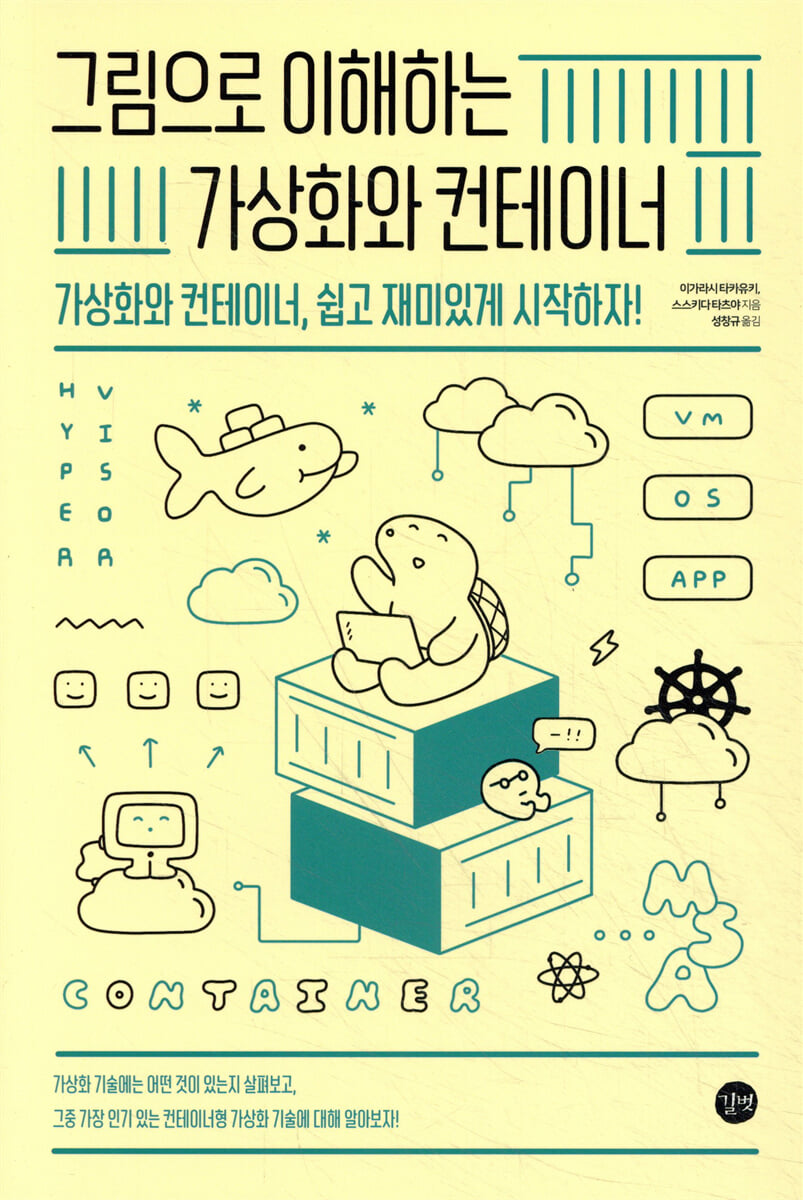
Understanding Virtualization and Containers in Pictures
 |
Description
Book Introduction
Getting started with virtualization and containers is easy and fun!
Virtualization is an essential technology for configuring large-scale systems or services.
In particular, container virtualization, a type of virtualization, is popular as a system construction environment because it allows for easy construction of virtual servers.
The software that implements this container virtualization is Docker, and it is used together with a tool called Kubernetes to efficiently manage containers.
This book explains the basics of virtualization and container-based virtualization technology, and introduces Kubernetes and Docker, which have become de facto industry standards, by focusing on the core concepts.
We also covered Kubernetes services provided by Microsoft, Google, and Amazon.
It is much easier to read because it explains difficult content in an easy-to-understand way with 145 illustrations and 10 tables.
If you want to study container environments, start with this book and have fun!
- You can preview some of the book's contents.
Preview
index
Chapter 1: Virtualization Basics
1.1 Virtualization: Flexibility and availability independent of physical configuration.
1.2 Types of Virtualization: Server Virtualization and Network Virtualization
1.3 Advantages and Disadvantages of Virtualization: Comparison with Physical Environments from an Efficiency and Operability Perspective
1.4 Virtualization and the Cloud: Virtualization Powering the Cloud
1.5 Cloud Security: While Secure, the Cloud Has Its Own Risks
Chapter 2: Principles and Technologies of Virtualization
2.1 Principle of Server Virtualization: Build multiple virtual servers on a physical server.
2.2 Host OS type virtualization: Multiple guest OSs run on the host OS.
2.3 Hypervisor-based virtualization: No host OS required
2.4 Container-type virtualization: Build independent spaces for each application.
2.5 Server Virtualization in the Cloud: Server Virtualization Services Provided by AWS, GCP, and Azure
2.6 Principle of Network Virtualization: Establish a logical network different from the physical configuration.
2.7 VLAN: Flexible network implementation independent of physical configuration
2.8 Overlay Networks: A Technology to Overcome the Weaknesses of VLANs
2.9 VPN: Technology for Building Virtual Private Lines
2.10 SDN: Defining the Network with Software
2.11 NFV: Implementing network device functions in software
2.12 SD-WAN: Centralizing connectivity between sites
2.13 Network Virtualization in the Cloud: Network Virtualization Services Provided by AWS, GCP, and Azure
Chapter 3 Container Technology and Basic Knowledge
3.1 History of Container Technology: The Surprisingly Old Origins of Container Technology
3.2 Advantages of Container Technology: Easily Build Virtual Servers
3.3 DevOps and Container Technology: Helping Development and Operations Connect Seamlessly
3.4 Major Container Technologies: Various Container Technologies Other than Docker
3.5 Microservices: Design Techniques That Work Well with Containers
3.6 Comparing Containers and Serverless: Two Major Streams in Service Development
Chapter 4: Container-type virtualization software, Docker
4.1 Docker: The de facto standard for container technology
4.2 Why Docker is in the spotlight: A look back at the history and development of Docker.
4.3 Docker Containers: Isolated Environments Unaffected by External Influence
4.4 Container Images: Templates for Running Containers
4.5 Container Life Cycle: From Container Creation to Deletion
4.6 Docker Daemon: The most important component supporting the Docker Engine.
4.7 Containers and Processes: Dividing Containers by Process
4.8 Namespaces: How to Separate Workspaces
4.9 Managing the Difference: How Docker Supports Rapid Deployments
4.10 Swarm Mode: Ability to Manage Clusters
4.11 Docker's Key Commands: Introducing Essential Commands
4.12 Docker Hub: A service for sharing container images
Chapter 5: Container Orchestration Tools, Kubernetes
5.1 Container Orchestration: Tasks for Managing Containers
5.2 Kubernetes: A tool for automating container management and operation
5.3 Pod: A unit that manages containers
5.4 Deployment Controller: The Most Crucial Element Supporting Orchestration
5.5 Service: A window to access the container.
5.6 Flannel: Technology that supports interconnection between containers
5.7 Load Balancing and Health Checks: How to Improve System Availability
5.8 Scaling: How to Improve System Performance
5.9 Key Kubernetes Commands: Introducing Essential Commands
5.10 Automated Build: Automate the process from image creation to deployment.
5.11 Multi-Cloud: Using Kubernetes on Multiple Clouds
5.12 Kubernetes Architecture: Components Running on Each Node
Chapter 6 Cloud Container Services
6.1 Current Status of Container Support in the Cloud: Various Container Services in Major Clouds
6.2 Amazon ECS: AWS's Container Orchestration Service
6.3 Amazon EKS: AWS's Kubernetes Service
6.4 AWS Fargate: AWS's Serverless Container Execution Environment
6.5 GKE: GCP's Kubernetes Service
6.6 Cloud Run: GCP's Serverless Container Execution Environment
6.7 AKS: Kubernetes Service on Azure
6.8 ACI: Azure's Serverless Container Execution Environment
6.9 Docker Enterprise: Enabling Multicloud with Centralized Management
Detailed image

Into the book
This book explains the concepts of virtualization and containers and related IT technologies in an easy-to-understand manner, with illustrations.
I think this is a good introductory book for those who have no basic knowledge of containers or are not clear about the difference between virtualization and containers.
Among the numerous tools used in container technology, Docker and Kubernetes are faithfully explained, and understanding these two concepts will be of great help in understanding containers.
-Seong Chang-gyu
--- From the Translator's Note
Publisher's Review
Just reading is enough!
Understanding virtualization and containers quickly and easily!
Virtualization is an essential technology for configuring large-scale systems or services.
In particular, container technology, a type of virtualization, is popular as a system construction environment because it allows for easy construction of virtual servers.
The software that implements this container-type virtualization technology is Docker, and it is used together with a tool called Kubernetes to efficiently manage containers.
While other tools offer similar functionality, Docker and Kubernetes have become the de facto industry standards due to their numerous advantages.
This book largely explains the basics of virtualization and container technology in the first half, and introduces Docker and Kubernetes in detail in the second half.
Additionally, it covers cloud container services provided by Google, Amazon, and Microsoft.
This book provides a quick overview of the potentially extensive virtualization and container technologies, distilling them down to their essentials. It also includes 145 illustrations and 10 tables for easy and enjoyable study.
I recommend this book as an introductory book for those who are just starting to study infrastructure, and as a refresher for those who want to accurately understand concepts they have vaguely understood.
GOODS SPECIFICS
- Publication date: November 23, 2022
- Page count, weight, size: 236 pages | 152*225*10mm
- ISBN13: 9791140702152
You may also like
카테고리
korean


korean


