

AI Robots and Safety
 |
Description
Book Introduction
It systematically categorizes the rights, property, physical, and social risks posed by AI robots and presents indicators (11 items, 52 indicators) for measuring them.
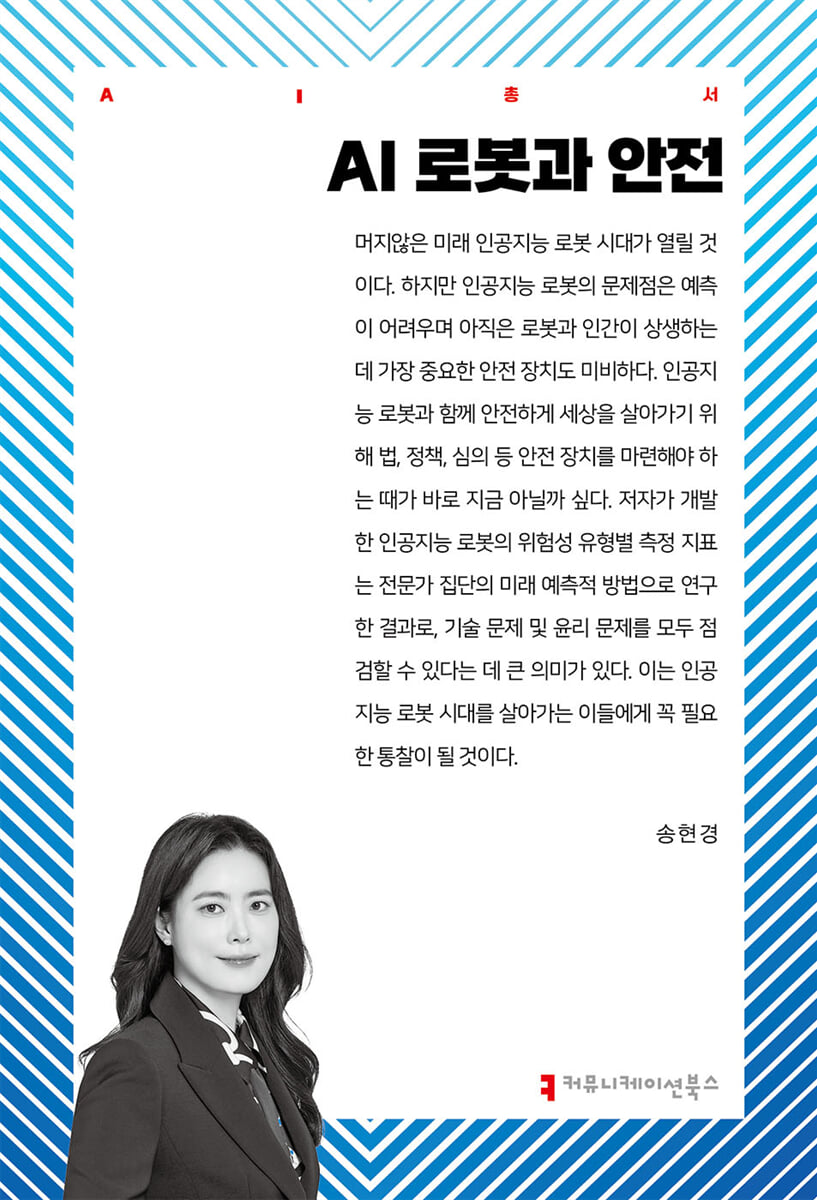
This comprehensive book comprehensively explains the conditions for coexistence in the AI-robot era, encompassing technology, ethics, and policy.
You can find the artificial intelligence knowledge you need at aiseries.oopy.io.
This comprehensive book comprehensively explains the conditions for coexistence in the AI-robot era, encompassing technology, ethics, and policy.
You can find the artificial intelligence knowledge you need at aiseries.oopy.io.
- You can preview some of the book's contents.
Preview
index
The Need for AI Robot Risk Measurement Indicators
01 AI Robot Development History
02 Definition of AI Robot
03 Threats to Human Bodies from AI Robots
04 Violation of Human Rights by AI Robots
05 Property damage caused by AI robots
06 Social Issues of AI Robots
07 AI Ethical Principles and Robot Ethics
08 Development of a Risk Measurement Index for AI Robots
09 Relationship with AI Ethical Principles
10 Ways to Use AI Robot Risk Measurement Indicators
01 AI Robot Development History
02 Definition of AI Robot
03 Threats to Human Bodies from AI Robots
04 Violation of Human Rights by AI Robots
05 Property damage caused by AI robots
06 Social Issues of AI Robots
07 AI Ethical Principles and Robot Ethics
08 Development of a Risk Measurement Index for AI Robots
09 Relationship with AI Ethical Principles
10 Ways to Use AI Robot Risk Measurement Indicators
Into the book
Robots that cook food, run errands, and perform other household tasks, as seen in science fiction movies like I, Robot, have now appeared in real life.
For us, robots are no longer something we only see in movies.
Recently, wearable robots that can be worn on the human body for rehabilitation or daily assistance have been developed.
In China, a humanoid robot participated in and finished a marathon.
Liquid in-body robots are also being developed to effectively treat diseases.
--- From 「01_“AI Robot Development History”」
In a future society where we live alongside humanoids, various dangerous situations and ethical issues caused by humanoids may occur on a daily basis.
In this case, it is quite possible that a controversy will arise over whether the person who purchased the humanoid should be held criminally liable for bodily harm or negligent homicide, or whether the manufacturer who manufactured and sold the humanoid should be held liable for compensation.
--- From “03_“Threats to Human Bodies from AI Robots”
Recently, AlphaGo's developers expressed concern over the potential misuse of AI technology, fearing that malicious users could misappropriate the technology for harmful purposes.
He also cited the potential for a lack of safeguards to control AI with human-level intelligence as a significant risk. Because AI robots can gather necessary data, learn, and make autonomous decisions, they may not behave as programmed and may even utter words that deviate from human commands or predictions.
--- From "06_“Social Issues of AI Robots”"
If the risk measurement indicators for AI robots are to be universally applicable to laws, systems, and policies, research on their relationship with AI ethical principles accepted in the international community is essential.
To achieve this, finding standardized AI ethics principles is crucial. To safely commercialize AI robots, institutional mechanisms to prevent risks from the planning and development stages are necessary, as are socially acceptable guidelines such as technical manuals and ethical assessment indicators.
For us, robots are no longer something we only see in movies.
Recently, wearable robots that can be worn on the human body for rehabilitation or daily assistance have been developed.
In China, a humanoid robot participated in and finished a marathon.
Liquid in-body robots are also being developed to effectively treat diseases.
--- From 「01_“AI Robot Development History”」
In a future society where we live alongside humanoids, various dangerous situations and ethical issues caused by humanoids may occur on a daily basis.
In this case, it is quite possible that a controversy will arise over whether the person who purchased the humanoid should be held criminally liable for bodily harm or negligent homicide, or whether the manufacturer who manufactured and sold the humanoid should be held liable for compensation.
--- From “03_“Threats to Human Bodies from AI Robots”
Recently, AlphaGo's developers expressed concern over the potential misuse of AI technology, fearing that malicious users could misappropriate the technology for harmful purposes.
He also cited the potential for a lack of safeguards to control AI with human-level intelligence as a significant risk. Because AI robots can gather necessary data, learn, and make autonomous decisions, they may not behave as programmed and may even utter words that deviate from human commands or predictions.
--- From "06_“Social Issues of AI Robots”"
If the risk measurement indicators for AI robots are to be universally applicable to laws, systems, and policies, research on their relationship with AI ethical principles accepted in the international community is essential.
To achieve this, finding standardized AI ethics principles is crucial. To safely commercialize AI robots, institutional mechanisms to prevent risks from the planning and development stages are necessary, as are socially acceptable guidelines such as technical manuals and ethical assessment indicators.
--- From “09_“Relationship with AI Ethical Principles””
Publisher's Review
How to Design Safety in the Age of AI Robots
As generative AI and robotics technologies become deeply ingrained in our daily lives, we will delve into the question we must first ask and prepare for: “How safe are AI robots?”
From Ghibli-style image transformations to serving robots, barista robots, wearable medical robots, and humanoids, AI robots have already taken root alongside humans in various forms.
But as the rate of spread increases, so too does the number of unpredictable events.
Fatal accidents caused by robots mistaking human bodies, rights violations resulting from misjudgments, economic losses, and social unrest are now structural risks that go beyond simple technological errors.
This book goes beyond simply warning of these dangers.
Through a systematic analysis that integrates technology, ethics, society, and law, we categorize four types of robot risks—physical risks, rights violations, property damage, and social risks—and present AI robot risk measurement indicators that can be used to assess and prepare for these risks.
This risk framework, comprised of 11 items and 52 detailed indicators, is closely aligned with the AI ethical principles of transparency, accountability, fairness, controllability, and safety, and is designed to be directly applied to policy, legislation, industry, and technology guidelines. In an era where AI robots are transforming the very fabric of civilization, transcending human convenience, safety is not an option, but a prerequisite for coexistence.
This book provides practical standards for predicting and preparing for the future we face.
As generative AI and robotics technologies become deeply ingrained in our daily lives, we will delve into the question we must first ask and prepare for: “How safe are AI robots?”
From Ghibli-style image transformations to serving robots, barista robots, wearable medical robots, and humanoids, AI robots have already taken root alongside humans in various forms.
But as the rate of spread increases, so too does the number of unpredictable events.
Fatal accidents caused by robots mistaking human bodies, rights violations resulting from misjudgments, economic losses, and social unrest are now structural risks that go beyond simple technological errors.
This book goes beyond simply warning of these dangers.
Through a systematic analysis that integrates technology, ethics, society, and law, we categorize four types of robot risks—physical risks, rights violations, property damage, and social risks—and present AI robot risk measurement indicators that can be used to assess and prepare for these risks.
This risk framework, comprised of 11 items and 52 detailed indicators, is closely aligned with the AI ethical principles of transparency, accountability, fairness, controllability, and safety, and is designed to be directly applied to policy, legislation, industry, and technology guidelines. In an era where AI robots are transforming the very fabric of civilization, transcending human convenience, safety is not an option, but a prerequisite for coexistence.
This book provides practical standards for predicting and preparing for the future we face.
GOODS SPECIFICS
- Date of issue: November 28, 2025
- Page count, weight, size: 138 pages | 128*188*7mm
- ISBN13: 9791143011183
You may also like
카테고리
korean


korean

![ELLE 엘르 A형 (여성월간) : 1월 [2026]](http://librairie.coreenne.fr/cdn/shop/files/3b70e1cf77cf67d6da56e0eb041901e8.jpg?v=1767265322&width=3840)


