

AI, heterotopia, travel
 |
Description
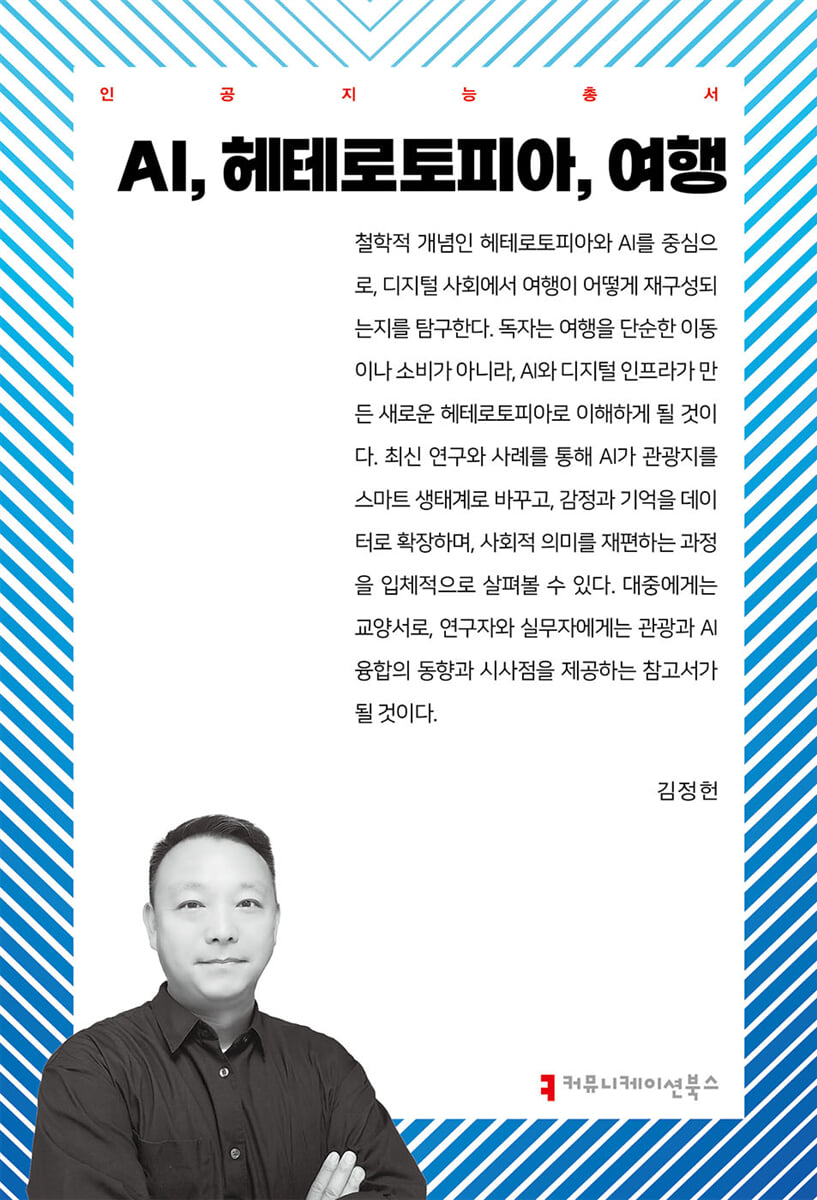
Book Introduction
Travel is an act of excitement and consumption of taste.
This book explores how the space and experience of travel are being reconstructed through AI-created "digital heterotopias" using 10 keywords.
It addresses technological evolution while also reflecting on the unchanging nature of travel.
You can find the artificial intelligence knowledge you need at aiseries.oopy.io.
This book explores how the space and experience of travel are being reconstructed through AI-created "digital heterotopias" using 10 keywords.
It addresses technological evolution while also reflecting on the unchanging nature of travel.
You can find the artificial intelligence knowledge you need at aiseries.oopy.io.
index
AI-created heterotopia
01 Smart Tourism City
02 Digital Tourism Site
03 AI Tourism Transportation
04 Digital Heterotopia
05 Heterotopian Festival
06 AI Recommendation Service
07 Neuro Tourism
08 Travel Chatbot
09 Service Robots
10 AI Travel Records
01 Smart Tourism City
02 Digital Tourism Site
03 AI Tourism Transportation
04 Digital Heterotopia
05 Heterotopian Festival
06 AI Recommendation Service
07 Neuro Tourism
08 Travel Chatbot
09 Service Robots
10 AI Travel Records
Into the book
This shift is rapidly spreading across the globe.
Barcelona, Spain, has introduced an on-demand bus service, allowing citizens and travelers to connect with public transportation by specifying their desired time and location through an app.
Kyoto, Japan, is operating a smart crowd management system that integrates ICT into cultural heritage management, controlling congestion in real time and guiding travelers to optimal routes.
--- From 「01_“Smart Tourism City”」
The key to AI tourism transportation is not a race for speed.
It lies in its power to rediscover the path, its ability to lead the traveler out of the familiar order and into an unfamiliar experience.
When transportation goes beyond simple route navigation and enables entry into other worlds, we experience heterotopia on the road.
--- From "03_“AI Tourism Transportation”"
Heterotopian festivals leverage technology to further enhance immersive experiences. VR and AR experiences offer participants the opportunity to experience worlds that don't exist in reality, enhancing sensory immersion and leading to greater satisfaction and learning outcomes.
Gamification transforms travelers from mere consumers into active players.
--- From "05_“Heterotopian Festival”"
Neurotourism uses brain science techniques to observe responses that travelers may not even be aware of.
Before we make a conscious choice, our brain is already evaluating surrounding stimuli and preparing how to react.
Therefore, it is possible to directly measure the emotions that tourists feel in a specific place, such as fascination, anxiety, and fatigue, through brain waves and brain imaging.
Barcelona, Spain, has introduced an on-demand bus service, allowing citizens and travelers to connect with public transportation by specifying their desired time and location through an app.
Kyoto, Japan, is operating a smart crowd management system that integrates ICT into cultural heritage management, controlling congestion in real time and guiding travelers to optimal routes.
--- From 「01_“Smart Tourism City”」
The key to AI tourism transportation is not a race for speed.
It lies in its power to rediscover the path, its ability to lead the traveler out of the familiar order and into an unfamiliar experience.
When transportation goes beyond simple route navigation and enables entry into other worlds, we experience heterotopia on the road.
--- From "03_“AI Tourism Transportation”"
Heterotopian festivals leverage technology to further enhance immersive experiences. VR and AR experiences offer participants the opportunity to experience worlds that don't exist in reality, enhancing sensory immersion and leading to greater satisfaction and learning outcomes.
Gamification transforms travelers from mere consumers into active players.
--- From "05_“Heterotopian Festival”"
Neurotourism uses brain science techniques to observe responses that travelers may not even be aware of.
Before we make a conscious choice, our brain is already evaluating surrounding stimuli and preparing how to react.
Therefore, it is possible to directly measure the emotions that tourists feel in a specific place, such as fascination, anxiety, and fatigue, through brain waves and brain imaging.
--- From 「07_“Neurotourism”」
Publisher's Review
Another dimension of travel created by AI: "Digital Heterotopia."
Traveling is always an act that brings excitement and unfamiliarity.
But today, travel has expanded beyond simple movement to become a social act that consumes images and symbols.
The 'heterotopia' that Michel Foucault spoke of allows us to look at these travel destinations with a new perspective.
A travel destination is a physical place, a mirror reflecting social order, and a space where reality and fantasy overlap.
With the introduction of artificial intelligence, travel evolves to another level.
Recommendation algorithms, the metaverse, digital twins, and neurotechnology are creating a "digital heterotopia" that transcends physical space.
Travelers experience unfamiliar experiences on alternative routes suggested by AI, experience immersion amplified by emotional data, and embark on a new dimension of travel where the virtual and the real intersect.
This book explores these changes through ten keywords, following the three streams of 'space-experience-technology.'
While addressing technological changes such as smart tourism cities, AI recommendations, and travel chatbots, we also reflect on the unchanging nature of travel.
Traveling is always an act that brings excitement and unfamiliarity.
But today, travel has expanded beyond simple movement to become a social act that consumes images and symbols.
The 'heterotopia' that Michel Foucault spoke of allows us to look at these travel destinations with a new perspective.
A travel destination is a physical place, a mirror reflecting social order, and a space where reality and fantasy overlap.
With the introduction of artificial intelligence, travel evolves to another level.
Recommendation algorithms, the metaverse, digital twins, and neurotechnology are creating a "digital heterotopia" that transcends physical space.
Travelers experience unfamiliar experiences on alternative routes suggested by AI, experience immersion amplified by emotional data, and embark on a new dimension of travel where the virtual and the real intersect.
This book explores these changes through ten keywords, following the three streams of 'space-experience-technology.'
While addressing technological changes such as smart tourism cities, AI recommendations, and travel chatbots, we also reflect on the unchanging nature of travel.
GOODS SPECIFICS
- Date of issue: November 3, 2025
- Format: Paperback book binding method guide
- Page count, weight, size: 128 pages | 128*188*9mm
- ISBN13: 9791143014276
You may also like
카테고리
korean


korean

![ELLE 엘르 A형 (여성월간) : 1월 [2026]](http://librairie.coreenne.fr/cdn/shop/files/3b70e1cf77cf67d6da56e0eb041901e8.jpg?v=1767265322&width=3840)


