

AI Courseware and Elementary Education
 |
Description
Book Introduction
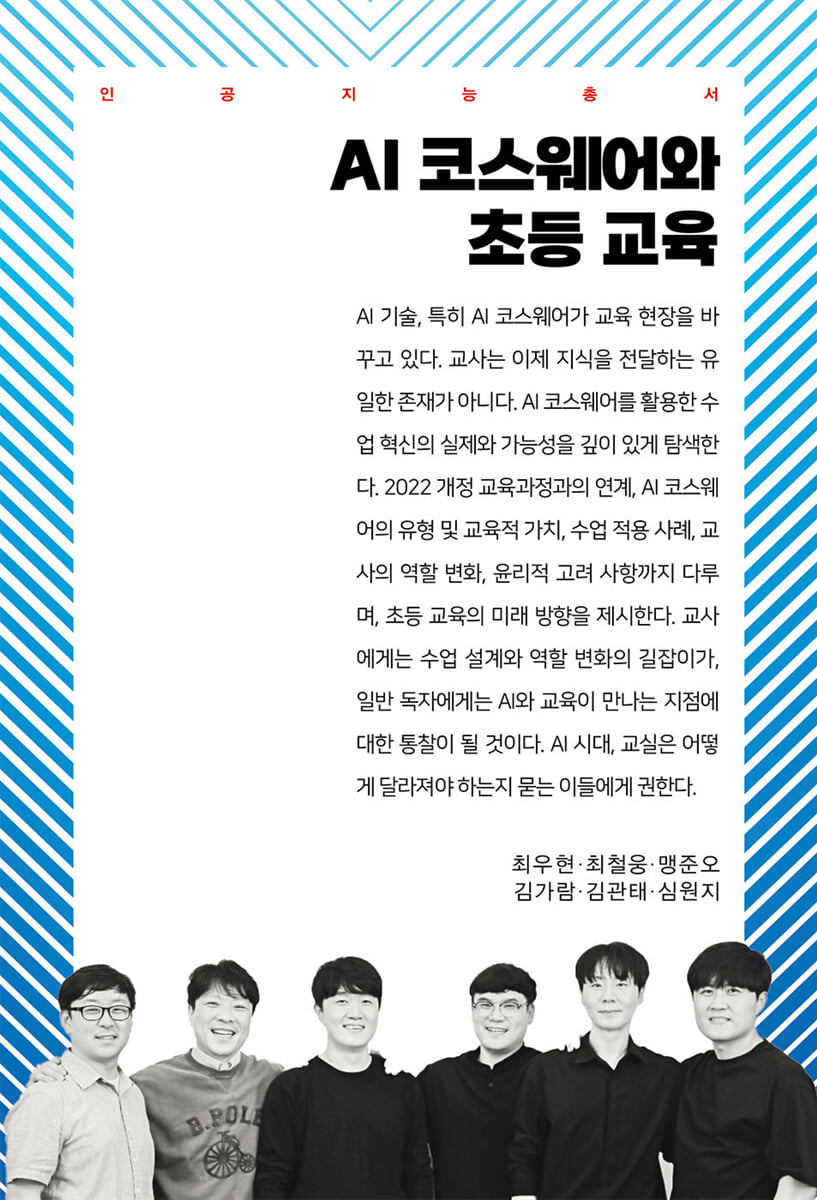
AI is transforming the classroom, providing personalized learning and immediate feedback in elementary education. This article provides a balanced view of the potential and challenges of AI courseware and suggests a future for education that teachers, policymakers, and parents can all co-create together.
Artificial Intelligence Encyclopedia.
You can find the artificial intelligence knowledge you need at aiseries.oopy.io.
Artificial Intelligence Encyclopedia.
You can find the artificial intelligence knowledge you need at aiseries.oopy.io.
- You can preview some of the book's contents.
Preview
index
AI Knocking on the Classroom Door: Opening New Horizons in Primary Education
01 Changes in Education and AI Technology
02 2022 Revised Curriculum and AI Courseware
03 Personalized Learning Created by AI Courseware
04 Types and Features of AI Courseware
05 AI Courseware Utilization Class Model
06 Real-life examples of AI courseware-based classes
07 AI Courseware in Public Education: Introduction and Future of AIDT
08 Ethical Issues and Solutions in AI Education
09 The Changing Role of Teachers in the AI Era
10 Convergence of AI Technology and Education: Future Prospects
01 Changes in Education and AI Technology
02 2022 Revised Curriculum and AI Courseware
03 Personalized Learning Created by AI Courseware
04 Types and Features of AI Courseware
05 AI Courseware Utilization Class Model
06 Real-life examples of AI courseware-based classes
07 AI Courseware in Public Education: Introduction and Future of AIDT
08 Ethical Issues and Solutions in AI Education
09 The Changing Role of Teachers in the AI Era
10 Convergence of AI Technology and Education: Future Prospects
Into the book
For example, if a student lacks understanding of a specific concept in a math learning process, AI courseware can quickly compensate for the individual learner's deficits by immediately providing supplementary content and repeated learning paths.
Furthermore, continuous formative assessment using AI courseware allows for detailed tracking of students' learning status and progress, significantly enhancing educational effectiveness. The use of AI courseware also enables innovation in assessment methods.
In traditional education, assessments were conducted uniformly according to a set schedule, such as midterm and final exams.
On the other hand, classes utilizing AI courseware enhance learning effectiveness by assessing, recording, and providing feedback on learners' achievement levels and issues in real time throughout the learning process.
In this way, AI courseware is positioned not as a simple content delivery system, but as a learning partner that unlocks the potential of each student.
--- From “01_“Changes in Education and AI Technology””
AI courseware analyzes students' learning patterns based on accumulated learning data and adjusts the direction of feedback.
For concepts or types of questions that learners frequently make mistakes on, we provide supplementary materials or step-by-step problems, and by presenting application problems when learners quickly find the right answer, we expand the depth of learning.
This can be said to be a shift in the learning structure toward improving the quality of learning in that it is student-centered, personalized feedback rather than teacher-centered, lump-sum feedback.
Ultimately, the feedback function of AI courseware functions as a meaningful interaction with learners, rather than a uniform feedback.
Through this, teachers and AI can complement each other's limitations and contribute substantially to the realization of learning-centered classes, the future of education.
--- From "03_“Individualized Learning Created by AI Courseware”"
Teachers use AI courseware to assess students' English skills.
Diagnostic tests may consist of checking simple vocabulary or listening to words and asking you to select the corresponding picture.
Based on the diagnostic results, teachers set lesson objectives and learning topics tailored to the students' level.
In the introduction stage of the class, we present activities that stimulate interest by utilizing the content provided by AI courseware.
For example, you can repeatedly practice key vocabulary through AI-powered flashcards and conduct preparatory activities to enhance understanding of key English expressions that will follow.
In this activity, the teacher takes the lead and guides the main expressions of the class.
To reinforce what they've learned, students practice speaking English in various situations. They engage in conversations with the AI or record themselves speaking. Using real-time speech recognition technology, the AI analyzes students' pronunciation, grammar, and expression errors and provides immediate feedback.
Students can check the accuracy of their pronunciation and expressions numerically, and improve the accuracy of their vocabulary and expressions by repeatedly practicing areas where they are lacking.
--- From "06_“The Reality of AI Courseware Utilization Classes”"
Teachers in the AI era are no longer just people who provide answers.
Rather, we must be reborn as beings who ask questions beyond the correct answers and lead people to find the meaning of learning.
Now, as a guide who walks alongside students and guides them through their learning journey, we need to be sensitive enough to listen to each individual's potential and coordinate their pace of growth.
Technology advances rapidly, but only people—teachers—can truly understand children's minds and walk the path of change alongside them.
Furthermore, continuous formative assessment using AI courseware allows for detailed tracking of students' learning status and progress, significantly enhancing educational effectiveness. The use of AI courseware also enables innovation in assessment methods.
In traditional education, assessments were conducted uniformly according to a set schedule, such as midterm and final exams.
On the other hand, classes utilizing AI courseware enhance learning effectiveness by assessing, recording, and providing feedback on learners' achievement levels and issues in real time throughout the learning process.
In this way, AI courseware is positioned not as a simple content delivery system, but as a learning partner that unlocks the potential of each student.
--- From “01_“Changes in Education and AI Technology””
AI courseware analyzes students' learning patterns based on accumulated learning data and adjusts the direction of feedback.
For concepts or types of questions that learners frequently make mistakes on, we provide supplementary materials or step-by-step problems, and by presenting application problems when learners quickly find the right answer, we expand the depth of learning.
This can be said to be a shift in the learning structure toward improving the quality of learning in that it is student-centered, personalized feedback rather than teacher-centered, lump-sum feedback.
Ultimately, the feedback function of AI courseware functions as a meaningful interaction with learners, rather than a uniform feedback.
Through this, teachers and AI can complement each other's limitations and contribute substantially to the realization of learning-centered classes, the future of education.
--- From "03_“Individualized Learning Created by AI Courseware”"
Teachers use AI courseware to assess students' English skills.
Diagnostic tests may consist of checking simple vocabulary or listening to words and asking you to select the corresponding picture.
Based on the diagnostic results, teachers set lesson objectives and learning topics tailored to the students' level.
In the introduction stage of the class, we present activities that stimulate interest by utilizing the content provided by AI courseware.
For example, you can repeatedly practice key vocabulary through AI-powered flashcards and conduct preparatory activities to enhance understanding of key English expressions that will follow.
In this activity, the teacher takes the lead and guides the main expressions of the class.
To reinforce what they've learned, students practice speaking English in various situations. They engage in conversations with the AI or record themselves speaking. Using real-time speech recognition technology, the AI analyzes students' pronunciation, grammar, and expression errors and provides immediate feedback.
Students can check the accuracy of their pronunciation and expressions numerically, and improve the accuracy of their vocabulary and expressions by repeatedly practicing areas where they are lacking.
--- From "06_“The Reality of AI Courseware Utilization Classes”"
Teachers in the AI era are no longer just people who provide answers.
Rather, we must be reborn as beings who ask questions beyond the correct answers and lead people to find the meaning of learning.
Now, as a guide who walks alongside students and guides them through their learning journey, we need to be sensitive enough to listen to each individual's potential and coordinate their pace of growth.
Technology advances rapidly, but only people—teachers—can truly understand children's minds and walk the path of change alongside them.
--- From "09_“The Changing Role of Teachers in the AI Era”"
Publisher's Review
AI Courseware: A New Path for Elementary Education
AI is now knocking on the doors of classrooms, opening new horizons in elementary education. We explore how AI courseware is revolutionizing teaching and enabling personalized learning for each student.
AI's strength lies in its ability to analyze learning data in real time, provide immediate feedback, and help students take initiative in their learning and realize their potential.
In this process, teachers transform from mere conveyors of knowledge to learning designers and emotional mentors.
It covers a wide range of topics, including the concept and types of AI courseware, practical application cases in classrooms, the introduction and challenges of AIDT (digital textbooks), ethical issues, and policy responses.
It goes beyond simply praising technology, but also addresses real-world issues such as data bias, the digital divide, and concerns about diminished creativity.
It conveys the message that the entire educational community, including teachers, educational administrators, policymakers, edtech developers, and parents, must participate as key players in the future of education.
We envision a future of education created by AI and teachers, based on a people-centered, rather than technology-centered, educational philosophy.
AI is now knocking on the doors of classrooms, opening new horizons in elementary education. We explore how AI courseware is revolutionizing teaching and enabling personalized learning for each student.
AI's strength lies in its ability to analyze learning data in real time, provide immediate feedback, and help students take initiative in their learning and realize their potential.
In this process, teachers transform from mere conveyors of knowledge to learning designers and emotional mentors.
It covers a wide range of topics, including the concept and types of AI courseware, practical application cases in classrooms, the introduction and challenges of AIDT (digital textbooks), ethical issues, and policy responses.
It goes beyond simply praising technology, but also addresses real-world issues such as data bias, the digital divide, and concerns about diminished creativity.
It conveys the message that the entire educational community, including teachers, educational administrators, policymakers, edtech developers, and parents, must participate as key players in the future of education.
We envision a future of education created by AI and teachers, based on a people-centered, rather than technology-centered, educational philosophy.
GOODS SPECIFICS
- Date of issue: September 15, 2025
- Page count, weight, size: 135 pages | 128*188*8mm
- ISBN13: 9791143007865
You may also like
카테고리
korean


korean

![ELLE 엘르 A형 (여성월간) : 1월 [2026]](http://librairie.coreenne.fr/cdn/shop/files/3b70e1cf77cf67d6da56e0eb041901e8.jpg?v=1767265322&width=3840)


