

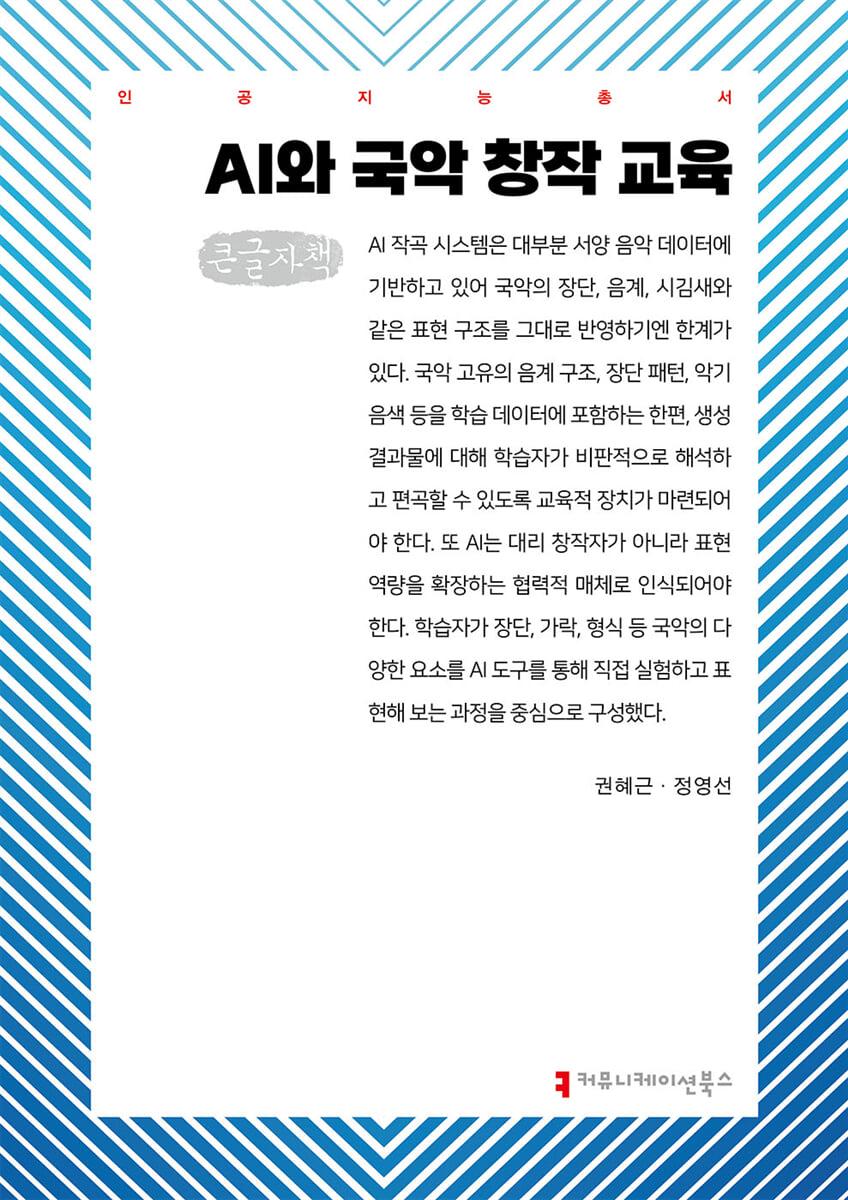
AI and Traditional Korean Music Creation Education (Large Print Book)
 |
Description
Book Introduction
Traditional Korean music education is now expanding from sensory acquisition to creative creation through AI and digital tools.
It proposes a path for future Korean traditional music education that harmonizes tradition and technology by presenting specific measures such as visualization of shimsae, AI accompaniment, copyright utilization, prompt-based creation, and innovation in evaluation.
Artificial Intelligence Encyclopedia.
You can find the artificial intelligence knowledge you need at aiseries.oopy.io.
It proposes a path for future Korean traditional music education that harmonizes tradition and technology by presenting specific measures such as visualization of shimsae, AI accompaniment, copyright utilization, prompt-based creation, and innovation in evaluation.
Artificial Intelligence Encyclopedia.
You can find the artificial intelligence knowledge you need at aiseries.oopy.io.
- You can preview some of the book's contents.
Preview
index
The Need for AI and Traditional Korean Music Creative Education
01 AI Emerges in Traditional Korean Music Education in Schools
02 Copyright, Traditional Korean Music Digital Sound Source
03 Chrome Music Lab, rhythm and melody creation
04 AI Lab, Visualization and Creation
05 Scratch, Creation and Ensemble
06 Band Lab, Signal Sounds and Creation
07 Prompt, Lyrics and Creation Using Traditional Korean Music Format
08 Collaboration: Vlog Production Using Humans and AI
09 Teachers, Evaluation and Feedback
10 School Traditional Korean Music Education: The Future of AI
01 AI Emerges in Traditional Korean Music Education in Schools
02 Copyright, Traditional Korean Music Digital Sound Source
03 Chrome Music Lab, rhythm and melody creation
04 AI Lab, Visualization and Creation
05 Scratch, Creation and Ensemble
06 Band Lab, Signal Sounds and Creation
07 Prompt, Lyrics and Creation Using Traditional Korean Music Format
08 Collaboration: Vlog Production Using Humans and AI
09 Teachers, Evaluation and Feedback
10 School Traditional Korean Music Education: The Future of AI
Into the book
To bridge the digital divide in Korean traditional music education, support is needed in the following three directions.
First, it is necessary to provide a laptop with the minimum specifications and stable Wi-Fi, which are the basic prerequisites for learning.
Second, there is a need to expand the number of free Korean traditional music apps and audio data sets (e.g., janggu rhythm samples, Korean traditional instrument sound sources, etc.) that are easily accessible to everyone.
Third, digital platforms that support teacher capacity building and content utilization must be developed in parallel.
Ultimately, for a sustainable digital transformation of Korean traditional music education, simultaneous strengthening of both the infrastructure (devices) and the content (data) is essential.
Without these two elements, the gap between devices and data could lead to a vicious cycle of imbalanced creative opportunities, seriously undermining the equality of traditional Korean music education.
--- From "01_School Traditional Music Education, the Emergence of AI"
Recently, Chrome Music Lab's 'Song Maker' has been attracting attention as a tool that allows for the creation of these traditional elements in a digital environment.
Songmaker is a web-based composition tool that can be run without any separate installation or login, and provides immediate feedback by visualizing notes and rhythms.
The screen is divided into areas for entering melody and rhythm, and students can compose music by tapping notes and beats with the mouse.
You can adjust Length, Beats per bar, Split beats into, Scale, Start on, and Range through the Settings menu at the bottom.
For example, the 3 beats and 3 small beats of the Semachi rhythm can be set to 3 for both the beat and the minute beat to create a 9-space grid, and the Gutgeori or Jajinmori rhythm can be set to 4 beats and 3 small beats to create a 12-space grid.
Because the rhythmic structure is presented visually in a grid format like this, students can systematically recognize the structure of the rhythm.
--- From "03_Chrome Music Lab, Rhythm and Melody Creation"
A digital audio workstation (DAW) is a music production software that integrates audio recording, editing, playback, and mastering based on digital signal processing.
These DAWs allow the entire music creation and production process to be implemented within a computer environment, and their use has been increasing in recent years, even in schools.
In particular, BandLab, an internet browser-based DAW, is attracting attention as a tool suitable for public education because it can be used without installation or paid purchase.
--- From "06_Band Lab, Signal Sound/Creation"
However, we warn that uncritical acceptance of AI output could weaken learners' musical judgment and critical thinking.
Furthermore, the results proposed by models that have not sufficiently learned the unique scales, sigimsae, and rhythm systems of Korean traditional music carry the risk of damaging tradition or distorting the method of expression.
Accordingly, evaluations of AI-powered classes should focus on explanatory evidence for why learners accepted, modified, or rejected specific AI suggestions, rather than on "convenience" or "musical perfection."
The Korea Institute of Curriculum and Evaluation also recommends recording the basis for learners' decision-making as an essential observation element in technology and media creative activities.
First, it is necessary to provide a laptop with the minimum specifications and stable Wi-Fi, which are the basic prerequisites for learning.
Second, there is a need to expand the number of free Korean traditional music apps and audio data sets (e.g., janggu rhythm samples, Korean traditional instrument sound sources, etc.) that are easily accessible to everyone.
Third, digital platforms that support teacher capacity building and content utilization must be developed in parallel.
Ultimately, for a sustainable digital transformation of Korean traditional music education, simultaneous strengthening of both the infrastructure (devices) and the content (data) is essential.
Without these two elements, the gap between devices and data could lead to a vicious cycle of imbalanced creative opportunities, seriously undermining the equality of traditional Korean music education.
--- From "01_School Traditional Music Education, the Emergence of AI"
Recently, Chrome Music Lab's 'Song Maker' has been attracting attention as a tool that allows for the creation of these traditional elements in a digital environment.
Songmaker is a web-based composition tool that can be run without any separate installation or login, and provides immediate feedback by visualizing notes and rhythms.
The screen is divided into areas for entering melody and rhythm, and students can compose music by tapping notes and beats with the mouse.
You can adjust Length, Beats per bar, Split beats into, Scale, Start on, and Range through the Settings menu at the bottom.
For example, the 3 beats and 3 small beats of the Semachi rhythm can be set to 3 for both the beat and the minute beat to create a 9-space grid, and the Gutgeori or Jajinmori rhythm can be set to 4 beats and 3 small beats to create a 12-space grid.
Because the rhythmic structure is presented visually in a grid format like this, students can systematically recognize the structure of the rhythm.
--- From "03_Chrome Music Lab, Rhythm and Melody Creation"
A digital audio workstation (DAW) is a music production software that integrates audio recording, editing, playback, and mastering based on digital signal processing.
These DAWs allow the entire music creation and production process to be implemented within a computer environment, and their use has been increasing in recent years, even in schools.
In particular, BandLab, an internet browser-based DAW, is attracting attention as a tool suitable for public education because it can be used without installation or paid purchase.
--- From "06_Band Lab, Signal Sound/Creation"
However, we warn that uncritical acceptance of AI output could weaken learners' musical judgment and critical thinking.
Furthermore, the results proposed by models that have not sufficiently learned the unique scales, sigimsae, and rhythm systems of Korean traditional music carry the risk of damaging tradition or distorting the method of expression.
Accordingly, evaluations of AI-powered classes should focus on explanatory evidence for why learners accepted, modified, or rejected specific AI suggestions, rather than on "convenience" or "musical perfection."
The Korea Institute of Curriculum and Evaluation also recommends recording the basis for learners' decision-making as an essential observation element in technology and media creative activities.
--- From "09_Teacher, Evaluation and Feedback"
Publisher's Review
A new Korean traditional music education where tradition and AI meet
Traditional Korean music education has originally emphasized sensory acquisition through the ears and body.
However, the introduction of digital devices and online platforms, as well as the non-face-to-face experience following COVID-19, has expanded traditional Korean music classes beyond the classroom.
Visualization of the poem, motion recognition-based programs, and AI accompaniment generation systems help learners understand intuitively and promote a shift toward creative exploration and production-centered classes.
In particular, generative AI is emerging as a new tool that can combine traditional elements of Korean traditional music with modern creative methods.
However, since most AI composition systems are based on Western music, it is necessary to build learning data that reflects the unique rhythm, scale, and timbre of Korean traditional music.
This book presents copyright compliance measures when utilizing digital sound sources in traditional Korean music education, specific tool usage methods such as Chrome Music Lab and Band Lab, creative practice through prompt engineering, and innovation in AI-based evaluation and feedback systems.
It also addresses institutional challenges such as building a Korean traditional music AI database and teacher training, and envisions a future education model where tradition and technology collaborate.
Traditional Korean music education has originally emphasized sensory acquisition through the ears and body.
However, the introduction of digital devices and online platforms, as well as the non-face-to-face experience following COVID-19, has expanded traditional Korean music classes beyond the classroom.
Visualization of the poem, motion recognition-based programs, and AI accompaniment generation systems help learners understand intuitively and promote a shift toward creative exploration and production-centered classes.
In particular, generative AI is emerging as a new tool that can combine traditional elements of Korean traditional music with modern creative methods.
However, since most AI composition systems are based on Western music, it is necessary to build learning data that reflects the unique rhythm, scale, and timbre of Korean traditional music.
This book presents copyright compliance measures when utilizing digital sound sources in traditional Korean music education, specific tool usage methods such as Chrome Music Lab and Band Lab, creative practice through prompt engineering, and innovation in AI-based evaluation and feedback systems.
It also addresses institutional challenges such as building a Korean traditional music AI database and teacher training, and envisions a future education model where tradition and technology collaborate.
GOODS SPECIFICS
- Date of issue: August 29, 2025
- Page count, weight, size: 104 pages | 210*290*8mm
- ISBN13: 9791143008473
You may also like
카테고리
korean


korean

![GQ KOREA Mark (Monthly): December [2025]](http://librairie.coreenne.fr/cdn/shop/files/8ef265dbbfbf186523ed75ba7319009d.jpg?v=1765340328&width=3840)


