

AI realistic content
 |
Description
Book Introduction
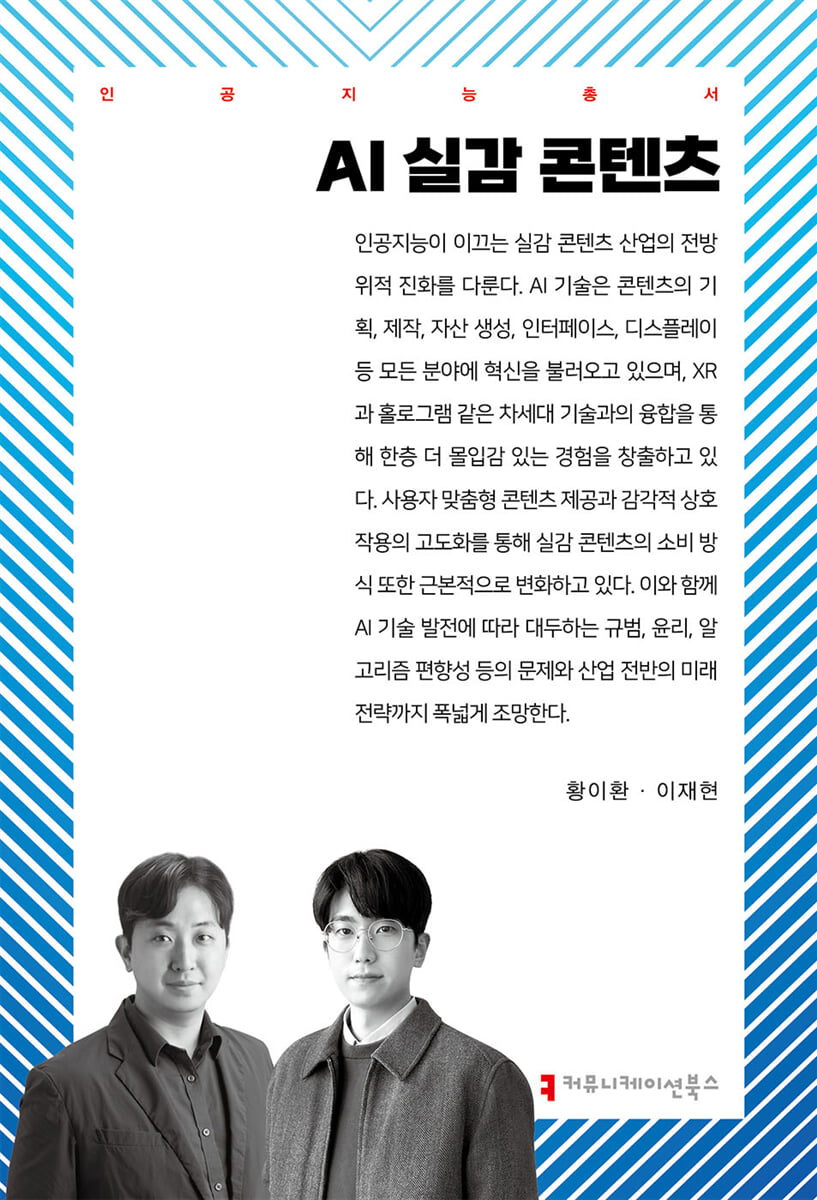
AI is a core technology involved in every stage of immersive content, from planning to production and consumption. Through real-world examples of XR, holograms, interfaces, and personalized recommendations, we examine the trends of technological convergence and the ethical challenges it poses, providing insight into the present and future of the immersive content industry.
Artificial Intelligence Encyclopedia.
You can find the artificial intelligence knowledge you need at aiseries.oopy.io.
Artificial Intelligence Encyclopedia.
You can find the artificial intelligence knowledge you need at aiseries.oopy.io.
- You can preview some of the book's contents.
Preview
index
The meeting of realistic content and AI
01 Topography of Realistic Content Technology
02 AI-powered realistic content planning
03 AI Interface Innovation
04 Innovation in AI-powered content asset creation
05 AI and XR Content Creation
06 AI and Holographic Content Creation
07 Evolution of AI and Realistic Content Display
08 AI and the Transformation of Personalized User Experience
09 AI and Realistic Content Norms and Ethics
10 Future Strategies for the AI-Powered Immersive Content Industry
01 Topography of Realistic Content Technology
02 AI-powered realistic content planning
03 AI Interface Innovation
04 Innovation in AI-powered content asset creation
05 AI and XR Content Creation
06 AI and Holographic Content Creation
07 Evolution of AI and Realistic Content Display
08 AI and the Transformation of Personalized User Experience
09 AI and Realistic Content Norms and Ethics
10 Future Strategies for the AI-Powered Immersive Content Industry
Into the book
Companies remotely monitor multiple display networks through a CMS and update videos in real time from their content library. An AI analytics module integrates playback and user response data to generate reports on which content generated the most attention, enabling them to reflect these results in the subsequent planning stage.
Large displays and digital signage are expected to further expand their implementation of 8K resolution, high-frame rate video, and HDR (High Dynamic Range) in the future.
Combining edge AI and IoT sensors here will evolve into a "smart content space" that automatically optimizes content based on internal building lighting, noise, and air quality data, providing users with the optimal visual and auditory experience in real time.
--- From "01_Topography of Realistic Content Technology"
AI-based interface technology is developing in three directions:
The first is naturalness.
In particular, it is developing toward more precisely reproducing 'voice'-based interfaces, which are a unique human communication method.
Moving beyond the simple command-based voice interfaces of the early days, we now have a comprehensive understanding of linguistic nuances, emotional flow, and cultural context.
This uses advanced natural language understanding (NLU) technology to analyze the user's intonation, speech rate, and emotional changes in real time, and generates a response optimized for the context.
Recently, it has been leading a qualitative change in human-machine interaction (HMI) by detecting even subtle changes in the user's expressions and providing natural responses.
--- From "03_AI Interface Innovation"
While traditional holographic systems have been limited in their interactive implementation due to numerical computation, large-capacity data transmission delays, and display resolution limitations, the convergence of the latest deep learning-based image processing techniques and 5G/edge computing is overcoming these limitations and opening up new horizons for real-time holographic displays.
A continuous RGB-D image stream captured by a depth camera is processed by a deep network of the Convolutional Neural Network (CNN) series to accurately separate the shape and movement of objects for each frame, and then a Recurrent Neural Network (RNN) structure is used to learn time-series correlations, thereby predicting and processing spatial and temporal changes in the 3D point cloud in real time.
These predictions are passed to an AI-based encoder, converted into an interference pattern, and then transmitted to an edge server. The client display device then reproduces the received pattern using a DMD (Digital Micromirror Device)-based projector at hundreds of hertz to create a smooth holographic animation without afterimages.
--- From "06_AI and Hologram Content Creation"
In a case where a copyright registration was attempted for the result of generating prompts based on a famous poet's poem and converting them into a video using AI, the Korea Copyright Commission rejected the application on the grounds that it "lacked human creativity."
However, if human creative intervention is added to AI output, or if multiple AI outputs are combined and organized into a specific arrangement, the possibility of recognition as an ‘edited work’ is open (Song Seon-mi, 2022).
In the United States, there is a case where the work “Zarya of Dawn,” which combines illustrations using the image-generating AI “Midjourney” and human text work, was registered as an “edited work.”
The U.S. Copyright Office initially approved the copyright registration because it was unaware that the work was a work utilizing AI, but later learned of the fact and canceled the existing registration and issued a new registration certificate.
However, the court only recognized the author's contribution to the creation, namely the text and the selection, arrangement, and adjustment of AI-generated pictures, and did not recognize the illustrations, which were AI output.
Large displays and digital signage are expected to further expand their implementation of 8K resolution, high-frame rate video, and HDR (High Dynamic Range) in the future.
Combining edge AI and IoT sensors here will evolve into a "smart content space" that automatically optimizes content based on internal building lighting, noise, and air quality data, providing users with the optimal visual and auditory experience in real time.
--- From "01_Topography of Realistic Content Technology"
AI-based interface technology is developing in three directions:
The first is naturalness.
In particular, it is developing toward more precisely reproducing 'voice'-based interfaces, which are a unique human communication method.
Moving beyond the simple command-based voice interfaces of the early days, we now have a comprehensive understanding of linguistic nuances, emotional flow, and cultural context.
This uses advanced natural language understanding (NLU) technology to analyze the user's intonation, speech rate, and emotional changes in real time, and generates a response optimized for the context.
Recently, it has been leading a qualitative change in human-machine interaction (HMI) by detecting even subtle changes in the user's expressions and providing natural responses.
--- From "03_AI Interface Innovation"
While traditional holographic systems have been limited in their interactive implementation due to numerical computation, large-capacity data transmission delays, and display resolution limitations, the convergence of the latest deep learning-based image processing techniques and 5G/edge computing is overcoming these limitations and opening up new horizons for real-time holographic displays.
A continuous RGB-D image stream captured by a depth camera is processed by a deep network of the Convolutional Neural Network (CNN) series to accurately separate the shape and movement of objects for each frame, and then a Recurrent Neural Network (RNN) structure is used to learn time-series correlations, thereby predicting and processing spatial and temporal changes in the 3D point cloud in real time.
These predictions are passed to an AI-based encoder, converted into an interference pattern, and then transmitted to an edge server. The client display device then reproduces the received pattern using a DMD (Digital Micromirror Device)-based projector at hundreds of hertz to create a smooth holographic animation without afterimages.
--- From "06_AI and Hologram Content Creation"
In a case where a copyright registration was attempted for the result of generating prompts based on a famous poet's poem and converting them into a video using AI, the Korea Copyright Commission rejected the application on the grounds that it "lacked human creativity."
However, if human creative intervention is added to AI output, or if multiple AI outputs are combined and organized into a specific arrangement, the possibility of recognition as an ‘edited work’ is open (Song Seon-mi, 2022).
In the United States, there is a case where the work “Zarya of Dawn,” which combines illustrations using the image-generating AI “Midjourney” and human text work, was registered as an “edited work.”
The U.S. Copyright Office initially approved the copyright registration because it was unaware that the work was a work utilizing AI, but later learned of the fact and canceled the existing registration and issued a new registration certificate.
However, the court only recognized the author's contribution to the creation, namely the text and the selection, arrangement, and adjustment of AI-generated pictures, and did not recognize the illustrations, which were AI output.
--- From "09_AI and Realistic Content Norms and Ethics"
Publisher's Review
Rewriting Realistic Content with AI
This book explores how generative AI and immersive content technologies are converging to create new creative and consumption environments. It provides a detailed, case-based analysis of the role AI plays across the immersive content industry, encompassing XR, holograms, interactive narratives, emotion recognition, and hyper-personalized interfaces. It highlights AI not as a simple automation tool but as a "creative partner" that transforms creator and consumer experiences across the entire planning, production, and distribution process. It also addresses issues such as copyright, ethics, and data bias that have emerged alongside technological advancements.
It provides practical directions and strategies needed by content industry workers, planners, and policy makers.
At this intersection of technology and sensibility, ethics and creativity, what kind of content will we create and consume?
This book explores how generative AI and immersive content technologies are converging to create new creative and consumption environments. It provides a detailed, case-based analysis of the role AI plays across the immersive content industry, encompassing XR, holograms, interactive narratives, emotion recognition, and hyper-personalized interfaces. It highlights AI not as a simple automation tool but as a "creative partner" that transforms creator and consumer experiences across the entire planning, production, and distribution process. It also addresses issues such as copyright, ethics, and data bias that have emerged alongside technological advancements.
It provides practical directions and strategies needed by content industry workers, planners, and policy makers.
At this intersection of technology and sensibility, ethics and creativity, what kind of content will we create and consume?
GOODS SPECIFICS
- Date of issue: August 11, 2025
- Page count, weight, size: 148 pages | 128*188*8mm
- ISBN13: 9791143004697
You may also like
카테고리
korean


korean

![ELLE 엘르 A형 (여성월간) : 1월 [2026]](http://librairie.coreenne.fr/cdn/shop/files/3b70e1cf77cf67d6da56e0eb041901e8.jpg?v=1767265322&width=3840)


